An excerpt from the original text.(complete · 3404 words)
or on the topmost tier of the hotel verandah, after being carried up
the steps in an armchair amid a bevy of footmen, maid-servants, and
other menials of the hotel, headed by the landlord (that functionary
had actually run out to meet a visitor who arrived with so much stir
and din, attended by her own retinue, and accompanied by so great a
pile of trunks and portmanteaux)—on the topmost tier of the verandah, I
say, there was sitting—the grandmother! Yes, it was she—rich, and
imposing, and seventy-five years of age—Antonida Vassilievna
Tarassevitcha, landowner and grande dame of Moscow—the “La
Baboulenka” who had caused so many telegrams to be sent off and
received—who had been dying, yet not dying—who had, in her own person,
descended upon us even as snow might fall from the clouds! Though
unable to walk, she had arrived borne aloft in an armchair (her mode of
conveyance for the last five years), as brisk, aggressive,
self-satisfied, bolt-upright, loudly imperious, and generally abusive
as ever. In fact, she looked exactly as she had on the only two
occasions when I had seen her since my appointment to the General’s
household. Naturally enough, I stood petrified with astonishment. She
had sighted me a hundred paces off! Even while she was being carried
along in her chair she had recognised me, and called me by name and
surname (which, as usual, after hearing once, she had remembered ever
afterwards).
“And this is the woman whom they had thought to see in her grave after
making her will!” I thought to myself. “Yet she will outlive us, and
every one else in the hotel. Good Lord! what is going to become of us
now? What on earth is to happen to the General? She will turn the place
upside down!”
“My good sir,” the old woman continued in a stentorian voice, “what are
you standing there for, with your eyes almost falling out of your
head? Cannot you come and say how-do-you-do? Are you too proud to shake
hands? Or do you not recognise me? Here, Potapitch!” she cried to an
old servant who, dressed in a frock coat and white waistcoat, had a
bald, red head (he was the chamberlain who always accompanied her on
her journeys). “Just think! Alexis Ivanovitch does not recognise me!
They have buried me for good and all! Yes, and after sending hosts of
telegrams to know if I were dead or not! Yes, yes, I have heard the
whole story. I am very much alive, though, as you may see.”
“Pardon me, Antonida Vassilievna,” I replied good humouredly as I
recovered my presence of mind. “I have no reason to wish you ill. I
am merely rather astonished to see you. Why should I not be so, seeing
how unexpected—”
“Why should you be astonished? I just got into my chair, and came.
Things are quiet enough in the train, for there is no one there to
chatter. Have you been out for a walk?”
“Yes. I have just been to the Casino.”
“Oh? Well, it is quite nice here,” she went on as she looked about her.
“The place seems comfortable, and all the trees are out. I like it very
well. Are your people at home? Is the General, for instance, indoors?”
“Yes; and probably all of them.”
“Do they observe the convenances, and keep up appearances? Such things
always give one tone. I have heard that they are keeping a carriage,
even as Russian gentlefolks ought to do. When abroad, our Russian
people always cut a dash. Is Prascovia here too?”
“Yes. Polina Alexandrovna is here.”
“And the Frenchwoman? However, I will go and look for them myself. Tell
me the nearest way to their rooms. Do you like being here?”
“Yes, I thank you, Antonida Vassilievna.”
“And you, Potapitch, you go and tell that fool of a landlord to reserve
me a suitable suite of rooms. They must be handsomely decorated, and
not too high up. Have my luggage taken up to them. But what are you
tumbling over yourselves for? Why are you all tearing about? What
scullions these fellows are!—Who is that with you?” she added to
myself.
“A Mr. Astley,” I replied.
“And who is Mr. Astley?”
“A fellow-traveller, and my very good friend, as well as an
acquaintance of the General’s.”
“Oh, an Englishman? Then that is why he stared at me without even
opening his lips. However, I like Englishmen. Now, take me upstairs,
direct to their rooms. Where are they lodging?”
Madame was lifted up in her chair by the lacqueys, and I preceded her
up the grand staircase. Our progress was exceedingly effective, for
everyone whom we met stopped to stare at the cortège. It happened that
the hotel had the reputation of being the best, the most expensive, and
the most aristocratic in all the spa, and at every turn on the
staircase or in the corridors we encountered fine ladies and
important-looking Englishmen—more than one of whom hastened downstairs
to inquire of the awestruck landlord who the newcomer was. To all such
questions he returned the same answer—namely, that the old lady was an
influential foreigner, a Russian, a Countess, and a grande dame, and
that she had taken the suite which, during the previous week, had been
tenanted by the Grande Duchesse de N.
Meanwhile the cause of the sensation—the Grandmother—was being borne
aloft in her armchair. Every person whom she met she scanned with an
inquisitive eye, after first of all interrogating me about him or her
at the top of her voice. She was stout of figure, and, though she could
not leave her chair, one felt, the moment that one first looked at her,
that she was also tall of stature. Her back was as straight as a board,
and never did she lean back in her seat. Also, her large grey head,
with its keen, rugged features, remained always erect as she glanced
about her in an imperious, challenging sort of way, with looks and
gestures that clearly were unstudied. Though she had reached her
seventy-sixth year, her face was still fresh, and her teeth had not
decayed. Lastly, she was dressed in a black silk gown and white mobcap.
“She interests me tremendously,” whispered Mr. Astley as, still
smoking, he walked by my side. Meanwhile I was reflecting that probably
the old lady knew all about the telegrams, and even about De Griers,
though little or nothing about Mlle. Blanche. I said as much to Mr.
Astley.
But what a frail creature is man! No sooner was my first surprise
abated than I found myself rejoicing in the shock which we were about
to administer to the General. So much did the thought inspire me that I
marched ahead in the gayest of fashions.
Our party was lodging on the third floor. Without knocking at the door,
or in any way announcing our presence, I threw open the portals, and
the Grandmother was borne through them in triumph. As though of set
purpose, the whole party chanced at that moment to be assembled in the
General’s study. The time was eleven o’clock, and it seemed that an
outing of some sort (at which a portion of the party were to drive in
carriages, and others to ride on horseback, accompanied by one or two
extraneous acquaintances) was being planned. The General was present,
and also Polina, the children, the latter’s nurses, De Griers, Mlle.
Blanche (attired in a riding-habit), her mother, the young Prince, and
a learned German whom I beheld for the first time. Into the midst of
this assembly the lacqueys conveyed Madame in her chair, and set her
down within three paces of the General!
Good heavens! Never shall I forget the spectacle which ensued! Just
before our entry, the General had been holding forth to the company,
with De Griers in support of him. I may also mention that, for the last
two or three days, Mlle. Blanche and De Griers had been making a great
deal of the young Prince, under the very nose of the poor General. In
short, the company, though decorous and conventional, was in a gay,
familiar mood. But no sooner did the Grandmother appear than the
General stopped dead in the middle of a word, and, with jaw dropping,
stared hard at the old lady—his eyes almost starting out of his head,
and his expression as spellbound as though he had just seen a basilisk.
In return, the Grandmother stared at him silently and without
moving—though with a look of mingled challenge, triumph, and ridicule
in her eyes. For ten seconds did the pair remain thus eyeing one
another, amid the profound silence of the company; and even De Griers
sat petrified—an extraordinary look of uneasiness dawning on his face.
As for Mlle. Blanche, she too stared wildly at the Grandmother, with
eyebrows raised and her lips parted—while the Prince and the German
savant contemplated the tableau in profound amazement. Only Polina
looked anything but perplexed or surprised. Presently, however, she too
turned as white as a sheet, and then reddened to her temples. Truly the
Grandmother’s arrival seemed to be a catastrophe for everybody! For my
own part, I stood looking from the Grandmother to the company, and back
again, while Mr. Astley, as usual, remained in the background, and
gazed calmly and decorously at the scene.
“Well, here I am—and instead of a telegram, too!” the Grandmother at
last ejaculated, to dissipate the silence. “What? You were not
expecting me?”
“Antonida Vassilievna! O my dearest mother! But how on earth did you,
did you—?” The mutterings of the unhappy General died away.
I verily believe that if the Grandmother had held her tongue a few
seconds longer she would have had a stroke.
“How on earth did I what?” she exclaimed. “Why, I just got into the
train and came here. What else is the railway meant for? But you
thought that I had turned up my toes and left my property to the lot of
you. Oh, I know all about the telegrams which you have been
dispatching. They must have cost you a pretty sum, I should think, for
telegrams are not sent from abroad for nothing. Well, I picked up my
heels, and came here. Who is this Frenchman? Monsieur de Griers, I
suppose?”
“Oui, madame,” assented De Griers. “Et, croyez, je suis si enchanté!
Votre santé—c’est un miracle vous voir ici. Une surprise charmante!”
“Just so. ‘Charmante!’ I happen to know you as a mountebank, and
therefore trust you no more than this.” She indicated her little
finger. “And who is that?” she went on, turning towards Mlle.
Blanche. Evidently the Frenchwoman looked so becoming in her
riding-habit, with her whip in her hand, that she had made an
impression upon the old lady. “Who is that woman there?”
“Mlle. de Cominges,” I said. “And this is her mother, Madame de
Cominges. They also are staying in the hotel.”
“Is the daughter married?” asked the old lady, without the least
semblance of ceremony.
“No,” I replied as respectfully as possible, but under my breath.
“Is she good company?”
I failed to understand the question.
“I mean, is she or is she not a bore? Can she speak Russian? When this
De Griers was in Moscow he soon learnt to make himself understood.”
I explained to the old lady that Mlle. Blanche had never visited
Russia.
“Bonjour, then,” said Madame, with sudden brusquerie.
“Bonjour, madame,” replied Mlle. Blanche with an elegant, ceremonious
bow as, under cover of an unwonted modesty, she endeavoured to express,
both in face and figure, her extreme surprise at such strange behaviour
on the part of the Grandmother.
“How the woman sticks out her eyes at me! How she mows and minces!” was
the Grandmother’s comment. Then she turned suddenly to the General, and
continued: “I have taken up my abode here, so am going to be your
next-door neighbour. Are you glad to hear that, or are you not?”
“My dear mother, believe me when I say that I am sincerely delighted,”
returned the General, who had now, to a certain extent, recovered his
senses; and inasmuch as, when occasion arose, he could speak with
fluency, gravity, and a certain effect, he set himself to be expansive
in his remarks, and went on: “We have been so dismayed and upset by the
news of your indisposition! We had received such hopeless telegrams
about you! Then suddenly—”
“Fibs, fibs!” interrupted the Grandmother.
“How on earth, too, did you come to decide upon the journey?” continued
the General, with raised voice as he hurried to overlook the old lady’s
last remark. “Surely, at your age, and in your present state of health,
the thing is so unexpected that our surprise is at least intelligible.
However, I am glad to see you (as indeed, are we all”—he said this with
a dignified, yet conciliatory, smile), “and will use my best endeavours
to render your stay here as pleasant as possible.”
“Enough! All this is empty chatter. You are talking the usual nonsense.
I shall know quite well how to spend my time. How did I come to
undertake the journey, you ask? Well, is there anything so very
surprising about it? It was done quite simply. What is every one going
into ecstasies about?—How do you do, Prascovia? What are you doing
here?”
“And how are you, Grandmother?” replied Polina, as she approached the
old lady. “Were you long on the journey?”
“The most sensible question that I have yet been asked! Well, you shall
hear for yourself how it all happened. I lay and lay, and was doctored
and doctored, until at last I drove the physicians from me, and called
in an apothecary from Nicolai who had cured an old woman of a malady
similar to my own—cured her merely with a little hayseed. Well, he did
me a great deal of good, for on the third day I broke into a sweat, and
was able to leave my bed. Then my German doctors held another
consultation, put on their spectacles, and told me that if I would go
abroad, and take a course of the waters, the indisposition would
finally pass away. ‘Why should it not?’ I thought to myself. So I had
got things ready, and on the following day, a Friday, set out for here.
I occupied a special compartment in the train, and where ever I had to
change I found at the station bearers who were ready to carry me for a
few coppers. You have nice quarters here,” she went on as she glanced
around the room. “But where on earth did you get the money for them, my
good sir? I thought that everything of yours had been mortgaged? This
Frenchman alone must be your creditor for a good deal. Oh, I know all
about it, all about it.”
“I-I am surprised at you, my dearest mother,” said the General in some
confusion. “I-I am greatly surprised. But I do not need any extraneous
control of my finances. Moreover, my expenses do not exceed my income,
and we—”
“They do not exceed it? Fie! Why, you are robbing your children of
their last kopeck—you, their guardian!”
“After this,” said the General, completely taken aback, “—after what
you have just said, I do not know whether—”
“You do not know what? By heavens, are you never going to drop that
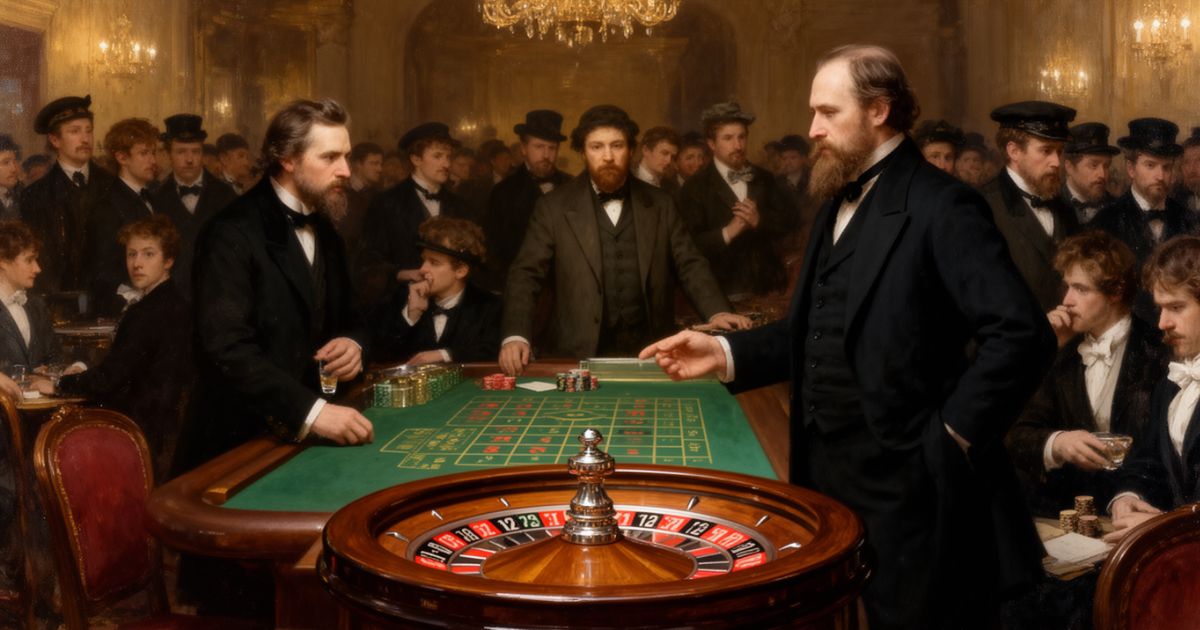
roulette of yours? Are you going to whistle all your property away?”
This made such an impression upon the General that he almost choked
with fury.
“Roulette, indeed? I play roulette? Really, in view of my
position—Recollect what you are saying, my dearest mother. You must
still be unwell.”
“Rubbish, rubbish!” she retorted. “The truth is that you cannot be
got away from that roulette. You are simply telling lies. This very day
I mean to go and see for myself what roulette is like. Prascovia, tell
me what there is to be seen here; and do you, Alexis Ivanovitch, show
me everything; and do you, Potapitch, make me a list of excursions.
What is there to be seen?” again she inquired of Polina.
“There is a ruined castle, and the Shlangenberg.”
“The Shlangenberg? What is it? A forest?”
“No, a mountain on the summit of which there is a place fenced off.
From it you can get a most beautiful view.”
“Could a chair be carried up that mountain of yours?”
“Doubtless we could find bearers for the purpose,” I interposed.
At this moment Theodosia, the nursemaid, approached the old lady with
the General’s children.
“No, I don’t want to see them,” said the Grandmother. “I hate kissing
children, for their noses are always wet. How are you getting on,
Theodosia?”
“I am very well, thank you, Madame,” replied the nursemaid. “And how is
your ladyship? We have been feeling so anxious about you!”
“Yes, I know, you simple soul—But who are those other guests?” the old
lady continued, turning again to Polina. “For instance, who is that old
rascal in the spectacles?”
“Prince Nilski, Grandmamma,” whispered Polina.
“Oh, a Russian? Why, I had no idea that he could understand me! Surely
he did not hear what I said? As for Mr. Astley, I have seen him
already, and I see that he is here again. How do you do?” she added to
the gentleman in question.
Mr. Astley bowed in silence.
“Have you nothing to say to me?” the old lady went on. “Say
something, for goodness’ sake! Translate to him, Polina.”
Polina did so.
“I have only to say,” replied Mr. Astley gravely, but also with
alacrity, “that I am indeed glad to see you in such good health.” This
was interpreted to the Grandmother, and she seemed much gratified.
“How well English people know how to answer one!” she remarked. “That
is why I like them so much better than French. Come here,” she added to
Mr. Astley. “I will try not to bore you too much. Polina, translate to
him that I am staying in rooms on a lower floor. Yes, on a lower
floor,” she repeated to Astley, pointing downwards with her finger.
Astley looked pleased at receiving the invitation.
Next, the old lady scanned Polina, from head to foot with minute
attention.
“I could almost have liked you, Prascovia,” suddenly she remarked, “for
you are a nice girl—the best of the lot. You have some character about
you. I too have character. Turn round. Surely that is not false hair
that you are wearing?”
“No, Grandmamma. It is my own.”
“Well, well. I do not like the stupid fashions of today. You are very
good looking. I should have fallen in love with you if I had been a
man. Why do you not get married? It is time now that I was going. I
want to walk, yet I always have to ride. Are you still in a bad
temper?” she added to the General.
“No, indeed,” rejoined the now mollified General.
“I quite understand that at your time of life—”
“Cette vieille est tombée en enfance,” De Griers whispered to me.
“But I want to look round a little,” the old lady added to the General.
Will you lend me Alexis Ivanovitch for the purpose?
“As much as you like. But I myself—yes, and Polina and Monsieur de
Griers too—we all of us hope to have the pleasure of escorting you.”
“Mais, madame, cela sera un plaisir,” De Griers commented with a
bewitching smile.
“‘Plaisir’ indeed! Why, I look upon you as a perfect fool, monsieur.”
Then she remarked to the General: “I am not going to let you have any
of my money. I must be off to my rooms now, to see what they are like.
Afterwards we will look round a little. Lift me up.”
Again the Grandmother was borne aloft and carried down the staircase
amid a perfect bevy of followers—the General walking as though he had
been hit over the head with a cudgel, and De Griers seeming to be
plunged in thought. Endeavouring to be left behind, Mlle. Blanche next
thought better of it, and followed the rest, with the Prince in her
wake. Only the German savant and Madame de Cominges did not leave the
General’s apartments.
Master this chapter. Complete your experience
Purchase the complete book to access all chapters and support classic literature
As an Amazon Associate, we earn a small commission from qualifying purchases at no additional cost to you.
Available in paperback, hardcover, and e-book formats
Let's Analyse the Pattern
When someone presumed weak or absent suddenly appears strong, they become dangerous truth-tellers who expose everyone's hidden agendas.
Why This Matters
Connect literature to life
This chapter teaches how to recognize when unexpected strength shifts expose hidden agendas and create opportunities for truth-telling.
Practice This Today
Next time someone who usually dismisses you suddenly wants to be friendly after your circumstances improve, pause and ask what changed - their respect for you, or their need from you.
Now let's explore the literary elements.
Key Quotes & Analysis
"And this is the woman whom they had been expecting to die!"
Context: The narrator's shocked realization as he sees the supposedly dying grandmother arrive in perfect health
This reveals the cruel irony of the situation - everyone has been planning their lives around her death, but she's more alive and powerful than ever. It exposes the moral bankruptcy of inheritance culture.
In Today's Words:
This is the person they've all been waiting to kick the bucket so they could get their hands on her money!
"Mountebank!"
Context: Her immediate assessment of De Griers after he tries his charm offensive
Shows her ability to see through elaborate deceptions instantly. Her blunt honesty cuts through all social pretense and exposes people's true nature without mercy.
In Today's Words:
You're a total fraud!
"I know all about your telegrams asking whether I was going to die soon"
Context: Confronting the family about their desperate inquiries into her health
Reveals that she's been fully aware of their schemes and financial desperation. Her knowledge gives her complete power over them and exposes their heartless calculations.
In Today's Words:
I know you've all been checking on me hoping I'd hurry up and die so you could get my money
Thematic Threads
Class
In This Chapter
The grandmother's old aristocratic directness cuts through the nouveau riche pretensions and social climbing of the others
Development
Builds on earlier class tensions, showing how genuine authority differs from performed status
In Your Life:
You might see this when someone with real experience calls out workplace posturing or family pretensions
Deception
In This Chapter
Everyone's carefully maintained lies about their motives crumble under the grandmother's direct questioning
Development
Escalates the web of lies established in earlier chapters by introducing someone immune to manipulation
In Your Life:
You might recognize this when an outsider arrives and immediately sees through dynamics you've normalized
Power
In This Chapter
The grandmother's unexpected survival completely reshuffles who has control and who is vulnerable
Development
Reverses the power dynamics that have driven the story so far
In Your Life:
You might experience this when someone you underestimated suddenly has leverage over your plans
Expectations
In This Chapter
Everyone's plans were built on the assumption of the grandmother's death, making her survival catastrophic
Development
Introduced here as a major theme about the danger of planning around assumptions
In Your Life:
You might face this when your life plans depend too heavily on circumstances outside your control
Authenticity
In This Chapter
Only Polina maintains genuine composure because she alone isn't performing a false role
Development
Continues Polina's arc as the most honest character in a world of pretense
In Your Life:
You might notice this in how differently people react to crisis depending on how much they've been pretending
You now have the context. Time to form your own thoughts.
Discussion Questions
- 1
What specific reactions does each family member have when the grandmother arrives, and what do these reactions reveal about their secret plans?
analysis • surface - 2
Why is the grandmother so effective at seeing through everyone's deceptions when she's been away from the situation?
analysis • medium - 3
When have you seen someone who was supposed to be 'out of the picture' suddenly return and expose what was really happening in their absence?
application • medium - 4
If you discovered that people in your life were making plans based on your weakness or absence, how would you handle that revelation?
application • deep - 5
What does this chapter suggest about the relationship between dependency and honesty in human relationships?
reflection • deep
Critical Thinking Exercise
Power Shift Analysis
Think of a situation in your own life where someone's unexpected strength or return changed everything - maybe a coworker who was supposed to retire, a family member who recovered from illness, or someone who was supposed to stay quiet but didn't. Write down who had power before, who gained power after, and what truths came out when the power shifted.
Consider:
- •Notice how people's behavior changes when they think someone can't fight back versus when that person regains strength
- •Consider whether the schemes that got exposed were necessarily malicious or just opportunistic
- •Think about what this reveals about building relationships on honest foundations versus temporary advantages
Journaling Prompt
Write about a time when you either gained unexpected power to speak truth, or when someone else's return to strength affected your plans. What did you learn about the difference between temporary advantage and lasting respect?
Coming Up Next...
Chapter 10: The Grandmother's First Taste of Victory
The grandmother wastes no time settling into her rooms and making plans to explore this foreign playground. Her first target: the casino that has been consuming her son's fortune. What will happen when this sharp-eyed old woman encounters the gambling tables that have ensnared so many?