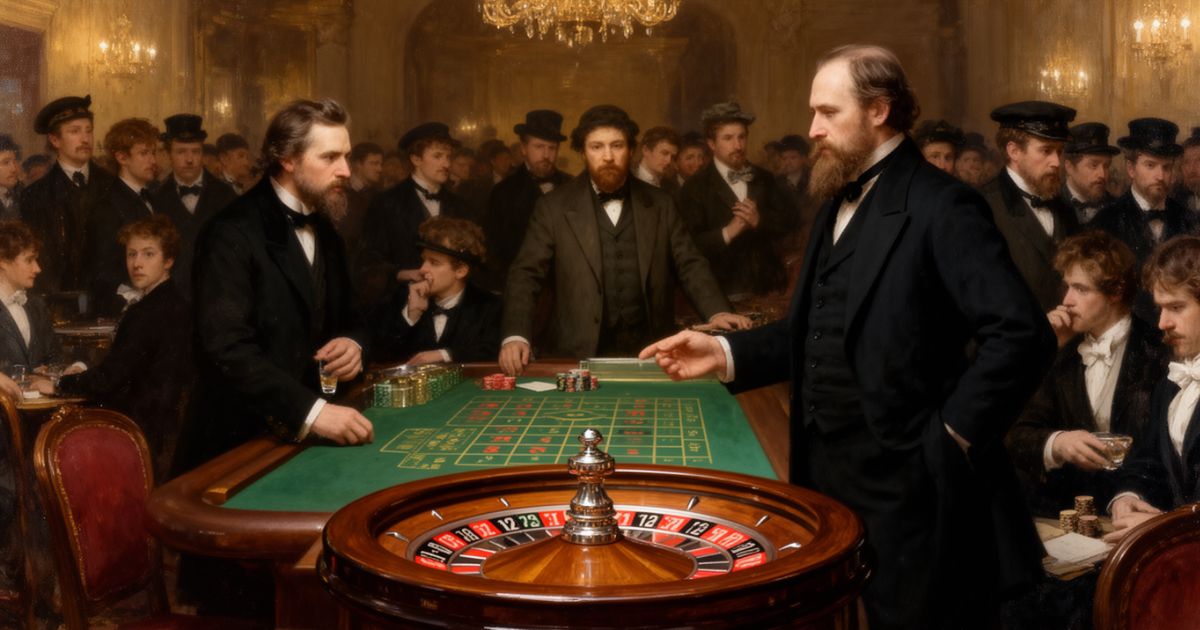
An excerpt from the original text.(complete · 3261 words)
ll at once, on the Promenade, as it was called—that is to say, in the
Chestnut Avenue—I came face to face with my Englishman.
“I was just coming to see you,” he said; “and you appear to be out on a
similar errand. So you have parted with your employers?”
“How do you know that?” I asked in astonishment. “Is every one aware
of the fact?”
“By no means. Not every one would consider such a fact to be of moment.
Indeed, I have never heard any one speak of it.”
“Then how come you to know it?”
“Because I have had occasion to do so. Whither are you bound? I like
you, and was therefore coming to pay you a visit.”
“What a splendid fellow you are, Mr. Astley!” I cried, though still
wondering how he had come by his knowledge. “And since I have not yet
had my coffee, and you have, in all probability, scarcely tasted yours,
let us adjourn to the Casino Café, where we can sit and smoke and have
a talk.”
The café in question was only a hundred paces away; so, when coffee had
been brought, we seated ourselves, and I lit a cigarette. Astley was no
smoker, but, taking a seat by my side, he prepared himself to listen.
“I do not intend to go away,” was my first remark. “I intend, on the
contrary, to remain here.”
“That I never doubted,” he answered good-humouredly.
It is a curious fact that, on my way to see him, I had never even
thought of telling him of my love for Polina. In fact, I had purposely
meant to avoid any mention of the subject. Nor, during our stay in the
place, had I ever made aught but the scantiest reference to it. You
see, not only was Astley a man of great reserve, but also from the
first I had perceived that Polina had made a great impression upon him,
although he never spoke of her. But now, strangely enough, he had no
sooner seated himself and bent his steely gaze upon me, than, for some
reason or another, I felt moved to tell him everything—to speak to him
of my love in all its phases. For an hour and a half did I discourse on
the subject, and found it a pleasure to do so, even though this was the
first occasion on which I had referred to the matter. Indeed, when, at
certain moments, I perceived that my more ardent passages confused him,
I purposely increased my ardour of narration. Yet one thing I regret:
and that is that I made references to the Frenchman which were a little
over-personal.
Mr. Astley sat without moving as he listened to me. Not a word nor a
sound of any kind did he utter as he stared into my eyes. Suddenly,
however, on my mentioning the Frenchman, he interrupted me, and
inquired sternly whether I did right to speak of an extraneous matter
(he had always been a strange man in his mode of propounding
questions).
“No, I fear not,” I replied.
“And concerning this Marquis and Mlle. Polina you know nothing beyond
surmise?”
Again I was surprised that such a categorical question should come from
such a reserved individual.
“No, I know nothing for certain about them” was my reply.
“No—nothing.”
“Then you have done very wrong to speak of them to me, or even to
imagine things about them.”
“Quite so, quite so,” I interrupted in some astonishment. “I admit
that. Yet that is not the question.” Whereupon I related to him in
detail the incident of two days ago. I spoke of Polina’s outburst, of
my encounter with the Baron, of my dismissal, of the General’s
extraordinary pusillanimity, and of the call which De Griers had that
morning paid me. In conclusion, I showed Astley the note which I had
lately received.
“What do you make of it?” I asked. “When I met you I was just coming to
ask you your opinion. For myself, I could have killed this Frenchman,
and am not sure that I shall not do so even yet.”
“I feel the same about it,” said Mr. Astley. “As for Mlle. Polina—well,
you yourself know that, if necessity drives, one enters into relation
with people whom one simply detests. Even between this couple there may
be something which, though unknown to you, depends upon extraneous
circumstances. For, my own part, I think that you may reassure
yourself—or at all events partially. And as for Mlle. Polina’s
proceedings of two days ago, they were, of course, strange; not because
she can have meant to get rid of you, or to earn for you a thrashing
from the Baron’s cudgel (which for some curious reason, he did not use,
although he had it ready in his hands), but because such proceedings on
the part of such—well, of such a refined lady as Mlle. Polina are, to
say the least of it, unbecoming. But she cannot have guessed that you
would carry out her absurd wish to the letter?”
“Do you know what?” suddenly I cried as I fixed Mr. Astley with my
gaze. “I believe that you have already heard the story from some
one—very possibly from Mlle. Polina herself?”
In return he gave me an astonished stare.
“Your eyes look very fiery,” he said with a return of his former calm,
“and in them I can read suspicion. Now, you have no right whatever to
be suspicious. It is not a right which I can for a moment recognise,
and I absolutely refuse to answer your questions.”
“Enough! You need say no more,” I cried with a strange emotion at my
heart, yet not altogether understanding what had aroused that emotion
in my breast. Indeed, when, where, and how could Polina have chosen
Astley to be one of her confidants? Of late I had come rather to
overlook him in this connection, even though Polina had always been a
riddle to me—so much so that now, when I had just permitted myself to
tell my friend of my infatuation in all its aspects, I had found myself
struck, during the very telling, with the fact that in my relations
with her I could specify nothing that was explicit, nothing that was
positive. On the contrary, my relations had been purely fantastic,
strange, and unreal; they had been unlike anything else that I could
think of.
“Very well, very well,” I replied with a warmth equal to Astley’s own.
“Then I stand confounded, and have no further opinions to offer. But
you are a good fellow, and I am glad to know what you think about it
all, even though I do not need your advice.”
Then, after a pause, I resumed:
“For instance, what reason should you assign for the General taking
fright in this way? Why should my stupid clowning have led the world to
elevate it into a serious incident? Even De Griers has found it
necessary to put in his oar (and he only interferes on the most
important occasions), and to visit me, and to address to me the most
earnest supplications. Yes, he, De Griers, has actually been playing
the suppliant to me! And, mark you, although he came to me as early
as nine o’clock, he had ready-prepared in his hand Mlle. Polina’s note.
When, I would ask, was that note written? Mlle. Polina must have been
aroused from sleep for the express purpose of writing it. At all events
the circumstance shows that she is an absolute slave to the Frenchman,
since she actually begs my pardon in the note—actually begs my pardon!
Yet what is her personal concern in the matter? Why is she interested
in it at all? Why, too, is the whole party so afraid of this precious
Baron? And what sort of a business do you call it for the General to be
going to marry Mlle. Blanche de Cominges? He told me last night that,
because of the circumstance, he must ‘move with especial care at
present.’ What is your opinion of it all? Your look convinces me that
you know more about it than I do.”
Mr. Astley smiled and nodded.
“Yes, I think I do know more about it than you do,” he assented. “The
affair centres around this Mlle. Blanche. Of that I feel certain.”
“And what of Mlle. Blanche?” I cried impatiently (for in me there had
dawned a sudden hope that this would enable me to discover something
about Polina).
“Well, my belief is that at the present moment Mlle. Blanche has, in
very truth, a special reason for wishing to avoid any trouble with the
Baron and the Baroness. It might lead not only to some unpleasantness,
but even to a scandal.”
“Oh, oh!”
“Also I may tell you that Mlle. Blanche has been in Roulettenberg
before, for she was staying here three seasons ago. I myself was in the
place at the time, and in those days Mlle. Blanche was not known as
Mlle. de Cominges, nor was her mother, the Widow de Cominges, even in
existence. In any case no one ever mentioned the latter. De Griers,
too, had not materialised, and I am convinced that not only do the
parties stand in no relation to one another, but also they have not
long enjoyed one another’s acquaintance. Likewise, the Marquisate de
Griers is of recent creation. Of that I have reason to be sure, owing
to a certain circumstance. Even the name De Griers itself may be taken
to be a new invention, seeing that I have a friend who once met the
said ‘Marquis’ under a different name altogether.”
“Yet he possesses a good circle of friends?”
“Possibly. Mlle. Blanche also may possess that. Yet it is not three
years since she received from the local police, at the instance of the
Baroness, an invitation to leave the town. And she left it.”
“But why?”
“Well, I must tell you that she first appeared here in company with an
Italian—a prince of some sort, a man who bore an historic name
(Barberini or something of the kind). The fellow was simply a mass of
rings and diamonds—real diamonds, too—and the couple used to drive out
in a marvellous carriage. At first Mlle. Blanche played ‘trente et
quarante’ with fair success, but, later, her luck took a marked change
for the worse. I distinctly remember that in a single evening she lost
an enormous sum. But worse was to ensue, for one fine morning her
prince disappeared—horses, carriage, and all. Also, the hotel bill
which he left unpaid was enormous. Upon this Mlle. Zelma (the name
which she assumed after figuring as Madame Barberini) was in despair.
She shrieked and howled all over the hotel, and even tore her clothes
in her frenzy. In the hotel there was staying also a Polish count (you
must know that ALL travelling Poles are counts!), and the spectacle of
Mlle. Zelma tearing her clothes and, catlike, scratching her face with
her beautiful, scented nails produced upon him a strong impression. So
the pair had a talk together, and, by luncheon time, she was consoled.
Indeed, that evening the couple entered the Casino arm-in-arm—Mlle.
Zelma laughing loudly, according to her custom, and showing even more
expansiveness in her manners than she had before shown. For instance,
she thrust her way into the file of women roulette-players in the exact
fashion of those ladies who, to clear a space for themselves at the
tables, push their fellow-players roughly aside. Doubtless you have
noticed them?”
“Yes, certainly.”
“Well, they are not worth noticing. To the annoyance of the decent
public they are allowed to remain here—at all events such of them as
daily change 4000 franc notes at the tables (though, as soon as ever
these women cease to do so, they receive an invitation to depart).
However, Mlle. Zelma continued to change notes of this kind, but her
play grew more and more unsuccessful, despite the fact that such
ladies’ luck is frequently good, for they have a surprising amount of
cash at their disposal. Suddenly, the Count too disappeared, even as
the Prince had done, and that same evening Mlle. Zelma was forced to
appear in the Casino alone. On this occasion no one offered her a
greeting. Two days later she had come to the end of her resources;
whereupon, after staking and losing her last louis d’or she chanced to
look around her, and saw standing by her side the Baron Burmergelm, who
had been eyeing her with fixed disapproval. To his distaste, however,
Mlle. paid no attention, but, turning to him with her well-known smile,
requested him to stake, on her behalf, ten louis on the red. Later that
evening a complaint from the Baroness led the authorities to request
Mlle. not to re-enter the Casino. If you feel in any way surprised that
I should know these petty and unedifying details, the reason is that I
had them from a relative of mine who, later that evening, drove Mlle.
Zelma in his carriage from Roulettenberg to Spa. Now, mark you, Mlle.
wants to become Madame General, in order that, in future, she may be
spared the receipt of such invitations from Casino authorities as she
received three years ago. At present she is not playing; but that is
only because, according to the signs, she is lending money to other
players. Yes, that is a much more paying game. I even suspect that the
unfortunate General is himself in her debt, as well as, perhaps, also
De Griers. Or, it may be that the latter has entered into a partnership
with her. Consequently you yourself will see that, until the marriage
shall have been consummated, Mlle. would scarcely like to have the
attention of the Baron and the Baroness drawn to herself. In short, to
any one in her position, a scandal would be most detrimental. You form
a member of the ménage of these people; wherefore, any act of yours
might cause such a scandal—and the more so since daily she appears in
public arm in arm with the General or with Mlle. Polina. Now do you
understand?”
“No, I do not!” I shouted as I banged my fist down upon the
table—banged it with such violence that a frightened waiter came
running towards us. “Tell me, Mr. Astley, why, if you knew this history
all along, and, consequently, always knew who this Mlle. Blanche is,
you never warned either myself or the General, nor, most of all, Mlle.
Polina” (who is accustomed to appear in the Casino—in public everywhere
with Mlle. Blanche). “How could you do it?”
“It would have done no good to warn you,” he replied quietly, “for the
reason that you could have effected nothing. Against what was I to warn
you? As likely as not, the General knows more about Mlle. Blanche even
than I do; yet the unhappy man still walks about with her and Mlle.
Polina. Only yesterday I saw this Frenchwoman riding, splendidly
mounted, with De Griers, while the General was careering in their wake
on a roan horse. He had said, that morning, that his legs were hurting
him, yet his riding-seat was easy enough. As he passed I looked at him,
and the thought occurred to me that he was a man lost for ever.
However, it is no affair of mine, for I have only recently had the
happiness to make Mlle. Polina’s acquaintance. Also”—he added this as
an afterthought—“I have already told you that I do not recognise your
right to ask me certain questions, however sincere be my liking for
you.”
“Enough,” I said, rising. “To me it is as clear as day that Mlle.
Polina knows all about this Mlle. Blanche, but cannot bring herself to
part with her Frenchman; wherefore, she consents also to be seen in
public with Mlle. Blanche. You may be sure that nothing else would ever
have induced her either to walk about with this Frenchwoman or to send
me a note not to touch the Baron. Yes, it is there that the influence
lies before which everything in the world must bow! Yet she herself it
was who launched me at the Baron! The devil take it, but I was left no
choice in the matter.”
“You forget, in the first place, that this Mlle. de Cominges is the
General’s inamorata, and, in the second place, that Mlle. Polina, the
General’s step-daughter, has a younger brother and sister who, though
they are the General’s own children, are completely neglected by this
madman, and robbed as well.”
“Yes, yes; that is so. For me to go and desert the children now would
mean their total abandonment; whereas, if I remain, I should be able to
defend their interests, and, perhaps, to save a moiety of their
property. Yes, yes; that is quite true. And yet, and yet—Oh, I can well
understand why they are all so interested in the General’s mother!”
“In whom?” asked Mr. Astley.
“In the old woman of Moscow who declines to die, yet concerning whom
they are for ever expecting telegrams to notify the fact of her death.”
“Ah, then of course their interests centre around her. It is a question
of succession. Let that but be settled, and the General will marry,
Mlle. Polina will be set free, and De Griers—”
“Yes, and De Griers?”
“Will be repaid his money, which is what he is now waiting for.”
“What? You think that he is waiting for that?”
“I know of nothing else,” asserted Mr. Astley doggedly.
“But, I do, I do!” I shouted in my fury. “He is waiting also for the
old woman’s will, for the reason that it awards Mlle. Polina a dowry.
As soon as ever the money is received, she will throw herself upon the
Frenchman’s neck. All women are like that. Even the proudest of them
become abject slaves where marriage is concerned. What Polina is good
for is to fall head over ears in love. That is my opinion. Look at
her—especially when she is sitting alone, and plunged in thought. All
this was pre-ordained and foretold, and is accursed. Polina could
perpetrate any mad act. She—she—But who called me by name?” I broke
off. “Who is shouting for me? I heard some one calling in Russian,
‘Alexis Ivanovitch!’ It was a woman’s voice. Listen!”
At the moment, we were approaching my hotel. We had left the café long
ago, without even noticing that we had done so.
“Yes, I did hear a woman’s voice calling, but whose I do not know.
The someone was calling you in Russian. Ah! NOW I can see whence the
cries come. They come from that lady there—the one who is sitting on
the settee, the one who has just been escorted to the verandah by a
crowd of lacqueys. Behind her see that pile of luggage! She must have
arrived by train.”
“But why should she be calling me? Hear her calling again! See! She
is beckoning to us!”
“Yes, so she is,” assented Mr. Astley.
“Alexis Ivanovitch, Alexis Ivanovitch! Good heavens, what a stupid
fellow!” came in a despairing wail from the verandah.
We had almost reached the portico, and I was just setting foot upon the
space before it, when my hands fell to my sides in limp astonishment,
and my feet glued themselves to the pavement!
Master this chapter. Complete your experience
Purchase the complete book to access all chapters and support classic literature
As an Amazon Associate, we earn a small commission from qualifying purchases at no additional cost to you.
Available in paperback, hardcover, and e-book formats
Let's Analyse the Pattern
The strategic withholding and timing of revelations to maintain power and manipulate outcomes in relationships and situations.
Why This Matters
Connect literature to life
This chapter teaches how people weaponize secrets and revelations to manipulate situations and maintain power over others.
Practice This Today
This week, notice when someone shares 'helpful' information about a third party - ask yourself why they're telling you this now, and what they might gain from your reaction.
Now let's explore the literary elements.
Key Quotes & Analysis
"I do not intend to go away. I intend, on the contrary, to remain here."
Context: When Astley asks about his plans after losing his job
Shows the narrator's stubborn refusal to face reality or make rational decisions. He's choosing to stay in a toxic environment rather than cut his losses and leave.
In Today's Words:
I'm not going anywhere, I'm staying put no matter what.
"Three years ago she was known here as Mlle. Zelma, and she went neither by her present name nor by that of Barberini."
Context: Revealing Blanche's criminal past and false identities
Exposes how completely Blanche has reinvented herself, showing the lengths people will go to escape their past and the fragility of reputation in their social world.
In Today's Words:
She's been using fake names - three years ago she went by something completely different.
"Any scandal would be a blow to her."
Context: Explaining why everyone is so worried about the Baron incident
Reveals the high stakes behind all the social maneuvering. Blanche's entire scheme depends on maintaining her new respectable image, making her vulnerable to exposure.
In Today's Words:
If this gets out, it'll ruin everything for her.
Thematic Threads
Deception
In This Chapter
Blanche's complete identity transformation from con artist Zelma to respectable lady seeking marriage
Development
Evolved from earlier hints about her questionable character to full revelation of systematic fraud
In Your Life:
You might encounter this when someone's story about their past doesn't quite add up or changes over time.
Class
In This Chapter
Blanche desperately seeking respectability through marriage to escape her criminal past and social exclusion
Development
Deepened from general class tensions to specific example of how reputation determines access to society
In Your Life:
You see this when people change their accent, clothes, or stories depending on who they're trying to impress.
Social Expectations
In This Chapter
Everyone tiptoeing around the Baron incident because any scandal could destroy Blanche's carefully constructed image
Development
Expanded from individual behavior to showing how one person's needs control an entire group's actions
In Your Life:
This happens when your family walks on eggshells around one person's reputation or when workplace gossip could ruin someone's career.
Identity
In This Chapter
The narrator confessing his true feelings to Astley while learning that Blanche is living a completely false identity
Development
Contrasted authentic vulnerability with calculated performance
In Your Life:
You experience this tension between who you really are and who you think you need to be to succeed.
Human Relationships
In This Chapter
Astley's strategic revelation shows how even seemingly helpful relationships involve manipulation and hidden agendas
Development
Complicated earlier portrayal of Astley as neutral observer by revealing his active involvement in the drama
In Your Life:
You might notice this when someone gives you 'helpful' information at a suspiciously convenient time.
You now have the context. Time to form your own thoughts.
Discussion Questions
- 1
Why does Astley wait until the narrator is confessing his feelings about Polina to reveal Blanche's scandalous past?
analysis • surface - 2
How does knowing about Blanche's history as 'Mlle. Zelma' change your understanding of why everyone is so worried about the Baron incident?
analysis • medium - 3
Think about your workplace or family - when have you seen someone strategically reveal information to change how others see a situation?
application • medium - 4
If you were the General and found out about Blanche's past right now, how would you handle the situation without destroying your own reputation?
application • deep - 5
What does this chapter reveal about how people use secrets and timing to control relationships and situations?
reflection • deep
Critical Thinking Exercise
Map Your Information Network
Draw a simple diagram of an important situation in your life - a workplace conflict, family drama, or relationship issue. Map out who knows what information and who's keeping secrets from whom. Use arrows to show how information flows (or doesn't flow) between people. Then identify who benefits from each person staying uninformed.
Consider:
- •Look for patterns where the same person controls multiple information streams
- •Notice if you're being kept in the dark about something that affects you
- •Consider whether you're withholding information and what you gain from that
Journaling Prompt
Write about a time when someone revealed important information to you at exactly the right moment to influence your decision. Looking back, what were they trying to accomplish?
Coming Up Next...
Chapter 9: The Grandmother's Explosive Arrival
The mysterious Russian woman calling from the hotel verandah is about to change everything. Her arrival will force the narrator to confront a connection from his past that could alter the entire dynamic of his situation in Roulettenberg.