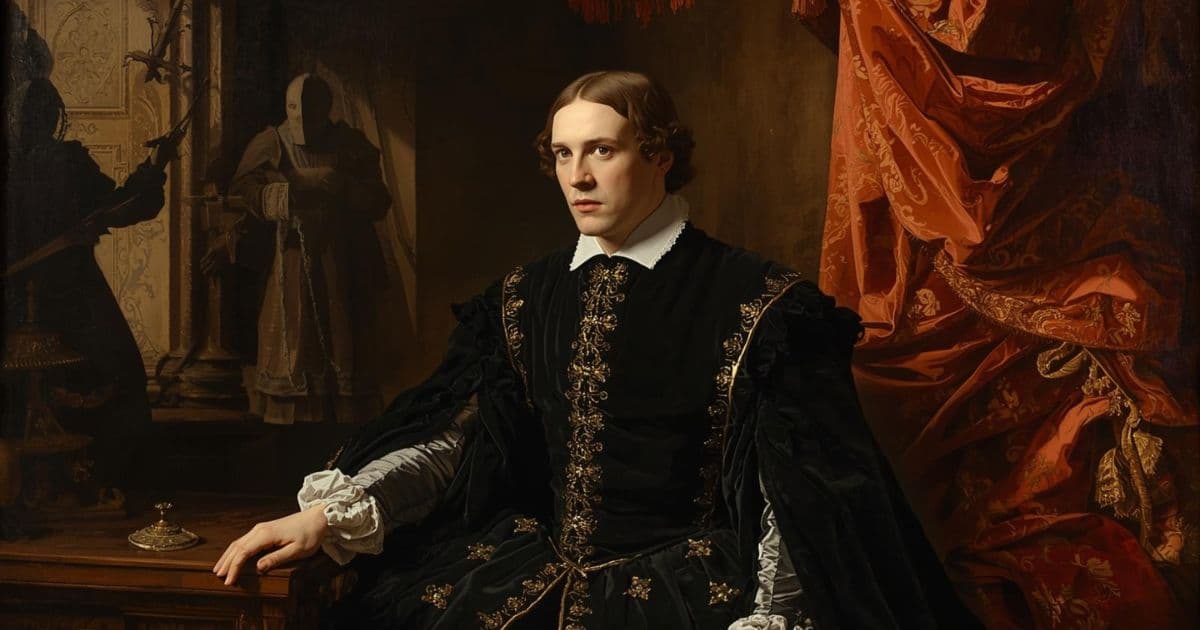
An excerpt from the original text.(complete · 4128 words)
Sudden Catastrophe
I may note that he had been called before Alyosha. But the usher of the
court announced to the President that, owing to an attack of illness or
some sort of fit, the witness could not appear at the moment, but was
ready to give his evidence as soon as he recovered. But no one seemed
to have heard it and it only came out later.
His entrance was for the first moment almost unnoticed. The principal
witnesses, especially the two rival ladies, had already been
questioned. Curiosity was satisfied for the time; the public was
feeling almost fatigued. Several more witnesses were still to be heard,
who probably had little information to give after all that had been
given. Time was passing. Ivan walked up with extraordinary slowness,
looking at no one, and with his head bowed, as though plunged in gloomy
thought. He was irreproachably dressed, but his face made a painful
impression, on me at least: there was an earthy look in it, a look like
a dying man’s. His eyes were lusterless; he raised them and looked
slowly round the court. Alyosha jumped up from his seat and moaned
“Ah!” I remember that, but it was hardly noticed.
The President began by informing him that he was a witness not on oath,
that he might answer or refuse to answer, but that, of course, he must
bear witness according to his conscience, and so on, and so on. Ivan
listened and looked at him blankly, but his face gradually relaxed into
a smile, and as soon as the President, looking at him in astonishment,
finished, he laughed outright.
“Well, and what else?” he asked in a loud voice.
There was a hush in the court; there was a feeling of something
strange. The President showed signs of uneasiness.
“You ... are perhaps still unwell?” he began, looking everywhere for
the usher.
“Don’t trouble yourself, your excellency, I am well enough and can tell
you something interesting,” Ivan answered with sudden calmness and
respectfulness.
“You have some special communication to make?” the President went on,
still mistrustfully.
Ivan looked down, waited a few seconds and, raising his head, answered,
almost stammering:
“No ... I haven’t. I have nothing particular.”
They began asking him questions. He answered, as it were, reluctantly,
with extreme brevity, with a sort of disgust which grew more and more
marked, though he answered rationally. To many questions he answered
that he did not know. He knew nothing of his father’s money relations
with Dmitri. “I wasn’t interested in the subject,” he added. Threats to
murder his father he had heard from the prisoner. Of the money in the
envelope he had heard from Smerdyakov.
“The same thing over and over again,” he interrupted suddenly, with a
look of weariness. “I have nothing particular to tell the court.”
“I see you are unwell and understand your feelings,” the President
began.
He turned to the prosecutor and the counsel for the defense to invite
them to examine the witness, if necessary, when Ivan suddenly asked in
an exhausted voice:
“Let me go, your excellency, I feel very ill.”
And with these words, without waiting for permission, he turned to walk
out of the court. But after taking four steps he stood still, as though
he had reached a decision, smiled slowly, and went back.
“I am like the peasant girl, your excellency ... you know. How does it
go? ‘I’ll stand up if I like, and I won’t if I don’t.’ They were trying
to put on her sarafan to take her to church to be married, and she
said, ‘I’ll stand up if I like, and I won’t if I don’t.’... It’s in
some book about the peasantry.”
“What do you mean by that?” the President asked severely.
“Why, this,” Ivan suddenly pulled out a roll of notes. “Here’s the
money ... the notes that lay in that envelope” (he nodded towards the
table on which lay the material evidence), “for the sake of which our
father was murdered. Where shall I put them? Mr. Superintendent, take
them.”
The usher of the court took the whole roll and handed it to the
President.
“How could this money have come into your possession if it is the same
money?” the President asked wonderingly.
“I got them from Smerdyakov, from the murderer, yesterday.... I was
with him just before he hanged himself. It was he, not my brother,
killed our father. He murdered him and I incited him to do it ... Who
doesn’t desire his father’s death?”
“Are you in your right mind?” broke involuntarily from the President.
“I should think I am in my right mind ... in the same nasty mind as all
of you ... as all these ... ugly faces.” He turned suddenly to the
audience. “My father has been murdered and they pretend they are
horrified,” he snarled, with furious contempt. “They keep up the sham
with one another. Liars! They all desire the death of their fathers.
One reptile devours another.... If there hadn’t been a murder, they’d
have been angry and gone home ill‐humored. It’s a spectacle they want!
Panem et circenses. Though I am one to talk! Have you any water? Give
me a drink for Christ’s sake!” He suddenly clutched his head.
The usher at once approached him. Alyosha jumped up and cried, “He is
ill. Don’t believe him: he has brain fever.” Katerina Ivanovna rose
impulsively from her seat and, rigid with horror, gazed at Ivan. Mitya
stood up and greedily looked at his brother and listened to him with a
wild, strange smile.
“Don’t disturb yourselves. I am not mad, I am only a murderer,” Ivan
began again. “You can’t expect eloquence from a murderer,” he added
suddenly for some reason and laughed a queer laugh.
The prosecutor bent over to the President in obvious dismay. The two
other judges communicated in agitated whispers. Fetyukovitch pricked up
his ears as he listened: the hall was hushed in expectation. The
President seemed suddenly to recollect himself.
“Witness, your words are incomprehensible and impossible here. Calm
yourself, if you can, and tell your story ... if you really have
something to tell. How can you confirm your statement ... if indeed you
are not delirious?”
“That’s just it. I have no proof. That cur Smerdyakov won’t send you
proofs from the other world ... in an envelope. You think of nothing
but envelopes—one is enough. I’ve no witnesses ... except one,
perhaps,” he smiled thoughtfully.
“Who is your witness?”
“He has a tail, your excellency, and that would be irregular! Le
diable n’existe point! Don’t pay attention: he is a paltry, pitiful
devil,” he added suddenly. He ceased laughing and spoke as it were,
confidentially. “He is here somewhere, no doubt—under that table with
the material evidence on it, perhaps. Where should he sit if not there?
You see, listen to me. I told him I don’t want to keep quiet, and he
talked about the geological cataclysm ... idiocy! Come, release the
monster ... he’s been singing a hymn. That’s because his heart is
light! It’s like a drunken man in the street bawling how ‘Vanka went to
Petersburg,’ and I would give a quadrillion quadrillions for two
seconds of joy. You don’t know me! Oh, how stupid all this business is!
Come, take me instead of him! I didn’t come for nothing.... Why, why is
everything so stupid?...”
And he began slowly, and as it were reflectively, looking round him
again. But the court was all excitement by now. Alyosha rushed towards
him, but the court usher had already seized Ivan by the arm.
“What are you about?” he cried, staring into the man’s face, and
suddenly seizing him by the shoulders, he flung him violently to the
floor. But the police were on the spot and he was seized. He screamed
furiously. And all the time he was being removed, he yelled and
screamed something incoherent.
The whole court was thrown into confusion. I don’t remember everything
as it happened. I was excited myself and could not follow. I only know
that afterwards, when everything was quiet again and every one
understood what had happened, the court usher came in for a reprimand,
though he very reasonably explained that the witness had been quite
well, that the doctor had seen him an hour ago, when he had a slight
attack of giddiness, but that, until he had come into the court, he had
talked quite consecutively, so that nothing could have been
foreseen—that he had, in fact, insisted on giving evidence. But before
every one had completely regained their composure and recovered from
this scene, it was followed by another. Katerina Ivanovna had an attack
of hysterics. She sobbed, shrieking loudly, but refused to leave the
court, struggled, and besought them not to remove her. Suddenly she
cried to the President:
“There is more evidence I must give at once ... at once! Here is a
document, a letter ... take it, read it quickly, quickly! It’s a letter
from that monster ... that man there, there!” she pointed to Mitya. “It
was he killed his father, you will see that directly. He wrote to me
how he would kill his father! But the other one is ill, he is ill, he
is delirious!” she kept crying out, beside herself.
The court usher took the document she held out to the President, and
she, dropping into her chair, hiding her face in her hands, began
convulsively and noiselessly sobbing, shaking all over, and stifling
every sound for fear she should be ejected from the court. The document
she had handed up was that letter Mitya had written at the “Metropolis”
tavern, which Ivan had spoken of as a “mathematical proof.” Alas! its
mathematical conclusiveness was recognized, and had it not been for
that letter, Mitya might have escaped his doom or, at least, that doom
would have been less terrible. It was, I repeat, difficult to notice
every detail. What followed is still confused to my mind. The President
must, I suppose, have at once passed on the document to the judges, the
jury, and the lawyers on both sides. I only remember how they began
examining the witness. On being gently asked by the President whether
she had recovered sufficiently, Katerina Ivanovna exclaimed
impetuously:
“I am ready, I am ready! I am quite equal to answering you,” she added,
evidently still afraid that she would somehow be prevented from giving
evidence. She was asked to explain in detail what this letter was and
under what circumstances she received it.
“I received it the day before the crime was committed, but he wrote it
the day before that, at the tavern—that is, two days before he
committed the crime. Look, it is written on some sort of bill!” she
cried breathlessly. “He hated me at that time, because he had behaved
contemptibly and was running after that creature ... and because he
owed me that three thousand.... Oh! he was humiliated by that three
thousand on account of his own meanness! This is how it happened about
that three thousand. I beg you, I beseech you, to hear me. Three weeks
before he murdered his father, he came to me one morning. I knew he was
in want of money, and what he wanted it for. Yes, yes—to win that
creature and carry her off. I knew then that he had been false to me
and meant to abandon me, and it was I, I, who gave him that money, who
offered it to him on the pretext of his sending it to my sister in
Moscow. And as I gave it him, I looked him in the face and said that he
could send it when he liked, ‘in a month’s time would do.’ How, how
could he have failed to understand that I was practically telling him
to his face, ‘You want money to be false to me with your creature, so
here’s the money for you. I give it to you myself. Take it, if you have
so little honor as to take it!’ I wanted to prove what he was, and what
happened? He took it, he took it, and squandered it with that creature
in one night.... But he knew, he knew that I knew all about it. I
assure you he understood, too, that I gave him that money to test him,
to see whether he was so lost to all sense of honor as to take it from
me. I looked into his eyes and he looked into mine, and he understood
it all and he took it—he carried off my money!”
“That’s true, Katya,” Mitya roared suddenly, “I looked into your eyes
and I knew that you were dishonoring me, and yet I took your money.
Despise me as a scoundrel, despise me, all of you! I’ve deserved it!”
“Prisoner,” cried the President, “another word and I will order you to
be removed.”
“That money was a torment to him,” Katya went on with impulsive haste.
“He wanted to repay it me. He wanted to, that’s true; but he needed
money for that creature, too. So he murdered his father, but he didn’t
repay me, and went off with her to that village where he was arrested.
There, again, he squandered the money he had stolen after the murder of
his father. And a day before the murder he wrote me this letter. He was
drunk when he wrote it. I saw it at once, at the time. He wrote it from
spite, and feeling certain, positively certain, that I should never
show it to any one, even if he did kill him, or else he wouldn’t have
written it. For he knew I shouldn’t want to revenge myself and ruin
him! But read it, read it attentively—more attentively, please—and you
will see that he had described it all in his letter, all beforehand,
how he would kill his father and where his money was kept. Look,
please, don’t overlook that, there’s one phrase there, ‘I shall kill
him as soon as Ivan has gone away.’ So he thought it all out beforehand
how he would kill him,” Katerina Ivanovna pointed out to the court with
venomous and malignant triumph. Oh! it was clear she had studied every
line of that letter and detected every meaning underlining it. “If he
hadn’t been drunk, he wouldn’t have written to me; but, look,
everything is written there beforehand, just as he committed the murder
after. A complete program of it!” she exclaimed frantically.
She was reckless now of all consequences to herself, though, no doubt,
she had foreseen them even a month ago, for even then, perhaps, shaking
with anger, she had pondered whether to show it at the trial or not.
Now she had taken the fatal plunge. I remember that the letter was read
aloud by the clerk, directly afterwards, I believe. It made an
overwhelming impression. They asked Mitya whether he admitted having
written the letter.
“It’s mine, mine!” cried Mitya. “I shouldn’t have written it, if I
hadn’t been drunk!... We’ve hated each other for many things, Katya,
but I swear, I swear I loved you even while I hated you, and you didn’t
love me!”
He sank back on his seat, wringing his hands in despair. The prosecutor
and counsel for the defense began cross‐examining her, chiefly to
ascertain what had induced her to conceal such a document and to give
her evidence in quite a different tone and spirit just before.
“Yes, yes. I was telling lies just now. I was lying against my honor
and my conscience, but I wanted to save him, for he has hated and
despised me so!” Katya cried madly. “Oh, he has despised me horribly,
he has always despised me, and do you know, he has despised me from the
very moment that I bowed down to him for that money. I saw that.... I
felt it at once at the time, but for a long time I wouldn’t believe it.
How often I have read it in his eyes, ‘You came of yourself, though.’
Oh, he didn’t understand, he had no idea why I ran to him, he can
suspect nothing but baseness, he judged me by himself, he thought every
one was like himself!” Katya hissed furiously, in a perfect frenzy.
“And he only wanted to marry me, because I’d inherited a fortune,
because of that, because of that! I always suspected it was because of
that! Oh, he is a brute! He was always convinced that I should be
trembling with shame all my life before him, because I went to him
then, and that he had a right to despise me for ever for it, and so to
be superior to me—that’s why he wanted to marry me! That’s so, that’s
all so! I tried to conquer him by my love—a love that knew no bounds. I
even tried to forgive his faithlessness; but he understood nothing,
nothing! How could he understand indeed? He is a monster! I only
received that letter the next evening: it was brought me from the
tavern—and only that morning, only that morning I wanted to forgive him
everything, everything—even his treachery!”
The President and the prosecutor, of course, tried to calm her. I can’t
help thinking that they felt ashamed of taking advantage of her
hysteria and of listening to such avowals. I remember hearing them say
to her, “We understand how hard it is for you; be sure we are able to
feel for you,” and so on, and so on. And yet they dragged the evidence
out of the raving, hysterical woman. She described at last with
extraordinary clearness, which is so often seen, though only for a
moment, in such over‐wrought states, how Ivan had been nearly driven
out of his mind during the last two months trying to save “the monster
and murderer,” his brother.
“He tortured himself,” she exclaimed, “he was always trying to minimize
his brother’s guilt and confessing to me that he, too, had never loved
his father, and perhaps desired his death himself. Oh, he has a tender,
over‐ tender conscience! He tormented himself with his conscience! He
told me everything, everything! He came every day and talked to me as
his only friend. I have the honor to be his only friend!” she cried
suddenly with a sort of defiance, and her eyes flashed. “He had been
twice to see Smerdyakov. One day he came to me and said, ‘If it was not
my brother, but Smerdyakov committed the murder’ (for the legend was
circulating everywhere that Smerdyakov had done it), ‘perhaps I too am
guilty, for Smerdyakov knew I didn’t like my father and perhaps
believed that I desired my father’s death.’ Then I brought out that
letter and showed it him. He was entirely convinced that his brother
had done it, and he was overwhelmed by it. He couldn’t endure the
thought that his own brother was a parricide! Only a week ago I saw
that it was making him ill. During the last few days he has talked
incoherently in my presence. I saw his mind was giving way. He walked
about, raving; he was seen muttering in the streets. The doctor from
Moscow, at my request, examined him the day before yesterday and told
me that he was on the eve of brain fever—and all on his account, on
account of this monster! And last night he learnt that Smerdyakov was
dead! It was such a shock that it drove him out of his mind ... and all
through this monster, all for the sake of saving the monster!”
Oh, of course, such an outpouring, such an avowal is only possible once
in a lifetime—at the hour of death, for instance, on the way to the
scaffold! But it was in Katya’s character, and it was such a moment in
her life. It was the same impetuous Katya who had thrown herself on the
mercy of a young profligate to save her father; the same Katya who had
just before, in her pride and chastity, sacrificed herself and her
maidenly modesty before all these people, telling of Mitya’s generous
conduct, in the hope of softening his fate a little. And now, again,
she sacrificed herself; but this time it was for another, and perhaps
only now—perhaps only at this moment—she felt and knew how dear that
other was to her! She had sacrificed herself in terror for him,
conceiving all of a sudden that he had ruined himself by his confession
that it was he who had committed the murder, not his brother, she had
sacrificed herself to save him, to save his good name, his reputation!
And yet one terrible doubt occurred to one—was she lying in her
description of her former relations with Mitya?—that was the question.
No, she had not intentionally slandered him when she cried that Mitya
despised her for her bowing down to him! She believed it herself. She
had been firmly convinced, perhaps ever since that bow, that the
simple‐hearted Mitya, who even then adored her, was laughing at her and
despising her. She had loved him with an hysterical, “lacerated” love
only from pride, from wounded pride, and that love was not like love,
but more like revenge. Oh! perhaps that lacerated love would have grown
into real love, perhaps Katya longed for nothing more than that, but
Mitya’s faithlessness had wounded her to the bottom of her heart, and
her heart could not forgive him. The moment of revenge had come upon
her suddenly, and all that had been accumulating so long and so
painfully in the offended woman’s breast burst out all at once and
unexpectedly. She betrayed Mitya, but she betrayed herself, too. And no
sooner had she given full expression to her feelings than the tension
of course was over and she was overwhelmed with shame. Hysterics began
again: she fell on the floor, sobbing and screaming. She was carried
out. At that moment Grushenka, with a wail, rushed towards Mitya before
they had time to prevent her.
“Mitya,” she wailed, “your serpent has destroyed you! There, she has
shown you what she is!” she shouted to the judges, shaking with anger.
At a signal from the President they seized her and tried to remove her
from the court. She wouldn’t allow it. She fought and struggled to get
back to Mitya. Mitya uttered a cry and struggled to get to her. He was
overpowered.
Yes, I think the ladies who came to see the spectacle must have been
satisfied—the show had been a varied one. Then I remember the Moscow
doctor appeared on the scene. I believe the President had previously
sent the court usher to arrange for medical aid for Ivan. The doctor
announced to the court that the sick man was suffering from a dangerous
attack of brain fever, and that he must be at once removed. In answer
to questions from the prosecutor and the counsel for the defense he
said that the patient had come to him of his own accord the day before
yesterday and that he had warned him that he had such an attack coming
on, but he had not consented to be looked after. “He was certainly not
in a normal state of mind: he told me himself that he saw visions when
he was awake, that he met several persons in the street, who were dead,
and that Satan visited him every evening,” said the doctor, in
conclusion. Having given his evidence, the celebrated doctor withdrew.
The letter produced by Katerina Ivanovna was added to the material
proofs. After some deliberation, the judges decided to proceed with the
trial and to enter both the unexpected pieces of evidence (given by
Ivan and Katerina Ivanovna) on the protocol.
But I will not detail the evidence of the other witnesses, who only
repeated and confirmed what had been said before, though all with their
characteristic peculiarities. I repeat, all was brought together in the
prosecutor’s speech, which I shall quote immediately. Every one was
excited, every one was electrified by the late catastrophe, and all
were awaiting the speeches for the prosecution and the defense with
intense impatience. Fetyukovitch was obviously shaken by Katerina
Ivanovna’s evidence. But the prosecutor was triumphant. When all the
evidence had been taken, the court was adjourned for almost an hour. I
believe it was just eight o’clock when the President returned to his
seat and our prosecutor, Ippolit Kirillovitch, began his speech.
Master this chapter. Complete your experience
Purchase the complete book to access all chapters and support classic literature
As an Amazon Associate, we earn a small commission from qualifying purchases at no additional cost to you.
Available in paperback, hardcover, and e-book formats
Let's Analyse the Pattern
Accumulated guilt and psychological pressure eventually force destructive confessions that harm both confessor and innocent bystanders.
Why This Matters
Connect literature to life
This chapter teaches how to identify when psychological pressure is building to dangerous levels in yourself and others.
Practice This Today
This week, notice when someone starts over-explaining or volunteering information nobody asked for—these are often signs they're approaching their breaking point and need support, not interrogation.
Now let's explore the literary elements.
Key Quotes & Analysis
"I told him to do it! I incited him to do it!"
Context: During his breakdown testimony, confessing his role in the murder
This shows how Ivan's philosophical guilt has become unbearable. He believes his intellectual discussions about morality gave Smerdyakov permission to kill, making him morally responsible even though he never directly ordered the murder.
In Today's Words:
I put the idea in his head! It's my fault he did it!
"He was irreproachably dressed, but his face made a painful impression... there was an earthy look in it, a look like a dying man's."
Context: Describing Ivan as he enters the courtroom
This physical description shows how psychological guilt has literally made Ivan sick. His outward respectability contrasts with his inner death, showing how conscience can destroy someone from within.
In Today's Words:
He looked put-together on the outside, but his face looked like death - you could see he was dying inside.
"Yes, I have that letter! Here it is!"
Context: Producing Dmitri's incriminating letter during her emotional breakdown
This moment shows how wounded pride can turn love into revenge. Katerina had been trying to save Dmitri, but her pain and humiliation finally overcome her loyalty, leading her to destroy him.
In Today's Words:
I've been holding onto this evidence that will ruin him, and now I'm going to use it!
Thematic Threads
Guilt
In This Chapter
Ivan's moral guilt over enabling murder drives him to confess and mental breakdown despite not physically committing the crime
Development
Evolved from Ivan's philosophical debates about morality to actual psychological collapse under guilt's weight
In Your Life:
You might recognize this when you feel responsible for outcomes you didn't directly cause but somehow enabled.
Pride
In This Chapter
Katerina's wounded pride transforms her love for Dmitri into vengeful testimony that destroys his case
Development
Her pride has been building throughout as she struggles with being publicly humiliated by Dmitri's affair
In Your Life:
You see this when your hurt feelings make you want to hurt someone back, even someone you once loved.
Truth
In This Chapter
Both characters reveal devastating truths under pressure—Ivan's moral complicity and Katerina's damning evidence
Development
Truth emerges not through careful investigation but through psychological breakdown and emotional explosion
In Your Life:
You experience this when stress makes you say things you've been hiding, often at the worst possible moment.
Love
In This Chapter
Katerina confesses her desperate love for Ivan while simultaneously destroying Dmitri through her testimony
Development
Love has become twisted into possession, manipulation, and revenge throughout the story
In Your Life:
You might recognize this when your love for someone becomes so desperate it drives you to harmful actions.
Justice
In This Chapter
The legal system struggles to handle psychological truth versus factual evidence as both witnesses break down
Development
Justice becomes complicated when moral guilt doesn't align with legal guilt
In Your Life:
You see this when you know someone is responsible for harm but can't prove it legally or officially.
You now have the context. Time to form your own thoughts.
Discussion Questions
- 1
What drove both Ivan and Katerina to confess damaging information in court, even though it hurt people they claimed to love?
analysis • surface - 2
Why does guilt sometimes make people confess to things that make their situation worse rather than better?
analysis • medium - 3
Where have you seen people 'crack under pressure' and spill secrets or truths that changed everything - at work, in families, or relationships?
application • medium - 4
How can you recognize when someone (including yourself) is building up psychological pressure that might explode destructively?
application • deep - 5
What does this chapter reveal about how love can transform into revenge when pride is wounded?
reflection • deep
Critical Thinking Exercise
Map Your Pressure Points
Think of a situation where you're carrying guilt, resentment, or unexpressed feelings that are building pressure. Write down what you're holding back and why. Then identify three people you could safely share pieces of this burden with before it explodes. Consider what small steps might release pressure gradually instead of waiting for a breakdown.
Consider:
- •Small releases of pressure are healthier than explosive confessions
- •Choose confidants who can handle your truth without judgment
- •Sometimes the guilt we carry isn't proportional to our actual responsibility
Journaling Prompt
Write about a time when you or someone close to you reached a breaking point and said things that changed relationships forever. What warning signs do you recognize now that you missed then?
Coming Up Next...
Chapter 85: The Prosecutor's Character Sketches
With all the dramatic testimony concluded, the prosecutor rises to deliver his closing argument. He'll weave together all the evidence into a devastating case against Dmitri, using every psychological insight and piece of evidence to paint him as a cold-blooded parricide.