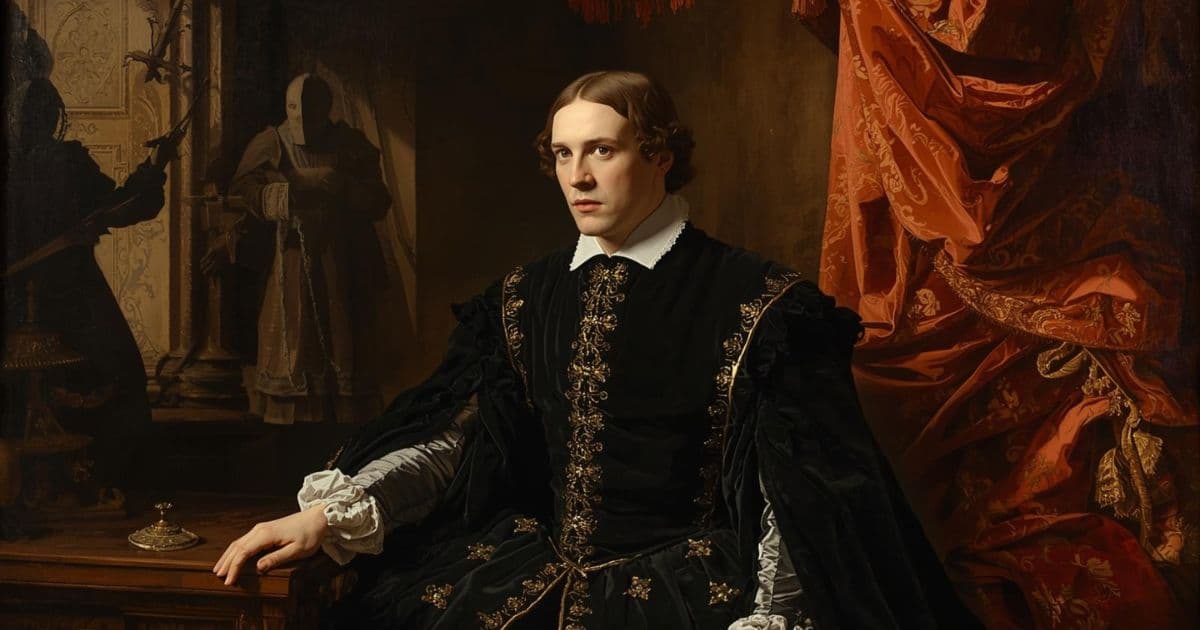
An excerpt from the original text.(complete · 4767 words)
itya’s Great Secret. Received With Hisses
“Gentlemen,” he began, still in the same agitation, “I want to make a
full confession: that money was my own.” The lawyers’ faces
lengthened. That was not at all what they expected.
“How do you mean?” faltered Nikolay Parfenovitch, “when at five o’clock
on the same day, from your own confession—”
“Damn five o’clock on the same day and my own confession! That’s
nothing to do with it now! That money was my own, my own, that is,
stolen by me ... not mine, I mean, but stolen by me, and it was fifteen
hundred roubles, and I had it on me all the time, all the time ...”
“But where did you get it?”
“I took it off my neck, gentlemen, off this very neck ... it was here,
round my neck, sewn up in a rag, and I’d had it round my neck a long
time, it’s a month since I put it round my neck ... to my shame and
disgrace!”
“And from whom did you ... appropriate it?”
“You mean, ‘steal it’? Speak out plainly now. Yes, I consider that I
practically stole it, but, if you prefer, I ‘appropriated it.’ I
consider I stole it. And last night I stole it finally.”
“Last night? But you said that it’s a month since you ... obtained
it?...”
“Yes. But not from my father. Not from my father, don’t be uneasy. I
didn’t steal it from my father, but from her. Let me tell you without
interrupting. It’s hard to do, you know. You see, a month ago, I was
sent for by Katerina Ivanovna, formerly my betrothed. Do you know her?”
“Yes, of course.”
“I know you know her. She’s a noble creature, noblest of the noble. But
she has hated me ever so long, oh, ever so long ... and hated me with
good reason, good reason!”
“Katerina Ivanovna!” Nikolay Parfenovitch exclaimed with wonder. The
prosecutor, too, stared.
“Oh, don’t take her name in vain! I’m a scoundrel to bring her into it.
Yes, I’ve seen that she hated me ... a long while.... From the very
first, even that evening at my lodging ... but enough, enough. You’re
unworthy even to know of that. No need of that at all.... I need only
tell you that she sent for me a month ago, gave me three thousand
roubles to send off to her sister and another relation in Moscow (as
though she couldn’t have sent it off herself!) and I ... it was just at
that fatal moment in my life when I ... well, in fact, when I’d just
come to love another, her, she’s sitting down below now, Grushenka. I
carried her off here to Mokroe then, and wasted here in two days half
that damned three thousand, but the other half I kept on me. Well, I’ve
kept that other half, that fifteen hundred, like a locket round my
neck, but yesterday I undid it, and spent it. What’s left of it, eight
hundred roubles, is in your hands now, Nikolay Parfenovitch. That’s the
change out of the fifteen hundred I had yesterday.”
“Excuse me. How’s that? Why, when you were here a month ago you spent
three thousand, not fifteen hundred, everybody knows that.”
“Who knows it? Who counted the money? Did I let any one count it?”
“Why, you told every one yourself that you’d spent exactly three
thousand.”
“It’s true, I did. I told the whole town so, and the whole town said
so. And here, at Mokroe, too, every one reckoned it was three thousand.
Yet I didn’t spend three thousand, but fifteen hundred. And the other
fifteen hundred I sewed into a little bag. That’s how it was,
gentlemen. That’s where I got that money yesterday....”
“This is almost miraculous,” murmured Nikolay Parfenovitch.
“Allow me to inquire,” observed the prosecutor at last, “have you
informed any one whatever of this circumstance before, I mean that you
had fifteen hundred left about you a month ago?”
“I told no one.”
“That’s strange. Do you mean absolutely no one?”
“Absolutely no one. No one and nobody.”
“What was your reason for this reticence? What was your motive for
making such a secret of it? To be more precise: You have told us at
last your secret, in your words, so ‘disgraceful,’ though in
reality—that is, of course, comparatively speaking—this action, that
is, the appropriation of three thousand roubles belonging to some one
else, and, of course, only for a time is, in my view at least, only an
act of the greatest recklessness and not so disgraceful, when one takes
into consideration your character.... Even admitting that it was an
action in the highest degree discreditable, still, discreditable is not
‘disgraceful.’... Many people have already guessed, during this last
month, about the three thousand of Katerina Ivanovna’s, that you have
spent, and I heard the legend myself, apart from your confession....
Mihail Makarovitch, for instance, had heard it, too, so that indeed, it
was scarcely a legend, but the gossip of the whole town. There are
indications, too, if I am not mistaken, that you confessed this
yourself to some one, I mean that the money was Katerina Ivanovna’s,
and so, it’s extremely surprising to me that hitherto, that is, up to
the present moment, you have made such an extraordinary secret of the
fifteen hundred you say you put by, apparently connecting a feeling of
positive horror with that secret.... It’s not easy to believe that it
could cost you such distress to confess such a secret.... You cried
out, just now, that Siberia would be better than confessing it ...”
The prosecutor ceased speaking. He was provoked. He did not conceal his
vexation, which was almost anger, and gave vent to all his accumulated
spleen, disconnectedly and incoherently, without choosing words.
“It’s not the fifteen hundred that’s the disgrace, but that I put it
apart from the rest of the three thousand,” said Mitya firmly.
“Why?” smiled the prosecutor irritably. “What is there disgraceful, to
your thinking, in your having set aside half of the three thousand you
had discreditably, if you prefer, ‘disgracefully,’ appropriated? Your
taking the three thousand is more important than what you did with it.
And by the way, why did you do that—why did you set apart that half,
for what purpose, for what object did you do it? Can you explain that
to us?”
“Oh, gentlemen, the purpose is the whole point!” cried Mitya. “I put it
aside because I was vile, that is, because I was calculating, and to be
calculating in such a case is vile ... and that vileness has been going
on a whole month.”
“It’s incomprehensible.”
“I wonder at you. But I’ll make it clearer. Perhaps it really is
incomprehensible. You see, attend to what I say. I appropriate three
thousand entrusted to my honor, I spend it on a spree, say I spend it
all, and next morning I go to her and say, ‘Katya, I’ve done wrong,
I’ve squandered your three thousand,’ well, is that right? No, it’s not
right—it’s dishonest and cowardly, I’m a beast, with no more
self‐control than a beast, that’s so, isn’t it? But still I’m not a
thief? Not a downright thief, you’ll admit! I squandered it, but I
didn’t steal it. Now a second, rather more favorable alternative:
follow me carefully, or I may get confused again—my head’s going
round—and so, for the second alternative: I spend here only fifteen
hundred out of the three thousand, that is, only half. Next day I go
and take that half to her: ‘Katya, take this fifteen hundred from me,
I’m a low beast, and an untrustworthy scoundrel, for I’ve wasted half
the money, and I shall waste this, too, so keep me from temptation!’
Well, what of that alternative? I should be a beast and a scoundrel,
and whatever you like; but not a thief, not altogether a thief, or I
should not have brought back what was left, but have kept that, too.
She would see at once that since I brought back half, I should pay back
what I’d spent, that I should never give up trying to, that I should
work to get it and pay it back. So in that case I should be a
scoundrel, but not a thief, you may say what you like, not a thief!”
“I admit that there is a certain distinction,” said the prosecutor,
with a cold smile. “But it’s strange that you see such a vital
difference.”
“Yes, I see a vital difference! Every man may be a scoundrel, and
perhaps every man is a scoundrel, but not every one can be a thief, it
takes an arch‐scoundrel to be that. Oh, of course, I don’t know how to
make these fine distinctions ... but a thief is lower than a scoundrel,
that’s my conviction. Listen, I carry the money about me a whole month,
I may make up my mind to give it back to‐morrow, and I’m a scoundrel no
longer, but I cannot make up my mind, you see, though I’m making up my
mind every day, and every day spurring myself on to do it, and yet for
a whole month I can’t bring myself to it, you see. Is that right to
your thinking, is that right?”
“Certainly, that’s not right, that I can quite understand, and that I
don’t dispute,” answered the prosecutor with reserve. “And let us give
up all discussion of these subtleties and distinctions, and, if you
will be so kind, get back to the point. And the point is, that you have
still not told us, altogether we’ve asked you, why, in the first place,
you halved the money, squandering one half and hiding the other? For
what purpose exactly did you hide it, what did you mean to do with that
fifteen hundred? I insist upon that question, Dmitri Fyodorovitch.”
“Yes, of course!” cried Mitya, striking himself on the forehead;
“forgive me, I’m worrying you, and am not explaining the chief point,
or you’d understand in a minute, for it’s just the motive of it that’s
the disgrace! You see, it was all to do with the old man, my dead
father. He was always pestering Agrafena Alexandrovna, and I was
jealous; I thought then that she was hesitating between me and him. So
I kept thinking every day, suppose she were to make up her mind all of
a sudden, suppose she were to leave off tormenting me, and were
suddenly to say to me, ‘I love you, not him; take me to the other end
of the world.’ And I’d only forty copecks; how could I take her away,
what could I do? Why, I’d be lost. You see, I didn’t know her then, I
didn’t understand her, I thought she wanted money, and that she
wouldn’t forgive my poverty. And so I fiendishly counted out the half
of that three thousand, sewed it up, calculating on it, sewed it up
before I was drunk, and after I had sewn it up, I went off to get drunk
on the rest. Yes, that was base. Do you understand now?”
Both the lawyers laughed aloud.
“I should have called it sensible and moral on your part not to have
squandered it all,” chuckled Nikolay Parfenovitch, “for after all what
does it amount to?”
“Why, that I stole it, that’s what it amounts to! Oh, God, you horrify
me by not understanding! Every day that I had that fifteen hundred sewn
up round my neck, every day and every hour I said to myself, ‘You’re a
thief! you’re a thief!’ Yes, that’s why I’ve been so savage all this
month, that’s why I fought in the tavern, that’s why I attacked my
father, it was because I felt I was a thief. I couldn’t make up my
mind, I didn’t dare even to tell Alyosha, my brother, about that
fifteen hundred: I felt I was such a scoundrel and such a pickpocket.
But, do you know, while I carried it I said to myself at the same time
every hour: ‘No, Dmitri Fyodorovitch, you may yet not be a thief.’ Why?
Because I might go next day and pay back that fifteen hundred to Katya.
And only yesterday I made up my mind to tear my amulet off my neck, on
my way from Fenya’s to Perhotin. I hadn’t been able till that moment to
bring myself to it. And it was only when I tore it off that I became a
downright thief, a thief and a dishonest man for the rest of my life.
Why? Because, with that I destroyed, too, my dream of going to Katya
and saying, ‘I’m a scoundrel, but not a thief!’ Do you understand now?
Do you understand?”
“What was it made you decide to do it yesterday?” Nikolay Parfenovitch
interrupted.
“Why? It’s absurd to ask. Because I had condemned myself to die at five
o’clock this morning, here, at dawn. I thought it made no difference
whether I died a thief or a man of honor. But I see it’s not so, it
turns out that it does make a difference. Believe me, gentlemen, what
has tortured me most during this night has not been the thought that
I’d killed the old servant, and that I was in danger of Siberia just
when my love was being rewarded, and Heaven was open to me again. Oh,
that did torture me, but not in the same way: not so much as the damned
consciousness that I had torn that damned money off my breast at last
and spent it, and had become a downright thief! Oh, gentlemen, I tell
you again, with a bleeding heart, I have learnt a great deal this
night. I have learnt that it’s not only impossible to live a scoundrel,
but impossible to die a scoundrel.... No, gentlemen, one must die
honest....”
Mitya was pale. His face had a haggard and exhausted look, in spite of
his being intensely excited.
“I am beginning to understand you, Dmitri Fyodorovitch,” the prosecutor
said slowly, in a soft and almost compassionate tone. “But all this, if
you’ll excuse my saying so, is a matter of nerves, in my opinion ...
your overwrought nerves, that’s what it is. And why, for instance,
should you not have saved yourself such misery for almost a month, by
going and returning that fifteen hundred to the lady who had entrusted
it to you? And why could you not have explained things to her, and in
view of your position, which you describe as being so awful, why could
you not have had recourse to the plan which would so naturally have
occurred to one’s mind, that is, after honorably confessing your errors
to her, why could you not have asked her to lend you the sum needed for
your expenses, which, with her generous heart, she would certainly not
have refused you in your distress, especially if it had been with some
guarantee, or even on the security you offered to the merchant
Samsonov, and to Madame Hohlakov? I suppose you still regard that
security as of value?”
Mitya suddenly crimsoned.
“Surely you don’t think me such an out and out scoundrel as that? You
can’t be speaking in earnest?” he said, with indignation, looking the
prosecutor straight in the face, and seeming unable to believe his
ears.
“I assure you I’m in earnest.... Why do you imagine I’m not serious?”
It was the prosecutor’s turn to be surprised.
“Oh, how base that would have been! Gentlemen, do you know, you are
torturing me! Let me tell you everything, so be it. I’ll confess all my
infernal wickedness, but to put you to shame, and you’ll be surprised
yourselves at the depth of ignominy to which a medley of human passions
can sink. You must know that I already had that plan myself, that plan
you spoke of, just now, prosecutor! Yes, gentlemen, I, too, have had
that thought in my mind all this current month, so that I was on the
point of deciding to go to Katya—I was mean enough for that. But to go
to her, to tell her of my treachery, and for that very treachery, to
carry it out, for the expenses of that treachery, to beg for money from
her, Katya (to beg, do you hear, to beg), and go straight from her to
run away with the other, the rival, who hated and insulted her—to think
of it! You must be mad, prosecutor!”
“Mad I am not, but I did speak in haste, without thinking ... of that
feminine jealousy ... if there could be jealousy in this case, as you
assert ... yes, perhaps there is something of the kind,” said the
prosecutor, smiling.
“But that would have been so infamous!” Mitya brought his fist down on
the table fiercely. “That would have been filthy beyond everything!
Yes, do you know that she might have given me that money, yes, and she
would have given it, too; she’d have been certain to give it, to be
revenged on me, she’d have given it to satisfy her vengeance, to show
her contempt for me, for hers is an infernal nature, too, and she’s a
woman of great wrath. I’d have taken the money, too, oh, I should have
taken it; I should have taken it, and then, for the rest of my life ...
oh, God! Forgive me, gentlemen, I’m making such an outcry because I’ve
had that thought in my mind so lately, only the day before yesterday,
that night when I was having all that bother with Lyagavy, and
afterwards yesterday, all day yesterday, I remember, till that happened
...”
“Till what happened?” put in Nikolay Parfenovitch inquisitively, but
Mitya did not hear it.
“I have made you an awful confession,” Mitya said gloomily in
conclusion. “You must appreciate it, and what’s more, you must respect
it, for if not, if that leaves your souls untouched, then you’ve simply
no respect for me, gentlemen, I tell you that, and I shall die of shame
at having confessed it to men like you! Oh, I shall shoot myself! Yes,
I see, I see already that you don’t believe me. What, you want to write
that down, too?” he cried in dismay.
“Yes, what you said just now,” said Nikolay Parfenovitch, looking at
him in surprise, “that is, that up to the last hour you were still
contemplating going to Katerina Ivanovna to beg that sum from her.... I
assure you, that’s a very important piece of evidence for us, Dmitri
Fyodorovitch, I mean for the whole case ... and particularly for you,
particularly important for you.”
“Have mercy, gentlemen!” Mitya flung up his hands. “Don’t write that,
anyway; have some shame. Here I’ve torn my heart asunder before you,
and you seize the opportunity and are fingering the wounds in both
halves.... Oh, my God!”
In despair he hid his face in his hands.
“Don’t worry yourself so, Dmitri Fyodorovitch,” observed the
prosecutor, “everything that is written down will be read over to you
afterwards, and what you don’t agree to we’ll alter as you like. But
now I’ll ask you one little question for the second time. Has no one,
absolutely no one, heard from you of that money you sewed up? That, I
must tell you, is almost impossible to believe.”
“No one, no one, I told you so before, or you’ve not understood
anything! Let me alone!”
“Very well, this matter is bound to be explained, and there’s plenty of
time for it, but meantime, consider; we have perhaps a dozen witnesses
that you yourself spread it abroad, and even shouted almost everywhere
about the three thousand you’d spent here; three thousand, not fifteen
hundred. And now, too, when you got hold of the money you had
yesterday, you gave many people to understand that you had brought
three thousand with you.”
“You’ve got not dozens, but hundreds of witnesses, two hundred
witnesses, two hundred have heard it, thousands have heard it!” cried
Mitya.
“Well, you see, all bear witness to it. And the word all means
something.”
“It means nothing. I talked rot, and every one began repeating it.”
“But what need had you to ‘talk rot,’ as you call it?”
“The devil knows. From bravado perhaps ... at having wasted so much
money.... To try and forget that money I had sewn up, perhaps ... yes,
that was why ... damn it ... how often will you ask me that question?
Well, I told a fib, and that was the end of it, once I’d said it, I
didn’t care to correct it. What does a man tell lies for sometimes?”
“That’s very difficult to decide, Dmitri Fyodorovitch, what makes a man
tell lies,” observed the prosecutor impressively. “Tell me, though, was
that ‘amulet,’ as you call it, on your neck, a big thing?”
“No, not big.”
“How big, for instance?”
“If you fold a hundred‐rouble note in half, that would be the size.”
“You’d better show us the remains of it. You must have them somewhere.”
“Damnation, what nonsense! I don’t know where they are.”
“But excuse me: where and when did you take it off your neck? According
to your own evidence you didn’t go home.”
“When I was going from Fenya’s to Perhotin’s, on the way I tore it off
my neck and took out the money.”
“In the dark?”
“What should I want a light for? I did it with my fingers in one
minute.”
“Without scissors, in the street?”
“In the market‐place I think it was. Why scissors? It was an old rag.
It was torn in a minute.”
“Where did you put it afterwards?”
“I dropped it there.”
“Where was it, exactly?”
“In the market‐place, in the market‐place! The devil knows whereabouts.
What do you want to know for?”
“That’s extremely important, Dmitri Fyodorovitch. It would be material
evidence in your favor. How is it you don’t understand that? Who helped
you to sew it up a month ago?”
“No one helped me. I did it myself.”
“Can you sew?”
“A soldier has to know how to sew. No knowledge was needed to do that.”
“Where did you get the material, that is, the rag in which you sewed
the money?”
“Are you laughing at me?”
“Not at all. And we are in no mood for laughing, Dmitri Fyodorovitch.”
“I don’t know where I got the rag from—somewhere, I suppose.”
“I should have thought you couldn’t have forgotten it?”
“Upon my word, I don’t remember. I might have torn a bit off my linen.”
“That’s very interesting. We might find in your lodgings to‐morrow the
shirt or whatever it is from which you tore the rag. What sort of rag
was it, cloth or linen?”
“Goodness only knows what it was. Wait a bit.... I believe I didn’t
tear it off anything. It was a bit of calico.... I believe I sewed it
up in a cap of my landlady’s.”
“In your landlady’s cap?”
“Yes. I took it from her.”
“How did you get it?”
“You see, I remember once taking a cap for a rag, perhaps to wipe my
pen on. I took it without asking, because it was a worthless rag. I
tore it up, and I took the notes and sewed them up in it. I believe it
was in that very rag I sewed them. An old piece of calico, washed a
thousand times.”
“And you remember that for certain now?”
“I don’t know whether for certain. I think it was in the cap. But, hang
it, what does it matter?”
“In that case your landlady will remember that the thing was lost?”
“No, she won’t, she didn’t miss it. It was an old rag, I tell you, an
old rag not worth a farthing.”
“And where did you get the needle and thread?”
“I’ll stop now. I won’t say any more. Enough of it!” said Mitya, losing
his temper at last.
“It’s strange that you should have so completely forgotten where you
threw the pieces in the market‐place.”
“Give orders for the market‐place to be swept to‐morrow, and perhaps
you’ll find it,” said Mitya, sneering. “Enough, gentlemen, enough!” he
decided, in an exhausted voice. “I see you don’t believe me! Not for a
moment! It’s my fault, not yours. I ought not to have been so ready.
Why, why did I degrade myself by confessing my secret to you? It’s a
joke to you. I see that from your eyes. You led me on to it,
prosecutor? Sing a hymn of triumph if you can.... Damn you, you
torturers!”
He bent his head, and hid his face in his hands. The lawyers were
silent. A minute later he raised his head and looked at them almost
vacantly. His face now expressed complete, hopeless despair, and he sat
mute and passive as though hardly conscious of what was happening. In
the meantime they had to finish what they were about. They had
immediately to begin examining the witnesses. It was by now eight
o’clock in the morning. The lights had been extinguished long ago.
Mihail Makarovitch and Kalganov, who had been continually in and out of
the room all the while the interrogation had been going on, had now
both gone out again. The lawyers, too, looked very tired. It was a
wretched morning, the whole sky was overcast, and the rain streamed
down in bucketfuls. Mitya gazed blankly out of the window.
“May I look out of the window?” he asked Nikolay Parfenovitch,
suddenly.
“Oh, as much as you like,” the latter replied.
Mitya got up and went to the window.... The rain lashed against its
little greenish panes. He could see the muddy road just below the
house, and farther away, in the rain and mist, a row of poor, black,
dismal huts, looking even blacker and poorer in the rain. Mitya thought
of “Phœbus the golden‐haired,” and how he had meant to shoot himself at
his first ray. “Perhaps it would be even better on a morning like
this,” he thought with a smile, and suddenly, flinging his hand
downwards, he turned to his “torturers.”
“Gentlemen,” he cried, “I see that I am lost! But she? Tell me about
her, I beseech you. Surely she need not be ruined with me? She’s
innocent, you know, she was out of her mind when she cried last night
‘It’s all my fault!’ She’s done nothing, nothing! I’ve been grieving
over her all night as I sat with you.... Can’t you, won’t you tell me
what you are going to do with her now?”
“You can set your mind quite at rest on that score, Dmitri
Fyodorovitch,” the prosecutor answered at once, with evident alacrity.
“We have, so far, no grounds for interfering with the lady in whom you
are so interested. I trust that it may be the same in the later
development of the case.... On the contrary, we’ll do everything that
lies in our power in that matter. Set your mind completely at rest.”
“Gentlemen, I thank you. I knew that you were honest, straight‐forward
people in spite of everything. You’ve taken a load off my heart....
Well, what are we to do now? I’m ready.”
“Well, we ought to make haste. We must pass to examining the witnesses
without delay. That must be done in your presence and therefore—”
“Shouldn’t we have some tea first?” interposed Nikolay Parfenovitch, “I
think we’ve deserved it!”
They decided that if tea were ready downstairs (Mihail Makarovitch had,
no doubt, gone down to get some) they would have a glass and then “go
on and on,” putting off their proper breakfast until a more favorable
opportunity. Tea really was ready below, and was soon brought up. Mitya
at first refused the glass that Nikolay Parfenovitch politely offered
him, but afterwards he asked for it himself and drank it greedily. He
looked surprisingly exhausted. It might have been supposed from his
Herculean strength that one night of carousing, even accompanied by the
most violent emotions, could have had little effect on him. But he felt
that he could hardly hold his head up, and from time to time all the
objects about him seemed heaving and dancing before his eyes. “A little
more and I shall begin raving,” he said to himself.
Master this chapter. Complete your experience
Purchase the complete book to access all chapters and support classic literature
As an Amazon Associate, we earn a small commission from qualifying purchases at no additional cost to you.
Available in paperback, hardcover, and e-book formats
Let's Analyse the Pattern
Creating elaborate distinctions between acceptable and unacceptable wrongdoing to preserve self-image while compromising values.
Why This Matters
Connect literature to life
This chapter teaches how to recognize when you're creating elaborate justifications to avoid facing uncomfortable truths about your actions.
Practice This Today
This week, notice when you find yourself explaining why your behavior is 'different' from similar actions you'd judge harshly in others—that's the moment to examine your moral hair-splitting honestly.
Now let's explore the literary elements.
Key Quotes & Analysis
"That money was my own, my own, that is, stolen by me ... not mine, I mean, but stolen by me"
Context: His frantic attempt to explain the money's origin to the prosecutors
Shows how guilt scrambles logical thinking. Mitya can barely form coherent sentences because he's trying to be honest while his shame overwhelms him. The repetition reveals his desperate need to be understood.
In Today's Words:
It was mine, well not really mine, but I took it, but it wasn't stealing exactly, except it totally was
"I consider that I practically stole it, but, if you prefer, I 'appropriated it.' I consider I stole it."
Context: Responding to the prosecutor's question about how he obtained the money
Demonstrates his internal struggle with terminology. He wants to use the harshest word for his actions while also showing he understands legal distinctions. This reveals someone who judges himself more harshly than the law might.
In Today's Words:
Look, I basically stole it, okay? Call it whatever fancy word you want, but I know what I did
"I'd had it round my neck a long time, it's a month since I put it round my neck ... to my shame and disgrace!"
Context: Explaining how he carried the stolen money sewn in a cloth around his neck
The physical detail of wearing his shame literally around his neck is powerful symbolism. It shows how guilt becomes a burden we carry constantly, and how our sins can feel like they're choking us.
In Today's Words:
I've been carrying this guilt around like a weight on my chest for a whole month
Thematic Threads
Self-Deception
In This Chapter
Mitya's month-long elaborate justification for keeping half of Katerina's money
Development
Escalated from earlier self-serving narratives to complete psychological torture
In Your Life:
You might catch yourself creating complex explanations for behavior you know is wrong.
Identity
In This Chapter
The desperate need to be seen as 'scoundrel' rather than 'thief'—flawed but redeemable
Development
Core struggle throughout—Mitya's identity crisis reaches breaking point
In Your Life:
You might find your self-worth tied to maintaining specific labels about who you are.
Shame
In This Chapter
Preferring execution to being viewed as a common thief
Development
Deepened from family shame to existential terror of moral corruption
In Your Life:
You might discover that how others see you matters more than the actual consequences.
Class
In This Chapter
The prosecutors' inability to understand why the distinction matters so much
Development
Ongoing theme of different social classes having different moral frameworks
In Your Life:
You might notice how your background shapes which moral distinctions feel important.
Confession
In This Chapter
Finally revealing the secret that's been driving his violent behavior and self-loathing
Development
Culmination of mounting pressure to tell the truth about his actions
In Your Life:
You might feel relief when finally admitting something you've been hiding from yourself.
You now have the context. Time to form your own thoughts.
Discussion Questions
- 1
Why does Mitya insist there's a crucial difference between being a 'scoundrel' and a 'thief,' even though he took money that wasn't his?
analysis • surface - 2
How did keeping half the money in a cloth pouch around his neck serve as Mitya's psychological lifeline for preserving his self-image?
analysis • medium - 3
Where do you see people today creating similar moral distinctions to justify their compromises—like 'borrowing' versus 'stealing' or 'bending rules' versus 'breaking them'?
application • medium - 4
When you catch yourself making elaborate justifications for questionable behavior, how can you tell if you're protecting genuine principles or just your self-image?
application • deep - 5
What does Mitya's torment reveal about why living in moral gray areas can be more exhausting than making clean choices, even difficult ones?
reflection • deep
Critical Thinking Exercise
Map Your Moral Hair-Splitting
Think of a situation where you've drawn fine moral distinctions to justify behavior you're not entirely comfortable with. Write down the specific language you use to describe what you do versus what you won't do. Then examine whether these distinctions serve genuine principles or just protect your self-image from uncomfortable truths.
Consider:
- •Notice the exact words you use—do they minimize or rationalize the behavior?
- •Ask if someone else doing the same thing would deserve the same generous interpretation
- •Consider whether maintaining these distinctions requires ongoing mental energy
Journaling Prompt
Write about a time when you finally stopped splitting moral hairs and made a clean choice. What was the relief like, and what did you learn about the cost of living in gray areas?
Coming Up Next...
Chapter 61: The Weight of Truth
The investigation shifts to witness testimony, where the stories of others will either support or demolish Mitya's version of events. What will those who saw him that night reveal about his true state of mind?