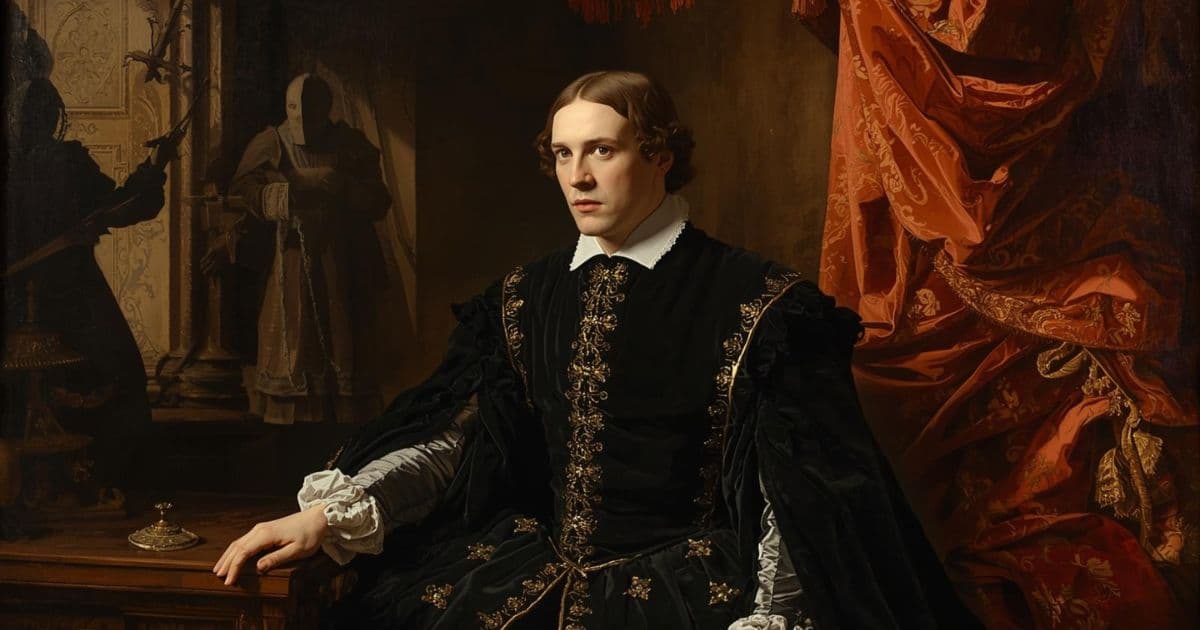
An excerpt from the original text.(complete · 3467 words)
Young Man Bent On A Career
Alyosha helped Father Zossima to his bedroom and seated him on his bed.
It was a little room furnished with the bare necessities. There was a
narrow iron bedstead, with a strip of felt for a mattress. In the
corner, under the ikons, was a reading‐desk with a cross and the Gospel
lying on it. The elder sank exhausted on the bed. His eyes glittered
and he breathed hard. He looked intently at Alyosha, as though
considering something.
“Go, my dear boy, go. Porfiry is enough for me. Make haste, you are
needed there, go and wait at the Father Superior’s table.”
“Let me stay here,” Alyosha entreated.
“You are more needed there. There is no peace there. You will wait, and
be of service. If evil spirits rise up, repeat a prayer. And remember,
my son”—the elder liked to call him that—“this is not the place for you
in the future. When it is God’s will to call me, leave the monastery.
Go away for good.”
Alyosha started.
“What is it? This is not your place for the time. I bless you for great
service in the world. Yours will be a long pilgrimage. And you will
have to take a wife, too. You will have to bear all before you come
back. There will be much to do. But I don’t doubt of you, and so I send
you forth. Christ is with you. Do not abandon Him and He will not
abandon you. You will see great sorrow, and in that sorrow you will be
happy. This is my last message to you: in sorrow seek happiness. Work,
work unceasingly. Remember my words, for although I shall talk with you
again, not only my days but my hours are numbered.”
Alyosha’s face again betrayed strong emotion. The corners of his mouth
quivered.
“What is it again?” Father Zossima asked, smiling gently. “The worldly
may follow the dead with tears, but here we rejoice over the father who
is departing. We rejoice and pray for him. Leave me, I must pray. Go,
and make haste. Be near your brothers. And not near one only, but near
both.”
Father Zossima raised his hand to bless him. Alyosha could make no
protest, though he had a great longing to remain. He longed, moreover,
to ask the significance of his bowing to Dmitri, the question was on
the tip of his tongue, but he dared not ask it. He knew that the elder
would have explained it unasked if he had thought fit. But evidently it
was not his will. That action had made a terrible impression on
Alyosha; he believed blindly in its mysterious significance.
Mysterious, and perhaps awful.
As he hastened out of the hermitage precincts to reach the monastery in
time to serve at the Father Superior’s dinner, he felt a sudden pang at
his heart, and stopped short. He seemed to hear again Father Zossima’s
words, foretelling his approaching end. What he had foretold so exactly
must infallibly come to pass. Alyosha believed that implicitly. But how
could he be left without him? How could he live without seeing and
hearing him? Where should he go? He had told him not to weep, and to
leave the monastery. Good God! It was long since Alyosha had known such
anguish. He hurried through the copse that divided the monastery from
the hermitage, and unable to bear the burden of his thoughts, he gazed
at the ancient pines beside the path. He had not far to go—about five
hundred paces. He expected to meet no one at that hour, but at the
first turn of the path he noticed Rakitin. He was waiting for some one.
“Are you waiting for me?” asked Alyosha, overtaking him.
“Yes,” grinned Rakitin. “You are hurrying to the Father Superior, I
know; he has a banquet. There’s not been such a banquet since the
Superior entertained the Bishop and General Pahatov, do you remember? I
shan’t be there, but you go and hand the sauces. Tell me one thing,
Alexey, what does that vision mean? That’s what I want to ask you.”
“What vision?”
“That bowing to your brother, Dmitri. And didn’t he tap the ground with
his forehead, too!”
“You speak of Father Zossima?”
“Yes, of Father Zossima.”
“Tapped the ground?”
“Ah, an irreverent expression! Well, what of it? Anyway, what does that
vision mean?”
“I don’t know what it means, Misha.”
“I knew he wouldn’t explain it to you! There’s nothing wonderful about
it, of course, only the usual holy mummery. But there was an object in
the performance. All the pious people in the town will talk about it
and spread the story through the province, wondering what it meant. To
my thinking the old man really has a keen nose; he sniffed a crime.
Your house stinks of it.”
“What crime?”
Rakitin evidently had something he was eager to speak of.
“It’ll be in your family, this crime. Between your brothers and your
rich old father. So Father Zossima flopped down to be ready for what
may turn up. If something happens later on, it’ll be: ‘Ah, the holy man
foresaw it, prophesied it!’ though it’s a poor sort of prophecy,
flopping like that. ‘Ah, but it was symbolic,’ they’ll say, ‘an
allegory,’ and the devil knows what all! It’ll be remembered to his
glory: ‘He predicted the crime and marked the criminal!’ That’s always
the way with these crazy fanatics; they cross themselves at the tavern
and throw stones at the temple. Like your elder, he takes a stick to a
just man and falls at the feet of a murderer.”
“What crime? What murderer? What do you mean?”
Alyosha stopped dead. Rakitin stopped, too.
“What murderer? As though you didn’t know! I’ll bet you’ve thought of
it before. That’s interesting, too, by the way. Listen, Alyosha, you
always speak the truth, though you’re always between two stools. Have
you thought of it or not? Answer.”
“I have,” answered Alyosha in a low voice. Even Rakitin was taken
aback.
“What? Have you really?” he cried.
“I ... I’ve not exactly thought it,” muttered Alyosha, “but directly
you began speaking so strangely, I fancied I had thought of it myself.”
“You see? (And how well you expressed it!) Looking at your father and
your brother Mitya to‐day you thought of a crime. Then I’m not
mistaken?”
“But wait, wait a minute,” Alyosha broke in uneasily. “What has led you
to see all this? Why does it interest you? That’s the first question.”
“Two questions, disconnected, but natural. I’ll deal with them
separately. What led me to see it? I shouldn’t have seen it, if I
hadn’t suddenly understood your brother Dmitri, seen right into the
very heart of him all at once. I caught the whole man from one trait.
These very honest but passionate people have a line which mustn’t be
crossed. If it were, he’d run at your father with a knife. But your
father’s a drunken and abandoned old sinner, who can never draw the
line—if they both let themselves go, they’ll both come to grief.”
“No, Misha, no. If that’s all, you’ve reassured me. It won’t come to
that.”
“But why are you trembling? Let me tell you; he may be honest, our
Mitya (he is stupid, but honest), but he’s—a sensualist. That’s the
very definition and inner essence of him. It’s your father has handed
him on his low sensuality. Do you know, I simply wonder at you,
Alyosha, how you can have kept your purity. You’re a Karamazov too, you
know! In your family sensuality is carried to a disease. But now, these
three sensualists are watching one another, with their knives in their
belts. The three of them are knocking their heads together, and you may
be the fourth.”
“You are mistaken about that woman. Dmitri—despises her,” said Alyosha,
with a sort of shudder.
“Grushenka? No, brother, he doesn’t despise her. Since he has openly
abandoned his betrothed for her, he doesn’t despise her. There’s
something here, my dear boy, that you don’t understand yet. A man will
fall in love with some beauty, with a woman’s body, or even with a part
of a woman’s body (a sensualist can understand that), and he’ll abandon
his own children for her, sell his father and mother, and his country,
Russia, too. If he’s honest, he’ll steal; if he’s humane, he’ll murder;
if he’s faithful, he’ll deceive. Pushkin, the poet of women’s feet,
sung of their feet in his verse. Others don’t sing their praises, but
they can’t look at their feet without a thrill—and it’s not only their
feet. Contempt’s no help here, brother, even if he did despise
Grushenka. He does, but he can’t tear himself away.”
“I understand that,” Alyosha jerked out suddenly.
“Really? Well, I dare say you do understand, since you blurt it out at
the first word,” said Rakitin, malignantly. “That escaped you unawares,
and the confession’s the more precious. So it’s a familiar subject;
you’ve thought about it already, about sensuality, I mean! Oh, you
virgin soul! You’re a quiet one, Alyosha, you’re a saint, I know, but
the devil only knows what you’ve thought about, and what you know
already! You are pure, but you’ve been down into the depths.... I’ve
been watching you a long time. You’re a Karamazov yourself; you’re a
thorough Karamazov—no doubt birth and selection have something to
answer for. You’re a sensualist from your father, a crazy saint from
your mother. Why do you tremble? Is it true, then? Do you know,
Grushenka has been begging me to bring you along. ‘I’ll pull off his
cassock,’ she says. You can’t think how she keeps begging me to bring
you. I wondered why she took such an interest in you. Do you know,
she’s an extraordinary woman, too!”
“Thank her and say I’m not coming,” said Alyosha, with a strained
smile. “Finish what you were saying, Misha. I’ll tell you my idea
after.”
“There’s nothing to finish. It’s all clear. It’s the same old tune,
brother. If even you are a sensualist at heart, what of your brother,
Ivan? He’s a Karamazov, too. What is at the root of all you Karamazovs
is that you’re all sensual, grasping and crazy! Your brother Ivan
writes theological articles in joke, for some idiotic, unknown motive
of his own, though he’s an atheist, and he admits it’s a fraud
himself—that’s your brother Ivan. He’s trying to get Mitya’s betrothed
for himself, and I fancy he’ll succeed, too. And what’s more, it’s with
Mitya’s consent. For Mitya will surrender his betrothed to him to be
rid of her, and escape to Grushenka. And he’s ready to do that in spite
of all his nobility and disinterestedness. Observe that. Those are the
most fatal people! Who the devil can make you out? He recognizes his
vileness and goes on with it! Let me tell you, too, the old man, your
father, is standing in Mitya’s way now. He has suddenly gone crazy over
Grushenka. His mouth waters at the sight of her. It’s simply on her
account he made that scene in the cell just now, simply because Miüsov
called her an ‘abandoned creature.’ He’s worse than a tom‐cat in love.
At first she was only employed by him in connection with his taverns
and in some other shady business, but now he has suddenly realized all
she is and has gone wild about her. He keeps pestering her with his
offers, not honorable ones, of course. And they’ll come into collision,
the precious father and son, on that path! But Grushenka favors neither
of them, she’s still playing with them, and teasing them both,
considering which she can get most out of. For though she could filch a
lot of money from the papa he wouldn’t marry her, and maybe he’ll turn
stingy in the end, and keep his purse shut. That’s where Mitya’s value
comes in; he has no money, but he’s ready to marry her. Yes, ready to
marry her! to abandon his betrothed, a rare beauty, Katerina Ivanovna,
who’s rich, and the daughter of a colonel, and to marry Grushenka, who
has been the mistress of a dissolute old merchant, Samsonov, a coarse,
uneducated, provincial mayor. Some murderous conflict may well come to
pass from all this, and that’s what your brother Ivan is waiting for.
It would suit him down to the ground. He’ll carry off Katerina
Ivanovna, for whom he is languishing, and pocket her dowry of sixty
thousand. That’s very alluring to start with, for a man of no
consequence and a beggar. And, take note, he won’t be wronging Mitya,
but doing him the greatest service. For I know as a fact that Mitya
only last week, when he was with some gypsy girls drunk in a tavern,
cried out aloud that he was unworthy of his betrothed, Katya, but that
his brother Ivan, he was the man who deserved her. And Katerina
Ivanovna will not in the end refuse such a fascinating man as Ivan.
She’s hesitating between the two of them already. And how has that Ivan
won you all, so that you all worship him? He is laughing at you, and
enjoying himself at your expense.”
“How do you know? How can you speak so confidently?” Alyosha asked
sharply, frowning.
“Why do you ask, and are frightened at my answer? It shows that you
know I’m speaking the truth.”
“You don’t like Ivan. Ivan wouldn’t be tempted by money.”
“Really? And the beauty of Katerina Ivanovna? It’s not only the money,
though a fortune of sixty thousand is an attraction.”
“Ivan is above that. He wouldn’t make up to any one for thousands. It
is not money, it’s not comfort Ivan is seeking. Perhaps it’s suffering
he is seeking.”
“What wild dream now? Oh, you—aristocrats!”
“Ah, Misha, he has a stormy spirit. His mind is in bondage. He is
haunted by a great, unsolved doubt. He is one of those who don’t want
millions, but an answer to their questions.”
“That’s plagiarism, Alyosha. You’re quoting your elder’s phrases. Ah,
Ivan has set you a problem!” cried Rakitin, with undisguised malice.
His face changed, and his lips twitched. “And the problem’s a stupid
one. It is no good guessing it. Rack your brains—you’ll understand it.
His article is absurd and ridiculous. And did you hear his stupid
theory just now: if there’s no immortality of the soul, then there’s no
virtue, and everything is lawful. (And by the way, do you remember how
your brother Mitya cried out: ‘I will remember!’) An attractive theory
for scoundrels!—(I’m being abusive, that’s stupid.) Not for scoundrels,
but for pedantic poseurs, ‘haunted by profound, unsolved doubts.’
He’s showing off, and what it all comes to is, ‘on the one hand we
cannot but admit’ and ‘on the other it must be confessed!’ His whole
theory is a fraud! Humanity will find in itself the power to live for
virtue even without believing in immortality. It will find it in love
for freedom, for equality, for fraternity.”
Rakitin could hardly restrain himself in his heat, but, suddenly, as
though remembering something, he stopped short.
“Well, that’s enough,” he said, with a still more crooked smile. “Why
are you laughing? Do you think I’m a vulgar fool?”
“No, I never dreamed of thinking you a vulgar fool. You are clever but
... never mind, I was silly to smile. I understand your getting hot
about it, Misha. I guess from your warmth that you are not indifferent
to Katerina Ivanovna yourself; I’ve suspected that for a long time,
brother, that’s why you don’t like my brother Ivan. Are you jealous of
him?”
“And jealous of her money, too? Won’t you add that?”
“I’ll say nothing about money. I am not going to insult you.”
“I believe it, since you say so, but confound you, and your brother
Ivan with you. Don’t you understand that one might very well dislike
him, apart from Katerina Ivanovna. And why the devil should I like him?
He condescends to abuse me, you know. Why haven’t I a right to abuse
him?”
“I never heard of his saying anything about you, good or bad. He
doesn’t speak of you at all.”
“But I heard that the day before yesterday at Katerina Ivanovna’s he
was abusing me for all he was worth—you see what an interest he takes
in your humble servant. And which is the jealous one after that,
brother, I can’t say. He was so good as to express the opinion that, if
I don’t go in for the career of an archimandrite in the immediate
future and don’t become a monk, I shall be sure to go to Petersburg and
get on to some solid magazine as a reviewer, that I shall write for the
next ten years, and in the end become the owner of the magazine, and
bring it out on the liberal and atheistic side, with a socialistic
tinge, with a tiny gloss of socialism, but keeping a sharp look out all
the time, that is, keeping in with both sides and hoodwinking the
fools. According to your brother’s account, the tinge of socialism
won’t hinder me from laying by the proceeds and investing them under
the guidance of some Jew, till at the end of my career I build a great
house in Petersburg and move my publishing offices to it, and let out
the upper stories to lodgers. He has even chosen the place for it, near
the new stone bridge across the Neva, which they say is to be built in
Petersburg.”
“Ah, Misha, that’s just what will really happen, every word of it,”
cried Alyosha, unable to restrain a good‐humored smile.
“You are pleased to be sarcastic, too, Alexey Fyodorovitch.”
“No, no, I’m joking, forgive me. I’ve something quite different in my
mind. But, excuse me, who can have told you all this? You can’t have
been at Katerina Ivanovna’s yourself when he was talking about you?”
“I wasn’t there, but Dmitri Fyodorovitch was; and I heard him tell it
with my own ears; if you want to know, he didn’t tell me, but I
overheard him, unintentionally, of course, for I was sitting in
Grushenka’s bedroom and I couldn’t go away because Dmitri Fyodorovitch
was in the next room.”
“Oh, yes, I’d forgotten she was a relation of yours.”
“A relation! That Grushenka a relation of mine!” cried Rakitin, turning
crimson. “Are you mad? You’re out of your mind!”
“Why, isn’t she a relation of yours? I heard so.”
“Where can you have heard it? You Karamazovs brag of being an ancient,
noble family, though your father used to run about playing the buffoon
at other men’s tables, and was only admitted to the kitchen as a favor.
I may be only a priest’s son, and dirt in the eyes of noblemen like
you, but don’t insult me so lightly and wantonly. I have a sense of
honor, too, Alexey Fyodorovitch, I couldn’t be a relation of Grushenka,
a common harlot. I beg you to understand that!”
Rakitin was intensely irritated.
“Forgive me, for goodness’ sake, I had no idea ... besides ... how can
you call her a harlot? Is she ... that sort of woman?” Alyosha flushed
suddenly. “I tell you again, I heard that she was a relation of yours.
You often go to see her, and you told me yourself you’re not her lover.
I never dreamed that you of all people had such contempt for her! Does
she really deserve it?”
“I may have reasons of my own for visiting her. That’s not your
business. But as for relationship, your brother, or even your father,
is more likely to make her yours than mine. Well, here we are. You’d
better go to the kitchen. Hullo! what’s wrong, what is it? Are we late?
They can’t have finished dinner so soon! Have the Karamazovs been
making trouble again? No doubt they have. Here’s your father and your
brother Ivan after him. They’ve broken out from the Father Superior’s.
And look, Father Isidor’s shouting out something after them from the
steps. And your father’s shouting and waving his arms. I expect he’s
swearing. Bah, and there goes Miüsov driving away in his carriage. You
see, he’s going. And there’s old Maximov running!—there must have been
a row. There can’t have been any dinner. Surely they’ve not been
beating the Father Superior! Or have they, perhaps, been beaten? It
would serve them right!”
There was reason for Rakitin’s exclamations. There had been a
scandalous, an unprecedented scene. It had all come from the impulse of
a moment.
Master this chapter. Complete your experience
Purchase the complete book to access all chapters and support classic literature
As an Amazon Associate, we earn a small commission from qualifying purchases at no additional cost to you.
Available in paperback, hardcover, and e-book formats
Let's Analyse the Pattern
Growth requires leaving protective environments before you feel ready, guided by those who see your potential better than you do.
Why This Matters
Connect literature to life
This chapter teaches how to distinguish between harmful rejection and necessary challenge from people who care about your growth.
Practice This Today
This week, notice when someone you trust pushes you toward something that scares you—ask yourself if they're seeing growth potential you can't.
Now let's explore the literary elements.
Key Quotes & Analysis
"This is not your place for the time. I bless you for great service in the world. Yours will be a long pilgrimage."
Context: Zossima tells Alyosha to leave the monastery permanently
The elder recognizes that real spiritual growth requires engagement with the messy world, not escape from it. He's preparing Alyosha for a harder but more meaningful path than monastery life.
In Today's Words:
You can't help people if you don't understand their struggles. Go live in the real world first.
"You will have to take a wife, too. You will have to bear all before you come back."
Context: Shocking advice to the monk-in-training
Zossima understands that Alyosha needs to experience human love, responsibility, and suffering to become truly wise. Spiritual development requires full human experience, not denial of it.
In Today's Words:
You need to fall in love, get your heart broken, and deal with real responsibility before you'll understand what life is about.
"There's going to be a tragedy in your family - your father and your brother Dmitri will be at each other's throats over that creature."
Context: Warning Alyosha about the brewing conflict
Rakitin sees what Alyosha's innocence blinds him to - that the family's shared weaknesses are creating a dangerous situation. His cynicism gives him clearer vision than Alyosha's faith.
In Today's Words:
Your dad and brother are going to destroy each other fighting over the same woman, and you're too naive to see it coming.
Thematic Threads
Mentorship
In This Chapter
Zossima prepares Alyosha by sending him away, knowing true teaching means eventual separation
Development
Evolved from earlier protective guidance to active preparation for independence
In Your Life:
The best mentors eventually make themselves unnecessary by pushing you toward challenges they won't be there to help with.
Family Cycles
In This Chapter
Rakitin predicts violence because all Karamazov men share the same passionate, destructive patterns around desire
Development
Building on established family dysfunction, now showing how patterns repeat across generations
In Your Life:
You might find yourself repeating your family's relationship mistakes until you consciously choose different responses.
Innocence vs Experience
In This Chapter
Alyosha's spiritual purity becomes a liability when faced with raw human nature and family politics
Development
Introduced here as Alyosha transitions from protected student to active participant
In Your Life:
Your good intentions and pure motives won't protect you from people who operate by different rules.
Competing Desires
In This Chapter
Three Karamazov men want the same woman for different reasons, creating inevitable conflict
Development
Introduced here as the central tension that will drive family destruction
In Your Life:
When multiple people want the same limited resource, the competition reveals everyone's true character.
Social Observation
In This Chapter
Rakitin serves as cynical analyst, seeing patterns and predicting outcomes that innocent Alyosha misses
Development
Introduced here as counterpoint to Alyosha's spiritual perspective
In Your Life:
Sometimes the people who seem most cynical are actually the most realistic about human nature.
You now have the context. Time to form your own thoughts.
Discussion Questions
- 1
Why does Father Zossima tell Alyosha to leave the monastery and enter the world, even marry? What does this reveal about how he sees Alyosha's future?
analysis • surface - 2
Rakitin predicts violence between Dmitri and his father over Grushenka. What family patterns does he identify that make this conflict almost inevitable?
analysis • medium - 3
Think about someone who pushed you out of your comfort zone when you didn't feel ready. How did that experience change you, and do you see the wisdom in their timing now?
application • medium - 4
Alyosha is caught between his spiritual calling and messy family realities. When you face competing loyalties or values, how do you decide which takes priority?
application • deep - 5
What does this chapter suggest about the difference between being protected and being prepared? How do we know when safety becomes a prison?
reflection • deep
Critical Thinking Exercise
Map Your Safety Zones
List three areas where you feel completely safe and comfortable—your job routine, social circle, daily habits, whatever feels most secure. For each one, identify what growth opportunity might exist just outside that comfort zone. Then honestly assess: is this safety serving your growth, or has it become a limitation?
Consider:
- •Safety zones aren't inherently bad—they provide necessary stability and recovery space
- •The question is whether you're choosing safety or defaulting to it out of fear
- •Sometimes the people who love us most can see our potential better than we can
Journaling Prompt
Write about a time when someone you trusted pushed you toward something that scared you. What did they see that you couldn't see at the time? How did that experience shape who you became?
Coming Up Next...
Chapter 13: The Scandalous Scene
The family dinner at the monastery erupts into chaos as the Karamazov men's simmering tensions finally explode in public. What started as a formal religious gathering becomes an unprecedented scandal that will echo through the entire community.