An excerpt from the original text.(complete · 3932 words)
hy Is Such A Man Alive?
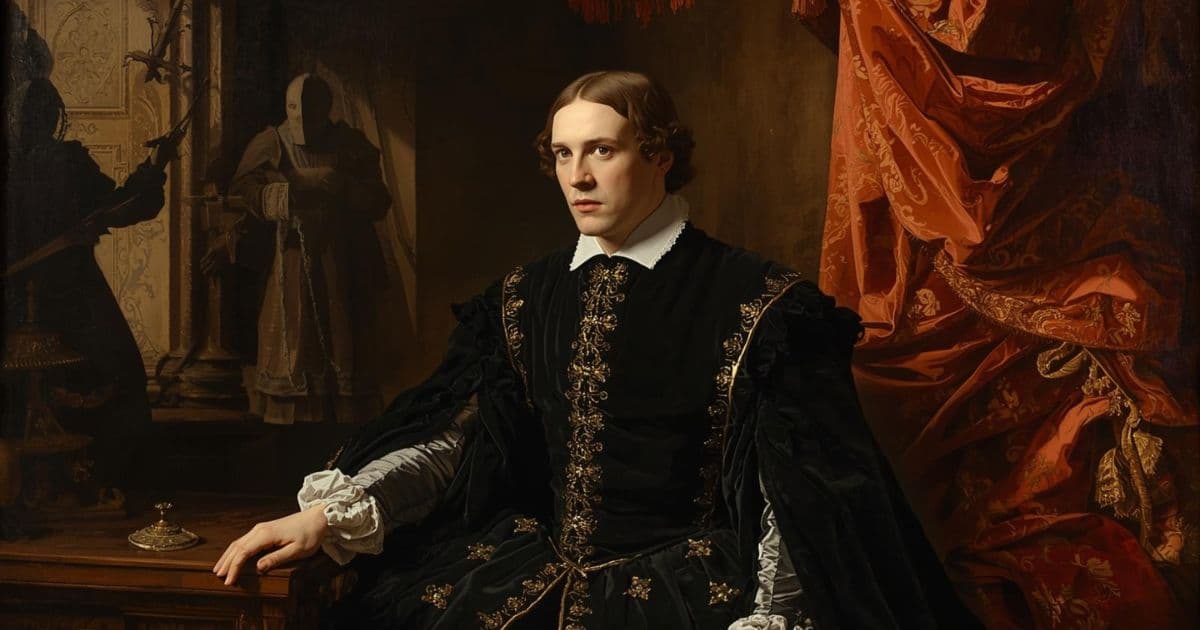
Dmitri Fyodorovitch, a young man of eight and twenty, of medium height
and agreeable countenance, looked older than his years. He was
muscular, and showed signs of considerable physical strength. Yet there
was something not healthy in his face. It was rather thin, his cheeks
were hollow, and there was an unhealthy sallowness in their color. His
rather large, prominent, dark eyes had an expression of firm
determination, and yet there was a vague look in them, too. Even when
he was excited and talking irritably, his eyes somehow did not follow
his mood, but betrayed something else, sometimes quite incongruous with
what was passing. “It’s hard to tell what he’s thinking,” those who
talked to him sometimes declared. People who saw something pensive and
sullen in his eyes were startled by his sudden laugh, which bore
witness to mirthful and light‐ hearted thoughts at the very time when
his eyes were so gloomy. A certain strained look in his face was easy
to understand at this moment. Every one knew, or had heard of, the
extremely restless and dissipated life which he had been leading of
late, as well as of the violent anger to which he had been roused in
his quarrels with his father. There were several stories current in the
town about it. It is true that he was irascible by nature, “of an
unstable and unbalanced mind,” as our justice of the peace,
Katchalnikov, happily described him.
He was stylishly and irreproachably dressed in a carefully buttoned
frock‐ coat. He wore black gloves and carried a top‐hat. Having only
lately left the army, he still had mustaches and no beard. His dark
brown hair was cropped short, and combed forward on his temples. He had
the long, determined stride of a military man. He stood still for a
moment on the threshold, and glancing at the whole party went straight
up to the elder, guessing him to be their host. He made him a low bow,
and asked his blessing. Father Zossima, rising in his chair, blessed
him. Dmitri kissed his hand respectfully, and with intense feeling,
almost anger, he said:
“Be so generous as to forgive me for having kept you waiting so long,
but Smerdyakov, the valet sent me by my father, in reply to my
inquiries, told me twice over that the appointment was for one. Now I
suddenly learn—”
“Don’t disturb yourself,” interposed the elder. “No matter. You are a
little late. It’s of no consequence....”
“I’m extremely obliged to you, and expected no less from your
goodness.”
Saying this, Dmitri bowed once more. Then, turning suddenly towards his
father, made him, too, a similarly low and respectful bow. He had
evidently considered it beforehand, and made this bow in all
seriousness, thinking it his duty to show his respect and good
intentions.
Although Fyodor Pavlovitch was taken unawares, he was equal to the
occasion. In response to Dmitri’s bow he jumped up from his chair and
made his son a bow as low in return. His face was suddenly solemn and
impressive, which gave him a positively malignant look. Dmitri bowed
generally to all present, and without a word walked to the window with
his long, resolute stride, sat down on the only empty chair, near
Father Païssy, and, bending forward, prepared to listen to the
conversation he had interrupted.
Dmitri’s entrance had taken no more than two minutes, and the
conversation was resumed. But this time Miüsov thought it unnecessary
to reply to Father Païssy’s persistent and almost irritable question.
“Allow me to withdraw from this discussion,” he observed with a certain
well‐bred nonchalance. “It’s a subtle question, too. Here Ivan
Fyodorovitch is smiling at us. He must have something interesting to
say about that also. Ask him.”
“Nothing special, except one little remark,” Ivan replied at once.
“European Liberals in general, and even our liberal dilettanti, often
mix up the final results of socialism with those of Christianity. This
wild notion is, of course, a characteristic feature. But it’s not only
Liberals and dilettanti who mix up socialism and Christianity, but, in
many cases, it appears, the police—the foreign police, of course—do the
same. Your Paris anecdote is rather to the point, Pyotr
Alexandrovitch.”
“I ask your permission to drop this subject altogether,” Miüsov
repeated. “I will tell you instead, gentlemen, another interesting and
rather characteristic anecdote of Ivan Fyodorovitch himself. Only five
days ago, in a gathering here, principally of ladies, he solemnly
declared in argument that there was nothing in the whole world to make
men love their neighbors. That there was no law of nature that man
should love mankind, and that, if there had been any love on earth
hitherto, it was not owing to a natural law, but simply because men
have believed in immortality. Ivan Fyodorovitch added in parenthesis
that the whole natural law lies in that faith, and that if you were to
destroy in mankind the belief in immortality, not only love but every
living force maintaining the life of the world would at once be dried
up. Moreover, nothing then would be immoral, everything would be
lawful, even cannibalism. That’s not all. He ended by asserting that
for every individual, like ourselves, who does not believe in God or
immortality, the moral law of nature must immediately be changed into
the exact contrary of the former religious law, and that egoism, even
to crime, must become not only lawful but even recognized as the
inevitable, the most rational, even honorable outcome of his position.
From this paradox, gentlemen, you can judge of the rest of our
eccentric and paradoxical friend Ivan Fyodorovitch’s theories.”
“Excuse me,” Dmitri cried suddenly; “if I’ve heard aright, crime must
not only be permitted but even recognized as the inevitable and the
most rational outcome of his position for every infidel! Is that so or
not?”
“Quite so,” said Father Païssy.
“I’ll remember it.”
Having uttered these words Dmitri ceased speaking as suddenly as he had
begun. Every one looked at him with curiosity.
“Is that really your conviction as to the consequences of the
disappearance of the faith in immortality?” the elder asked Ivan
suddenly.
“Yes. That was my contention. There is no virtue if there is no
immortality.”
“You are blessed in believing that, or else most unhappy.”
“Why unhappy?” Ivan asked smiling.
“Because, in all probability you don’t believe yourself in the
immortality of your soul, nor in what you have written yourself in your
article on Church jurisdiction.”
“Perhaps you are right! ... But I wasn’t altogether joking,” Ivan
suddenly and strangely confessed, flushing quickly.
“You were not altogether joking. That’s true. The question is still
fretting your heart, and not answered. But the martyr likes sometimes
to divert himself with his despair, as it were driven to it by despair
itself. Meanwhile, in your despair, you, too, divert yourself with
magazine articles, and discussions in society, though you don’t believe
your own arguments, and with an aching heart mock at them inwardly....
That question you have not answered, and it is your great grief, for it
clamors for an answer.”
“But can it be answered by me? Answered in the affirmative?” Ivan went
on asking strangely, still looking at the elder with the same
inexplicable smile.
“If it can’t be decided in the affirmative, it will never be decided in
the negative. You know that that is the peculiarity of your heart, and
all its suffering is due to it. But thank the Creator who has given you
a lofty heart capable of such suffering; of thinking and seeking higher
things, for our dwelling is in the heavens. God grant that your heart
will attain the answer on earth, and may God bless your path.”
The elder raised his hand and would have made the sign of the cross
over Ivan from where he stood. But the latter rose from his seat, went
up to him, received his blessing, and kissing his hand went back to his
place in silence. His face looked firm and earnest. This action and all
the preceding conversation, which was so surprising from Ivan,
impressed every one by its strangeness and a certain solemnity, so that
all were silent for a moment, and there was a look almost of
apprehension in Alyosha’s face. But Miüsov suddenly shrugged his
shoulders. And at the same moment Fyodor Pavlovitch jumped up from his
seat.
“Most pious and holy elder,” he cried, pointing to Ivan, “that is my
son, flesh of my flesh, the dearest of my flesh! He is my most dutiful
Karl Moor, so to speak, while this son who has just come in, Dmitri,
against whom I am seeking justice from you, is the undutiful Franz
Moor—they are both out of Schiller’s Robbers, and so I am the
reigning Count von Moor! Judge and save us! We need not only your
prayers but your prophecies!”
“Speak without buffoonery, and don’t begin by insulting the members of
your family,” answered the elder, in a faint, exhausted voice. He was
obviously getting more and more fatigued, and his strength was failing.
“An unseemly farce which I foresaw when I came here!” cried Dmitri
indignantly. He too leapt up. “Forgive it, reverend Father,” he added,
addressing the elder. “I am not a cultivated man, and I don’t even know
how to address you properly, but you have been deceived and you have
been too good‐natured in letting us meet here. All my father wants is a
scandal. Why he wants it only he can tell. He always has some motive.
But I believe I know why—”
“They all blame me, all of them!” cried Fyodor Pavlovitch in his turn.
“Pyotr Alexandrovitch here blames me too. You have been blaming me,
Pyotr Alexandrovitch, you have!” he turned suddenly to Miüsov, although
the latter was not dreaming of interrupting him. “They all accuse me of
having hidden the children’s money in my boots, and cheated them, but
isn’t there a court of law? There they will reckon out for you, Dmitri
Fyodorovitch, from your notes, your letters, and your agreements, how
much money you had, how much you have spent, and how much you have
left. Why does Pyotr Alexandrovitch refuse to pass judgment? Dmitri is
not a stranger to him. Because they are all against me, while Dmitri
Fyodorovitch is in debt to me, and not a little, but some thousands of
which I have documentary proof. The whole town is echoing with his
debaucheries. And where he was stationed before, he several times spent
a thousand or two for the seduction of some respectable girl; we know
all about that, Dmitri Fyodorovitch, in its most secret details. I’ll
prove it.... Would you believe it, holy Father, he has captivated the
heart of the most honorable of young ladies of good family and fortune,
daughter of a gallant colonel, formerly his superior officer, who had
received many honors and had the Anna Order on his breast. He
compromised the girl by his promise of marriage, now she is an orphan
and here; she is betrothed to him, yet before her very eyes he is
dancing attendance on a certain enchantress. And although this
enchantress has lived in, so to speak, civil marriage with a
respectable man, yet she is of an independent character, an
unapproachable fortress for everybody, just like a legal wife—for she
is virtuous, yes, holy Fathers, she is virtuous. Dmitri Fyodorovitch
wants to open this fortress with a golden key, and that’s why he is
insolent to me now, trying to get money from me, though he has wasted
thousands on this enchantress already. He’s continually borrowing money
for the purpose. From whom do you think? Shall I say, Mitya?”
“Be silent!” cried Dmitri, “wait till I’m gone. Don’t dare in my
presence to asperse the good name of an honorable girl! That you should
utter a word about her is an outrage, and I won’t permit it!”
He was breathless.
“Mitya! Mitya!” cried Fyodor Pavlovitch hysterically, squeezing out a
tear. “And is your father’s blessing nothing to you? If I curse you,
what then?”
“Shameless hypocrite!” exclaimed Dmitri furiously.
“He says that to his father! his father! What would he be with others?
Gentlemen, only fancy; there’s a poor but honorable man living here,
burdened with a numerous family, a captain who got into trouble and was
discharged from the army, but not publicly, not by court‐martial, with
no slur on his honor. And three weeks ago, Dmitri seized him by the
beard in a tavern, dragged him out into the street and beat him
publicly, and all because he is an agent in a little business of mine.”
“It’s all a lie! Outwardly it’s the truth, but inwardly a lie!” Dmitri
was trembling with rage. “Father, I don’t justify my action. Yes, I
confess it publicly, I behaved like a brute to that captain, and I
regret it now, and I’m disgusted with myself for my brutal rage. But
this captain, this agent of yours, went to that lady whom you call an
enchantress, and suggested to her from you, that she should take
I.O.U.’s of mine which were in your possession, and should sue me for
the money so as to get me into prison by means of them, if I persisted
in claiming an account from you of my property. Now you reproach me for
having a weakness for that lady when you yourself incited her to
captivate me! She told me so to my face.... She told me the story and
laughed at you.... You wanted to put me in prison because you are
jealous of me with her, because you’d begun to force your attentions
upon her; and I know all about that, too; she laughed at you for that
as well—you hear—she laughed at you as she described it. So here you
have this man, this father who reproaches his profligate son!
Gentlemen, forgive my anger, but I foresaw that this crafty old man
would only bring you together to create a scandal. I had come to
forgive him if he held out his hand; to forgive him, and ask
forgiveness! But as he has just this minute insulted not only me, but
an honorable young lady, for whom I feel such reverence that I dare not
take her name in vain, I have made up my mind to show up his game,
though he is my father....”
He could not go on. His eyes were glittering and he breathed with
difficulty. But every one in the cell was stirred. All except Father
Zossima got up from their seats uneasily. The monks looked austere but
waited for guidance from the elder. He sat still, pale, not from
excitement but from the weakness of disease. An imploring smile lighted
up his face; from time to time he raised his hand, as though to check
the storm, and, of course, a gesture from him would have been enough to
end the scene; but he seemed to be waiting for something and watched
them intently as though trying to make out something which was not
perfectly clear to him. At last Miüsov felt completely humiliated and
disgraced.
“We are all to blame for this scandalous scene,” he said hotly. “But I
did not foresee it when I came, though I knew with whom I had to deal.
This must be stopped at once! Believe me, your reverence, I had no
precise knowledge of the details that have just come to light, I was
unwilling to believe them, and I learn for the first time.... A father
is jealous of his son’s relations with a woman of loose behavior and
intrigues with the creature to get his son into prison! This is the
company in which I have been forced to be present! I was deceived. I
declare to you all that I was as much deceived as any one.”
“Dmitri Fyodorovitch,” yelled Fyodor Pavlovitch suddenly, in an
unnatural voice, “if you were not my son I would challenge you this
instant to a duel ... with pistols, at three paces ... across a
handkerchief,” he ended, stamping with both feet.
With old liars who have been acting all their lives there are moments
when they enter so completely into their part that they tremble or shed
tears of emotion in earnest, although at that very moment, or a second
later, they are able to whisper to themselves, “You know you are lying,
you shameless old sinner! You’re acting now, in spite of your ‘holy’
wrath.”
Dmitri frowned painfully, and looked with unutterable contempt at his
father.
“I thought ... I thought,” he said, in a soft and, as it were,
controlled voice, “that I was coming to my native place with the angel
of my heart, my betrothed, to cherish his old age, and I find nothing
but a depraved profligate, a despicable clown!”
“A duel!” yelled the old wretch again, breathless and spluttering at
each syllable. “And you, Pyotr Alexandrovitch Miüsov, let me tell you
that there has never been in all your family a loftier, and more
honest—you hear—more honest woman than this ‘creature,’ as you have
dared to call her! And you, Dmitri Fyodorovitch, have abandoned your
betrothed for that ‘creature,’ so you must yourself have thought that
your betrothed couldn’t hold a candle to her. That’s the woman called a
‘creature’!”
“Shameful!” broke from Father Iosif.
“Shameful and disgraceful!” Kalganov, flushing crimson, cried in a
boyish voice, trembling with emotion. He had been silent till that
moment.
“Why is such a man alive?” Dmitri, beside himself with rage, growled in
a hollow voice, hunching up his shoulders till he looked almost
deformed. “Tell me, can he be allowed to go on defiling the earth?” He
looked round at every one and pointed at the old man. He spoke evenly
and deliberately.
“Listen, listen, monks, to the parricide!” cried Fyodor Pavlovitch,
rushing up to Father Iosif. “That’s the answer to your ‘shameful!’ What
is shameful? That ‘creature,’ that ‘woman of loose behavior’ is perhaps
holier than you are yourselves, you monks who are seeking salvation!
She fell perhaps in her youth, ruined by her environment. But she loved
much, and Christ himself forgave the woman ‘who loved much.’ ”
“It was not for such love Christ forgave her,” broke impatiently from
the gentle Father Iosif.
“Yes, it was for such, monks, it was! You save your souls here, eating
cabbage, and think you are the righteous. You eat a gudgeon a day, and
you think you bribe God with gudgeon.”
“This is unendurable!” was heard on all sides in the cell.
But this unseemly scene was cut short in a most unexpected way. Father
Zossima rose suddenly from his seat. Almost distracted with anxiety for
the elder and every one else, Alyosha succeeded, however, in supporting
him by the arm. Father Zossima moved towards Dmitri and reaching him
sank on his knees before him. Alyosha thought that he had fallen from
weakness, but this was not so. The elder distinctly and deliberately
bowed down at Dmitri’s feet till his forehead touched the floor.
Alyosha was so astounded that he failed to assist him when he got up
again. There was a faint smile on his lips.
“Good‐by! Forgive me, all of you!” he said, bowing on all sides to his
guests.
Dmitri stood for a few moments in amazement. Bowing down to him—what
did it mean? Suddenly he cried aloud, “Oh, God!” hid his face in his
hands, and rushed out of the room. All the guests flocked out after
him, in their confusion not saying good‐by, or bowing to their host.
Only the monks went up to him again for a blessing.
“What did it mean, falling at his feet like that? Was it symbolic or
what?” said Fyodor Pavlovitch, suddenly quieted and trying to reopen
conversation without venturing to address anybody in particular. They
were all passing out of the precincts of the hermitage at the moment.
“I can’t answer for a madhouse and for madmen,” Miüsov answered at once
ill‐humoredly, “but I will spare myself your company, Fyodor
Pavlovitch, and, trust me, for ever. Where’s that monk?”
“That monk,” that is, the monk who had invited them to dine with the
Superior, did not keep them waiting. He met them as soon as they came
down the steps from the elder’s cell, as though he had been waiting for
them all the time.
“Reverend Father, kindly do me a favor. Convey my deepest respect to
the Father Superior, apologize for me, personally, Miüsov, to his
reverence, telling him that I deeply regret that owing to unforeseen
circumstances I am unable to have the honor of being present at his
table, greatly as I should desire to do so,” Miüsov said irritably to
the monk.
“And that unforeseen circumstance, of course, is myself,” Fyodor
Pavlovitch cut in immediately. “Do you hear, Father; this gentleman
doesn’t want to remain in my company or else he’d come at once. And you
shall go, Pyotr Alexandrovitch, pray go to the Father Superior and good
appetite to you. I will decline, and not you. Home, home, I’ll eat at
home, I don’t feel equal to it here, Pyotr Alexandrovitch, my amiable
relative.”
“I am not your relative and never have been, you contemptible man!”
“I said it on purpose to madden you, because you always disclaim the
relationship, though you really are a relation in spite of your
shuffling. I’ll prove it by the church calendar. As for you, Ivan, stay
if you like. I’ll send the horses for you later. Propriety requires you
to go to the Father Superior, Pyotr Alexandrovitch, to apologize for
the disturbance we’ve been making....”
“Is it true that you are going home? Aren’t you lying?”
“Pyotr Alexandrovitch! How could I dare after what’s happened! Forgive
me, gentlemen, I was carried away! And upset besides! And, indeed, I am
ashamed. Gentlemen, one man has the heart of Alexander of Macedon and
another the heart of the little dog Fido. Mine is that of the little
dog Fido. I am ashamed! After such an escapade how can I go to dinner,
to gobble up the monastery’s sauces? I am ashamed, I can’t. You must
excuse me!”
“The devil only knows, what if he deceives us?” thought Miüsov, still
hesitating, and watching the retreating buffoon with distrustful eyes.
The latter turned round, and noticing that Miüsov was watching him,
waved him a kiss.
“Well, are you coming to the Superior?” Miüsov asked Ivan abruptly.
“Why not? I was especially invited yesterday.”
“Unfortunately I feel myself compelled to go to this confounded
dinner,” said Miüsov with the same irritability, regardless of the fact
that the monk was listening. “We ought, at least, to apologize for the
disturbance, and explain that it was not our doing. What do you think?”
“Yes, we must explain that it wasn’t our doing. Besides, father won’t
be there,” observed Ivan.
“Well, I should hope not! Confound this dinner!”
They all walked on, however. The monk listened in silence. On the road
through the copse he made one observation however—that the Father
Superior had been waiting a long time, and that they were more than
half an hour late. He received no answer. Miüsov looked with hatred at
Ivan.
“Here he is, going to the dinner as though nothing had happened,” he
thought. “A brazen face, and the conscience of a Karamazov!”
Master this chapter. Complete your experience
Purchase the complete book to access all chapters and support classic literature
As an Amazon Associate, we earn a small commission from qualifying purchases at no additional cost to you.
Available in paperback, hardcover, and e-book formats
Let's Analyse the Pattern
Creating conflict to justify your own harmful behavior by making your target look unstable.
Why This Matters
Connect literature to life
This chapter teaches how to recognize when someone provokes you deliberately, then uses your reaction as evidence against you.
Practice This Today
This week, notice when someone's 'concern' consistently leaves you feeling worse about yourself - that's often manipulation disguised as care.
Now let's explore the literary elements.
Key Quotes & Analysis
"Why is such a man alive?"
Context: Dmitri's anguished question about his father after being publicly humiliated
This reveals Dmitri's deep pain and desperation. He's not just angry - he's genuinely questioning why someone who causes so much damage continues to exist. It shows how abuse can push someone to dark thoughts.
In Today's Words:
Why do toxic people get to keep hurting everyone around them?
"He was irascible by nature, of an unstable and unbalanced mind"
Context: How the townspeople describe Dmitri's reputation
This shows how reactive abuse works - Dmitri gets labeled as the unstable one when he's actually responding to his father's manipulation. The real problem gets ignored while the victim gets pathologized.
In Today's Words:
Everyone thinks he's the crazy one with anger issues
"His eyes somehow did not follow his mood, but betrayed something else"
Context: Describing Dmitri's complex emotional state
This captures how trauma affects someone - their surface emotions don't match their deeper pain. Dmitri appears angry but his eyes show hurt and confusion underneath.
In Today's Words:
You could tell there was more going on with him than just anger
Thematic Threads
Manipulation
In This Chapter
Fyodor deliberately provokes Dmitri then plays the wounded father when his son reacts angrily
Development
Introduced here as a family dynamic that will define their relationship
In Your Life:
You might see this in relationships where someone pushes your buttons then blames you for getting upset
Recognition
In This Chapter
Elder Zossima bows to Dmitri, seeing something others miss about his true nature versus his reactions
Development
Introduced here as spiritual insight that cuts through surface behavior
In Your Life:
You might experience this when someone sees your potential despite your mistakes or defensive reactions
Public Shame
In This Chapter
Family conflicts played out as public theater, with Fyodor deliberately humiliating his son before an audience
Development
Introduced here as a tool of control and dominance
In Your Life:
You might face this when someone criticizes or embarrasses you in front of others to gain power over you
Identity
In This Chapter
Dmitri struggles with who he really is versus how others define him based on his worst moments
Development
Deepening from earlier hints about his complexity and self-doubt
In Your Life:
You might struggle with this when your reputation doesn't match who you know yourself to be inside
Justice
In This Chapter
Dmitri questions why someone like his father should exist, grappling with cosmic unfairness
Development
Introduced here as a philosophical challenge to moral order
In Your Life:
You might feel this when dealing with people who seem to cause only harm yet face no consequences
You now have the context. Time to form your own thoughts.
Discussion Questions
- 1
What specific tactics does Fyodor use to provoke Dmitri, and how does he shift into victim mode when Dmitri reacts?
analysis • surface - 2
Why does Fyodor choose a public setting like the monastery for this confrontation rather than handling family business privately?
analysis • medium - 3
Where have you seen this pattern of 'provoke then play victim' in your workplace, family, or community?
application • medium - 4
If you were Dmitri's friend, what advice would you give him about dealing with his father's manipulation tactics?
application • deep - 5
What do you think the elder Zossima saw in Dmitri that made him bow down, and what does this teach us about seeing past someone's reactions to their circumstances?
reflection • deep
Critical Thinking Exercise
Decode the Manipulation Playbook
Think of someone in your life who uses the 'provoke then play victim' pattern. Write down their specific tactics: what buttons do they push, how do they create drama, and how do they make themselves look innocent afterward? Then identify the warning signs that help you recognize when they're starting this cycle.
Consider:
- •Focus on patterns of behavior, not just individual incidents
- •Notice how they time these confrontations - public settings, family gatherings, stressful moments
- •Pay attention to how they tell the story afterward to others
Journaling Prompt
Write about a time when you refused to take someone's bait. What happened when you stayed calm instead of reacting? How did it change the dynamic between you?
Coming Up Next...
Chapter 12: The Mentor's Final Blessing
As the family scatters after the monastery scandal, we meet a young man with ambitious plans who will play a crucial role in the Karamazov family drama. His calculating nature and career aspirations will soon intersect with the brothers' lives in unexpected ways.