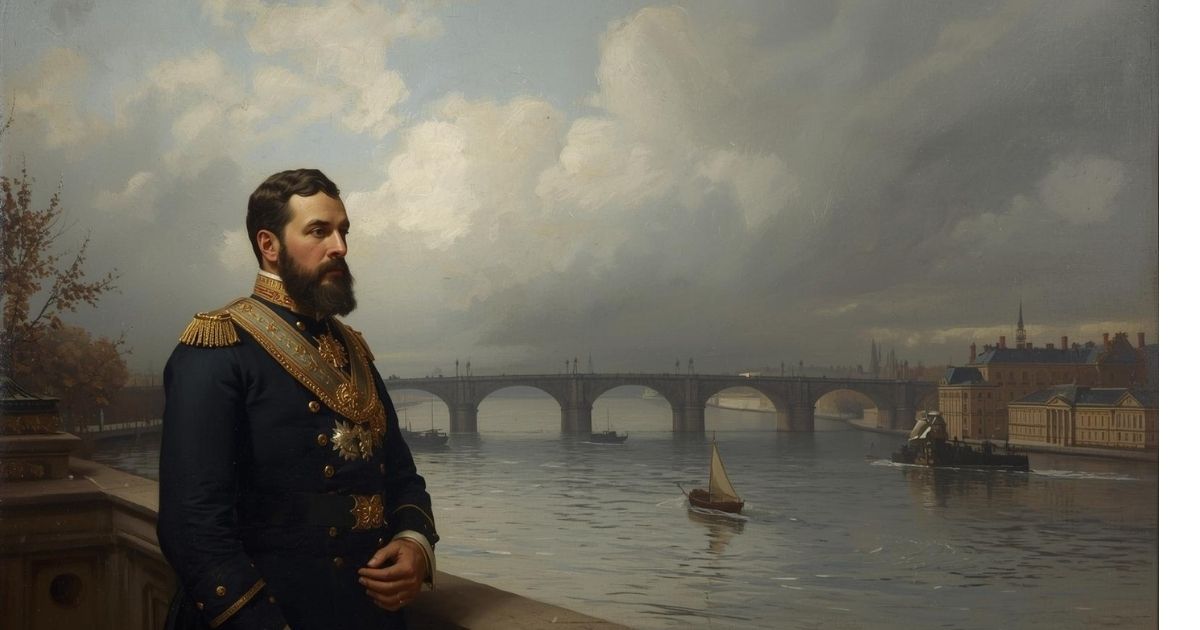
An excerpt from the original text.(complete · 5408 words)
he prince did not die before his wedding—either by day or night, as he
had foretold that he might. Very probably he passed disturbed nights,
and was afflicted with bad dreams; but, during the daytime, among his
fellow-men, he seemed as kind as ever, and even contented; only a
little thoughtful when alone.
The wedding was hurried on. The day was fixed for exactly a week after
Evgenie’s visit to the prince. In the face of such haste as this, even
the prince’s best friends (if he had had any) would have felt the
hopelessness of any attempt to save “the poor madman.” Rumour said that
in the visit of Evgenie Pavlovitch was to be discerned the influence of
Lizabetha Prokofievna and her husband... But if those good souls, in
the boundless kindness of their hearts, were desirous of saving the
eccentric young fellow from ruin, they were unable to take any stronger
measures to attain that end. Neither their position, nor their private
inclination, perhaps (and only naturally), would allow them to use any
more pronounced means.
We have observed before that even some of the prince’s nearest
neighbours had begun to oppose him. Vera Lebedeff’s passive
disagreement was limited to the shedding of a few solitary tears; to
more frequent sitting alone at home, and to a diminished frequency in
her visits to the prince’s apartments.
Colia was occupied with his father at this time. The old man died
during a second stroke, which took place just eight days after the
first. The prince showed great sympathy in the grief of the family, and
during the first days of their mourning he was at the house a great
deal with Nina Alexandrovna. He went to the funeral, and it was
observable that the public assembled in church greeted his arrival and
departure with whisperings, and watched him closely.
The same thing happened in the park and in the street, wherever he
went. He was pointed out when he drove by, and he often overheard the
name of Nastasia Philipovna coupled with his own as he passed. People
looked out for her at the funeral, too, but she was not there; and
another conspicuous absentee was the captain’s widow, whom Lebedeff had
prevented from coming.
The funeral service produced a great effect on the prince. He whispered
to Lebedeff that this was the first time he had ever heard a Russian
funeral service since he was a little boy. Observing that he was
looking about him uneasily, Lebedeff asked him whom he was seeking.
“Nothing. I only thought I—”
“Is it Rogojin?”
“Why—is he here?”
“Yes, he’s in church.”
“I thought I caught sight of his eyes!” muttered the prince, in
confusion. “But what of it!—Why is he here? Was he asked?”
“Oh, dear, no! Why, they don’t even know him! Anyone can come in, you
know. Why do you look so amazed? I often meet him; I’ve seen him at
least four times, here at Pavlofsk, within the last week.”
“I haven’t seen him once—since that day!” the prince murmured.
As Nastasia Philipovna had not said a word about having met Rogojin
since “that day,” the prince concluded that the latter had his own
reasons for wishing to keep out of sight. All the day of the funeral
our hero was in a deeply thoughtful state, while Nastasia Philipovna
was particularly merry, both in the daytime and in the evening.
Colia had made it up with the prince before his father’s death, and it
was he who urged him to make use of Keller and Burdovsky, promising to
answer himself for the former’s behaviour. Nina Alexandrovna and
Lebedeff tried to persuade him to have the wedding in St. Petersburg,
instead of in the public fashion contemplated, down here at Pavlofsk in
the height of the season. But the prince only said that Nastasia
Philipovna desired to have it so, though he saw well enough what
prompted their arguments.
The next day Keller came to visit the prince. He was in a high state of
delight with the post of honour assigned to him at the wedding.
Before entering he stopped on the threshold, raised his hand as if
making a solemn vow, and cried:
“I won’t drink!”
Then he went up to the prince, seized both his hands, shook them
warmly, and declared that he had at first felt hostile towards the
project of this marriage, and had openly said so in the billiard-rooms,
but that the reason simply was that, with the impatience of a friend,
he had hoped to see the prince marry at least a Princess de Rohan or de
Chabot; but that now he saw that the prince’s way of thinking was ten
times more noble than that of “all the rest put together.” For he
desired neither pomp nor wealth nor honour, but only the truth! The
sympathies of exalted personages were well known, and the prince was
too highly placed by his education, and so on, not to be in some sense
an exalted personage!
“But all the common herd judge differently; in the town, at the
meetings, in the villas, at the band, in the inns and the
billiard-rooms, the coming event has only to be mentioned and there are
shouts and cries from everybody. I have even heard talk of getting up a
‘charivari’ under the windows on the wedding-night. So if ‘you have
need of the pistol’ of an honest man, prince, I am ready to fire half a
dozen shots even before you rise from your nuptial couch!”
Keller also advised, in anticipation of the crowd making a rush after
the ceremony, that a fire-hose should be placed at the entrance to the
house; but Lebedeff was opposed to this measure, which he said might
result in the place being pulled down.
“I assure you, prince, that Lebedeff is intriguing against you. He
wants to put you under control. Imagine that! To take ‘from you the use
of your free-will and your money’—that is to say, the two things that
distinguish us from the animals! I have heard it said positively. It is
the sober truth.”
The prince recollected that somebody had told him something of the kind
before, and he had, of course, scoffed at it. He only laughed now, and
forgot the hint at once.
Lebedeff really had been busy for some little while; but, as usual, his
plans had become too complex to succeed, through sheer excess of
ardour. When he came to the prince—the very day before the wedding—to
confess (for he always confessed to the persons against whom he
intrigued, especially when the plan failed), he informed our hero that
he himself was a born Talleyrand, but for some unknown reason had
become simple Lebedeff. He then proceeded to explain his whole game to
the prince, interesting the latter exceedingly.
According to Lebedeff’s account, he had first tried what he could do
with General Epanchin. The latter informed him that he wished well to
the unfortunate young man, and would gladly do what he could to “save
him,” but that he did not think it would be seemly for him to interfere
in this matter. Lizabetha Prokofievna would neither hear nor see him.
Prince S. and Evgenie Pavlovitch only shrugged their shoulders, and
implied that it was no business of theirs. However, Lebedeff had not
lost heart, and went off to a clever lawyer,—a worthy and respectable
man, whom he knew well. This old gentleman informed him that the thing
was perfectly feasible if he could get hold of competent witnesses as
to Muishkin’s mental incapacity. Then, with the assistance of a few
influential persons, he would soon see the matter arranged.
Lebedeff immediately procured the services of an old doctor, and
carried the latter away to Pavlofsk to see the prince, by way of
viewing the ground, as it were, and to give him (Lebedeff) counsel as
to whether the thing was to be done or not. The visit was not to be
official, but merely friendly.
Muishkin remembered the doctor’s visit quite well. He remembered that
Lebedeff had said that he looked ill, and had better see a doctor; and
although the prince scouted the idea, Lebedeff had turned up almost
immediately with his old friend, explaining that they had just met at
the bedside of Hippolyte, who was very ill, and that the doctor had
something to tell the prince about the sick man.
The prince had, of course, at once received him, and had plunged into a
conversation about Hippolyte. He had given the doctor an account of
Hippolyte’s attempted suicide; and had proceeded thereafter to talk of
his own malady,—of Switzerland, of Schneider, and so on; and so deeply
was the old man interested by the prince’s conversation and his
description of Schneider’s system, that he sat on for two hours.
Muishkin gave him excellent cigars to smoke, and Lebedeff, for his
part, regaled him with liqueurs, brought in by Vera, to whom the
doctor—a married man and the father of a family—addressed such
compliments that she was filled with indignation. They parted friends,
and, after leaving the prince, the doctor said to Lebedeff: “If all
such people were put under restraint, there would be no one left for
keepers.” Lebedeff then, in tragic tones, told of the approaching
marriage, whereupon the other nodded his head and replied that, after
all, marriages like that were not so rare; that he had heard that the
lady was very fascinating and of extraordinary beauty, which was enough
to explain the infatuation of a wealthy man; that, further, thanks to
the liberality of Totski and of Rogojin, she possessed—so he had
heard—not only money, but pearls, diamonds, shawls, and furniture, and
consequently she could not be considered a bad match. In brief, it
seemed to the doctor that the prince’s choice, far from being a sign of
foolishness, denoted, on the contrary, a shrewd, calculating, and
practical mind. Lebedeff had been much struck by this point of view,
and he terminated his confession by assuring the prince that he was
ready, if need be, to shed his very life’s blood for him.
Hippolyte, too, was a source of some distraction to the prince at this
time; he would send for him at any and every hour of the day. They
lived,—Hippolyte and his mother and the children,—in a small house not
far off, and the little ones were happy, if only because they were able
to escape from the invalid into the garden. The prince had enough to do
in keeping the peace between the irritable Hippolyte and his mother,
and eventually the former became so malicious and sarcastic on the
subject of the approaching wedding, that Muishkin took offence at last,
and refused to continue his visits.
A couple of days later, however, Hippolyte’s mother came with tears in
her eyes, and begged the prince to come back, “or he would eat her up
bodily.” She added that Hippolyte had a great secret to disclose. Of
course the prince went. There was no secret, however, unless we reckon
certain pantings and agitated glances around (probably all put on) as
the invalid begged his visitor to “beware of Rogojin.”
“He is the sort of man,” he continued, “who won’t give up his object,
you know; he is not like you and me, prince—he belongs to quite a
different order of beings. If he sets his heart on a thing he won’t be
afraid of anything—” and so on.
Hippolyte was very ill, and looked as though he could not long survive.
He was tearful at first, but grew more and more sarcastic and malicious
as the interview proceeded.
The prince questioned him in detail as to his hints about Rogojin. He
was anxious to seize upon some facts which might confirm Hippolyte’s
vague warnings; but there were none; only Hippolyte’s own private
impressions and feelings.
However, the invalid—to his immense satisfaction—ended by seriously
alarming the prince.
At first Muishkin had not cared to make any reply to his sundry
questions, and only smiled in response to Hippolyte’s advice to “run
for his life—abroad, if necessary. There are Russian priests
everywhere, and one can get married all over the world.”
But it was Hippolyte’s last idea which upset him.
“What I am really alarmed about, though,” he said, “is Aglaya Ivanovna.
Rogojin knows how you love her. Love for love. You took Nastasia
Philipovna from him. He will murder Aglaya Ivanovna; for though she is
not yours, of course, now, still such an act would pain you,—wouldn’t
it?”
He had attained his end. The prince left the house beside himself with
terror.
These warnings about Rogojin were expressed on the day before the
wedding. That evening the prince saw Nastasia Philipovna for the last
time before they were to meet at the altar; but Nastasia was not in a
position to give him any comfort or consolation. On the contrary, she
only added to his mental perturbation as the evening went on. Up to
this time she had invariably done her best to cheer him—she was afraid
of his looking melancholy; she would try singing to him, and telling
him every sort of funny story or reminiscence that she could recall.
The prince nearly always pretended to be amused, whether he were so
actually or no; but often enough he laughed sincerely, delighted by the
brilliancy of her wit when she was carried away by her narrative, as
she very often was. Nastasia would be wild with joy to see the
impression she had made, and to hear his laugh of real amusement; and
she would remain the whole evening in a state of pride and happiness.
But this evening her melancholy and thoughtfulness grew with every
hour.
The prince had told Evgenie Pavlovitch with perfect sincerity that he
loved Nastasia Philipovna with all his soul. In his love for her there
was the sort of tenderness one feels for a sick, unhappy child which
cannot be left alone. He never spoke of his feelings for Nastasia to
anyone, not even to herself. When they were together they never
discussed their “feelings,” and there was nothing in their cheerful,
animated conversation which an outsider could not have heard. Daria
Alexeyevna, with whom Nastasia was staying, told afterwards how she had
been filled with joy and delight only to look at them, all this time.
Thanks to the manner in which he regarded Nastasia’s mental and moral
condition, the prince was to some extent freed from other perplexities.
She was now quite different from the woman he had known three months
before. He was not astonished, for instance, to see her now so
impatient to marry him—she who formerly had wept with rage and hurled
curses and reproaches at him if he mentioned marriage! “It shows that
she no longer fears, as she did then, that she would make me unhappy by
marrying me,” he thought. And he felt sure that so sudden a change
could not be a natural one. This rapid growth of self-confidence could
not be due only to her hatred for Aglaya. To suppose that would be to
suspect the depth of her feelings. Nor could it arise from dread of the
fate that awaited her if she married Rogojin. These causes, indeed, as
well as others, might have played a part in it, but the true reason,
Muishkin decided, was the one he had long suspected—that the poor sick
soul had come to the end of its forces. Yet this was an explanation
that did not procure him any peace of mind. At times he seemed to be
making violent efforts to think of nothing, and one would have said
that he looked on his marriage as an unimportant formality, and on his
future happiness as a thing not worth considering. As to conversations
such as the one held with Evgenie Pavlovitch, he avoided them as far as
possible, feeling that there were certain objections to which he could
make no answer.
The prince had observed that Nastasia knew well enough what Aglaya was
to him. He never spoke of it, but he had seen her face when she had
caught him starting off for the Epanchins’ house on several occasions.
When the Epanchins left Pavlofsk, she had beamed with radiance and
happiness. Unsuspicious and unobservant as he was, he had feared at
that time that Nastasia might have some scheme in her mind for a scene
or scandal which would drive Aglaya out of Pavlofsk. She had encouraged
the rumours and excitement among the inhabitants of the place as to her
marriage with the prince, in order to annoy her rival; and, finding it
difficult to meet the Epanchins anywhere, she had, on one occasion,
taken him for a drive past their house. He did not observe what was
happening until they were almost passing the windows, when it was too
late to do anything. He said nothing, but for two days afterwards he
was ill.
Nastasia did not try that particular experiment again. A few days
before that fixed for the wedding, she grew grave and thoughtful. She
always ended by getting the better of her melancholy, and becoming
merry and cheerful again, but not quite so unaffectedly happy as she
had been some days earlier.
The prince redoubled his attentive study of her symptoms. It was a most
curious circumstance, in his opinion, that she never spoke of Rogojin.
But once, about five days before the wedding, when the prince was at
home, a messenger arrived begging him to come at once, as Nastasia
Philipovna was very ill.
He had found her in a condition approaching to absolute madness. She
screamed, and trembled, and cried out that Rogojin was hiding out there
in the garden—that she had seen him herself—and that he would murder
her in the night—that he would cut her throat. She was terribly
agitated all day. But it so happened that the prince called at
Hippolyte’s house later on, and heard from his mother that she had been
in town all day, and had there received a visit from Rogojin, who had
made inquiries about Pavlofsk. On inquiry, it turned out that Rogojin
visited the old lady in town at almost the same moment when Nastasia
declared that she had seen him in the garden; so that the whole thing
turned out to be an illusion on her part. Nastasia immediately went
across to Hippolyte’s to inquire more accurately, and returned
immensely relieved and comforted.
On the day before the wedding, the prince left Nastasia in a state of
great animation. Her wedding-dress and all sorts of finery had just
arrived from town. Muishkin had not imagined that she would be so
excited over it, but he praised everything, and his praise rendered her
doubly happy.
But Nastasia could not hide the cause of her intense interest in her
wedding splendour. She had heard of the indignation in the town, and
knew that some of the populace was getting up a sort of charivari with
music, that verses had been composed for the occasion, and that the
rest of Pavlofsk society more or less encouraged these preparations.
So, since attempts were being made to humiliate her, she wanted to hold
her head even higher than usual, and to overwhelm them all with the
beauty and taste of her toilette. “Let them shout and whistle, if they
dare!” Her eyes flashed at the thought. But, underneath this, she had
another motive, of which she did not speak. She thought that possibly
Aglaya, or at any rate someone sent by her, would be present incognito
at the ceremony, or in the crowd, and she wished to be prepared for
this eventuality.
The prince left her at eleven, full of these thoughts, and went home.
But it was not twelve o’clock when a messenger came to say that
Nastasia was very bad, and he must come at once.
On hurrying back he found his bride locked up in her own room and could
hear her hysterical cries and sobs. It was some time before she could
be made to hear that the prince had come, and then she opened the door
only just sufficiently to let him in, and immediately locked it behind
him. She then fell on her knees at his feet. (So at least Dana
Alexeyevna reported.)
“What am I doing? What am I doing to you?” she sobbed convulsively,
embracing his knees.
The prince was a whole hour soothing and comforting her, and left her,
at length, pacified and composed. He sent another messenger during the
night to inquire after her, and two more next morning. The last brought
back a message that Nastasia was surrounded by a whole army of
dressmakers and maids, and was as happy and as busy as such a beauty
should be on her wedding morning, and that there was not a vestige of
yesterday’s agitation remaining. The message concluded with the news
that at the moment of the bearer’s departure there was a great
confabulation in progress as to which diamonds were to be worn, and
how.
This message entirely calmed the prince’s mind.
The following report of the proceedings on the wedding day may be
depended upon, as coming from eye-witnesses.
The wedding was fixed for eight o’clock in the evening. Nastasia
Philipovna was ready at seven. From six o’clock groups of people began
to gather at Nastasia’s house, at the prince’s, and at the church door,
but more especially at the former place. The church began to fill at
seven.
Colia and Vera Lebedeff were very anxious on the prince’s account, but
they were so busy over the arrangements for receiving the guests after
the wedding, that they had not much time for the indulgence of personal
feelings.
There were to be very few guests besides the best men and so on; only
Dana Alexeyevna, the Ptitsins, Gania, and the doctor. When the prince
asked Lebedeff why he had invited the doctor, who was almost a
stranger, Lebedeff replied:
“Why, he wears an ‘order,’ and it looks so well!”
This idea amused the prince.
Keller and Burdovsky looked wonderfully correct in their dress-coats
and white kid gloves, although Keller caused the bridegroom some alarm
by his undisguisedly hostile glances at the gathering crowd of
sight-seers outside.
At about half-past seven the prince started for the church in his
carriage.
We may remark here that he seemed anxious not to omit a single one of
the recognized customs and traditions observed at weddings. He wished
all to be done as openly as possible, and “in due order.”
Arrived at the church, Muishkin, under Keller’s guidance, passed
through the crowd of spectators, amid continuous whispering and excited
exclamations. The prince stayed near the altar, while Keller made off
once more to fetch the bride.
On reaching the gate of Daria Alexeyevna’s house, Keller found a far
denser crowd than he had encountered at the prince’s. The remarks and
exclamations of the spectators here were of so irritating a nature that
Keller was very near making them a speech on the impropriety of their
conduct, but was luckily caught by Burdovsky, in the act of turning to
address them, and hurried indoors.
Nastasia Philipovna was ready. She rose from her seat, looked into the
glass and remarked, as Keller told the tale afterwards, that she was
“as pale as a corpse.” She then bent her head reverently, before the
ikon in the corner, and left the room.
A torrent of voices greeted her appearance at the front door. The crowd
whistled, clapped its hands, and laughed and shouted; but in a moment
or two isolated voices were distinguishable.
“What a beauty!” cried one.
“Well, she isn’t the first in the world, nor the last,” said another.
“Marriage covers everything,” observed a third.
“I defy you to find another beauty like that,” said a fourth.
“She’s a real princess! I’d sell my soul for such a princess as that!”
Nastasia came out of the house looking as white as any handkerchief;
but her large dark eyes shone upon the vulgar crowd like blazing coals.
The spectators’ cries were redoubled, and became more exultant and
triumphant every moment. The door of the carriage was open, and Keller
had given his hand to the bride to help her in, when suddenly with a
loud cry she rushed from him, straight into the surging crowd. Her
friends about her were stupefied with amazement; the crowd parted as
she rushed through it, and suddenly, at a distance of five or six yards
from the carriage, appeared Rogojin. It was his look that had caught
her eyes.
Nastasia rushed to him like a madwoman, and seized both his hands.
“Save me!” she cried. “Take me away, anywhere you like, quick!”
Rogojin seized her in his arms and almost carried her to the carriage.
Then, in a flash, he tore a hundred-rouble note out of his pocket and
held it to the coachman.
“To the station, quick! If you catch the train you shall have another.
Quick!”
He leaped into the carriage after Nastasia and banged the door. The
coachman did not hesitate a moment; he whipped up the horses, and they
were off.
“One more second and I should have stopped him,” said Keller,
afterwards. In fact, he and Burdovsky jumped into another carriage and
set off in pursuit; but it struck them as they drove along that it was
not much use trying to bring Nastasia back by force.
“Besides,” said Burdovsky, “the prince would not like it, would he?” So
they gave up the pursuit.
Rogojin and Nastasia Philipovna reached the station just in time for
the train. As he jumped out of the carriage and was almost on the point
of entering the train, Rogojin accosted a young girl standing on the
platform and wearing an old-fashioned, but respectable-looking, black
cloak and a silk handkerchief over her head.
“Take fifty roubles for your cloak?” he shouted, holding the money out
to the girl. Before the astonished young woman could collect her
scattered senses, he pushed the money into her hand, seized the mantle,
and threw it and the handkerchief over Nastasia’s head and shoulders.
The latter’s wedding-array would have attracted too much attention, and
it was not until some time later that the girl understood why her old
cloak and kerchief had been bought at such a price.
The news of what had happened reached the church with extraordinary
rapidity. When Keller arrived, a host of people whom he did not know
thronged around to ask him questions. There was much excited talking,
and shaking of heads, even some laughter; but no one left the church,
all being anxious to observe how the now celebrated bridegroom would
take the news. He grew very pale upon hearing it, but took it quite
quietly.
“I was afraid,” he muttered, scarcely audibly, “but I hardly thought it
would come to this.” Then after a short silence, he added: “However, in
her state, it is quite consistent with the natural order of things.”
Even Keller admitted afterwards that this was “extraordinarily
philosophical” on the prince’s part. He left the church quite calm, to
all appearances, as many witnesses were found to declare afterwards. He
seemed anxious to reach home and be left alone as quickly as possible;
but this was not to be. He was accompanied by nearly all the invited
guests, and besides this, the house was almost besieged by excited
bands of people, who insisted upon being allowed to enter the verandah.
The prince heard Keller and Lebedeff remonstrating and quarrelling with
these unknown individuals, and soon went out himself. He approached the
disturbers of his peace, requested courteously to be told what was
desired; then politely putting Lebedeff and Keller aside, he addressed
an old gentleman who was standing on the verandah steps at the head of
the band of would-be guests, and courteously requested him to honour
him with a visit. The old fellow was quite taken aback by this, but
entered, followed by a few more, who tried to appear at their ease. The
rest remained outside, and presently the whole crowd was censuring
those who had accepted the invitation. The prince offered seats to his
strange visitors, tea was served, and a general conversation sprang up.
Everything was done most decorously, to the considerable surprise of
the intruders. A few tentative attempts were made to turn the
conversation to the events of the day, and a few indiscreet questions
were asked; but Muishkin replied to everybody with such simplicity and
good-humour, and at the same time with so much dignity, and showed such
confidence in the good breeding of his guests, that the indiscreet
talkers were quickly silenced. By degrees the conversation became
almost serious. One gentleman suddenly exclaimed, with great vehemence:
“Whatever happens, I shall not sell my property; I shall wait.
Enterprise is better than money, and there, sir, you have my whole
system of economy, if you wish!” He addressed the prince, who warmly
commended his sentiments, though Lebedeff whispered in his ear that
this gentleman, who talked so much of his “property,” had never had
either house or home.
Nearly an hour passed thus, and when tea was over the visitors seemed
to think that it was time to go. As they went out, the doctor and the
old gentleman bade Muishkin a warm farewell, and all the rest took
their leave with hearty protestations of good-will, dropping remarks to
the effect that “it was no use worrying,” and that “perhaps all would
turn out for the best,” and so on. Some of the younger intruders would
have asked for champagne, but they were checked by the older ones. When
all had departed, Keller leaned over to Lebedeff, and said:
“With you and me there would have been a scene. We should have shouted
and fought, and called in the police. But he has simply made some new
friends—and such friends, too! I know them!”
Lebedeff, who was slightly intoxicated, answered with a sigh:
“Things are hidden from the wise and prudent, and revealed unto babes.
I have applied those words to him before, but now I add that God has
preserved the babe himself from the abyss, He and all His saints.”
At last, about half-past ten, the prince was left alone. His head
ached. Colia was the last to go, after having helped him to change his
wedding clothes. They parted on affectionate terms, and, without
speaking of what had happened, Colia promised to come very early the
next day. He said later that the prince had given no hint of his
intentions when they said good-bye, but had hidden them even from him.
Soon there was hardly anyone left in the house. Burdovsky had gone to
see Hippolyte; Keller and Lebedeff had wandered off together somewhere.
Only Vera Lebedeff remained hurriedly rearranging the furniture in the
rooms. As she left the verandah, she glanced at the prince. He was
seated at the table, with both elbows upon it, and his head resting on
his hands. She approached him, and touched his shoulder gently. The
prince started and looked at her in perplexity; he seemed to be
collecting his senses for a minute or so, before he could remember
where he was. As recollection dawned upon him, he became violently
agitated. All he did, however, was to ask Vera very earnestly to knock
at his door and awake him in time for the first train to Petersburg
next morning. Vera promised, and the prince entreated her not to tell
anyone of his intention. She promised this, too; and at last, when she
had half-closed the door, he called her back a third time, took her
hands in his, kissed them, then kissed her forehead, and in a rather
peculiar manner said to her, “Until tomorrow!”
Such was Vera’s story afterwards.
She went away in great anxiety about him, but when she saw him in the
morning, he seemed to be quite himself again, greeted her with a smile,
and told her that he would very likely be back by the evening. It
appears that he did not consider it necessary to inform anyone
excepting Vera of his departure for town.
Master this chapter. Complete your experience
Purchase the complete book to access all chapters and support classic literature
As an Amazon Associate, we earn a small commission from qualifying purchases at no additional cost to you.
Available in paperback, hardcover, and e-book formats
Let's Analyse the Pattern
When publicly humiliated or betrayed, choosing compassionate understanding over defensive anger transforms potential social destruction into unexpected respect and new relationships.
Why This Matters
Connect literature to life
This chapter teaches how to separate personal hurt from the other person's limitations, allowing for graceful responses to painful situations.
Practice This Today
Next time someone lets you down publicly, ask yourself: 'What story am I telling myself about this?' and choose your response based on your values, not your wounded pride.
Now let's explore the literary elements.
Key Quotes & Analysis
"Nastasia's actions are consistent with the natural order of things given her mental state"
Context: When shocked witnesses ask how he can be so calm about being abandoned
This shows Myshkin's radical compassion - he sees Nastasia's betrayal as a symptom of her illness, not a personal attack. His ability to separate her actions from his own worth is what allows him to maintain dignity.
In Today's Words:
She's not well right now, so this is what I expected might happen
"She is a sick, unhappy child"
Context: Explaining Nastasia's behavior to the confused townspeople
Myshkin refuses to demonize Nastasia despite her public humiliation of him. This perspective protects him from bitterness and allows others to see her with compassion too.
In Today's Words:
She's hurting and not thinking clearly - she needs help, not judgment
"Even some of the prince's nearest neighbors had begun to oppose him"
Context: Describing how people tried to talk him out of the wedding
Shows how Myshkin's kindness is seen as weakness by those who don't understand it. People mistake his compassion for foolishness and try to 'save' him from his own choices.
In Today's Words:
Everyone thought he was being an idiot and tried to talk sense into him
Thematic Threads
Dignity
In This Chapter
Myshkin maintains composure and grace when abandoned at the altar, refusing to let public humiliation destroy his character
Development
Evolution from his earlier naive goodness to mature dignity that can withstand real tests
In Your Life:
Your response to public embarrassment or betrayal reveals and shapes who you really are
Social Expectations
In This Chapter
The townspeople expect drama and victim behavior from Myshkin, but his gracious response completely upends their expectations
Development
Continued exploration of how defying social scripts can transform relationships
In Your Life:
People often have scripts for how you should react to being wronged—you don't have to follow them
Compassion
In This Chapter
Myshkin sees Nastasia as mentally ill rather than malicious, allowing him to respond with understanding instead of anger
Development
His empathy deepens from general kindness to specific understanding of human frailty
In Your Life:
Reframing someone's hurtful behavior as their struggle rather than your attack changes everything
Identity
In This Chapter
Myshkin's sense of self remains intact despite public rejection, showing identity independent of others' approval
Development
Culmination of his journey toward authentic selfhood that doesn't depend on external validation
In Your Life:
Your worth isn't determined by how others treat you or what they think of you
Transformation
In This Chapter
A moment of potential destruction becomes an opportunity for new connections and respect from unexpected sources
Development
Consistent theme of how crisis can become catalyst when handled with wisdom
In Your Life:
Your worst moments can become your most defining ones if you choose your response carefully
You now have the context. Time to form your own thoughts.
Discussion Questions
- 1
When Nastasia abandons Myshkin at the altar, how does he respond differently than most people would?
analysis • surface - 2
Why does Myshkin call Nastasia 'a sick, unhappy child' instead of focusing on how she wronged him?
analysis • medium - 3
Think of a time when someone publicly embarrassed or betrayed you. How did your response affect what happened next?
application • medium - 4
When townspeople invade Myshkin's home expecting drama, he serves tea and has genuine conversations. How does refusing to play the victim role change power dynamics?
application • deep - 5
What does Myshkin's response reveal about the relationship between dignity and strength?
reflection • deep
Critical Thinking Exercise
Reframe the Betrayal
Think of a recent situation where someone let you down or embarrassed you. Write two versions of what happened: first, the story your wounded pride tells (focusing on how you were wronged), then rewrite it from a place of understanding (like how Myshkin sees Nastasia as troubled rather than malicious). Notice how each version makes you feel and what actions each story suggests.
Consider:
- •What facts stay the same in both versions, and what changes?
- •Which version gives you more power to move forward constructively?
- •How might your response differ based on which story you choose to believe?
Journaling Prompt
Write about a time when someone's graceful response to your mistake or poor behavior surprised you. How did their reaction affect your feelings toward them and yourself?
Coming Up Next...
Chapter 49: The Final Confrontation
Myshkin quietly prepares to leave for Petersburg, but his calm demeanor may be masking deeper intentions. Meanwhile, Nastasia and Rogojin's desperate flight sets the stage for a final, devastating confrontation that will test every character's capacity for redemption.