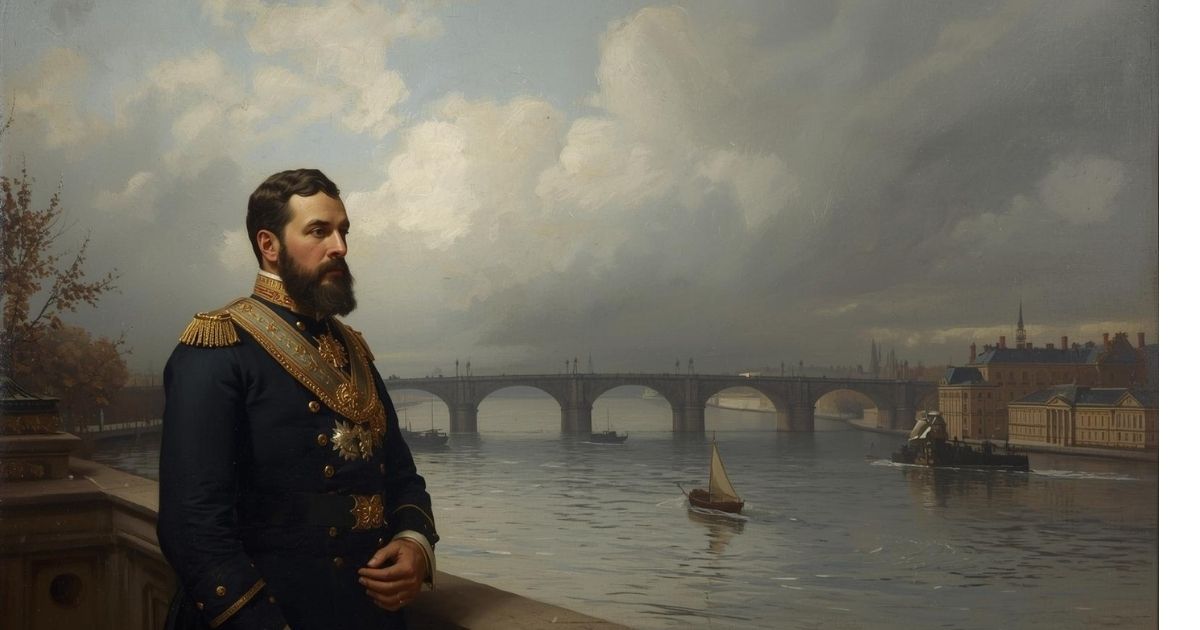
An excerpt from the original text.(complete · 5559 words)
n hour later he was in St. Petersburg, and by ten o’clock he had rung
the bell at Rogojin’s.
He had gone to the front door, and was kept waiting a long while before
anyone came. At last the door of old Mrs. Rogojin’s flat was opened,
and an aged servant appeared.
“Parfen Semionovitch is not at home,” she announced from the doorway.
“Whom do you want?”
“Parfen Semionovitch.”
“He is not in.”
The old woman examined the prince from head to foot with great
curiosity.
“At all events tell me whether he slept at home last night, and whether
he came alone?”
The old woman continued to stare at him, but said nothing.
“Was not Nastasia Philipovna here with him, yesterday evening?”
“And, pray, who are you yourself?”
“Prince Lef Nicolaievitch Muishkin; he knows me well.”
“He is not at home.”
The woman lowered her eyes.
“And Nastasia Philipovna?”
“I know nothing about it.”
“Stop a minute! When will he come back?”
“I don’t know that either.”
The door was shut with these words, and the old woman disappeared. The
prince decided to come back within an hour. Passing out of the house,
he met the porter.
“Is Parfen Semionovitch at home?” he asked.
“Yes.”
“Why did they tell me he was not at home, then?”
“Where did they tell you so,—at his door?”
“No, at his mother’s flat; I rang at Parfen Semionovitch’s door and
nobody came.”
“Well, he may have gone out. I can’t tell. Sometimes he takes the keys
with him, and leaves the rooms empty for two or three days.”
“Do you know for certain that he was at home last night?”
“Yes, he was.”
“Was Nastasia Philipovna with him?”
“I don’t know; she doesn’t come often. I think I should have known if
she had come.”
The prince went out deep in thought, and walked up and down the
pavement for some time. The windows of all the rooms occupied by
Rogojin were closed, those of his mother’s apartments were open. It was
a hot, bright day. The prince crossed the road in order to have a good
look at the windows again; not only were Rogojin’s closed, but the
white blinds were all down as well.
He stood there for a minute and then, suddenly and strangely enough, it
seemed to him that a little corner of one of the blinds was lifted, and
Rogojin’s face appeared for an instant and then vanished. He waited
another minute, and decided to go and ring the bell once more; however,
he thought better of it again and put it off for an hour.
The chief object in his mind at this moment was to get as quickly as he
could to Nastasia Philipovna’s lodging. He remembered that, not long
since, when she had left Pavlofsk at his request, he had begged her to
put up in town at the house of a respectable widow, who had
well-furnished rooms to let, near the Ismailofsky barracks. Probably
Nastasia had kept the rooms when she came down to Pavlofsk this last
time; and most likely she would have spent the night in them, Rogojin
having taken her straight there from the station.
The prince took a droshky. It struck him as he drove on that he ought
to have begun by coming here, since it was most improbable that Rogojin
should have taken Nastasia to his own house last night. He remembered
that the porter said she very rarely came at all, so that it was still
less likely that she would have gone there so late at night.
Vainly trying to comfort himself with these reflections, the prince
reached the Ismailofsky barracks more dead than alive.
To his consternation the good people at the lodgings had not only heard
nothing of Nastasia, but all came out to look at him as if he were a
marvel of some sort. The whole family, of all ages, surrounded him, and
he was begged to enter. He guessed at once that they knew perfectly
well who he was, and that yesterday ought to have been his wedding-day;
and further that they were dying to ask about the wedding, and
especially about why he should be here now, inquiring for the woman who
in all reasonable human probability might have been expected to be with
him in Pavlofsk.
He satisfied their curiosity, in as few words as possible, with regard
to the wedding, but their exclamations and sighs were so numerous and
sincere that he was obliged to tell the whole story—in a short form, of
course. The advice of all these agitated ladies was that the prince
should go at once and knock at Rogojin’s until he was let in: and when
let in insist upon a substantial explanation of everything. If Rogojin
was really not at home, the prince was advised to go to a certain
house, the address of which was given, where lived a German lady, a
friend of Nastasia Philipovna’s. It was possible that she might have
spent the night there in her anxiety to conceal herself.
The prince rose from his seat in a condition of mental collapse. The
good ladies reported afterwards that “his pallor was terrible to see,
and his legs seemed to give way underneath him.” With difficulty he was
made to understand that his new friends would be glad of his address,
in order to act with him if possible. After a moment’s thought he gave
the address of the small hotel, on the stairs of which he had had a fit
some five weeks since. He then set off once more for Rogojin’s.
This time they neither opened the door at Rogojin’s flat nor at the one
opposite. The prince found the porter with difficulty, but when found,
the man would hardly look at him or answer his questions, pretending to
be busy. Eventually, however, he was persuaded to reply so far as to
state that Rogojin had left the house early in the morning and gone to
Pavlofsk, and that he would not return today at all.
“I shall wait; he may come back this evening.”
“He may not be home for a week.”
“Then, at all events, he did sleep here, did he?”
“Well—he did sleep here, yes.”
All this was suspicious and unsatisfactory. Very likely the porter had
received new instructions during the interval of the prince’s absence;
his manner was so different now. He had been obliging—now he was as
obstinate and silent as a mule. However, the prince decided to call
again in a couple of hours, and after that to watch the house, in case
of need. His hope was that he might yet find Nastasia at the address
which he had just received. To that address he now set off at full
speed.
But alas! at the German lady’s house they did not even appear to
understand what he wanted. After a while, by means of certain hints, he
was able to gather that Nastasia must have had a quarrel with her
friend two or three weeks ago, since which date the latter had neither
heard nor seen anything of her. He was given to understand that the
subject of Nastasia’s present whereabouts was not of the slightest
interest to her; and that Nastasia might marry all the princes in the
world for all she cared! So Muishkin took his leave hurriedly. It
struck him now that she might have gone away to Moscow just as she had
done the last time, and that Rogojin had perhaps gone after her, or
even with her. If only he could find some trace!
However, he must take his room at the hotel; and he started off in that
direction. Having engaged his room, he was asked by the waiter whether
he would take dinner; replying mechanically in the affirmative, he sat
down and waited; but it was not long before it struck him that dining
would delay him. Enraged at this idea, he started up, crossed the dark
passage (which filled him with horrible impressions and gloomy
forebodings), and set out once more for Rogojin’s. Rogojin had not
returned, and no one came to the door. He rang at the old lady’s door
opposite, and was informed that Parfen Semionovitch would not return
for three days. The curiosity with which the old servant stared at him
again impressed the prince disagreeably. He could not find the porter
this time at all.
As before, he crossed the street and watched the windows from the other
side, walking up and down in anguish of soul for half an hour or so in
the stifling heat. Nothing stirred; the blinds were motionless; indeed,
the prince began to think that the apparition of Rogojin’s face could
have been nothing but fancy. Soothed by this thought, he drove off once
more to his friends at the Ismailofsky barracks. He was expected there.
The mother had already been to three or four places to look for
Nastasia, but had not found a trace of any kind.
The prince said nothing, but entered the room, sat down silently, and
stared at them, one after the other, with the air of a man who cannot
understand what is being said to him. It was strange—one moment he
seemed to be so observant, the next so absent; his behaviour struck all
the family as most remarkable. At length he rose from his seat, and
begged to be shown Nastasia’s rooms. The ladies reported afterwards how
he had examined everything in the apartments. He observed an open book
on the table, Madam Bovary, and requested the leave of the lady of the
house to take it with him. He had turned down the leaf at the open
page, and pocketed it before they could explain that it was a library
book. He had then seated himself by the open window, and seeing a
card-table, he asked who played cards.
He was informed that Nastasia used to play with Rogojin every evening,
either at “preference” or “little fool,” or “whist”; that this had been
their practice since her last return from Pavlofsk; that she had taken
to this amusement because she did not like to see Rogojin sitting
silent and dull for whole evenings at a time; that the day after
Nastasia had made a remark to this effect, Rogojin had whipped a pack
of cards out of his pocket. Nastasia had laughed, but soon they began
playing. The prince asked where were the cards, but was told that
Rogojin used to bring a new pack every day, and always carried it away
in his pocket.
The good ladies recommended the prince to try knocking at Rogojin’s
once more—not at once, but in the evening. Meanwhile, the mother would
go to Pavlofsk to inquire at Dana Alexeyevna’s whether anything had
been heard of Nastasia there. The prince was to come back at ten
o’clock and meet her, to hear her news and arrange plans for the
morrow.
In spite of the kindly-meant consolations of his new friends, the
prince walked to his hotel in inexpressible anguish of spirit, through
the hot, dusty streets, aimlessly staring at the faces of those who
passed him. Arrived at his destination, he determined to rest awhile in
his room before he started for Rogojin’s once more. He sat down, rested
his elbows on the table and his head on his hands, and fell to
thinking.
Heaven knows how long and upon what subjects he thought. He thought of
many things—of Vera Lebedeff, and of her father; of Hippolyte; of
Rogojin himself, first at the funeral, then as he had met him in the
park, then, suddenly, as they had met in this very passage, outside,
when Rogojin had watched in the darkness and awaited him with uplifted
knife. The prince remembered his enemy’s eyes as they had glared at him
in the darkness. He shuddered, as a sudden idea struck him.
This idea was, that if Rogojin were in Petersburg, though he might hide
for a time, yet he was quite sure to come to him—the prince—before
long, with either good or evil intentions, but probably with the same
intention as on that other occasion. At all events, if Rogojin were to
come at all he would be sure to seek the prince here—he had no other
town address—perhaps in this same corridor; he might well seek him here
if he needed him. And perhaps he did need him. This idea seemed quite
natural to the prince, though he could not have explained why he should
so suddenly have become necessary to Rogojin. Rogojin would not come if
all were well with him, that was part of the thought; he would come if
all were not well; and certainly, undoubtedly, all would not be well
with him. The prince could not bear this new idea; he took his hat and
rushed out towards the street. It was almost dark in the passage.
“What if he were to come out of that corner as I go by and—and stop
me?” thought the prince, as he approached the familiar spot. But no one
came out.
He passed under the gateway and into the street. The crowds of people
walking about—as is always the case at sunset in Petersburg, during the
summer—surprised him, but he walked on in the direction of Rogojin’s
house.
About fifty yards from the hotel, at the first cross-road, as he passed
through the crowd of foot-passengers sauntering along, someone touched
his shoulder, and said in a whisper into his ear:
“Lef Nicolaievitch, my friend, come along with me.” It was Rogojin.
The prince immediately began to tell him, eagerly and joyfully, how he
had but the moment before expected to see him in the dark passage of
the hotel.
“I was there,” said Rogojin, unexpectedly. “Come along.” The prince was
surprised at this answer; but his astonishment increased a couple of
minutes afterwards, when he began to consider it. Having thought it
over, he glanced at Rogojin in alarm. The latter was striding along a
yard or so ahead, looking straight in front of him, and mechanically
making way for anyone he met.
“Why did you not ask for me at my room if you were in the hotel?” asked
the prince, suddenly.
Rogojin stopped and looked at him; then reflected, and replied as
though he had not heard the question:
“Look here, Lef Nicolaievitch, you go straight on to the house; I shall
walk on the other side. See that we keep together.”
So saying, Rogojin crossed the road.
Arrived on the opposite pavement, he looked back to see whether the
prince were moving, waved his hand in the direction of the Gorohovaya,
and strode on, looking across every moment to see whether Muishkin
understood his instructions. The prince supposed that Rogojin desired
to look out for someone whom he was afraid to miss; but if so, why had
he not told him whom to look out for? So the two proceeded for half a
mile or so. Suddenly the prince began to tremble from some unknown
cause. He could not bear it, and signalled to Rogojin across the road.
The latter came at once.
“Is Nastasia Philipovna at your house?”
“Yes.”
“And was it you looked out of the window under the blind this morning?”
“Yes.”
“Then why did—”
But the prince could not finish his question; he did not know what to
say. Besides this, his heart was beating so that he found it difficult
to speak at all. Rogojin was silent also and looked at him as before,
with an expression of deep thoughtfulness.
“Well, I’m going,” he said, at last, preparing to recross the road.
“You go along here as before; we will keep to different sides of the
road; it’s better so, you’ll see.”
When they reached the Gorohovaya, and came near the house, the prince’s
legs were trembling so that he could hardly walk. It was about ten
o’clock. The old lady’s windows were open, as before; Rogojin’s were
all shut, and in the darkness the white blinds showed whiter than ever.
Rogojin and the prince each approached the house on his respective side
of the road; Rogojin, who was on the near side, beckoned the prince
across. He went over to the doorway.
“Even the porter does not know that I have come home now. I told him,
and told them at my mother’s too, that I was off to Pavlofsk,” said
Rogojin, with a cunning and almost satisfied smile. “We’ll go in
quietly and nobody will hear us.”
He had the key in his hand. Mounting the staircase he turned and
signalled to the prince to go more softly; he opened the door very
quietly, let the prince in, followed him, locked the door behind him,
and put the key in his pocket.
“Come along,” he whispered.
He had spoken in a whisper all the way. In spite of his apparent
outward composure, he was evidently in a state of great mental
agitation. Arrived in a large salon, next to the study, he went to the
window and cautiously beckoned the prince up to him.
“When you rang the bell this morning I thought it must be you. I went
to the door on tip-toe and heard you talking to the servant opposite. I
had told her before that if anyone came and rang—especially you, and I
gave her your name—she was not to tell about me. Then I thought, what
if he goes and stands opposite and looks up, or waits about to watch
the house? So I came to this very window, looked out, and there you
were staring straight at me. That’s how it came about.”
“Where is Nastasia Philipovna?” asked the prince, breathlessly.
“She’s here,” replied Rogojin, slowly, after a slight pause.
“Where?”
Rogojin raised his eyes and gazed intently at the prince.
“Come,” he said.
He continued to speak in a whisper, very deliberately as before, and
looked strangely thoughtful and dreamy. Even while he told the story of
how he had peeped through the blind, he gave the impression of wishing
to say something else. They entered the study. In this room some
changes had taken place since the prince last saw it. It was now
divided into two equal parts by a heavy green silk curtain stretched
across it, separating the alcove beyond, where stood Rogojin’s bed,
from the rest of the room.
The heavy curtain was drawn now, and it was very dark. The bright
Petersburg summer nights were already beginning to close in, and but
for the full moon, it would have been difficult to distinguish anything
in Rogojin’s dismal room, with the drawn blinds. They could just see
one anothers faces, however, though not in detail. Rogojin’s face was
white, as usual. His glittering eyes watched the prince with an intent
stare.
“Had you not better light a candle?” said Muishkin.
“No, I needn’t,” replied Rogojin, and taking the other by the hand he
drew him down to a chair. He himself took a chair opposite and drew it
up so close that he almost pressed against the prince’s knees. At their
side was a little round table.
“Sit down,” said Rogojin; “let’s rest a bit.” There was silence for a
moment.
“I knew you would be at that hotel,” he continued, just as men
sometimes commence a serious conversation by discussing any outside
subject before leading up to the main point. “As I entered the passage
it struck me that perhaps you were sitting and waiting for me, just as
I was waiting for you. Have you been to the old lady at Ismailofsky
barracks?”
“Yes,” said the prince, squeezing the word out with difficulty owing to
the dreadful beating of his heart.
“I thought you would. ‘They’ll talk about it,’ I thought; so I
determined to go and fetch you to spend the night here—‘We will be
together,’ I thought, ‘for this one night—’”
“Rogojin, where is Nastasia Philipovna?” said the prince, suddenly
rising from his seat. He was quaking in all his limbs, and his words
came in a scarcely audible whisper. Rogojin rose also.
“There,” he whispered, nodding his head towards the curtain.
“Asleep?” whispered the prince.
Rogojin looked intently at him again, as before.
“Let’s go in—but you mustn’t—well—let’s go in.”
He lifted the curtain, paused—and turned to the prince. “Go in,” he
said, motioning him to pass behind the curtain. Muishkin went in.
“It’s so dark,” he said.
“You can see quite enough,” muttered Rogojin.
“I can just see there’s a bed—”
“Go nearer,” suggested Rogojin, softly.
The prince took a step forward—then another—and paused. He stood and
stared for a minute or two.
Neither of the men spoke a word while at the bedside. The prince’s
heart beat so loud that its knocking seemed to be distinctly audible in
the deathly silence.
But now his eyes had become so far accustomed to the darkness that he
could distinguish the whole of the bed. Someone was asleep upon it—in
an absolutely motionless sleep. Not the slightest movement was
perceptible, not the faintest breathing could be heard. The sleeper was
covered with a white sheet; the outline of the limbs was hardly
distinguishable. He could only just make out that a human being lay
outstretched there.
All around, on the bed, on a chair beside it, on the floor, were
scattered the different portions of a magnificent white silk dress,
bits of lace, ribbons and flowers. On a small table at the bedside
glittered a mass of diamonds, torn off and thrown down anyhow. From
under a heap of lace at the end of the bed peeped a small white foot,
which looked as though it had been chiselled out of marble; it was
terribly still.
The prince gazed and gazed, and felt that the more he gazed the more
death-like became the silence. Suddenly a fly awoke somewhere, buzzed
across the room, and settled on the pillow. The prince shuddered.
“Let’s go,” said Rogojin, touching his shoulder. They left the alcove
and sat down in the two chairs they had occupied before, opposite to
one another. The prince trembled more and more violently, and never
took his questioning eyes off Rogojin’s face.
“I see you are shuddering, Lef Nicolaievitch,” said the latter, at
length, “almost as you did once in Moscow, before your fit; don’t you
remember? I don’t know what I shall do with you—”
The prince bent forward to listen, putting all the strain he could
muster upon his understanding in order to take in what Rogojin said,
and continuing to gaze at the latter’s face.
“Was it you?” he muttered, at last, motioning with his head towards the
curtain.
“Yes, it was I,” whispered Rogojin, looking down.
Neither spoke for five minutes.
“Because, you know,” Rogojin recommenced, as though continuing a former
sentence, “if you were ill now, or had a fit, or screamed, or anything,
they might hear it in the yard, or even in the street, and guess that
someone was passing the night in the house. They would all come and
knock and want to come in, because they know I am not at home. I didn’t
light a candle for the same reason. When I am not here—for two or three
days at a time, now and then—no one comes in to tidy the house or
anything; those are my orders. So that I want them to not know we are
spending the night here—”
“Wait,” interrupted the prince. “I asked both the porter and the woman
whether Nastasia Philipovna had spent last night in the house; so they
knew—”
“I know you asked. I told them that she had called in for ten minutes,
and then gone straight back to Pavlofsk. No one knows she slept here.
Last night we came in just as carefully as you and I did today. I
thought as I came along with her that she would not like to creep in so
secretly, but I was quite wrong. She whispered, and walked on tip-toe;
she carried her skirt over her arm, so that it shouldn’t rustle, and
she held up her finger at me on the stairs, so that I shouldn’t make a
noise—it was you she was afraid of. She was mad with terror in the
train, and she begged me to bring her to this house. I thought of
taking her to her rooms at the Ismailofsky barracks first; but she
wouldn’t hear of it. She said, ‘No—not there; he’ll find me out at once
there. Take me to your own house, where you can hide me, and tomorrow
we’ll set off for Moscow.’ Thence she would go to Orel, she said. When
she went to bed, she was still talking about going to Orel.”
“Wait! What do you intend to do now, Parfen?”
“Well, I’m afraid of you. You shudder and tremble so. We’ll pass the
night here together. There are no other beds besides that one; but I’ve
thought how we’ll manage. I’ll take the cushions off all the sofas, and
lay them down on the floor, up against the curtain here—for you and
me—so that we shall be together. For if they come in and look about
now, you know, they’ll find her, and carry her away, and they’ll be
asking me questions, and I shall say I did it, and then they’ll take me
away, too, don’t you see? So let her lie close to us—close to you and
me.”
“Yes, yes,” agreed the prince, warmly.
“So we will not say anything about it, or let them take her away?”
“Not for anything!” cried the other; “no, no, no!”
“So I had decided, my friend; not to give her up to anyone,” continued
Rogojin. “We’ll be very quiet. I have only been out of the house one
hour all day, all the rest of the time I have been with her. I dare say
the air is very bad here. It is so hot. Do you find it bad?”
“I don’t know—perhaps—by morning it will be.”
“I’ve covered her with oilcloth—best American oilcloth, and put the
sheet over that, and four jars of disinfectant, on account of the
smell—as they did at Moscow—you remember? And she’s lying so still; you
shall see, in the morning, when it’s light. What! can’t you get up?”
asked Rogojin, seeing the other was trembling so that he could not rise
from his seat.
“My legs won’t move,” said the prince; “it’s fear, I know. When my fear
is over, I’ll get up—”
“Wait a bit—I’ll make the bed, and you can lie down. I’ll lie down,
too, and we’ll listen and watch, for I don’t know yet what I shall
do... I tell you beforehand, so that you may be ready in case I—”
Muttering these disconnected words, Rogojin began to make up the beds.
It was clear that he had devised these beds long before; last night he
slept on the sofa. But there was no room for two on the sofa, and he
seemed anxious that he and the prince should be close to one another;
therefore, he now dragged cushions of all sizes and shapes from the
sofas, and made a sort of bed of them close by the curtain. He then
approached the prince, and gently helped him to rise, and led him
towards the bed. But the prince could now walk by himself, so that his
fear must have passed; for all that, however, he continued to shudder.
“It’s hot weather, you see,” continued Rogojin, as he lay down on the
cushions beside Muishkin, “and, naturally, there will be a smell. I
daren’t open the window. My mother has some beautiful flowers in pots;
they have a delicious scent; I thought of fetching them in, but that
old servant will find out, she’s very inquisitive.”
“Yes, she is inquisitive,” assented the prince.
“I thought of buying flowers, and putting them all round her; but I was
afraid it would make us sad to see her with flowers round her.”
“Look here,” said the prince; he was bewildered, and his brain
wandered. He seemed to be continually groping for the questions he
wished to ask, and then losing them. “Listen—tell me—how did you—with a
knife?—That same one?”
“Yes, that same one.”
“Wait a minute, I want to ask you something else, Parfen; all sorts of
things; but tell me first, did you intend to kill her before my
wedding, at the church door, with your knife?”
“I don’t know whether I did or not,” said Rogojin, drily, seeming to be
a little astonished at the question, and not quite taking it in.
“Did you never take your knife to Pavlofsk with you?”
“No. As to the knife,” he added, “this is all I can tell you about it.”
He was silent for a moment, and then said, “I took it out of the locked
drawer this morning about three, for it was in the early morning all
this—happened. It has been inside the book ever since—and—and—this is
what is such a marvel to me, the knife only went in a couple of inches
at most, just under her left breast, and there wasn’t more than half a
tablespoonful of blood altogether, not more.”
“Yes—yes—yes—” The prince jumped up in extraordinary agitation. “I
know, I know, I’ve read of that sort of thing—it’s internal
haemorrhage, you know. Sometimes there isn’t a drop—if the blow goes
straight to the heart—”
“Wait—listen!” cried Rogojin, suddenly, starting up. “Somebody’s
walking about, do you hear? In the hall.” Both sat up to listen.
“I hear,” said the prince in a whisper, his eyes fixed on Rogojin.
“Footsteps?”
“Yes.”
“Shall we shut the door, and lock it, or not?”
“Yes, lock it.”
They locked the door, and both lay down again. There was a long
silence.
“Yes, by-the-by,” whispered the prince, hurriedly and excitedly as
before, as though he had just seized hold of an idea and was afraid of
losing it again. “I—I wanted those cards! They say you played cards
with her?”
“Yes, I played with her,” said Rogojin, after a short silence.
“Where are the cards?”
“Here they are,” said Rogojin, after a still longer pause.
He pulled out a pack of cards, wrapped in a bit of paper, from his
pocket, and handed them to the prince. The latter took them, with a
sort of perplexity. A new, sad, helpless feeling weighed on his heart;
he had suddenly realized that not only at this moment, but for a long
while, he had not been saying what he wanted to say, had not been
acting as he wanted to act; and that these cards which he held in his
hand, and which he had been so delighted to have at first, were now of
no use—no use... He rose, and wrung his hands. Rogojin lay motionless,
and seemed neither to hear nor see his movements; but his eyes blazed
in the darkness, and were fixed in a wild stare.
The prince sat down on a chair, and watched him in alarm. Half an hour
went by.
Suddenly Rogojin burst into a loud abrupt laugh, as though he had quite
forgotten that they must speak in whispers.
“That officer, eh!—that young officer—don’t you remember that fellow at
the band? Eh? Ha, ha, ha! Didn’t she whip him smartly, eh?”
The prince jumped up from his seat in renewed terror. When Rogojin
quieted down (which he did at once) the prince bent over him, sat down
beside him, and with painfully beating heart and still more painful
breath, watched his face intently. Rogojin never turned his head, and
seemed to have forgotten all about him. The prince watched and waited.
Time went on—it began to grow light.
Rogojin began to wander—muttering disconnectedly; then he took to
shouting and laughing. The prince stretched out a trembling hand and
gently stroked his hair and his cheeks—he could do nothing more. His
legs trembled again and he seemed to have lost the use of them. A new
sensation came over him, filling his heart and soul with infinite
anguish.
Meanwhile the daylight grew full and strong; and at last the prince lay
down, as though overcome by despair, and laid his face against the
white, motionless face of Rogojin. His tears flowed on to Rogojin’s
cheek, though he was perhaps not aware of them himself.
At all events when, after many hours, the door was opened and people
thronged in, they found the murderer unconscious and in a raging fever.
The prince was sitting by him, motionless, and each time that the sick
man gave a laugh, or a shout, he hastened to pass his own trembling
hand over his companion’s hair and cheeks, as though trying to soothe
and quiet him. But alas! he understood nothing of what was said to him,
and recognized none of those who surrounded him.
If Schneider himself had arrived then and seen his former pupil and
patient, remembering the prince’s condition during the first year in
Switzerland, he would have flung up his hands, despairingly, and cried,
as he did then:
“An idiot!”
Master this chapter. Complete your experience
Purchase the complete book to access all chapters and support classic literature
As an Amazon Associate, we earn a small commission from qualifying purchases at no additional cost to you.
Available in paperback, hardcover, and e-book formats
Let's Analyse the Pattern
When reality exceeds our mental capacity to process it, the mind shuts down as an emergency protection mechanism.
Why This Matters
Connect literature to life
This chapter teaches how to identify when emotional stress is approaching the breaking point before permanent damage occurs.
Practice This Today
This week, notice when you feel emotionally 'full'—that's your early warning system telling you to seek support before overload hits.
Now let's explore the literary elements.
Key Quotes & Analysis
"He is not at home."
Context: Repeatedly lying to Prince Myshkin about Rogojin's whereabouts
This simple lie represents how ordinary people become complicit in extraordinary evil. The servant chooses loyalty over truth, protecting her employer even when murder has been committed. Her repeated denial shows how institutions protect the powerful.
In Today's Words:
I don't know anything about that.
"Come, brother, let us go in together."
Context: Leading the prince into his house where Nastasia's body lies hidden
Rogojin's use of 'brother' shows how killers can still crave human connection and understanding. He needs the prince to witness his crime, perhaps seeking absolution or shared guilt. The invitation into horror reflects how evil draws innocence into its web.
In Today's Words:
Come on, man, we're in this together now.
"She's there... behind the curtain."
Context: Revealing Nastasia's corpse to the horrified prince
This revelation shatters all hope and illusion. Rogojin's matter-of-fact tone shows his disconnection from reality after committing murder. The curtain symbolizes how thin the barrier is between normal life and absolute horror.
In Today's Words:
There she is... I did it.
Thematic Threads
Truth
In This Chapter
The horrifying reality of Nastasia's murder represents truth too terrible for the human mind to bear
Development
Throughout the novel, truth has been elusive and complex; here it becomes literally unbearable
In Your Life:
You might recognize this when avoiding medical test results or refusing to acknowledge a relationship's end
Compassion
In This Chapter
Even in horror, Myshkin stays with Rogojin rather than flee, showing compassion's persistence
Development
Myshkin's compassion has been tested repeatedly; here it survives even ultimate tragedy
In Your Life:
You might see this when comforting someone who has hurt you, choosing empathy over self-protection
Obsession
In This Chapter
Rogojin's jealous obsession with Nastasia leads to murder and his complete mental collapse
Development
His obsession has escalated from pursuit to possession to destruction
In Your Life:
You might recognize this in relationships where love becomes control, or in any consuming fixation
Innocence
In This Chapter
Myshkin's innocent nature cannot survive exposure to such deliberate evil and violence
Development
His innocence has been challenged throughout; here it finally breaks under unbearable weight
In Your Life:
You might experience this when discovering betrayal by someone you trusted completely
Destruction
In This Chapter
All three main characters are destroyed: Nastasia dead, Rogojin mad, Myshkin mentally broken
Development
The novel's destructive forces reach their ultimate conclusion, sparing no one
In Your Life:
You might see this pattern when toxic situations escalate until everyone involved is damaged
You now have the context. Time to form your own thoughts.
Discussion Questions
- 1
What does Prince Myshkin's frantic search through Petersburg reveal about how we behave when someone we care about disappears?
analysis • surface - 2
Why does Myshkin's mind retreat into incapacity after witnessing Nastasia's death, while Rogojin descends into madness?
analysis • medium - 3
Where do you see this pattern of 'psychological overload' in modern professions like healthcare, social work, or emergency services?
application • medium - 4
How would you build support systems to protect yourself from emotional circuit overload in high-stress situations?
application • deep - 5
What does this chapter teach us about the relationship between compassion and self-preservation when facing unbearable truths?
reflection • deep
Critical Thinking Exercise
Map Your Breaking Points
Think about the most emotionally overwhelming situation you've faced or witnessed. Create a simple map showing: the trigger event, your initial reaction, how your mind/body protected you, and what support you needed. This isn't about reliving trauma, but understanding your psychological patterns.
Consider:
- •Notice whether you tend toward shutdown (like Myshkin) or spiraling (like Rogojin)
- •Identify early warning signs that you're approaching emotional overload
- •Consider who in your life could provide grounding during crisis
Journaling Prompt
Write about a time when you had to step back from a situation to protect your mental health. What did that decision cost you, and what did it save you?
Coming Up Next...
Chapter 50: The Aftermath and Final Reckonings
The final chapter reveals the aftermath of this tragedy and the fates of those left behind, bringing Dostoevsky's exploration of innocence and corruption to its inevitable conclusion.