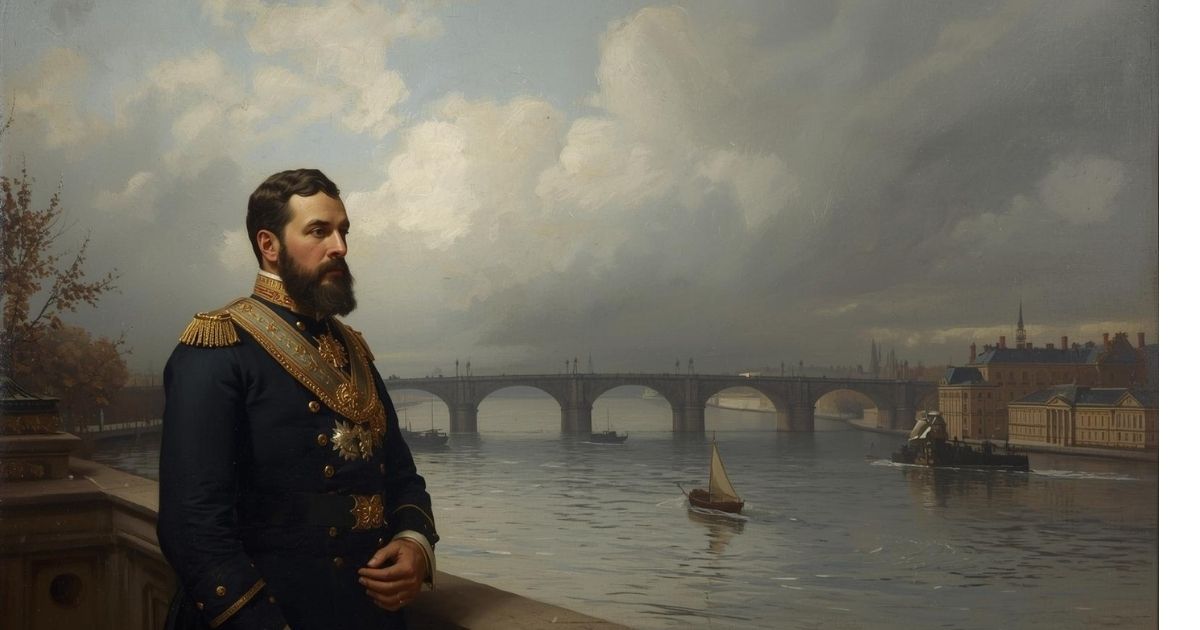
An excerpt from the original text.(complete · 2663 words)
he prince understood at last why he shivered with dread every time he
thought of the three letters in his pocket, and why he had put off
reading them until the evening.
When he fell into a heavy sleep on the sofa on the verandah, without
having had the courage to open a single one of the three envelopes, he
again dreamed a painful dream, and once more that poor, “sinful” woman
appeared to him. Again she gazed at him with tears sparkling on her
long lashes, and beckoned him after her; and again he awoke, as before,
with the picture of her face haunting him.
He longed to get up and go to her at once—but he could not. At
length, almost in despair, he unfolded the letters, and began to read
them.
These letters, too, were like a dream. We sometimes have strange,
impossible dreams, contrary to all the laws of nature. When we awake we
remember them and wonder at their strangeness. You remember, perhaps,
that you were in full possession of your reason during this succession
of fantastic images; even that you acted with extraordinary logic and
cunning while surrounded by murderers who hid their intentions and made
great demonstrations of friendship, while waiting for an opportunity to
cut your throat. You remember how you escaped them by some ingenious
stratagem; then you doubted if they were really deceived, or whether
they were only pretending not to know your hiding-place; then you
thought of another plan and hoodwinked them once again. You remember
all this quite clearly, but how is it that your reason calmly accepted
all the manifest absurdities and impossibilities that crowded into your
dream? One of the murderers suddenly changed into a woman before your
very eyes; then the woman was transformed into a hideous, cunning
little dwarf; and you believed it, and accepted it all almost as a
matter of course—while at the same time your intelligence seemed
unusually keen, and accomplished miracles of cunning, sagacity, and
logic! Why is it that when you awake to the world of realities you
nearly always feel, sometimes very vividly, that the vanished dream has
carried with it some enigma which you have failed to solve? You smile
at the extravagance of your dream, and yet you feel that this tissue of
absurdity contained some real idea, something that belongs to your true
life,—something that exists, and has always existed, in your heart. You
search your dream for some prophecy that you were expecting. It has
left a deep impression upon you, joyful or cruel, but what it means, or
what has been predicted to you in it, you can neither understand nor
remember.
The reading of these letters produced some such effect upon the prince.
He felt, before he even opened the envelopes, that the very fact of
their existence was like a nightmare. How could she ever have made up
her mind to write to her? he asked himself. How could she write about
that at all? And how could such a wild idea have entered her head? And
yet, the strangest part of the matter was, that while he read the
letters, he himself almost believed in the possibility, and even in the
justification, of the idea he had thought so wild. Of course it was a
mad dream, a nightmare, and yet there was something cruelly real about
it. For hours he was haunted by what he had read. Several passages
returned again and again to his mind, and as he brooded over them, he
felt inclined to say to himself that he had foreseen and known all that
was written here; it even seemed to him that he had read the whole of
this some time or other, long, long ago; and all that had tormented and
grieved him up to now was to be found in these old, long since read,
letters.
“When you open this letter” (so the first began), “look first at the
signature. The signature will tell you all, so that I need explain
nothing, nor attempt to justify myself. Were I in any way on a footing
with you, you might be offended at my audacity; but who am I, and who
are you? We are at such extremes, and I am so far removed from you,
that I could not offend you if I wished to do so.”
Farther on, in another place, she wrote: “Do not consider my words as
the sickly ecstasies of a diseased mind, but you are, in my
opinion—perfection! I have seen you—I see you every day. I do not judge
you; I have not weighed you in the scales of Reason and found you
Perfection—it is simply an article of faith. But I must confess one sin
against you—I love you. One should not love perfection. One should only
look on it as perfection—yet I am in love with you. Though love
equalizes, do not fear. I have not lowered you to my level, even in my
most secret thoughts. I have written ‘Do not fear,’ as if you could
fear. I would kiss your footprints if I could; but, oh! I am not
putting myself on a level with you!—Look at the signature—quick, look
at the signature!”
“However, observe” (she wrote in another of the letters), “that
although I couple you with him, yet I have not once asked you whether
you love him. He fell in love with you, though he saw you but once. He
spoke of you as of ‘the light.’ These are his own words—I heard him use
them. But I understood without his saying it that you were all that
light is to him. I lived near him for a whole month, and I understood
then that you, too, must love him. I think of you and him as one.”
“What was the matter yesterday?” (she wrote on another sheet). “I
passed by you, and you seemed to me to blush. Perhaps it was only my
fancy. If I were to bring you to the most loathsome den, and show you
the revelation of undisguised vice—you should not blush. You can never
feel the sense of personal affront. You may hate all who are mean, or
base, or unworthy—but not for yourself—only for those whom they wrong.
No one can wrong you. Do you know, I think you ought to love me—for
you are the same in my eyes as in his—you are as light. An angel cannot
hate, perhaps cannot love, either. I often ask myself—is it possible to
love everybody? Indeed it is not; it is not in nature. Abstract love of
humanity is nearly always love of self. But you are different. You
cannot help loving all, since you can compare with none, and are above
all personal offence or anger. Oh! how bitter it would be to me to know
that you felt anger or shame on my account, for that would be your
fall—you would become comparable at once with such as me.
“Yesterday, after seeing you, I went home and thought out a picture.
“Artists always draw the Saviour as an actor in one of the Gospel
stories. I should do differently. I should represent Christ alone—the
disciples did leave Him alone occasionally. I should paint one little
child left with Him. This child has been playing about near Him, and
had probably just been telling the Saviour something in its pretty baby
prattle. Christ had listened to it, but was now musing—one hand
reposing on the child’s bright head. His eyes have a far-away
expression. Thought, great as the Universe, is in them—His face is sad.
The little one leans its elbow upon Christ’s knee, and with its cheek
resting on its hand, gazes up at Him, pondering as children sometimes
do ponder. The sun is setting. There you have my picture.
“You are innocent—and in your innocence lies all your perfection—oh,
remember that! What is my passion to you?—you are mine now; I shall be
near you all my life—I shall not live long!”
At length, in the last letter of all, he found:
“For Heaven’s sake, don’t misunderstand me! Do not think that I
humiliate myself by writing thus to you, or that I belong to that class
of people who take a satisfaction in humiliating themselves—from pride.
I have my consolation, though it would be difficult to explain it—but I
do not humiliate myself.
“Why do I wish to unite you two? For your sakes or my own? For my own
sake, naturally. All the problems of my life would thus be solved; I
have thought so for a long time. I know that once when your sister
Adelaida saw my portrait she said that such beauty could overthrow the
world. But I have renounced the world. You think it strange that I
should say so, for you saw me decked with lace and diamonds, in the
company of drunkards and wastrels. Take no notice of that; I know that
I have almost ceased to exist. God knows what it is dwelling within me
now—it is not myself. I can see it every day in two dreadful eyes which
are always looking at me, even when not present. These eyes are silent
now, they say nothing; but I know their secret. His house is gloomy,
and there is a secret in it. I am convinced that in some box he has a
razor hidden, tied round with silk, just like the one that Moscow
murderer had. This man also lived with his mother, and had a razor
hidden away, tied round with white silk, and with this razor he
intended to cut a throat.
“All the while I was in their house I felt sure that somewhere beneath
the floor there was hidden away some dreadful corpse, wrapped in
oil-cloth, perhaps buried there by his father, who knows? Just as in
the Moscow case. I could have shown you the very spot!
“He is always silent, but I know well that he loves me so much that he
must hate me. My wedding and yours are to be on the same day; so I have
arranged with him. I have no secrets from him. I would kill him from
very fright, but he will kill me first. He has just burst out laughing,
and says that I am raving. He knows I am writing to you.”
There was much more of this delirious wandering in the letters—one of
them was very long.
At last the prince came out of the dark, gloomy park, in which he had
wandered about for hours just as yesterday. The bright night seemed to
him to be lighter than ever. “It must be quite early,” he thought. (He
had forgotten his watch.) There was a sound of distant music somewhere.
“Ah,” he thought, “the Vauxhall! They won’t be there today, of course!”
At this moment he noticed that he was close to their house; he had felt
that he must gravitate to this spot eventually, and, with a beating
heart, he mounted the verandah steps.
No one met him; the verandah was empty, and nearly pitch dark. He
opened the door into the room, but it, too, was dark and empty. He
stood in the middle of the room in perplexity. Suddenly the door
opened, and in came Alexandra, candle in hand. Seeing the prince she
stopped before him in surprise, looking at him questioningly.
It was clear that she had been merely passing through the room from
door to door, and had not had the remotest notion that she would meet
anyone.
“How did you come here?” she asked, at last.
“I—I—came in—”
“Mamma is not very well, nor is Aglaya. Adelaida has gone to bed, and I
am just going. We were alone the whole evening. Father and Prince S.
have gone to town.”
“I have come to you—now—to—”
“Do you know what time it is?”
“N—no!”
“Half-past twelve. We are always in bed by one.”
“I—I thought it was half-past nine!”
“Never mind!” she laughed, “but why didn’t you come earlier? Perhaps
you were expected!”
“I thought” he stammered, making for the door.
“Au revoir! I shall amuse them all with this story tomorrow!”
He walked along the road towards his own house. His heart was beating,
his thoughts were confused, everything around seemed to be part of a
dream.
And suddenly, just as twice already he had awaked from sleep with the
same vision, that very apparition now seemed to rise up before him. The
woman appeared to step out from the park, and stand in the path in
front of him, as though she had been waiting for him there.
He shuddered and stopped; she seized his hand and pressed it
frenziedly.
No, this was no apparition!
There she stood at last, face to face with him, for the first time
since their parting.
She said something, but he looked silently back at her. His heart ached
with anguish. Oh! never would he banish the recollection of this
meeting with her, and he never remembered it but with the same pain and
agony of mind.
She went on her knees before him—there in the open road—like a
madwoman. He retreated a step, but she caught his hand and kissed it,
and, just as in his dream, the tears were sparkling on her long,
beautiful lashes.
“Get up!” he said, in a frightened whisper, raising her. “Get up at
once!”
“Are you happy—are you happy?” she asked. “Say this one word. Are you
happy now? Today, this moment? Have you just been with her? What did
she say?”
She did not rise from her knees; she would not listen to him; she put
her questions hurriedly, as though she were pursued.
“I am going away tomorrow, as you bade me—I won’t write—so that this is
the last time I shall see you, the last time! This is really the last
time!”
“Oh, be calm—be calm! Get up!” he entreated, in despair.
She gazed thirstily at him and clutched his hands.
“Good-bye!” she said at last, and rose and left him, very quickly.
The prince noticed that Rogojin had suddenly appeared at her side, and
had taken her arm and was leading her away.
“Wait a minute, prince,” shouted the latter, as he went. “I shall be
back in five minutes.”
He reappeared in five minutes as he had said. The prince was waiting
for him.
“I’ve put her in the carriage,” he said; “it has been waiting round the
corner there since ten o’clock. She expected that you would be with
them all the evening. I told her exactly what you wrote me. She won’t
write to the girl any more, she promises; and tomorrow she will be off,
as you wish. She desired to see you for the last time, although you
refused, so we’ve been sitting and waiting on that bench till you
should pass on your way home.”
“Did she bring you with her of her own accord?”
“Of course she did!” said Rogojin, showing his teeth; “and I saw for
myself what I knew before. You’ve read her letters, I suppose?”
“Did you read them?” asked the prince, struck by the thought.
“Of course—she showed them to me herself. You are thinking of the
razor, eh? Ha, ha, ha!”
“Oh, she is mad!” cried the prince, wringing his hands.
“Who knows? Perhaps she is not so mad after all,” said Rogojin, softly,
as though thinking aloud.
The prince made no reply.
“Well, good-bye,” said Rogojin. “I’m off tomorrow too, you know.
Remember me kindly! By-the-by,” he added, turning round sharply again,
“did you answer her question just now? Are you happy, or not?”
“No, no, no!” cried the prince, with unspeakable sadness.
“Ha, ha! I never supposed you would say ‘yes,’” cried Rogojin, laughing
sardonically.
And he disappeared, without looking round again.
Master this chapter. Complete your experience
Purchase the complete book to access all chapters and support classic literature
As an Amazon Associate, we earn a small commission from qualifying purchases at no additional cost to you.
Available in paperback, hardcover, and e-book formats
Let's Analyse the Pattern
Using self-destruction and suffering as tools to control others while appearing selfless and noble.
Why This Matters
Connect literature to life
This chapter teaches how to recognize when someone weaponizes their suffering to control others while appearing to sacrifice themselves.
Practice This Today
This week, notice when someone's crisis consistently becomes your emergency, and practice responding with specific offers of help rather than open-ended emotional rescue.
Now let's explore the literary elements.
Key Quotes & Analysis
"These letters, too, were like a dream. We sometimes have strange, impossible dreams, contrary to all the laws of nature."
Context: Describing Myshkin's experience reading Nastasya's disturbing letters
This sets up how trauma and mental breakdown can make reality feel surreal and disconnected. The letters don't follow normal logic because Nastasya's mind isn't functioning normally.
In Today's Words:
Her messages were so messed up they didn't even seem real
"Are you happy? That was all I wanted to ask you - are you happy now?"
Context: Her final words to Myshkin before disappearing with Rogojin
This question reveals her desperate need for meaning in her sacrifice. She's given up everything supposedly for his happiness, and needs confirmation that it was worth it.
In Today's Words:
I threw my life away for you - tell me it was worth something
"She is mad, quite mad!"
Context: Confirming Nastasya's mental state to Myshkin
Rogojin's blunt assessment shows he understands her condition but is still pursuing her. This reveals how some people are drawn to others' vulnerability and brokenness.
In Today's Words:
She's completely lost it, but I'm still going after her
Thematic Threads
Identity
In This Chapter
Nastasya can only conceive of herself in extremes—either pure saint or irredeemable sinner, with no middle ground for ordinary humanity
Development
Evolved from her earlier social masks to complete psychological fragmentation
In Your Life:
You might recognize this in your own all-or-nothing thinking about mistakes or failures.
Control
In This Chapter
Nastasya maintains control through apparent powerlessness, using her breakdown to orchestrate everyone else's choices
Development
Escalated from subtle manipulation to overt emotional terrorism
In Your Life:
You might see this in relationships where someone uses their problems to dictate family decisions.
Boundaries
In This Chapter
Myshkin's inability to set limits with Nastasya enables her destructive behavior while appearing compassionate
Development
His passive kindness has consistently failed to help anyone throughout the novel
In Your Life:
You might struggle with saying no to people in crisis, even when helping hurts them.
Shame
In This Chapter
Nastasya's internalized shame creates a worldview where redemption is impossible and destruction is inevitable
Development
Her shame has deepened from social embarrassment to complete self-hatred
In Your Life:
You might recognize how past mistakes can create a narrative that you're fundamentally flawed.
Communication
In This Chapter
The letters reveal how trauma can distort communication into fevered manipulation disguised as confession
Development
Communication has broken down from difficult but honest to completely delusional
In Your Life:
You might notice how stress makes your own communication become dramatic or manipulative.
You now have the context. Time to form your own thoughts.
Discussion Questions
- 1
What does Nastasya's behavior in her letters and final meeting reveal about how she sees herself and her relationship with Myshkin?
analysis • surface - 2
Why does Nastasya push Myshkin toward Aglaya while simultaneously making herself the center of his emotional world?
analysis • medium - 3
Where have you seen someone use their suffering or problems to control situations while appearing to be selfless?
application • medium - 4
How should you respond when someone repeatedly creates crises that demand your immediate attention and emotional energy?
application • deep - 5
What does this chapter teach us about the difference between genuine self-sacrifice and using suffering as a form of manipulation?
reflection • deep
Critical Thinking Exercise
Map the Manipulation Pattern
Think of someone in your life who frequently has crises that require others to drop everything and help them. Write down their typical pattern: What triggers the crisis? How do they present it? What response do they expect? How do they react if you don't respond as expected? Then identify what they actually gain from this cycle.
Consider:
- •Look for how they frame themselves as the victim while making others responsible for fixing things
- •Notice if their crises tend to happen when attention is on someone else or during important events
- •Pay attention to whether they actually follow through on solutions offered or if they find reasons why nothing works
Journaling Prompt
Write about a time when you realized someone was using their problems to control your behavior. How did you handle it, and what would you do differently now?
Coming Up Next...
Chapter 39: The Weight of Ordinary Lives
The consequences of this final meeting begin to unfold as the wedding day approaches, and the tensions that have been building throughout the novel reach their breaking point.