An excerpt from the original text.(complete · 3961 words)
remember, too, how, without moving from her place, or changing her
attitude, she gazed into my face.
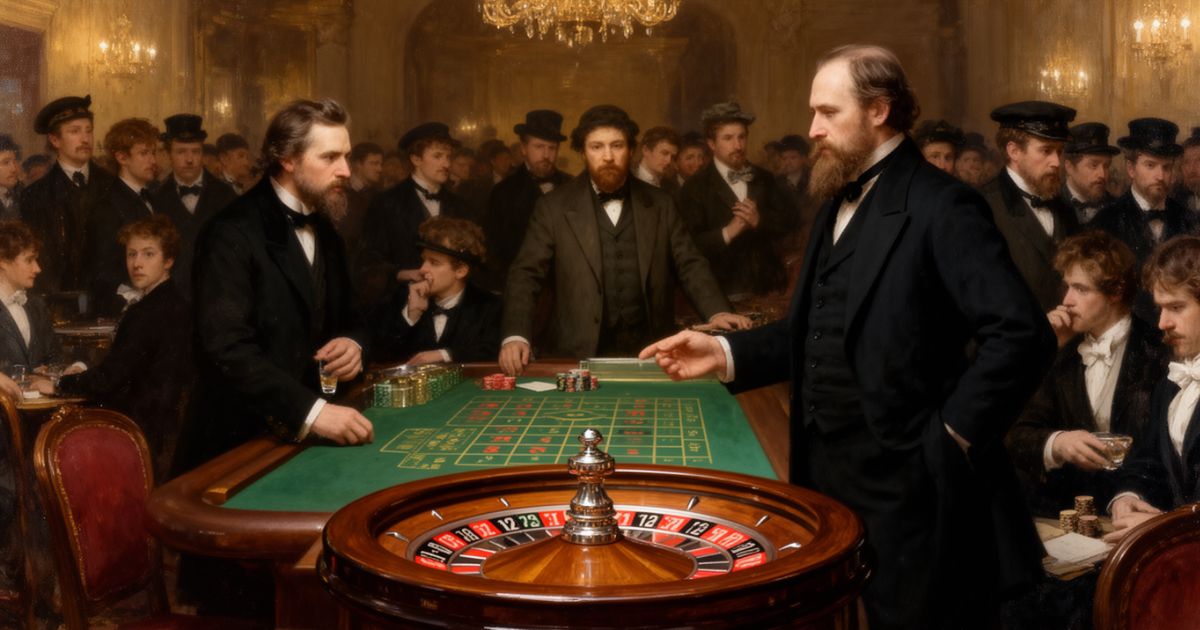
“I have won two hundred thousand francs!” cried I as I pulled out my
last sheaf of bank-notes. The pile of paper currency occupied the whole
table. I could not withdraw my eyes from it. Consequently, for a moment
or two Polina escaped my mind. Then I set myself to arrange the pile in
order, and to sort the notes, and to mass the gold in a separate heap.
That done, I left everything where it lay, and proceeded to pace the
room with rapid strides as I lost myself in thought. Then I darted to
the table once more, and began to recount the money; until all of a
sudden, as though I had remembered something, I rushed to the door, and
closed and double-locked it. Finally I came to a meditative halt before
my little trunk.
“Shall I put the money there until tomorrow?” I asked, turning sharply
round to Polina as the recollection of her returned to me.
She was still in her old place—still making not a sound. Yet her eyes
had followed every one of my movements. Somehow in her face there was a
strange expression—an expression which I did not like. I think that I
shall not be wrong if I say that it indicated sheer hatred.
Impulsively I approached her.
“Polina,” I said, “here are twenty-five thousand florins—fifty thousand
francs, or more. Take them, and tomorrow throw them in De Griers’
face.”
She returned no answer.
“Or, if you should prefer,” I continued, “let me take them to him
myself tomorrow—yes, early tomorrow morning. Shall I?”
Then all at once she burst out laughing, and laughed for a long while.
With astonishment and a feeling of offence I gazed at her. Her laughter
was too like the derisive merriment which she had so often indulged in
of late—merriment which had broken forth always at the time of my most
passionate explanations. At length she ceased, and frowned at me from
under her eyebrows.
“I am not going to take your money,” she said contemptuously.
“Why not?” I cried. “Why not, Polina?”
“Because I am not in the habit of receiving money for nothing.”
“But I am offering it to you as a friend. In the same way I would
offer you my very life.”
Upon this she threw me a long, questioning glance, as though she were
seeking to probe me to the depths.
“You are giving too much for me,” she remarked with a smile. “The
beloved of De Griers is not worth fifty thousand francs.”
“Oh Polina, how can you speak so?” I exclaimed reproachfully. “Am I
De Griers?”
“You?” she cried with her eyes suddenly flashing. “Why, I hate you!
Yes, yes, I hate you! I love you no more than I do De Griers.”
Then she buried her face in her hands, and relapsed into hysterics. I
darted to her side. Somehow I had an intuition of something having
happened to her which had nothing to do with myself. She was like a
person temporarily insane.
“Buy me, would you, would you? Would you buy me for fifty thousand
francs as De Griers did?” she gasped between her convulsive sobs.
I clasped her in my arms, kissed her hands and feet, and fell upon my
knees before her.
Presently the hysterical fit passed away, and, laying her hands upon my
shoulders, she gazed for a while into my face, as though trying to read
it—something I said to her, but it was clear that she did not hear it.
Her face looked so dark and despondent that I began to fear for her
reason. At length she drew me towards herself—a trustful smile playing
over her features; and then, as suddenly, she pushed me away again as
she eyed me dimly.
Finally she threw herself upon me in an embrace.
“You love me?” she said. “Do you?—you who were willing even to
quarrel with the Baron at my bidding?”
Then she laughed—laughed as though something dear, but laughable, had
recurred to her memory. Yes, she laughed and wept at the same time.
What was I to do? I was like a man in a fever. I remember that she
began to say something to me—though what I do not know, since she
spoke with a feverish lisp, as though she were trying to tell me
something very quickly. At intervals, too, she would break off into the
smile which I was beginning to dread. “No, no!” she kept repeating.
“You are my dear one; you are the man I trust.” Again she laid her
hands upon my shoulders, and again she gazed at me as she reiterated:
“You love me, you love me? Will you always love me?” I could not take
my eyes off her. Never before had I seen her in this mood of humility
and affection. True, the mood was the outcome of hysteria; but—! All of
a sudden she noticed my ardent gaze, and smiled slightly. The next
moment, for no apparent reason, she began to talk of Astley.
She continued talking and talking about him, but I could not make out
all she said—more particularly when she was endeavouring to tell me of
something or other which had happened recently. On the whole, she
appeared to be laughing at Astley, for she kept repeating that he was
waiting for her, and did I know whether, even at that moment, he was
not standing beneath the window? “Yes, yes, he is there,” she said.
“Open the window, and see if he is not.” She pushed me in that
direction; yet, no sooner did I make a movement to obey her behest than
she burst into laughter, and I remained beside her, and she embraced
me.
“Shall we go away tomorrow?” presently she asked, as though some
disturbing thought had recurred to her recollection. “How would it be
if we were to try and overtake Grandmamma? I think we should do so at
Berlin. And what think you she would have to say to us when we caught
her up, and her eyes first lit upon us? What, too, about Mr. Astley?
He would not leap from the Shlangenberg for my sake! No! Of that I am
very sure!”—and she laughed. “Do you know where he is going next year?
He says he intends to go to the North Pole for scientific
investigations, and has invited me to go with him! Ha, ha, ha! He also
says that we Russians know nothing, can do nothing, without European
help. But he is a good fellow all the same. For instance, he does not
blame the General in the matter, but declares that Mlle. Blanche—that
love—But no; I do not know, I do not know.” She stopped suddenly, as
though she had said her say, and was feeling bewildered. “What poor
creatures these people are. How sorry I am for them, and for
Grandmamma! But when are you going to kill De Griers? Surely you do not
intend actually to murder him? You fool! Do you suppose that I should
allow you to fight De Griers? Nor shall you kill the Baron.” Here she
burst out laughing. “How absurd you looked when you were talking to the
Burmergelms! I was watching you all the time—watching you from where I
was sitting. And how unwilling you were to go when I sent you! Oh, how
I laughed and laughed!”
Then she kissed and embraced me again; again she pressed her face to
mine with tender passion. Yet I neither saw nor heard her, for my head
was in a whirl....
It must have been about seven o’clock in the morning when I awoke.
Daylight had come, and Polina was sitting by my side—a strange
expression on her face, as though she had seen a vision and was unable
to collect her thoughts. She too had just awoken, and was now staring
at the money on the table. My head ached; it felt heavy. I attempted to
take Polina’s hand, but she pushed me from her, and leapt from the
sofa. The dawn was full of mist, for rain had fallen, yet she moved to
the window, opened it, and, leaning her elbows upon the window-sill,
thrust out her head and shoulders to take the air. In this position did
she remain for several minutes, without ever looking round at me, or
listening to what I was saying. Into my head there came the uneasy
thought: What is to happen now? How is it all to end? Suddenly Polina
rose from the window, approached the table, and, looking at me with an
expression of infinite aversion, said with lips which quivered with
anger:
“Well? Are you going to hand me over my fifty thousand francs?”
“Polina, you say that again, again?” I exclaimed.
“You have changed your mind, then? Ha, ha, ha! You are sorry you ever
promised them?”
On the table where, the previous night, I had counted the money there
still was lying the packet of twenty five thousand florins. I handed it
to her.
“The francs are mine, then, are they? They are mine?” she inquired
viciously as she balanced the money in her hands.
“Yes; they have always been yours,” I said.
“Then take your fifty thousand francs!” and she hurled them full in
my face. The packet burst as she did so, and the floor became strewed
with bank-notes. The instant that the deed was done she rushed from the
room.
At that moment she cannot have been in her right mind; yet, what was
the cause of her temporary aberration I cannot say. For a month past
she had been unwell. Yet what had brought about this present
condition of mind, above all things, this outburst? Had it come of
wounded pride? Had it come of despair over her decision to come to me?
Had it come of the fact that, presuming too much on my good fortune, I
had seemed to be intending to desert her (even as De Griers had done)
when once I had given her the fifty thousand francs? But, on my honour,
I had never cherished any such intention. What was at fault, I think,
was her own pride, which kept urging her not to trust me, but, rather,
to insult me—even though she had not realised the fact. In her eyes I
corresponded to De Griers, and therefore had been condemned for a fault
not wholly my own. Her mood of late had been a sort of delirium, a sort
of light-headedness—that I knew full well; yet, never had I
sufficiently taken it into consideration. Perhaps she would not pardon
me now? Ah, but this was the present. What about the future? Her
delirium and sickness were not likely to make her forget what she had
done in bringing me De Griers’ letter. No, she must have known what she
was doing when she brought it.
Somehow I contrived to stuff the pile of notes and gold under the bed,
to cover them over, and then to leave the room some ten minutes after
Polina. I felt sure that she had returned to her own room; wherefore, I
intended quietly to follow her, and to ask the nursemaid aid who opened
the door how her mistress was. Judge, therefore, of my surprise when,
meeting the domestic on the stairs, she informed me that Polina had not
yet returned, and that she (the domestic) was at that moment on her way
to my room in quest of her!
“Mlle. left me but ten minutes ago,” I said. “What can have become of
her?” The nursemaid looked at me reproachfully.
Already sundry rumours were flying about the hotel. Both in the office
of the commissionaire and in that of the landlord it was whispered
that, at seven o’clock that morning, the Fräulein had left the hotel,
and set off, despite the rain, in the direction of the Hôtel
d’Angleterre. From words and hints let fall I could see that the fact
of Polina having spent the night in my room was now public property.
Also, sundry rumours were circulating concerning the General’s family
affairs. It was known that last night he had gone out of his mind, and
paraded the hotel in tears; also, that the old lady who had arrived was
his mother, and that she had come from Russia on purpose to forbid her
son’s marriage with Mlle. de Cominges, as well as to cut him out of her
will if he should disobey her; also that, because he had disobeyed her,
she had squandered all her money at roulette, in order to have nothing
more to leave to him. “Oh, these Russians!” exclaimed the landlord,
with an angry toss of the head, while the bystanders laughed and the
clerk betook himself to his accounts. Also, every one had learnt about
my winnings; Karl, the corridor lacquey, was the first to congratulate
me. But with these folk I had nothing to do. My business was to set off
at full speed to the Hôtel d’Angleterre.
As yet it was early for Mr. Astley to receive visitors; but, as soon as
he learnt that it was I who had arrived, he came out into the
corridor to meet me, and stood looking at me in silence with his
steel-grey eyes as he waited to hear what I had to say. I inquired
after Polina.
“She is ill,” he replied, still looking at me with his direct,
unwavering glance.
“And she is in your rooms.”
“Yes, she is in my rooms.”
“Then you are minded to keep her there?”
“Yes, I am minded to keep her there.”
“But, Mr. Astley, that will raise a scandal. It ought not to be
allowed. Besides, she is very ill. Perhaps you had not remarked that?”
“Yes, I have. It was I who told you about it. Had she not been ill, she
would not have gone and spent the night with you.”
“Then you know all about it?”
“Yes; for last night she was to have accompanied me to the house of a
relative of mine. Unfortunately, being ill, she made a mistake, and
went to your rooms instead.”
“Indeed? Then I wish you joy, Mr. Astley. Apropos, you have reminded me
of something. Were you beneath my window last night? Every moment Mlle.
Polina kept telling me to open the window and see if you were there;
after which she always smiled.”
“Indeed? No, I was not there; but I was waiting in the corridor, and
walking about the hotel.”
“She ought to see a doctor, you know, Mr. Astley.”
“Yes, she ought. I have sent for one, and, if she dies, I shall hold
you responsible.”
This surprised me.
“Pardon me,” I replied, “but what do you mean?”
“Never mind. Tell me if it is true that, last night, you won two
hundred thousand thalers?”
“No; I won a hundred thousand florins.”
“Good heavens! Then I suppose you will be off to Paris this morning?”
“Why?”
“Because all Russians who have grown rich go to Paris,” explained
Astley, as though he had read the fact in a book.
“But what could I do in Paris in summer time?—I love her, Mr. Astley!
Surely you know that?”
“Indeed? I am sure that you do not. Moreover, if you were to stay
here, you would lose everything that you possess, and have nothing left
with which to pay your expenses in Paris. Well, good-bye now. I feel
sure that today will see you gone from here.”
“Good-bye. But I am not going to Paris. Likewise—pardon me—what is to
become of this family? I mean that the affair of the General and Mlle.
Polina will soon be all over the town.”
“I daresay; yet, I hardly suppose that that will break the General’s
heart. Moreover, Mlle. Polina has a perfect right to live where she
chooses. In short, we may say that, as a family, this family has ceased
to exist.”
I departed, and found myself smiling at the Englishman’s strange
assurance that I should soon be leaving for Paris. “I suppose he means
to shoot me in a duel, should Polina die. Yes, that is what he intends
to do.” Now, although I was honestly sorry for Polina, it is a fact
that, from the moment when, the previous night, I had approached the
gaming-table, and begun to rake in the packets of bank-notes, my love
for her had entered upon a new plane. Yes, I can say that now;
although, at the time, I was barely conscious of it. Was I, then, at
heart a gambler? Did I, after all, love Polina not so very much? No,
no! As God is my witness, I loved her! Even when I was returning home
from Mr. Astley’s my suffering was genuine, and my self-reproach
sincere. But presently I was to go through an exceedingly strange and
ugly experience.
I was proceeding to the General’s rooms when I heard a door near me
open, and a voice call me by name. It was Mlle.’s mother, the Widow de
Cominges who was inviting me, in her daughter’s name, to enter.
I did so; whereupon, I heard a laugh and a little cry proceed from the
bedroom (the pair occupied a suite of two apartments), where Mlle.
Blanche was just arising.
“Ah, c’est lui! Viens, donc, bête! Is it true that you have won a
mountain of gold and silver? J’aimerais mieux l’or.”
“Yes,” I replied with a smile.
“How much?”
“A hundred thousand florins.”
“Bibi, comme tu es bête! Come in here, for I can’t hear you where you
are now. Nous ferons bombance, n’est-ce pas?”
Entering her room, I found her lolling under a pink satin coverlet, and
revealing a pair of swarthy, wonderfully healthy shoulders—shoulders
such as one sees in dreams—shoulders covered over with a white cambric
nightgown which, trimmed with lace, stood out, in striking relief,
against the darkness of her skin.
“Mon fils, as-tu du cœur?” she cried when she saw me, and then giggled.
Her laugh had always been a very cheerful one, and at times it even
sounded sincere.
“Tout autre—” I began, paraphrasing Corneille.
“See here,” she prattled on. “Please search for my stockings, and help
me to dress. Aussi, si tu n’es pas trop bête je te prends à Paris. I am
just off, let me tell you.”
“This moment?”
“In half an hour.”
True enough, everything stood ready-packed—trunks, portmanteaux, and
all. Coffee had long been served.
“Eh bien, tu verras Paris. Dis donc, qu’est-ce que c’est qu’un
‘utchitel’? Tu étais bien bête quand tu étais ‘utchitel.’ Where are my
stockings? Please help me to dress.”
And she lifted up a really ravishing foot—small, swarthy, and not
misshapen like the majority of feet which look dainty only in bottines.
I laughed, and started to draw on to the foot a silk stocking, while
Mlle. Blanche sat on the edge of the bed and chattered.
“Eh bien, que feras-tu si je te prends avec moi? First of all I must
have fifty thousand francs, and you shall give them to me at Frankfurt.
Then we will go on to Paris, where we will live together, et je te
ferai voir des étoiles en plein jour. Yes, you shall see such women as
your eyes have never lit upon.”
“Stop a moment. If I were to give you those fifty thousand francs, what
should I have left for myself?”
“Another hundred thousand francs, please to remember. Besides, I could
live with you in your rooms for a month, or even for two; or even for
longer. But it would not take us more than two months to get through
fifty thousand francs; for, look you, je suis bonne enfante, et tu
verras des étoiles, you may be sure.”
“What? You mean to say that we should spend the whole in two months?”
“Certainly. Does that surprise you very much? Ah, vil esclave! Why, one
month of that life would be better than all your previous existence.
One month—et après, le déluge! Mais tu ne peux comprendre. Va! Away,
away! You are not worth it.—Ah, que fais-tu?”
For, while drawing on the other stocking, I had felt constrained to
kiss her. Immediately she shrunk back, kicked me in the face with her
toes, and turned me neck and crop out of the room.
“Eh bien, mon ‘utchitel’,” she called after me, “je t’attends, si tu
veux. I start in a quarter of an hour’s time.”
I returned to my own room with my head in a whirl. It was not my fault
that Polina had thrown a packet in my face, and preferred Mr. Astley to
myself. A few bank-notes were still fluttering about the floor, and I
picked them up. At that moment the door opened, and the landlord
appeared—a person who, until now, had never bestowed upon me so much as
a glance. He had come to know if I would prefer to move to a lower
floor—to a suite which had just been tenanted by Count V.
For a moment I reflected.
“No!” I shouted. “My account, please, for in ten minutes I shall be
gone.”
“To Paris, to Paris!” I added to myself. “Every man of birth must make
her acquaintance.”
Within a quarter of an hour all three of us were seated in a family
compartment—Mlle. Blanche, the Widow de Cominges, and myself. Mlle.
kept laughing hysterically as she looked at me, and Madame re-echoed
her; but I did not feel so cheerful. My life had broken in two, and
yesterday had infected me with a habit of staking my all upon a card.
Although it might be that I had failed to win my stake, that I had lost
my senses, that I desired nothing better, I felt that the scene was to
be changed only for a time. “Within a month from now,” I kept
thinking to myself, “I shall be back again in Roulettenberg; and then
I mean to have it out with you, Mr. Astley!” Yes, as now I look back at
things, I remember that I felt greatly depressed, despite the absurd
gigglings of the egregious Blanche.
“What is the matter with you? How dull you are!” she cried at length as
she interrupted her laughter to take me seriously to task.
“Come, come! We are going to spend your two hundred thousand francs for
you, et tu seras heureux comme un petit roi. I myself will tie your tie
for you, and introduce you to Hortense. And when we have spent your
money you shall return here, and break the bank again. What did those
two Jews tell you?—that the thing most needed is daring, and that you
possess it? Consequently, this is not the first time that you will be
hurrying to Paris with money in your pocket. Quant à moi, je veux
cinquante mille francs de rente, et alors——”
“But what about the General?” I interrupted.
“The General? You know well enough that at about this hour every day he
goes to buy me a bouquet. On this occasion, I took care to tell him
that he must hunt for the choicest of flowers; and when he returns
home, the poor fellow will find the bird flown. Possibly he may take
wing in pursuit—ha, ha, ha! And if so, I shall not be sorry, for he
could be useful to me in Paris, and Mr. Astley will pay his debts
here.”
In this manner did I depart for the Gay City.
Master this chapter. Complete your experience
Purchase the complete book to access all chapters and support classic literature
As an Amazon Associate, we earn a small commission from qualifying purchases at no additional cost to you.
Available in paperback, hardcover, and e-book formats
Let's Analyse the Pattern
The belief that financial gestures can heal emotional wounds or prove devotion when the real problem requires emotional work.
Why This Matters
Connect literature to life
This chapter teaches how to recognize when someone's anger or hurt stems from feeling disrespected rather than lacking resources.
Practice This Today
This week, notice when you want to solve a relationship problem by spending money—pause and ask what the person actually needs to feel heard or valued.
Now let's explore the literary elements.
Key Quotes & Analysis
"I have won two hundred thousand francs!"
Context: The narrator bursts in to tell Polina about his massive gambling win
His excitement reveals he thinks money will solve their relationship problems. He's high on the win and can't read the room. The exclamation shows how gambling victory has made him tone-deaf to others' feelings.
In Today's Words:
I'm rich! This changes everything!
"Somehow in her face there was a strange expression—an expression which I did not like. I think that I shall not be wrong if I say that it indicated sheer hatred."
Context: He notices Polina's reaction as he counts his money obsessively
He sees her disgust but doesn't understand it. His focus on the money blinds him to how his behavior looks to her. The 'sheer hatred' foreshadows her explosive rejection of his offer.
In Today's Words:
She was looking at me like I was trash, but I didn't get why
"You wished to buy me! You thought that you could buy me!"
Context: Her furious response to the narrator's offer of money
She sees his 'generous' offer as identical to De Griers' manipulation. Money offered as love feels like purchase to someone who's been treated as property. Her repetition shows how deeply this wounds her.
In Today's Words:
You think you can just throw money at me and I'll be yours!
"She is very ill, and I think that she is out of her mind."
Context: Explaining why Polina is staying in his hotel rooms
Astley's clinical description shows Polina's complete breakdown. Her 'madness' reflects the impossible position of needing help but refusing to be owned. It also justifies the scandal of their living arrangement.
In Today's Words:
She's having a complete breakdown and isn't thinking straight
Thematic Threads
Pride
In This Chapter
The narrator's pride in his winnings blinds him to Polina's actual needs and feelings
Development
Evolved from earlier gambling pride to romantic pride—now he believes money proves his worth as a lover
In Your Life:
You might see this when you use achievements or purchases to prove your value to others instead of being vulnerable
Class
In This Chapter
Polina's shame about being treated as a commodity reveals how class dynamics poison intimate relationships
Development
Deepened from earlier social climbing themes to show how class shame affects personal identity
In Your Life:
You might feel this when someone's financial help makes you feel like you owe them or aren't their equal
Addiction
In This Chapter
The narrator abandons his deepest values, leaving with Blanche despite claiming to love Polina
Development
Progressed from gambling compulsion to showing how addiction destroys our ability to act on our stated priorities
In Your Life:
You might recognize this when you repeatedly choose the immediate gratification over what you say matters most
Identity
In This Chapter
Astley predicts the narrator will become another stereotypical rich Russian in Paris, and he does
Development
Culminated earlier themes about social expectations becoming self-fulfilling prophecies
In Your Life:
You might see this when others' low expectations of you become the path you actually follow
Communication
In This Chapter
Polina and the narrator completely misread each other—she sees his offer as an insult, he sees her rejection as inexplicable
Development
Introduced here as the breakdown of understanding between people who claim to love each other
In Your Life:
You might experience this when your good intentions are completely misunderstood by someone you care about
You now have the context. Time to form your own thoughts.
Discussion Questions
- 1
Why does the narrator believe his gambling winnings will fix his relationship with Polina, and how does she actually react to his offer?
analysis • surface - 2
What does Polina mean when she accuses the narrator of trying to 'buy' her like De Griers did, and why does this make her so angry?
analysis • medium - 3
Where do you see people today trying to solve emotional problems with money instead of addressing the real issues?
application • medium - 4
When someone you care about is hurt or angry, how can you tell the difference between problems that money can solve and problems that need emotional healing?
application • deep - 5
What does this chapter reveal about why throwing money at relationship problems often backfires, even when our intentions are good?
reflection • deep
Critical Thinking Exercise
Diagnose the Real Problem
Think of a recent conflict or tension in your life where someone (maybe you) tried to fix things with money, gifts, or material gestures. Write down what the surface problem seemed to be, then dig deeper to identify what the person really needed. Finally, brainstorm three non-monetary ways the situation could have been addressed.
Consider:
- •Look for patterns where money became a substitute for time, attention, or emotional work
- •Consider how the person receiving the money or gifts actually felt about the gesture
- •Think about whether the underlying emotional need was ever directly acknowledged or addressed
Journaling Prompt
Write about a time when someone tried to solve a problem with you using money or gifts when what you really needed was something else entirely. How did it make you feel, and what would have actually helped?
Coming Up Next...
Chapter 16: The Gambler's Last Dance
In Paris, the narrator discovers what happens when a gambling addict tries to buy happiness in the world's most expensive playground. Will his fortune last, or will his compulsions destroy everything he's won?