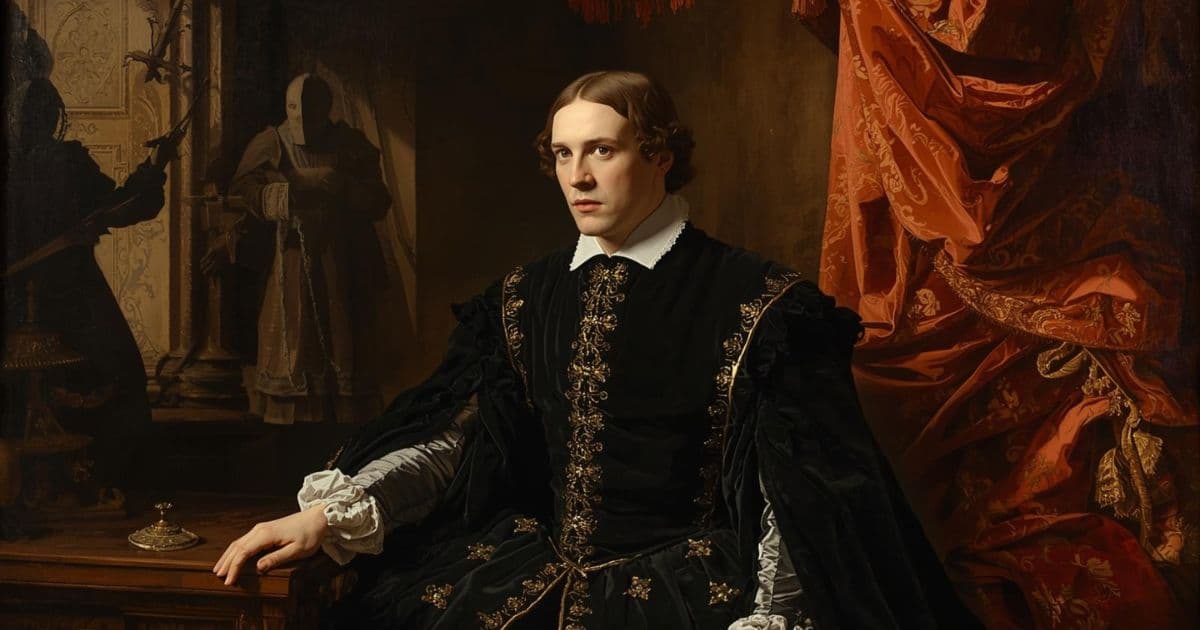
An excerpt from the original text.(complete · 6410 words)
he Third And Last Interview With Smerdyakov
When he was half‐way there, the keen dry wind that had been blowing
early that morning rose again, and a fine dry snow began falling
thickly. It did not lie on the ground, but was whirled about by the
wind, and soon there was a regular snowstorm. There were scarcely any
lamp‐posts in the part of the town where Smerdyakov lived. Ivan strode
alone in the darkness, unconscious of the storm, instinctively picking
out his way. His head ached and there was a painful throbbing in his
temples. He felt that his hands were twitching convulsively. Not far
from Marya Kondratyevna’s cottage, Ivan suddenly came upon a solitary
drunken little peasant. He was wearing a coarse and patched coat, and
was walking in zigzags, grumbling and swearing to himself. Then
suddenly he would begin singing in a husky drunken voice:
“Ach, Vanka’s gone to Petersburg;
I won’t wait till he comes back.”
But he broke off every time at the second line and began swearing
again; then he would begin the same song again. Ivan felt an intense
hatred for him before he had thought about him at all. Suddenly he
realized his presence and felt an irresistible impulse to knock him
down. At that moment they met, and the peasant with a violent lurch
fell full tilt against Ivan, who pushed him back furiously. The peasant
went flying backwards and fell like a log on the frozen ground. He
uttered one plaintive “O—oh!” and then was silent. Ivan stepped up to
him. He was lying on his back, without movement or consciousness. “He
will be frozen,” thought Ivan, and he went on his way to Smerdyakov’s.
In the passage, Marya Kondratyevna, who ran out to open the door with a
candle in her hand, whispered that Smerdyakov was very ill, “It’s not
that he’s laid up, but he seems not himself, and he even told us to
take the tea away; he wouldn’t have any.”
“Why, does he make a row?” asked Ivan coarsely.
“Oh, dear, no, quite the contrary, he’s very quiet. Only please don’t
talk to him too long,” Marya Kondratyevna begged him. Ivan opened the
door and stepped into the room.
It was over‐heated as before, but there were changes in the room. One
of the benches at the side had been removed, and in its place had been
put a large old mahogany leather sofa, on which a bed had been made up,
with fairly clean white pillows. Smerdyakov was sitting on the sofa,
wearing the same dressing‐gown. The table had been brought out in front
of the sofa, so that there was hardly room to move. On the table lay a
thick book in yellow cover, but Smerdyakov was not reading it. He
seemed to be sitting doing nothing. He met Ivan with a slow silent
gaze, and was apparently not at all surprised at his coming. There was
a great change in his face; he was much thinner and sallower. His eyes
were sunken and there were blue marks under them.
“Why, you really are ill?” Ivan stopped short. “I won’t keep you long,
I won’t even take off my coat. Where can one sit down?”
He went to the other end of the table, moved up a chair and sat down on
it.
“Why do you look at me without speaking? I’ve only come with one
question, and I swear I won’t go without an answer. Has the young lady,
Katerina Ivanovna, been with you?”
Smerdyakov still remained silent, looking quietly at Ivan as before.
Suddenly, with a motion of his hand, he turned his face away.
“What’s the matter with you?” cried Ivan.
“Nothing.”
“What do you mean by ‘nothing’?”
“Yes, she has. It’s no matter to you. Let me alone.”
“No, I won’t let you alone. Tell me, when was she here?”
“Why, I’d quite forgotten about her,” said Smerdyakov, with a scornful
smile, and turning his face to Ivan again, he stared at him with a look
of frenzied hatred, the same look that he had fixed on him at their
last interview, a month before.
“You seem very ill yourself, your face is sunken; you don’t look like
yourself,” he said to Ivan.
“Never mind my health, tell me what I ask you.”
“But why are your eyes so yellow? The whites are quite yellow. Are you
so worried?” He smiled contemptuously and suddenly laughed outright.
“Listen; I’ve told you I won’t go away without an answer!” Ivan cried,
intensely irritated.
“Why do you keep pestering me? Why do you torment me?” said Smerdyakov,
with a look of suffering.
“Damn it! I’ve nothing to do with you. Just answer my question and I’ll
go away.”
“I’ve no answer to give you,” said Smerdyakov, looking down again.
“You may be sure I’ll make you answer!”
“Why are you so uneasy?” Smerdyakov stared at him, not simply with
contempt, but almost with repulsion. “Is this because the trial begins
to‐ morrow? Nothing will happen to you; can’t you believe that at last?
Go home, go to bed and sleep in peace, don’t be afraid of anything.”
“I don’t understand you.... What have I to be afraid of to‐morrow?”
Ivan articulated in astonishment, and suddenly a chill breath of fear
did in fact pass over his soul. Smerdyakov measured him with his eyes.
“You don’t understand?” he drawled reproachfully. “It’s a strange thing
a sensible man should care to play such a farce!”
Ivan looked at him speechless. The startling, incredibly supercilious
tone of this man who had once been his valet, was extraordinary in
itself. He had not taken such a tone even at their last interview.
“I tell you, you’ve nothing to be afraid of. I won’t say anything about
you; there’s no proof against you. I say, how your hands are trembling!
Why are your fingers moving like that? Go home, you did not murder
him.”
Ivan started. He remembered Alyosha.
“I know it was not I,” he faltered.
“Do you?” Smerdyakov caught him up again.
Ivan jumped up and seized him by the shoulder.
“Tell me everything, you viper! Tell me everything!”
Smerdyakov was not in the least scared. He only riveted his eyes on
Ivan with insane hatred.
“Well, it was you who murdered him, if that’s it,” he whispered
furiously.
Ivan sank back on his chair, as though pondering something. He laughed
malignantly.
“You mean my going away. What you talked about last time?”
“You stood before me last time and understood it all, and you
understand it now.”
“All I understand is that you are mad.”
“Aren’t you tired of it? Here we are face to face; what’s the use of
going on keeping up a farce to each other? Are you still trying to
throw it all on me, to my face? You murdered him; you are the real
murderer, I was only your instrument, your faithful servant, and it was
following your words I did it.”
“Did it? Why, did you murder him?” Ivan turned cold.
Something seemed to give way in his brain, and he shuddered all over
with a cold shiver. Then Smerdyakov himself looked at him wonderingly;
probably the genuineness of Ivan’s horror struck him.
“You don’t mean to say you really did not know?” he faltered
mistrustfully, looking with a forced smile into his eyes. Ivan still
gazed at him, and seemed unable to speak.
Ach, Vanka’s gone to Petersburg;
I won’t wait till he comes back,
suddenly echoed in his head.
“Do you know, I am afraid that you are a dream, a phantom sitting
before me,” he muttered.
“There’s no phantom here, but only us two and one other. No doubt he is
here, that third, between us.”
“Who is he? Who is here? What third person?” Ivan cried in alarm,
looking about him, his eyes hastily searching in every corner.
“That third is God Himself—Providence. He is the third beside us now.
Only don’t look for Him, you won’t find Him.”
“It’s a lie that you killed him!” Ivan cried madly. “You are mad, or
teasing me again!”
Smerdyakov, as before, watched him curiously, with no sign of fear. He
could still scarcely get over his incredulity; he still fancied that
Ivan knew everything and was trying to “throw it all on him to his
face.”
“Wait a minute,” he said at last in a weak voice, and suddenly bringing
up his left leg from under the table, he began turning up his trouser
leg. He was wearing long white stockings and slippers. Slowly he took
off his garter and fumbled to the bottom of his stocking. Ivan gazed at
him, and suddenly shuddered in a paroxysm of terror.
“He’s mad!” he cried, and rapidly jumping up, he drew back, so that he
knocked his back against the wall and stood up against it, stiff and
straight. He looked with insane terror at Smerdyakov, who, entirely
unaffected by his terror, continued fumbling in his stocking, as though
he were making an effort to get hold of something with his fingers and
pull it out. At last he got hold of it and began pulling it out. Ivan
saw that it was a piece of paper, or perhaps a roll of papers.
Smerdyakov pulled it out and laid it on the table.
“Here,” he said quietly.
“What is it?” asked Ivan, trembling.
“Kindly look at it,” Smerdyakov answered, still in the same low tone.
Ivan stepped up to the table, took up the roll of paper and began
unfolding it, but suddenly he drew back his fingers, as though from
contact with a loathsome reptile.
“Your hands keep twitching,” observed Smerdyakov, and he deliberately
unfolded the bundle himself. Under the wrapper were three packets of
hundred‐rouble notes.
“They are all here, all the three thousand roubles; you need not count
them. Take them,” Smerdyakov suggested to Ivan, nodding at the notes.
Ivan sank back in his chair. He was as white as a handkerchief.
“You frightened me ... with your stocking,” he said, with a strange
grin.
“Can you really not have known till now?” Smerdyakov asked once more.
“No, I did not know. I kept thinking of Dmitri. Brother, brother! Ach!”
He suddenly clutched his head in both hands.
“Listen. Did you kill him alone? With my brother’s help or without?”
“It was only with you, with your help, I killed him, and Dmitri
Fyodorovitch is quite innocent.”
“All right, all right. Talk about me later. Why do I keep on trembling?
I can’t speak properly.”
“You were bold enough then. You said ‘everything was lawful,’ and how
frightened you are now,” Smerdyakov muttered in surprise. “Won’t you
have some lemonade? I’ll ask for some at once. It’s very refreshing.
Only I must hide this first.”
And again he motioned at the notes. He was just going to get up and
call at the door to Marya Kondratyevna to make some lemonade and bring
it them, but, looking for something to cover up the notes that she
might not see them, he first took out his handkerchief, and as it
turned out to be very dirty, took up the big yellow book that Ivan had
noticed at first lying on the table, and put it over the notes. The
book was The Sayings of the Holy Father Isaac the Syrian. Ivan read
it mechanically.
“I won’t have any lemonade,” he said. “Talk of me later. Sit down and
tell me how you did it. Tell me all about it.”
“You’d better take off your greatcoat, or you’ll be too hot.” Ivan, as
though he’d only just thought of it, took off his coat, and, without
getting up from his chair, threw it on the bench.
“Speak, please, speak.”
He seemed calmer. He waited, feeling sure that Smerdyakov would tell
him all about it.
“How it was done?” sighed Smerdyakov. “It was done in a most natural
way, following your very words.”
“Of my words later,” Ivan broke in again, apparently with complete
self‐ possession, firmly uttering his words, and not shouting as
before. “Only tell me in detail how you did it. Everything, as it
happened. Don’t forget anything. The details, above everything, the
details, I beg you.”
“You’d gone away, then I fell into the cellar.”
“In a fit or in a sham one?”
“A sham one, naturally. I shammed it all. I went quietly down the steps
to the very bottom and lay down quietly, and as I lay down I gave a
scream, and struggled, till they carried me out.”
“Stay! And were you shamming all along, afterwards, and in the
hospital?”
“No, not at all. Next day, in the morning, before they took me to the
hospital, I had a real attack and a more violent one than I’ve had for
years. For two days I was quite unconscious.”
“All right, all right. Go on.”
“They laid me on the bed. I knew I’d be the other side of the
partition, for whenever I was ill, Marfa Ignatyevna used to put me
there, near them. She’s always been very kind to me, from my birth up.
At night I moaned, but quietly. I kept expecting Dmitri Fyodorovitch to
come.”
“Expecting him? To come to you?”
“Not to me. I expected him to come into the house, for I’d no doubt
that he’d come that night, for being without me and getting no news,
he’d be sure to come and climb over the fence, as he used to, and do
something.”
“And if he hadn’t come?”
“Then nothing would have happened. I should never have brought myself
to it without him.”
“All right, all right ... speak more intelligibly, don’t hurry; above
all, don’t leave anything out!”
“I expected him to kill Fyodor Pavlovitch. I thought that was certain,
for I had prepared him for it ... during the last few days.... He knew
about the knocks, that was the chief thing. With his suspiciousness and
the fury which had been growing in him all those days, he was bound to
get into the house by means of those taps. That was inevitable, so I
was expecting him.”
“Stay,” Ivan interrupted; “if he had killed him, he would have taken
the money and carried it away; you must have considered that. What
would you have got by it afterwards? I don’t see.”
“But he would never have found the money. That was only what I told
him, that the money was under the mattress. But that wasn’t true. It
had been lying in a box. And afterwards I suggested to Fyodor
Pavlovitch, as I was the only person he trusted, to hide the envelope
with the notes in the corner behind the ikons, for no one would have
guessed that place, especially if they came in a hurry. So that’s where
the envelope lay, in the corner behind the ikons. It would have been
absurd to keep it under the mattress; the box, anyway, could be locked.
But all believe it was under the mattress. A stupid thing to believe.
So if Dmitri Fyodorovitch had committed the murder, finding nothing, he
would either have run away in a hurry, afraid of every sound, as always
happens with murderers, or he would have been arrested. So I could
always have clambered up to the ikons and have taken away the money
next morning or even that night, and it would have all been put down to
Dmitri Fyodorovitch. I could reckon upon that.”
“But what if he did not kill him, but only knocked him down?”
“If he did not kill him, of course, I would not have ventured to take
the money, and nothing would have happened. But I calculated that he
would beat him senseless, and I should have time to take it then, and
then I’d make out to Fyodor Pavlovitch that it was no one but Dmitri
Fyodorovitch who had taken the money after beating him.”
“Stop ... I am getting mixed. Then it was Dmitri after all who killed
him; you only took the money?”
“No, he didn’t kill him. Well, I might as well have told you now that
he was the murderer.... But I don’t want to lie to you now, because ...
because if you really haven’t understood till now, as I see for myself,
and are not pretending, so as to throw your guilt on me to my very
face, you are still responsible for it all, since you knew of the
murder and charged me to do it, and went away knowing all about it. And
so I want to prove to your face this evening that you are the only real
murderer in the whole affair, and I am not the real murderer, though I
did kill him. You are the rightful murderer.”
“Why, why, am I a murderer? Oh, God!” Ivan cried, unable to restrain
himself at last, and forgetting that he had put off discussing himself
till the end of the conversation. “You still mean that Tchermashnya?
Stay, tell me, why did you want my consent, if you really took
Tchermashnya for consent? How will you explain that now?”
“Assured of your consent, I should have known that you wouldn’t have
made an outcry over those three thousand being lost, even if I’d been
suspected, instead of Dmitri Fyodorovitch, or as his accomplice; on the
contrary, you would have protected me from others.... And when you got
your inheritance you would have rewarded me when you were able, all the
rest of your life. For you’d have received your inheritance through me,
seeing that if he had married Agrafena Alexandrovna, you wouldn’t have
had a farthing.”
“Ah! Then you intended to worry me all my life afterwards,” snarled
Ivan. “And what if I hadn’t gone away then, but had informed against
you?”
“What could you have informed? That I persuaded you to go to
Tchermashnya? That’s all nonsense. Besides, after our conversation you
would either have gone away or have stayed. If you had stayed, nothing
would have happened. I should have known that you didn’t want it done,
and should have attempted nothing. As you went away, it meant you
assured me that you wouldn’t dare to inform against me at the trial,
and that you’d overlook my having the three thousand. And, indeed, you
couldn’t have prosecuted me afterwards, because then I should have told
it all in the court; that is, not that I had stolen the money or killed
him—I shouldn’t have said that—but that you’d put me up to the theft
and the murder, though I didn’t consent to it. That’s why I needed your
consent, so that you couldn’t have cornered me afterwards, for what
proof could you have had? I could always have cornered you, revealing
your eagerness for your father’s death, and I tell you the public would
have believed it all, and you would have been ashamed for the rest of
your life.”
“Was I then so eager, was I?” Ivan snarled again.
“To be sure you were, and by your consent you silently sanctioned my
doing it.” Smerdyakov looked resolutely at Ivan. He was very weak and
spoke slowly and wearily, but some hidden inner force urged him on. He
evidently had some design. Ivan felt that.
“Go on,” he said. “Tell me what happened that night.”
“What more is there to tell! I lay there and I thought I heard the
master shout. And before that Grigory Vassilyevitch had suddenly got up
and came out, and he suddenly gave a scream, and then all was silence
and darkness. I lay there waiting, my heart beating; I couldn’t bear
it. I got up at last, went out. I saw the window open on the left into
the garden, and I stepped to the left to listen whether he was sitting
there alive, and I heard the master moving about, sighing, so I knew he
was alive. ‘Ech!’ I thought. I went to the window and shouted to the
master, ‘It’s I.’ And he shouted to me, ‘He’s been, he’s been; he’s run
away.’ He meant Dmitri Fyodorovitch had been. ‘He’s killed Grigory!’
‘Where?’ I whispered. ‘There, in the corner,’ he pointed. He was
whispering, too. ‘Wait a bit,’ I said. I went to the corner of the
garden to look, and there I came upon Grigory Vassilyevitch lying by
the wall, covered with blood, senseless. So it’s true that Dmitri
Fyodorovitch has been here, was the thought that came into my head, and
I determined on the spot to make an end of it, as Grigory
Vassilyevitch, even if he were alive, would see nothing of it, as he
lay there senseless. The only risk was that Marfa Ignatyevna might wake
up. I felt that at the moment, but the longing to get it done came over
me, till I could scarcely breathe. I went back to the window to the
master and said, ‘She’s here, she’s come; Agrafena Alexandrovna has
come, wants to be let in.’ And he started like a baby. ‘Where is she?’
he fairly gasped, but couldn’t believe it. ‘She’s standing there,’ said
I. ‘Open.’ He looked out of the window at me, half believing and half
distrustful, but afraid to open. ‘Why, he is afraid of me now,’ I
thought. And it was funny. I bethought me to knock on the window‐frame
those taps we’d agreed upon as a signal that Grushenka had come, in his
presence, before his eyes. He didn’t seem to believe my word, but as
soon as he heard the taps, he ran at once to open the door. He opened
it. I would have gone in, but he stood in the way to prevent me
passing. ‘Where is she? Where is she?’ He looked at me, all of a
tremble. ‘Well,’ thought I, ‘if he’s so frightened of me as all that,
it’s a bad look out!’ And my legs went weak with fright that he
wouldn’t let me in or would call out, or Marfa Ignatyevna would run up,
or something else might happen. I don’t remember now, but I must have
stood pale, facing him. I whispered to him, ‘Why, she’s there, there,
under the window; how is it you don’t see her?’ I said. ‘Bring her
then, bring her.’ ‘She’s afraid,’ said I; ‘she was frightened at the
noise, she’s hidden in the bushes; go and call to her yourself from the
study.’ He ran to the window, put the candle in the window.
‘Grushenka,’ he cried, ‘Grushenka, are you here?’ Though he cried that,
he didn’t want to lean out of the window, he didn’t want to move away
from me, for he was panic‐stricken; he was so frightened he didn’t dare
to turn his back on me. ‘Why, here she is,’ said I. I went up to the
window and leaned right out of it. ‘Here she is; she’s in the bush,
laughing at you, don’t you see her?’ He suddenly believed it; he was
all of a shake—he was awfully crazy about her—and he leaned right out
of the window. I snatched up that iron paper‐weight from his table; do
you remember, weighing about three pounds? I swung it and hit him on
the top of the skull with the corner of it. He didn’t even cry out. He
only sank down suddenly, and I hit him again and a third time. And the
third time I knew I’d broken his skull. He suddenly rolled on his back,
face upwards, covered with blood. I looked round. There was no blood on
me, not a spot. I wiped the paper‐weight, put it back, went up to the
ikons, took the money out of the envelope, and flung the envelope on
the floor and the pink ribbon beside it. I went out into the garden all
of a tremble, straight to the apple‐tree with a hollow in it—you know
that hollow. I’d marked it long before and put a rag and a piece of
paper ready in it. I wrapped all the notes in the rag and stuffed it
deep down in the hole. And there it stayed for over a fortnight. I took
it out later, when I came out of the hospital. I went back to my bed,
lay down and thought, ‘If Grigory Vassilyevitch has been killed
outright it may be a bad job for me, but if he is not killed and
recovers, it will be first‐rate, for then he’ll bear witness that
Dmitri Fyodorovitch has been here, and so he must have killed him and
taken the money.’ Then I began groaning with suspense and impatience,
so as to wake Marfa Ignatyevna as soon as possible. At last she got up
and she rushed to me, but when she saw Grigory Vassilyevitch was not
there, she ran out, and I heard her scream in the garden. And that set
it all going and set my mind at rest.”
He stopped. Ivan had listened all the time in dead silence without
stirring or taking his eyes off him. As he told his story Smerdyakov
glanced at him from time to time, but for the most part kept his eyes
averted. When he had finished he was evidently agitated and was
breathing hard. The perspiration stood out on his face. But it was
impossible to tell whether it was remorse he was feeling, or what.
“Stay,” cried Ivan, pondering. “What about the door? If he only opened
the door to you, how could Grigory have seen it open before? For
Grigory saw it before you went.”
It was remarkable that Ivan spoke quite amicably, in a different tone,
not angry as before, so if any one had opened the door at that moment
and peeped in at them, he would certainly have concluded that they were
talking peaceably about some ordinary, though interesting, subject.
“As for that door and Grigory Vassilyevitch’s having seen it open,
that’s only his fancy,” said Smerdyakov, with a wry smile. “He is not a
man, I assure you, but an obstinate mule. He didn’t see it, but fancied
he had seen it, and there’s no shaking him. It’s just our luck he took
that notion into his head, for they can’t fail to convict Dmitri
Fyodorovitch after that.”
“Listen ...” said Ivan, beginning to seem bewildered again and making
an effort to grasp something. “Listen. There are a lot of questions I
want to ask you, but I forget them ... I keep forgetting and getting
mixed up. Yes. Tell me this at least, why did you open the envelope and
leave it there on the floor? Why didn’t you simply carry off the
envelope?... When you were telling me, I thought you spoke about it as
though it were the right thing to do ... but why, I can’t
understand....”
“I did that for a good reason. For if a man had known all about it, as
I did for instance, if he’d seen those notes before, and perhaps had
put them in that envelope himself, and had seen the envelope sealed up
and addressed, with his own eyes, if such a man had done the murder,
what should have made him tear open the envelope afterwards, especially
in such desperate haste, since he’d know for certain the notes must be
in the envelope? No, if the robber had been some one like me, he’d
simply have put the envelope straight in his pocket and got away with
it as fast as he could. But it’d be quite different with Dmitri
Fyodorovitch. He only knew about the envelope by hearsay; he had never
seen it, and if he’d found it, for instance, under the mattress, he’d
have torn it open as quickly as possible to make sure the notes were in
it. And he’d have thrown the envelope down, without having time to
think that it would be evidence against him. Because he was not an
habitual thief and had never directly stolen anything before, for he is
a gentleman born, and if he did bring himself to steal, it would not be
regular stealing, but simply taking what was his own, for he’d told the
whole town he meant to before, and had even bragged aloud before every
one that he’d go and take his property from Fyodor Pavlovitch. I didn’t
say that openly to the prosecutor when I was being examined, but quite
the contrary, I brought him to it by a hint, as though I didn’t see it
myself, and as though he’d thought of it himself and I hadn’t prompted
him; so that Mr. Prosecutor’s mouth positively watered at my
suggestion.”
“But can you possibly have thought of all that on the spot?” cried
Ivan, overcome with astonishment. He looked at Smerdyakov again with
alarm.
“Mercy on us! Could any one think of it all in such a desperate hurry?
It was all thought out beforehand.”
“Well ... well, it was the devil helped you!” Ivan cried again. “No,
you are not a fool, you are far cleverer than I thought....”
He got up, obviously intending to walk across the room. He was in
terrible distress. But as the table blocked his way, and there was
hardly room to pass between the table and the wall, he only turned
round where he stood and sat down again. Perhaps the impossibility of
moving irritated him, as he suddenly cried out almost as furiously as
before.
“Listen, you miserable, contemptible creature! Don’t you understand
that if I haven’t killed you, it’s simply because I am keeping you to
answer to‐morrow at the trial. God sees,” Ivan raised his hand,
“perhaps I, too, was guilty; perhaps I really had a secret desire for
my father’s ... death, but I swear I was not as guilty as you think,
and perhaps I didn’t urge you on at all. No, no, I didn’t urge you on!
But no matter, I will give evidence against myself to‐morrow at the
trial. I’m determined to! I shall tell everything, everything. But
we’ll make our appearance together. And whatever you may say against me
at the trial, whatever evidence you give, I’ll face it; I am not afraid
of you. I’ll confirm it all myself! But you must confess, too! You
must, you must; we’ll go together. That’s how it shall be!”
Ivan said this solemnly and resolutely and from his flashing eyes alone
it could be seen that it would be so.
“You are ill, I see; you are quite ill. Your eyes are yellow,”
Smerdyakov commented, without the least irony, with apparent sympathy
in fact.
“We’ll go together,” Ivan repeated. “And if you won’t go, no matter,
I’ll go alone.”
Smerdyakov paused as though pondering.
“There’ll be nothing of the sort, and you won’t go,” he concluded at
last positively.
“You don’t understand me,” Ivan exclaimed reproachfully.
“You’ll be too much ashamed, if you confess it all. And, what’s more,
it will be no use at all, for I shall say straight out that I never
said anything of the sort to you, and that you are either ill (and it
looks like it, too), or that you’re so sorry for your brother that you
are sacrificing yourself to save him and have invented it all against
me, for you’ve always thought no more of me than if I’d been a fly. And
who will believe you, and what single proof have you got?”
“Listen, you showed me those notes just now to convince me.”
Smerdyakov lifted the book off the notes and laid it on one side.
“Take that money away with you,” Smerdyakov sighed.
“Of course, I shall take it. But why do you give it to me, if you
committed the murder for the sake of it?” Ivan looked at him with great
surprise.
“I don’t want it,” Smerdyakov articulated in a shaking voice, with a
gesture of refusal. “I did have an idea of beginning a new life with
that money in Moscow or, better still, abroad. I did dream of it,
chiefly because ‘all things are lawful.’ That was quite right what you
taught me, for you talked a lot to me about that. For if there’s no
everlasting God, there’s no such thing as virtue, and there’s no need
of it. You were right there. So that’s how I looked at it.”
“Did you come to that of yourself?” asked Ivan, with a wry smile.
“With your guidance.”
“And now, I suppose, you believe in God, since you are giving back the
money?”
“No, I don’t believe,” whispered Smerdyakov.
“Then why are you giving it back?”
“Leave off ... that’s enough!” Smerdyakov waved his hand again. “You
used to say yourself that everything was lawful, so now why are you so
upset, too? You even want to go and give evidence against yourself....
Only there’ll be nothing of the sort! You won’t go to give evidence,”
Smerdyakov decided with conviction.
“You’ll see,” said Ivan.
“It isn’t possible. You are very clever. You are fond of money, I know
that. You like to be respected, too, for you’re very proud; you are far
too fond of female charms, too, and you mind most of all about living
in undisturbed comfort, without having to depend on any one—that’s what
you care most about. You won’t want to spoil your life for ever by
taking such a disgrace on yourself. You are like Fyodor Pavlovitch, you
are more like him than any of his children; you’ve the same soul as he
had.”
“You are not a fool,” said Ivan, seeming struck. The blood rushed to
his face. “You are serious now!” he observed, looking suddenly at
Smerdyakov with a different expression.
“It was your pride made you think I was a fool. Take the money.”
Ivan took the three rolls of notes and put them in his pocket without
wrapping them in anything.
“I shall show them at the court to‐morrow,” he said.
“Nobody will believe you, as you’ve plenty of money of your own; you
may simply have taken it out of your cash‐box and brought it to the
court.”
Ivan rose from his seat.
“I repeat,” he said, “the only reason I haven’t killed you is that I
need you for to‐morrow, remember that, don’t forget it!”
“Well, kill me. Kill me now,” Smerdyakov said, all at once looking
strangely at Ivan. “You won’t dare do that even!” he added, with a
bitter smile. “You won’t dare to do anything, you, who used to be so
bold!”
“Till to‐morrow,” cried Ivan, and moved to go out.
“Stay a moment.... Show me those notes again.”
Ivan took out the notes and showed them to him. Smerdyakov looked at
them for ten seconds.
“Well, you can go,” he said, with a wave of his hand. “Ivan
Fyodorovitch!” he called after him again.
“What do you want?” Ivan turned without stopping.
“Good‐by!”
“Till to‐morrow!” Ivan cried again, and he walked out of the cottage.
The snowstorm was still raging. He walked the first few steps boldly,
but suddenly began staggering. “It’s something physical,” he thought
with a grin. Something like joy was springing up in his heart. He was
conscious of unbounded resolution; he would make an end of the wavering
that had so tortured him of late. His determination was taken, “and now
it will not be changed,” he thought with relief. At that moment he
stumbled against something and almost fell down. Stopping short, he
made out at his feet the peasant he had knocked down, still lying
senseless and motionless. The snow had almost covered his face. Ivan
seized him and lifted him in his arms. Seeing a light in the little
house to the right he went up, knocked at the shutters, and asked the
man to whom the house belonged to help him carry the peasant to the
police‐station, promising him three roubles. The man got ready and came
out. I won’t describe in detail how Ivan succeeded in his object,
bringing the peasant to the police‐station and arranging for a doctor
to see him at once, providing with a liberal hand for the expenses. I
will only say that this business took a whole hour, but Ivan was well
content with it. His mind wandered and worked incessantly.
“If I had not taken my decision so firmly for to‐morrow,” he reflected
with satisfaction, “I should not have stayed a whole hour to look after
the peasant, but should have passed by, without caring about his being
frozen. I am quite capable of watching myself, by the way,” he thought
at the same instant, with still greater satisfaction, “although they
have decided that I am going out of my mind!”
Just as he reached his own house he stopped short, asking himself
suddenly hadn’t he better go at once to the prosecutor and tell him
everything. He decided the question by turning back to the house.
“Everything together to‐morrow!” he whispered to himself, and, strange
to say, almost all his gladness and self‐satisfaction passed in one
instant.
As he entered his own room he felt something like a touch of ice on his
heart, like a recollection or, more exactly, a reminder, of something
agonizing and revolting that was in that room now, at that moment, and
had been there before. He sank wearily on his sofa. The old woman
brought him a samovar; he made tea, but did not touch it. He sat on the
sofa and felt giddy. He felt that he was ill and helpless. He was
beginning to drop asleep, but got up uneasily and walked across the
room to shake off his drowsiness. At moments he fancied he was
delirious, but it was not illness that he thought of most. Sitting down
again, he began looking round, as though searching for something. This
happened several times. At last his eyes were fastened intently on one
point. Ivan smiled, but an angry flush suffused his face. He sat a long
time in his place, his head propped on both arms, though he looked
sideways at the same point, at the sofa that stood against the opposite
wall. There was evidently something, some object, that irritated him
there, worried him and tormented him.
Master this chapter. Complete your experience
Purchase the complete book to access all chapters and support classic literature
As an Amazon Associate, we earn a small commission from qualifying purchases at no additional cost to you.
Available in paperback, hardcover, and e-book formats
Let's Analyse the Pattern
When abstract ideas or willful ignorance provide cover for enabling harmful actions while maintaining plausible deniability.
Why This Matters
Connect literature to life
This chapter teaches how to spot when your ideas, words, or silence enable others to justify harmful actions.
Practice This Today
This week, notice when your complaints or casual comments might sound like instructions to someone looking for permission to act badly.
Now let's explore the literary elements.
Key Quotes & Analysis
"You said then, 'everything is lawful,' and now you are so frightened!"
Context: Smerdyakov confronts Ivan about how his philosophical teachings enabled the murder
This quote reveals how abstract ideas can have deadly real-world consequences. Smerdyakov shows Ivan that his intellectual discussions weren't harmless philosophy but actual instructions for murder. It exposes the dangerous gap between theory and practice.
In Today's Words:
You told me nothing really matters, so why are you freaking out now that I acted like it?
"You murdered him; you are the real murderer, I was only your instrument, your faithful servant."
Context: Smerdyakov explains Ivan's role as the intellectual architect of the murder
This devastating accusation forces Ivan to confront his moral complicity. While Smerdyakov wielded the weapon, Ivan provided the philosophical framework that made murder seem justified. It's a masterful psychological manipulation that contains uncomfortable truth.
In Today's Words:
You pulled the strings, I just did the dirty work - you're the real villain here.
"I shall go to the court tomorrow and tell them everything, everything."
Context: Ivan vows to confess his role at Dmitri's trial
This represents Ivan's desperate attempt to reclaim his moral center and take responsibility for his actions. However, his decision comes from guilt and horror rather than genuine moral clarity, making it questionable whether he'll follow through.
In Today's Words:
I'm going to tell everyone the truth tomorrow, no matter what it costs me.
Thematic Threads
Moral Responsibility
In This Chapter
Ivan realizes his philosophical discussions enabled murder, making him morally culpable despite not physically committing the crime
Development
Evolved from Ivan's earlier abstract debates about morality to concrete consequences of his ideas
In Your Life:
You might recognize this when your complaints about someone create permission for others to treat them badly.
Class Manipulation
In This Chapter
Smerdyakov, the servant, uses his master's own philosophy to justify murdering him, inverting the power dynamic
Development
Builds on ongoing theme of servants understanding their masters better than masters understand themselves
In Your Life:
You see this when people in lower positions use your own words or policies against you.
Pride and Denial
In This Chapter
Ivan vows to confess at trial but Smerdyakov predicts he won't—too proud and comfortable to sacrifice himself
Development
Continues Ivan's pattern of intellectual arrogance preventing him from taking real action
In Your Life:
You might recognize this when you make bold promises to do the right thing but find excuses when the moment comes.
Recognition and Horror
In This Chapter
Ivan experiences the shock of seeing his abstract ideas turned into concrete murder, realizing his complicity
Development
Climax of Ivan's journey from detached intellectual to someone forced to confront consequences
In Your Life:
You feel this when you suddenly see how your seemingly harmless actions contributed to someone's real pain.
Power of Words
In This Chapter
Ivan's philosophical discussions become the framework Smerdyakov uses to justify and plan the murder
Development
Demonstrates how intellectual influence can be more dangerous than physical force
In Your Life:
You see this when your casual comments about someone create lasting damage to their reputation or relationships.
You now have the context. Time to form your own thoughts.
Discussion Questions
- 1
What does Smerdyakov reveal to Ivan, and why does he claim Ivan is the 'real' murderer?
analysis • surface - 2
How did Ivan's philosophical discussions about morality become a 'weapon' in Smerdyakov's hands?
analysis • medium - 3
Where do you see people today using 'intellectual distance' to avoid responsibility for the consequences of their words or decisions?
application • medium - 4
When have you seen someone's ideas or casual comments taken to harmful extremes by others? How could they have prevented this?
application • deep - 5
What does this chapter reveal about the relationship between our abstract beliefs and their real-world impact on others?
reflection • deep
Critical Thinking Exercise
Trace Your Influence Chain
Think of a recent conversation where you expressed strong opinions about work, relationships, or life choices. Map out how someone could take your words to an extreme conclusion. Then identify three ways you could have framed your ideas more responsibly while still being honest about your views.
Consider:
- •Consider who looks up to you or might take your words as permission
- •Think about the difference between sharing your perspective and creating a framework others might misuse
- •Remember that influence often travels further than we realize
Journaling Prompt
Write about a time when you realized your words or silence contributed to a situation you didn't intend. What would you do differently now, knowing what you know about the chain of influence?
Coming Up Next...
Chapter 78: The Devil in the Details
Alone in his room, Ivan faces his most terrifying visitor yet—one who knows all his secrets and speaks with his own voice. The final confrontation with his conscience takes a form he never expected.