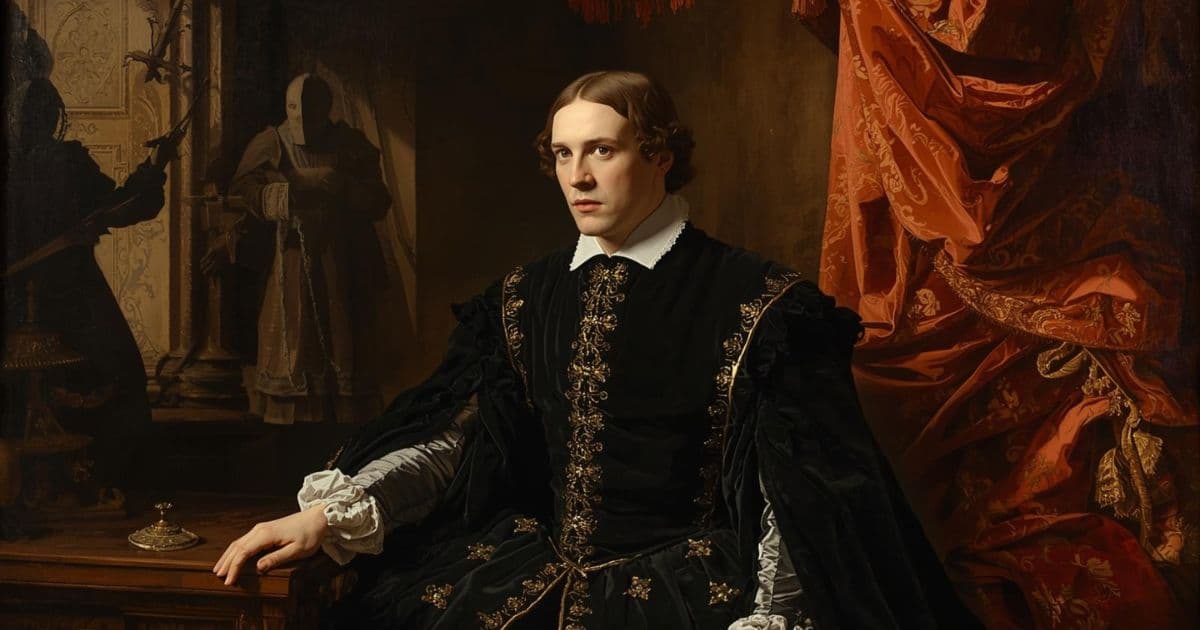
An excerpt from the original text.(complete · 4004 words)
he First Interview With Smerdyakov
This was the third time that Ivan had been to see Smerdyakov since his
return from Moscow. The first time he had seen him and talked to him
was on the first day of his arrival, then he had visited him once more,
a fortnight later. But his visits had ended with that second one, so
that it was now over a month since he had seen him. And he had scarcely
heard anything of him.
Ivan had only returned five days after his father’s death, so that he
was not present at the funeral, which took place the day before he came
back. The cause of his delay was that Alyosha, not knowing his Moscow
address, had to apply to Katerina Ivanovna to telegraph to him, and
she, not knowing his address either, telegraphed to her sister and
aunt, reckoning on Ivan’s going to see them as soon as he arrived in
Moscow. But he did not go to them till four days after his arrival.
When he got the telegram, he had, of course, set off post‐haste to our
town. The first to meet him was Alyosha, and Ivan was greatly surprised
to find that, in opposition to the general opinion of the town, he
refused to entertain a suspicion against Mitya, and spoke openly of
Smerdyakov as the murderer. Later on, after seeing the police captain
and the prosecutor, and hearing the details of the charge and the
arrest, he was still more surprised at Alyosha, and ascribed his
opinion only to his exaggerated brotherly feeling and sympathy with
Mitya, of whom Alyosha, as Ivan knew, was very fond.
By the way, let us say a word or two of Ivan’s feeling to his brother
Dmitri. He positively disliked him; at most, felt sometimes a
compassion for him, and even that was mixed with great contempt, almost
repugnance. Mitya’s whole personality, even his appearance, was
extremely unattractive to him. Ivan looked with indignation on Katerina
Ivanovna’s love for his brother. Yet he went to see Mitya on the first
day of his arrival, and that interview, far from shaking Ivan’s belief
in his guilt, positively strengthened it. He found his brother
agitated, nervously excited. Mitya had been talkative, but very
absent‐minded and incoherent. He used violent language, accused
Smerdyakov, and was fearfully muddled. He talked principally about the
three thousand roubles, which he said had been “stolen” from him by his
father.
“The money was mine, it was my money,” Mitya kept repeating. “Even if I
had stolen it, I should have had the right.”
He hardly contested the evidence against him, and if he tried to turn a
fact to his advantage, it was in an absurd and incoherent way. He
hardly seemed to wish to defend himself to Ivan or any one else. Quite
the contrary, he was angry and proudly scornful of the charges against
him; he was continually firing up and abusing every one. He only
laughed contemptuously at Grigory’s evidence about the open door, and
declared that it was “the devil that opened it.” But he could not bring
forward any coherent explanation of the fact. He even succeeded in
insulting Ivan during their first interview, telling him sharply that
it was not for people who declared that “everything was lawful,” to
suspect and question him. Altogether he was anything but friendly with
Ivan on that occasion. Immediately after that interview with Mitya,
Ivan went for the first time to see Smerdyakov.
In the railway train on his way from Moscow, he kept thinking of
Smerdyakov and of his last conversation with him on the evening before
he went away. Many things seemed to him puzzling and suspicious. But
when he gave his evidence to the investigating lawyer Ivan said
nothing, for the time, of that conversation. He put that off till he
had seen Smerdyakov, who was at that time in the hospital.
Doctor Herzenstube and Varvinsky, the doctor he met in the hospital,
confidently asserted in reply to Ivan’s persistent questions, that
Smerdyakov’s epileptic attack was unmistakably genuine, and were
surprised indeed at Ivan asking whether he might not have been shamming
on the day of the catastrophe. They gave him to understand that the
attack was an exceptional one, the fits persisting and recurring
several times, so that the patient’s life was positively in danger, and
it was only now, after they had applied remedies, that they could
assert with confidence that the patient would survive. “Though it might
well be,” added Doctor Herzenstube, “that his reason would be impaired
for a considerable period, if not permanently.” On Ivan’s asking
impatiently whether that meant that he was now mad, they told him that
this was not yet the case, in the full sense of the word, but that
certain abnormalities were perceptible. Ivan decided to find out for
himself what those abnormalities were.
At the hospital he was at once allowed to see the patient. Smerdyakov
was lying on a truckle‐bed in a separate ward. There was only one other
bed in the room, and in it lay a tradesman of the town, swollen with
dropsy, who was obviously almost dying; he could be no hindrance to
their conversation. Smerdyakov grinned uncertainly on seeing Ivan, and
for the first instant seemed nervous. So at least Ivan fancied. But
that was only momentary. For the rest of the time he was struck, on the
contrary, by Smerdyakov’s composure. From the first glance Ivan had no
doubt that he was very ill. He was very weak; he spoke slowly, seeming
to move his tongue with difficulty; he was much thinner and sallower.
Throughout the interview, which lasted twenty minutes, he kept
complaining of headache and of pain in all his limbs. His thin
emasculate face seemed to have become so tiny; his hair was ruffled,
and his crest of curls in front stood up in a thin tuft. But in the
left eye, which was screwed up and seemed to be insinuating something,
Smerdyakov showed himself unchanged. “It’s always worth while speaking
to a clever man.” Ivan was reminded of that at once. He sat down on the
stool at his feet. Smerdyakov, with painful effort, shifted his
position in bed, but he was not the first to speak. He remained dumb,
and did not even look much interested.
“Can you talk to me?” asked Ivan. “I won’t tire you much.”
“Certainly I can,” mumbled Smerdyakov, in a faint voice. “Has your
honor been back long?” he added patronizingly, as though encouraging a
nervous visitor.
“I only arrived to‐day.... To see the mess you are in here.”
Smerdyakov sighed.
“Why do you sigh? You knew of it all along,” Ivan blurted out.
Smerdyakov was stolidly silent for a while.
“How could I help knowing? It was clear beforehand. But how could I
tell it would turn out like that?”
“What would turn out? Don’t prevaricate! You’ve foretold you’d have a
fit; on the way down to the cellar, you know. You mentioned the very
spot.”
“Have you said so at the examination yet?” Smerdyakov queried with
composure.
Ivan felt suddenly angry.
“No, I haven’t yet, but I certainly shall. You must explain a great
deal to me, my man; and let me tell you, I am not going to let you play
with me!”
“Why should I play with you, when I put my whole trust in you, as in
God Almighty?” said Smerdyakov, with the same composure, only for a
moment closing his eyes.
“In the first place,” began Ivan, “I know that epileptic fits can’t be
told beforehand. I’ve inquired; don’t try and take me in. You can’t
foretell the day and the hour. How was it you told me the day and the
hour beforehand, and about the cellar, too? How could you tell that you
would fall down the cellar stairs in a fit, if you didn’t sham a fit on
purpose?”
“I had to go to the cellar anyway, several times a day, indeed,”
Smerdyakov drawled deliberately. “I fell from the garret just in the
same way a year ago. It’s quite true you can’t tell the day and hour of
a fit beforehand, but you can always have a presentiment of it.”
“But you did foretell the day and the hour!”
“In regard to my epilepsy, sir, you had much better inquire of the
doctors here. You can ask them whether it was a real fit or a sham;
it’s no use my saying any more about it.”
“And the cellar? How could you know beforehand of the cellar?”
“You don’t seem able to get over that cellar! As I was going down to
the cellar, I was in terrible dread and doubt. What frightened me most
was losing you and being left without defense in all the world. So I
went down into the cellar thinking, ‘Here, it’ll come on directly,
it’ll strike me down directly, shall I fall?’ And it was through this
fear that I suddenly felt the spasm that always comes ... and so I went
flying. All that and all my previous conversation with you at the gate
the evening before, when I told you how frightened I was and spoke of
the cellar, I told all that to Doctor Herzenstube and Nikolay
Parfenovitch, the investigating lawyer, and it’s all been written down
in the protocol. And the doctor here, Mr. Varvinsky, maintained to all
of them that it was just the thought of it brought it on, the
apprehension that I might fall. It was just then that the fit seized
me. And so they’ve written it down, that it’s just how it must have
happened, simply from my fear.”
As he finished, Smerdyakov drew a deep breath, as though exhausted.
“Then you have said all that in your evidence?” said Ivan, somewhat
taken aback. He had meant to frighten him with the threat of repeating
their conversation, and it appeared that Smerdyakov had already
reported it all himself.
“What have I to be afraid of? Let them write down the whole truth,”
Smerdyakov pronounced firmly.
“And have you told them every word of our conversation at the gate?”
“No, not to say every word.”
“And did you tell them that you can sham fits, as you boasted then?”
“No, I didn’t tell them that either.”
“Tell me now, why did you send me then to Tchermashnya?”
“I was afraid you’d go away to Moscow; Tchermashnya is nearer, anyway.”
“You are lying; you suggested my going away yourself; you told me to
get out of the way of trouble.”
“That was simply out of affection and my sincere devotion to you,
foreseeing trouble in the house, to spare you. Only I wanted to spare
myself even more. That’s why I told you to get out of harm’s way, that
you might understand that there would be trouble in the house, and
would remain at home to protect your father.”
“You might have said it more directly, you blockhead!” Ivan suddenly
fired up.
“How could I have said it more directly then? It was simply my fear
that made me speak, and you might have been angry, too. I might well
have been apprehensive that Dmitri Fyodorovitch would make a scene and
carry away that money, for he considered it as good as his own; but who
could tell that it would end in a murder like this? I thought that he
would only carry off the three thousand that lay under the master’s
mattress in the envelope, and you see, he’s murdered him. How could you
guess it either, sir?”
“But if you say yourself that it couldn’t be guessed, how could I have
guessed and stayed at home? You contradict yourself!” said Ivan,
pondering.
“You might have guessed from my sending you to Tchermashnya and not to
Moscow.”
“How could I guess it from that?”
Smerdyakov seemed much exhausted, and again he was silent for a minute.
“You might have guessed from the fact of my asking you not to go to
Moscow, but to Tchermashnya, that I wanted to have you nearer, for
Moscow’s a long way off, and Dmitri Fyodorovitch, knowing you are not
far off, would not be so bold. And if anything had happened, you might
have come to protect me, too, for I warned you of Grigory
Vassilyevitch’s illness, and that I was afraid of having a fit. And
when I explained those knocks to you, by means of which one could go in
to the deceased, and that Dmitri Fyodorovitch knew them all through me,
I thought that you would guess yourself that he would be sure to do
something, and so wouldn’t go to Tchermashnya even, but would stay.”
“He talks very coherently,” thought Ivan, “though he does mumble;
what’s the derangement of his faculties that Herzenstube talked of?”
“You are cunning with me, damn you!” he exclaimed, getting angry.
“But I thought at the time that you quite guessed,” Smerdyakov parried
with the simplest air.
“If I’d guessed, I should have stayed,” cried Ivan.
“Why, I thought that it was because you guessed, that you went away in
such a hurry, only to get out of trouble, only to run away and save
yourself in your fright.”
“You think that every one is as great a coward as yourself?”
“Forgive me, I thought you were like me.”
“Of course, I ought to have guessed,” Ivan said in agitation; “and I
did guess there was some mischief brewing on your part ... only you are
lying, you are lying again,” he cried, suddenly recollecting. “Do you
remember how you went up to the carriage and said to me, ‘It’s always
worth while speaking to a clever man’? So you were glad I went away,
since you praised me?”
Smerdyakov sighed again and again. A trace of color came into his face.
“If I was pleased,” he articulated rather breathlessly, “it was simply
because you agreed not to go to Moscow, but to Tchermashnya. For it was
nearer, anyway. Only when I said these words to you, it was not by way
of praise, but of reproach. You didn’t understand it.”
“What reproach?”
“Why, that foreseeing such a calamity you deserted your own father, and
would not protect us, for I might have been taken up any time for
stealing that three thousand.”
“Damn you!” Ivan swore again. “Stay, did you tell the prosecutor and
the investigating lawyer about those knocks?”
“I told them everything just as it was.”
Ivan wondered inwardly again.
“If I thought of anything then,” he began again, “it was solely of some
wickedness on your part. Dmitri might kill him, but that he would
steal—I did not believe that then.... But I was prepared for any
wickedness from you. You told me yourself you could sham a fit. What
did you say that for?”
“It was just through my simplicity, and I never have shammed a fit on
purpose in my life. And I only said so then to boast to you. It was
just foolishness. I liked you so much then, and was open‐hearted with
you.”
“My brother directly accuses you of the murder and theft.”
“What else is left for him to do?” said Smerdyakov, with a bitter grin.
“And who will believe him with all the proofs against him? Grigory
Vassilyevitch saw the door open. What can he say after that? But never
mind him! He is trembling to save himself.”
He slowly ceased speaking; then suddenly, as though on reflection,
added:
“And look here again. He wants to throw it on me and make out that it
is the work of my hands—I’ve heard that already. But as to my being
clever at shamming a fit: should I have told you beforehand that I
could sham one, if I really had had such a design against your father?
If I had been planning such a murder could I have been such a fool as
to give such evidence against myself beforehand? And to his son, too!
Upon my word! Is that likely? As if that could be, such a thing has
never happened. No one hears this talk of ours now, except Providence
itself, and if you were to tell of it to the prosecutor and Nikolay
Parfenovitch you might defend me completely by doing so, for who would
be likely to be such a criminal, if he is so open‐hearted beforehand?
Any one can see that.”
“Well,” and Ivan got up to cut short the conversation, struck by
Smerdyakov’s last argument. “I don’t suspect you at all, and I think
it’s absurd, indeed, to suspect you. On the contrary, I am grateful to
you for setting my mind at rest. Now I am going, but I’ll come again.
Meanwhile, good‐by. Get well. Is there anything you want?”
“I am very thankful for everything. Marfa Ignatyevna does not forget
me, and provides me anything I want, according to her kindness. Good
people visit me every day.”
“Good‐by. But I shan’t say anything of your being able to sham a fit,
and I don’t advise you to, either,” something made Ivan say suddenly.
“I quite understand. And if you don’t speak of that, I shall say
nothing of that conversation of ours at the gate.”
Then it happened that Ivan went out, and only when he had gone a dozen
steps along the corridor, he suddenly felt that there was an insulting
significance in Smerdyakov’s last words. He was almost on the point of
turning back, but it was only a passing impulse, and muttering,
“Nonsense!” he went out of the hospital.
His chief feeling was one of relief at the fact that it was not
Smerdyakov, but Mitya, who had committed the murder, though he might
have been expected to feel the opposite. He did not want to analyze the
reason for this feeling, and even felt a positive repugnance at prying
into his sensations. He felt as though he wanted to make haste to
forget something. In the following days he became convinced of Mitya’s
guilt, as he got to know all the weight of evidence against him. There
was evidence of people of no importance, Fenya and her mother, for
instance, but the effect of it was almost overpowering. As to Perhotin,
the people at the tavern, and at Plotnikov’s shop, as well as the
witnesses at Mokroe, their evidence seemed conclusive. It was the
details that were so damning. The secret of the knocks impressed the
lawyers almost as much as Grigory’s evidence as to the open door.
Grigory’s wife, Marfa, in answer to Ivan’s questions, declared that
Smerdyakov had been lying all night the other side of the partition
wall. “He was not three paces from our bed,” and that although she was
a sound sleeper she waked several times and heard him moaning, “He was
moaning the whole time, moaning continually.”
Talking to Herzenstube, and giving it as his opinion that Smerdyakov
was not mad, but only rather weak, Ivan only evoked from the old man a
subtle smile.
“Do you know how he spends his time now?” he asked; “learning lists of
French words by heart. He has an exercise‐book under his pillow with
the French words written out in Russian letters for him by some one, he
he he!”
Ivan ended by dismissing all doubts. He could not think of Dmitri
without repulsion. Only one thing was strange, however. Alyosha
persisted that Dmitri was not the murderer, and that “in all
probability” Smerdyakov was. Ivan always felt that Alyosha’s opinion
meant a great deal to him, and so he was astonished at it now. Another
thing that was strange was that Alyosha did not make any attempt to
talk about Mitya with Ivan, that he never began on the subject and only
answered his questions. This, too, struck Ivan particularly.
But he was very much preoccupied at that time with something quite
apart from that. On his return from Moscow, he abandoned himself
hopelessly to his mad and consuming passion for Katerina Ivanovna. This
is not the time to begin to speak of this new passion of Ivan’s, which
left its mark on all the rest of his life: this would furnish the
subject for another novel, which I may perhaps never write. But I
cannot omit to mention here that when Ivan, on leaving Katerina
Ivanovna with Alyosha, as I’ve related already, told him, “I am not
keen on her,” it was an absolute lie: he loved her madly, though at
times he hated her so that he might have murdered her. Many causes
helped to bring about this feeling. Shattered by what had happened with
Mitya, she rushed on Ivan’s return to meet him as her one salvation.
She was hurt, insulted and humiliated in her feelings. And here the man
had come back to her, who had loved her so ardently before (oh! she
knew that very well), and whose heart and intellect she considered so
superior to her own. But the sternly virtuous girl did not abandon
herself altogether to the man she loved, in spite of the Karamazov
violence of his passions and the great fascination he had for her. She
was continually tormented at the same time by remorse for having
deserted Mitya, and in moments of discord and violent anger (and they
were numerous) she told Ivan so plainly. This was what he had called to
Alyosha “lies upon lies.” There was, of course, much that was false in
it, and that angered Ivan more than anything.... But of all this later.
He did, in fact, for a time almost forget Smerdyakov’s existence, and
yet, a fortnight after his first visit to him, he began to be haunted
by the same strange thoughts as before. It’s enough to say that he was
continually asking himself, why was it that on that last night in
Fyodor Pavlovitch’s house he had crept out on to the stairs like a
thief and listened to hear what his father was doing below? Why had he
recalled that afterwards with repulsion? Why next morning, had he been
suddenly so depressed on the journey? Why, as he reached Moscow, had he
said to himself, “I am a scoundrel”? And now he almost fancied that
these tormenting thoughts would make him even forget Katerina Ivanovna,
so completely did they take possession of him again. It was just after
fancying this, that he met Alyosha in the street. He stopped him at
once, and put a question to him:
“Do you remember when Dmitri burst in after dinner and beat father, and
afterwards I told you in the yard that I reserved ‘the right to
desire’?... Tell me, did you think then that I desired father’s death
or not?”
“I did think so,” answered Alyosha, softly.
“It was so, too; it was not a matter of guessing. But didn’t you fancy
then that what I wished was just that ‘one reptile should devour
another’; that is, just that Dmitri should kill father, and as soon as
possible ... and that I myself was even prepared to help to bring that
about?”
Alyosha turned rather pale, and looked silently into his brother’s
face.
“Speak!” cried Ivan, “I want above everything to know what you thought
then. I want the truth, the truth!”
He drew a deep breath, looking angrily at Alyosha before his answer
came.
“Forgive me, I did think that, too, at the time,” whispered Alyosha,
and he did not add one softening phrase.
“Thanks,” snapped Ivan, and, leaving Alyosha, he went quickly on his
way. From that time Alyosha noticed that Ivan began obviously to avoid
him and seemed even to have taken a dislike to him, so much so that
Alyosha gave up going to see him. Immediately after that meeting with
him, Ivan had not gone home, but went straight to Smerdyakov again.
Master this chapter. Complete your experience
Purchase the complete book to access all chapters and support classic literature
As an Amazon Associate, we earn a small commission from qualifying purchases at no additional cost to you.
Available in paperback, hardcover, and e-book formats
Let's Analyse the Pattern
When carrying secret guilt or shame, we become aggressive investigators of others' wrongdoing to avoid confronting our own.
Why This Matters
Connect literature to life
This chapter teaches how aggressive moral policing often masks personal guilt and unexamined conscience.
Practice This Today
This week, notice when you become unusually focused on someone else's wrongdoing - pause and ask yourself what you might be avoiding examining in your own behavior.
Now let's explore the literary elements.
Key Quotes & Analysis
"I was afraid that you might do something crazy in your anger"
Context: Explaining why he warned Ivan about leaving town before the murder
This shows Smerdyakov's manipulative intelligence - he plants the idea that his warnings were protective rather than incriminating. He's making Ivan complicit by suggesting Ivan was capable of violence.
In Today's Words:
I was worried you might lose it and do something stupid when you got mad
"I hoped that Mitya would kill him, and I didn't try to prevent it"
Context: Ivan's confession to Alyosha about his true feelings
This brutal honesty reveals Ivan's moral crisis - he's admitting to passive participation in his father's potential murder through his wishes and inaction. It's the core of his guilt.
In Today's Words:
I wanted my brother to kill our dad, and I didn't try to stop it
"You knew it would happen, and you went away"
Context: Confronting Ivan about his departure before the murder
Alyosha cuts through Ivan's rationalizations to the heart of his moral failure. This simple statement forces Ivan to face that his leaving wasn't innocent - it was enabling.
In Today's Words:
You saw this coming and you bailed
Thematic Threads
Guilt
In This Chapter
Ivan's secret wish for his father's death creates desperate need to prove someone else is the killer
Development
Evolved from Ivan's earlier philosophical detachment to active psychological torment
In Your Life:
Notice when your strongest moral outrage might be covering your own uncomfortable truths
Truth
In This Chapter
Smerdyakov's answers are simultaneously truthful and evasive, revealing how facts can mislead
Development
Building on earlier themes about multiple versions of truth within families
In Your Life:
Someone can tell you facts while hiding the real truth you need to hear
Class
In This Chapter
Ivan interrogates the servant while avoiding his own privileged complicity in family violence
Development
Continues pattern of upper-class characters using lower-class ones as scapegoats
In Your Life:
Power dynamics shape who gets blamed and who gets believed in difficult situations
Brotherhood
In This Chapter
Ivan's confession to Alyosha creates distance between them, showing how honesty can damage relationships
Development
First major crack in the brothers' bonds, contrasting earlier mutual support
In Your Life:
Sometimes telling the truth about your dark thoughts pushes away the people you need most
Complicity
In This Chapter
Ivan realizes his desires contributed to the murder without his direct action
Development
Introduced here as new recognition of indirect responsibility
In Your Life:
Your unexpressed wishes and silent encouragement can make you partly responsible for others' actions
You now have the context. Time to form your own thoughts.
Discussion Questions
- 1
Why does Ivan interrogate Smerdyakov so aggressively, and what is he really trying to prove?
analysis • surface - 2
How does Ivan's confession to Alyosha about secretly wishing their father dead change our understanding of his behavior throughout the investigation?
analysis • medium - 3
Think about times when people become unusually focused on others' mistakes or wrongdoing. What patterns do you notice in your workplace, family, or community?
application • medium - 4
When you catch yourself obsessing over someone else's behavior or building a case against them, what questions should you ask yourself first?
application • deep - 5
What does Ivan's relief at Mitya's apparent guilt reveal about how we handle our own moral failures and dark impulses?
reflection • deep
Critical Thinking Exercise
Track Your Projection Patterns
Think of a recent situation where you found yourself unusually critical of someone else's behavior or mistakes. Write down what they did wrong, then honestly examine what you might have been avoiding in your own actions or thoughts. Look for connections between your criticism of them and your own unresolved guilt or shortcomings.
Consider:
- •The louder your criticism, the more likely you're projecting something personal
- •Ask yourself: 'Am I building a case or addressing a genuine concern?'
- •Notice if you feel relief when others are caught doing what you've done or wanted to do
Journaling Prompt
Write about a time when you realized your harsh judgment of someone else was really about your own behavior or desires. How did recognizing this pattern change how you handled similar situations?
Coming Up Next...
Chapter 76: The Web of Mutual Accusation
Ivan's doubts about Smerdyakov refuse to stay buried. Despite his relief and the mounting evidence against Mitya, something about that hospital conversation continues to gnaw at him, drawing him back for another confrontation.