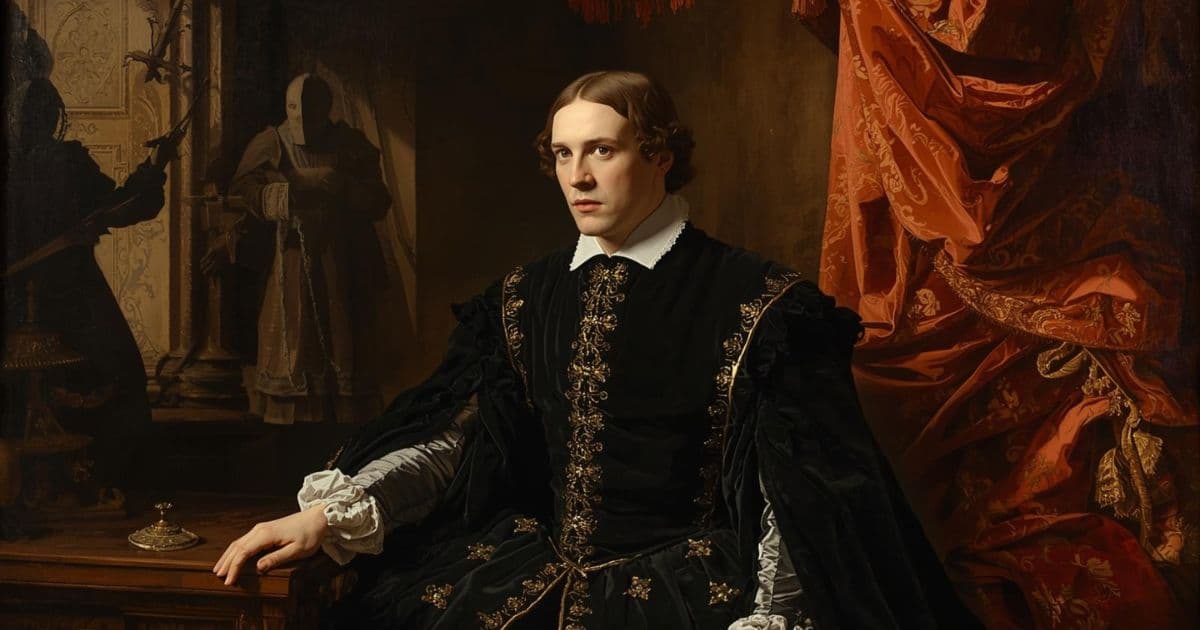
An excerpt from the original text.(complete · 3576 words)
he Old Buffoon
They entered the room almost at the same moment that the elder came in
from his bedroom. There were already in the cell, awaiting the elder,
two monks of the hermitage, one the Father Librarian, and the other
Father Païssy, a very learned man, so they said, in delicate health,
though not old. There was also a tall young man, who looked about two
and twenty, standing in the corner throughout the interview. He had a
broad, fresh face, and clever, observant, narrow brown eyes, and was
wearing ordinary dress. He was a divinity student, living under the
protection of the monastery. His expression was one of unquestioning,
but self‐respecting, reverence. Being in a subordinate and dependent
position, and so not on an equality with the guests, he did not greet
them with a bow.
Father Zossima was accompanied by a novice, and by Alyosha. The two
monks rose and greeted him with a very deep bow, touching the ground
with their fingers; then kissed his hand. Blessing them, the elder
replied with as deep a reverence to them, and asked their blessing. The
whole ceremony was performed very seriously and with an appearance of
feeling, not like an everyday rite. But Miüsov fancied that it was all
done with intentional impressiveness. He stood in front of the other
visitors. He ought—he had reflected upon it the evening before—from
simple politeness, since it was the custom here, to have gone up to
receive the elder’s blessing, even if he did not kiss his hand. But
when he saw all this bowing and kissing on the part of the monks he
instantly changed his mind. With dignified gravity he made a rather
deep, conventional bow, and moved away to a chair. Fyodor Pavlovitch
did the same, mimicking Miüsov like an ape. Ivan bowed with great
dignity and courtesy, but he too kept his hands at his sides, while
Kalganov was so confused that he did not bow at all. The elder let fall
the hand raised to bless them, and bowing to them again, asked them all
to sit down. The blood rushed to Alyosha’s cheeks. He was ashamed. His
forebodings were coming true.
Father Zossima sat down on a very old‐fashioned mahogany sofa, covered
with leather, and made his visitors sit down in a row along the
opposite wall on four mahogany chairs, covered with shabby black
leather. The monks sat, one at the door and the other at the window.
The divinity student, the novice, and Alyosha remained standing. The
cell was not very large and had a faded look. It contained nothing but
the most necessary furniture, of coarse and poor quality. There were
two pots of flowers in the window, and a number of holy pictures in the
corner. Before one huge ancient ikon of the Virgin a lamp was burning.
Near it were two other holy pictures in shining settings, and, next
them, carved cherubims, china eggs, a Catholic cross of ivory, with a
Mater Dolorosa embracing it, and several foreign engravings from the
great Italian artists of past centuries. Next to these costly and
artistic engravings were several of the roughest Russian prints of
saints and martyrs, such as are sold for a few farthings at all the
fairs. On the other walls were portraits of Russian bishops, past and
present.
Miüsov took a cursory glance at all these “conventional” surroundings
and bent an intent look upon the elder. He had a high opinion of his
own insight, a weakness excusable in him as he was fifty, an age at
which a clever man of the world of established position can hardly help
taking himself rather seriously. At the first moment he did not like
Zossima. There was, indeed, something in the elder’s face which many
people besides Miüsov might not have liked. He was a short, bent,
little man, with very weak legs, and though he was only sixty‐five, he
looked at least ten years older. His face was very thin and covered
with a network of fine wrinkles, particularly numerous about his eyes,
which were small, light‐colored, quick, and shining like two bright
points. He had a sprinkling of gray hair about his temples. His pointed
beard was small and scanty, and his lips, which smiled frequently, were
as thin as two threads. His nose was not long, but sharp, like a bird’s
beak.
“To all appearances a malicious soul, full of petty pride,” thought
Miüsov. He felt altogether dissatisfied with his position.
A cheap little clock on the wall struck twelve hurriedly, and served to
begin the conversation.
“Precisely to our time,” cried Fyodor Pavlovitch, “but no sign of my
son, Dmitri. I apologize for him, sacred elder!” (Alyosha shuddered all
over at “sacred elder.”) “I am always punctual myself, minute for
minute, remembering that punctuality is the courtesy of kings....”
“But you are not a king, anyway,” Miüsov muttered, losing his self‐
restraint at once.
“Yes; that’s true. I’m not a king, and, would you believe it, Pyotr
Alexandrovitch, I was aware of that myself. But, there! I always say
the wrong thing. Your reverence,” he cried, with sudden pathos, “you
behold before you a buffoon in earnest! I introduce myself as such.
It’s an old habit, alas! And if I sometimes talk nonsense out of place
it’s with an object, with the object of amusing people and making
myself agreeable. One must be agreeable, mustn’t one? I was seven years
ago in a little town where I had business, and I made friends with some
merchants there. We went to the captain of police because we had to see
him about something, and to ask him to dine with us. He was a tall,
fat, fair, sulky man, the most dangerous type in such cases. It’s their
liver. I went straight up to him, and with the ease of a man of the
world, you know, ‘Mr. Ispravnik,’ said I, ‘be our Napravnik.’ ‘What do
you mean by Napravnik?’ said he. I saw, at the first half‐second, that
it had missed fire. He stood there so glum. ‘I wanted to make a joke,’
said I, ‘for the general diversion, as Mr. Napravnik is our well‐known
Russian orchestra conductor and what we need for the harmony of our
undertaking is some one of that sort.’ And I explained my comparison
very reasonably, didn’t I? ‘Excuse me,’ said he, ‘I am an Ispravnik,
and I do not allow puns to be made on my calling.’ He turned and walked
away. I followed him, shouting, ‘Yes, yes, you are an Ispravnik, not a
Napravnik.’ ‘No,’ he said, ‘since you called me a Napravnik I am one.’
And would you believe it, it ruined our business! And I’m always like
that, always like that. Always injuring myself with my politeness.
Once, many years ago, I said to an influential person: ‘Your wife is a
ticklish lady,’ in an honorable sense, of the moral qualities, so to
speak. But he asked me, ‘Why, have you tickled her?’ I thought I’d be
polite, so I couldn’t help saying, ‘Yes,’ and he gave me a fine
tickling on the spot. Only that happened long ago, so I’m not ashamed
to tell the story. I’m always injuring myself like that.”
“You’re doing it now,” muttered Miüsov, with disgust.
Father Zossima scrutinized them both in silence.
“Am I? Would you believe it, I was aware of that, too, Pyotr
Alexandrovitch, and let me tell you, indeed, I foresaw I should as soon
as I began to speak. And do you know I foresaw, too, that you’d be the
first to remark on it. The minute I see my joke isn’t coming off, your
reverence, both my cheeks feel as though they were drawn down to the
lower jaw and there is almost a spasm in them. That’s been so since I
was young, when I had to make jokes for my living in noblemen’s
families. I am an inveterate buffoon, and have been from birth up, your
reverence, it’s as though it were a craze in me. I dare say it’s a
devil within me. But only a little one. A more serious one would have
chosen another lodging. But not your soul, Pyotr Alexandrovitch; you’re
not a lodging worth having either. But I do believe—I believe in God,
though I have had doubts of late. But now I sit and await words of
wisdom. I’m like the philosopher, Diderot, your reverence. Did you ever
hear, most Holy Father, how Diderot went to see the Metropolitan
Platon, in the time of the Empress Catherine? He went in and said
straight out, ‘There is no God.’ To which the great bishop lifted up
his finger and answered, ‘The fool hath said in his heart there is no
God.’ And he fell down at his feet on the spot. ‘I believe,’ he cried,
‘and will be christened.’ And so he was. Princess Dashkov was his
godmother, and Potyomkin his godfather.”
“Fyodor Pavlovitch, this is unbearable! You know you’re telling lies
and that that stupid anecdote isn’t true. Why are you playing the
fool?” cried Miüsov in a shaking voice.
“I suspected all my life that it wasn’t true,” Fyodor Pavlovitch cried
with conviction. “But I’ll tell you the whole truth, gentlemen. Great
elder! Forgive me, the last thing about Diderot’s christening I made up
just now. I never thought of it before. I made it up to add piquancy. I
play the fool, Pyotr Alexandrovitch, to make myself agreeable. Though I
really don’t know myself, sometimes, what I do it for. And as for
Diderot, I heard as far as ‘the fool hath said in his heart’ twenty
times from the gentry about here when I was young. I heard your aunt,
Pyotr Alexandrovitch, tell the story. They all believe to this day that
the infidel Diderot came to dispute about God with the Metropolitan
Platon....”
Miüsov got up, forgetting himself in his impatience. He was furious,
and conscious of being ridiculous.
What was taking place in the cell was really incredible. For forty or
fifty years past, from the times of former elders, no visitors had
entered that cell without feelings of the profoundest veneration.
Almost every one admitted to the cell felt that a great favor was being
shown him. Many remained kneeling during the whole visit. Of those
visitors, many had been men of high rank and learning, some even
freethinkers, attracted by curiosity, but all without exception had
shown the profoundest reverence and delicacy, for here there was no
question of money, but only, on the one side love and kindness, and on
the other penitence and eager desire to decide some spiritual problem
or crisis. So that such buffoonery amazed and bewildered the
spectators, or at least some of them. The monks, with unchanged
countenances, waited, with earnest attention, to hear what the elder
would say, but seemed on the point of standing up, like Miüsov. Alyosha
stood, with hanging head, on the verge of tears. What seemed to him
strangest of all was that his brother Ivan, on whom alone he had rested
his hopes, and who alone had such influence on his father that he could
have stopped him, sat now quite unmoved, with downcast eyes, apparently
waiting with interest to see how it would end, as though he had nothing
to do with it. Alyosha did not dare to look at Rakitin, the divinity
student, whom he knew almost intimately. He alone in the monastery knew
Rakitin’s thoughts.
“Forgive me,” began Miüsov, addressing Father Zossima, “for perhaps I
seem to be taking part in this shameful foolery. I made a mistake in
believing that even a man like Fyodor Pavlovitch would understand what
was due on a visit to so honored a personage. I did not suppose I
should have to apologize simply for having come with him....”
Pyotr Alexandrovitch could say no more, and was about to leave the
room, overwhelmed with confusion.
“Don’t distress yourself, I beg.” The elder got on to his feeble legs,
and taking Pyotr Alexandrovitch by both hands, made him sit down again.
“I beg you not to disturb yourself. I particularly beg you to be my
guest.” And with a bow he went back and sat down again on his little
sofa.
“Great elder, speak! Do I annoy you by my vivacity?” Fyodor Pavlovitch
cried suddenly, clutching the arms of his chair in both hands, as
though ready to leap up from it if the answer were unfavorable.
“I earnestly beg you, too, not to disturb yourself, and not to be
uneasy,” the elder said impressively. “Do not trouble. Make yourself
quite at home. And, above all, do not be so ashamed of yourself, for
that is at the root of it all.”
“Quite at home? To be my natural self? Oh, that is much too much, but I
accept it with grateful joy. Do you know, blessed Father, you’d better
not invite me to be my natural self. Don’t risk it.... I will not go so
far as that myself. I warn you for your own sake. Well, the rest is
still plunged in the mists of uncertainty, though there are people
who’d be pleased to describe me for you. I mean that for you, Pyotr
Alexandrovitch. But as for you, holy being, let me tell you, I am
brimming over with ecstasy.”
He got up, and throwing up his hands, declaimed, “Blessed be the womb
that bare thee, and the paps that gave thee suck—the paps especially.
When you said just now, ‘Don’t be so ashamed of yourself, for that is
at the root of it all,’ you pierced right through me by that remark,
and read me to the core. Indeed, I always feel when I meet people that
I am lower than all, and that they all take me for a buffoon. So I say,
‘Let me really play the buffoon. I am not afraid of your opinion, for
you are every one of you worse than I am.’ That is why I am a buffoon.
It is from shame, great elder, from shame; it’s simply
over‐sensitiveness that makes me rowdy. If I had only been sure that
every one would accept me as the kindest and wisest of men, oh, Lord,
what a good man I should have been then! Teacher!” he fell suddenly on
his knees, “what must I do to gain eternal life?”
It was difficult even now to decide whether he was joking or really
moved.
Father Zossima, lifting his eyes, looked at him, and said with a smile:
“You have known for a long time what you must do. You have sense
enough: don’t give way to drunkenness and incontinence of speech; don’t
give way to sensual lust; and, above all, to the love of money. And
close your taverns. If you can’t close all, at least two or three. And,
above all—don’t lie.”
“You mean about Diderot?”
“No, not about Diderot. Above all, don’t lie to yourself. The man who
lies to himself and listens to his own lie comes to such a pass that he
cannot distinguish the truth within him, or around him, and so loses
all respect for himself and for others. And having no respect he ceases
to love, and in order to occupy and distract himself without love he
gives way to passions and coarse pleasures, and sinks to bestiality in
his vices, all from continual lying to other men and to himself. The
man who lies to himself can be more easily offended than any one. You
know it is sometimes very pleasant to take offense, isn’t it? A man may
know that nobody has insulted him, but that he has invented the insult
for himself, has lied and exaggerated to make it picturesque, has
caught at a word and made a mountain out of a molehill—he knows that
himself, yet he will be the first to take offense, and will revel in
his resentment till he feels great pleasure in it, and so pass to
genuine vindictiveness. But get up, sit down, I beg you. All this, too,
is deceitful posturing....”
“Blessed man! Give me your hand to kiss.”
Fyodor Pavlovitch skipped up, and imprinted a rapid kiss on the elder’s
thin hand. “It is, it is pleasant to take offense. You said that so
well, as I never heard it before. Yes, I have been all my life taking
offense, to please myself, taking offense on esthetic grounds, for it
is not so much pleasant as distinguished sometimes to be insulted—that
you had forgotten, great elder, it is distinguished! I shall make a
note of that. But I have been lying, lying positively my whole life
long, every day and hour of it. Of a truth, I am a lie, and the father
of lies. Though I believe I am not the father of lies. I am getting
mixed in my texts. Say, the son of lies, and that will be enough. Only
... my angel ... I may sometimes talk about Diderot! Diderot will do no
harm, though sometimes a word will do harm. Great elder, by the way, I
was forgetting, though I had been meaning for the last two years to
come here on purpose to ask and to find out something. Only do tell
Pyotr Alexandrovitch not to interrupt me. Here is my question: Is it
true, great Father, that the story is told somewhere in the Lives of
the Saints of a holy saint martyred for his faith who, when his head
was cut off at last, stood up, picked up his head, and, ‘courteously
kissing it,’ walked a long way, carrying it in his hands. Is that true
or not, honored Father?”
“No, it is untrue,” said the elder.
“There is nothing of the kind in all the lives of the saints. What
saint do you say the story is told of?” asked the Father Librarian.
“I do not know what saint. I do not know, and can’t tell. I was
deceived. I was told the story. I had heard it, and do you know who
told it? Pyotr Alexandrovitch Miüsov here, who was so angry just now
about Diderot. He it was who told the story.”
“I have never told it you, I never speak to you at all.”
“It is true you did not tell me, but you told it when I was present. It
was three years ago. I mentioned it because by that ridiculous story
you shook my faith, Pyotr Alexandrovitch. You knew nothing of it, but I
went home with my faith shaken, and I have been getting more and more
shaken ever since. Yes, Pyotr Alexandrovitch, you were the cause of a
great fall. That was not a Diderot!”
Fyodor Pavlovitch got excited and pathetic, though it was perfectly
clear to every one by now that he was playing a part again. Yet Miüsov
was stung by his words.
“What nonsense, and it is all nonsense,” he muttered. “I may really
have told it, some time or other ... but not to you. I was told it
myself. I heard it in Paris from a Frenchman. He told me it was read at
our mass from the Lives of the Saints ... he was a very learned man
who had made a special study of Russian statistics and had lived a long
time in Russia.... I have not read the Lives of the Saints myself,
and I am not going to read them ... all sorts of things are said at
dinner—we were dining then.”
“Yes, you were dining then, and so I lost my faith!” said Fyodor
Pavlovitch, mimicking him.
“What do I care for your faith?” Miüsov was on the point of shouting,
but he suddenly checked himself, and said with contempt, “You defile
everything you touch.”
The elder suddenly rose from his seat. “Excuse me, gentlemen, for
leaving you a few minutes,” he said, addressing all his guests. “I have
visitors awaiting me who arrived before you. But don’t you tell lies
all the same,” he added, turning to Fyodor Pavlovitch with a
good‐humored face. He went out of the cell. Alyosha and the novice flew
to escort him down the steps. Alyosha was breathless: he was glad to
get away, but he was glad, too, that the elder was good‐humored and not
offended. Father Zossima was going towards the portico to bless the
people waiting for him there. But Fyodor Pavlovitch persisted in
stopping him at the door of the cell.
“Blessed man!” he cried, with feeling. “Allow me to kiss your hand once
more. Yes, with you I could still talk, I could still get on. Do you
think I always lie and play the fool like this? Believe me, I have been
acting like this all the time on purpose to try you. I have been
testing you all the time to see whether I could get on with you. Is
there room for my humility beside your pride? I am ready to give you a
testimonial that one can get on with you! But now, I’ll be quiet; I
will keep quiet all the time. I’ll sit in a chair and hold my tongue.
Now it is for you to speak, Pyotr Alexandrovitch. You are the principal
person left now—for ten minutes.”
Master this chapter. Complete your experience
Purchase the complete book to access all chapters and support classic literature
As an Amazon Associate, we earn a small commission from qualifying purchases at no additional cost to you.
Available in paperback, hardcover, and e-book formats
Let's Analyse the Pattern
Using self-sabotage and clownish behavior to control how others perceive us, preventing genuine connection while protecting the ego from authentic rejection.
Why This Matters
Connect literature to life
This chapter teaches how to recognize when someone (including yourself) uses performance and chaos as shields against vulnerability and genuine evaluation.
Practice This Today
This week, notice when you make self-deprecating jokes or perform incompetence in situations where you could show genuine effort instead.
Now let's explore the literary elements.
Key Quotes & Analysis
"I am a buffoon and I know it. But what if everyone who comes to you is a buffoon?"
Context: Fyodor admits his clownish behavior while challenging the elder's other visitors
This reveals Fyodor's self-awareness about his performance while deflecting responsibility. He's saying everyone else is fake too, so why should he be different? It's a classic defense mechanism.
In Today's Words:
Yeah, I'm a mess, but isn't everyone else here just pretending to be better than they are?
"Above all, don't lie to yourself. The man who lies to himself and listens to his own lie comes to a point that he cannot distinguish the truth within him."
Context: The elder's core advice to Fyodor about spiritual growth
This is Dostoevsky's central insight about human psychology. Self-deception destroys our ability to navigate reality and have genuine relationships. It's the foundation of all other problems.
In Today's Words:
Stop making excuses and lying to yourself - once you start believing your own BS, you lose track of what's actually real.
"I always feel when I meet people that I am lower than all, and that they all take me for a buffoon; so I say let me play the buffoon."
Context: Fyodor explains why he acts out in social situations
This shows how shame drives destructive behavior. Rather than risk genuine connection and possible rejection, he controls the narrative by playing the fool first. It's self-sabotage disguised as self-protection.
In Today's Words:
I assume everyone thinks I'm a loser anyway, so I might as well act like one before they figure it out.
Thematic Threads
Shame
In This Chapter
Fyodor's buffoonery stems from deep shame and his belief that everyone sees him as lower than themselves
Development
Building from earlier hints of family dysfunction—now we see how shame drives destructive behavior
In Your Life:
You might recognize this when you make jokes about your own failures before others can judge you.
Self-Deception
In This Chapter
Zossima identifies lying to oneself as the root of all other problems, destroying our ability to distinguish truth
Development
Introduced here as a central spiritual and psychological concept
In Your Life:
You might see this when you tell yourself you 'don't care' about something that actually matters deeply to you.
Performance vs Authenticity
In This Chapter
Fyodor chooses theatrical buffoonery over genuine interaction, controlling the narrative through self-degradation
Development
Introduced here—the tension between protective performance and vulnerable truth
In Your Life:
You might notice this when you act like the 'class clown' at work to avoid being seen as incompetent.
Spiritual Authority
In This Chapter
Father Zossima sees through Fyodor's act and offers practical, not mystical, guidance for change
Development
Developing from earlier reverence for the elder—now we see his actual wisdom in action
In Your Life:
You might recognize this in mentors who cut through your excuses to address what you actually need to change.
Class and Social Position
In This Chapter
Fyodor's behavior reflects his assumption that others see him as beneath them socially
Development
Building on established themes of social hierarchy and family dysfunction
In Your Life:
You might feel this when you assume people with more education or money automatically look down on you.
You now have the context. Time to form your own thoughts.
Discussion Questions
- 1
Why does Fyodor choose to act like a buffoon in the monastery instead of showing respect?
analysis • surface - 2
What does Fyodor mean when he says he performs foolishness because he believes everyone already sees him as lower than themselves?
analysis • medium - 3
Where do you see people using humor or chaos to avoid genuine vulnerability in your own life?
application • medium - 4
Father Zossima tells Fyodor to stop lying to himself above all else. How would you help someone recognize when they're deceiving themselves?
application • deep - 5
What does this chapter reveal about the relationship between shame and self-sabotage?
reflection • deep
Critical Thinking Exercise
Map Your Own Performance Patterns
Think about situations where you feel insecure or judged. Write down three specific ways you might 'perform' to control how others see you—through humor, self-deprecation, creating chaos, or other defensive behaviors. For each pattern, identify what you're really trying to protect or avoid.
Consider:
- •Consider both obvious performances (like making jokes when nervous) and subtle ones (like always being 'too busy' to commit to plans)
- •Notice the difference between genuine humor or humility versus defensive performance
- •Think about what small truth you could share instead of the performance
Journaling Prompt
Write about a time when you dropped a defensive performance and showed up authentically. What happened? How did it feel different from performing your expected role?
Coming Up Next...
Chapter 8: The Healing Power of Being Heard
Father Zossima steps outside to meet with peasant women who have traveled far to seek his blessing and counsel. Their simple, desperate faith will provide a stark contrast to the theatrical doubt and manipulation we've just witnessed.