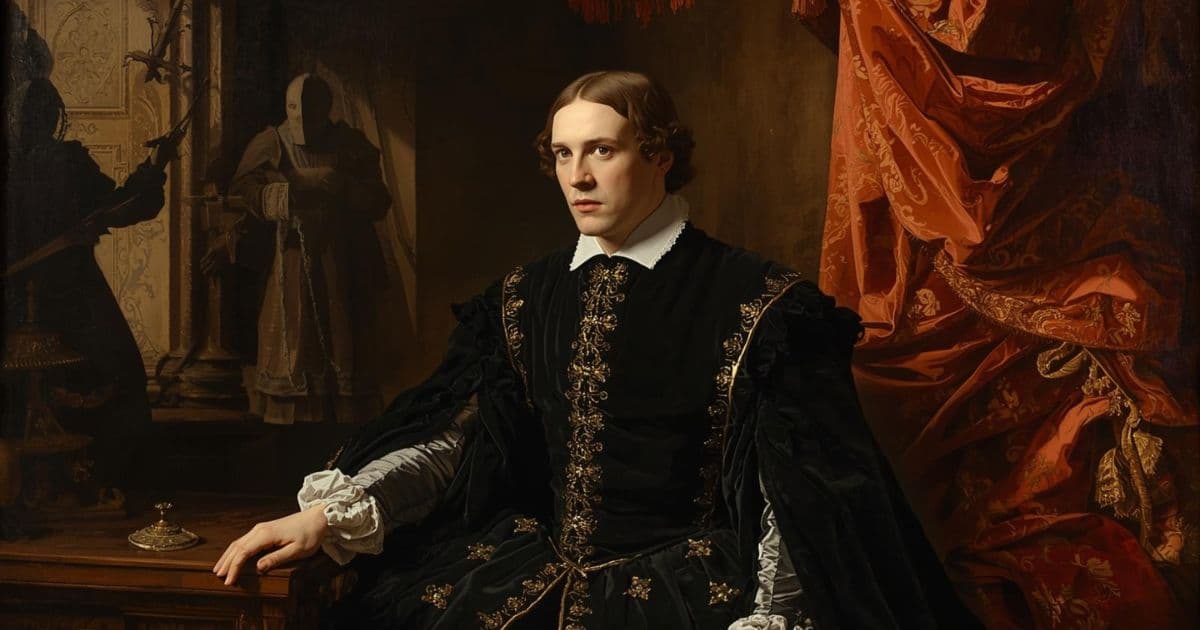
An excerpt from the original text.(complete · 3576 words)
he Sufferings Of A Soul, The First Ordeal
And so Mitya sat looking wildly at the people round him, not
understanding what was said to him. Suddenly he got up, flung up his
hands, and shouted aloud:
“I’m not guilty! I’m not guilty of that blood! I’m not guilty of my
father’s blood.... I meant to kill him. But I’m not guilty. Not I.”
But he had hardly said this, before Grushenka rushed from behind the
curtain and flung herself at the police captain’s feet.
“It was my fault! Mine! My wickedness!” she cried, in a heartrending
voice, bathed in tears, stretching out her clasped hands towards them.
“He did it through me. I tortured him and drove him to it. I tortured
that poor old man that’s dead, too, in my wickedness, and brought him
to this! It’s my fault, mine first, mine most, my fault!”
“Yes, it’s your fault! You’re the chief criminal! You fury! You harlot!
You’re the most to blame!” shouted the police captain, threatening her
with his hand. But he was quickly and resolutely suppressed. The
prosecutor positively seized hold of him.
“This is absolutely irregular, Mihail Makarovitch!” he cried. “You are
positively hindering the inquiry.... You’re ruining the case....” he
almost gasped.
“Follow the regular course! Follow the regular course!” cried Nikolay
Parfenovitch, fearfully excited too, “otherwise it’s absolutely
impossible!...”
“Judge us together!” Grushenka cried frantically, still kneeling.
“Punish us together. I will go with him now, if it’s to death!”
“Grusha, my life, my blood, my holy one!” Mitya fell on his knees
beside her and held her tight in his arms. “Don’t believe her,” he
cried, “she’s not guilty of anything, of any blood, of anything!”
He remembered afterwards that he was forcibly dragged away from her by
several men, and that she was led out, and that when he recovered
himself he was sitting at the table. Beside him and behind him stood
the men with metal plates. Facing him on the other side of the table
sat Nikolay Parfenovitch, the investigating lawyer. He kept persuading
him to drink a little water out of a glass that stood on the table.
“That will refresh you, that will calm you. Be calm, don’t be
frightened,” he added, extremely politely. Mitya (he remembered it
afterwards) became suddenly intensely interested in his big rings, one
with an amethyst, and another with a transparent bright yellow stone,
of great brilliance. And long afterwards he remembered with wonder how
those rings had riveted his attention through all those terrible hours
of interrogation, so that he was utterly unable to tear himself away
from them and dismiss them, as things that had nothing to do with his
position. On Mitya’s left side, in the place where Maximov had been
sitting at the beginning of the evening, the prosecutor was now seated,
and on Mitya’s right hand, where Grushenka had been, was a rosy‐cheeked
young man in a sort of shabby hunting‐jacket, with ink and paper before
him. This was the secretary of the investigating lawyer, who had
brought him with him. The police captain was now standing by the window
at the other end of the room, beside Kalganov, who was sitting there.
“Drink some water,” said the investigating lawyer softly, for the tenth
time.
“I have drunk it, gentlemen, I have ... but ... come, gentlemen, crush
me, punish me, decide my fate!” cried Mitya, staring with terribly
fixed wide‐ open eyes at the investigating lawyer.
“So you positively declare that you are not guilty of the death of your
father, Fyodor Pavlovitch?” asked the investigating lawyer, softly but
insistently.
“I am not guilty. I am guilty of the blood of another old man but not
of my father’s. And I weep for it! I killed, I killed the old man and
knocked him down.... But it’s hard to have to answer for that murder
with another, a terrible murder of which I am not guilty.... It’s a
terrible accusation, gentlemen, a knock‐down blow. But who has killed
my father, who has killed him? Who can have killed him if I didn’t?
It’s marvelous, extraordinary, impossible.”
“Yes, who can have killed him?” the investigating lawyer was beginning,
but Ippolit Kirillovitch, the prosecutor, glancing at him, addressed
Mitya.
“You need not worry yourself about the old servant, Grigory
Vassilyevitch. He is alive, he has recovered, and in spite of the
terrible blows inflicted, according to his own and your evidence, by
you, there seems no doubt that he will live, so the doctor says, at
least.”
“Alive? He’s alive?” cried Mitya, flinging up his hands. His face
beamed. “Lord, I thank Thee for the miracle Thou has wrought for me, a
sinner and evildoer. That’s an answer to my prayer. I’ve been praying
all night.” And he crossed himself three times. He was almost
breathless.
“So from this Grigory we have received such important evidence
concerning you, that—” The prosecutor would have continued, but Mitya
suddenly jumped up from his chair.
“One minute, gentlemen, for God’s sake, one minute; I will run to her—”
“Excuse me, at this moment it’s quite impossible,” Nikolay Parfenovitch
almost shrieked. He, too, leapt to his feet. Mitya was seized by the
men with the metal plates, but he sat down of his own accord....
“Gentlemen, what a pity! I wanted to see her for one minute only; I
wanted to tell her that it has been washed away, it has gone, that
blood that was weighing on my heart all night, and that I am not a
murderer now! Gentlemen, she is my betrothed!” he said ecstatically and
reverently, looking round at them all. “Oh, thank you, gentlemen! Oh,
in one minute you have given me new life, new heart!... That old man
used to carry me in his arms, gentlemen. He used to wash me in the tub
when I was a baby three years old, abandoned by every one, he was like
a father to me!...”
“And so you—” the investigating lawyer began.
“Allow me, gentlemen, allow me one minute more,” interposed Mitya,
putting his elbows on the table and covering his face with his hands.
“Let me have a moment to think, let me breathe, gentlemen. All this is
horribly upsetting, horribly. A man is not a drum, gentlemen!”
“Drink a little more water,” murmured Nikolay Parfenovitch.
Mitya took his hands from his face and laughed. His eyes were
confident. He seemed completely transformed in a moment. His whole
bearing was changed; he was once more the equal of these men, with all
of whom he was acquainted, as though they had all met the day before,
when nothing had happened, at some social gathering. We may note in
passing that, on his first arrival, Mitya had been made very welcome at
the police captain’s, but later, during the last month especially,
Mitya had hardly called at all, and when the police captain met him, in
the street, for instance, Mitya noticed that he frowned and only bowed
out of politeness. His acquaintance with the prosecutor was less
intimate, though he sometimes paid his wife, a nervous and fanciful
lady, visits of politeness, without quite knowing why, and she always
received him graciously and had, for some reason, taken an interest in
him up to the last. He had not had time to get to know the
investigating lawyer, though he had met him and talked to him twice,
each time about the fair sex.
“You’re a most skillful lawyer, I see, Nikolay Parfenovitch,” cried
Mitya, laughing gayly, “but I can help you now. Oh, gentlemen, I feel
like a new man, and don’t be offended at my addressing you so simply
and directly. I’m rather drunk, too, I’ll tell you that frankly. I
believe I’ve had the honor and pleasure of meeting you, Nikolay
Parfenovitch, at my kinsman Miüsov’s. Gentlemen, gentlemen, I don’t
pretend to be on equal terms with you. I understand, of course, in what
character I am sitting before you. Oh, of course, there’s a horrible
suspicion ... hanging over me ... if Grigory has given evidence.... A
horrible suspicion! It’s awful, awful, I understand that! But to
business, gentlemen, I am ready, and we will make an end of it in one
moment; for, listen, listen, gentlemen! Since I know I’m innocent, we
can put an end to it in a minute. Can’t we? Can’t we?”
Mitya spoke much and quickly, nervously and effusively, as though he
positively took his listeners to be his best friends.
“So, for the present, we will write that you absolutely deny the charge
brought against you,” said Nikolay Parfenovitch, impressively, and
bending down to the secretary he dictated to him in an undertone what
to write.
“Write it down? You want to write that down? Well, write it; I consent,
I give my full consent, gentlemen, only ... do you see?... Stay, stay,
write this. Of disorderly conduct I am guilty, of violence on a poor
old man I am guilty. And there is something else at the bottom of my
heart, of which I am guilty, too—but that you need not write down” (he
turned suddenly to the secretary); “that’s my personal life, gentlemen,
that doesn’t concern you, the bottom of my heart, that’s to say.... But
of the murder of my old father I’m not guilty. That’s a wild idea. It’s
quite a wild idea!... I will prove you that and you’ll be convinced
directly.... You will laugh, gentlemen. You’ll laugh yourselves at your
suspicion!...”
“Be calm, Dmitri Fyodorovitch,” said the investigating lawyer evidently
trying to allay Mitya’s excitement by his own composure. “Before we go
on with our inquiry, I should like, if you will consent to answer, to
hear you confirm the statement that you disliked your father, Fyodor
Pavlovitch, that you were involved in continual disputes with him. Here
at least, a quarter of an hour ago, you exclaimed that you wanted to
kill him: ‘I didn’t kill him,’ you said, ‘but I wanted to kill him.’ ”
“Did I exclaim that? Ach, that may be so, gentlemen! Yes, unhappily, I
did want to kill him ... many times I wanted to ... unhappily,
unhappily!”
“You wanted to. Would you consent to explain what motives precisely led
you to such a sentiment of hatred for your parent?”
“What is there to explain, gentlemen?” Mitya shrugged his shoulders
sullenly, looking down. “I have never concealed my feelings. All the
town knows about it—every one knows in the tavern. Only lately I
declared them in Father Zossima’s cell.... And the very same day, in
the evening I beat my father. I nearly killed him, and I swore I’d come
again and kill him, before witnesses.... Oh, a thousand witnesses! I’ve
been shouting it aloud for the last month, any one can tell you
that!... The fact stares you in the face, it speaks for itself, it
cries aloud, but feelings, gentlemen, feelings are another matter. You
see, gentlemen”—Mitya frowned—“it seems to me that about feelings
you’ve no right to question me. I know that you are bound by your
office, I quite understand that, but that’s my affair, my private,
intimate affair, yet ... since I haven’t concealed my feelings in the
past ... in the tavern, for instance, I’ve talked to every one, so ...
so I won’t make a secret of it now. You see, I understand, gentlemen,
that there are terrible facts against me in this business. I told every
one that I’d kill him, and now, all of a sudden, he’s been killed. So
it must have been me! Ha ha! I can make allowances for you, gentlemen,
I can quite make allowances. I’m struck all of a heap myself, for who
can have murdered him, if not I? That’s what it comes to, isn’t it? If
not I, who can it be, who? Gentlemen, I want to know, I insist on
knowing!” he exclaimed suddenly. “Where was he murdered? How was he
murdered? How, and with what? Tell me,” he asked quickly, looking at
the two lawyers.
“We found him in his study, lying on his back on the floor, with his
head battered in,” said the prosecutor.
“That’s horrible!” Mitya shuddered and, putting his elbows on the
table, hid his face in his right hand.
“We will continue,” interposed Nikolay Parfenovitch. “So what was it
that impelled you to this sentiment of hatred? You have asserted in
public, I believe, that it was based upon jealousy?”
“Well, yes, jealousy. And not only jealousy.”
“Disputes about money?”
“Yes, about money, too.”
“There was a dispute about three thousand roubles, I think, which you
claimed as part of your inheritance?”
“Three thousand! More, more,” cried Mitya hotly; “more than six
thousand, more than ten, perhaps. I told every one so, shouted it at
them. But I made up my mind to let it go at three thousand. I was
desperately in need of that three thousand ... so the bundle of notes
for three thousand that I knew he kept under his pillow, ready for
Grushenka, I considered as simply stolen from me. Yes, gentlemen, I
looked upon it as mine, as my own property....”
The prosecutor looked significantly at the investigating lawyer, and
had time to wink at him on the sly.
“We will return to that subject later,” said the lawyer promptly. “You
will allow us to note that point and write it down; that you looked
upon that money as your own property?”
“Write it down, by all means. I know that’s another fact that tells
against me, but I’m not afraid of facts and I tell them against myself.
Do you hear? Do you know, gentlemen, you take me for a different sort
of man from what I am,” he added, suddenly gloomy and dejected. “You
have to deal with a man of honor, a man of the highest honor; above
all—don’t lose sight of it—a man who’s done a lot of nasty things, but
has always been, and still is, honorable at bottom, in his inner being.
I don’t know how to express it. That’s just what’s made me wretched all
my life, that I yearned to be honorable, that I was, so to say, a
martyr to a sense of honor, seeking for it with a lantern, with the
lantern of Diogenes, and yet all my life I’ve been doing filthy things
like all of us, gentlemen ... that is like me alone. That was a
mistake, like me alone, me alone!... Gentlemen, my head aches ...” His
brows contracted with pain. “You see, gentlemen, I couldn’t bear the
look of him, there was something in him ignoble, impudent, trampling on
everything sacred, something sneering and irreverent, loathsome,
loathsome. But now that he’s dead, I feel differently.”
“How do you mean?”
“I don’t feel differently, but I wish I hadn’t hated him so.”
“You feel penitent?”
“No, not penitent, don’t write that. I’m not much good myself, I’m not
very beautiful, so I had no right to consider him repulsive. That’s
what I mean. Write that down, if you like.”
Saying this Mitya became very mournful. He had grown more and more
gloomy as the inquiry continued.
At that moment another unexpected scene followed. Though Grushenka had
been removed, she had not been taken far away, only into the room next
but one from the blue room, in which the examination was proceeding. It
was a little room with one window, next beyond the large room in which
they had danced and feasted so lavishly. She was sitting there with no
one by her but Maximov, who was terribly depressed, terribly scared,
and clung to her side, as though for security. At their door stood one
of the peasants with a metal plate on his breast. Grushenka was crying,
and suddenly her grief was too much for her, she jumped up, flung up
her arms and, with a loud wail of sorrow, rushed out of the room to
him, to her Mitya, and so unexpectedly that they had not time to stop
her. Mitya, hearing her cry, trembled, jumped up, and with a yell
rushed impetuously to meet her, not knowing what he was doing. But they
were not allowed to come together, though they saw one another. He was
seized by the arms. He struggled, and tried to tear himself away. It
took three or four men to hold him. She was seized too, and he saw her
stretching out her arms to him, crying aloud as they carried her away.
When the scene was over, he came to himself again, sitting in the same
place as before, opposite the investigating lawyer, and crying out to
them:
“What do you want with her? Why do you torment her? She’s done nothing,
nothing!...”
The lawyers tried to soothe him. About ten minutes passed like this. At
last Mihail Makarovitch, who had been absent, came hurriedly into the
room, and said in a loud and excited voice to the prosecutor:
“She’s been removed, she’s downstairs. Will you allow me to say one
word to this unhappy man, gentlemen? In your presence, gentlemen, in
your presence.”
“By all means, Mihail Makarovitch,” answered the investigating lawyer.
“In the present case we have nothing against it.”
“Listen, Dmitri Fyodorovitch, my dear fellow,” began the police
captain, and there was a look of warm, almost fatherly, feeling for the
luckless prisoner on his excited face. “I took your Agrafena
Alexandrovna downstairs myself, and confided her to the care of the
landlord’s daughters, and that old fellow Maximov is with her all the
time. And I soothed her, do you hear? I soothed and calmed her. I
impressed on her that you have to clear yourself, so she mustn’t hinder
you, must not depress you, or you may lose your head and say the wrong
thing in your evidence. In fact, I talked to her and she understood.
She’s a sensible girl, my boy, a good‐hearted girl, she would have
kissed my old hands, begging help for you. She sent me herself, to tell
you not to worry about her. And I must go, my dear fellow, I must go
and tell her that you are calm and comforted about her. And so you must
be calm, do you understand? I was unfair to her; she is a Christian
soul, gentlemen, yes, I tell you, she’s a gentle soul, and not to blame
for anything. So what am I to tell her, Dmitri Fyodorovitch? Will you
sit quiet or not?”
The good‐natured police captain said a great deal that was irregular,
but Grushenka’s suffering, a fellow creature’s suffering, touched his
good‐ natured heart, and tears stood in his eyes. Mitya jumped up and
rushed towards him.
“Forgive me, gentlemen, oh, allow me, allow me!” he cried. “You’ve the
heart of an angel, an angel, Mihail Makarovitch, I thank you for her. I
will, I will be calm, cheerful, in fact. Tell her, in the kindness of
your heart, that I am cheerful, quite cheerful, that I shall be
laughing in a minute, knowing that she has a guardian angel like you. I
shall have done with all this directly, and as soon as I’m free, I’ll
be with her, she’ll see, let her wait. Gentlemen,” he said, turning to
the two lawyers, “now I’ll open my whole soul to you; I’ll pour out
everything. We’ll finish this off directly, finish it off gayly. We
shall laugh at it in the end, shan’t we? But, gentlemen, that woman is
the queen of my heart. Oh, let me tell you that. That one thing I’ll
tell you now.... I see I’m with honorable men. She is my light, she is
my holy one, and if only you knew! Did you hear her cry, ‘I’ll go to
death with you’? And what have I, a penniless beggar, done for her? Why
such love for me? How can a clumsy, ugly brute like me, with my ugly
face, deserve such love, that she is ready to go to exile with me? And
how she fell down at your feet for my sake, just now!... and yet she’s
proud and has done nothing! How can I help adoring her, how can I help
crying out and rushing to her as I did just now? Gentlemen, forgive me!
But now, now I am comforted.”
And he sank back in his chair and, covering his face with his hands,
burst into tears. But they were happy tears. He recovered himself
instantly. The old police captain seemed much pleased, and the lawyers
also. They felt that the examination was passing into a new phase. When
the police captain went out, Mitya was positively gay.
“Now, gentlemen, I am at your disposal, entirely at your disposal. And
if it were not for all these trivial details, we should understand one
another in a minute. I’m at those details again. I’m at your disposal,
gentlemen, but I declare that we must have mutual confidence, you in me
and I in you, or there’ll be no end to it. I speak in your interests.
To business, gentlemen, to business, and don’t rummage in my soul;
don’t tease me with trifles, but only ask me about facts and what
matters, and I will satisfy you at once. And damn the details!”
So spoke Mitya. The interrogation began again.
Master this chapter. Complete your experience
Purchase the complete book to access all chapters and support classic literature
As an Amazon Associate, we earn a small commission from qualifying purchases at no additional cost to you.
Available in paperback, hardcover, and e-book formats
Let's Analyse the Pattern
Crisis strips away social masks and reveals authentic character through elimination of performance energy.
Why This Matters
Connect literature to life
This chapter teaches how to distinguish between someone's surface behavior and their core integrity when stakes are highest.
Practice This Today
This week, notice when stress hits your workplace - observe who maintains honesty and protects others versus who throws people under the bus for self-preservation.
Now let's explore the literary elements.
Key Quotes & Analysis
"I'm not guilty! I'm not guilty of that blood! I'm not guilty of my father's blood.... I meant to kill him. But I'm not guilty. Not I."
Context: His first outburst when the interrogation begins
This reveals Mitya's complex relationship with truth and responsibility. He's honest about his murderous intentions but maintains his innocence of the actual crime. It shows someone who won't lie even to save himself.
In Today's Words:
I didn't do it! I didn't kill him! Yeah, I wanted to, but I didn't actually do it!
"It was my fault! Mine! My wickedness! He did it through me. I tortured him and drove him to it."
Context: When she throws herself at the officials' feet to take blame
Shows how guilt can make people take responsibility for others' actions. Grushenka genuinely believes her treatment of Mitya contributed to the tragedy, demonstrating the complexity of moral responsibility.
In Today's Words:
This is all my fault! I messed with his head and pushed him over the edge!
"Judge us together! Punish us together. I will go with him now, if it's to death!"
Context: Her desperate plea to share Mitya's fate
Reveals the depth of their bond and her willingness to sacrifice everything for love. It's both romantic and tragic, showing how love can make people choose suffering over separation.
In Today's Words:
Whatever happens to him happens to me! I'm not leaving his side, even if it kills us both!
"Follow the regular course! Follow the regular course!"
Context: When the police captain disrupts proper procedure
Shows how important legal procedures are, even in emotional situations. The system only works if everyone follows the rules, regardless of personal feelings about the case.
In Today's Words:
Stick to the rules! We have to do this by the book!
Thematic Threads
Identity
In This Chapter
Mitya's true self emerges under interrogation—honest about his flaws but maintaining core honor
Development
Evolved from earlier identity confusion to crisis-forced authenticity
In Your Life:
You discover who you really are when everything's on the line and pretense becomes impossible.
Human Relationships
In This Chapter
Grushenka's willingness to die with Mitya and his desperate need to protect her reveals love's depth
Development
Their relationship transforms from passion to partnership under shared crisis
In Your Life:
Real love shows up not in good times but when someone's willing to share your worst moments.
Social Expectations
In This Chapter
The formal interrogation process expects certain responses that Mitya's emotional honesty disrupts
Development
Continued clash between authentic expression and institutional demands
In Your Life:
Systems expect you to perform roles rather than express authentic responses to crisis.
Personal Growth
In This Chapter
Learning Grigory survived transforms Mitya from broken to cooperative—growth through relief from guilt
Development
First clear moment of positive transformation after chapters of decline
In Your Life:
Sometimes growth comes not from facing hard truths but from learning fears were unfounded.
You now have the context. Time to form your own thoughts.
Discussion Questions
- 1
What changes in Mitya's behavior once he learns that Grigory is alive?
analysis • surface - 2
Why does Mitya confess to wanting to kill his father and hitting Grigory, but refuse to admit to the actual murder?
analysis • medium - 3
Think about a time when someone you know was under extreme pressure. Did their true character come out, or did they act completely differently than usual?
application • medium - 4
If you were facing false accusations about something serious, how would you balance protecting yourself with maintaining your integrity?
application • deep - 5
What does Mitya's response to crisis teach us about the difference between someone's flaws and their core character?
reflection • deep
Critical Thinking Exercise
Map Your Pressure Points
Think about the last time you were under serious stress - a work crisis, family emergency, or financial pressure. Write down how you actually responded versus how you wish you had responded. Then identify what this reveals about your core values and character patterns.
Consider:
- •What behaviors stayed consistent even under pressure?
- •Where did you compromise your values, and where did you hold firm?
- •How did stress affect your treatment of others - family, coworkers, strangers?
Journaling Prompt
Write about someone in your life who has shown remarkable integrity under pressure. What specific actions revealed their character, and what can you learn from their example?
Coming Up Next...
Chapter 57: The Art of Interrogation
Now that Mitya has agreed to cooperate fully, the real interrogation begins. The investigators will dig deeper into the events of that fatal night, and Mitya's version of what happened will be put to the test.