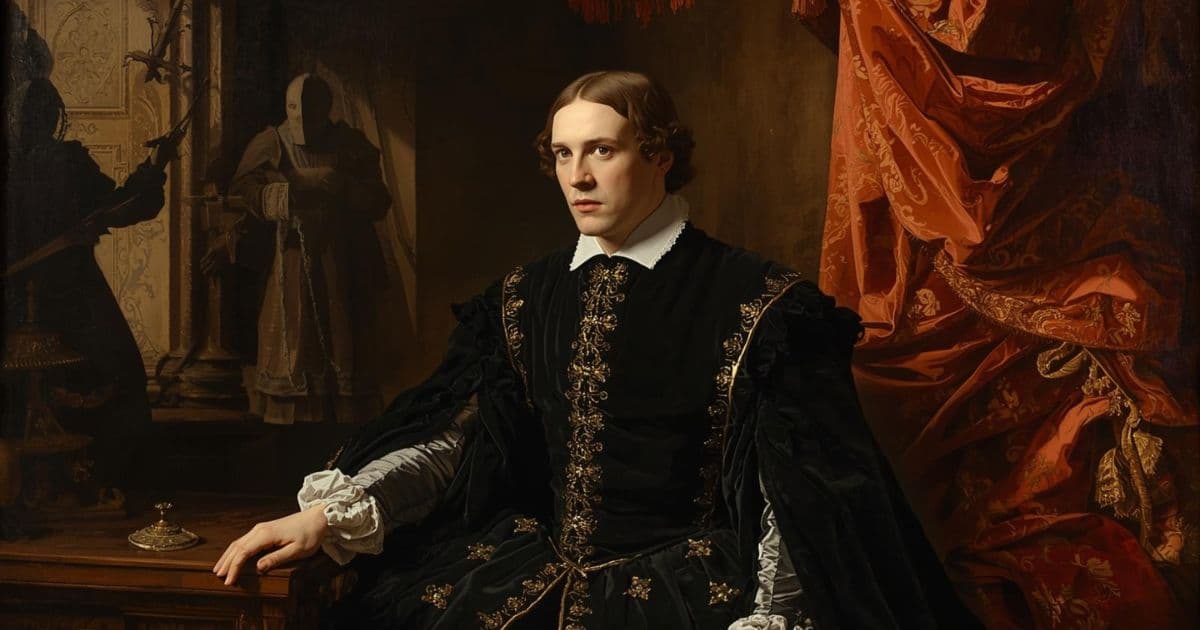
An excerpt from the original text.(complete · 9267 words)
he Grand Inquisitor
“Even this must have a preface—that is, a literary preface,” laughed
Ivan, “and I am a poor hand at making one. You see, my action takes
place in the sixteenth century, and at that time, as you probably
learnt at school, it was customary in poetry to bring down heavenly
powers on earth. Not to speak of Dante, in France, clerks, as well as
the monks in the monasteries, used to give regular performances in
which the Madonna, the saints, the angels, Christ, and God himself were
brought on the stage. In those days it was done in all simplicity. In
Victor Hugo’s Notre Dame de Paris an edifying and gratuitous
spectacle was provided for the people in the Hôtel de Ville of Paris in
the reign of Louis XI. in honor of the birth of the dauphin. It was
called Le bon jugement de la très sainte et gracieuse Vierge Marie,
and she appears herself on the stage and pronounces her bon jugement.
Similar plays, chiefly from the Old Testament, were occasionally
performed in Moscow too, up to the times of Peter the Great. But
besides plays there were all sorts of legends and ballads scattered
about the world, in which the saints and angels and all the powers of
Heaven took part when required. In our monasteries the monks busied
themselves in translating, copying, and even composing such poems—and
even under the Tatars. There is, for instance, one such poem (of
course, from the Greek), The Wanderings of Our Lady through Hell,
with descriptions as bold as Dante’s. Our Lady visits hell, and the
Archangel Michael leads her through the torments. She sees the sinners
and their punishment. There she sees among others one noteworthy set of
sinners in a burning lake; some of them sink to the bottom of the lake
so that they can’t swim out, and ‘these God forgets’—an expression of
extraordinary depth and force. And so Our Lady, shocked and weeping,
falls before the throne of God and begs for mercy for all in hell—for
all she has seen there, indiscriminately. Her conversation with God is
immensely interesting. She beseeches Him, she will not desist, and when
God points to the hands and feet of her Son, nailed to the Cross, and
asks, ‘How can I forgive His tormentors?’ she bids all the saints, all
the martyrs, all the angels and archangels to fall down with her and
pray for mercy on all without distinction. It ends by her winning from
God a respite of suffering every year from Good Friday till Trinity
Day, and the sinners at once raise a cry of thankfulness from hell,
chanting, ‘Thou art just, O Lord, in this judgment.’ Well, my poem
would have been of that kind if it had appeared at that time. He comes
on the scene in my poem, but He says nothing, only appears and passes
on. Fifteen centuries have passed since He promised to come in His
glory, fifteen centuries since His prophet wrote, ‘Behold, I come
quickly’; ‘Of that day and that hour knoweth no man, neither the Son,
but the Father,’ as He Himself predicted on earth. But humanity awaits
him with the same faith and with the same love. Oh, with greater faith,
for it is fifteen centuries since man has ceased to see signs from
heaven.
No signs from heaven come to‐day
To add to what the heart doth say.
There was nothing left but faith in what the heart doth say. It is true
there were many miracles in those days. There were saints who performed
miraculous cures; some holy people, according to their biographies,
were visited by the Queen of Heaven herself. But the devil did not
slumber, and doubts were already arising among men of the truth of
these miracles. And just then there appeared in the north of Germany a
terrible new heresy. “A huge star like to a torch” (that is, to a
church) “fell on the sources of the waters and they became bitter.”
These heretics began blasphemously denying miracles. But those who
remained faithful were all the more ardent in their faith. The tears of
humanity rose up to Him as before, awaited His coming, loved Him, hoped
for Him, yearned to suffer and die for Him as before. And so many ages
mankind had prayed with faith and fervor, “O Lord our God, hasten Thy
coming,” so many ages called upon Him, that in His infinite mercy He
deigned to come down to His servants. Before that day He had come down,
He had visited some holy men, martyrs and hermits, as is written in
their lives. Among us, Tyutchev, with absolute faith in the truth of
his words, bore witness that
Bearing the Cross, in slavish dress,
Weary and worn, the Heavenly King
Our mother, Russia, came to bless,
And through our land went wandering.
And that certainly was so, I assure you.
“And behold, He deigned to appear for a moment to the people, to the
tortured, suffering people, sunk in iniquity, but loving Him like
children. My story is laid in Spain, in Seville, in the most terrible
time of the Inquisition, when fires were lighted every day to the glory
of God, and ‘in the splendid auto da fé the wicked heretics were
burnt.’ Oh, of course, this was not the coming in which He will appear
according to His promise at the end of time in all His heavenly glory,
and which will be sudden ‘as lightning flashing from east to west.’ No,
He visited His children only for a moment, and there where the flames
were crackling round the heretics. In His infinite mercy He came once
more among men in that human shape in which He walked among men for
three years fifteen centuries ago. He came down to the ‘hot pavements’
of the southern town in which on the day before almost a hundred
heretics had, ad majorem gloriam Dei, been burnt by the cardinal, the
Grand Inquisitor, in a magnificent auto da fé, in the presence of the
king, the court, the knights, the cardinals, the most charming ladies
of the court, and the whole population of Seville.
“He came softly, unobserved, and yet, strange to say, every one
recognized Him. That might be one of the best passages in the poem. I
mean, why they recognized Him. The people are irresistibly drawn to
Him, they surround Him, they flock about Him, follow Him. He moves
silently in their midst with a gentle smile of infinite compassion. The
sun of love burns in His heart, light and power shine from His eyes,
and their radiance, shed on the people, stirs their hearts with
responsive love. He holds out His hands to them, blesses them, and a
healing virtue comes from contact with Him, even with His garments. An
old man in the crowd, blind from childhood, cries out, ‘O Lord, heal me
and I shall see Thee!’ and, as it were, scales fall from his eyes and
the blind man sees Him. The crowd weeps and kisses the earth under His
feet. Children throw flowers before Him, sing, and cry hosannah. ‘It is
He—it is He!’ all repeat. ‘It must be He, it can be no one but Him!’ He
stops at the steps of the Seville cathedral at the moment when the
weeping mourners are bringing in a little open white coffin. In it lies
a child of seven, the only daughter of a prominent citizen. The dead
child lies hidden in flowers. ‘He will raise your child,’ the crowd
shouts to the weeping mother. The priest, coming to meet the coffin,
looks perplexed, and frowns, but the mother of the dead child throws
herself at His feet with a wail. ‘If it is Thou, raise my child!’ she
cries, holding out her hands to Him. The procession halts, the coffin
is laid on the steps at His feet. He looks with compassion, and His
lips once more softly pronounce, ‘Maiden, arise!’ and the maiden
arises. The little girl sits up in the coffin and looks round, smiling
with wide‐ open wondering eyes, holding a bunch of white roses they had
put in her hand.
“There are cries, sobs, confusion among the people, and at that moment
the cardinal himself, the Grand Inquisitor, passes by the cathedral. He
is an old man, almost ninety, tall and erect, with a withered face and
sunken eyes, in which there is still a gleam of light. He is not
dressed in his gorgeous cardinal’s robes, as he was the day before,
when he was burning the enemies of the Roman Church—at this moment he
is wearing his coarse, old, monk’s cassock. At a distance behind him
come his gloomy assistants and slaves and the ‘holy guard.’ He stops at
the sight of the crowd and watches it from a distance. He sees
everything; he sees them set the coffin down at His feet, sees the
child rise up, and his face darkens. He knits his thick gray brows and
his eyes gleam with a sinister fire. He holds out his finger and bids
the guards take Him. And such is his power, so completely are the
people cowed into submission and trembling obedience to him, that the
crowd immediately makes way for the guards, and in the midst of
deathlike silence they lay hands on Him and lead Him away. The crowd
instantly bows down to the earth, like one man, before the old
Inquisitor. He blesses the people in silence and passes on. The guards
lead their prisoner to the close, gloomy vaulted prison in the ancient
palace of the Holy Inquisition and shut Him in it. The day passes and
is followed by the dark, burning, ‘breathless’ night of Seville. The
air is ‘fragrant with laurel and lemon.’ In the pitch darkness the iron
door of the prison is suddenly opened and the Grand Inquisitor himself
comes in with a light in his hand. He is alone; the door is closed at
once behind him. He stands in the doorway and for a minute or two gazes
into His face. At last he goes up slowly, sets the light on the table
and speaks.
“ ‘Is it Thou? Thou?’ but receiving no answer, he adds at once, ‘Don’t
answer, be silent. What canst Thou say, indeed? I know too well what
Thou wouldst say. And Thou hast no right to add anything to what Thou
hadst said of old. Why, then, art Thou come to hinder us? For Thou hast
come to hinder us, and Thou knowest that. But dost Thou know what will
be to‐ morrow? I know not who Thou art and care not to know whether it
is Thou or only a semblance of Him, but to‐morrow I shall condemn Thee
and burn Thee at the stake as the worst of heretics. And the very
people who have to‐day kissed Thy feet, to‐morrow at the faintest sign
from me will rush to heap up the embers of Thy fire. Knowest Thou that?
Yes, maybe Thou knowest it,’ he added with thoughtful penetration,
never for a moment taking his eyes off the Prisoner.”
“I don’t quite understand, Ivan. What does it mean?” Alyosha, who had
been listening in silence, said with a smile. “Is it simply a wild
fantasy, or a mistake on the part of the old man—some impossible
quiproquo?”
“Take it as the last,” said Ivan, laughing, “if you are so corrupted by
modern realism and can’t stand anything fantastic. If you like it to be
a case of mistaken identity, let it be so. It is true,” he went on,
laughing, “the old man was ninety, and he might well be crazy over his
set idea. He might have been struck by the appearance of the Prisoner.
It might, in fact, be simply his ravings, the delusion of an old man of
ninety, over‐excited by the auto da fé of a hundred heretics the day
before. But does it matter to us after all whether it was a mistake of
identity or a wild fantasy? All that matters is that the old man should
speak out, should speak openly of what he has thought in silence for
ninety years.”
“And the Prisoner too is silent? Does He look at him and not say a
word?”
“That’s inevitable in any case,” Ivan laughed again. “The old man has
told Him He hasn’t the right to add anything to what He has said of
old. One may say it is the most fundamental feature of Roman
Catholicism, in my opinion at least. ‘All has been given by Thee to the
Pope,’ they say, ‘and all, therefore, is still in the Pope’s hands, and
there is no need for Thee to come now at all. Thou must not meddle for
the time, at least.’ That’s how they speak and write too—the Jesuits,
at any rate. I have read it myself in the works of their theologians.
‘Hast Thou the right to reveal to us one of the mysteries of that world
from which Thou hast come?’ my old man asks Him, and answers the
question for Him. ‘No, Thou hast not; that Thou mayest not add to what
has been said of old, and mayest not take from men the freedom which
Thou didst exalt when Thou wast on earth. Whatsoever Thou revealest
anew will encroach on men’s freedom of faith; for it will be manifest
as a miracle, and the freedom of their faith was dearer to Thee than
anything in those days fifteen hundred years ago. Didst Thou not often
say then, “I will make you free”? But now Thou hast seen these “free”
men,’ the old man adds suddenly, with a pensive smile. ‘Yes, we’ve paid
dearly for it,’ he goes on, looking sternly at Him, ‘but at last we
have completed that work in Thy name. For fifteen centuries we have
been wrestling with Thy freedom, but now it is ended and over for good.
Dost Thou not believe that it’s over for good? Thou lookest meekly at
me and deignest not even to be wroth with me. But let me tell Thee that
now, to‐day, people are more persuaded than ever that they have perfect
freedom, yet they have brought their freedom to us and laid it humbly
at our feet. But that has been our doing. Was this what Thou didst? Was
this Thy freedom?’ ”
“I don’t understand again,” Alyosha broke in. “Is he ironical, is he
jesting?”
“Not a bit of it! He claims it as a merit for himself and his Church
that at last they have vanquished freedom and have done so to make men
happy. ‘For now’ (he is speaking of the Inquisition, of course) ‘for
the first time it has become possible to think of the happiness of men.
Man was created a rebel; and how can rebels be happy? Thou wast
warned,’ he says to Him. ‘Thou hast had no lack of admonitions and
warnings, but Thou didst not listen to those warnings; Thou didst
reject the only way by which men might be made happy. But, fortunately,
departing Thou didst hand on the work to us. Thou hast promised, Thou
hast established by Thy word, Thou hast given to us the right to bind
and to unbind, and now, of course, Thou canst not think of taking it
away. Why, then, hast Thou come to hinder us?’ ”
“And what’s the meaning of ‘no lack of admonitions and warnings’?”
asked Alyosha.
“Why, that’s the chief part of what the old man must say.
“ ‘The wise and dread spirit, the spirit of self‐destruction and non‐
existence,’ the old man goes on, ‘the great spirit talked with Thee in
the wilderness, and we are told in the books that he “tempted” Thee. Is
that so? And could anything truer be said than what he revealed to Thee
in three questions and what Thou didst reject, and what in the books is
called “the temptation”? And yet if there has ever been on earth a real
stupendous miracle, it took place on that day, on the day of the three
temptations. The statement of those three questions was itself the
miracle. If it were possible to imagine simply for the sake of argument
that those three questions of the dread spirit had perished utterly
from the books, and that we had to restore them and to invent them
anew, and to do so had gathered together all the wise men of the
earth—rulers, chief priests, learned men, philosophers, poets—and had
set them the task to invent three questions, such as would not only fit
the occasion, but express in three words, three human phrases, the
whole future history of the world and of humanity—dost Thou believe
that all the wisdom of the earth united could have invented anything in
depth and force equal to the three questions which were actually put to
Thee then by the wise and mighty spirit in the wilderness? From those
questions alone, from the miracle of their statement, we can see that
we have here to do not with the fleeting human intelligence, but with
the absolute and eternal. For in those three questions the whole
subsequent history of mankind is, as it were, brought together into one
whole, and foretold, and in them are united all the unsolved historical
contradictions of human nature. At the time it could not be so clear,
since the future was unknown; but now that fifteen hundred years have
passed, we see that everything in those three questions was so justly
divined and foretold, and has been so truly fulfilled, that nothing can
be added to them or taken from them.
“ ‘Judge Thyself who was right—Thou or he who questioned Thee then?
Remember the first question; its meaning, in other words, was this:
“Thou wouldst go into the world, and art going with empty hands, with
some promise of freedom which men in their simplicity and their natural
unruliness cannot even understand, which they fear and dread—for
nothing has ever been more insupportable for a man and a human society
than freedom. But seest Thou these stones in this parched and barren
wilderness? Turn them into bread, and mankind will run after Thee like
a flock of sheep, grateful and obedient, though for ever trembling,
lest Thou withdraw Thy hand and deny them Thy bread.” But Thou wouldst
not deprive man of freedom and didst reject the offer, thinking, what
is that freedom worth, if obedience is bought with bread? Thou didst
reply that man lives not by bread alone. But dost Thou know that for
the sake of that earthly bread the spirit of the earth will rise up
against Thee and will strive with Thee and overcome Thee, and all will
follow him, crying, “Who can compare with this beast? He has given us
fire from heaven!” Dost Thou know that the ages will pass, and humanity
will proclaim by the lips of their sages that there is no crime, and
therefore no sin; there is only hunger? “Feed men, and then ask of them
virtue!” that’s what they’ll write on the banner, which they will raise
against Thee, and with which they will destroy Thy temple. Where Thy
temple stood will rise a new building; the terrible tower of Babel will
be built again, and though, like the one of old, it will not be
finished, yet Thou mightest have prevented that new tower and have cut
short the sufferings of men for a thousand years; for they will come
back to us after a thousand years of agony with their tower. They will
seek us again, hidden underground in the catacombs, for we shall be
again persecuted and tortured. They will find us and cry to us, “Feed
us, for those who have promised us fire from heaven haven’t given it!”
And then we shall finish building their tower, for he finishes the
building who feeds them. And we alone shall feed them in Thy name,
declaring falsely that it is in Thy name. Oh, never, never can they
feed themselves without us! No science will give them bread so long as
they remain free. In the end they will lay their freedom at our feet,
and say to us, “Make us your slaves, but feed us.” They will understand
themselves, at last, that freedom and bread enough for all are
inconceivable together, for never, never will they be able to share
between them! They will be convinced, too, that they can never be free,
for they are weak, vicious, worthless and rebellious. Thou didst
promise them the bread of Heaven, but, I repeat again, can it compare
with earthly bread in the eyes of the weak, ever sinful and ignoble
race of man? And if for the sake of the bread of Heaven thousands shall
follow Thee, what is to become of the millions and tens of thousands of
millions of creatures who will not have the strength to forego the
earthly bread for the sake of the heavenly? Or dost Thou care only for
the tens of thousands of the great and strong, while the millions,
numerous as the sands of the sea, who are weak but love Thee, must
exist only for the sake of the great and strong? No, we care for the
weak too. They are sinful and rebellious, but in the end they too will
become obedient. They will marvel at us and look on us as gods, because
we are ready to endure the freedom which they have found so dreadful
and to rule over them—so awful it will seem to them to be free. But we
shall tell them that we are Thy servants and rule them in Thy name. We
shall deceive them again, for we will not let Thee come to us again.
That deception will be our suffering, for we shall be forced to lie.
“ ‘This is the significance of the first question in the wilderness,
and this is what Thou hast rejected for the sake of that freedom which
Thou hast exalted above everything. Yet in this question lies hid the
great secret of this world. Choosing “bread,” Thou wouldst have
satisfied the universal and everlasting craving of humanity—to find
some one to worship. So long as man remains free he strives for nothing
so incessantly and so painfully as to find some one to worship. But man
seeks to worship what is established beyond dispute, so that all men
would agree at once to worship it. For these pitiful creatures are
concerned not only to find what one or the other can worship, but to
find something that all would believe in and worship; what is essential
is that all may be together in it. This craving for community of
worship is the chief misery of every man individually and of all
humanity from the beginning of time. For the sake of common worship
they’ve slain each other with the sword. They have set up gods and
challenged one another, “Put away your gods and come and worship ours,
or we will kill you and your gods!” And so it will be to the end of the
world, even when gods disappear from the earth; they will fall down
before idols just the same. Thou didst know, Thou couldst not but have
known, this fundamental secret of human nature, but Thou didst reject
the one infallible banner which was offered Thee to make all men bow
down to Thee alone—the banner of earthly bread; and Thou hast rejected
it for the sake of freedom and the bread of Heaven. Behold what Thou
didst further. And all again in the name of freedom! I tell Thee that
man is tormented by no greater anxiety than to find some one quickly to
whom he can hand over that gift of freedom with which the ill‐fated
creature is born. But only one who can appease their conscience can
take over their freedom. In bread there was offered Thee an invincible
banner; give bread, and man will worship thee, for nothing is more
certain than bread. But if some one else gains possession of his
conscience—oh! then he will cast away Thy bread and follow after him
who has ensnared his conscience. In that Thou wast right. For the
secret of man’s being is not only to live but to have something to live
for. Without a stable conception of the object of life, man would not
consent to go on living, and would rather destroy himself than remain
on earth, though he had bread in abundance. That is true. But what
happened? Instead of taking men’s freedom from them, Thou didst make it
greater than ever! Didst Thou forget that man prefers peace, and even
death, to freedom of choice in the knowledge of good and evil? Nothing
is more seductive for man than his freedom of conscience, but nothing
is a greater cause of suffering. And behold, instead of giving a firm
foundation for setting the conscience of man at rest for ever, Thou
didst choose all that is exceptional, vague and enigmatic; Thou didst
choose what was utterly beyond the strength of men, acting as though
Thou didst not love them at all—Thou who didst come to give Thy life
for them! Instead of taking possession of men’s freedom, Thou didst
increase it, and burdened the spiritual kingdom of mankind with its
sufferings for ever. Thou didst desire man’s free love, that he should
follow Thee freely, enticed and taken captive by Thee. In place of the
rigid ancient law, man must hereafter with free heart decide for
himself what is good and what is evil, having only Thy image before him
as his guide. But didst Thou not know that he would at last reject even
Thy image and Thy truth, if he is weighed down with the fearful burden
of free choice? They will cry aloud at last that the truth is not in
Thee, for they could not have been left in greater confusion and
suffering than Thou hast caused, laying upon them so many cares and
unanswerable problems.
“ ‘So that, in truth, Thou didst Thyself lay the foundation for the
destruction of Thy kingdom, and no one is more to blame for it. Yet
what was offered Thee? There are three powers, three powers alone, able
to conquer and to hold captive for ever the conscience of these
impotent rebels for their happiness—those forces are miracle, mystery
and authority. Thou hast rejected all three and hast set the example
for doing so. When the wise and dread spirit set Thee on the pinnacle
of the temple and said to Thee, “If Thou wouldst know whether Thou art
the Son of God then cast Thyself down, for it is written: the angels
shall hold him up lest he fall and bruise himself, and Thou shalt know
then whether Thou art the Son of God and shalt prove then how great is
Thy faith in Thy Father.” But Thou didst refuse and wouldst not cast
Thyself down. Oh, of course, Thou didst proudly and well, like God; but
the weak, unruly race of men, are they gods? Oh, Thou didst know then
that in taking one step, in making one movement to cast Thyself down,
Thou wouldst be tempting God and have lost all Thy faith in Him, and
wouldst have been dashed to pieces against that earth which Thou didst
come to save. And the wise spirit that tempted Thee would have
rejoiced. But I ask again, are there many like Thee? And couldst Thou
believe for one moment that men, too, could face such a temptation? Is
the nature of men such, that they can reject miracle, and at the great
moments of their life, the moments of their deepest, most agonizing
spiritual difficulties, cling only to the free verdict of the heart?
Oh, Thou didst know that Thy deed would be recorded in books, would be
handed down to remote times and the utmost ends of the earth, and Thou
didst hope that man, following Thee, would cling to God and not ask for
a miracle. But Thou didst not know that when man rejects miracle he
rejects God too; for man seeks not so much God as the miraculous. And
as man cannot bear to be without the miraculous, he will create new
miracles of his own for himself, and will worship deeds of sorcery and
witchcraft, though he might be a hundred times over a rebel, heretic
and infidel. Thou didst not come down from the Cross when they shouted
to Thee, mocking and reviling Thee, “Come down from the cross and we
will believe that Thou art He.” Thou didst not come down, for again
Thou wouldst not enslave man by a miracle, and didst crave faith given
freely, not based on miracle. Thou didst crave for free love and not
the base raptures of the slave before the might that has overawed him
for ever. But Thou didst think too highly of men therein, for they are
slaves, of course, though rebellious by nature. Look round and judge;
fifteen centuries have passed, look upon them. Whom hast Thou raised up
to Thyself? I swear, man is weaker and baser by nature than Thou hast
believed him! Can he, can he do what Thou didst? By showing him so much
respect, Thou didst, as it were, cease to feel for him, for Thou didst
ask far too much from him—Thou who hast loved him more than Thyself!
Respecting him less, Thou wouldst have asked less of him. That would
have been more like love, for his burden would have been lighter. He is
weak and vile. What though he is everywhere now rebelling against our
power, and proud of his rebellion? It is the pride of a child and a
schoolboy. They are little children rioting and barring out the teacher
at school. But their childish delight will end; it will cost them dear.
They will cast down temples and drench the earth with blood. But they
will see at last, the foolish children, that, though they are rebels,
they are impotent rebels, unable to keep up their own rebellion. Bathed
in their foolish tears, they will recognize at last that He who created
them rebels must have meant to mock at them. They will say this in
despair, and their utterance will be a blasphemy which will make them
more unhappy still, for man’s nature cannot bear blasphemy, and in the
end always avenges it on itself. And so unrest, confusion and
unhappiness—that is the present lot of man after Thou didst bear so
much for their freedom! The great prophet tells in vision and in image,
that he saw all those who took part in the first resurrection and that
there were of each tribe twelve thousand. But if there were so many of
them, they must have been not men but gods. They had borne Thy cross,
they had endured scores of years in the barren, hungry wilderness,
living upon locusts and roots—and Thou mayest indeed point with pride
at those children of freedom, of free love, of free and splendid
sacrifice for Thy name. But remember that they were only some
thousands; and what of the rest? And how are the other weak ones to
blame, because they could not endure what the strong have endured? How
is the weak soul to blame that it is unable to receive such terrible
gifts? Canst Thou have simply come to the elect and for the elect? But
if so, it is a mystery and we cannot understand it. And if it is a
mystery, we too have a right to preach a mystery, and to teach them
that it’s not the free judgment of their hearts, not love that matters,
but a mystery which they must follow blindly, even against their
conscience. So we have done. We have corrected Thy work and have
founded it upon miracle, mystery and authority. And men rejoiced
that they were again led like sheep, and that the terrible gift that
had brought them such suffering was, at last, lifted from their hearts.
Were we right teaching them this? Speak! Did we not love mankind, so
meekly acknowledging their feebleness, lovingly lightening their
burden, and permitting their weak nature even sin with our sanction?
Why hast Thou come now to hinder us? And why dost Thou look silently
and searchingly at me with Thy mild eyes? Be angry. I don’t want Thy
love, for I love Thee not. And what use is it for me to hide anything
from Thee? Don’t I know to Whom I am speaking? All that I can say is
known to Thee already. And is it for me to conceal from Thee our
mystery? Perhaps it is Thy will to hear it from my lips. Listen, then.
We are not working with Thee, but with him—that is our mystery. It’s
long—eight centuries—since we have been on his side and not on Thine.
Just eight centuries ago, we took from him what Thou didst reject with
scorn, that last gift he offered Thee, showing Thee all the kingdoms of
the earth. We took from him Rome and the sword of Cæsar, and proclaimed
ourselves sole rulers of the earth, though hitherto we have not been
able to complete our work. But whose fault is that? Oh, the work is
only beginning, but it has begun. It has long to await completion and
the earth has yet much to suffer, but we shall triumph and shall be
Cæsars, and then we shall plan the universal happiness of man. But Thou
mightest have taken even then the sword of Cæsar. Why didst Thou reject
that last gift? Hadst Thou accepted that last counsel of the mighty
spirit, Thou wouldst have accomplished all that man seeks on earth—that
is, some one to worship, some one to keep his conscience, and some
means of uniting all in one unanimous and harmonious ant‐heap, for the
craving for universal unity is the third and last anguish of men.
Mankind as a whole has always striven to organize a universal state.
There have been many great nations with great histories, but the more
highly they were developed the more unhappy they were, for they felt
more acutely than other people the craving for world‐wide union. The
great conquerors, Timours and Ghenghis‐Khans, whirled like hurricanes
over the face of the earth striving to subdue its people, and they too
were but the unconscious expression of the same craving for universal
unity. Hadst Thou taken the world and Cæsar’s purple, Thou wouldst have
founded the universal state and have given universal peace. For who can
rule men if not he who holds their conscience and their bread in his
hands? We have taken the sword of Cæsar, and in taking it, of course,
have rejected Thee and followed him. Oh, ages are yet to come of the
confusion of free thought, of their science and cannibalism. For having
begun to build their tower of Babel without us, they will end, of
course, with cannibalism. But then the beast will crawl to us and lick
our feet and spatter them with tears of blood. And we shall sit upon
the beast and raise the cup, and on it will be written, “Mystery.” But
then, and only then, the reign of peace and happiness will come for
men. Thou art proud of Thine elect, but Thou hast only the elect, while
we give rest to all. And besides, how many of those elect, those mighty
ones who could become elect, have grown weary waiting for Thee, and
have transferred and will transfer the powers of their spirit and the
warmth of their heart to the other camp, and end by raising their
free banner against Thee. Thou didst Thyself lift up that banner. But
with us all will be happy and will no more rebel nor destroy one
another as under Thy freedom. Oh, we shall persuade them that they will
only become free when they renounce their freedom to us and submit to
us. And shall we be right or shall we be lying? They will be convinced
that we are right, for they will remember the horrors of slavery and
confusion to which Thy freedom brought them. Freedom, free thought and
science, will lead them into such straits and will bring them face to
face with such marvels and insoluble mysteries, that some of them, the
fierce and rebellious, will destroy themselves, others, rebellious but
weak, will destroy one another, while the rest, weak and unhappy, will
crawl fawning to our feet and whine to us: “Yes, you were right, you
alone possess His mystery, and we come back to you, save us from
ourselves!”
“ ‘Receiving bread from us, they will see clearly that we take the
bread made by their hands from them, to give it to them, without any
miracle. They will see that we do not change the stones to bread, but
in truth they will be more thankful for taking it from our hands than
for the bread itself! For they will remember only too well that in old
days, without our help, even the bread they made turned to stones in
their hands, while since they have come back to us, the very stones
have turned to bread in their hands. Too, too well will they know the
value of complete submission! And until men know that, they will be
unhappy. Who is most to blame for their not knowing it?—speak! Who
scattered the flock and sent it astray on unknown paths? But the flock
will come together again and will submit once more, and then it will be
once for all. Then we shall give them the quiet humble happiness of
weak creatures such as they are by nature. Oh, we shall persuade them
at last not to be proud, for Thou didst lift them up and thereby taught
them to be proud. We shall show them that they are weak, that they are
only pitiful children, but that childlike happiness is the sweetest of
all. They will become timid and will look to us and huddle close to us
in fear, as chicks to the hen. They will marvel at us and will be
awe‐stricken before us, and will be proud at our being so powerful and
clever, that we have been able to subdue such a turbulent flock of
thousands of millions. They will tremble impotently before our wrath,
their minds will grow fearful, they will be quick to shed tears like
women and children, but they will be just as ready at a sign from us to
pass to laughter and rejoicing, to happy mirth and childish song. Yes,
we shall set them to work, but in their leisure hours we shall make
their life like a child’s game, with children’s songs and innocent
dance. Oh, we shall allow them even sin, they are weak and helpless,
and they will love us like children because we allow them to sin. We
shall tell them that every sin will be expiated, if it is done with our
permission, that we allow them to sin because we love them, and the
punishment for these sins we take upon ourselves. And we shall take it
upon ourselves, and they will adore us as their saviors who have taken
on themselves their sins before God. And they will have no secrets from
us. We shall allow or forbid them to live with their wives and
mistresses, to have or not to have children—according to whether they
have been obedient or disobedient—and they will submit to us gladly and
cheerfully. The most painful secrets of their conscience, all, all they
will bring to us, and we shall have an answer for all. And they will be
glad to believe our answer, for it will save them from the great
anxiety and terrible agony they endure at present in making a free
decision for themselves. And all will be happy, all the millions of
creatures except the hundred thousand who rule over them. For only we,
we who guard the mystery, shall be unhappy. There will be thousands of
millions of happy babes, and a hundred thousand sufferers who have
taken upon themselves the curse of the knowledge of good and evil.
Peacefully they will die, peacefully they will expire in Thy name, and
beyond the grave they will find nothing but death. But we shall keep
the secret, and for their happiness we shall allure them with the
reward of heaven and eternity. Though if there were anything in the
other world, it certainly would not be for such as they. It is
prophesied that Thou wilt come again in victory, Thou wilt come with
Thy chosen, the proud and strong, but we will say that they have only
saved themselves, but we have saved all. We are told that the harlot
who sits upon the beast, and holds in her hands the mystery, shall be
put to shame, that the weak will rise up again, and will rend her royal
purple and will strip naked her loathsome body. But then I will stand
up and point out to Thee the thousand millions of happy children who
have known no sin. And we who have taken their sins upon us for their
happiness will stand up before Thee and say: “Judge us if Thou canst
and darest.” Know that I fear Thee not. Know that I too have been in
the wilderness, I too have lived on roots and locusts, I too prized the
freedom with which Thou hast blessed men, and I too was striving to
stand among Thy elect, among the strong and powerful, thirsting “to
make up the number.” But I awakened and would not serve madness. I
turned back and joined the ranks of those who have corrected Thy
work. I left the proud and went back to the humble, for the happiness
of the humble. What I say to Thee will come to pass, and our dominion
will be built up. I repeat, to‐morrow Thou shalt see that obedient
flock who at a sign from me will hasten to heap up the hot cinders
about the pile on which I shall burn Thee for coming to hinder us. For
if any one has ever deserved our fires, it is Thou. To‐morrow I shall
burn Thee. Dixi.’ ”
Ivan stopped. He was carried away as he talked, and spoke with
excitement; when he had finished, he suddenly smiled.
Alyosha had listened in silence; towards the end he was greatly moved
and seemed several times on the point of interrupting, but restrained
himself. Now his words came with a rush.
“But ... that’s absurd!” he cried, flushing. “Your poem is in praise of
Jesus, not in blame of Him—as you meant it to be. And who will believe
you about freedom? Is that the way to understand it? That’s not the
idea of it in the Orthodox Church.... That’s Rome, and not even the
whole of Rome, it’s false—those are the worst of the Catholics, the
Inquisitors, the Jesuits!... And there could not be such a fantastic
creature as your Inquisitor. What are these sins of mankind they take
on themselves? Who are these keepers of the mystery who have taken some
curse upon themselves for the happiness of mankind? When have they been
seen? We know the Jesuits, they are spoken ill of, but surely they are
not what you describe? They are not that at all, not at all.... They
are simply the Romish army for the earthly sovereignty of the world in
the future, with the Pontiff of Rome for Emperor ... that’s their
ideal, but there’s no sort of mystery or lofty melancholy about it....
It’s simple lust of power, of filthy earthly gain, of
domination—something like a universal serfdom with them as
masters—that’s all they stand for. They don’t even believe in God
perhaps. Your suffering Inquisitor is a mere fantasy.”
“Stay, stay,” laughed Ivan, “how hot you are! A fantasy you say, let it
be so! Of course it’s a fantasy. But allow me to say: do you really
think that the Roman Catholic movement of the last centuries is
actually nothing but the lust of power, of filthy earthly gain? Is that
Father Païssy’s teaching?”
“No, no, on the contrary, Father Païssy did once say something rather
the same as you ... but of course it’s not the same, not a bit the
same,” Alyosha hastily corrected himself.
“A precious admission, in spite of your ‘not a bit the same.’ I ask you
why your Jesuits and Inquisitors have united simply for vile material
gain? Why can there not be among them one martyr oppressed by great
sorrow and loving humanity? You see, only suppose that there was one
such man among all those who desire nothing but filthy material gain—if
there’s only one like my old Inquisitor, who had himself eaten roots in
the desert and made frenzied efforts to subdue his flesh to make
himself free and perfect. But yet all his life he loved humanity, and
suddenly his eyes were opened, and he saw that it is no great moral
blessedness to attain perfection and freedom, if at the same time one
gains the conviction that millions of God’s creatures have been created
as a mockery, that they will never be capable of using their freedom,
that these poor rebels can never turn into giants to complete the
tower, that it was not for such geese that the great idealist dreamt
his dream of harmony. Seeing all that he turned back and joined—the
clever people. Surely that could have happened?”
“Joined whom, what clever people?” cried Alyosha, completely carried
away. “They have no such great cleverness and no mysteries and
secrets.... Perhaps nothing but Atheism, that’s all their secret. Your
Inquisitor does not believe in God, that’s his secret!”
“What if it is so! At last you have guessed it. It’s perfectly true,
it’s true that that’s the whole secret, but isn’t that suffering, at
least for a man like that, who has wasted his whole life in the desert
and yet could not shake off his incurable love of humanity? In his old
age he reached the clear conviction that nothing but the advice of the
great dread spirit could build up any tolerable sort of life for the
feeble, unruly, ‘incomplete, empirical creatures created in jest.’ And
so, convinced of this, he sees that he must follow the counsel of the
wise spirit, the dread spirit of death and destruction, and therefore
accept lying and deception, and lead men consciously to death and
destruction, and yet deceive them all the way so that they may not
notice where they are being led, that the poor blind creatures may at
least on the way think themselves happy. And note, the deception is in
the name of Him in Whose ideal the old man had so fervently believed
all his life long. Is not that tragic? And if only one such stood at
the head of the whole army ‘filled with the lust of power only for the
sake of filthy gain’—would not one such be enough to make a tragedy?
More than that, one such standing at the head is enough to create the
actual leading idea of the Roman Church with all its armies and
Jesuits, its highest idea. I tell you frankly that I firmly believe
that there has always been such a man among those who stood at the head
of the movement. Who knows, there may have been some such even among
the Roman Popes. Who knows, perhaps the spirit of that accursed old man
who loves mankind so obstinately in his own way, is to be found even
now in a whole multitude of such old men, existing not by chance but by
agreement, as a secret league formed long ago for the guarding of the
mystery, to guard it from the weak and the unhappy, so as to make them
happy. No doubt it is so, and so it must be indeed. I fancy that even
among the Masons there’s something of the same mystery at the bottom,
and that that’s why the Catholics so detest the Masons as their rivals
breaking up the unity of the idea, while it is so essential that there
should be one flock and one shepherd.... But from the way I defend my
idea I might be an author impatient of your criticism. Enough of it.”
“You are perhaps a Mason yourself!” broke suddenly from Alyosha. “You
don’t believe in God,” he added, speaking this time very sorrowfully.
He fancied besides that his brother was looking at him ironically. “How
does your poem end?” he asked, suddenly looking down. “Or was it the
end?”
“I meant to end it like this. When the Inquisitor ceased speaking he
waited some time for his Prisoner to answer him. His silence weighed
down upon him. He saw that the Prisoner had listened intently all the
time, looking gently in his face and evidently not wishing to reply.
The old man longed for Him to say something, however bitter and
terrible. But He suddenly approached the old man in silence and softly
kissed him on his bloodless aged lips. That was all His answer. The old
man shuddered. His lips moved. He went to the door, opened it, and said
to Him: ‘Go, and come no more ... come not at all, never, never!’ And
he let Him out into the dark alleys of the town. The Prisoner went
away.”
“And the old man?”
“The kiss glows in his heart, but the old man adheres to his idea.”
“And you with him, you too?” cried Alyosha, mournfully.
Ivan laughed.
“Why, it’s all nonsense, Alyosha. It’s only a senseless poem of a
senseless student, who could never write two lines of verse. Why do you
take it so seriously? Surely you don’t suppose I am going straight off
to the Jesuits, to join the men who are correcting His work? Good Lord,
it’s no business of mine. I told you, all I want is to live on to
thirty, and then ... dash the cup to the ground!”
“But the little sticky leaves, and the precious tombs, and the blue
sky, and the woman you love! How will you live, how will you love
them?” Alyosha cried sorrowfully. “With such a hell in your heart and
your head, how can you? No, that’s just what you are going away for, to
join them ... if not, you will kill yourself, you can’t endure it!”
“There is a strength to endure everything,” Ivan said with a cold
smile.
“What strength?”
“The strength of the Karamazovs—the strength of the Karamazov
baseness.”
“To sink into debauchery, to stifle your soul with corruption, yes?”
“Possibly even that ... only perhaps till I am thirty I shall escape
it, and then—”
“How will you escape it? By what will you escape it? That’s impossible
with your ideas.”
“In the Karamazov way, again.”
“ ‘Everything is lawful,’ you mean? Everything is lawful, is that it?”
Ivan scowled, and all at once turned strangely pale.
“Ah, you’ve caught up yesterday’s phrase, which so offended Miüsov—and
which Dmitri pounced upon so naïvely, and paraphrased!” he smiled
queerly. “Yes, if you like, ‘everything is lawful’ since the word has
been said. I won’t deny it. And Mitya’s version isn’t bad.”
Alyosha looked at him in silence.
“I thought that going away from here I have you at least,” Ivan said
suddenly, with unexpected feeling; “but now I see that there is no
place for me even in your heart, my dear hermit. The formula, ‘all is
lawful,’ I won’t renounce—will you renounce me for that, yes?”
Alyosha got up, went to him and softly kissed him on the lips.
“That’s plagiarism,” cried Ivan, highly delighted. “You stole that from
my poem. Thank you though. Get up, Alyosha, it’s time we were going,
both of us.”
They went out, but stopped when they reached the entrance of the
restaurant.
“Listen, Alyosha,” Ivan began in a resolute voice, “if I am really able
to care for the sticky little leaves I shall only love them,
remembering you. It’s enough for me that you are somewhere here, and I
shan’t lose my desire for life yet. Is that enough for you? Take it as
a declaration of love if you like. And now you go to the right and I to
the left. And it’s enough, do you hear, enough. I mean even if I don’t
go away to‐morrow (I think I certainly shall go) and we meet again,
don’t say a word more on these subjects. I beg that particularly. And
about Dmitri too, I ask you specially, never speak to me again,” he
added, with sudden irritation; “it’s all exhausted, it has all been
said over and over again, hasn’t it? And I’ll make you one promise in
return for it. When at thirty, I want to ‘dash the cup to the ground,’
wherever I may be I’ll come to have one more talk with you, even though
it were from America, you may be sure of that. I’ll come on purpose. It
will be very interesting to have a look at you, to see what you’ll be
by that time. It’s rather a solemn promise, you see. And we really may
be parting for seven years or ten. Come, go now to your Pater
Seraphicus, he is dying. If he dies without you, you will be angry with
me for having kept you. Good‐by, kiss me once more; that’s right, now
go.”
Ivan turned suddenly and went his way without looking back. It was just
as Dmitri had left Alyosha the day before, though the parting had been
very different. The strange resemblance flashed like an arrow through
Alyosha’s mind in the distress and dejection of that moment. He waited
a little, looking after his brother. He suddenly noticed that Ivan
swayed as he walked and that his right shoulder looked lower than his
left. He had never noticed it before. But all at once he turned too,
and almost ran to the monastery. It was nearly dark, and he felt almost
frightened; something new was growing up in him for which he could not
account. The wind had risen again as on the previous evening, and the
ancient pines murmured gloomily about him when he entered the hermitage
copse. He almost ran. “Pater Seraphicus—he got that name from
somewhere—where from?” Alyosha wondered. “Ivan, poor Ivan, and when
shall I see you again?... Here is the hermitage. Yes, yes, that he is,
Pater Seraphicus, he will save me—from him and for ever!”
Several times afterwards he wondered how he could on leaving Ivan so
completely forget his brother Dmitri, though he had that morning, only
a few hours before, so firmly resolved to find him and not to give up
doing so, even should he be unable to return to the monastery that
night.
Master this chapter. Complete your experience
Purchase the complete book to access all chapters and support classic literature
As an Amazon Associate, we earn a small commission from qualifying purchases at no additional cost to you.
Available in paperback, hardcover, and e-book formats
Let's Analyse the Pattern
When people in power limit others' choices while claiming it's for their protection or benefit.
Why This Matters
Connect literature to life
This chapter teaches how to recognize when someone uses your perceived weakness as permission to limit your choices while claiming it's for your benefit.
Practice This Today
This week, notice when someone says 'you can't handle' or 'I'm protecting you from'—then ask yourself who really benefits from your dependence.
Now let's explore the literary elements.
Key Quotes & Analysis
"We have corrected Thy work and have founded it upon miracle, mystery and authority."
Context: The Inquisitor explains to Christ how the Church has 'improved' his original message
This reveals how institutions often claim to fix what they see as flaws in original ideals. The Inquisitor genuinely believes he's helping humanity by making religion easier and less demanding. It shows how power corrupts even good intentions.
In Today's Words:
We fixed your mistakes by giving people spectacle, keeping them confused, and telling them what to do.
"Thou didst desire man's free love, that he should follow Thee freely, enticed and taken captive by Thee."
Context: The Inquisitor accuses Christ of placing too heavy a burden on humanity
This captures the central tension between freedom and security. The Inquisitor sees Christ's demand for genuine choice as cruel because it requires people to struggle with difficult decisions. He argues that most people would rather be told what to do.
In Today's Words:
You wanted people to choose to love you on their own, but that's too hard for most people.
"They will marvel at us and will be awe-stricken before us, and will be proud at our being so powerful and clever that we have been able to subdue such a turbulent flock of thousands of millions."
Context: The Inquisitor describes how people will worship their controllers
This shows how people can be grateful to those who limit their freedom, seeing control as strength rather than oppression. It's a chilling prediction of how populations can celebrate their own subjugation when it's presented as protection.
In Today's Words:
People will be impressed that we're smart and strong enough to keep millions of troublemakers in line.
Thematic Threads
Authority
In This Chapter
The Grand Inquisitor claims religious authority to override Christ himself, arguing the Church knows better than God
Development
Builds on earlier power struggles between church and family authority
In Your Life:
You might see this when bosses, doctors, or family members use their position to make decisions you should make yourself
Freedom vs Security
In This Chapter
The Inquisitor argues that freedom is a burden most people can't handle and security is more important
Development
Introduced here as central philosophical conflict
In Your Life:
You face this choice whenever someone offers to handle your problems in exchange for giving up control
Faith
In This Chapter
Ivan's parable challenges whether true faith requires the freedom to doubt and choose
Development
Deepens from Alyosha's simple monastery faith to complex questions about belief
In Your Life:
You might question whether your beliefs are truly yours or just what you've been told to accept
Human Nature
In This Chapter
The story explores whether people are fundamentally weak and need to be controlled or strong enough to handle freedom
Development
Builds on character studies showing both human weakness and strength
In Your Life:
You might notice how you view others' capabilities—do you trust people to make their own choices?
Silence
In This Chapter
Christ's silent kiss becomes more powerful than any argument against the Inquisitor's logic
Development
Contrasts with earlier chapters full of debate and argument
In Your Life:
You might find that sometimes actions speak louder than defending yourself with words
You now have the context. Time to form your own thoughts.
Discussion Questions
- 1
Why does the Grand Inquisitor arrest Christ, and what does he claim the Church has been doing for centuries?
analysis • surface - 2
The Inquisitor argues that most people are too weak to handle freedom and choice. What evidence does he give for this belief, and how does he justify taking away their agency?
analysis • medium - 3
Where do you see this 'justified control' pattern in modern life—people or institutions claiming to limit your choices 'for your own good'?
application • medium - 4
If someone in your life was using the Grand Inquisitor's logic to control your decisions, how would you respond while still maintaining the relationship?
application • deep - 5
Christ's only response is a silent kiss before walking away free. What does this teach us about how to respond when someone tries to control us through 'compassion'?
reflection • deep
Critical Thinking Exercise
Spot the Justified Controller
Think of a situation where someone limited your choices while claiming it was for your benefit. Write down their exact words or reasoning, then rewrite their argument from your perspective. What were they really protecting—you, or their own comfort and control?
Consider:
- •Look for phrases like 'I'm just trying to help' or 'You don't understand how dangerous this is'
- •Notice if they become defensive when you try to make your own choice
- •Consider whether their 'protection' actually made you stronger or more dependent
Journaling Prompt
Write about a time when you had to choose between safety and freedom. What did you learn about yourself from that choice, and how did it shape who you are today?
Coming Up Next...
Chapter 37: The Valet's Dangerous Game
As Alyosha hurries back to the monastery, he faces his own crisis of faith. The elder Zosima's condition worsens, and Alyosha must confront whether his spiritual foundation can withstand the philosophical earthquake Ivan has just triggered.