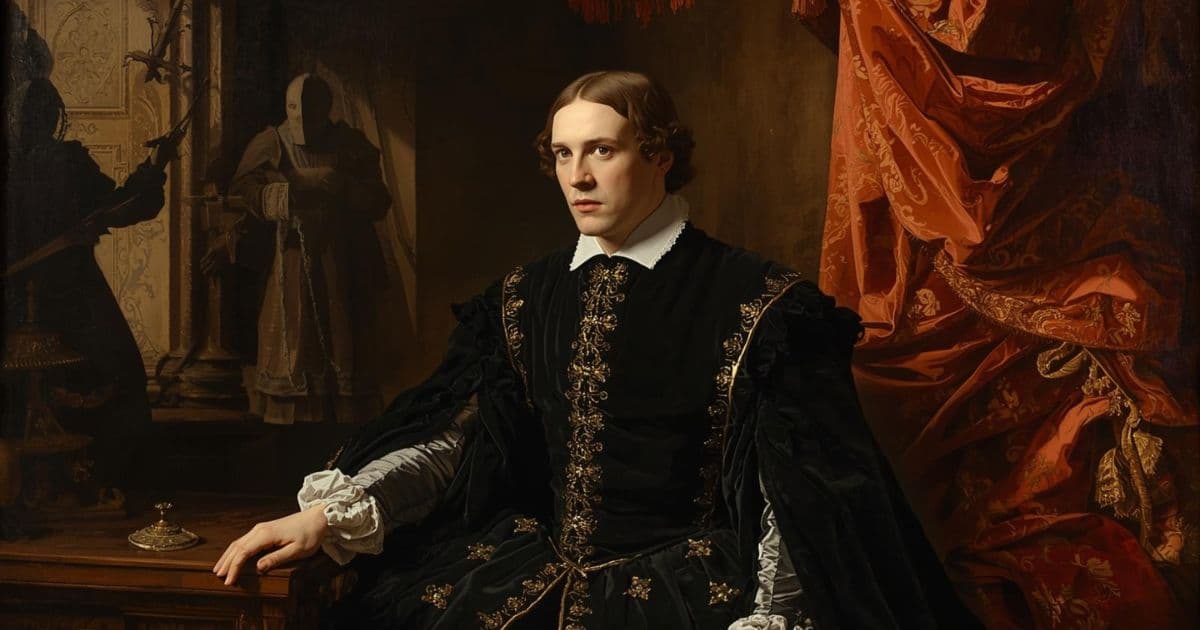
An excerpt from the original text.(complete · 2149 words)
merdyakov
He did in fact find his father still at table. Though there was a
dining‐ room in the house, the table was laid as usual in the
drawing‐room, which was the largest room, and furnished with
old‐fashioned ostentation. The furniture was white and very old,
upholstered in old, red, silky material. In the spaces between the
windows there were mirrors in elaborate white and gilt frames, of
old‐fashioned carving. On the walls, covered with white paper, which
was torn in many places, there hung two large portraits—one of some
prince who had been governor of the district thirty years before, and
the other of some bishop, also long since dead. In the corner opposite
the door there were several ikons, before which a lamp was lighted at
nightfall ... not so much for devotional purposes as to light the room.
Fyodor Pavlovitch used to go to bed very late, at three or four o’clock
in the morning, and would wander about the room at night or sit in an
arm‐chair, thinking. This had become a habit with him. He often slept
quite alone in the house, sending his servants to the lodge; but
usually Smerdyakov remained, sleeping on a bench in the hall.
When Alyosha came in, dinner was over, but coffee and preserves had
been served. Fyodor Pavlovitch liked sweet things with brandy after
dinner. Ivan was also at table, sipping coffee. The servants, Grigory
and Smerdyakov, were standing by. Both the gentlemen and the servants
seemed in singularly good spirits. Fyodor Pavlovitch was roaring with
laughter. Before he entered the room, Alyosha heard the shrill laugh he
knew so well, and could tell from the sound of it that his father had
only reached the good‐humored stage, and was far from being completely
drunk.
“Here he is! Here he is!” yelled Fyodor Pavlovitch, highly delighted at
seeing Alyosha. “Join us. Sit down. Coffee is a lenten dish, but it’s
hot and good. I don’t offer you brandy, you’re keeping the fast. But
would you like some? No; I’d better give you some of our famous
liqueur. Smerdyakov, go to the cupboard, the second shelf on the right.
Here are the keys. Look sharp!”
Alyosha began refusing the liqueur.
“Never mind. If you won’t have it, we will,” said Fyodor Pavlovitch,
beaming. “But stay—have you dined?”
“Yes,” answered Alyosha, who had in truth only eaten a piece of bread
and drunk a glass of kvas in the Father Superior’s kitchen. “Though I
should be pleased to have some hot coffee.”
“Bravo, my darling! He’ll have some coffee. Does it want warming? No,
it’s boiling. It’s capital coffee: Smerdyakov’s making. My Smerdyakov’s
an artist at coffee and at fish patties, and at fish soup, too. You
must come one day and have some fish soup. Let me know beforehand....
But, stay; didn’t I tell you this morning to come home with your
mattress and pillow and all? Have you brought your mattress? He he he!”
“No, I haven’t,” said Alyosha, smiling, too.
“Ah, but you were frightened, you were frightened this morning, weren’t
you? There, my darling, I couldn’t do anything to vex you. Do you know,
Ivan, I can’t resist the way he looks one straight in the face and
laughs? It makes me laugh all over. I’m so fond of him. Alyosha, let me
give you my blessing—a father’s blessing.”
Alyosha rose, but Fyodor Pavlovitch had already changed his mind.
“No, no,” he said. “I’ll just make the sign of the cross over you, for
now. Sit still. Now we’ve a treat for you, in your own line, too. It’ll
make you laugh. Balaam’s ass has begun talking to us here—and how he
talks! How he talks!”
Balaam’s ass, it appeared, was the valet, Smerdyakov. He was a young
man of about four and twenty, remarkably unsociable and taciturn. Not
that he was shy or bashful. On the contrary, he was conceited and
seemed to despise everybody.
But we must pause to say a few words about him now. He was brought up
by Grigory and Marfa, but the boy grew up “with no sense of gratitude,”
as Grigory expressed it; he was an unfriendly boy, and seemed to look
at the world mistrustfully. In his childhood he was very fond of
hanging cats, and burying them with great ceremony. He used to dress up
in a sheet as though it were a surplice, and sang, and waved some
object over the dead cat as though it were a censer. All this he did on
the sly, with the greatest secrecy. Grigory caught him once at this
diversion and gave him a sound beating. He shrank into a corner and
sulked there for a week. “He doesn’t care for you or me, the monster,”
Grigory used to say to Marfa, “and he doesn’t care for any one. Are you
a human being?” he said, addressing the boy directly. “You’re not a
human being. You grew from the mildew in the bath‐house.[2] That’s what
you are.” Smerdyakov, it appeared afterwards, could never forgive him
those words. Grigory taught him to read and write, and when he was
twelve years old, began teaching him the Scriptures. But this teaching
came to nothing. At the second or third lesson the boy suddenly
grinned.
“What’s that for?” asked Grigory, looking at him threateningly from
under his spectacles.
“Oh, nothing. God created light on the first day, and the sun, moon,
and stars on the fourth day. Where did the light come from on the first
day?”
Grigory was thunderstruck. The boy looked sarcastically at his teacher.
There was something positively condescending in his expression. Grigory
could not restrain himself. “I’ll show you where!” he cried, and gave
the boy a violent slap on the cheek. The boy took the slap without a
word, but withdrew into his corner again for some days. A week later he
had his first attack of the disease to which he was subject all the
rest of his life—epilepsy. When Fyodor Pavlovitch heard of it, his
attitude to the boy seemed changed at once. Till then he had taken no
notice of him, though he never scolded him, and always gave him a
copeck when he met him. Sometimes, when he was in good humor, he would
send the boy something sweet from his table. But as soon as he heard of
his illness, he showed an active interest in him, sent for a doctor,
and tried remedies, but the disease turned out to be incurable. The
fits occurred, on an average, once a month, but at various intervals.
The fits varied too, in violence: some were light and some were very
severe. Fyodor Pavlovitch strictly forbade Grigory to use corporal
punishment to the boy, and began allowing him to come upstairs to him.
He forbade him to be taught anything whatever for a time, too. One day
when the boy was about fifteen, Fyodor Pavlovitch noticed him lingering
by the bookcase, and reading the titles through the glass. Fyodor
Pavlovitch had a fair number of books—over a hundred—but no one ever
saw him reading. He at once gave Smerdyakov the key of the bookcase.
“Come, read. You shall be my librarian. You’ll be better sitting
reading than hanging about the courtyard. Come, read this,” and Fyodor
Pavlovitch gave him Evenings in a Cottage near Dikanka.
He read a little but didn’t like it. He did not once smile, and ended
by frowning.
“Why? Isn’t it funny?” asked Fyodor Pavlovitch.
Smerdyakov did not speak.
“Answer, stupid!”
“It’s all untrue,” mumbled the boy, with a grin.
“Then go to the devil! You have the soul of a lackey. Stay, here’s
Smaragdov’s Universal History. That’s all true. Read that.”
But Smerdyakov did not get through ten pages of Smaragdov. He thought
it dull. So the bookcase was closed again.
Shortly afterwards Marfa and Grigory reported to Fyodor Pavlovitch that
Smerdyakov was gradually beginning to show an extraordinary
fastidiousness. He would sit before his soup, take up his spoon and
look into the soup, bend over it, examine it, take a spoonful and hold
it to the light.
“What is it? A beetle?” Grigory would ask.
“A fly, perhaps,” observed Marfa.
The squeamish youth never answered, but he did the same with his bread,
his meat, and everything he ate. He would hold a piece on his fork to
the light, scrutinize it microscopically, and only after long
deliberation decide to put it in his mouth.
“Ach! What fine gentlemen’s airs!” Grigory muttered, looking at him.
When Fyodor Pavlovitch heard of this development in Smerdyakov he
determined to make him his cook, and sent him to Moscow to be trained.
He spent some years there and came back remarkably changed in
appearance. He looked extraordinarily old for his age. His face had
grown wrinkled, yellow, and strangely emasculate. In character he
seemed almost exactly the same as before he went away. He was just as
unsociable, and showed not the slightest inclination for any
companionship. In Moscow, too, as we heard afterwards, he had always
been silent. Moscow itself had little interest for him; he saw very
little there, and took scarcely any notice of anything. He went once to
the theater, but returned silent and displeased with it. On the other
hand, he came back to us from Moscow well dressed, in a clean coat and
clean linen. He brushed his clothes most scrupulously twice a day
invariably, and was very fond of cleaning his smart calf boots with a
special English polish, so that they shone like mirrors. He turned out
a first‐rate cook. Fyodor Pavlovitch paid him a salary, almost the
whole of which Smerdyakov spent on clothes, pomade, perfumes, and such
things. But he seemed to have as much contempt for the female sex as
for men; he was discreet, almost unapproachable, with them. Fyodor
Pavlovitch began to regard him rather differently. His fits were
becoming more frequent, and on the days he was ill Marfa cooked, which
did not suit Fyodor Pavlovitch at all.
“Why are your fits getting worse?” asked Fyodor Pavlovitch, looking
askance at his new cook. “Would you like to get married? Shall I find
you a wife?”
But Smerdyakov turned pale with anger, and made no reply. Fyodor
Pavlovitch left him with an impatient gesture. The great thing was that
he had absolute confidence in his honesty. It happened once, when
Fyodor Pavlovitch was drunk, that he dropped in the muddy courtyard
three hundred‐rouble notes which he had only just received. He only
missed them next day, and was just hastening to search his pockets when
he saw the notes lying on the table. Where had they come from?
Smerdyakov had picked them up and brought them in the day before.
“Well, my lad, I’ve never met any one like you,” Fyodor Pavlovitch said
shortly, and gave him ten roubles. We may add that he not only believed
in his honesty, but had, for some reason, a liking for him, although
the young man looked as morosely at him as at every one and was always
silent. He rarely spoke. If it had occurred to any one to wonder at the
time what the young man was interested in, and what was in his mind, it
would have been impossible to tell by looking at him. Yet he used
sometimes to stop suddenly in the house, or even in the yard or street,
and would stand still for ten minutes, lost in thought. A physiognomist
studying his face would have said that there was no thought in it, no
reflection, but only a sort of contemplation. There is a remarkable
picture by the painter Kramskoy, called “Contemplation.” There is a
forest in winter, and on a roadway through the forest, in absolute
solitude, stands a peasant in a torn kaftan and bark shoes. He stands,
as it were, lost in thought. Yet he is not thinking; he is
“contemplating.” If any one touched him he would start and look at one
as though awakening and bewildered. It’s true he would come to himself
immediately; but if he were asked what he had been thinking about, he
would remember nothing. Yet probably he has, hidden within himself, the
impression which had dominated him during the period of contemplation.
Those impressions are dear to him and no doubt he hoards them
imperceptibly, and even unconsciously. How and why, of course, he does
not know either. He may suddenly, after hoarding impressions for many
years, abandon everything and go off to Jerusalem on a pilgrimage for
his soul’s salvation, or perhaps he will suddenly set fire to his
native village, and perhaps do both. There are a good many
“contemplatives” among the peasantry. Well, Smerdyakov was probably one
of them, and he probably was greedily hoarding up his impressions,
hardly knowing why.
Master this chapter. Complete your experience
Purchase the complete book to access all chapters and support classic literature
As an Amazon Associate, we earn a small commission from qualifying purchases at no additional cost to you.
Available in paperback, hardcover, and e-book formats
Let's Analyse the Pattern
People without clear belonging develop dangerous power through observation and accumulated resentment.
Why This Matters
Connect literature to life
This chapter teaches how to identify who really holds information and influence in any organization, especially those who seem powerless but see everything.
Practice This Today
This week, notice who the silent watchers are in your workplace—the cleaning staff, night shift workers, or temps who observe but aren't asked for input.
Now let's explore the literary elements.
Key Quotes & Analysis
"He was one of those contemplative people who will stand motionless and gaze for hours together"
Context: Describing Smerdyakov's psychological type and warning nature
This reveals Smerdyakov as someone who appears passive but is constantly processing information. Dostoevsky is warning us that still waters run deep and this character is potentially dangerous.
In Today's Words:
He was the type who'd just stand there watching everything, taking it all in
"Such people are always scrupulously honest and incapable of telling a lie"
Context: Explaining Smerdyakov's rigid honesty despite his psychological damage
This paradox shows how damaged people can develop extreme behaviors as coping mechanisms. His honesty isn't virtue but a form of psychological armor.
In Today's Words:
These kinds of people never lie - they're too messed up to bend the truth
"It's always worth while speaking to a clever man"
Context: Commenting on Smerdyakov's intelligence despite his servant status
This shows the father's recognition of Smerdyakov's abilities while maintaining the class barrier. It's both acknowledgment and condescension, feeding Smerdyakov's resentment.
In Today's Words:
It's nice talking to someone who actually gets it
Thematic Threads
Identity
In This Chapter
Smerdyakov exists between servant and family member, belonging fully to neither world
Development
Builds on earlier themes of family legitimacy and social position
In Your Life:
You might feel this when you're 'part of' a workplace or family but never fully accepted or heard
Class
In This Chapter
The illegitimate son serves the legitimate family, highlighting rigid social boundaries
Development
Continues exploration of how birth circumstances determine life possibilities
In Your Life:
You see this in how some people get opportunities based on connections while others stay invisible despite competence
Power
In This Chapter
Smerdyakov gains influence through indispensability and secret knowledge rather than position
Development
Introduced here as alternative form of power outside traditional hierarchies
In Your Life:
You might recognize this in how the 'right hand' person often has more real influence than the official boss
Alienation
In This Chapter
Despite being trusted and competent, Smerdyakov remains completely antisocial and isolated
Development
New theme showing how competence doesn't guarantee belonging
In Your Life:
You might feel this when being good at your job doesn't translate to feeling part of the team
Observation
In This Chapter
Smerdyakov is described as absorbing impressions while appearing thoughtless, like a contemplative
Development
Introduced here as survival strategy for those without voice
In Your Life:
You might do this when you feel safer watching and learning than speaking up in uncertain situations
You now have the context. Time to form your own thoughts.
Discussion Questions
- 1
What specific behaviors and traits make Smerdyakov both valuable and unsettling to the Karamazov household?
analysis • surface - 2
Why does Dostoevsky describe Smerdyakov as a 'contemplative' who might suddenly abandon everything or burn down his village?
analysis • medium - 3
Where do you see the 'Silent Watcher' pattern in modern workplaces or families—people who know everything but belong nowhere?
application • medium - 4
If you were managing someone like Smerdyakov, how would you address their competence while recognizing their alienation?
application • deep - 5
What does Smerdyakov's story reveal about the hidden costs of keeping people in liminal spaces—neither fully inside nor outside our systems?
reflection • deep
Critical Thinking Exercise
Map Your Silent Watchers
Think about your workplace, family, or community. Identify someone who fits the Silent Watcher pattern—they have access, knowledge, and competence but lack clear belonging or voice. Write down what they see that others might miss, what power they hold through observation, and what risks this creates for everyone involved.
Consider:
- •Consider both the watcher's perspective and the system that created their position
- •Think about what information or insights they might have that others overlook
- •Reflect on whether this dynamic serves anyone well long-term
Journaling Prompt
Write about a time when you were the silent watcher yourself. What did you see that others missed? How did it feel to have knowledge but no voice? What would have helped you feel more included?
Coming Up Next...
Chapter 20: Faith, Logic, and Loopholes
The stage is set for a heated philosophical debate that will reveal the deep ideological divisions tearing the Karamazov family apart. Ivan and his father are about to clash over fundamental questions of faith and morality.