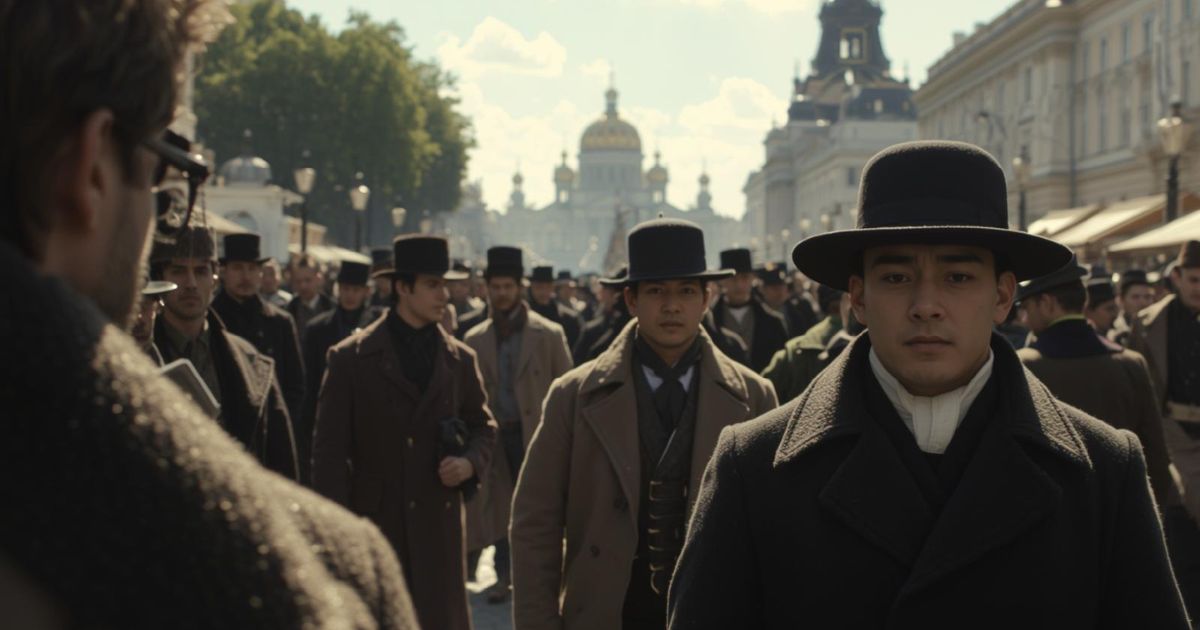
An excerpt from the original text.(complete · 5084 words)
is mother’s letter had been a torture to him, but as regards the chief
fact in it, he had felt not one moment’s hesitation, even whilst he was
reading the letter. The essential question was settled, and irrevocably
settled, in his mind: “Never such a marriage while I am alive and
Mr. Luzhin be damned!” “The thing is perfectly clear,” he muttered
to himself, with a malignant smile anticipating the triumph of his
decision. “No, mother, no, Dounia, you won’t deceive me! and then they
apologise for not asking my advice and for taking the decision without
me! I dare say! They imagine it is arranged now and can’t be broken
off; but we will see whether it can or not! A magnificent excuse:
‘Pyotr Petrovitch is such a busy man that even his wedding has to be in
post-haste, almost by express.’ No, Dounia, I see it all and I know what
you want to say to me; and I know too what you were thinking about, when
you walked up and down all night, and what your prayers were like before
the Holy Mother of Kazan who stands in mother’s bedroom. Bitter is
the ascent to Golgotha.... Hm... so it is finally settled; you have
determined to marry a sensible business man, Avdotya Romanovna, one
who has a fortune (has already made his fortune, that is so much
more solid and impressive), a man who holds two government posts and who
shares the ideas of our most rising generation, as mother writes, and
who seems to be kind, as Dounia herself observes. That seems beats
everything! And that very Dounia for that very ‘seems’ is marrying
him! Splendid! splendid!
“... But I should like to know why mother has written to me about ‘our
most rising generation’? Simply as a descriptive touch, or with the idea
of prepossessing me in favour of Mr. Luzhin? Oh, the cunning of them!
I should like to know one thing more: how far they were open with one
another that day and night and all this time since? Was it all put into
words, or did both understand that they had the same thing at heart
and in their minds, so that there was no need to speak of it aloud, and
better not to speak of it. Most likely it was partly like that, from
mother’s letter it’s evident: he struck her as rude a little, and
mother in her simplicity took her observations to Dounia. And she was
sure to be vexed and ‘answered her angrily.’ I should think so! Who
would not be angered when it was quite clear without any naïve questions
and when it was understood that it was useless to discuss it. And why
does she write to me, ‘love Dounia, Rodya, and she loves you more than
herself’? Has she a secret conscience-prick at sacrificing her daughter
to her son? ‘You are our one comfort, you are everything to us.’ Oh,
mother!”
His bitterness grew more and more intense, and if he had happened to
meet Mr. Luzhin at the moment, he might have murdered him.
“Hm... yes, that’s true,” he continued, pursuing the whirling ideas that
chased each other in his brain, “it is true that ‘it needs time and care
to get to know a man,’ but there is no mistake about Mr. Luzhin. The
chief thing is he is ‘a man of business and seems kind,’ that was
something, wasn’t it, to send the bags and big box for them! A kind man,
no doubt after that! But his bride and her mother are to drive in a
peasant’s cart covered with sacking (I know, I have been driven in
it). No matter! It is only ninety versts and then they can ‘travel very
comfortably, third class,’ for a thousand versts! Quite right, too. One
must cut one’s coat according to one’s cloth, but what about you, Mr.
Luzhin? She is your bride.... And you must be aware that her mother has
to raise money on her pension for the journey. To be sure it’s a matter
of business, a partnership for mutual benefit, with equal shares and
expenses;--food and drink provided, but pay for your tobacco. The
business man has got the better of them, too. The luggage will cost less
than their fares and very likely go for nothing. How is it that they
don’t both see all that, or is it that they don’t want to see? And
they are pleased, pleased! And to think that this is only the first
blossoming, and that the real fruits are to come! But what really
matters is not the stinginess, is not the meanness, but the tone
of the whole thing. For that will be the tone after marriage, it’s a
foretaste of it. And mother too, why should she be so lavish? What will
she have by the time she gets to Petersburg? Three silver roubles or
two ‘paper ones’ as she says.... that old woman... hm. What does
she expect to live upon in Petersburg afterwards? She has her reasons
already for guessing that she could not live with Dounia after the
marriage, even for the first few months. The good man has no doubt let
slip something on that subject also, though mother would deny it: ‘I
shall refuse,’ says she. On whom is she reckoning then? Is she counting
on what is left of her hundred and twenty roubles of pension when
Afanasy Ivanovitch’s debt is paid? She knits woollen shawls and
embroiders cuffs, ruining her old eyes. And all her shawls don’t add
more than twenty roubles a year to her hundred and twenty, I know
that. So she is building all her hopes all the time on Mr. Luzhin’s
generosity; ‘he will offer it of himself, he will press it on me.’
You may wait a long time for that! That’s how it always is with these
Schilleresque noble hearts; till the last moment every goose is a swan
with them, till the last moment, they hope for the best and will see
nothing wrong, and although they have an inkling of the other side of
the picture, yet they won’t face the truth till they are forced to; the
very thought of it makes them shiver; they thrust the truth away with
both hands, until the man they deck out in false colours puts a fool’s
cap on them with his own hands. I should like to know whether Mr. Luzhin
has any orders of merit; I bet he has the Anna in his buttonhole and
that he puts it on when he goes to dine with contractors or merchants.
He will be sure to have it for his wedding, too! Enough of him, confound
him!
“Well,... mother I don’t wonder at, it’s like her, God bless her, but
how could Dounia? Dounia darling, as though I did not know you! You were
nearly twenty when I saw you last: I understood you then. Mother writes
that ‘Dounia can put up with a great deal.’ I know that very well. I
knew that two years and a half ago, and for the last two and a half
years I have been thinking about it, thinking of just that, that ‘Dounia
can put up with a great deal.’ If she could put up with Mr. Svidrigaïlov
and all the rest of it, she certainly can put up with a great deal. And
now mother and she have taken it into their heads that she can put up
with Mr. Luzhin, who propounds the theory of the superiority of
wives raised from destitution and owing everything to their husband’s
bounty--who propounds it, too, almost at the first interview. Granted
that he ‘let it slip,’ though he is a sensible man, (yet maybe it
was not a slip at all, but he meant to make himself clear as soon as
possible) but Dounia, Dounia? She understands the man, of course, but
she will have to live with the man. Why! she’d live on black bread
and water, she would not sell her soul, she would not barter her moral
freedom for comfort; she would not barter it for all Schleswig-Holstein,
much less Mr. Luzhin’s money. No, Dounia was not that sort when I knew
her and... she is still the same, of course! Yes, there’s no denying,
the Svidrigaïlovs are a bitter pill! It’s a bitter thing to spend one’s
life a governess in the provinces for two hundred roubles, but I know
she would rather be a nigger on a plantation or a Lett with a German
master than degrade her soul, and her moral dignity, by binding herself
for ever to a man whom she does not respect and with whom she has
nothing in common--for her own advantage. And if Mr. Luzhin had been of
unalloyed gold, or one huge diamond, she would never have consented to
become his legal concubine. Why is she consenting then? What’s the
point of it? What’s the answer? It’s clear enough: for herself, for her
comfort, to save her life she would not sell herself, but for someone
else she is doing it! For one she loves, for one she adores, she will
sell herself! That’s what it all amounts to; for her brother, for her
mother, she will sell herself! She will sell everything! In such cases,
‘we overcome our moral feeling if necessary,’ freedom, peace, conscience
even, all, all are brought into the market. Let my life go, if only my
dear ones may be happy! More than that, we become casuists, we learn
to be Jesuitical and for a time maybe we can soothe ourselves, we can
persuade ourselves that it is one’s duty for a good object. That’s just
like us, it’s as clear as daylight. It’s clear that Rodion Romanovitch
Raskolnikov is the central figure in the business, and no one else. Oh,
yes, she can ensure his happiness, keep him in the university, make him
a partner in the office, make his whole future secure; perhaps he may
even be a rich man later on, prosperous, respected, and may even end his
life a famous man! But my mother? It’s all Rodya, precious Rodya, her
first born! For such a son who would not sacrifice such a daughter! Oh,
loving, over-partial hearts! Why, for his sake we would not shrink even
from Sonia’s fate. Sonia, Sonia Marmeladov, the eternal victim so long
as the world lasts. Have you taken the measure of your sacrifice, both
of you? Is it right? Can you bear it? Is it any use? Is there sense in
it? And let me tell you, Dounia, Sonia’s life is no worse than life with
Mr. Luzhin. ‘There can be no question of love,’ mother writes. And what
if there can be no respect either, if on the contrary there is aversion,
contempt, repulsion, what then? So you will have to ‘keep up your
appearance,’ too. Is not that so? Do you understand what that smartness
means? Do you understand that the Luzhin smartness is just the same
thing as Sonia’s and may be worse, viler, baser, because in your case,
Dounia, it’s a bargain for luxuries, after all, but with Sonia it’s
simply a question of starvation. It has to be paid for, it has to be
paid for, Dounia, this smartness. And what if it’s more than you can
bear afterwards, if you regret it? The bitterness, the misery, the
curses, the tears hidden from all the world, for you are not a Marfa
Petrovna. And how will your mother feel then? Even now she is uneasy,
she is worried, but then, when she sees it all clearly? And I? Yes,
indeed, what have you taken me for? I won’t have your sacrifice, Dounia,
I won’t have it, mother! It shall not be, so long as I am alive, it
shall not, it shall not! I won’t accept it!”
He suddenly paused in his reflection and stood still.
“It shall not be? But what are you going to do to prevent it? You’ll
forbid it? And what right have you? What can you promise them on your
side to give you such a right? Your whole life, your whole future, you
will devote to them when you have finished your studies and obtained a
post? Yes, we have heard all that before, and that’s all words, but
now? Now something must be done, now, do you understand that? And
what are you doing now? You are living upon them. They borrow on their
hundred roubles pension. They borrow from the Svidrigaïlovs. How are
you going to save them from Svidrigaïlovs, from Afanasy Ivanovitch
Vahrushin, oh, future millionaire Zeus who would arrange their lives for
them? In another ten years? In another ten years, mother will be blind
with knitting shawls, maybe with weeping too. She will be worn to a
shadow with fasting; and my sister? Imagine for a moment what may have
become of your sister in ten years? What may happen to her during those
ten years? Can you fancy?”
So he tortured himself, fretting himself with such questions, and
finding a kind of enjoyment in it. And yet all these questions were not
new ones suddenly confronting him, they were old familiar aches. It was
long since they had first begun to grip and rend his heart. Long, long
ago his present anguish had its first beginnings; it had waxed and
gathered strength, it had matured and concentrated, until it had taken
the form of a fearful, frenzied and fantastic question, which tortured
his heart and mind, clamouring insistently for an answer. Now his
mother’s letter had burst on him like a thunderclap. It was clear
that he must not now suffer passively, worrying himself over unsolved
questions, but that he must do something, do it at once, and do it
quickly. Anyway he must decide on something, or else...
“Or throw up life altogether!” he cried suddenly, in a frenzy--“accept
one’s lot humbly as it is, once for all and stifle everything in
oneself, giving up all claim to activity, life and love!”
“Do you understand, sir, do you understand what it means when you have
absolutely nowhere to turn?” Marmeladov’s question came suddenly into
his mind, “for every man must have somewhere to turn....”
He gave a sudden start; another thought, that he had had yesterday,
slipped back into his mind. But he did not start at the thought
recurring to him, for he knew, he had felt beforehand, that it must
come back, he was expecting it; besides it was not only yesterday’s
thought. The difference was that a month ago, yesterday even, the
thought was a mere dream: but now... now it appeared not a dream at all,
it had taken a new menacing and quite unfamiliar shape, and he suddenly
became aware of this himself.... He felt a hammering in his head, and
there was a darkness before his eyes.
He looked round hurriedly, he was searching for something. He wanted
to sit down and was looking for a seat; he was walking along the K----
Boulevard. There was a seat about a hundred paces in front of him. He
walked towards it as fast he could; but on the way he met with a little
adventure which absorbed all his attention. Looking for the seat, he had
noticed a woman walking some twenty paces in front of him, but at first
he took no more notice of her than of other objects that crossed his
path. It had happened to him many times going home not to notice the
road by which he was going, and he was accustomed to walk like that. But
there was at first sight something so strange about the woman in front
of him, that gradually his attention was riveted upon her, at first
reluctantly and, as it were, resentfully, and then more and more
intently. He felt a sudden desire to find out what it was that was so
strange about the woman. In the first place, she appeared to be a girl
quite young, and she was walking in the great heat bareheaded and with
no parasol or gloves, waving her arms about in an absurd way. She had
on a dress of some light silky material, but put on strangely awry, not
properly hooked up, and torn open at the top of the skirt, close to the
waist: a great piece was rent and hanging loose. A little kerchief was
flung about her bare throat, but lay slanting on one side. The girl was
walking unsteadily, too, stumbling and staggering from side to side. She
drew Raskolnikov’s whole attention at last. He overtook the girl at the
seat, but, on reaching it, she dropped down on it, in the corner;
she let her head sink on the back of the seat and closed her eyes,
apparently in extreme exhaustion. Looking at her closely, he saw at once
that she was completely drunk. It was a strange and shocking sight. He
could hardly believe that he was not mistaken. He saw before him the
face of a quite young, fair-haired girl--sixteen, perhaps not more than
fifteen, years old, pretty little face, but flushed and heavy looking
and, as it were, swollen. The girl seemed hardly to know what she was
doing; she crossed one leg over the other, lifting it indecorously, and
showed every sign of being unconscious that she was in the street.
Raskolnikov did not sit down, but he felt unwilling to leave her,
and stood facing her in perplexity. This boulevard was never much
frequented; and now, at two o’clock, in the stifling heat, it was quite
deserted. And yet on the further side of the boulevard, about fifteen
paces away, a gentleman was standing on the edge of the pavement. He,
too, would apparently have liked to approach the girl with some object
of his own. He, too, had probably seen her in the distance and had
followed her, but found Raskolnikov in his way. He looked angrily at
him, though he tried to escape his notice, and stood impatiently biding
his time, till the unwelcome man in rags should have moved away. His
intentions were unmistakable. The gentleman was a plump, thickly-set
man, about thirty, fashionably dressed, with a high colour, red lips and
moustaches. Raskolnikov felt furious; he had a sudden longing to insult
this fat dandy in some way. He left the girl for a moment and walked
towards the gentleman.
“Hey! You Svidrigaïlov! What do you want here?” he shouted, clenching
his fists and laughing, spluttering with rage.
“What do you mean?” the gentleman asked sternly, scowling in haughty
astonishment.
“Get away, that’s what I mean.”
“How dare you, you low fellow!”
He raised his cane. Raskolnikov rushed at him with his fists, without
reflecting that the stout gentleman was a match for two men like
himself. But at that instant someone seized him from behind, and a
police constable stood between them.
“That’s enough, gentlemen, no fighting, please, in a public place. What
do you want? Who are you?” he asked Raskolnikov sternly, noticing his
rags.
Raskolnikov looked at him intently. He had a straight-forward, sensible,
soldierly face, with grey moustaches and whiskers.
“You are just the man I want,” Raskolnikov cried, catching at his arm.
“I am a student, Raskolnikov.... You may as well know that too,” he
added, addressing the gentleman, “come along, I have something to show
you.”
And taking the policeman by the hand he drew him towards the seat.
“Look here, hopelessly drunk, and she has just come down the boulevard.
There is no telling who and what she is, she does not look like a
professional. It’s more likely she has been given drink and deceived
somewhere... for the first time... you understand? and they’ve put her
out into the street like that. Look at the way her dress is torn, and
the way it has been put on: she has been dressed by somebody, she has
not dressed herself, and dressed by unpractised hands, by a man’s hands;
that’s evident. And now look there: I don’t know that dandy with whom I
was going to fight, I see him for the first time, but he, too, has seen
her on the road, just now, drunk, not knowing what she is doing, and now
he is very eager to get hold of her, to get her away somewhere while she
is in this state... that’s certain, believe me, I am not wrong. I saw
him myself watching her and following her, but I prevented him, and he
is just waiting for me to go away. Now he has walked away a little, and
is standing still, pretending to make a cigarette.... Think how can we
keep her out of his hands, and how are we to get her home?”
The policeman saw it all in a flash. The stout gentleman was easy to
understand, he turned to consider the girl. The policeman bent over to
examine her more closely, and his face worked with genuine compassion.
“Ah, what a pity!” he said, shaking his head--“why, she is quite a
child! She has been deceived, you can see that at once. Listen, lady,”
he began addressing her, “where do you live?” The girl opened her weary
and sleepy-looking eyes, gazed blankly at the speaker and waved her
hand.
“Here,” said Raskolnikov feeling in his pocket and finding twenty
copecks, “here, call a cab and tell him to drive her to her address. The
only thing is to find out her address!”
“Missy, missy!” the policeman began again, taking the money. “I’ll fetch
you a cab and take you home myself. Where shall I take you, eh? Where do
you live?”
“Go away! They won’t let me alone,” the girl muttered, and once more
waved her hand.
“Ach, ach, how shocking! It’s shameful, missy, it’s a shame!” He shook
his head again, shocked, sympathetic and indignant.
“It’s a difficult job,” the policeman said to Raskolnikov, and as he
did so, he looked him up and down in a rapid glance. He, too, must have
seemed a strange figure to him: dressed in rags and handing him money!
“Did you meet her far from here?” he asked him.
“I tell you she was walking in front of me, staggering, just here, in
the boulevard. She only just reached the seat and sank down on it.”
“Ah, the shameful things that are done in the world nowadays, God have
mercy on us! An innocent creature like that, drunk already! She has been
deceived, that’s a sure thing. See how her dress has been torn too....
Ah, the vice one sees nowadays! And as likely as not she belongs to
gentlefolk too, poor ones maybe.... There are many like that nowadays.
She looks refined, too, as though she were a lady,” and he bent over her
once more.
Perhaps he had daughters growing up like that, “looking like ladies and
refined” with pretensions to gentility and smartness....
“The chief thing is,” Raskolnikov persisted, “to keep her out of this
scoundrel’s hands! Why should he outrage her? It’s as clear as day what
he is after; ah, the brute, he is not moving off!”
Raskolnikov spoke aloud and pointed to him. The gentleman heard him,
and seemed about to fly into a rage again, but thought better of it, and
confined himself to a contemptuous look. He then walked slowly another
ten paces away and again halted.
“Keep her out of his hands we can,” said the constable thoughtfully,
“if only she’d tell us where to take her, but as it is.... Missy, hey,
missy!” he bent over her once more.
She opened her eyes fully all of a sudden, looked at him intently, as
though realising something, got up from the seat and walked away in the
direction from which she had come. “Oh shameful wretches, they won’t let
me alone!” she said, waving her hand again. She walked quickly, though
staggering as before. The dandy followed her, but along another avenue,
keeping his eye on her.
“Don’t be anxious, I won’t let him have her,” the policeman said
resolutely, and he set off after them.
“Ah, the vice one sees nowadays!” he repeated aloud, sighing.
At that moment something seemed to sting Raskolnikov; in an instant a
complete revulsion of feeling came over him.
“Hey, here!” he shouted after the policeman.
The latter turned round.
“Let them be! What is it to do with you? Let her go! Let him amuse
himself.” He pointed at the dandy, “What is it to do with you?”
The policeman was bewildered, and stared at him open-eyed. Raskolnikov
laughed.
“Well!” ejaculated the policeman, with a gesture of contempt, and he
walked after the dandy and the girl, probably taking Raskolnikov for a
madman or something even worse.
“He has carried off my twenty copecks,” Raskolnikov murmured angrily
when he was left alone. “Well, let him take as much from the other
fellow to allow him to have the girl and so let it end. And why did I
want to interfere? Is it for me to help? Have I any right to help? Let
them devour each other alive--what is it to me? How did I dare to give him
twenty copecks? Were they mine?”
In spite of those strange words he felt very wretched. He sat down on
the deserted seat. His thoughts strayed aimlessly.... He found it hard
to fix his mind on anything at that moment. He longed to forget himself
altogether, to forget everything, and then to wake up and begin life
anew....
“Poor girl!” he said, looking at the empty corner where she had
sat--“She will come to herself and weep, and then her mother will find
out.... She will give her a beating, a horrible, shameful beating and
then maybe, turn her out of doors.... And even if she does not, the
Darya Frantsovnas will get wind of it, and the girl will soon be
slipping out on the sly here and there. Then there will be the hospital
directly (that’s always the luck of those girls with respectable
mothers, who go wrong on the sly) and then... again the hospital...
drink... the taverns... and more hospital, in two or three years--a
wreck, and her life over at eighteen or nineteen.... Have not I seen
cases like that? And how have they been brought to it? Why, they’ve all
come to it like that. Ugh! But what does it matter? That’s as it should
be, they tell us. A certain percentage, they tell us, must every year
go... that way... to the devil, I suppose, so that the rest may remain
chaste, and not be interfered with. A percentage! What splendid words
they have; they are so scientific, so consolatory.... Once you’ve said
‘percentage’ there’s nothing more to worry about. If we had any other
word... maybe we might feel more uneasy.... But what if Dounia were one
of the percentage! Of another one if not that one?
“But where am I going?” he thought suddenly. “Strange, I came out for
something. As soon as I had read the letter I came out.... I was going
to Vassilyevsky Ostrov, to Razumihin. That’s what it was... now I
remember. What for, though? And what put the idea of going to Razumihin
into my head just now? That’s curious.”
He wondered at himself. Razumihin was one of his old comrades at the
university. It was remarkable that Raskolnikov had hardly any friends at
the university; he kept aloof from everyone, went to see no one, and did
not welcome anyone who came to see him, and indeed everyone soon gave
him up. He took no part in the students’ gatherings, amusements or
conversations. He worked with great intensity without sparing himself,
and he was respected for this, but no one liked him. He was very poor,
and there was a sort of haughty pride and reserve about him, as though
he were keeping something to himself. He seemed to some of his comrades
to look down upon them all as children, as though he were superior in
development, knowledge and convictions, as though their beliefs and
interests were beneath him.
With Razumihin he had got on, or, at least, he was more unreserved and
communicative with him. Indeed it was impossible to be on any other
terms with Razumihin. He was an exceptionally good-humoured and candid
youth, good-natured to the point of simplicity, though both depth and
dignity lay concealed under that simplicity. The better of his comrades
understood this, and all were fond of him. He was extremely intelligent,
though he was certainly rather a simpleton at times. He was of striking
appearance--tall, thin, black-haired and always badly shaved. He was
sometimes uproarious and was reputed to be of great physical strength.
One night, when out in a festive company, he had with one blow laid
a gigantic policeman on his back. There was no limit to his drinking
powers, but he could abstain from drink altogether; he sometimes went
too far in his pranks; but he could do without pranks altogether.
Another thing striking about Razumihin, no failure distressed him, and
it seemed as though no unfavourable circumstances could crush him. He
could lodge anywhere, and bear the extremes of cold and hunger. He was
very poor, and kept himself entirely on what he could earn by work of
one sort or another. He knew of no end of resources by which to earn
money. He spent one whole winter without lighting his stove, and used to
declare that he liked it better, because one slept more soundly in
the cold. For the present he, too, had been obliged to give up the
university, but it was only for a time, and he was working with all his
might to save enough to return to his studies again. Raskolnikov had
not been to see him for the last four months, and Razumihin did not even
know his address. About two months before, they had met in the street,
but Raskolnikov had turned away and even crossed to the other side that
he might not be observed. And though Razumihin noticed him, he passed
him by, as he did not want to annoy him.
Master this chapter. Complete your experience
Purchase the complete book to access all chapters and support classic literature
As an Amazon Associate, we earn a small commission from qualifying purchases at no additional cost to you.
Available in paperback, hardcover, and e-book formats
Let's Analyse the Pattern
Why This Matters
Connect literature to life
This chapter trains you to distinguish genuine support from 'rescue' that demands obedience, gratitude, or loss of dignity.
Now let's explore the literary elements.
Key Quotes & Analysis
"Never such a marriage while I am alive and Mr. Luzhin be damned!"
Context: Reading his mother's letter about Dunya's engagement
Captures his immediate moral rejection of any arrangement built on dependency and control, even before he can offer a practical alternative.
"For one she loves, for one she adores, she will sell herself! That's what it all amounts to."
Context: Recognizing Dunya's sacrifice is for family survival
Names the chapter's central violence: devotion converted into transaction when poverty turns relationships into economic strategy.
"I won't have your sacrifice, Dounia, I won't have it, mother! It shall not be, so long as I am alive."
Context: His internal vow after spiraling through the consequences
Shows the collision between moral refusal and material powerlessness that pushes him toward increasingly extreme thinking.
Thematic Threads
Sacrifice
In This Chapter
Dunya's proposed marriage reframes self-denial as family duty, raising the question of when sacrifice becomes self-betrayal.
Development
Moves from abstract loyalty to concrete economic coercion, showing the emotional cost of survival bargains.
Power
In This Chapter
Luzhin's offer appears generous but is structured to keep authority and gratitude flowing one way.
Development
Expands the novel's critique of social hierarchy from institutions into intimate relationships.
Poverty
In This Chapter
Financial precarity drives decisions that would otherwise be morally unacceptable.
Development
Reinforces that class pressure is not background scenery; it actively reshapes ethics and agency.
Moral Agency
In This Chapter
Raskolnikov rejects the sacrifice in principle but lacks legitimate means to stop it.
Development
Intensifies his crisis by exposing the gap between moral clarity and practical power.
You now have the context. Time to form your own thoughts.
Discussion Questions
- 1
Where is the line between necessary family sacrifice and unacceptable self-erasure in Dunya's decision?
- 2
How does Luzhin frame control as generosity, and why is that framing persuasive when people are financially vulnerable?
- 3
Why does Raskolnikov's moral clarity fail to produce practical solutions, and what does that reveal about poverty?
- 4
What modern situations resemble this chapter's 'respectable coercion' pattern in work, school, or relationships?
- 5
If you were advising Dunya, what alternatives would preserve both safety and dignity?
Critical Thinking Exercise
Evaluate a 'Rescue Offer'
Think of a time someone offered help that came with visible or hidden strings attached. Write down the offer, the cost, and the emotional pressure around saying yes. Then evaluate it with four checks: freedom to refuse, freedom to exit, decision-making power, and dignity preserved.
Consider:
- •Distinguish immediate relief from long-term dependency
- •Identify which constraints are economic and which are relational
- •Name one alternative path that preserves more agency, even if slower
Coming Up Next...
Chapter 5: The Dream of the Mare
Raskolnikov's paranoia deepens as he's summoned to the police station, where a routine matter about his unpaid rent becomes a psychological battlefield. Every question feels like an interrogation, and his guilty conscience turns innocent remarks into accusations.