An excerpt from the original text.(complete · 4198 words)
“f course, I’ve been meaning lately to go to Razumihin’s to ask for
work, to ask him to get me lessons or something...” Raskolnikov thought,
“but what help can he be to me now? Suppose he gets me lessons, suppose
he shares his last farthing with me, if he has any farthings, so that
I could get some boots and make myself tidy enough to give lessons...
hm... Well and what then? What shall I do with the few coppers I
earn? That’s not what I want now. It’s really absurd for me to go to
Razumihin....”
The question why he was now going to Razumihin agitated him even more
than he was himself aware; he kept uneasily seeking for some sinister
significance in this apparently ordinary action.
“Could I have expected to set it all straight and to find a way out by
means of Razumihin alone?” he asked himself in perplexity.
He pondered and rubbed his forehead, and, strange to say, after long
musing, suddenly, as if it were spontaneously and by chance, a fantastic
thought came into his head.
“Hm... to Razumihin’s,” he said all at once, calmly, as though he had
reached a final determination. “I shall go to Razumihin’s of course,
but... not now. I shall go to him... on the next day after It, when It
will be over and everything will begin afresh....”
And suddenly he realised what he was thinking.
“After It,” he shouted, jumping up from the seat, “but is It really
going to happen? Is it possible it really will happen?” He left the
seat, and went off almost at a run; he meant to turn back, homewards,
but the thought of going home suddenly filled him with intense loathing;
in that hole, in that awful little cupboard of his, all this had for a
month past been growing up in him; and he walked on at random.
His nervous shudder had passed into a fever that made him feel
shivering; in spite of the heat he felt cold. With a kind of effort he
began almost unconsciously, from some inner craving, to stare at all
the objects before him, as though looking for something to distract his
attention; but he did not succeed, and kept dropping every moment into
brooding. When with a start he lifted his head again and looked round,
he forgot at once what he had just been thinking about and even where he
was going. In this way he walked right across Vassilyevsky Ostrov, came
out on to the Lesser Neva, crossed the bridge and turned towards the
islands. The greenness and freshness were at first restful to his weary
eyes after the dust of the town and the huge houses that hemmed him in
and weighed upon him. Here there were no taverns, no stifling closeness,
no stench. But soon these new pleasant sensations passed into morbid
irritability. Sometimes he stood still before a brightly painted summer
villa standing among green foliage, he gazed through the fence, he saw
in the distance smartly dressed women on the verandahs and balconies,
and children running in the gardens. The flowers especially caught his
attention; he gazed at them longer than at anything. He was met, too, by
luxurious carriages and by men and women on horseback; he watched them
with curious eyes and forgot about them before they had vanished from
his sight. Once he stood still and counted his money; he found he had
thirty copecks. “Twenty to the policeman, three to Nastasya for the
letter, so I must have given forty-seven or fifty to the Marmeladovs
yesterday,” he thought, reckoning it up for some unknown reason, but he
soon forgot with what object he had taken the money out of his pocket.
He recalled it on passing an eating-house or tavern, and felt that he
was hungry.... Going into the tavern he drank a glass of vodka and ate a
pie of some sort. He finished eating it as he walked away. It was a long
while since he had taken vodka and it had an effect upon him at once,
though he only drank a wineglassful. His legs felt suddenly heavy and
a great drowsiness came upon him. He turned homewards, but reaching
Petrovsky Ostrov he stopped completely exhausted, turned off the road
into the bushes, sank down upon the grass and instantly fell asleep.
In a morbid condition of the brain, dreams often have a singular
actuality, vividness, and extraordinary semblance of reality. At times
monstrous images are created, but the setting and the whole picture are
so truth-like and filled with details so delicate, so unexpectedly, but
so artistically consistent, that the dreamer, were he an artist like
Pushkin or Turgenev even, could never have invented them in the waking
state. Such sick dreams always remain long in the memory and make a
powerful impression on the overwrought and deranged nervous system.
Raskolnikov had a fearful dream. He dreamt he was back in his childhood
in the little town of his birth. He was a child about seven years old,
walking into the country with his father on the evening of a holiday. It
was a grey and heavy day, the country was exactly as he remembered it;
indeed he recalled it far more vividly in his dream than he had done in
memory. The little town stood on a level flat as bare as the hand, not
even a willow near it; only in the far distance, a copse lay, a dark
blur on the very edge of the horizon. A few paces beyond the last market
garden stood a tavern, a big tavern, which had always aroused in him a
feeling of aversion, even of fear, when he walked by it with his father.
There was always a crowd there, always shouting, laughter and abuse,
hideous hoarse singing and often fighting. Drunken and horrible-looking
figures were hanging about the tavern. He used to cling close to his
father, trembling all over when he met them. Near the tavern the road
became a dusty track, the dust of which was always black. It was a
winding road, and about a hundred paces further on, it turned to the
right to the graveyard. In the middle of the graveyard stood a stone
church with a green cupola where he used to go to mass two or three
times a year with his father and mother, when a service was held in
memory of his grandmother, who had long been dead, and whom he had never
seen. On these occasions they used to take on a white dish tied up in a
table napkin a special sort of rice pudding with raisins stuck in it in
the shape of a cross. He loved that church, the old-fashioned, unadorned
ikons and the old priest with the shaking head. Near his grandmother’s
grave, which was marked by a stone, was the little grave of his younger
brother who had died at six months old. He did not remember him at all,
but he had been told about his little brother, and whenever he visited
the graveyard he used religiously and reverently to cross himself and
to bow down and kiss the little grave. And now he dreamt that he was
walking with his father past the tavern on the way to the graveyard; he
was holding his father’s hand and looking with dread at the tavern. A
peculiar circumstance attracted his attention: there seemed to be
some kind of festivity going on, there were crowds of gaily dressed
townspeople, peasant women, their husbands, and riff-raff of all sorts,
all singing and all more or less drunk. Near the entrance of the tavern
stood a cart, but a strange cart. It was one of those big carts usually
drawn by heavy cart-horses and laden with casks of wine or other heavy
goods. He always liked looking at those great cart-horses, with their
long manes, thick legs, and slow even pace, drawing along a perfect
mountain with no appearance of effort, as though it were easier going
with a load than without it. But now, strange to say, in the shafts of
such a cart he saw a thin little sorrel beast, one of those peasants’
nags which he had often seen straining their utmost under a heavy load
of wood or hay, especially when the wheels were stuck in the mud or in
a rut. And the peasants would beat them so cruelly, sometimes even
about the nose and eyes, and he felt so sorry, so sorry for them that
he almost cried, and his mother always used to take him away from the
window. All of a sudden there was a great uproar of shouting, singing
and the balalaïka, and from the tavern a number of big and very drunken
peasants came out, wearing red and blue shirts and coats thrown over
their shoulders.
“Get in, get in!” shouted one of them, a young thick-necked peasant with
a fleshy face red as a carrot. “I’ll take you all, get in!”
But at once there was an outbreak of laughter and exclamations in the
crowd.
“Take us all with a beast like that!”
“Why, Mikolka, are you crazy to put a nag like that in such a cart?”
“And this mare is twenty if she is a day, mates!”
“Get in, I’ll take you all,” Mikolka shouted again, leaping first into
the cart, seizing the reins and standing straight up in front. “The bay
has gone with Matvey,” he shouted from the cart--“and this brute, mates,
is just breaking my heart, I feel as if I could kill her. She’s just
eating her head off. Get in, I tell you! I’ll make her gallop! She’ll
gallop!” and he picked up the whip, preparing himself with relish to
flog the little mare.
“Get in! Come along!” The crowd laughed. “D’you hear, she’ll gallop!”
“Gallop indeed! She has not had a gallop in her for the last ten years!”
“She’ll jog along!”
“Don’t you mind her, mates, bring a whip each of you, get ready!”
“All right! Give it to her!”
They all clambered into Mikolka’s cart, laughing and making jokes. Six
men got in and there was still room for more. They hauled in a fat,
rosy-cheeked woman. She was dressed in red cotton, in a pointed, beaded
headdress and thick leather shoes; she was cracking nuts and laughing.
The crowd round them was laughing too and indeed, how could they help
laughing? That wretched nag was to drag all the cartload of them at a
gallop! Two young fellows in the cart were just getting whips ready to
help Mikolka. With the cry of “now,” the mare tugged with all her might,
but far from galloping, could scarcely move forward; she struggled with
her legs, gasping and shrinking from the blows of the three whips which
were showered upon her like hail. The laughter in the cart and in the
crowd was redoubled, but Mikolka flew into a rage and furiously thrashed
the mare, as though he supposed she really could gallop.
“Let me get in, too, mates,” shouted a young man in the crowd whose
appetite was aroused.
“Get in, all get in,” cried Mikolka, “she will draw you all. I’ll beat
her to death!” And he thrashed and thrashed at the mare, beside himself
with fury.
“Father, father,” he cried, “father, what are they doing? Father, they
are beating the poor horse!”
“Come along, come along!” said his father. “They are drunken and
foolish, they are in fun; come away, don’t look!” and he tried to draw
him away, but he tore himself away from his hand, and, beside himself
with horror, ran to the horse. The poor beast was in a bad way. She was
gasping, standing still, then tugging again and almost falling.
“Beat her to death,” cried Mikolka, “it’s come to that. I’ll do for
her!”
“What are you about, are you a Christian, you devil?” shouted an old man
in the crowd.
“Did anyone ever see the like? A wretched nag like that pulling such a
cartload,” said another.
“You’ll kill her,” shouted the third.
“Don’t meddle! It’s my property, I’ll do what I choose. Get in, more of
you! Get in, all of you! I will have her go at a gallop!...”
All at once laughter broke into a roar and covered everything: the mare,
roused by the shower of blows, began feebly kicking. Even the old man
could not help smiling. To think of a wretched little beast like that
trying to kick!
Two lads in the crowd snatched up whips and ran to the mare to beat her
about the ribs. One ran each side.
“Hit her in the face, in the eyes, in the eyes,” cried Mikolka.
“Give us a song, mates,” shouted someone in the cart and everyone in the
cart joined in a riotous song, jingling a tambourine and whistling. The
woman went on cracking nuts and laughing.
... He ran beside the mare, ran in front of her, saw her being whipped
across the eyes, right in the eyes! He was crying, he felt choking, his
tears were streaming. One of the men gave him a cut with the whip across
the face, he did not feel it. Wringing his hands and screaming, he
rushed up to the grey-headed old man with the grey beard, who was
shaking his head in disapproval. One woman seized him by the hand and
would have taken him away, but he tore himself from her and ran back to
the mare. She was almost at the last gasp, but began kicking once more.
“I’ll teach you to kick,” Mikolka shouted ferociously. He threw down
the whip, bent forward and picked up from the bottom of the cart a long,
thick shaft, he took hold of one end with both hands and with an effort
brandished it over the mare.
“He’ll crush her,” was shouted round him. “He’ll kill her!”
“It’s my property,” shouted Mikolka and brought the shaft down with a
swinging blow. There was a sound of a heavy thud.
“Thrash her, thrash her! Why have you stopped?” shouted voices in the
crowd.
And Mikolka swung the shaft a second time and it fell a second time
on the spine of the luckless mare. She sank back on her haunches, but
lurched forward and tugged forward with all her force, tugged first on
one side and then on the other, trying to move the cart. But the six
whips were attacking her in all directions, and the shaft was raised
again and fell upon her a third time, then a fourth, with heavy measured
blows. Mikolka was in a fury that he could not kill her at one blow.
“She’s a tough one,” was shouted in the crowd.
“She’ll fall in a minute, mates, there will soon be an end of her,” said
an admiring spectator in the crowd.
“Fetch an axe to her! Finish her off,” shouted a third.
“I’ll show you! Stand off,” Mikolka screamed frantically; he threw down
the shaft, stooped down in the cart and picked up an iron crowbar. “Look
out,” he shouted, and with all his might he dealt a stunning blow at the
poor mare. The blow fell; the mare staggered, sank back, tried to pull,
but the bar fell again with a swinging blow on her back and she fell on
the ground like a log.
“Finish her off,” shouted Mikolka and he leapt beside himself, out of
the cart. Several young men, also flushed with drink, seized anything
they could come across--whips, sticks, poles, and ran to the dying
mare. Mikolka stood on one side and began dealing random blows with the
crowbar. The mare stretched out her head, drew a long breath and died.
“You butchered her,” someone shouted in the crowd.
“Why wouldn’t she gallop then?”
“My property!” shouted Mikolka, with bloodshot eyes, brandishing the bar
in his hands. He stood as though regretting that he had nothing more to
beat.
“No mistake about it, you are not a Christian,” many voices were
shouting in the crowd.
But the poor boy, beside himself, made his way, screaming, through the
crowd to the sorrel nag, put his arms round her bleeding dead head and
kissed it, kissed the eyes and kissed the lips.... Then he jumped up and
flew in a frenzy with his little fists out at Mikolka. At that instant
his father, who had been running after him, snatched him up and carried
him out of the crowd.
“Come along, come! Let us go home,” he said to him.
“Father! Why did they... kill... the poor horse!” he sobbed, but his
voice broke and the words came in shrieks from his panting chest.
“They are drunk.... They are brutal... it’s not our business!” said his
father. He put his arms round his father but he felt choked, choked. He
tried to draw a breath, to cry out--and woke up.
He waked up, gasping for breath, his hair soaked with perspiration, and
stood up in terror.
“Thank God, that was only a dream,” he said, sitting down under a tree
and drawing deep breaths. “But what is it? Is it some fever coming on?
Such a hideous dream!”
He felt utterly broken: darkness and confusion were in his soul. He
rested his elbows on his knees and leaned his head on his hands.
“Good God!” he cried, “can it be, can it be, that I shall really take an
axe, that I shall strike her on the head, split her skull open... that I
shall tread in the sticky warm blood, break the lock, steal and tremble;
hide, all spattered in the blood... with the axe.... Good God, can it
be?”
He was shaking like a leaf as he said this.
“But why am I going on like this?” he continued, sitting up again, as it
were in profound amazement. “I knew that I could never bring myself
to it, so what have I been torturing myself for till now? Yesterday,
yesterday, when I went to make that... experiment, yesterday I
realised completely that I could never bear to do it.... Why am I going
over it again, then? Why am I hesitating? As I came down the stairs
yesterday, I said myself that it was base, loathsome, vile, vile... the
very thought of it made me feel sick and filled me with horror.
“No, I couldn’t do it, I couldn’t do it! Granted, granted that there is
no flaw in all that reasoning, that all that I have concluded this last
month is clear as day, true as arithmetic.... My God! Anyway I couldn’t
bring myself to it! I couldn’t do it, I couldn’t do it! Why, why then am
I still...?”
He rose to his feet, looked round in wonder as though surprised at
finding himself in this place, and went towards the bridge. He was pale,
his eyes glowed, he was exhausted in every limb, but he seemed suddenly
to breathe more easily. He felt he had cast off that fearful burden that
had so long been weighing upon him, and all at once there was a sense
of relief and peace in his soul. “Lord,” he prayed, “show me my path--I
renounce that accursed... dream of mine.”
Crossing the bridge, he gazed quietly and calmly at the Neva, at the
glowing red sun setting in the glowing sky. In spite of his weakness he
was not conscious of fatigue. It was as though an abscess that had been
forming for a month past in his heart had suddenly broken. Freedom,
freedom! He was free from that spell, that sorcery, that obsession!
Later on, when he recalled that time and all that happened to him during
those days, minute by minute, point by point, he was superstitiously
impressed by one circumstance, which, though in itself not very
exceptional, always seemed to him afterwards the predestined
turning-point of his fate. He could never understand and explain to
himself why, when he was tired and worn out, when it would have been
more convenient for him to go home by the shortest and most direct way,
he had returned by the Hay Market where he had no need to go. It was
obviously and quite unnecessarily out of his way, though not much so. It
is true that it happened to him dozens of times to return home without
noticing what streets he passed through. But why, he was always asking
himself, why had such an important, such a decisive and at the same time
such an absolutely chance meeting happened in the Hay Market (where he
had moreover no reason to go) at the very hour, the very minute of his
life when he was just in the very mood and in the very circumstances
in which that meeting was able to exert the gravest and most decisive
influence on his whole destiny? As though it had been lying in wait for
him on purpose!
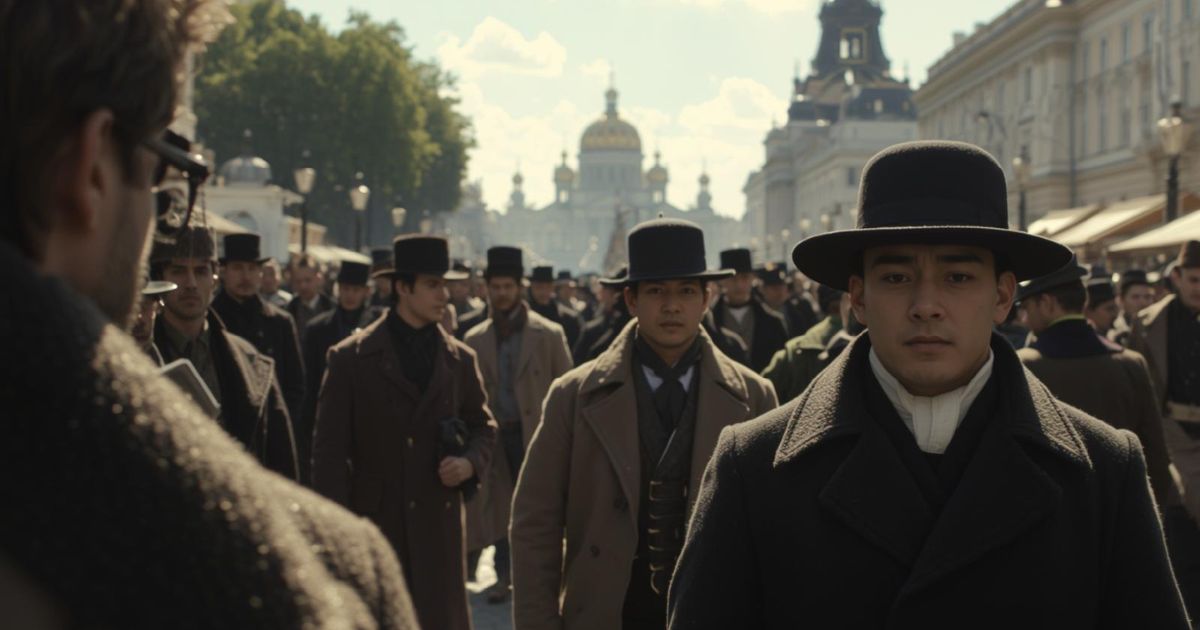
It was about nine o’clock when he crossed the Hay Market. At the tables
and the barrows, at the booths and the shops, all the market people were
closing their establishments or clearing away and packing up their
wares and, like their customers, were going home. Rag pickers and
costermongers of all kinds were crowding round the taverns in the dirty
and stinking courtyards of the Hay Market. Raskolnikov particularly
liked this place and the neighbouring alleys, when he wandered aimlessly
in the streets. Here his rags did not attract contemptuous attention,
and one could walk about in any attire without scandalising people. At
the corner of an alley a huckster and his wife had two tables set out
with tapes, thread, cotton handkerchiefs, etc. They, too, had got up to
go home, but were lingering in conversation with a friend, who had just
come up to them. This friend was Lizaveta Ivanovna, or, as everyone
called her, Lizaveta, the younger sister of the old pawnbroker, Alyona
Ivanovna, whom Raskolnikov had visited the previous day to pawn his
watch and make his experiment.... He already knew all about Lizaveta
and she knew him a little too. She was a single woman of about
thirty-five, tall, clumsy, timid, submissive and almost idiotic. She was
a complete slave and went in fear and trembling of her sister, who
made her work day and night, and even beat her. She was standing with
a bundle before the huckster and his wife, listening earnestly and
doubtfully. They were talking of something with special warmth. The
moment Raskolnikov caught sight of her, he was overcome by a strange
sensation as it were of intense astonishment, though there was nothing
astonishing about this meeting.
“You could make up your mind for yourself, Lizaveta Ivanovna,” the
huckster was saying aloud. “Come round to-morrow about seven. They will
be here too.”
“To-morrow?” said Lizaveta slowly and thoughtfully, as though unable to
make up her mind.
“Upon my word, what a fright you are in of Alyona Ivanovna,” gabbled
the huckster’s wife, a lively little woman. “I look at you, you are like
some little babe. And she is not your own sister either--nothing but a
step-sister and what a hand she keeps over you!”
“But this time don’t say a word to Alyona Ivanovna,” her husband
interrupted; “that’s my advice, but come round to us without asking.
It will be worth your while. Later on your sister herself may have a
notion.”
“Am I to come?”
“About seven o’clock to-morrow. And they will be here. You will be able
to decide for yourself.”
“And we’ll have a cup of tea,” added his wife.
“All right, I’ll come,” said Lizaveta, still pondering, and she began
slowly moving away.
Raskolnikov had just passed and heard no more. He passed softly,
unnoticed, trying not to miss a word. His first amazement was followed
by a thrill of horror, like a shiver running down his spine. He had
learnt, he had suddenly quite unexpectedly learnt, that the next day at
seven o’clock Lizaveta, the old woman’s sister and only companion, would
be away from home and that therefore at seven o’clock precisely the old
woman would be left alone.
He was only a few steps from his lodging. He went in like a man
condemned to death. He thought of nothing and was incapable of thinking;
but he felt suddenly in his whole being that he had no more freedom
of thought, no will, and that everything was suddenly and irrevocably
decided.
Certainly, if he had to wait whole years for a suitable opportunity, he
could not reckon on a more certain step towards the success of the plan
than that which had just presented itself. In any case, it would have
been difficult to find out beforehand and with certainty, with
greater exactness and less risk, and without dangerous inquiries and
investigations, that next day at a certain time an old woman, on whose
life an attempt was contemplated, would be at home and entirely alone.
Master this chapter. Complete your experience
Purchase the complete book to access all chapters and support classic literature
As an Amazon Associate, we earn a small commission from qualifying purchases at no additional cost to you.
Available in paperback, hardcover, and e-book formats
Let's Analyse the Pattern
Why This Matters
Connect literature to life
This chapter shows how people rationalize harmful choices as fate, and how to reclaim agency before crossing irreversible lines.
Now let's explore the literary elements.
Key Quotes & Analysis
"Can it be, can it be, that I shall really take an axe, that I shall strike her on the head...?"
Context: After waking from the dream of the mare
Shows direct moral horror at the concrete reality of violence, cutting through his earlier intellectual justifications.
"Freedom, freedom! He was free from that spell, that sorcery, that obsession!"
Context: Momentary relief after renouncing the plan
Captures a brief restoration of agency before chance circumstances pull him back into fatalistic thinking.
"He had learnt... that the next day at seven o'clock... the old woman would be left alone."
Context: After overhearing the Hay Market conversation
Marks the chapter's turning point from psychological struggle to perceived inevitability and operational intent.
Thematic Threads
Conscience
In This Chapter
The dream forces Raskolnikov to feel the human reality of violence rather than merely theorize it.
Development
Evolves from abstract moral debate into embodied emotional knowledge.
Fate vs Agency
In This Chapter
A chance encounter at the Hay Market is interpreted as predestination.
Development
Shows how people surrender responsibility by narrating decisions as unavoidable.
Violence
In This Chapter
The mare's beating dramatizes cruelty as public spectacle and moral numbness.
Development
Foreshadows the dehumanization required for planned murder.
Psychological Threshold
In This Chapter
Raskolnikov crosses from fantasy and argument into concrete planning pressure.
Development
Defines the chapter as a hinge between contemplation and action.
You now have the context. Time to form your own thoughts.
Discussion Questions
- 1
How does the mare dream function as a moral warning rather than just a surreal episode?
- 2
Why does Raskolnikov's brief moment of freedom fail once he hears about Lizaveta's schedule?
- 3
Where is the line between external pressure and self-deception in his claim of inevitability?
- 4
What modern examples show people reframing choice as fate to avoid responsibility?
- 5
What practical intervention might have helped Raskolnikov keep agency in this chapter?
Critical Thinking Exercise
Catch the 'No Choice' Narrative
Recall a moment when you told yourself, 'I had no choice.' Write the exact situation, then separate facts (constraints, deadlines, consequences) from story (what felt inevitable). List at least two alternatives you ignored and why.
Consider:
- •Notice whether urgency was real or emotionally amplified
- •Identify where you shifted from values-language to survival-language
- •Define one pause ritual you can use before irreversible choices
Coming Up Next...
Chapter 6: Overhearing Fate
Raskolnikov prepares for the murder with mechanical precision, crafting clever tools and justifications. But even as he steals the axe and walks to the pawnbroker's door, part of him knows he'll never actually go through with it - until he does.