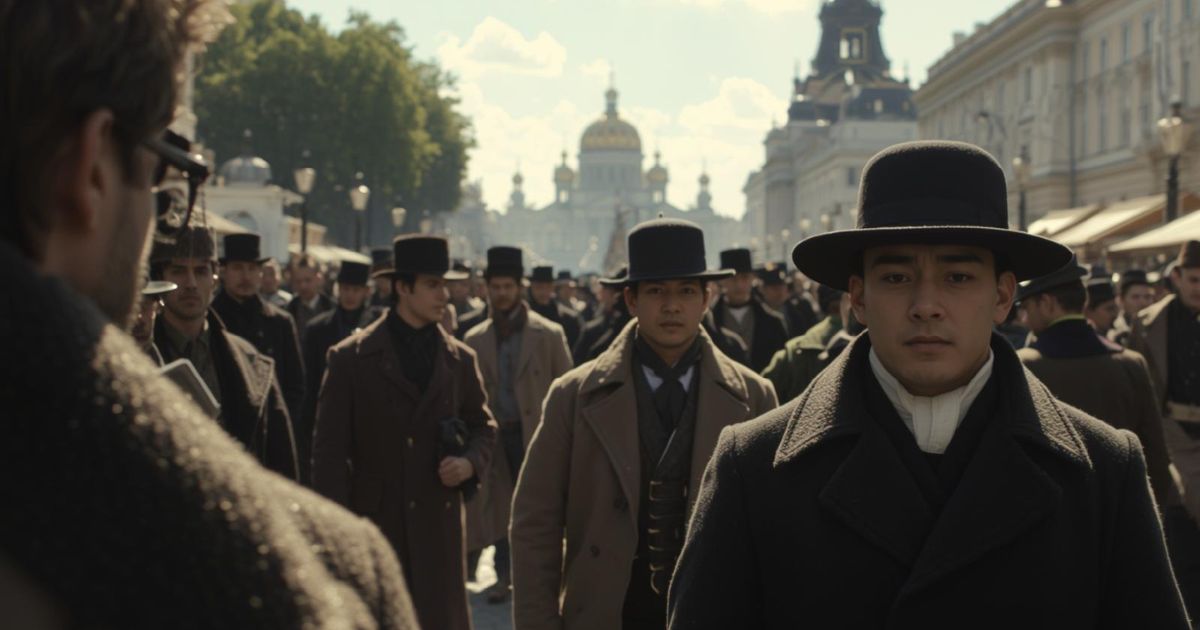
An excerpt from the original text.(complete · 5539 words)
e waked up late next day after a broken sleep. But his sleep had not
refreshed him; he waked up bilious, irritable, ill-tempered, and looked
with hatred at his room. It was a tiny cupboard of a room about six
paces in length. It had a poverty-stricken appearance with its dusty
yellow paper peeling off the walls, and it was so low-pitched that a man
of more than average height was ill at ease in it and felt every moment
that he would knock his head against the ceiling. The furniture was in
keeping with the room: there were three old chairs, rather rickety; a
painted table in the corner on which lay a few manuscripts and books;
the dust that lay thick upon them showed that they had been long
untouched. A big clumsy sofa occupied almost the whole of one wall and
half the floor space of the room; it was once covered with chintz, but
was now in rags and served Raskolnikov as a bed. Often he went to sleep
on it, as he was, without undressing, without sheets, wrapped in his old
student’s overcoat, with his head on one little pillow, under which he
heaped up all the linen he had, clean and dirty, by way of a bolster. A
little table stood in front of the sofa.
It would have been difficult to sink to a lower ebb of disorder, but to
Raskolnikov in his present state of mind this was positively agreeable.
He had got completely away from everyone, like a tortoise in its shell,
and even the sight of a servant girl who had to wait upon him and looked
sometimes into his room made him writhe with nervous irritation. He was
in the condition that overtakes some monomaniacs entirely concentrated
upon one thing. His landlady had for the last fortnight given up sending
him in meals, and he had not yet thought of expostulating with her,
though he went without his dinner. Nastasya, the cook and only servant,
was rather pleased at the lodger’s mood and had entirely given up
sweeping and doing his room, only once a week or so she would stray into
his room with a broom. She waked him up that day.
“Get up, why are you asleep?” she called to him. “It’s past nine, I have
brought you some tea; will you have a cup? I should think you’re fairly
starving?”
Raskolnikov opened his eyes, started and recognised Nastasya.
“From the landlady, eh?” he asked, slowly and with a sickly face sitting
up on the sofa.
“From the landlady, indeed!”
She set before him her own cracked teapot full of weak and stale tea and
laid two yellow lumps of sugar by the side of it.
“Here, Nastasya, take it please,” he said, fumbling in his pocket (for
he had slept in his clothes) and taking out a handful of coppers--“run
and buy me a loaf. And get me a little sausage, the cheapest, at the
pork-butcher’s.”
“The loaf I’ll fetch you this very minute, but wouldn’t you rather have
some cabbage soup instead of sausage? It’s capital soup, yesterday’s. I
saved it for you yesterday, but you came in late. It’s fine soup.”
When the soup had been brought, and he had begun upon it, Nastasya
sat down beside him on the sofa and began chatting. She was a country
peasant-woman and a very talkative one.
“Praskovya Pavlovna means to complain to the police about you,” she
said.
He scowled.
“To the police? What does she want?”
“You don’t pay her money and you won’t turn out of the room. That’s what
she wants, to be sure.”
“The devil, that’s the last straw,” he muttered, grinding his teeth,
“no, that would not suit me... just now. She is a fool,” he added aloud.
“I’ll go and talk to her to-day.”
“Fool she is and no mistake, just as I am. But why, if you are so
clever, do you lie here like a sack and have nothing to show for it? One
time you used to go out, you say, to teach children. But why is it you
do nothing now?”
“I am doing...” Raskolnikov began sullenly and reluctantly.
“What are you doing?”
“Work...”
“What sort of work?”
“I am thinking,” he answered seriously after a pause.
Nastasya was overcome with a fit of laughter. She was given to laughter
and when anything amused her, she laughed inaudibly, quivering and
shaking all over till she felt ill.
“And have you made much money by your thinking?” she managed to
articulate at last.
“One can’t go out to give lessons without boots. And I’m sick of it.”
“Don’t quarrel with your bread and butter.”
“They pay so little for lessons. What’s the use of a few coppers?” he
answered, reluctantly, as though replying to his own thought.
“And you want to get a fortune all at once?”
He looked at her strangely.
“Yes, I want a fortune,” he answered firmly, after a brief pause.
“Don’t be in such a hurry, you quite frighten me! Shall I get you the
loaf or not?”
“As you please.”
“Ah, I forgot! A letter came for you yesterday when you were out.”
“A letter? for me! from whom?”
“I can’t say. I gave three copecks of my own to the postman for it. Will
you pay me back?”
“Then bring it to me, for God’s sake, bring it,” cried Raskolnikov
greatly excited--“good God!”
A minute later the letter was brought him. That was it: from his mother,
from the province of R----. He turned pale when he took it. It was a
long while since he had received a letter, but another feeling also
suddenly stabbed his heart.
“Nastasya, leave me alone, for goodness’ sake; here are your three
copecks, but for goodness’ sake, make haste and go!”
The letter was quivering in his hand; he did not want to open it in her
presence; he wanted to be left alone with this letter. When Nastasya
had gone out, he lifted it quickly to his lips and kissed it; then he
gazed intently at the address, the small, sloping handwriting, so dear
and familiar, of the mother who had once taught him to read and write.
He delayed; he seemed almost afraid of something. At last he opened it;
it was a thick heavy letter, weighing over two ounces, two large sheets
of note paper were covered with very small handwriting.
“My dear Rodya,” wrote his mother--“it’s two months since I last had a
talk with you by letter which has distressed me and even kept me
awake at night, thinking. But I am sure you will not blame me for my
inevitable silence. You know how I love you; you are all we have to look
to, Dounia and I, you are our all, our one hope, our one stay. What a
grief it was to me when I heard that you had given up the university
some months ago, for want of means to keep yourself and that you had
lost your lessons and your other work! How could I help you out of my
hundred and twenty roubles a year pension? The fifteen roubles I sent
you four months ago I borrowed, as you know, on security of my pension,
from Vassily Ivanovitch Vahrushin a merchant of this town. He is a
kind-hearted man and was a friend of your father’s too. But having given
him the right to receive the pension, I had to wait till the debt was
paid off and that is only just done, so that I’ve been unable to send
you anything all this time. But now, thank God, I believe I shall
be able to send you something more and in fact we may congratulate
ourselves on our good fortune now, of which I hasten to inform you. In
the first place, would you have guessed, dear Rodya, that your sister
has been living with me for the last six weeks and we shall not be
separated in the future. Thank God, her sufferings are over, but I will
tell you everything in order, so that you may know just how everything
has happened and all that we have hitherto concealed from you. When you
wrote to me two months ago that you had heard that Dounia had a great
deal to put up with in the Svidrigaïlovs’ house, when you wrote that
and asked me to tell you all about it--what could I write in answer to
you? If I had written the whole truth to you, I dare say you would have
thrown up everything and have come to us, even if you had to walk all
the way, for I know your character and your feelings, and you would not
let your sister be insulted. I was in despair myself, but what could I
do? And, besides, I did not know the whole truth myself then. What
made it all so difficult was that Dounia received a hundred roubles
in advance when she took the place as governess in their family, on
condition of part of her salary being deducted every month, and so it
was impossible to throw up the situation without repaying the debt.
This sum (now I can explain it all to you, my precious Rodya) she took
chiefly in order to send you sixty roubles, which you needed so terribly
then and which you received from us last year. We deceived you then,
writing that this money came from Dounia’s savings, but that was not
so, and now I tell you all about it, because, thank God, things have
suddenly changed for the better, and that you may know how Dounia loves
you and what a heart she has. At first indeed Mr. Svidrigaïlov treated
her very rudely and used to make disrespectful and jeering remarks at
table.... But I don’t want to go into all those painful details, so as
not to worry you for nothing when it is now all over. In short, in spite
of the kind and generous behaviour of Marfa Petrovna, Mr. Svidrigaïlov’s
wife, and all the rest of the household, Dounia had a very hard time,
especially when Mr. Svidrigaïlov, relapsing into his old regimental
habits, was under the influence of Bacchus. And how do you think it
was all explained later on? Would you believe that the crazy fellow had
conceived a passion for Dounia from the beginning, but had concealed
it under a show of rudeness and contempt. Possibly he was ashamed and
horrified himself at his own flighty hopes, considering his years and
his being the father of a family; and that made him angry with Dounia.
And possibly, too, he hoped by his rude and sneering behaviour to hide
the truth from others. But at last he lost all control and had the face
to make Dounia an open and shameful proposal, promising her all sorts of
inducements and offering, besides, to throw up everything and take her
to another estate of his, or even abroad. You can imagine all she went
through! To leave her situation at once was impossible not only on
account of the money debt, but also to spare the feelings of Marfa
Petrovna, whose suspicions would have been aroused: and then Dounia
would have been the cause of a rupture in the family. And it would
have meant a terrible scandal for Dounia too; that would have been
inevitable. There were various other reasons owing to which Dounia could
not hope to escape from that awful house for another six weeks. You know
Dounia, of course; you know how clever she is and what a strong will she
has. Dounia can endure a great deal and even in the most difficult cases
she has the fortitude to maintain her firmness. She did not even write
to me about everything for fear of upsetting me, although we were
constantly in communication. It all ended very unexpectedly. Marfa
Petrovna accidentally overheard her husband imploring Dounia in the
garden, and, putting quite a wrong interpretation on the position, threw
the blame upon her, believing her to be the cause of it all. An awful
scene took place between them on the spot in the garden; Marfa Petrovna
went so far as to strike Dounia, refused to hear anything and was
shouting at her for a whole hour and then gave orders that Dounia should
be packed off at once to me in a plain peasant’s cart, into which they
flung all her things, her linen and her clothes, all pell-mell, without
folding it up and packing it. And a heavy shower of rain came on, too,
and Dounia, insulted and put to shame, had to drive with a peasant in an
open cart all the seventeen versts into town. Only think now what answer
could I have sent to the letter I received from you two months ago and
what could I have written? I was in despair; I dared not write to
you the truth because you would have been very unhappy, mortified
and indignant, and yet what could you do? You could only perhaps ruin
yourself, and, besides, Dounia would not allow it; and fill up my letter
with trifles when my heart was so full of sorrow, I could not. For a
whole month the town was full of gossip about this scandal, and it came
to such a pass that Dounia and I dared not even go to church on account
of the contemptuous looks, whispers, and even remarks made aloud about
us. All our acquaintances avoided us, nobody even bowed to us in the
street, and I learnt that some shopmen and clerks were intending to
insult us in a shameful way, smearing the gates of our house with pitch,
so that the landlord began to tell us we must leave. All this was set
going by Marfa Petrovna who managed to slander Dounia and throw dirt at
her in every family. She knows everyone in the neighbourhood, and that
month she was continually coming into the town, and as she is
rather talkative and fond of gossiping about her family affairs and
particularly of complaining to all and each of her husband--which is not
at all right--so in a short time she had spread her story not only in
the town, but over the whole surrounding district. It made me ill, but
Dounia bore it better than I did, and if only you could have seen how
she endured it all and tried to comfort me and cheer me up! She is
an angel! But by God’s mercy, our sufferings were cut short: Mr.
Svidrigaïlov returned to his senses and repented and, probably
feeling sorry for Dounia, he laid before Marfa Petrovna a complete and
unmistakable proof of Dounia’s innocence, in the form of a letter Dounia
had been forced to write and give to him, before Marfa Petrovna
came upon them in the garden. This letter, which remained in Mr.
Svidrigaïlov’s hands after her departure, she had written to refuse
personal explanations and secret interviews, for which he was entreating
her. In that letter she reproached him with great heat and indignation
for the baseness of his behaviour in regard to Marfa Petrovna, reminding
him that he was the father and head of a family and telling him how
infamous it was of him to torment and make unhappy a defenceless girl,
unhappy enough already. Indeed, dear Rodya, the letter was so nobly and
touchingly written that I sobbed when I read it and to this day I cannot
read it without tears. Moreover, the evidence of the servants, too,
cleared Dounia’s reputation; they had seen and known a great deal more
than Mr. Svidrigaïlov had himself supposed--as indeed is always the case
with servants. Marfa Petrovna was completely taken aback, and ‘again
crushed’ as she said herself to us, but she was completely convinced of
Dounia’s innocence. The very next day, being Sunday, she went straight
to the Cathedral, knelt down and prayed with tears to Our Lady to give
her strength to bear this new trial and to do her duty. Then she
came straight from the Cathedral to us, told us the whole story, wept
bitterly and, fully penitent, she embraced Dounia and besought her to
forgive her. The same morning without any delay, she went round to all
the houses in the town and everywhere, shedding tears, she asserted in
the most flattering terms Dounia’s innocence and the nobility of
her feelings and her behavior. What was more, she showed and read to
everyone the letter in Dounia’s own handwriting to Mr. Svidrigaïlov and
even allowed them to take copies of it--which I must say I think was
superfluous. In this way she was busy for several days in driving about
the whole town, because some people had taken offence through precedence
having been given to others. And therefore they had to take turns, so
that in every house she was expected before she arrived, and everyone
knew that on such and such a day Marfa Petrovna would be reading the
letter in such and such a place and people assembled for every reading
of it, even many who had heard it several times already both in their
own houses and in other people’s. In my opinion a great deal, a very
great deal of all this was unnecessary; but that’s Marfa Petrovna’s
character. Anyway she succeeded in completely re-establishing Dounia’s
reputation and the whole ignominy of this affair rested as an indelible
disgrace upon her husband, as the only person to blame, so that I really
began to feel sorry for him; it was really treating the crazy fellow too
harshly. Dounia was at once asked to give lessons in several families,
but she refused. All of a sudden everyone began to treat her with marked
respect and all this did much to bring about the event by which, one may
say, our whole fortunes are now transformed. You must know, dear Rodya,
that Dounia has a suitor and that she has already consented to marry
him. I hasten to tell you all about the matter, and though it has been
arranged without asking your consent, I think you will not be aggrieved
with me or with your sister on that account, for you will see that we
could not wait and put off our decision till we heard from you. And you
could not have judged all the facts without being on the spot. This
was how it happened. He is already of the rank of a counsellor, Pyotr
Petrovitch Luzhin, and is distantly related to Marfa Petrovna, who
has been very active in bringing the match about. It began with his
expressing through her his desire to make our acquaintance. He was
properly received, drank coffee with us and the very next day he sent
us a letter in which he very courteously made an offer and begged for a
speedy and decided answer. He is a very busy man and is in a great hurry
to get to Petersburg, so that every moment is precious to him. At first,
of course, we were greatly surprised, as it had all happened so quickly
and unexpectedly. We thought and talked it over the whole day. He is a
well-to-do man, to be depended upon, he has two posts in the government
and has already made his fortune. It is true that he is forty-five years
old, but he is of a fairly prepossessing appearance and might still be
thought attractive by women, and he is altogether a very respectable and
presentable man, only he seems a little morose and somewhat conceited.
But possibly that may only be the impression he makes at first sight.
And beware, dear Rodya, when he comes to Petersburg, as he shortly will
do, beware of judging him too hastily and severely, as your way is, if
there is anything you do not like in him at first sight. I give you this
warning, although I feel sure that he will make a favourable impression
upon you. Moreover, in order to understand any man one must be
deliberate and careful to avoid forming prejudices and mistaken ideas,
which are very difficult to correct and get over afterwards. And Pyotr
Petrovitch, judging by many indications, is a thoroughly estimable man.
At his first visit, indeed, he told us that he was a practical man, but
still he shares, as he expressed it, many of the convictions ‘of our
most rising generation’ and he is an opponent of all prejudices. He
said a good deal more, for he seems a little conceited and likes to be
listened to, but this is scarcely a vice. I, of course, understood very
little of it, but Dounia explained to me that, though he is not a man
of great education, he is clever and seems to be good-natured. You know
your sister’s character, Rodya. She is a resolute, sensible, patient and
generous girl, but she has a passionate heart, as I know very well.
Of course, there is no great love either on his side, or on hers, but
Dounia is a clever girl and has the heart of an angel, and will make
it her duty to make her husband happy who on his side will make her
happiness his care. Of that we have no good reason to doubt, though it
must be admitted the matter has been arranged in great haste. Besides he
is a man of great prudence and he will see, to be sure, of himself, that
his own happiness will be the more secure, the happier Dounia is with
him. And as for some defects of character, for some habits and even
certain differences of opinion--which indeed are inevitable even in
the happiest marriages--Dounia has said that, as regards all that, she
relies on herself, that there is nothing to be uneasy about, and
that she is ready to put up with a great deal, if only their future
relationship can be an honourable and straightforward one. He struck me,
for instance, at first, as rather abrupt, but that may well come
from his being an outspoken man, and that is no doubt how it is. For
instance, at his second visit, after he had received Dounia’s consent,
in the course of conversation, he declared that before making
Dounia’s acquaintance, he had made up his mind to marry a girl of
good reputation, without dowry and, above all, one who had experienced
poverty, because, as he explained, a man ought not to be indebted to his
wife, but that it is better for a wife to look upon her husband as her
benefactor. I must add that he expressed it more nicely and politely
than I have done, for I have forgotten his actual phrases and only
remember the meaning. And, besides, it was obviously not said of design,
but slipped out in the heat of conversation, so that he tried afterwards
to correct himself and smooth it over, but all the same it did strike
me as somewhat rude, and I said so afterwards to Dounia. But Dounia was
vexed, and answered that ‘words are not deeds,’ and that, of course, is
perfectly true. Dounia did not sleep all night before she made up
her mind, and, thinking that I was asleep, she got out of bed and was
walking up and down the room all night; at last she knelt down before
the ikon and prayed long and fervently and in the morning she told me
that she had decided.
“I have mentioned already that Pyotr Petrovitch is just setting off for
Petersburg, where he has a great deal of business, and he wants to open
a legal bureau. He has been occupied for many years in conducting civil
and commercial litigation, and only the other day he won an important
case. He has to be in Petersburg because he has an important case before
the Senate. So, Rodya dear, he may be of the greatest use to you, in
every way indeed, and Dounia and I have agreed that from this very day
you could definitely enter upon your career and might consider that
your future is marked out and assured for you. Oh, if only this comes to
pass! This would be such a benefit that we could only look upon it as a
providential blessing. Dounia is dreaming of nothing else. We have even
ventured already to drop a few words on the subject to Pyotr Petrovitch.
He was cautious in his answer, and said that, of course, as he could not
get on without a secretary, it would be better to be paying a salary to
a relation than to a stranger, if only the former were fitted for the
duties (as though there could be doubt of your being fitted!) but then
he expressed doubts whether your studies at the university would leave
you time for work at his office. The matter dropped for the time, but
Dounia is thinking of nothing else now. She has been in a sort of fever
for the last few days, and has already made a regular plan for
your becoming in the end an associate and even a partner in Pyotr
Petrovitch’s business, which might well be, seeing that you are a
student of law. I am in complete agreement with her, Rodya, and share
all her plans and hopes, and think there is every probability of
realising them. And in spite of Pyotr Petrovitch’s evasiveness, very
natural at present (since he does not know you), Dounia is firmly
persuaded that she will gain everything by her good influence over her
future husband; this she is reckoning upon. Of course we are careful
not to talk of any of these more remote plans to Pyotr Petrovitch,
especially of your becoming his partner. He is a practical man and might
take this very coldly, it might all seem to him simply a day-dream. Nor
has either Dounia or I breathed a word to him of the great hopes we have
of his helping us to pay for your university studies; we have not spoken
of it in the first place, because it will come to pass of itself,
later on, and he will no doubt without wasting words offer to do it of
himself, (as though he could refuse Dounia that) the more readily since
you may by your own efforts become his right hand in the office, and
receive this assistance not as a charity, but as a salary earned by your
own work. Dounia wants to arrange it all like this and I quite agree
with her. And we have not spoken of our plans for another reason, that
is, because I particularly wanted you to feel on an equal footing when
you first meet him. When Dounia spoke to him with enthusiasm about
you, he answered that one could never judge of a man without seeing
him close, for oneself, and that he looked forward to forming his own
opinion when he makes your acquaintance. Do you know, my precious
Rodya, I think that perhaps for some reasons (nothing to do with Pyotr
Petrovitch though, simply for my own personal, perhaps old-womanish,
fancies) I should do better to go on living by myself, apart, than with
them, after the wedding. I am convinced that he will be generous and
delicate enough to invite me and to urge me to remain with my daughter
for the future, and if he has said nothing about it hitherto, it is
simply because it has been taken for granted; but I shall refuse. I have
noticed more than once in my life that husbands don’t quite get on with
their mothers-in-law, and I don’t want to be the least bit in anyone’s
way, and for my own sake, too, would rather be quite independent, so
long as I have a crust of bread of my own, and such children as you and
Dounia. If possible, I would settle somewhere near you, for the most
joyful piece of news, dear Rodya, I have kept for the end of my letter:
know then, my dear boy, that we may, perhaps, be all together in a
very short time and may embrace one another again after a separation of
almost three years! It is settled for certain that Dounia and I are to
set off for Petersburg, exactly when I don’t know, but very, very soon,
possibly in a week. It all depends on Pyotr Petrovitch who will let us
know when he has had time to look round him in Petersburg. To suit his
own arrangements he is anxious to have the ceremony as soon as possible,
even before the fast of Our Lady, if it could be managed, or if that is
too soon to be ready, immediately after. Oh, with what happiness I shall
press you to my heart! Dounia is all excitement at the joyful thought
of seeing you, she said one day in joke that she would be ready to marry
Pyotr Petrovitch for that alone. She is an angel! She is not writing
anything to you now, and has only told me to write that she has so much,
so much to tell you that she is not going to take up her pen now, for
a few lines would tell you nothing, and it would only mean upsetting
herself; she bids me send you her love and innumerable kisses. But
although we shall be meeting so soon, perhaps I shall send you as much
money as I can in a day or two. Now that everyone has heard that Dounia
is to marry Pyotr Petrovitch, my credit has suddenly improved and I know
that Afanasy Ivanovitch will trust me now even to seventy-five roubles
on the security of my pension, so that perhaps I shall be able to send
you twenty-five or even thirty roubles. I would send you more, but I am
uneasy about our travelling expenses; for though Pyotr Petrovitch has
been so kind as to undertake part of the expenses of the journey, that
is to say, he has taken upon himself the conveyance of our bags and big
trunk (which will be conveyed through some acquaintances of his), we
must reckon upon some expense on our arrival in Petersburg, where we
can’t be left without a halfpenny, at least for the first few days. But
we have calculated it all, Dounia and I, to the last penny, and we see
that the journey will not cost very much. It is only ninety versts from
us to the railway and we have come to an agreement with a driver we
know, so as to be in readiness; and from there Dounia and I can travel
quite comfortably third class. So that I may very likely be able to send
to you not twenty-five, but thirty roubles. But enough; I have covered
two sheets already and there is no space left for more; our whole
history, but so many events have happened! And now, my precious Rodya,
I embrace you and send you a mother’s blessing till we meet. Love Dounia
your sister, Rodya; love her as she loves you and understand that she
loves you beyond everything, more than herself. She is an angel and you,
Rodya, you are everything to us--our one hope, our one consolation. If
only you are happy, we shall be happy. Do you still say your prayers,
Rodya, and believe in the mercy of our Creator and our Redeemer? I am
afraid in my heart that you may have been visited by the new spirit of
infidelity that is abroad to-day; If it is so, I pray for you. Remember,
dear boy, how in your childhood, when your father was living, you used
to lisp your prayers at my knee, and how happy we all were in those
days. Good-bye, till we meet then--I embrace you warmly, warmly, with
many kisses.
“Yours till death,
“PULCHERIA RASKOLNIKOV.”
Almost from the first, while he read the letter, Raskolnikov’s face was
wet with tears; but when he finished it, his face was pale and distorted
and a bitter, wrathful and malignant smile was on his lips. He laid his
head down on his threadbare dirty pillow and pondered, pondered a long
time. His heart was beating violently, and his brain was in a turmoil.
At last he felt cramped and stifled in the little yellow room that was
like a cupboard or a box. His eyes and his mind craved for space. He
took up his hat and went out, this time without dread of meeting
anyone; he had forgotten his dread. He turned in the direction of the
Vassilyevsky Ostrov, walking along Vassilyevsky Prospect, as though
hastening on some business, but he walked, as his habit was, without
noticing his way, muttering and even speaking aloud to himself, to the
astonishment of the passers-by. Many of them took him to be drunk.
Master this chapter. Complete your experience
Purchase the complete book to access all chapters and support classic literature
As an Amazon Associate, we earn a small commission from qualifying purchases at no additional cost to you.
Available in paperback, hardcover, and e-book formats
Let's Analyse the Pattern
Why This Matters
Connect literature to life
This chapter teaches how to identify when we're seeking confirmation for our worst impulses rather than genuine guidance.
Now let's explore the literary elements.
Key Quotes & Analysis
"Kill her and take her money, so that afterwards with its help you can devote yourself to the service of all humanity and the common cause."
Context: Speaking hypothetically about the pawnbroker woman in the tavern
This quote shows how people rationalize evil by claiming it serves a greater good. The student presents murder as almost a noble act, which terrifies and excites Raskolnikov because it mirrors his own twisted logic.
"On one side we have a stupid, senseless, worthless, spiteful, ailing, horrid old woman, not simply useless but doing actual mischief."
Context: Describing the pawnbroker woman to justify why her death wouldn't matter
This dehumanizing language shows how people convince themselves that some lives are worthless. By reducing a human being to a list of negative traits, the speaker makes murder seem reasonable rather than horrific.
"It was not chance that brought me here! It was not chance!"
Context: His internal reaction to overhearing the conversation about the pawnbroker
Raskolnikov interprets this coincidence as fate confirming his plan. This shows how desperate people can see signs and meaning everywhere, using random events to justify decisions they've already made in their hearts.
Thematic Threads
Isolation
In This Chapter
Raskolnikov's physical and mental isolation makes him vulnerable to interpreting coincidence as confirmation
Development
Building from earlier chapters where his poverty forced withdrawal from society
Class
In This Chapter
The conversation reveals how the poor are exploited by those with slightly more power, like the pawnbroker
Development
Deepening the theme of how economic desperation creates moral compromises
Pride
In This Chapter
Raskolnikov sees himself as superior, someone who has the right to decide who deserves to live
Development
His intellectual arrogance is now revealed as potentially murderous
Moral Corruption
In This Chapter
Desperate circumstances and grandiose thinking combine to make murder seem reasonable
Development
Introduced here as the central moral crisis of the novel
Social Influence
In This Chapter
Random strangers unknowingly provide the final push toward violence through casual conversation
Development
Shows how external voices can amplify our internal darkness
You now have the context. Time to form your own thoughts.
Discussion Questions
- 1
What does Raskolnikov overhear in the tavern, and why does this conversation affect him so powerfully?
- 2
Why does hearing strangers voice his own thoughts make Raskolnikov feel like his plan is justified rather than making him question it?
- 3
Where do you see people today using others' agreement as proof they're right, especially when making questionable decisions?
- 4
How can you tell the difference between genuinely good advice and people just telling you what you want to hear?
- 5
What does this chapter reveal about how isolation and desperation can warp our ability to judge right from wrong?
Critical Thinking Exercise
Track Your Echo Chamber
Think of a recent decision you made or opinion you formed after talking to others about it. Write down what you wanted to hear before the conversations, then list what people actually told you. Look for patterns: Did you seek out people likely to agree with you? Did you dismiss advice that challenged you? How might the outcome have been different if you'd intentionally sought opposing viewpoints?
Consider:
- •Notice whether you framed the situation to get the response you wanted
- •Consider what kind of person typically challenges your thinking versus validates it
- •Ask yourself if you were seeking wisdom or permission
Coming Up Next...
Chapter 4: Dunya's Sacrifice
Raskolnikov returns to his cramped room where a surprise visitor waits - someone from his past who will force him to confront the reality of his situation. Meanwhile, his resolve about the terrible deed continues to strengthen.