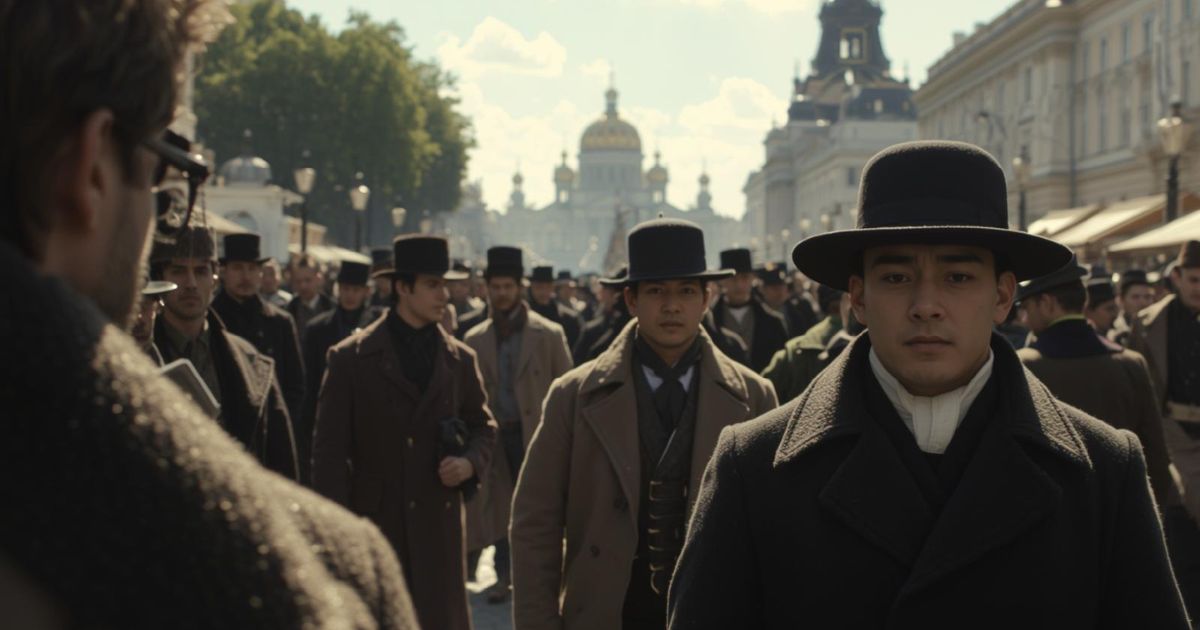
An excerpt from the original text.(complete · 3788 words)
e hurried to Svidrigaïlov’s. What he had to hope from that man he
did not know. But that man had some hidden power over him. Having once
recognised this, he could not rest, and now the time had come.
On the way, one question particularly worried him: had Svidrigaïlov been
to Porfiry’s?
As far as he could judge, he would swear to it, that he had not. He
pondered again and again, went over Porfiry’s visit; no, he hadn’t been,
of course he hadn’t.
But if he had not been yet, would he go? Meanwhile, for the present he
fancied he couldn’t. Why? He could not have explained, but if he could,
he would not have wasted much thought over it at the moment. It all
worried him and at the same time he could not attend to it. Strange to
say, none would have believed it perhaps, but he only felt a faint vague
anxiety about his immediate future. Another, much more important anxiety
tormented him--it concerned himself, but in a different, more vital way.
Moreover, he was conscious of immense moral fatigue, though his mind was
working better that morning than it had done of late.
And was it worth while, after all that had happened, to contend with
these new trivial difficulties? Was it worth while, for instance, to
manoeuvre that Svidrigaïlov should not go to Porfiry’s? Was it worth
while to investigate, to ascertain the facts, to waste time over anyone
like Svidrigaïlov?
Oh, how sick he was of it all!
And yet he was hastening to Svidrigaïlov; could he be expecting
something new from him, information, or means of escape? Men will
catch at straws! Was it destiny or some instinct bringing them together?
Perhaps it was only fatigue, despair; perhaps it was not Svidrigaïlov
but some other whom he needed, and Svidrigaïlov had simply presented
himself by chance. Sonia? But what should he go to Sonia for now? To beg
her tears again? He was afraid of Sonia, too. Sonia stood before him as
an irrevocable sentence. He must go his own way or hers. At that moment
especially he did not feel equal to seeing her. No, would it not be
better to try Svidrigaïlov? And he could not help inwardly owning that
he had long felt that he must see him for some reason.
But what could they have in common? Their very evil-doing could not
be of the same kind. The man, moreover, was very unpleasant, evidently
depraved, undoubtedly cunning and deceitful, possibly malignant. Such
stories were told about him. It is true he was befriending Katerina
Ivanovna’s children, but who could tell with what motive and what it
meant? The man always had some design, some project.
There was another thought which had been continually hovering of late
about Raskolnikov’s mind, and causing him great uneasiness. It was so
painful that he made distinct efforts to get rid of it. He sometimes
thought that Svidrigaïlov was dogging his footsteps. Svidrigaïlov had
found out his secret and had had designs on Dounia. What if he had them
still? Wasn’t it practically certain that he had? And what if, having
learnt his secret and so having gained power over him, he were to use it
as a weapon against Dounia?
This idea sometimes even tormented his dreams, but it had never
presented itself so vividly to him as on his way to Svidrigaïlov.
The very thought moved him to gloomy rage. To begin with, this would
transform everything, even his own position; he would have at once to
confess his secret to Dounia. Would he have to give himself up perhaps
to prevent Dounia from taking some rash step? The letter? This morning
Dounia had received a letter. From whom could she get letters in
Petersburg? Luzhin, perhaps? It’s true Razumihin was there to protect
her, but Razumihin knew nothing of the position. Perhaps it was his duty
to tell Razumihin? He thought of it with repugnance.
In any case he must see Svidrigaïlov as soon as possible, he decided
finally. Thank God, the details of the interview were of little
consequence, if only he could get at the root of the matter; but
if Svidrigaïlov were capable... if he were intriguing against
Dounia--then...
Raskolnikov was so exhausted by what he had passed through that month
that he could only decide such questions in one way; “then I shall kill
him,” he thought in cold despair.
A sudden anguish oppressed his heart, he stood still in the middle of
the street and began looking about to see where he was and which way he
was going. He found himself in X. Prospect, thirty or forty paces from
the Hay Market, through which he had come. The whole second storey of
the house on the left was used as a tavern. All the windows were wide
open; judging from the figures moving at the windows, the rooms were
full to overflowing. There were sounds of singing, of clarionet and
violin, and the boom of a Turkish drum. He could hear women shrieking.
He was about to turn back wondering why he had come to the X. Prospect,
when suddenly at one of the end windows he saw Svidrigaïlov, sitting
at a tea-table right in the open window with a pipe in his mouth.
Raskolnikov was dreadfully taken aback, almost terrified. Svidrigaïlov
was silently watching and scrutinising him and, what struck Raskolnikov
at once, seemed to be meaning to get up and slip away unobserved.
Raskolnikov at once pretended not to have seen him, but to be looking
absent-mindedly away, while he watched him out of the corner of his eye.
His heart was beating violently. Yet, it was evident that Svidrigaïlov
did not want to be seen. He took the pipe out of his mouth and was on
the point of concealing himself, but as he got up and moved back his
chair, he seemed to have become suddenly aware that Raskolnikov had seen
him, and was watching him. What had passed between them was much the
same as what happened at their first meeting in Raskolnikov’s room. A
sly smile came into Svidrigaïlov’s face and grew broader and
broader. Each knew that he was seen and watched by the other. At last
Svidrigaïlov broke into a loud laugh.
“Well, well, come in if you want me; I am here!” he shouted from the
window.
Raskolnikov went up into the tavern. He found Svidrigaïlov in a tiny
back room, adjoining the saloon in which merchants, clerks and numbers
of people of all sorts were drinking tea at twenty little tables to the
desperate bawling of a chorus of singers. The click of billiard balls
could be heard in the distance. On the table before Svidrigaïlov stood
an open bottle and a glass half full of champagne. In the room he found
also a boy with a little hand organ, a healthy-looking red-cheeked girl
of eighteen, wearing a tucked-up striped skirt, and a Tyrolese hat with
ribbons. In spite of the chorus in the other room, she was singing some
servants’ hall song in a rather husky contralto, to the accompaniment of
the organ.
“Come, that’s enough,” Svidrigaïlov stopped her at Raskolnikov’s
entrance. The girl at once broke off and stood waiting respectfully.
She had sung her guttural rhymes, too, with a serious and respectful
expression in her face.
“Hey, Philip, a glass!” shouted Svidrigaïlov.
“I won’t drink anything,” said Raskolnikov.
“As you like, I didn’t mean it for you. Drink, Katia! I don’t want
anything more to-day, you can go.” He poured her out a full glass, and
laid down a yellow note.
Katia drank off her glass of wine, as women do, without putting it down,
in twenty gulps, took the note and kissed Svidrigaïlov’s hand, which he
allowed quite seriously. She went out of the room and the boy trailed
after her with the organ. Both had been brought in from the street.
Svidrigaïlov had not been a week in Petersburg, but everything about him
was already, so to speak, on a patriarchal footing; the waiter, Philip,
was by now an old friend and very obsequious.
The door leading to the saloon had a lock on it. Svidrigaïlov was at
home in this room and perhaps spent whole days in it. The tavern was
dirty and wretched, not even second-rate.
“I was going to see you and looking for you,” Raskolnikov began, “but
I don’t know what made me turn from the Hay Market into the X. Prospect
just now. I never take this turning. I turn to the right from the Hay
Market. And this isn’t the way to you. I simply turned and here you are.
It is strange!”
“Why don’t you say at once ‘it’s a miracle’?”
“Because it may be only chance.”
“Oh, that’s the way with all you folk,” laughed Svidrigaïlov. “You won’t
admit it, even if you do inwardly believe it a miracle! Here you say
that it may be only chance. And what cowards they all are here, about
having an opinion of their own, you can’t fancy, Rodion Romanovitch. I
don’t mean you, you have an opinion of your own and are not afraid to
have it. That’s how it was you attracted my curiosity.”
“Nothing else?”
“Well, that’s enough, you know,” Svidrigaïlov was obviously exhilarated,
but only slightly so, he had not had more than half a glass of wine.
“I fancy you came to see me before you knew that I was capable of having
what you call an opinion of my own,” observed Raskolnikov.
“Oh, well, it was a different matter. Everyone has his own plans. And
apropos of the miracle let me tell you that I think you have been asleep
for the last two or three days. I told you of this tavern myself, there
is no miracle in your coming straight here. I explained the way myself,
told you where it was, and the hours you could find me here. Do you
remember?”
“I don’t remember,” answered Raskolnikov with surprise.
“I believe you. I told you twice. The address has been stamped
mechanically on your memory. You turned this way mechanically and yet
precisely according to the direction, though you are not aware of
it. When I told you then, I hardly hoped you understood me. You give
yourself away too much, Rodion Romanovitch. And another thing, I’m
convinced there are lots of people in Petersburg who talk to themselves
as they walk. This is a town of crazy people. If only we had scientific
men, doctors, lawyers and philosophers might make most valuable
investigations in Petersburg each in his own line. There are few places
where there are so many gloomy, strong and queer influences on the soul
of man as in Petersburg. The mere influences of climate mean so much.
And it’s the administrative centre of all Russia and its character must
be reflected on the whole country. But that is neither here nor there
now. The point is that I have several times watched you. You walk out
of your house--holding your head high--twenty paces from home you let it
sink, and fold your hands behind your back. You look and evidently see
nothing before nor beside you. At last you begin moving your lips and
talking to yourself, and sometimes you wave one hand and declaim, and at
last stand still in the middle of the road. That’s not at all the thing.
Someone may be watching you besides me, and it won’t do you any good.
It’s nothing really to do with me and I can’t cure you, but, of course,
you understand me.”
“Do you know that I am being followed?” asked Raskolnikov, looking
inquisitively at him.
“No, I know nothing about it,” said Svidrigaïlov, seeming surprised.
“Well, then, let us leave me alone,” Raskolnikov muttered, frowning.
“Very good, let us leave you alone.”
“You had better tell me, if you come here to drink, and directed me
twice to come here to you, why did you hide, and try to get away just
now when I looked at the window from the street? I saw it.”
“He-he! And why was it you lay on your sofa with closed eyes and
pretended to be asleep, though you were wide awake while I stood in your
doorway? I saw it.”
“I may have had... reasons. You know that yourself.”
“And I may have had my reasons, though you don’t know them.”
Raskolnikov dropped his right elbow on the table, leaned his chin in the
fingers of his right hand, and stared intently at Svidrigaïlov. For a
full minute he scrutinised his face, which had impressed him before. It
was a strange face, like a mask; white and red, with bright red lips,
with a flaxen beard, and still thick flaxen hair. His eyes were somehow
too blue and their expression somehow too heavy and fixed. There was
something awfully unpleasant in that handsome face, which looked so
wonderfully young for his age. Svidrigaïlov was smartly dressed in light
summer clothes and was particularly dainty in his linen. He wore a huge
ring with a precious stone in it.
“Have I got to bother myself about you, too, now?” said Raskolnikov
suddenly, coming with nervous impatience straight to the point. “Even
though perhaps you are the most dangerous man if you care to injure me,
I don’t want to put myself out any more. I will show you at once that I
don’t prize myself as you probably think I do. I’ve come to tell you at
once that if you keep to your former intentions with regard to my sister
and if you think to derive any benefit in that direction from what has
been discovered of late, I will kill you before you get me locked up.
You can reckon on my word. You know that I can keep it. And in the
second place if you want to tell me anything--for I keep fancying all
this time that you have something to tell me--make haste and tell it,
for time is precious and very likely it will soon be too late.”
“Why in such haste?” asked Svidrigaïlov, looking at him curiously.
“Everyone has his plans,” Raskolnikov answered gloomily and impatiently.
“You urged me yourself to frankness just now, and at the first question
you refuse to answer,” Svidrigaïlov observed with a smile. “You
keep fancying that I have aims of my own and so you look at me with
suspicion. Of course it’s perfectly natural in your position. But
though I should like to be friends with you, I shan’t trouble myself
to convince you of the contrary. The game isn’t worth the candle and I
wasn’t intending to talk to you about anything special.”
“What did you want me for, then? It was you who came hanging about me.”
“Why, simply as an interesting subject for observation. I liked the
fantastic nature of your position--that’s what it was! Besides, you are
the brother of a person who greatly interested me, and from that person
I had in the past heard a very great deal about you, from which I
gathered that you had a great influence over her; isn’t that enough?
Ha-ha-ha! Still I must admit that your question is rather complex, and
is difficult for me to answer. Here, you, for instance, have come to me
not only for a definite object, but for the sake of hearing something
new. Isn’t that so? Isn’t that so?” persisted Svidrigaïlov with a sly
smile. “Well, can’t you fancy then that I, too, on my way here in the
train was reckoning on you, on your telling me something new, and on my
making some profit out of you! You see what rich men we are!”
“What profit could you make?”
“How can I tell you? How do I know? You see in what a tavern I spend all
my time and it’s my enjoyment, that’s to say it’s no great enjoyment,
but one must sit somewhere; that poor Katia now--you saw her?... If only
I had been a glutton now, a club gourmand, but you see I can eat this.”
He pointed to a little table in the corner where the remnants of a
terrible-looking beef-steak and potatoes lay on a tin dish.
“Have you dined, by the way? I’ve had something and want nothing more.
I don’t drink, for instance, at all. Except for champagne I never touch
anything, and not more than a glass of that all the evening, and even
that is enough to make my head ache. I ordered it just now to wind
myself up, for I am just going off somewhere and you see me in a
peculiar state of mind. That was why I hid myself just now like a
schoolboy, for I was afraid you would hinder me. But I believe,” he
pulled out his watch, “I can spend an hour with you. It’s half-past
four now. If only I’d been something, a landowner, a father, a cavalry
officer, a photographer, a journalist... I am nothing, no specialty,
and sometimes I am positively bored. I really thought you would tell me
something new.”
“But what are you, and why have you come here?”
“What am I? You know, a gentleman, I served for two years in the
cavalry, then I knocked about here in Petersburg, then I married Marfa
Petrovna and lived in the country. There you have my biography!”
“You are a gambler, I believe?”
“No, a poor sort of gambler. A card-sharper--not a gambler.”
“You have been a card-sharper then?”
“Yes, I’ve been a card-sharper too.”
“Didn’t you get thrashed sometimes?”
“It did happen. Why?”
“Why, you might have challenged them... altogether it must have been
lively.”
“I won’t contradict you, and besides I am no hand at philosophy. I
confess that I hastened here for the sake of the women.”
“As soon as you buried Marfa Petrovna?”
“Quite so,” Svidrigaïlov smiled with engaging candour. “What of it? You
seem to find something wrong in my speaking like that about women?”
“You ask whether I find anything wrong in vice?”
“Vice! Oh, that’s what you are after! But I’ll answer you in order,
first about women in general; you know I am fond of talking. Tell me,
what should I restrain myself for? Why should I give up women, since I
have a passion for them? It’s an occupation, anyway.”
“So you hope for nothing here but vice?”
“Oh, very well, for vice then. You insist on its being vice. But anyway
I like a direct question. In this vice at least there is something
permanent, founded indeed upon nature and not dependent on fantasy,
something present in the blood like an ever-burning ember, for ever
setting one on fire and, maybe, not to be quickly extinguished, even
with years. You’ll agree it’s an occupation of a sort.”
“That’s nothing to rejoice at, it’s a disease and a dangerous one.”
“Oh, that’s what you think, is it! I agree, that it is a disease like
everything that exceeds moderation. And, of course, in this one must
exceed moderation. But in the first place, everybody does so in one way
or another, and in the second place, of course, one ought to be moderate
and prudent, however mean it may be, but what am I to do? If I hadn’t
this, I might have to shoot myself. I am ready to admit that a decent
man ought to put up with being bored, but yet...”
“And could you shoot yourself?”
“Oh, come!” Svidrigaïlov parried with disgust. “Please don’t speak of
it,” he added hurriedly and with none of the bragging tone he had shown
in all the previous conversation. His face quite changed. “I admit it’s
an unpardonable weakness, but I can’t help it. I am afraid of death and
I dislike its being talked of. Do you know that I am to a certain extent
a mystic?”
“Ah, the apparitions of Marfa Petrovna! Do they still go on visiting
you?”
“Oh, don’t talk of them; there have been no more in Petersburg, confound
them!” he cried with an air of irritation. “Let’s rather talk of that...
though... H’m! I have not much time, and can’t stay long with you,
it’s a pity! I should have found plenty to tell you.”
“What’s your engagement, a woman?”
“Yes, a woman, a casual incident.... No, that’s not what I want to talk
of.”
“And the hideousness, the filthiness of all your surroundings, doesn’t
that affect you? Have you lost the strength to stop yourself?”
“And do you pretend to strength, too? He-he-he! You surprised me just
now, Rodion Romanovitch, though I knew beforehand it would be so.
You preach to me about vice and æsthetics! You--a Schiller, you--an
idealist! Of course that’s all as it should be and it would be
surprising if it were not so, yet it is strange in reality.... Ah,
what a pity I have no time, for you’re a most interesting type! And,
by-the-way, are you fond of Schiller? I am awfully fond of him.”
“But what a braggart you are,” Raskolnikov said with some disgust.
“Upon my word, I am not,” answered Svidrigaïlov laughing. “However, I
won’t dispute it, let me be a braggart, why not brag, if it hurts no
one? I spent seven years in the country with Marfa Petrovna, so now when
I come across an intelligent person like you--intelligent and highly
interesting--I am simply glad to talk and, besides, I’ve drunk that
half-glass of champagne and it’s gone to my head a little. And besides,
there’s a certain fact that has wound me up tremendously, but about that
I... will keep quiet. Where are you off to?” he asked in alarm.
Raskolnikov had begun getting up. He felt oppressed and stifled and,
as it were, ill at ease at having come here. He felt convinced that
Svidrigaïlov was the most worthless scoundrel on the face of the earth.
“A-ach! Sit down, stay a little!” Svidrigaïlov begged. “Let them bring
you some tea, anyway. Stay a little, I won’t talk nonsense, about
myself, I mean. I’ll tell you something. If you like I’ll tell you how a
woman tried ‘to save’ me, as you would call it? It will be an answer to
your first question indeed, for the woman was your sister. May I tell
you? It will help to spend the time.”
“Tell me, but I trust that you...”
“Oh, don’t be uneasy. Besides, even in a worthless low fellow like me,
Avdotya Romanovna can only excite the deepest respect.”
Master this chapter. Complete your experience
Purchase the complete book to access all chapters and support classic literature
As an Amazon Associate, we earn a small commission from qualifying purchases at no additional cost to you.
Available in paperback, hardcover, and e-book formats
Let's Analyse the Pattern
Why This Matters
Connect literature to life
This chapter helps readers identify how stress reshapes judgment, power, and relationship dynamics in real time.
Now let's explore the literary elements.
Key Quotes & Analysis
"The decision is made."
Context: Core movement described by the chapter summary
This line captures the chapter's central pressure point and the shift it creates in character behavior.
"Actions under pressure expose deeper motives and limits."
Context: Interpreting this chapter's conflict
The chapter emphasizes that crisis does not invent character; it reveals structure already present.
Thematic Threads
Consequence
In This Chapter
Prior choices narrow present options and increase emotional stakes.
Development
The chapter advances from abstract tension to concrete cost.
Power
In This Chapter
Status, dependence, or leverage shape who can define reality in the scene.
Development
Control shifts through conversation, framing, and reaction.
Identity
In This Chapter
Characters struggle to maintain a coherent self-story under contradiction.
Development
Internal narratives are tested against observable behavior.
Relationship Strain
In This Chapter
Trust and communication degrade when secrecy or fear dominate interaction.
Development
The chapter escalates interpersonal risk alongside plot risk.
You now have the context. Time to form your own thoughts.
Discussion Questions
- 1
What pressure in this chapter most strongly drives behavior change?
- 2
Which character controls the frame of the conflict, and how?
- 3
Where does self-justification break down into visible consequence?
- 4
How do status and vulnerability shape what each person can safely say?
- 5
What alternative choice might have reduced downstream harm?
Critical Thinking Exercise
Pressure Map
Map one chapter decision with four columns: pressure source, available options, likely short-term relief, and long-term consequence. Then identify which option best preserves integrity under constraint.
Consider:
- •Separate immediate emotion from structural incentives
- •Track who bears risk versus who controls terms
- •Define one boundary that prevents escalation
Coming Up Next...
Chapter 35: Sonia's Faith
Now that Sonia knows the truth, Raskolnikov must face what comes next. Will she help him find a path toward redemption, or will the weight of his confession drive them apart?