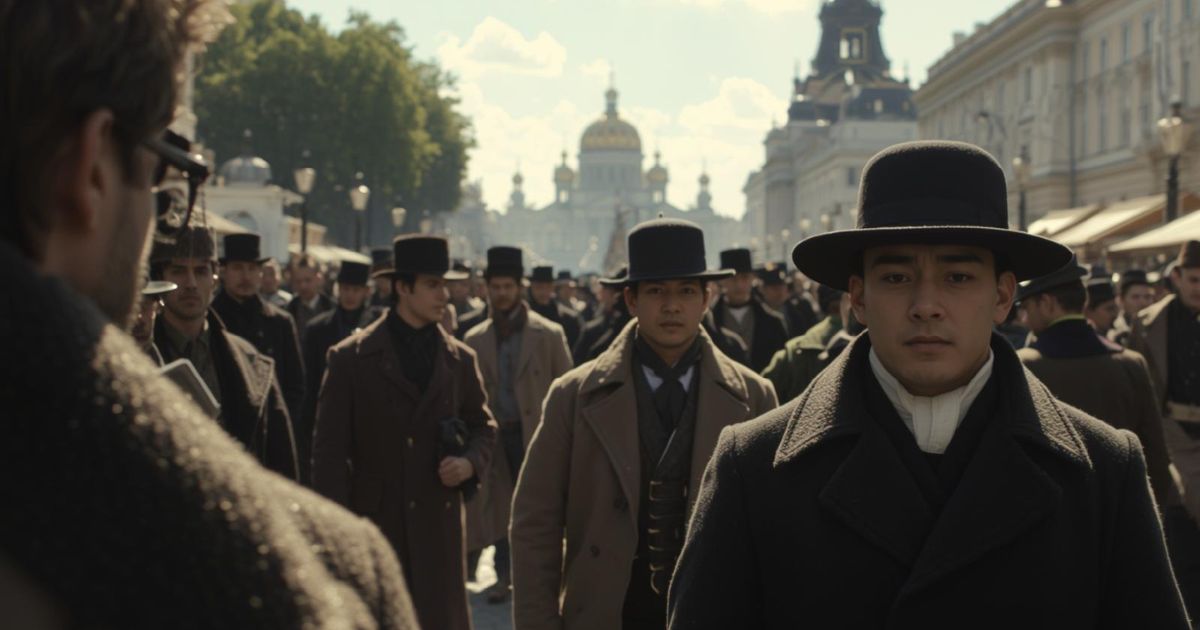
An excerpt from the original text.(complete · 4381 words)
“ou know perhaps--yes, I told you myself,” began Svidrigaïlov, “that
I was in the debtors’ prison here, for an immense sum, and had not
any expectation of being able to pay it. There’s no need to go into
particulars how Marfa Petrovna bought me out; do you know to what a
point of insanity a woman can sometimes love? She was an honest woman,
and very sensible, although completely uneducated. Would you believe
that this honest and jealous woman, after many scenes of hysterics and
reproaches, condescended to enter into a kind of contract with me which
she kept throughout our married life? She was considerably older than
I, and besides, she always kept a clove or something in her mouth. There
was so much swinishness in my soul and honesty too, of a sort, as to
tell her straight out that I couldn’t be absolutely faithful to her.
This confession drove her to frenzy, but yet she seems in a way to have
liked my brutal frankness. She thought it showed I was unwilling to
deceive her if I warned her like this beforehand and for a jealous
woman, you know, that’s the first consideration. After many tears an
unwritten contract was drawn up between us: first, that I would never
leave Marfa Petrovna and would always be her husband; secondly, that I
would never absent myself without her permission; thirdly, that I would
never set up a permanent mistress; fourthly, in return for this, Marfa
Petrovna gave me a free hand with the maidservants, but only with her
secret knowledge; fifthly, God forbid my falling in love with a woman of
our class; sixthly, in case I--which God forbid--should be visited by
a great serious passion I was bound to reveal it to Marfa Petrovna. On
this last score, however, Marfa Petrovna was fairly at ease. She was a
sensible woman and so she could not help looking upon me as a dissolute
profligate incapable of real love. But a sensible woman and a jealous
woman are two very different things, and that’s where the trouble
came in. But to judge some people impartially we must renounce certain
preconceived opinions and our habitual attitude to the ordinary people
about us. I have reason to have faith in your judgment rather than
in anyone’s. Perhaps you have already heard a great deal that was
ridiculous and absurd about Marfa Petrovna. She certainly had some very
ridiculous ways, but I tell you frankly that I feel really sorry for the
innumerable woes of which I was the cause. Well, and that’s enough, I
think, by way of a decorous oraison funèbre for the most tender wife
of a most tender husband. When we quarrelled, I usually held my tongue
and did not irritate her and that gentlemanly conduct rarely failed to
attain its object, it influenced her, it pleased her, indeed. These were
times when she was positively proud of me. But your sister she couldn’t
put up with, anyway. And however she came to risk taking such a
beautiful creature into her house as a governess. My explanation is that
Marfa Petrovna was an ardent and impressionable woman and simply fell
in love herself--literally fell in love--with your sister. Well, little
wonder--look at Avdotya Romanovna! I saw the danger at the first glance
and what do you think, I resolved not to look at her even. But Avdotya
Romanovna herself made the first step, would you believe it? Would you
believe it too that Marfa Petrovna was positively angry with me at first
for my persistent silence about your sister, for my careless reception
of her continual adoring praises of Avdotya Romanovna. I don’t know
what it was she wanted! Well, of course, Marfa Petrovna told Avdotya
Romanovna every detail about me. She had the unfortunate habit of
telling literally everyone all our family secrets and continually
complaining of me; how could she fail to confide in such a delightful
new friend? I expect they talked of nothing else but me and no doubt
Avdotya Romanovna heard all those dark mysterious rumours that were
current about me.... I don’t mind betting that you too have heard
something of the sort already?”
“I have. Luzhin charged you with having caused the death of a child. Is
that true?”
“Don’t refer to those vulgar tales, I beg,” said Svidrigaïlov with
disgust and annoyance. “If you insist on wanting to know about all that
idiocy, I will tell you one day, but now...”
“I was told too about some footman of yours in the country whom you
treated badly.”
“I beg you to drop the subject,” Svidrigaïlov interrupted again with
obvious impatience.
“Was that the footman who came to you after death to fill your pipe?...
you told me about it yourself.” Raskolnikov felt more and more
irritated.
Svidrigaïlov looked at him attentively and Raskolnikov fancied he caught
a flash of spiteful mockery in that look. But Svidrigaïlov restrained
himself and answered very civilly:
“Yes, it was. I see that you, too, are extremely interested and shall
feel it my duty to satisfy your curiosity at the first opportunity. Upon
my soul! I see that I really might pass for a romantic figure with
some people. Judge how grateful I must be to Marfa Petrovna for having
repeated to Avdotya Romanovna such mysterious and interesting gossip
about me. I dare not guess what impression it made on her, but in any
case it worked in my interests. With all Avdotya Romanovna’s natural
aversion and in spite of my invariably gloomy and repellent aspect--she
did at least feel pity for me, pity for a lost soul. And if once a
girl’s heart is moved to pity, it’s more dangerous than anything. She
is bound to want to ‘save him,’ to bring him to his senses, and lift
him up and draw him to nobler aims, and restore him to new life and
usefulness--well, we all know how far such dreams can go. I saw at once
that the bird was flying into the cage of herself. And I too made ready.
I think you are frowning, Rodion Romanovitch? There’s no need. As you
know, it all ended in smoke. (Hang it all, what a lot I am drinking!)
Do you know, I always, from the very beginning, regretted that it wasn’t
your sister’s fate to be born in the second or third century A.D., as
the daughter of a reigning prince or some governor or pro-consul in Asia
Minor. She would undoubtedly have been one of those who would endure
martyrdom and would have smiled when they branded her bosom with hot
pincers. And she would have gone to it of herself. And in the fourth or
fifth century she would have walked away into the Egyptian desert and
would have stayed there thirty years living on roots and ecstasies and
visions. She is simply thirsting to face some torture for someone, and
if she can’t get her torture, she’ll throw herself out of a window. I’ve
heard something of a Mr. Razumihin--he’s said to be a sensible fellow;
his surname suggests it, indeed. He’s probably a divinity student. Well,
he’d better look after your sister! I believe I understand her, and I am
proud of it. But at the beginning of an acquaintance, as you know, one
is apt to be more heedless and stupid. One doesn’t see clearly. Hang it
all, why is she so handsome? It’s not my fault. In fact, it began on
my side with a most irresistible physical desire. Avdotya Romanovna is
awfully chaste, incredibly and phenomenally so. Take note, I tell you
this about your sister as a fact. She is almost morbidly chaste, in
spite of her broad intelligence, and it will stand in her way. There
happened to be a girl in the house then, Parasha, a black-eyed
wench, whom I had never seen before--she had just come from another
village--very pretty, but incredibly stupid: she burst into tears,
wailed so that she could be heard all over the place and caused scandal.
One day after dinner Avdotya Romanovna followed me into an avenue in
the garden and with flashing eyes insisted on my leaving poor Parasha
alone. It was almost our first conversation by ourselves. I, of course,
was only too pleased to obey her wishes, tried to appear disconcerted,
embarrassed, in fact played my part not badly. Then came interviews,
mysterious conversations, exhortations, entreaties, supplications, even
tears--would you believe it, even tears? Think what the passion for
propaganda will bring some girls to! I, of course, threw it all on
my destiny, posed as hungering and thirsting for light, and finally
resorted to the most powerful weapon in the subjection of the
female heart, a weapon which never fails one. It’s the well-known
resource--flattery. Nothing in the world is harder than speaking the
truth and nothing easier than flattery. If there’s the hundredth part
of a false note in speaking the truth, it leads to a discord, and that
leads to trouble. But if all, to the last note, is false in flattery, it
is just as agreeable, and is heard not without satisfaction. It may be
a coarse satisfaction, but still a satisfaction. And however coarse the
flattery, at least half will be sure to seem true. That’s so for all
stages of development and classes of society. A vestal virgin might be
seduced by flattery. I can never remember without laughter how I once
seduced a lady who was devoted to her husband, her children, and her
principles. What fun it was and how little trouble! And the lady really
had principles--of her own, anyway. All my tactics lay in simply being
utterly annihilated and prostrate before her purity. I flattered her
shamelessly, and as soon as I succeeded in getting a pressure of
the hand, even a glance from her, I would reproach myself for having
snatched it by force, and would declare that she had resisted, so that
I could never have gained anything but for my being so unprincipled.
I maintained that she was so innocent that she could not foresee my
treachery, and yielded to me unconsciously, unawares, and so on. In
fact, I triumphed, while my lady remained firmly convinced that she was
innocent, chaste, and faithful to all her duties and obligations and
had succumbed quite by accident. And how angry she was with me when I
explained to her at last that it was my sincere conviction that she was
just as eager as I. Poor Marfa Petrovna was awfully weak on the side of
flattery, and if I had only cared to, I might have had all her property
settled on me during her lifetime. (I am drinking an awful lot of wine
now and talking too much.) I hope you won’t be angry if I mention now
that I was beginning to produce the same effect on Avdotya Romanovna.
But I was stupid and impatient and spoiled it all. Avdotya Romanovna had
several times--and one time in particular--been greatly displeased by
the expression of my eyes, would you believe it? There was sometimes a
light in them which frightened her and grew stronger and stronger and
more unguarded till it was hateful to her. No need to go into detail,
but we parted. There I acted stupidly again. I fell to jeering in the
coarsest way at all such propaganda and efforts to convert me; Parasha
came on to the scene again, and not she alone; in fact there was a
tremendous to-do. Ah, Rodion Romanovitch, if you could only see how your
sister’s eyes can flash sometimes! Never mind my being drunk at this
moment and having had a whole glass of wine. I am speaking the truth.
I assure you that this glance has haunted my dreams; the very rustle of
her dress was more than I could stand at last. I really began to think
that I might become epileptic. I could never have believed that I could
be moved to such a frenzy. It was essential, indeed, to be reconciled,
but by then it was impossible. And imagine what I did then! To what
a pitch of stupidity a man can be brought by frenzy! Never undertake
anything in a frenzy, Rodion Romanovitch. I reflected that Avdotya
Romanovna was after all a beggar (ach, excuse me, that’s not the word...
but does it matter if it expresses the meaning?), that she lived by
her work, that she had her mother and you to keep (ach, hang it, you
are frowning again), and I resolved to offer her all my money--thirty
thousand roubles I could have realised then--if she would run away with
me here, to Petersburg. Of course I should have vowed eternal love,
rapture, and so on. Do you know, I was so wild about her at that time
that if she had told me to poison Marfa Petrovna or to cut her throat
and to marry herself, it would have been done at once! But it ended in
the catastrophe of which you know already. You can fancy how frantic I
was when I heard that Marfa Petrovna had got hold of that scoundrelly
attorney, Luzhin, and had almost made a match between them--which would
really have been just the same thing as I was proposing. Wouldn’t it?
Wouldn’t it? I notice that you’ve begun to be very attentive... you
interesting young man....”
Svidrigaïlov struck the table with his fist impatiently. He was flushed.
Raskolnikov saw clearly that the glass or glass and a half of champagne
that he had sipped almost unconsciously was affecting him--and he
resolved to take advantage of the opportunity. He felt very suspicious
of Svidrigaïlov.
“Well, after what you have said, I am fully convinced that you have
come to Petersburg with designs on my sister,” he said directly to
Svidrigaïlov, in order to irritate him further.
“Oh, nonsense,” said Svidrigaïlov, seeming to rouse himself. “Why, I
told you... besides your sister can’t endure me.”
“Yes, I am certain that she can’t, but that’s not the point.”
“Are you so sure that she can’t?” Svidrigaïlov screwed up his eyes and
smiled mockingly. “You are right, she doesn’t love me, but you can
never be sure of what has passed between husband and wife or lover and
mistress. There’s always a little corner which remains a secret to
the world and is only known to those two. Will you answer for it that
Avdotya Romanovna regarded me with aversion?”
“From some words you’ve dropped, I notice that you still have
designs--and of course evil ones--on Dounia and mean to carry them out
promptly.”
“What, have I dropped words like that?” Svidrigaïlov asked in naïve
dismay, taking not the slightest notice of the epithet bestowed on his
designs.
“Why, you are dropping them even now. Why are you so frightened? What
are you so afraid of now?”
“Me--afraid? Afraid of you? You have rather to be afraid of me, cher
ami. But what nonsense.... I’ve drunk too much though, I see that. I
was almost saying too much again. Damn the wine! Hi! there, water!”
He snatched up the champagne bottle and flung it without ceremony out of
the window. Philip brought the water.
“That’s all nonsense!” said Svidrigaïlov, wetting a towel and putting it
to his head. “But I can answer you in one word and annihilate all your
suspicions. Do you know that I am going to get married?”
“You told me so before.”
“Did I? I’ve forgotten. But I couldn’t have told you so for certain for
I had not even seen my betrothed; I only meant to. But now I really
have a betrothed and it’s a settled thing, and if it weren’t that I have
business that can’t be put off, I would have taken you to see them
at once, for I should like to ask your advice. Ach, hang it, only ten
minutes left! See, look at the watch. But I must tell you, for it’s an
interesting story, my marriage, in its own way. Where are you off to?
Going again?”
“No, I’m not going away now.”
“Not at all? We shall see. I’ll take you there, I’ll show you my
betrothed, only not now. For you’ll soon have to be off. You have to go
to the right and I to the left. Do you know that Madame Resslich, the
woman I am lodging with now, eh? I know what you’re thinking, that she’s
the woman whose girl they say drowned herself in the winter. Come, are
you listening? She arranged it all for me. You’re bored, she said,
you want something to fill up your time. For, you know, I am a gloomy,
depressed person. Do you think I’m light-hearted? No, I’m gloomy. I do
no harm, but sit in a corner without speaking a word for three days at a
time. And that Resslich is a sly hussy, I tell you. I know what she has
got in her mind; she thinks I shall get sick of it, abandon my wife and
depart, and she’ll get hold of her and make a profit out of her--in our
class, of course, or higher. She told me the father was a broken-down
retired official, who has been sitting in a chair for the last three
years with his legs paralysed. The mamma, she said, was a sensible
woman. There is a son serving in the provinces, but he doesn’t help;
there is a daughter, who is married, but she doesn’t visit them. And
they’ve two little nephews on their hands, as though their own children
were not enough, and they’ve taken from school their youngest daughter,
a girl who’ll be sixteen in another month, so that then she can be
married. She was for me. We went there. How funny it was! I present
myself--a landowner, a widower, of a well-known name, with connections,
with a fortune. What if I am fifty and she is not sixteen? Who thinks
of that? But it’s fascinating, isn’t it? It is fascinating, ha-ha! You
should have seen how I talked to the papa and mamma. It was worth paying
to have seen me at that moment. She comes in, curtseys, you can fancy,
still in a short frock--an unopened bud! Flushing like a sunset--she had
been told, no doubt. I don’t know how you feel about female faces, but
to my mind these sixteen years, these childish eyes, shyness and tears
of bashfulness are better than beauty; and she is a perfect little
picture, too. Fair hair in little curls, like a lamb’s, full little rosy
lips, tiny feet, a charmer!... Well, we made friends. I told them I was
in a hurry owing to domestic circumstances, and the next day, that is
the day before yesterday, we were betrothed. When I go now I take her on
my knee at once and keep her there.... Well, she flushes like a sunset
and I kiss her every minute. Her mamma of course impresses on her that
this is her husband and that this must be so. It’s simply delicious! The
present betrothed condition is perhaps better than marriage. Here you
have what is called la nature et la vérité, ha-ha! I’ve talked to her
twice, she is far from a fool. Sometimes she steals a look at me that
positively scorches me. Her face is like Raphael’s Madonna. You know,
the Sistine Madonna’s face has something fantastic in it, the face
of mournful religious ecstasy. Haven’t you noticed it? Well, she’s
something in that line. The day after we’d been betrothed, I bought her
presents to the value of fifteen hundred roubles--a set of diamonds and
another of pearls and a silver dressing-case as large as this, with all
sorts of things in it, so that even my Madonna’s face glowed. I sat her
on my knee, yesterday, and I suppose rather too unceremoniously--she
flushed crimson and the tears started, but she didn’t want to show it.
We were left alone, she suddenly flung herself on my neck (for the first
time of her own accord), put her little arms round me, kissed me, and
vowed that she would be an obedient, faithful, and good wife, would make
me happy, would devote all her life, every minute of her life, would
sacrifice everything, everything, and that all she asks in return is
my respect, and that she wants ‘nothing, nothing more from me, no
presents.’ You’ll admit that to hear such a confession, alone, from an
angel of sixteen in a muslin frock, with little curls, with a flush
of maiden shyness in her cheeks and tears of enthusiasm in her eyes is
rather fascinating! Isn’t it fascinating? It’s worth paying for, isn’t
it? Well... listen, we’ll go to see my betrothed, only not just now!”
“The fact is this monstrous difference in age and development excites
your sensuality! Will you really make such a marriage?”
“Why, of course. Everyone thinks of himself, and he lives most gaily who
knows best how to deceive himself. Ha-ha! But why are you so keen about
virtue? Have mercy on me, my good friend. I am a sinful man. Ha-ha-ha!”
“But you have provided for the children of Katerina Ivanovna. Though...
though you had your own reasons.... I understand it all now.”
“I am always fond of children, very fond of them,” laughed Svidrigaïlov.
“I can tell you one curious instance of it. The first day I came here I
visited various haunts, after seven years I simply rushed at them. You
probably notice that I am not in a hurry to renew acquaintance with my
old friends. I shall do without them as long as I can. Do you know, when
I was with Marfa Petrovna in the country, I was haunted by the thought
of these places where anyone who knows his way about can find a great
deal. Yes, upon my soul! The peasants have vodka, the educated young
people, shut out from activity, waste themselves in impossible dreams
and visions and are crippled by theories; Jews have sprung up and are
amassing money, and all the rest give themselves up to debauchery. From
the first hour the town reeked of its familiar odours. I chanced to be
in a frightful den--I like my dens dirty--it was a dance, so called, and
there was a cancan such as I never saw in my day. Yes, there you
have progress. All of a sudden I saw a little girl of thirteen, nicely
dressed, dancing with a specialist in that line, with another one
vis-à-vis. Her mother was sitting on a chair by the wall. You can’t
fancy what a cancan that was! The girl was ashamed, blushed, at
last felt insulted, and began to cry. Her partner seized her and began
whirling her round and performing before her; everyone laughed and--I
like your public, even the cancan public--they laughed and shouted,
‘Serves her right--serves her right! Shouldn’t bring children!’ Well,
it’s not my business whether that consoling reflection was logical or
not. I at once fixed on my plan, sat down by the mother, and began by
saying that I too was a stranger and that people here were ill-bred and
that they couldn’t distinguish decent folks and treat them with respect,
gave her to understand that I had plenty of money, offered to take them
home in my carriage. I took them home and got to know them. They were
lodging in a miserable little hole and had only just arrived from the
country. She told me that she and her daughter could only regard my
acquaintance as an honour. I found out that they had nothing of their
own and had come to town upon some legal business. I proffered my
services and money. I learnt that they had gone to the dancing saloon
by mistake, believing that it was a genuine dancing class. I offered to
assist in the young girl’s education in French and dancing. My offer was
accepted with enthusiasm as an honour--and we are still friendly.... If
you like, we’ll go and see them, only not just now.”
“Stop! Enough of your vile, nasty anecdotes, depraved vile, sensual
man!”
“Schiller, you are a regular Schiller! O la vertu va-t-elle se nicher?
But you know I shall tell you these things on purpose, for the pleasure
of hearing your outcries!”
“I dare say. I can see I am ridiculous myself,” muttered Raskolnikov
angrily.
Svidrigaïlov laughed heartily; finally he called Philip, paid his bill,
and began getting up.
“I say, but I am drunk, assez causé,” he said. “It’s been a pleasure.”
“I should rather think it must be a pleasure!” cried Raskolnikov,
getting up. “No doubt it is a pleasure for a worn-out profligate to
describe such adventures with a monstrous project of the same sort in
his mind--especially under such circumstances and to such a man as
me.... It’s stimulating!”
“Well, if you come to that,” Svidrigaïlov answered, scrutinising
Raskolnikov with some surprise, “if you come to that, you are a thorough
cynic yourself. You’ve plenty to make you so, anyway. You can understand
a great deal... and you can do a great deal too. But enough. I sincerely
regret not having had more talk with you, but I shan’t lose sight of
you.... Only wait a bit.”
Svidrigaïlov walked out of the restaurant. Raskolnikov walked out after
him. Svidrigaïlov was not however very drunk, the wine had affected him
for a moment, but it was passing off every minute. He was preoccupied
with something of importance and was frowning. He was apparently excited
and uneasy in anticipation of something. His manner to Raskolnikov had
changed during the last few minutes, and he was ruder and more sneering
every moment. Raskolnikov noticed all this, and he too was uneasy. He
became very suspicious of Svidrigaïlov and resolved to follow him.
They came out on to the pavement.
“You go to the right, and I to the left, or if you like, the other way.
Only adieu, mon plaisir, may we meet again.”
And he walked to the right towards the Hay Market.
Master this chapter. Complete your experience
Purchase the complete book to access all chapters and support classic literature
As an Amazon Associate, we earn a small commission from qualifying purchases at no additional cost to you.
Available in paperback, hardcover, and e-book formats
Let's Analyse the Pattern
Why This Matters
Connect literature to life
This chapter helps readers identify how stress reshapes judgment, power, and relationship dynamics in real time.
Now let's explore the literary elements.
Key Quotes & Analysis
"The aftermath of confession brings unexpected relief mixed with new anxieties."
Context: Core movement described by the chapter summary
This line captures the chapter's central pressure point and the shift it creates in character behavior.
"Actions under pressure expose deeper motives and limits."
Context: Interpreting this chapter's conflict
The chapter emphasizes that crisis does not invent character; it reveals structure already present.
Thematic Threads
Consequence
In This Chapter
Prior choices narrow present options and increase emotional stakes.
Development
The chapter advances from abstract tension to concrete cost.
Power
In This Chapter
Status, dependence, or leverage shape who can define reality in the scene.
Development
Control shifts through conversation, framing, and reaction.
Identity
In This Chapter
Characters struggle to maintain a coherent self-story under contradiction.
Development
Internal narratives are tested against observable behavior.
Relationship Strain
In This Chapter
Trust and communication degrade when secrecy or fear dominate interaction.
Development
The chapter escalates interpersonal risk alongside plot risk.
You now have the context. Time to form your own thoughts.
Discussion Questions
- 1
What pressure in this chapter most strongly drives behavior change?
- 2
Which character controls the frame of the conflict, and how?
- 3
Where does self-justification break down into visible consequence?
- 4
How do status and vulnerability shape what each person can safely say?
- 5
What alternative choice might have reduced downstream harm?
Critical Thinking Exercise
Pressure Map
Map one chapter decision with four columns: pressure source, available options, likely short-term relief, and long-term consequence. Then identify which option best preserves integrity under constraint.
Consider:
- •Separate immediate emotion from structural incentives
- •Track who bears risk versus who controls terms
- •Define one boundary that prevents escalation
Coming Up Next...
Chapter 36: At the Crossroads
With his secret finally shared, Raskolnikov must face the practical reality of what comes next. But Porfiry has been waiting patiently, and their final confrontation will test everything Raskolnikov thinks he knows about guilt, punishment, and redemption.