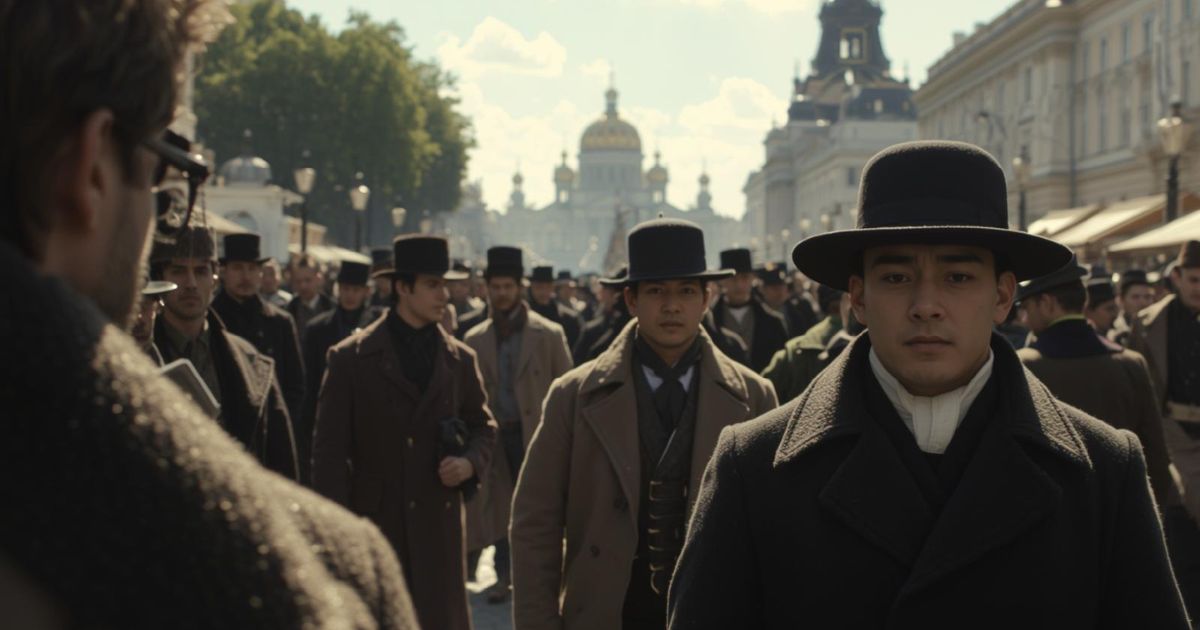
An excerpt from the original text.(complete · 4535 words)
t was nearly eight o’clock. The two young men hurried to Bakaleyev’s,
to arrive before Luzhin.
“Why, who was that?” asked Razumihin, as soon as they were in the
street.
“It was Svidrigaïlov, that landowner in whose house my sister was
insulted when she was their governess. Through his persecuting her with
his attentions, she was turned out by his wife, Marfa Petrovna. This
Marfa Petrovna begged Dounia’s forgiveness afterwards, and she’s just
died suddenly. It was of her we were talking this morning. I don’t
know why I’m afraid of that man. He came here at once after his wife’s
funeral. He is very strange, and is determined on doing something.... We
must guard Dounia from him... that’s what I wanted to tell you, do you
hear?”
“Guard her! What can he do to harm Avdotya Romanovna? Thank you, Rodya,
for speaking to me like that.... We will, we will guard her. Where does
he live?”
“I don’t know.”
“Why didn’t you ask? What a pity! I’ll find out, though.”
“Did you see him?” asked Raskolnikov after a pause.
“Yes, I noticed him, I noticed him well.”
“You did really see him? You saw him clearly?” Raskolnikov insisted.
“Yes, I remember him perfectly, I should know him in a thousand; I have
a good memory for faces.”
They were silent again.
“Hm!... that’s all right,” muttered Raskolnikov. “Do you know, I
fancied... I keep thinking that it may have been an hallucination.”
“What do you mean? I don’t understand you.”
“Well, you all say,” Raskolnikov went on, twisting his mouth into a
smile, “that I am mad. I thought just now that perhaps I really am mad,
and have only seen a phantom.”
“What do you mean?”
“Why, who can tell? Perhaps I am really mad, and perhaps everything that
happened all these days may be only imagination.”
“Ach, Rodya, you have been upset again!... But what did he say, what did
he come for?”
Raskolnikov did not answer. Razumihin thought a minute.
“Now let me tell you my story,” he began, “I came to you, you were
asleep. Then we had dinner and then I went to Porfiry’s, Zametov was
still with him. I tried to begin, but it was no use. I couldn’t speak in
the right way. They don’t seem to understand and can’t understand, but
are not a bit ashamed. I drew Porfiry to the window, and began talking
to him, but it was still no use. He looked away and I looked away. At
last I shook my fist in his ugly face, and told him as a cousin I’d
brain him. He merely looked at me, I cursed and came away. That was
all. It was very stupid. To Zametov I didn’t say a word. But, you see, I
thought I’d made a mess of it, but as I went downstairs a brilliant idea
struck me: why should we trouble? Of course if you were in any danger
or anything, but why need you care? You needn’t care a hang for them. We
shall have a laugh at them afterwards, and if I were in your place I’d
mystify them more than ever. How ashamed they’ll be afterwards! Hang
them! We can thrash them afterwards, but let’s laugh at them now!”
“To be sure,” answered Raskolnikov. “But what will you say to-morrow?”
he thought to himself. Strange to say, till that moment it had never
occurred to him to wonder what Razumihin would think when he knew. As he
thought it, Raskolnikov looked at him. Razumihin’s account of his visit
to Porfiry had very little interest for him, so much had come and gone
since then.
In the corridor they came upon Luzhin; he had arrived punctually
at eight, and was looking for the number, so that all three went in
together without greeting or looking at one another. The young men
walked in first, while Pyotr Petrovitch, for good manners, lingered a
little in the passage, taking off his coat. Pulcheria Alexandrovna came
forward at once to greet him in the doorway, Dounia was welcoming her
brother. Pyotr Petrovitch walked in and quite amiably, though with
redoubled dignity, bowed to the ladies. He looked, however, as though
he were a little put out and could not yet recover himself. Pulcheria
Alexandrovna, who seemed also a little embarrassed, hastened to make
them all sit down at the round table where a samovar was boiling. Dounia
and Luzhin were facing one another on opposite sides of the table.
Razumihin and Raskolnikov were facing Pulcheria Alexandrovna, Razumihin
was next to Luzhin and Raskolnikov was beside his sister.
A moment’s silence followed. Pyotr Petrovitch deliberately drew out a
cambric handkerchief reeking of scent and blew his nose with an air of
a benevolent man who felt himself slighted, and was firmly resolved to
insist on an explanation. In the passage the idea had occurred to him to
keep on his overcoat and walk away, and so give the two ladies a sharp
and emphatic lesson and make them feel the gravity of the position.
But he could not bring himself to do this. Besides, he could not endure
uncertainty, and he wanted an explanation: if his request had been so
openly disobeyed, there was something behind it, and in that case it was
better to find it out beforehand; it rested with him to punish them and
there would always be time for that.
“I trust you had a favourable journey,” he inquired officially of
Pulcheria Alexandrovna.
“Oh, very, Pyotr Petrovitch.”
“I am gratified to hear it. And Avdotya Romanovna is not over-fatigued
either?”
“I am young and strong, I don’t get tired, but it was a great strain for
mother,” answered Dounia.
“That’s unavoidable! our national railways are of terrible length.
‘Mother Russia,’ as they say, is a vast country.... In spite of all my
desire to do so, I was unable to meet you yesterday. But I trust all
passed off without inconvenience?”
“Oh, no, Pyotr Petrovitch, it was all terribly disheartening,” Pulcheria
Alexandrovna hastened to declare with peculiar intonation, “and if
Dmitri Prokofitch had not been sent us, I really believe by God Himself,
we should have been utterly lost. Here, he is! Dmitri Prokofitch
Razumihin,” she added, introducing him to Luzhin.
“I had the pleasure... yesterday,” muttered Pyotr Petrovitch with a
hostile glance sidelong at Razumihin; then he scowled and was silent.
Pyotr Petrovitch belonged to that class of persons, on the surface very
polite in society, who make a great point of punctiliousness, but who,
directly they are crossed in anything, are completely disconcerted, and
become more like sacks of flour than elegant and lively men of society.
Again all was silent; Raskolnikov was obstinately mute, Avdotya
Romanovna was unwilling to open the conversation too soon. Razumihin had
nothing to say, so Pulcheria Alexandrovna was anxious again.
“Marfa Petrovna is dead, have you heard?” she began having recourse to
her leading item of conversation.
“To be sure, I heard so. I was immediately informed, and I have come to
make you acquainted with the fact that Arkady Ivanovitch Svidrigaïlov
set off in haste for Petersburg immediately after his wife’s funeral. So
at least I have excellent authority for believing.”
“To Petersburg? here?” Dounia asked in alarm and looked at her mother.
“Yes, indeed, and doubtless not without some design, having in view the
rapidity of his departure, and all the circumstances preceding it.”
“Good heavens! won’t he leave Dounia in peace even here?” cried
Pulcheria Alexandrovna.
“I imagine that neither you nor Avdotya Romanovna have any grounds for
uneasiness, unless, of course, you are yourselves desirous of getting
into communication with him. For my part I am on my guard, and am now
discovering where he is lodging.”
“Oh, Pyotr Petrovitch, you would not believe what a fright you have
given me,” Pulcheria Alexandrovna went on: “I’ve only seen him twice,
but I thought him terrible, terrible! I am convinced that he was the
cause of Marfa Petrovna’s death.”
“It’s impossible to be certain about that. I have precise information. I
do not dispute that he may have contributed to accelerate the course of
events by the moral influence, so to say, of the affront; but as to the
general conduct and moral characteristics of that personage, I am
in agreement with you. I do not know whether he is well off now, and
precisely what Marfa Petrovna left him; this will be known to me within
a very short period; but no doubt here in Petersburg, if he has any
pecuniary resources, he will relapse at once into his old ways. He is
the most depraved, and abjectly vicious specimen of that class of men.
I have considerable reason to believe that Marfa Petrovna, who was so
unfortunate as to fall in love with him and to pay his debts eight years
ago, was of service to him also in another way. Solely by her exertions
and sacrifices, a criminal charge, involving an element of fantastic
and homicidal brutality for which he might well have been sentenced to
Siberia, was hushed up. That’s the sort of man he is, if you care to
know.”
“Good heavens!” cried Pulcheria Alexandrovna. Raskolnikov listened
attentively.
“Are you speaking the truth when you say that you have good evidence of
this?” Dounia asked sternly and emphatically.
“I only repeat what I was told in secret by Marfa Petrovna. I must
observe that from the legal point of view the case was far from clear.
There was, and I believe still is, living here a woman called Resslich,
a foreigner, who lent small sums of money at interest, and did other
commissions, and with this woman Svidrigaïlov had for a long while close
and mysterious relations. She had a relation, a niece I believe, living
with her, a deaf and dumb girl of fifteen, or perhaps not more than
fourteen. Resslich hated this girl, and grudged her every crust; she
used to beat her mercilessly. One day the girl was found hanging in
the garret. At the inquest the verdict was suicide. After the usual
proceedings the matter ended, but, later on, information was given that
the child had been... cruelly outraged by Svidrigaïlov. It is true, this
was not clearly established, the information was given by another German
woman of loose character whose word could not be trusted; no statement
was actually made to the police, thanks to Marfa Petrovna’s money and
exertions; it did not get beyond gossip. And yet the story is a very
significant one. You heard, no doubt, Avdotya Romanovna, when you were
with them the story of the servant Philip who died of ill treatment he
received six years ago, before the abolition of serfdom.”
“I heard, on the contrary, that this Philip hanged himself.”
“Quite so, but what drove him, or rather perhaps disposed him,
to suicide was the systematic persecution and severity of Mr.
Svidrigaïlov.”
“I don’t know that,” answered Dounia, dryly. “I only heard a queer story
that Philip was a sort of hypochondriac, a sort of domestic philosopher,
the servants used to say, ‘he read himself silly,’ and that he hanged
himself partly on account of Mr. Svidrigaïlov’s mockery of him and not
his blows. When I was there he behaved well to the servants, and they
were actually fond of him, though they certainly did blame him for
Philip’s death.”
“I perceive, Avdotya Romanovna, that you seem disposed to undertake his
defence all of a sudden,” Luzhin observed, twisting his lips into
an ambiguous smile, “there’s no doubt that he is an astute man, and
insinuating where ladies are concerned, of which Marfa Petrovna, who has
died so strangely, is a terrible instance. My only desire has been to be
of service to you and your mother with my advice, in view of the renewed
efforts which may certainly be anticipated from him. For my part it’s
my firm conviction, that he will end in a debtor’s prison again.
Marfa Petrovna had not the slightest intention of settling anything
substantial on him, having regard for his children’s interests, and,
if she left him anything, it would only be the merest sufficiency,
something insignificant and ephemeral, which would not last a year for a
man of his habits.”
“Pyotr Petrovitch, I beg you,” said Dounia, “say no more of Mr.
Svidrigaïlov. It makes me miserable.”
“He has just been to see me,” said Raskolnikov, breaking his silence for
the first time.
There were exclamations from all, and they all turned to him. Even Pyotr
Petrovitch was roused.
“An hour and a half ago, he came in when I was asleep, waked me, and
introduced himself,” Raskolnikov continued. “He was fairly cheerful
and at ease, and quite hopes that we shall become friends. He is
particularly anxious, by the way, Dounia, for an interview with you, at
which he asked me to assist. He has a proposition to make to you, and
he told me about it. He told me, too, that a week before her death Marfa
Petrovna left you three thousand roubles in her will, Dounia, and that
you can receive the money very shortly.”
“Thank God!” cried Pulcheria Alexandrovna, crossing herself. “Pray for
her soul, Dounia!”
“It’s a fact!” broke from Luzhin.
“Tell us, what more?” Dounia urged Raskolnikov.
“Then he said that he wasn’t rich and all the estate was left to his
children who are now with an aunt, then that he was staying somewhere
not far from me, but where, I don’t know, I didn’t ask....”
“But what, what does he want to propose to Dounia?” cried Pulcheria
Alexandrovna in a fright. “Did he tell you?”
“Yes.”
“What was it?”
“I’ll tell you afterwards.”
Raskolnikov ceased speaking and turned his attention to his tea.
Pyotr Petrovitch looked at his watch.
“I am compelled to keep a business engagement, and so I shall not be in
your way,” he added with an air of some pique and he began getting up.
“Don’t go, Pyotr Petrovitch,” said Dounia, “you intended to spend
the evening. Besides, you wrote yourself that you wanted to have an
explanation with mother.”
“Precisely so, Avdotya Romanovna,” Pyotr Petrovitch answered
impressively, sitting down again, but still holding his hat. “I
certainly desired an explanation with you and your honoured mother upon
a very important point indeed. But as your brother cannot speak openly
in my presence of some proposals of Mr. Svidrigaïlov, I, too, do not
desire and am not able to speak openly... in the presence of others...
of certain matters of the greatest gravity. Moreover, my most weighty
and urgent request has been disregarded....”
Assuming an aggrieved air, Luzhin relapsed into dignified silence.
“Your request that my brother should not be present at our meeting was
disregarded solely at my insistence,” said Dounia. “You wrote that you
had been insulted by my brother; I think that this must be explained at
once, and you must be reconciled. And if Rodya really has insulted you,
then he should and will apologise.”
Pyotr Petrovitch took a stronger line.
“There are insults, Avdotya Romanovna, which no goodwill can make us
forget. There is a line in everything which it is dangerous to overstep;
and when it has been overstepped, there is no return.”
“That wasn’t what I was speaking of exactly, Pyotr Petrovitch,” Dounia
interrupted with some impatience. “Please understand that our whole
future depends now on whether all this is explained and set right as
soon as possible. I tell you frankly at the start that I cannot look at
it in any other light, and if you have the least regard for me, all this
business must be ended to-day, however hard that may be. I repeat that
if my brother is to blame he will ask your forgiveness.”
“I am surprised at your putting the question like that,” said Luzhin,
getting more and more irritated. “Esteeming, and so to say, adoring you,
I may at the same time, very well indeed, be able to dislike some member
of your family. Though I lay claim to the happiness of your hand, I
cannot accept duties incompatible with...”
“Ah, don’t be so ready to take offence, Pyotr Petrovitch,” Dounia
interrupted with feeling, “and be the sensible and generous man I have
always considered, and wish to consider, you to be. I’ve given you a
great promise, I am your betrothed. Trust me in this matter and, believe
me, I shall be capable of judging impartially. My assuming the part of
judge is as much a surprise for my brother as for you. When I insisted
on his coming to our interview to-day after your letter, I told
him nothing of what I meant to do. Understand that, if you are not
reconciled, I must choose between you--it must be either you or he. That
is how the question rests on your side and on his. I don’t want to be
mistaken in my choice, and I must not be. For your sake I must break off
with my brother, for my brother’s sake I must break off with you. I can
find out for certain now whether he is a brother to me, and I want to
know it; and of you, whether I am dear to you, whether you esteem me,
whether you are the husband for me.”
“Avdotya Romanovna,” Luzhin declared huffily, “your words are of too
much consequence to me; I will say more, they are offensive in view
of the position I have the honour to occupy in relation to you. To say
nothing of your strange and offensive setting me on a level with an
impertinent boy, you admit the possibility of breaking your promise to
me. You say ‘you or he,’ showing thereby of how little consequence I
am in your eyes... I cannot let this pass considering the relationship
and... the obligations existing between us.”
“What!” cried Dounia, flushing. “I set your interest beside all that has
hitherto been most precious in my life, what has made up the whole of
my life, and here you are offended at my making too little account of
you.”
Raskolnikov smiled sarcastically, Razumihin fidgeted, but Pyotr
Petrovitch did not accept the reproof; on the contrary, at every word he
became more persistent and irritable, as though he relished it.
“Love for the future partner of your life, for your husband, ought to
outweigh your love for your brother,” he pronounced sententiously, “and
in any case I cannot be put on the same level.... Although I said so
emphatically that I would not speak openly in your brother’s presence,
nevertheless, I intend now to ask your honoured mother for a necessary
explanation on a point of great importance closely affecting my dignity.
Your son,” he turned to Pulcheria Alexandrovna, “yesterday in the
presence of Mr. Razsudkin (or... I think that’s it? excuse me, I have
forgotten your surname”) (he bowed politely to Razumihin), “insulted me
by misrepresenting the idea I expressed to you in a private
conversation, drinking coffee, that is, that marriage with a poor girl
who has had experience of trouble is more advantageous from the conjugal
point of view than with one who has lived in luxury, since it is more
profitable for the moral character. Your son intentionally exaggerated
the significance of my words and made them ridiculous, accusing me of
malicious intentions, and, as far as I could see, relied upon your
correspondence with him. I shall consider myself happy, Pulcheria
Alexandrovna, if it is possible for you to convince me of an opposite
conclusion, and thereby considerately reassure me. Kindly let me know
in what terms precisely you repeated my words in your letter to Rodion
Romanovitch.”
“I don’t remember,” faltered Pulcheria Alexandrovna. “I repeated them as
I understood them. I don’t know how Rodya repeated them to you, perhaps
he exaggerated.”
“He could not have exaggerated them, except at your instigation.”
“Pyotr Petrovitch,” Pulcheria Alexandrovna declared with dignity, “the
proof that Dounia and I did not take your words in a very bad sense is
the fact that we are here.”
“Good, mother,” said Dounia approvingly.
“Then this is my fault again,” said Luzhin, aggrieved.
“Well, Pyotr Petrovitch, you keep blaming Rodion, but you yourself have
just written what was false about him,” Pulcheria Alexandrovna added,
gaining courage.
“I don’t remember writing anything false.”
“You wrote,” Raskolnikov said sharply, not turning to Luzhin, “that I
gave money yesterday not to the widow of the man who was killed, as was
the fact, but to his daughter (whom I had never seen till yesterday).
You wrote this to make dissension between me and my family, and for that
object added coarse expressions about the conduct of a girl whom you
don’t know. All that is mean slander.”
“Excuse me, sir,” said Luzhin, quivering with fury. “I enlarged upon
your qualities and conduct in my letter solely in response to your
sister’s and mother’s inquiries, how I found you, and what impression
you made on me. As for what you’ve alluded to in my letter, be so good
as to point out one word of falsehood, show, that is, that you didn’t
throw away your money, and that there are not worthless persons in that
family, however unfortunate.”
“To my thinking, you, with all your virtues, are not worth the little
finger of that unfortunate girl at whom you throw stones.”
“Would you go so far then as to let her associate with your mother and
sister?”
“I have done so already, if you care to know. I made her sit down to-day
with mother and Dounia.”
“Rodya!” cried Pulcheria Alexandrovna. Dounia crimsoned, Razumihin
knitted his brows. Luzhin smiled with lofty sarcasm.
“You may see for yourself, Avdotya Romanovna,” he said, “whether it is
possible for us to agree. I hope now that this question is at an end,
once and for all. I will withdraw, that I may not hinder the pleasures
of family intimacy, and the discussion of secrets.” He got up from his
chair and took his hat. “But in withdrawing, I venture to request
that for the future I may be spared similar meetings, and, so to
say, compromises. I appeal particularly to you, honoured Pulcheria
Alexandrovna, on this subject, the more as my letter was addressed to
you and to no one else.”
Pulcheria Alexandrovna was a little offended.
“You seem to think we are completely under your authority, Pyotr
Petrovitch. Dounia has told you the reason your desire was disregarded,
she had the best intentions. And indeed you write as though you were
laying commands upon me. Are we to consider every desire of yours as
a command? Let me tell you on the contrary that you ought to show
particular delicacy and consideration for us now, because we have thrown
up everything, and have come here relying on you, and so we are in any
case in a sense in your hands.”
“That is not quite true, Pulcheria Alexandrovna, especially at the
present moment, when the news has come of Marfa Petrovna’s legacy, which
seems indeed very apropos, judging from the new tone you take to me,” he
added sarcastically.
“Judging from that remark, we may certainly presume that you were
reckoning on our helplessness,” Dounia observed irritably.
“But now in any case I cannot reckon on it, and I particularly desire
not to hinder your discussion of the secret proposals of Arkady
Ivanovitch Svidrigaïlov, which he has entrusted to your brother and
which have, I perceive, a great and possibly a very agreeable interest
for you.”
“Good heavens!” cried Pulcheria Alexandrovna.
Razumihin could not sit still on his chair.
“Aren’t you ashamed now, sister?” asked Raskolnikov.
“I am ashamed, Rodya,” said Dounia. “Pyotr Petrovitch, go away,” she
turned to him, white with anger.
Pyotr Petrovitch had apparently not at all expected such a conclusion.
He had too much confidence in himself, in his power and in the
helplessness of his victims. He could not believe it even now. He turned
pale, and his lips quivered.
“Avdotya Romanovna, if I go out of this door now, after such a
dismissal, then, you may reckon on it, I will never come back. Consider
what you are doing. My word is not to be shaken.”
“What insolence!” cried Dounia, springing up from her seat. “I don’t
want you to come back again.”
“What! So that’s how it stands!” cried Luzhin, utterly unable to the
last moment to believe in the rupture and so completely thrown out of
his reckoning now. “So that’s how it stands! But do you know, Avdotya
Romanovna, that I might protest?”
“What right have you to speak to her like that?” Pulcheria Alexandrovna
intervened hotly. “And what can you protest about? What rights have you?
Am I to give my Dounia to a man like you? Go away, leave us altogether!
We are to blame for having agreed to a wrong action, and I above
all....”
“But you have bound me, Pulcheria Alexandrovna,” Luzhin stormed in a
frenzy, “by your promise, and now you deny it and... besides... I have
been led on account of that into expenses....”
This last complaint was so characteristic of Pyotr Petrovitch, that
Raskolnikov, pale with anger and with the effort of restraining it,
could not help breaking into laughter. But Pulcheria Alexandrovna was
furious.
“Expenses? What expenses? Are you speaking of our trunk? But the
conductor brought it for nothing for you. Mercy on us, we have bound
you! What are you thinking about, Pyotr Petrovitch, it was you bound us,
hand and foot, not we!”
“Enough, mother, no more please,” Avdotya Romanovna implored. “Pyotr
Petrovitch, do be kind and go!”
“I am going, but one last word,” he said, quite unable to control
himself. “Your mamma seems to have entirely forgotten that I made up my
mind to take you, so to speak, after the gossip of the town had spread
all over the district in regard to your reputation. Disregarding public
opinion for your sake and reinstating your reputation, I certainly
might very well reckon on a fitting return, and might indeed look for
gratitude on your part. And my eyes have only now been opened! I see
myself that I may have acted very, very recklessly in disregarding the
universal verdict....”
“Does the fellow want his head smashed?” cried Razumihin, jumping up.
“You are a mean and spiteful man!” cried Dounia.
“Not a word! Not a movement!” cried Raskolnikov, holding Razumihin back;
then going close up to Luzhin, “Kindly leave the room!” he said quietly
and distinctly, “and not a word more or...”
Pyotr Petrovitch gazed at him for some seconds with a pale face that
worked with anger, then he turned, went out, and rarely has any man
carried away in his heart such vindictive hatred as he felt against
Raskolnikov. Him, and him alone, he blamed for everything. It is
noteworthy that as he went downstairs he still imagined that his case
was perhaps not utterly lost, and that, so far as the ladies were
concerned, all might “very well indeed” be set right again.
Master this chapter. Complete your experience
Purchase the complete book to access all chapters and support classic literature
As an Amazon Associate, we earn a small commission from qualifying purchases at no additional cost to you.
Available in paperback, hardcover, and e-book formats
Let's Analyse the Pattern
Why This Matters
Connect literature to life
This chapter helps readers identify how stress reshapes judgment, power, and relationship dynamics in real time.
Now let's explore the literary elements.
Key Quotes & Analysis
"A tense family gathering unfolds as Luzhin, Dunya's fiancé, finally meets her brother."
Context: Core movement described by the chapter summary
This line captures the chapter's central pressure point and the shift it creates in character behavior.
"Actions under pressure expose deeper motives and limits."
Context: Interpreting this chapter's conflict
The chapter emphasizes that crisis does not invent character; it reveals structure already present.
Thematic Threads
Consequence
In This Chapter
Prior choices narrow present options and increase emotional stakes.
Development
The chapter advances from abstract tension to concrete cost.
Power
In This Chapter
Status, dependence, or leverage shape who can define reality in the scene.
Development
Control shifts through conversation, framing, and reaction.
Identity
In This Chapter
Characters struggle to maintain a coherent self-story under contradiction.
Development
Internal narratives are tested against observable behavior.
Relationship Strain
In This Chapter
Trust and communication degrade when secrecy or fear dominate interaction.
Development
The chapter escalates interpersonal risk alongside plot risk.
You now have the context. Time to form your own thoughts.
Discussion Questions
- 1
What pressure in this chapter most strongly drives behavior change?
- 2
Which character controls the frame of the conflict, and how?
- 3
Where does self-justification break down into visible consequence?
- 4
How do status and vulnerability shape what each person can safely say?
- 5
What alternative choice might have reduced downstream harm?
Critical Thinking Exercise
Pressure Map
Map one chapter decision with four columns: pressure source, available options, likely short-term relief, and long-term consequence. Then identify which option best preserves integrity under constraint.
Consider:
- •Separate immediate emotion from structural incentives
- •Track who bears risk versus who controls terms
- •Define one boundary that prevents escalation
Coming Up Next...
Chapter 23: Luzhin's Trap
Sonia's unwavering faith begins to crack through Raskolnikov's intellectual defenses, but he's not ready to surrender his theories about extraordinary people. Their philosophical battle intensifies as she challenges everything he believes about himself and his crime.