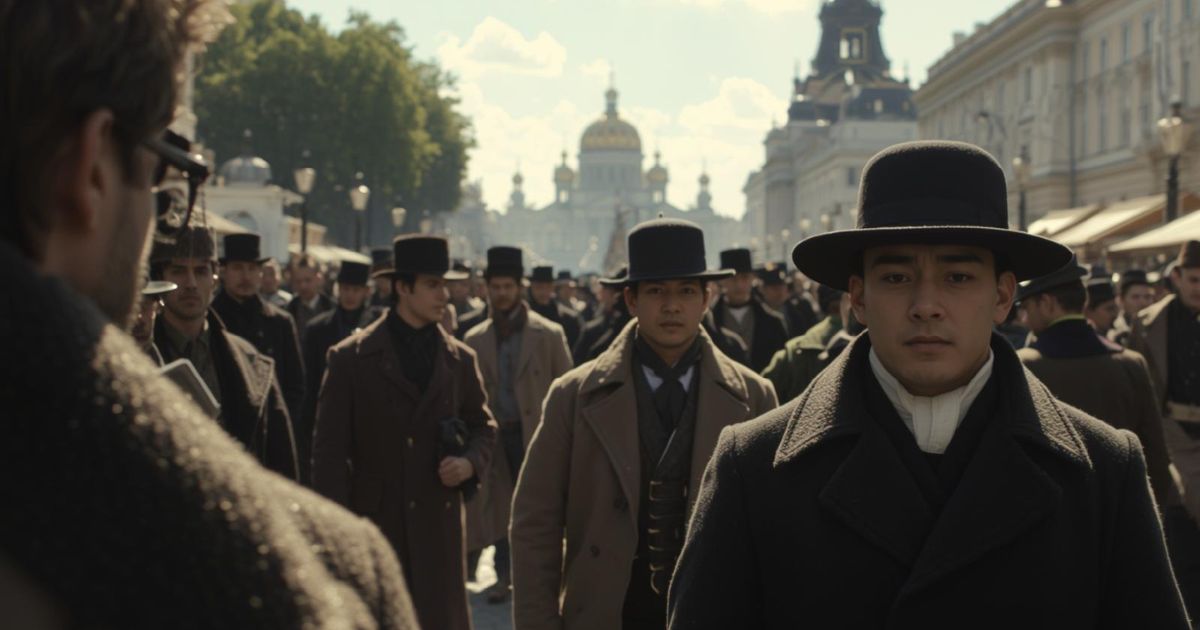
An excerpt from the original text.(complete · 3029 words)
he fact was that up to the last moment he had never expected such an
ending; he had been overbearing to the last degree, never dreaming that
two destitute and defenceless women could escape from his control. This
conviction was strengthened by his vanity and conceit, a conceit to
the point of fatuity. Pyotr Petrovitch, who had made his way up from
insignificance, was morbidly given to self-admiration, had the highest
opinion of his intelligence and capacities, and sometimes even gloated
in solitude over his image in the glass. But what he loved and valued
above all was the money he had amassed by his labour, and by all sorts
of devices: that money made him the equal of all who had been his
superiors.
When he had bitterly reminded Dounia that he had decided to take her in
spite of evil report, Pyotr Petrovitch had spoken with perfect sincerity
and had, indeed, felt genuinely indignant at such “black ingratitude.”
And yet, when he made Dounia his offer, he was fully aware of the
groundlessness of all the gossip. The story had been everywhere
contradicted by Marfa Petrovna, and was by then disbelieved by all the
townspeople, who were warm in Dounia’s defence. And he would not have
denied that he knew all that at the time. Yet he still thought highly
of his own resolution in lifting Dounia to his level and regarded it as
something heroic. In speaking of it to Dounia, he had let out the secret
feeling he cherished and admired, and he could not understand that
others should fail to admire it too. He had called on Raskolnikov with
the feelings of a benefactor who is about to reap the fruits of his good
deeds and to hear agreeable flattery. And as he went downstairs now, he
considered himself most undeservedly injured and unrecognised.
Dounia was simply essential to him; to do without her was unthinkable.
For many years he had had voluptuous dreams of marriage, but he had
gone on waiting and amassing money. He brooded with relish, in profound
secret, over the image of a girl--virtuous, poor (she must be poor),
very young, very pretty, of good birth and education, very timid, one
who had suffered much, and was completely humbled before him, one who
would all her life look on him as her saviour, worship him, admire him
and only him. How many scenes, how many amorous episodes he had imagined
on this seductive and playful theme, when his work was over! And,
behold, the dream of so many years was all but realised; the beauty and
education of Avdotya Romanovna had impressed him; her helpless position
had been a great allurement; in her he had found even more than he
dreamed of. Here was a girl of pride, character, virtue, of education
and breeding superior to his own (he felt that), and this creature would
be slavishly grateful all her life for his heroic condescension, and
would humble herself in the dust before him, and he would have absolute,
unbounded power over her!... Not long before, he had, too, after long
reflection and hesitation, made an important change in his career and
was now entering on a wider circle of business. With this change his
cherished dreams of rising into a higher class of society seemed likely
to be realised.... He was, in fact, determined to try his fortune
in Petersburg. He knew that women could do a very great deal. The
fascination of a charming, virtuous, highly educated woman might make
his way easier, might do wonders in attracting people to him, throwing
an aureole round him, and now everything was in ruins! This sudden
horrible rupture affected him like a clap of thunder; it was like a
hideous joke, an absurdity. He had only been a tiny bit masterful,
had not even time to speak out, had simply made a joke, been carried
away--and it had ended so seriously. And, of course, too, he did love
Dounia in his own way; he already possessed her in his dreams--and all
at once! No! The next day, the very next day, it must all be set right,
smoothed over, settled. Above all he must crush that conceited milksop
who was the cause of it all. With a sick feeling he could not help
recalling Razumihin too, but, he soon reassured himself on that score;
as though a fellow like that could be put on a level with him! The man
he really dreaded in earnest was Svidrigaïlov.... He had, in short, a
great deal to attend to....
*****
“No, I, I am more to blame than anyone!” said Dounia, kissing and
embracing her mother. “I was tempted by his money, but on my honour,
brother, I had no idea he was such a base man. If I had seen through him
before, nothing would have tempted me! Don’t blame me, brother!”
“God has delivered us! God has delivered us!” Pulcheria Alexandrovna
muttered, but half consciously, as though scarcely able to realise what
had happened.
They were all relieved, and in five minutes they were laughing. Only now
and then Dounia turned white and frowned, remembering what had passed.
Pulcheria Alexandrovna was surprised to find that she, too, was glad:
she had only that morning thought rupture with Luzhin a terrible
misfortune. Razumihin was delighted. He did not yet dare to express his
joy fully, but he was in a fever of excitement as though a ton-weight
had fallen off his heart. Now he had the right to devote his life to
them, to serve them.... Anything might happen now! But he felt afraid to
think of further possibilities and dared not let his imagination
range. But Raskolnikov sat still in the same place, almost sullen and
indifferent. Though he had been the most insistent on getting rid of
Luzhin, he seemed now the least concerned at what had happened. Dounia
could not help thinking that he was still angry with her, and Pulcheria
Alexandrovna watched him timidly.
“What did Svidrigaïlov say to you?” said Dounia, approaching him.
“Yes, yes!” cried Pulcheria Alexandrovna.
Raskolnikov raised his head.
“He wants to make you a present of ten thousand roubles and he desires
to see you once in my presence.”
“See her! On no account!” cried Pulcheria Alexandrovna. “And how dare he
offer her money!”
Then Raskolnikov repeated (rather dryly) his conversation with
Svidrigaïlov, omitting his account of the ghostly visitations of Marfa
Petrovna, wishing to avoid all unnecessary talk.
“What answer did you give him?” asked Dounia.
“At first I said I would not take any message to you. Then he said that
he would do his utmost to obtain an interview with you without my help.
He assured me that his passion for you was a passing infatuation, now he
has no feeling for you. He doesn’t want you to marry Luzhin.... His talk
was altogether rather muddled.”
“How do you explain him to yourself, Rodya? How did he strike you?”
“I must confess I don’t quite understand him. He offers you ten
thousand, and yet says he is not well off. He says he is going away, and
in ten minutes he forgets he has said it. Then he says he is going to be
married and has already fixed on the girl.... No doubt he has a motive,
and probably a bad one. But it’s odd that he should be so clumsy about
it if he had any designs against you.... Of course, I refused this
money on your account, once for all. Altogether, I thought him very
strange.... One might almost think he was mad. But I may be mistaken;
that may only be the part he assumes. The death of Marfa Petrovna seems
to have made a great impression on him.”
“God rest her soul,” exclaimed Pulcheria Alexandrovna. “I shall always,
always pray for her! Where should we be now, Dounia, without this three
thousand! It’s as though it had fallen from heaven! Why, Rodya, this
morning we had only three roubles in our pocket and Dounia and I were
just planning to pawn her watch, so as to avoid borrowing from that man
until he offered help.”
Dounia seemed strangely impressed by Svidrigaïlov’s offer. She still
stood meditating.
“He has got some terrible plan,” she said in a half whisper to herself,
almost shuddering.
Raskolnikov noticed this disproportionate terror.
“I fancy I shall have to see him more than once again,” he said to
Dounia.
“We will watch him! I will track him out!” cried Razumihin, vigorously.
“I won’t lose sight of him. Rodya has given me leave. He said to me
himself just now. ‘Take care of my sister.’ Will you give me leave, too,
Avdotya Romanovna?”
Dounia smiled and held out her hand, but the look of anxiety did not
leave her face. Pulcheria Alexandrovna gazed at her timidly, but the
three thousand roubles had obviously a soothing effect on her.
A quarter of an hour later, they were all engaged in a lively
conversation. Even Raskolnikov listened attentively for some time,
though he did not talk. Razumihin was the speaker.
“And why, why should you go away?” he flowed on ecstatically. “And what
are you to do in a little town? The great thing is, you are all here
together and you need one another--you do need one another, believe me.
For a time, anyway.... Take me into partnership, and I assure you we’ll
plan a capital enterprise. Listen! I’ll explain it all in detail to
you, the whole project! It all flashed into my head this morning,
before anything had happened... I tell you what; I have an uncle, I must
introduce him to you (a most accommodating and respectable old man).
This uncle has got a capital of a thousand roubles, and he lives on his
pension and has no need of that money. For the last two years he has
been bothering me to borrow it from him and pay him six per cent
interest. I know what that means; he simply wants to help me. Last year
I had no need of it, but this year I resolved to borrow it as soon as
he arrived. Then you lend me another thousand of your three and we have
enough for a start, so we’ll go into partnership, and what are we going
to do?”
Then Razumihin began to unfold his project, and he explained at length
that almost all our publishers and booksellers know nothing at all
of what they are selling, and for that reason they are usually bad
publishers, and that any decent publications pay as a rule and give
a profit, sometimes a considerable one. Razumihin had, indeed, been
dreaming of setting up as a publisher. For the last two years he had
been working in publishers’ offices, and knew three European languages
well, though he had told Raskolnikov six days before that he was
“schwach” in German with an object of persuading him to take half his
translation and half the payment for it. He had told a lie then, and
Raskolnikov knew he was lying.
“Why, why should we let our chance slip when we have one of the chief
means of success--money of our own!” cried Razumihin warmly. “Of course
there will be a lot of work, but we will work, you, Avdotya Romanovna,
I, Rodion.... You get a splendid profit on some books nowadays! And
the great point of the business is that we shall know just what wants
translating, and we shall be translating, publishing, learning all at
once. I can be of use because I have experience. For nearly two years
I’ve been scuttling about among the publishers, and now I know every
detail of their business. You need not be a saint to make pots, believe
me! And why, why should we let our chance slip! Why, I know--and I kept
the secret--two or three books which one might get a hundred roubles
simply for thinking of translating and publishing. Indeed, and I would
not take five hundred for the very idea of one of them. And what do you
think? If I were to tell a publisher, I dare say he’d hesitate--they are
such blockheads! And as for the business side, printing, paper, selling,
you trust to me, I know my way about. We’ll begin in a small way and go
on to a large. In any case it will get us our living and we shall get
back our capital.”
Dounia’s eyes shone.
“I like what you are saying, Dmitri Prokofitch!” she said.
“I know nothing about it, of course,” put in Pulcheria Alexandrovna,
“it may be a good idea, but again God knows. It’s new and untried. Of
course, we must remain here at least for a time.” She looked at Rodya.
“What do you think, brother?” said Dounia.
“I think he’s got a very good idea,” he answered. “Of course, it’s too
soon to dream of a publishing firm, but we certainly might bring out
five or six books and be sure of success. I know of one book myself
which would be sure to go well. And as for his being able to manage it,
there’s no doubt about that either. He knows the business.... But we can
talk it over later....”
“Hurrah!” cried Razumihin. “Now, stay, there’s a flat here in this
house, belonging to the same owner. It’s a special flat apart, not
communicating with these lodgings. It’s furnished, rent moderate,
three rooms. Suppose you take them to begin with. I’ll pawn your watch
to-morrow and bring you the money, and everything can be arranged then.
You can all three live together, and Rodya will be with you. But where
are you off to, Rodya?”
“What, Rodya, you are going already?” Pulcheria Alexandrovna asked in
dismay.
“At such a minute?” cried Razumihin.
Dounia looked at her brother with incredulous wonder. He held his cap in
his hand, he was preparing to leave them.
“One would think you were burying me or saying good-bye for ever,” he
said somewhat oddly. He attempted to smile, but it did not turn out a
smile. “But who knows, perhaps it is the last time we shall see each
other...” he let slip accidentally. It was what he was thinking, and it
somehow was uttered aloud.
“What is the matter with you?” cried his mother.
“Where are you going, Rodya?” asked Dounia rather strangely.
“Oh, I’m quite obliged to...” he answered vaguely, as though hesitating
what he would say. But there was a look of sharp determination in his
white face.
“I meant to say... as I was coming here... I meant to tell you, mother,
and you, Dounia, that it would be better for us to part for a time. I
feel ill, I am not at peace.... I will come afterwards, I will come of
myself... when it’s possible. I remember you and love you.... Leave me,
leave me alone. I decided this even before... I’m absolutely resolved on
it. Whatever may come to me, whether I come to ruin or not, I want to be
alone. Forget me altogether, it’s better. Don’t inquire about me. When
I can, I’ll come of myself or... I’ll send for you. Perhaps it will all
come back, but now if you love me, give me up... else I shall begin to
hate you, I feel it.... Good-bye!”
“Good God!” cried Pulcheria Alexandrovna. Both his mother and his sister
were terribly alarmed. Razumihin was also.
“Rodya, Rodya, be reconciled with us! Let us be as before!” cried his
poor mother.
He turned slowly to the door and slowly went out of the room. Dounia
overtook him.
“Brother, what are you doing to mother?” she whispered, her eyes
flashing with indignation.
He looked dully at her.
“No matter, I shall come.... I’m coming,” he muttered in an undertone,
as though not fully conscious of what he was saying, and he went out of
the room.
“Wicked, heartless egoist!” cried Dounia.
“He is insane, but not heartless. He is mad! Don’t you see it? You’re
heartless after that!” Razumihin whispered in her ear, squeezing
her hand tightly. “I shall be back directly,” he shouted to the
horror-stricken mother, and he ran out of the room.
Raskolnikov was waiting for him at the end of the passage.
“I knew you would run after me,” he said. “Go back to them--be with
them... be with them to-morrow and always.... I... perhaps I shall
come... if I can. Good-bye.”
And without holding out his hand he walked away.
“But where are you going? What are you doing? What’s the matter with
you? How can you go on like this?” Razumihin muttered, at his wits’ end.
Raskolnikov stopped once more.
“Once for all, never ask me about anything. I have nothing to tell you.
Don’t come to see me. Maybe I’ll come here.... Leave me, but don’t
leave them. Do you understand me?”
It was dark in the corridor, they were standing near the lamp. For a
minute they were looking at one another in silence. Razumihin remembered
that minute all his life. Raskolnikov’s burning and intent eyes
grew more penetrating every moment, piercing into his soul, into his
consciousness. Suddenly Razumihin started. Something strange, as it
were, passed between them.... Some idea, some hint, as it were, slipped,
something awful, hideous, and suddenly understood on both sides....
Razumihin turned pale.
“Do you understand now?” said Raskolnikov, his face twitching nervously.
“Go back, go to them,” he said suddenly, and turning quickly, he went
out of the house.
I will not attempt to describe how Razumihin went back to the ladies,
how he soothed them, how he protested that Rodya needed rest in his
illness, protested that Rodya was sure to come, that he would come every
day, that he was very, very much upset, that he must not be irritated,
that he, Razumihin, would watch over him, would get him a doctor, the
best doctor, a consultation.... In fact from that evening Razumihin took
his place with them as a son and a brother.
Master this chapter. Complete your experience
Purchase the complete book to access all chapters and support classic literature
As an Amazon Associate, we earn a small commission from qualifying purchases at no additional cost to you.
Available in paperback, hardcover, and e-book formats
Let's Analyse the Pattern
Why This Matters
Connect literature to life
This chapter helps readers identify how stress reshapes judgment, power, and relationship dynamics in real time.
Now let's explore the literary elements.
Key Quotes & Analysis
"The investigation takes a dramatic turn when Porfiry Petrovich summons our protagonist for another "chat." This interrogation is a masterclass in psychological warfare."
Context: Core movement described by the chapter summary
This line captures the chapter's central pressure point and the shift it creates in character behavior.
"Actions under pressure expose deeper motives and limits."
Context: Interpreting this chapter's conflict
The chapter emphasizes that crisis does not invent character; it reveals structure already present.
Thematic Threads
Consequence
In This Chapter
Prior choices narrow present options and increase emotional stakes.
Development
The chapter advances from abstract tension to concrete cost.
Power
In This Chapter
Status, dependence, or leverage shape who can define reality in the scene.
Development
Control shifts through conversation, framing, and reaction.
Identity
In This Chapter
Characters struggle to maintain a coherent self-story under contradiction.
Development
Internal narratives are tested against observable behavior.
Relationship Strain
In This Chapter
Trust and communication degrade when secrecy or fear dominate interaction.
Development
The chapter escalates interpersonal risk alongside plot risk.
You now have the context. Time to form your own thoughts.
Discussion Questions
- 1
What pressure in this chapter most strongly drives behavior change?
- 2
Which character controls the frame of the conflict, and how?
- 3
Where does self-justification break down into visible consequence?
- 4
How do status and vulnerability shape what each person can safely say?
- 5
What alternative choice might have reduced downstream harm?
Critical Thinking Exercise
Pressure Map
Map one chapter decision with four columns: pressure source, available options, likely short-term relief, and long-term consequence. Then identify which option best preserves integrity under constraint.
Consider:
- •Separate immediate emotion from structural incentives
- •Track who bears risk versus who controls terms
- •Define one boundary that prevents escalation
Coming Up Next...
Chapter 24: The Confrontation
Having shared his darkest secret, Raskolnikov must now face what comes next with Sonia's knowledge between them. The weight of confession brings unexpected consequences, and the path forward becomes both clearer and more terrifying.