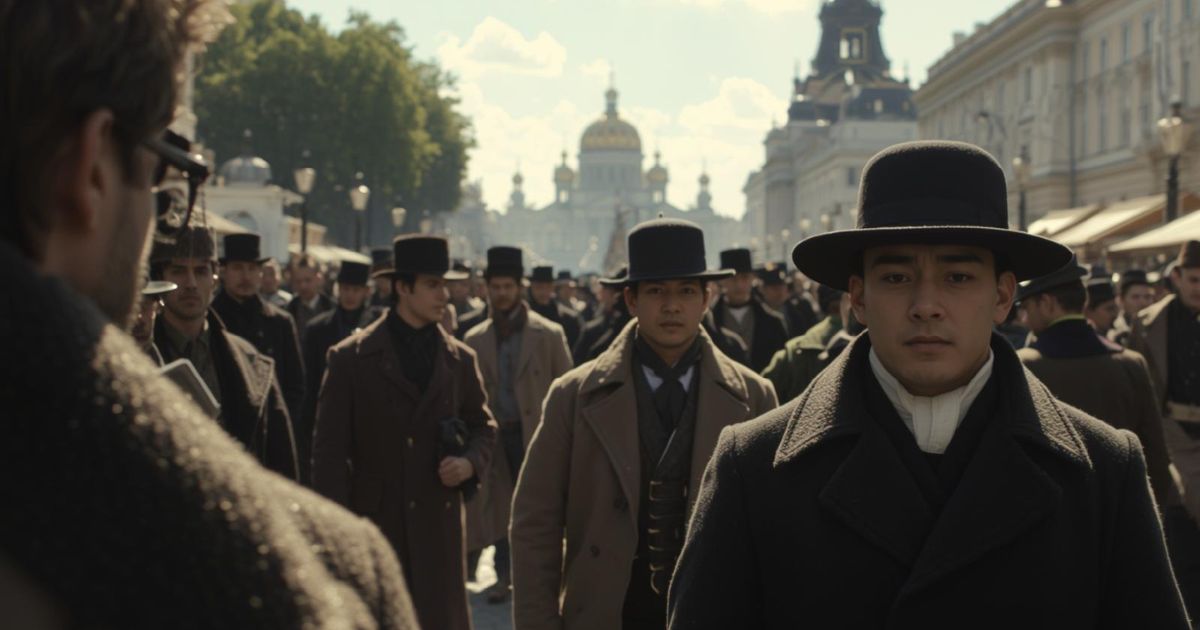
An excerpt from the original text.(complete · 5281 words)
e was not completely unconscious, however, all the time he was ill; he
was in a feverish state, sometimes delirious, sometimes half conscious.
He remembered a great deal afterwards. Sometimes it seemed as though
there were a number of people round him; they wanted to take him away
somewhere, there was a great deal of squabbling and discussing about
him. Then he would be alone in the room; they had all gone away afraid
of him, and only now and then opened the door a crack to look at him;
they threatened him, plotted something together, laughed, and mocked
at him. He remembered Nastasya often at his bedside; he distinguished
another person, too, whom he seemed to know very well, though he could
not remember who he was, and this fretted him, even made him cry.
Sometimes he fancied he had been lying there a month; at other times
it all seemed part of the same day. But of that--of that he had
no recollection, and yet every minute he felt that he had forgotten
something he ought to remember. He worried and tormented himself trying
to remember, moaned, flew into a rage, or sank into awful, intolerable
terror. Then he struggled to get up, would have run away, but someone
always prevented him by force, and he sank back into impotence and
forgetfulness. At last he returned to complete consciousness.
It happened at ten o’clock in the morning. On fine days the sun shone
into the room at that hour, throwing a streak of light on the right
wall and the corner near the door. Nastasya was standing beside him
with another person, a complete stranger, who was looking at him
very inquisitively. He was a young man with a beard, wearing a full,
short-waisted coat, and looked like a messenger. The landlady was
peeping in at the half-opened door. Raskolnikov sat up.
“Who is this, Nastasya?” he asked, pointing to the young man.
“I say, he’s himself again!” she said.
“He is himself,” echoed the man.
Concluding that he had returned to his senses, the landlady closed the
door and disappeared. She was always shy and dreaded conversations or
discussions. She was a woman of forty, not at all bad-looking, fat
and buxom, with black eyes and eyebrows, good-natured from fatness and
laziness, and absurdly bashful.
“Who... are you?” he went on, addressing the man. But at that moment
the door was flung open, and, stooping a little, as he was so tall,
Razumihin came in.
“What a cabin it is!” he cried. “I am always knocking my head. You call
this a lodging! So you are conscious, brother? I’ve just heard the news
from Pashenka.”
“He has just come to,” said Nastasya.
“Just come to,” echoed the man again, with a smile.
“And who are you?” Razumihin asked, suddenly addressing him. “My name is
Vrazumihin, at your service; not Razumihin, as I am always called, but
Vrazumihin, a student and gentleman; and he is my friend. And who are
you?”
“I am the messenger from our office, from the merchant Shelopaev, and
I’ve come on business.”
“Please sit down.” Razumihin seated himself on the other side of the
table. “It’s a good thing you’ve come to, brother,” he went on to
Raskolnikov. “For the last four days you have scarcely eaten or drunk
anything. We had to give you tea in spoonfuls. I brought Zossimov to see
you twice. You remember Zossimov? He examined you carefully and said at
once it was nothing serious--something seemed to have gone to your head.
Some nervous nonsense, the result of bad feeding, he says you have not
had enough beer and radish, but it’s nothing much, it will pass and you
will be all right. Zossimov is a first-rate fellow! He is making quite a
name. Come, I won’t keep you,” he said, addressing the man again. “Will
you explain what you want? You must know, Rodya, this is the second time
they have sent from the office; but it was another man last time, and I
talked to him. Who was it came before?”
“That was the day before yesterday, I venture to say, if you please,
sir. That was Alexey Semyonovitch; he is in our office, too.”
“He was more intelligent than you, don’t you think so?”
“Yes, indeed, sir, he is of more weight than I am.”
“Quite so; go on.”
“At your mamma’s request, through Afanasy Ivanovitch Vahrushin, of whom
I presume you have heard more than once, a remittance is sent to you
from our office,” the man began, addressing Raskolnikov. “If you are in
an intelligible condition, I’ve thirty-five roubles to remit to you, as
Semyon Semyonovitch has received from Afanasy Ivanovitch at your mamma’s
request instructions to that effect, as on previous occasions. Do you
know him, sir?”
“Yes, I remember... Vahrushin,” Raskolnikov said dreamily.
“You hear, he knows Vahrushin,” cried Razumihin. “He is in ‘an
intelligible condition’! And I see you are an intelligent man too. Well,
it’s always pleasant to hear words of wisdom.”
“That’s the gentleman, Vahrushin, Afanasy Ivanovitch. And at the request
of your mamma, who has sent you a remittance once before in the
same manner through him, he did not refuse this time also, and sent
instructions to Semyon Semyonovitch some days since to hand you
thirty-five roubles in the hope of better to come.”
“That ‘hoping for better to come’ is the best thing you’ve said, though
‘your mamma’ is not bad either. Come then, what do you say? Is he fully
conscious, eh?”
“That’s all right. If only he can sign this little paper.”
“He can scrawl his name. Have you got the book?”
“Yes, here’s the book.”
“Give it to me. Here, Rodya, sit up. I’ll hold you. Take the pen and
scribble ‘Raskolnikov’ for him. For just now, brother, money is sweeter
to us than treacle.”
“I don’t want it,” said Raskolnikov, pushing away the pen.
“Not want it?”
“I won’t sign it.”
“How the devil can you do without signing it?”
“I don’t want... the money.”
“Don’t want the money! Come, brother, that’s nonsense, I bear witness.
Don’t trouble, please, it’s only that he is on his travels again. But
that’s pretty common with him at all times though.... You are a man of
judgment and we will take him in hand, that is, more simply, take his
hand and he will sign it. Here.”
“But I can come another time.”
“No, no. Why should we trouble you? You are a man of judgment.... Now,
Rodya, don’t keep your visitor, you see he is waiting,” and he made
ready to hold Raskolnikov’s hand in earnest.
“Stop, I’ll do it alone,” said the latter, taking the pen and signing
his name.
The messenger took out the money and went away.
“Bravo! And now, brother, are you hungry?”
“Yes,” answered Raskolnikov.
“Is there any soup?”
“Some of yesterday’s,” answered Nastasya, who was still standing there.
“With potatoes and rice in it?”
“Yes.”
“I know it by heart. Bring soup and give us some tea.”
“Very well.”
Raskolnikov looked at all this with profound astonishment and a dull,
unreasoning terror. He made up his mind to keep quiet and see what
would happen. “I believe I am not wandering. I believe it’s reality,” he
thought.
In a couple of minutes Nastasya returned with the soup, and announced
that the tea would be ready directly. With the soup she brought two
spoons, two plates, salt, pepper, mustard for the beef, and so on. The
table was set as it had not been for a long time. The cloth was clean.
“It would not be amiss, Nastasya, if Praskovya Pavlovna were to send us
up a couple of bottles of beer. We could empty them.”
“Well, you are a cool hand,” muttered Nastasya, and she departed to
carry out his orders.
Raskolnikov still gazed wildly with strained attention. Meanwhile
Razumihin sat down on the sofa beside him, as clumsily as a bear put his
left arm round Raskolnikov’s head, although he was able to sit up, and
with his right hand gave him a spoonful of soup, blowing on it that
it might not burn him. But the soup was only just warm. Raskolnikov
swallowed one spoonful greedily, then a second, then a third. But after
giving him a few more spoonfuls of soup, Razumihin suddenly stopped, and
said that he must ask Zossimov whether he ought to have more.
Nastasya came in with two bottles of beer.
“And will you have tea?”
“Yes.”
“Cut along, Nastasya, and bring some tea, for tea we may venture on
without the faculty. But here is the beer!” He moved back to his chair,
pulled the soup and meat in front of him, and began eating as though he
had not touched food for three days.
“I must tell you, Rodya, I dine like this here every day now,” he
mumbled with his mouth full of beef, “and it’s all Pashenka, your dear
little landlady, who sees to that; she loves to do anything for me. I
don’t ask for it, but, of course, I don’t object. And here’s Nastasya
with the tea. She is a quick girl. Nastasya, my dear, won’t you have
some beer?”
“Get along with your nonsense!”
“A cup of tea, then?”
“A cup of tea, maybe.”
“Pour it out. Stay, I’ll pour it out myself. Sit down.”
He poured out two cups, left his dinner, and sat on the sofa again. As
before, he put his left arm round the sick man’s head, raised him up
and gave him tea in spoonfuls, again blowing each spoonful steadily and
earnestly, as though this process was the principal and most effective
means towards his friend’s recovery. Raskolnikov said nothing and made
no resistance, though he felt quite strong enough to sit up on the sofa
without support and could not merely have held a cup or a spoon, but
even perhaps could have walked about. But from some queer, almost
animal, cunning he conceived the idea of hiding his strength and lying
low for a time, pretending if necessary not to be yet in full possession
of his faculties, and meanwhile listening to find out what was going on.
Yet he could not overcome his sense of repugnance. After sipping a dozen
spoonfuls of tea, he suddenly released his head, pushed the spoon away
capriciously, and sank back on the pillow. There were actually real
pillows under his head now, down pillows in clean cases, he observed
that, too, and took note of it.
“Pashenka must give us some raspberry jam to-day to make him some
raspberry tea,” said Razumihin, going back to his chair and attacking
his soup and beer again.
“And where is she to get raspberries for you?” asked Nastasya, balancing
a saucer on her five outspread fingers and sipping tea through a lump of
sugar.
“She’ll get it at the shop, my dear. You see, Rodya, all sorts of things
have been happening while you have been laid up. When you decamped in
that rascally way without leaving your address, I felt so angry that I
resolved to find you out and punish you. I set to work that very day.
How I ran about making inquiries for you! This lodging of yours I had
forgotten, though I never remembered it, indeed, because I did not know
it; and as for your old lodgings, I could only remember it was at the
Five Corners, Harlamov’s house. I kept trying to find that Harlamov’s
house, and afterwards it turned out that it was not Harlamov’s, but
Buch’s. How one muddles up sound sometimes! So I lost my temper, and I
went on the chance to the address bureau next day, and only fancy, in
two minutes they looked you up! Your name is down there.”
“My name!”
“I should think so; and yet a General Kobelev they could not find while
I was there. Well, it’s a long story. But as soon as I did land on this
place, I soon got to know all your affairs--all, all, brother, I know
everything; Nastasya here will tell you. I made the acquaintance of
Nikodim Fomitch and Ilya Petrovitch, and the house-porter and Mr.
Zametov, Alexandr Grigorievitch, the head clerk in the police office,
and, last, but not least, of Pashenka; Nastasya here knows....”
“He’s got round her,” Nastasya murmured, smiling slyly.
“Why don’t you put the sugar in your tea, Nastasya Nikiforovna?”
“You are a one!” Nastasya cried suddenly, going off into a giggle. “I am
not Nikiforovna, but Petrovna,” she added suddenly, recovering from her
mirth.
“I’ll make a note of it. Well, brother, to make a long story short,
I was going in for a regular explosion here to uproot all malignant
influences in the locality, but Pashenka won the day. I had not
expected, brother, to find her so... prepossessing. Eh, what do you
think?”
Raskolnikov did not speak, but he still kept his eyes fixed upon him,
full of alarm.
“And all that could be wished, indeed, in every respect,” Razumihin went
on, not at all embarrassed by his silence.
“Ah, the sly dog!” Nastasya shrieked again. This conversation afforded
her unspeakable delight.
“It’s a pity, brother, that you did not set to work in the right way
at first. You ought to have approached her differently. She is, so
to speak, a most unaccountable character. But we will talk about her
character later.... How could you let things come to such a pass that
she gave up sending you your dinner? And that I O U? You must have been
mad to sign an I O U. And that promise of marriage when her daughter,
Natalya Yegorovna, was alive?... I know all about it! But I see that’s
a delicate matter and I am an ass; forgive me. But, talking of
foolishness, do you know Praskovya Pavlovna is not nearly so foolish as
you would think at first sight?”
“No,” mumbled Raskolnikov, looking away, but feeling that it was better
to keep up the conversation.
“She isn’t, is she?” cried Razumihin, delighted to get an answer out
of him. “But she is not very clever either, eh? She is essentially,
essentially an unaccountable character! I am sometimes quite at a loss,
I assure you.... She must be forty; she says she is thirty-six, and
of course she has every right to say so. But I swear I judge her
intellectually, simply from the metaphysical point of view; there is a
sort of symbolism sprung up between us, a sort of algebra or what not!
I don’t understand it! Well, that’s all nonsense. Only, seeing that you
are not a student now and have lost your lessons and your clothes, and
that through the young lady’s death she has no need to treat you as
a relation, she suddenly took fright; and as you hid in your den and
dropped all your old relations with her, she planned to get rid of you.
And she’s been cherishing that design a long time, but was sorry to lose
the I O U, for you assured her yourself that your mother would pay.”
“It was base of me to say that.... My mother herself is almost
a beggar... and I told a lie to keep my lodging... and be fed,”
Raskolnikov said loudly and distinctly.
“Yes, you did very sensibly. But the worst of it is that at that point
Mr. Tchebarov turns up, a business man. Pashenka would never have
thought of doing anything on her own account, she is too retiring; but
the business man is by no means retiring, and first thing he puts the
question, ‘Is there any hope of realising the I O U?’ Answer: there is,
because he has a mother who would save her Rodya with her hundred and
twenty-five roubles pension, if she has to starve herself; and a sister,
too, who would go into bondage for his sake. That’s what he was building
upon.... Why do you start? I know all the ins and outs of your affairs
now, my dear boy--it’s not for nothing that you were so open with
Pashenka when you were her prospective son-in-law, and I say all this as
a friend.... But I tell you what it is; an honest and sensitive man is
open; and a business man ‘listens and goes on eating’ you up. Well,
then she gave the I O U by way of payment to this Tchebarov, and without
hesitation he made a formal demand for payment. When I heard of all this
I wanted to blow him up, too, to clear my conscience, but by that time
harmony reigned between me and Pashenka, and I insisted on stopping
the whole affair, engaging that you would pay. I went security for you,
brother. Do you understand? We called Tchebarov, flung him ten
roubles and got the I O U back from him, and here I have the honour of
presenting it to you. She trusts your word now. Here, take it, you see I
have torn it.”
Razumihin put the note on the table. Raskolnikov looked at him and
turned to the wall without uttering a word. Even Razumihin felt a
twinge.
“I see, brother,” he said a moment later, “that I have been playing the
fool again. I thought I should amuse you with my chatter, and I believe
I have only made you cross.”
“Was it you I did not recognise when I was delirious?” Raskolnikov
asked, after a moment’s pause without turning his head.
“Yes, and you flew into a rage about it, especially when I brought
Zametov one day.”
“Zametov? The head clerk? What for?” Raskolnikov turned round quickly
and fixed his eyes on Razumihin.
“What’s the matter with you?... What are you upset about? He wanted to
make your acquaintance because I talked to him a lot about you.... How
could I have found out so much except from him? He is a capital
fellow, brother, first-rate... in his own way, of course. Now we are
friends--see each other almost every day. I have moved into this part,
you know. I have only just moved. I’ve been with him to Luise Ivanovna
once or twice.... Do you remember Luise, Luise Ivanovna?”
“Did I say anything in delirium?”
“I should think so! You were beside yourself.”
“What did I rave about?”
“What next? What did you rave about? What people do rave about.... Well,
brother, now I must not lose time. To work.” He got up from the table
and took up his cap.
“What did I rave about?”
“How he keeps on! Are you afraid of having let out some secret? Don’t
worry yourself; you said nothing about a countess. But you said a lot
about a bulldog, and about ear-rings and chains, and about Krestovsky
Island, and some porter, and Nikodim Fomitch and Ilya Petrovitch, the
assistant superintendent. And another thing that was of special interest
to you was your own sock. You whined, ‘Give me my sock.’ Zametov
hunted all about your room for your socks, and with his own scented,
ring-bedecked fingers he gave you the rag. And only then were you
comforted, and for the next twenty-four hours you held the wretched
thing in your hand; we could not get it from you. It is most likely
somewhere under your quilt at this moment. And then you asked so
piteously for fringe for your trousers. We tried to find out what sort
of fringe, but we could not make it out. Now to business! Here are
thirty-five roubles; I take ten of them, and shall give you an account
of them in an hour or two. I will let Zossimov know at the same time,
though he ought to have been here long ago, for it is nearly twelve. And
you, Nastasya, look in pretty often while I am away, to see whether he
wants a drink or anything else. And I will tell Pashenka what is wanted
myself. Good-bye!”
“He calls her Pashenka! Ah, he’s a deep one!” said Nastasya as he went
out; then she opened the door and stood listening, but could not resist
running downstairs after him. She was very eager to hear what he would
say to the landlady. She was evidently quite fascinated by Razumihin.
No sooner had she left the room than the sick man flung off the
bedclothes and leapt out of bed like a madman. With burning, twitching
impatience he had waited for them to be gone so that he might set to
work. But to what work? Now, as though to spite him, it eluded him.
“Good God, only tell me one thing: do they know of it yet or not? What
if they know it and are only pretending, mocking me while I am laid up,
and then they will come in and tell me that it’s been discovered long
ago and that they have only... What am I to do now? That’s what I’ve
forgotten, as though on purpose; forgotten it all at once, I remembered
a minute ago.”
He stood in the middle of the room and gazed in miserable bewilderment
about him; he walked to the door, opened it, listened; but that was not
what he wanted. Suddenly, as though recalling something, he rushed to
the corner where there was a hole under the paper, began examining it,
put his hand into the hole, fumbled--but that was not it. He went to the
stove, opened it and began rummaging in the ashes; the frayed edges of
his trousers and the rags cut off his pocket were lying there just as
he had thrown them. No one had looked, then! Then he remembered the sock
about which Razumihin had just been telling him. Yes, there it lay on
the sofa under the quilt, but it was so covered with dust and grime that
Zametov could not have seen anything on it.
“Bah, Zametov! The police office! And why am I sent for to the police
office? Where’s the notice? Bah! I am mixing it up; that was then. I
looked at my sock then, too, but now... now I have been ill. But
what did Zametov come for? Why did Razumihin bring him?” he muttered,
helplessly sitting on the sofa again. “What does it mean? Am I still in
delirium, or is it real? I believe it is real.... Ah, I remember; I must
escape! Make haste to escape. Yes, I must, I must escape! Yes... but
where? And where are my clothes? I’ve no boots. They’ve taken them away!
They’ve hidden them! I understand! Ah, here is my coat--they passed that
over! And here is money on the table, thank God! And here’s the I O U...
I’ll take the money and go and take another lodging. They won’t find
me!... Yes, but the address bureau? They’ll find me, Razumihin will find
me. Better escape altogether... far away... to America, and let them
do their worst! And take the I O U... it would be of use there.... What
else shall I take? They think I am ill! They don’t know that I can walk,
ha-ha-ha! I could see by their eyes that they know all about it! If
only I could get downstairs! And what if they have set a watch
there--policemen! What’s this tea? Ah, and here is beer left, half a
bottle, cold!”
He snatched up the bottle, which still contained a glassful of beer, and
gulped it down with relish, as though quenching a flame in his breast.
But in another minute the beer had gone to his head, and a faint and
even pleasant shiver ran down his spine. He lay down and pulled the
quilt over him. His sick and incoherent thoughts grew more and more
disconnected, and soon a light, pleasant drowsiness came upon him. With
a sense of comfort he nestled his head into the pillow, wrapped more
closely about him the soft, wadded quilt which had replaced the old,
ragged greatcoat, sighed softly and sank into a deep, sound, refreshing
sleep.
He woke up, hearing someone come in. He opened his eyes and saw
Razumihin standing in the doorway, uncertain whether to come in or
not. Raskolnikov sat up quickly on the sofa and gazed at him, as though
trying to recall something.
“Ah, you are not asleep! Here I am! Nastasya, bring in the parcel!”
Razumihin shouted down the stairs. “You shall have the account
directly.”
“What time is it?” asked Raskolnikov, looking round uneasily.
“Yes, you had a fine sleep, brother, it’s almost evening, it will be six
o’clock directly. You have slept more than six hours.”
“Good heavens! Have I?”
“And why not? It will do you good. What’s the hurry? A tryst, is it?
We’ve all time before us. I’ve been waiting for the last three hours for
you; I’ve been up twice and found you asleep. I’ve called on Zossimov
twice; not at home, only fancy! But no matter, he will turn up. And
I’ve been out on my own business, too. You know I’ve been moving to-day,
moving with my uncle. I have an uncle living with me now. But that’s
no matter, to business. Give me the parcel, Nastasya. We will open it
directly. And how do you feel now, brother?”
“I am quite well, I am not ill. Razumihin, have you been here long?”
“I tell you I’ve been waiting for the last three hours.”
“No, before.”
“How do you mean?”
“How long have you been coming here?”
“Why I told you all about it this morning. Don’t you remember?”
Raskolnikov pondered. The morning seemed like a dream to him. He could
not remember alone, and looked inquiringly at Razumihin.
“Hm!” said the latter, “he has forgotten. I fancied then that you were
not quite yourself. Now you are better for your sleep.... You really
look much better. First-rate! Well, to business. Look here, my dear
boy.”
He began untying the bundle, which evidently interested him.
“Believe me, brother, this is something specially near my heart. For we
must make a man of you. Let’s begin from the top. Do you see this
cap?” he said, taking out of the bundle a fairly good though cheap and
ordinary cap. “Let me try it on.”
“Presently, afterwards,” said Raskolnikov, waving it off pettishly.
“Come, Rodya, my boy, don’t oppose it, afterwards will be too late; and
I shan’t sleep all night, for I bought it by guess, without measure.
Just right!” he cried triumphantly, fitting it on, “just your size! A
proper head-covering is the first thing in dress and a recommendation in
its own way. Tolstyakov, a friend of mine, is always obliged to take off
his pudding basin when he goes into any public place where other
people wear their hats or caps. People think he does it from slavish
politeness, but it’s simply because he is ashamed of his bird’s nest;
he is such a boastful fellow! Look, Nastasya, here are two specimens of
headgear: this Palmerston”--he took from the corner Raskolnikov’s old,
battered hat, which for some unknown reason, he called a Palmerston--“or
this jewel! Guess the price, Rodya, what do you suppose I paid for it,
Nastasya!” he said, turning to her, seeing that Raskolnikov did not
speak.
“Twenty copecks, no more, I dare say,” answered Nastasya.
“Twenty copecks, silly!” he cried, offended. “Why, nowadays you would
cost more than that--eighty copecks! And that only because it has been
worn. And it’s bought on condition that when’s it’s worn out, they will
give you another next year. Yes, on my word! Well, now let us pass to
the United States of America, as they called them at school. I assure
you I am proud of these breeches,” and he exhibited to Raskolnikov a
pair of light, summer trousers of grey woollen material. “No holes, no
spots, and quite respectable, although a little worn; and a waistcoat
to match, quite in the fashion. And its being worn really is an
improvement, it’s softer, smoother.... You see, Rodya, to my thinking,
the great thing for getting on in the world is always to keep to the
seasons; if you don’t insist on having asparagus in January, you keep
your money in your purse; and it’s the same with this purchase. It’s
summer now, so I’ve been buying summer things--warmer materials will be
wanted for autumn, so you will have to throw these away in any case...
especially as they will be done for by then from their own lack of
coherence if not your higher standard of luxury. Come, price them! What
do you say? Two roubles twenty-five copecks! And remember the condition:
if you wear these out, you will have another suit for nothing! They only
do business on that system at Fedyaev’s; if you’ve bought a thing once,
you are satisfied for life, for you will never go there again of your
own free will. Now for the boots. What do you say? You see that they are
a bit worn, but they’ll last a couple of months, for it’s foreign work
and foreign leather; the secretary of the English Embassy sold them last
week--he had only worn them six days, but he was very short of cash.
Price--a rouble and a half. A bargain?”
“But perhaps they won’t fit,” observed Nastasya.
“Not fit? Just look!” and he pulled out of his pocket Raskolnikov’s
old, broken boot, stiffly coated with dry mud. “I did not go
empty-handed--they took the size from this monster. We all did our best.
And as to your linen, your landlady has seen to that. Here, to begin
with are three shirts, hempen but with a fashionable front.... Well
now then, eighty copecks the cap, two roubles twenty-five copecks the
suit--together three roubles five copecks--a rouble and a half for the
boots--for, you see, they are very good--and that makes four roubles
fifty-five copecks; five roubles for the underclothes--they were
bought in the lot--which makes exactly nine roubles fifty-five copecks.
Forty-five copecks change in coppers. Will you take it? And so, Rodya,
you are set up with a complete new rig-out, for your overcoat will
serve, and even has a style of its own. That comes from getting one’s
clothes from Sharmer’s! As for your socks and other things, I leave them
to you; we’ve twenty-five roubles left. And as for Pashenka and paying
for your lodging, don’t you worry. I tell you she’ll trust you for
anything. And now, brother, let me change your linen, for I daresay you
will throw off your illness with your shirt.”
“Let me be! I don’t want to!” Raskolnikov waved him off. He had listened
with disgust to Razumihin’s efforts to be playful about his purchases.
“Come, brother, don’t tell me I’ve been trudging around for nothing,”
Razumihin insisted. “Nastasya, don’t be bashful, but help me--that’s
it,” and in spite of Raskolnikov’s resistance he changed his linen. The
latter sank back on the pillows and for a minute or two said nothing.
“It will be long before I get rid of them,” he thought. “What money was
all that bought with?” he asked at last, gazing at the wall.
“Money? Why, your own, what the messenger brought from Vahrushin, your
mother sent it. Have you forgotten that, too?”
“I remember now,” said Raskolnikov after a long, sullen silence.
Razumihin looked at him, frowning and uneasy.
The door opened and a tall, stout man whose appearance seemed familiar
to Raskolnikov came in.
Master this chapter. Complete your experience
Purchase the complete book to access all chapters and support classic literature
As an Amazon Associate, we earn a small commission from qualifying purchases at no additional cost to you.
Available in paperback, hardcover, and e-book formats
Let's Analyse the Pattern
Why This Matters
Connect literature to life
This chapter teaches how guilt transforms innocent interactions into psychological minefields, helping readers identify when their own conscience is creating the problems they fear.
Now let's explore the literary elements.
Key Quotes & Analysis
"Could they have found out already? Could they have discovered it?"
Context: His first panicked thoughts when summoned to the police station
This shows how guilt creates paranoia - he immediately assumes the worst. His conscience is already punishing him by making every interaction feel like a trap, even before anyone suspects him.
"What if it's all imagination? What if I'm going mad and it's all a delusion?"
Context: As his paranoia intensifies during the police station visit
He's starting to question his own perception of reality. This reveals how psychological pressure can make someone doubt everything, including their own sanity. It's the beginning of his mental breakdown.
"He felt he was being watched, that they all had their eyes on him."
Context: Describing Raskolnikov's state of mind at the police station
This captures the suffocating feeling of guilt-induced paranoia. When you're hiding something major, every normal interaction feels loaded with suspicion and danger.
Thematic Threads
Guilt
In This Chapter
Raskolnikov's body betrays his carefully constructed facade through fainting at the police station
Development
Evolved from theoretical justification to physical manifestation of psychological torment
Class
In This Chapter
The police summons reveals his financial vulnerability - he's there about unpaid rent, not murder
Development
Continues showing how poverty creates additional layers of surveillance and control
Identity
In This Chapter
His intellectual self-image as an extraordinary person crashes against his human psychological limits
Development
The gap between who he thinks he is and who he actually is widens dangerously
Deception
In This Chapter
Every interaction becomes a performance, with his fainting spell drawing the exact attention he's trying to avoid
Development
Self-deception evolving into exhausting social deception that's increasingly unsustainable
Power
In This Chapter
The police clerk Zametov gains power over Raskolnikov simply by paying attention to his suspicious behavior
Development
Power dynamics shifting as Raskolnikov's guilt makes him vulnerable to those he once felt superior to
You now have the context. Time to form your own thoughts.
Discussion Questions
- 1
What specific event triggered Raskolnikov's visit to the police station, and how did his body betray his mental state?
- 2
Why does Raskolnikov interpret an innocent summons about unpaid rent as a trap, and what does his fainting reveal about guilt's physical effects?
- 3
Where do you see this pattern of guilt-induced hypervigilance in modern life - people reading threats into innocent situations?
- 4
If you noticed yourself becoming paranoid about normal interactions, what steps would you take to determine if it's real danger or guilty conscience?
- 5
What does Raskolnikov's experience teach us about the relationship between our moral boundaries and our mental health?
Critical Thinking Exercise
Map Your Stress Signals
Think of a time when you felt guilty about something - maybe cutting corners at work, lying to someone you care about, or breaking a promise to yourself. Write down three physical symptoms you experienced (sweating, trouble sleeping, jumpy reactions) and three ways your thinking changed (reading into comments, avoiding certain people, over-explaining). Then identify what your body was trying to tell you about your values.
Consider:
- •Notice how guilt affects your body before your mind admits there's a problem
- •Consider whether your stress was proportional to the actual consequences or amplified by shame
- •Reflect on whether addressing the guilt directly would have been less exhausting than managing the symptoms
Coming Up Next...
Chapter 11: Return to the Scene
Raskolnikov's suspicious behavior at the police station has consequences, and his paranoia reaches new heights. Meanwhile, a surprise visitor arrives with news that will shake his world and force him to confront uncomfortable truths about his family.