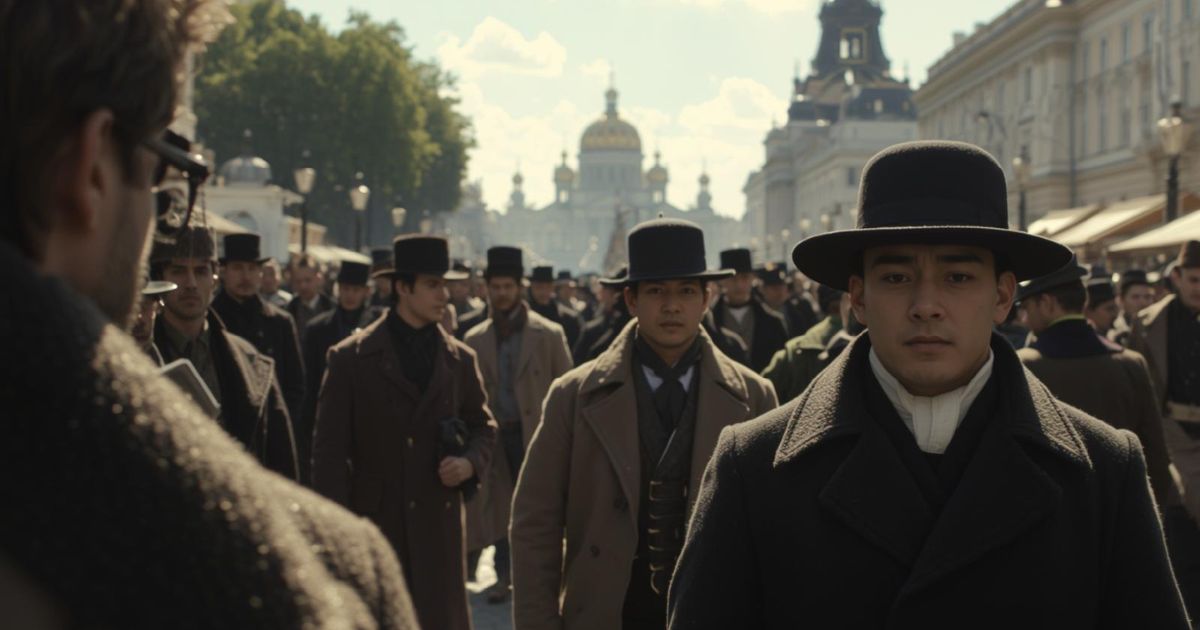
An excerpt from the original text.(complete · 4155 words)
“nd what if there has been a search already? What if I find them in my
room?”
But here was his room. Nothing and no one in it. No one had peeped in.
Even Nastasya had not touched it. But heavens! how could he have left
all those things in the hole?
He rushed to the corner, slipped his hand under the paper, pulled the
things out and lined his pockets with them. There were eight articles in
all: two little boxes with ear-rings or something of the sort, he hardly
looked to see; then four small leather cases. There was a chain, too,
merely wrapped in newspaper and something else in newspaper, that looked
like a decoration.... He put them all in the different pockets of his
overcoat, and the remaining pocket of his trousers, trying to conceal
them as much as possible. He took the purse, too. Then he went out of
his room, leaving the door open. He walked quickly and resolutely, and
though he felt shattered, he had his senses about him. He was afraid of
pursuit, he was afraid that in another half-hour, another quarter of an
hour perhaps, instructions would be issued for his pursuit, and so at
all costs, he must hide all traces before then. He must clear everything
up while he still had some strength, some reasoning power left him....
Where was he to go?
That had long been settled: “Fling them into the canal, and all traces
hidden in the water, the thing would be at an end.” So he had decided in
the night of his delirium when several times he had had the impulse to
get up and go away, to make haste, and get rid of it all. But to get
rid of it, turned out to be a very difficult task. He wandered along
the bank of the Ekaterininsky Canal for half an hour or more and looked
several times at the steps running down to the water, but he could not
think of carrying out his plan; either rafts stood at the steps’ edge,
and women were washing clothes on them, or boats were moored there, and
people were swarming everywhere. Moreover he could be seen and noticed
from the banks on all sides; it would look suspicious for a man to go
down on purpose, stop, and throw something into the water. And what if
the boxes were to float instead of sinking? And of course they would.
Even as it was, everyone he met seemed to stare and look round, as if
they had nothing to do but to watch him. “Why is it, or can it be my
fancy?” he thought.
At last the thought struck him that it might be better to go to the
Neva. There were not so many people there, he would be less observed,
and it would be more convenient in every way, above all it was further
off. He wondered how he could have been wandering for a good half-hour,
worried and anxious in this dangerous past without thinking of it
before. And that half-hour he had lost over an irrational plan, simply
because he had thought of it in delirium! He had become extremely absent
and forgetful and he was aware of it. He certainly must make haste.
He walked towards the Neva along V---- Prospect, but on the way
another idea struck him. “Why to the Neva? Would it not be better to go
somewhere far off, to the Islands again, and there hide the things
in some solitary place, in a wood or under a bush, and mark the spot
perhaps?” And though he felt incapable of clear judgment, the idea
seemed to him a sound one. But he was not destined to go there. For
coming out of V---- Prospect towards the square, he saw on the left a
passage leading between two blank walls to a courtyard. On the right
hand, the blank unwhitewashed wall of a four-storied house stretched far
into the court; on the left, a wooden hoarding ran parallel with it for
twenty paces into the court, and then turned sharply to the left. Here
was a deserted fenced-off place where rubbish of different sorts was
lying. At the end of the court, the corner of a low, smutty, stone shed,
apparently part of some workshop, peeped from behind the hoarding. It
was probably a carriage builder’s or carpenter’s shed; the whole place
from the entrance was black with coal dust. Here would be the place to
throw it, he thought. Not seeing anyone in the yard, he slipped in, and
at once saw near the gate a sink, such as is often put in yards where
there are many workmen or cab-drivers; and on the hoarding above had
been scribbled in chalk the time-honoured witticism, “Standing here
strictly forbidden.” This was all the better, for there would be nothing
suspicious about his going in. “Here I could throw it all in a heap and
get away!”
Looking round once more, with his hand already in his pocket, he noticed
against the outer wall, between the entrance and the sink, a big unhewn
stone, weighing perhaps sixty pounds. The other side of the wall was a
street. He could hear passers-by, always numerous in that part, but he
could not be seen from the entrance, unless someone came in from the
street, which might well happen indeed, so there was need of haste.
He bent down over the stone, seized the top of it firmly in both hands,
and using all his strength turned it over. Under the stone was a small
hollow in the ground, and he immediately emptied his pocket into it.
The purse lay at the top, and yet the hollow was not filled up. Then he
seized the stone again and with one twist turned it back, so that it was
in the same position again, though it stood a very little higher. But
he scraped the earth about it and pressed it at the edges with his foot.
Nothing could be noticed.
Then he went out, and turned into the square. Again an intense,
almost unbearable joy overwhelmed him for an instant, as it had in
the police-office. “I have buried my tracks! And who, who can think of
looking under that stone? It has been lying there most likely ever since
the house was built, and will lie as many years more. And if it were
found, who would think of me? It is all over! No clue!” And he laughed.
Yes, he remembered that he began laughing a thin, nervous noiseless
laugh, and went on laughing all the time he was crossing the square. But
when he reached the K---- Boulevard where two days before he had come
upon that girl, his laughter suddenly ceased. Other ideas crept into his
mind. He felt all at once that it would be loathsome to pass that seat
on which after the girl was gone, he had sat and pondered, and that it
would be hateful, too, to meet that whiskered policeman to whom he had
given the twenty copecks: “Damn him!”
He walked, looking about him angrily and distractedly. All his ideas now
seemed to be circling round some single point, and he felt that there
really was such a point, and that now, now, he was left facing that
point--and for the first time, indeed, during the last two months.
“Damn it all!” he thought suddenly, in a fit of ungovernable fury.
“If it has begun, then it has begun. Hang the new life! Good Lord, how
stupid it is!... And what lies I told to-day! How despicably I fawned
upon that wretched Ilya Petrovitch! But that is all folly! What do I
care for them all, and my fawning upon them! It is not that at all! It
is not that at all!”
Suddenly he stopped; a new utterly unexpected and exceedingly simple
question perplexed and bitterly confounded him.
“If it all has really been done deliberately and not idiotically, if
I really had a certain and definite object, how is it I did not even
glance into the purse and don’t know what I had there, for which I have
undergone these agonies, and have deliberately undertaken this base,
filthy degrading business? And here I wanted at once to throw into the
water the purse together with all the things which I had not seen
either... how’s that?”
Yes, that was so, that was all so. Yet he had known it all before, and
it was not a new question for him, even when it was decided in the night
without hesitation and consideration, as though so it must be, as though
it could not possibly be otherwise.... Yes, he had known it all, and
understood it all; it surely had all been settled even yesterday at the
moment when he was bending over the box and pulling the jewel-cases out
of it.... Yes, so it was.
“It is because I am very ill,” he decided grimly at last, “I have been
worrying and fretting myself, and I don’t know what I am doing....
Yesterday and the day before yesterday and all this time I have been
worrying myself.... I shall get well and I shall not worry.... But what
if I don’t get well at all? Good God, how sick I am of it all!”
He walked on without resting. He had a terrible longing for some
distraction, but he did not know what to do, what to attempt. A new
overwhelming sensation was gaining more and more mastery over him
every moment; this was an immeasurable, almost physical, repulsion for
everything surrounding him, an obstinate, malignant feeling of hatred.
All who met him were loathsome to him--he loathed their faces, their
movements, their gestures. If anyone had addressed him, he felt that he
might have spat at him or bitten him....
He stopped suddenly, on coming out on the bank of the Little Neva, near
the bridge to Vassilyevsky Ostrov. “Why, he lives here, in that house,”
he thought, “why, I have not come to Razumihin of my own accord! Here
it’s the same thing over again.... Very interesting to know, though;
have I come on purpose or have I simply walked here by chance? Never
mind, I said the day before yesterday that I would go and see him the
day after; well, and so I will! Besides I really cannot go further
now.”
He went up to Razumihin’s room on the fifth floor.
The latter was at home in his garret, busily writing at the moment, and
he opened the door himself. It was four months since they had seen each
other. Razumihin was sitting in a ragged dressing-gown, with slippers on
his bare feet, unkempt, unshaven and unwashed. His face showed surprise.
“Is it you?” he cried. He looked his comrade up and down; then after a
brief pause, he whistled. “As hard up as all that! Why, brother, you’ve
cut me out!” he added, looking at Raskolnikov’s rags. “Come sit down,
you are tired, I’ll be bound.”
And when he had sunk down on the American leather sofa, which was
in even worse condition than his own, Razumihin saw at once that his
visitor was ill.
“Why, you are seriously ill, do you know that?” He began feeling his
pulse. Raskolnikov pulled away his hand.
“Never mind,” he said, “I have come for this: I have no lessons.... I
wanted,... but I don’t really want lessons....”
“But I say! You are delirious, you know!” Razumihin observed, watching
him carefully.
“No, I am not.”
Raskolnikov got up from the sofa. As he had mounted the stairs to
Razumihin’s, he had not realised that he would be meeting his friend
face to face. Now, in a flash, he knew, that what he was least of all
disposed for at that moment was to be face to face with anyone in the
wide world. His spleen rose within him. He almost choked with rage at
himself as soon as he crossed Razumihin’s threshold.
“Good-bye,” he said abruptly, and walked to the door.
“Stop, stop! You queer fish.”
“I don’t want to,” said the other, again pulling away his hand.
“Then why the devil have you come? Are you mad, or what? Why, this
is... almost insulting! I won’t let you go like that.”
“Well, then, I came to you because I know no one but you who could
help... to begin... because you are kinder than anyone--cleverer, I
mean, and can judge... and now I see that I want nothing. Do you hear?
Nothing at all... no one’s services... no one’s sympathy. I am by
myself... alone. Come, that’s enough. Leave me alone.”
“Stay a minute, you sweep! You are a perfect madman. As you like for all
I care. I have no lessons, do you see, and I don’t care about that, but
there’s a bookseller, Heruvimov--and he takes the place of a lesson.
I would not exchange him for five lessons. He’s doing publishing of a
kind, and issuing natural science manuals and what a circulation they
have! The very titles are worth the money! You always maintained that I
was a fool, but by Jove, my boy, there are greater fools than I am!
Now he is setting up for being advanced, not that he has an inkling of
anything, but, of course, I encourage him. Here are two signatures of
the German text--in my opinion, the crudest charlatanism; it discusses
the question, ‘Is woman a human being?’ And, of course, triumphantly
proves that she is. Heruvimov is going to bring out this work as a
contribution to the woman question; I am translating it; he will expand
these two and a half signatures into six, we shall make up a gorgeous
title half a page long and bring it out at half a rouble. It will do! He
pays me six roubles the signature, it works out to about fifteen roubles
for the job, and I’ve had six already in advance. When we have finished
this, we are going to begin a translation about whales, and then some of
the dullest scandals out of the second part of Les Confessions we have
marked for translation; somebody has told Heruvimov, that Rousseau was
a kind of Radishchev. You may be sure I don’t contradict him, hang him!
Well, would you like to do the second signature of ‘Is woman a human
being?’ If you would, take the German and pens and paper--all those
are provided, and take three roubles; for as I have had six roubles in
advance on the whole thing, three roubles come to you for your share.
And when you have finished the signature there will be another three
roubles for you. And please don’t think I am doing you a service; quite
the contrary, as soon as you came in, I saw how you could help me; to
begin with, I am weak in spelling, and secondly, I am sometimes utterly
adrift in German, so that I make it up as I go along for the most part.
The only comfort is, that it’s bound to be a change for the better.
Though who can tell, maybe it’s sometimes for the worse. Will you take
it?”
Raskolnikov took the German sheets in silence, took the three roubles
and without a word went out. Razumihin gazed after him in astonishment.
But when Raskolnikov was in the next street, he turned back, mounted the
stairs to Razumihin’s again and laying on the table the German article
and the three roubles, went out again, still without uttering a word.
“Are you raving, or what?” Razumihin shouted, roused to fury at last.
“What farce is this? You’ll drive me crazy too... what did you come to
see me for, damn you?”
“I don’t want... translation,” muttered Raskolnikov from the stairs.
“Then what the devil do you want?” shouted Razumihin from above.
Raskolnikov continued descending the staircase in silence.
“Hey, there! Where are you living?”
No answer.
“Well, confound you then!”
But Raskolnikov was already stepping into the street. On the Nikolaevsky
Bridge he was roused to full consciousness again by an unpleasant
incident. A coachman, after shouting at him two or three times, gave him
a violent lash on the back with his whip, for having almost fallen under
his horses’ hoofs. The lash so infuriated him that he dashed away to the
railing (for some unknown reason he had been walking in the very middle
of the bridge in the traffic). He angrily clenched and ground his teeth.
He heard laughter, of course.
“Serves him right!”
“A pickpocket I dare say.”
“Pretending to be drunk, for sure, and getting under the wheels on
purpose; and you have to answer for him.”
“It’s a regular profession, that’s what it is.”
But while he stood at the railing, still looking angry and bewildered
after the retreating carriage, and rubbing his back, he suddenly felt
someone thrust money into his hand. He looked. It was an elderly woman
in a kerchief and goatskin shoes, with a girl, probably her daughter,
wearing a hat, and carrying a green parasol.
“Take it, my good man, in Christ’s name.”
He took it and they passed on. It was a piece of twenty copecks. From
his dress and appearance they might well have taken him for a beggar
asking alms in the streets, and the gift of the twenty copecks he
doubtless owed to the blow, which made them feel sorry for him.
He closed his hand on the twenty copecks, walked on for ten paces, and
turned facing the Neva, looking towards the palace. The sky was without
a cloud and the water was almost bright blue, which is so rare in the
Neva. The cupola of the cathedral, which is seen at its best from the
bridge about twenty paces from the chapel, glittered in the sunlight,
and in the pure air every ornament on it could be clearly distinguished.
The pain from the lash went off, and Raskolnikov forgot about it; one
uneasy and not quite definite idea occupied him now completely. He stood
still, and gazed long and intently into the distance; this spot was
especially familiar to him. When he was attending the university, he had
hundreds of times--generally on his way home--stood still on this spot,
gazed at this truly magnificent spectacle and almost always marvelled at
a vague and mysterious emotion it roused in him. It left him strangely
cold; this gorgeous picture was for him blank and lifeless. He wondered
every time at his sombre and enigmatic impression and, mistrusting
himself, put off finding the explanation of it. He vividly recalled
those old doubts and perplexities, and it seemed to him that it was
no mere chance that he recalled them now. It struck him as strange and
grotesque, that he should have stopped at the same spot as before,
as though he actually imagined he could think the same thoughts, be
interested in the same theories and pictures that had interested him...
so short a time ago. He felt it almost amusing, and yet it wrung his
heart. Deep down, hidden far away out of sight all that seemed to him
now--all his old past, his old thoughts, his old problems and theories,
his old impressions and that picture and himself and all, all.... He
felt as though he were flying upwards, and everything were vanishing
from his sight. Making an unconscious movement with his hand, he
suddenly became aware of the piece of money in his fist. He opened his
hand, stared at the coin, and with a sweep of his arm flung it into
the water; then he turned and went home. It seemed to him, he had cut
himself off from everyone and from everything at that moment.
Evening was coming on when he reached home, so that he must have been
walking about six hours. How and where he came back he did not remember.
Undressing, and quivering like an overdriven horse, he lay down on the
sofa, drew his greatcoat over him, and at once sank into oblivion....
It was dusk when he was waked up by a fearful scream. Good God, what a
scream! Such unnatural sounds, such howling, wailing, grinding, tears,
blows and curses he had never heard.
He could never have imagined such brutality, such frenzy. In terror he
sat up in bed, almost swooning with agony. But the fighting, wailing
and cursing grew louder and louder. And then to his intense amazement
he caught the voice of his landlady. She was howling, shrieking and
wailing, rapidly, hurriedly, incoherently, so that he could not make
out what she was talking about; she was beseeching, no doubt, not to be
beaten, for she was being mercilessly beaten on the stairs. The voice of
her assailant was so horrible from spite and rage that it was almost
a croak; but he, too, was saying something, and just as quickly
and indistinctly, hurrying and spluttering. All at once Raskolnikov
trembled; he recognised the voice--it was the voice of Ilya Petrovitch.
Ilya Petrovitch here and beating the landlady! He is kicking her,
banging her head against the steps--that’s clear, that can be told
from the sounds, from the cries and the thuds. How is it, is the world
topsy-turvy? He could hear people running in crowds from all the storeys
and all the staircases; he heard voices, exclamations, knocking, doors
banging. “But why, why, and how could it be?” he repeated, thinking
seriously that he had gone mad. But no, he heard too distinctly! And
they would come to him then next, “for no doubt... it’s all about
that... about yesterday.... Good God!” He would have fastened his door
with the latch, but he could not lift his hand... besides, it would
be useless. Terror gripped his heart like ice, tortured him and numbed
him.... But at last all this uproar, after continuing about ten minutes,
began gradually to subside. The landlady was moaning and groaning; Ilya
Petrovitch was still uttering threats and curses.... But at last he,
too, seemed to be silent, and now he could not be heard. “Can he have
gone away? Good Lord!” Yes, and now the landlady is going too, still
weeping and moaning... and then her door slammed.... Now the crowd was
going from the stairs to their rooms, exclaiming, disputing, calling
to one another, raising their voices to a shout, dropping them to a
whisper. There must have been numbers of them--almost all the inmates
of the block. “But, good God, how could it be! And why, why had he come
here!”
Raskolnikov sank worn out on the sofa, but could not close his eyes. He
lay for half an hour in such anguish, such an intolerable sensation of
infinite terror as he had never experienced before. Suddenly a bright
light flashed into his room. Nastasya came in with a candle and a plate
of soup. Looking at him carefully and ascertaining that he was not
asleep, she set the candle on the table and began to lay out what she
had brought--bread, salt, a plate, a spoon.
“You’ve eaten nothing since yesterday, I warrant. You’ve been trudging
about all day, and you’re shaking with fever.”
“Nastasya... what were they beating the landlady for?”
She looked intently at him.
“Who beat the landlady?”
“Just now... half an hour ago, Ilya Petrovitch, the assistant
superintendent, on the stairs.... Why was he ill-treating her like that,
and... why was he here?”
Nastasya scrutinised him, silent and frowning, and her scrutiny lasted a
long time. He felt uneasy, even frightened at her searching eyes.
“Nastasya, why don’t you speak?” he said timidly at last in a weak
voice.
“It’s the blood,” she answered at last softly, as though speaking to
herself.
“Blood? What blood?” he muttered, growing white and turning towards the
wall.
Nastasya still looked at him without speaking.
“Nobody has been beating the landlady,” she declared at last in a firm,
resolute voice.
He gazed at her, hardly able to breathe.
“I heard it myself.... I was not asleep... I was sitting up,” he
said still more timidly. “I listened a long while. The assistant
superintendent came.... Everyone ran out on to the stairs from all the
flats.”
“No one has been here. That’s the blood crying in your ears. When
there’s no outlet for it and it gets clotted, you begin fancying
things.... Will you eat something?”
He made no answer. Nastasya still stood over him, watching him.
“Give me something to drink... Nastasya.”
She went downstairs and returned with a white earthenware jug of water.
He remembered only swallowing one sip of the cold water and spilling
some on his neck. Then followed forgetfulness.
Master this chapter. Complete your experience
Purchase the complete book to access all chapters and support classic literature
As an Amazon Associate, we earn a small commission from qualifying purchases at no additional cost to you.
Available in paperback, hardcover, and e-book formats
Let's Analyse the Pattern
Why This Matters
Connect literature to life
This chapter helps readers identify how stress reshapes judgment, power, and relationship dynamics in real time.
Now let's explore the literary elements.
Key Quotes & Analysis
"Raskolnikov finds himself face-to-face with Porfiry Petrovich, the investigating magistrate, in what becomes a masterful psychological chess match."
Context: Core movement described by the chapter summary
This line captures the chapter's central pressure point and the shift it creates in character behavior.
"Actions under pressure expose deeper motives and limits."
Context: Interpreting this chapter's conflict
The chapter emphasizes that crisis does not invent character; it reveals structure already present.
Thematic Threads
Consequence
In This Chapter
Prior choices narrow present options and increase emotional stakes.
Development
The chapter advances from abstract tension to concrete cost.
Power
In This Chapter
Status, dependence, or leverage shape who can define reality in the scene.
Development
Control shifts through conversation, framing, and reaction.
Identity
In This Chapter
Characters struggle to maintain a coherent self-story under contradiction.
Development
Internal narratives are tested against observable behavior.
Relationship Strain
In This Chapter
Trust and communication degrade when secrecy or fear dominate interaction.
Development
The chapter escalates interpersonal risk alongside plot risk.
You now have the context. Time to form your own thoughts.
Discussion Questions
- 1
What pressure in this chapter most strongly drives behavior change?
- 2
Which character controls the frame of the conflict, and how?
- 3
Where does self-justification break down into visible consequence?
- 4
How do status and vulnerability shape what each person can safely say?
- 5
What alternative choice might have reduced downstream harm?
Critical Thinking Exercise
Pressure Map
Map one chapter decision with four columns: pressure source, available options, likely short-term relief, and long-term consequence. Then identify which option best preserves integrity under constraint.
Consider:
- •Separate immediate emotion from structural incentives
- •Track who bears risk versus who controls terms
- •Define one boundary that prevents escalation
Coming Up Next...
Chapter 10: At the Police Station
Raskolnikov leaves the meeting shaken and paranoid, but his troubles are far from over. A surprise visitor arrives with news that will turn his world completely upside down.