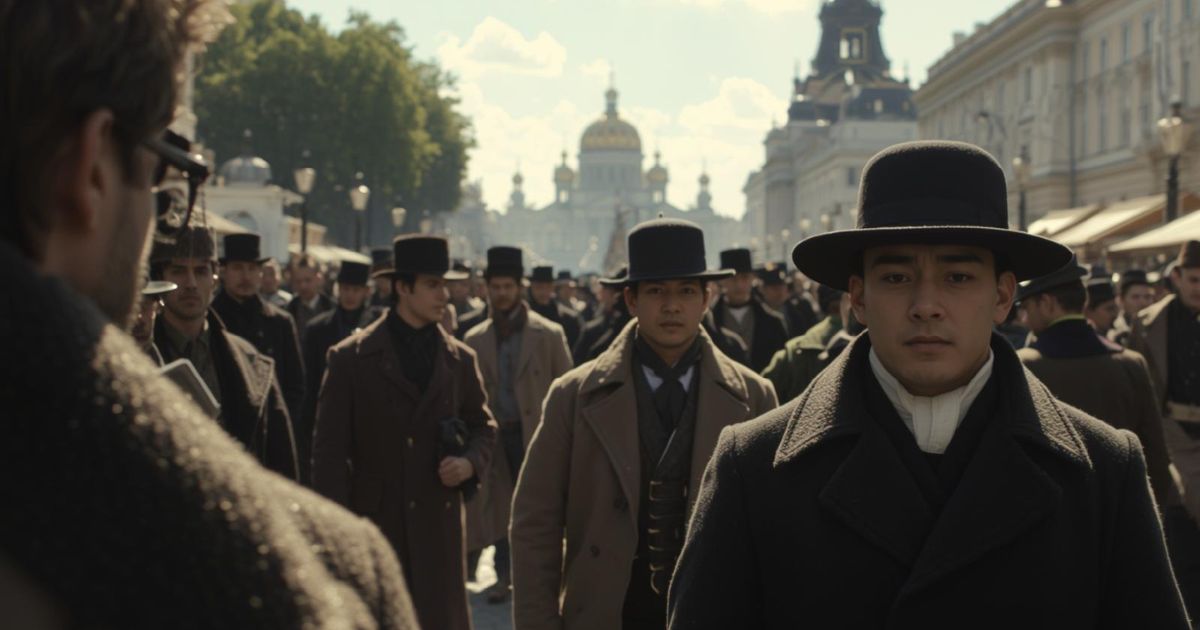
An excerpt from the original text.(complete · 4064 words)
ossimov was a tall, fat man with a puffy, colourless, clean-shaven face
and straight flaxen hair. He wore spectacles, and a big gold ring on
his fat finger. He was twenty-seven. He had on a light grey fashionable
loose coat, light summer trousers, and everything about him loose,
fashionable and spick and span; his linen was irreproachable, his
watch-chain was massive. In manner he was slow and, as it were,
nonchalant, and at the same time studiously free and easy; he made
efforts to conceal his self-importance, but it was apparent at every
instant. All his acquaintances found him tedious, but said he was clever
at his work.
“I’ve been to you twice to-day, brother. You see, he’s come to himself,”
cried Razumihin.
“I see, I see; and how do we feel now, eh?” said Zossimov to
Raskolnikov, watching him carefully and, sitting down at the foot of the
sofa, he settled himself as comfortably as he could.
“He is still depressed,” Razumihin went on. “We’ve just changed his
linen and he almost cried.”
“That’s very natural; you might have put it off if he did not wish
it.... His pulse is first-rate. Is your head still aching, eh?”
“I am well, I am perfectly well!” Raskolnikov declared positively
and irritably. He raised himself on the sofa and looked at them with
glittering eyes, but sank back on to the pillow at once and turned to
the wall. Zossimov watched him intently.
“Very good.... Going on all right,” he said lazily. “Has he eaten
anything?”
They told him, and asked what he might have.
“He may have anything... soup, tea... mushrooms and cucumbers, of
course, you must not give him; he’d better not have meat either, and...
but no need to tell you that!” Razumihin and he looked at each
other. “No more medicine or anything. I’ll look at him again to-morrow.
Perhaps, to-day even... but never mind...”
“To-morrow evening I shall take him for a walk,” said Razumihin. “We are
going to the Yusupov garden and then to the Palais de Cristal.”
“I would not disturb him to-morrow at all, but I don’t know... a little,
maybe... but we’ll see.”
“Ach, what a nuisance! I’ve got a house-warming party to-night; it’s
only a step from here. Couldn’t he come? He could lie on the sofa. You
are coming?” Razumihin said to Zossimov. “Don’t forget, you promised.”
“All right, only rather later. What are you going to do?”
“Oh, nothing--tea, vodka, herrings. There will be a pie... just our
friends.”
“And who?”
“All neighbours here, almost all new friends, except my old uncle, and
he is new too--he only arrived in Petersburg yesterday to see to some
business of his. We meet once in five years.”
“What is he?”
“He’s been stagnating all his life as a district postmaster; gets a
little pension. He is sixty-five--not worth talking about.... But I
am fond of him. Porfiry Petrovitch, the head of the Investigation
Department here... But you know him.”
“Is he a relation of yours, too?”
“A very distant one. But why are you scowling? Because you quarrelled
once, won’t you come then?”
“I don’t care a damn for him.”
“So much the better. Well, there will be some students, a teacher, a
government clerk, a musician, an officer and Zametov.”
“Do tell me, please, what you or he”--Zossimov nodded at
Raskolnikov--“can have in common with this Zametov?”
“Oh, you particular gentleman! Principles! You are worked by principles,
as it were by springs; you won’t venture to turn round on your own
account. If a man is a nice fellow, that’s the only principle I go upon.
Zametov is a delightful person.”
“Though he does take bribes.”
“Well, he does! and what of it? I don’t care if he does take bribes,”
Razumihin cried with unnatural irritability. “I don’t praise him for
taking bribes. I only say he is a nice man in his own way! But if one
looks at men in all ways--are there many good ones left? Why, I am sure
I shouldn’t be worth a baked onion myself... perhaps with you thrown
in.”
“That’s too little; I’d give two for you.”
“And I wouldn’t give more than one for you. No more of your jokes!
Zametov is no more than a boy. I can pull his hair and one must draw him
not repel him. You’ll never improve a man by repelling him, especially
a boy. One has to be twice as careful with a boy. Oh, you progressive
dullards! You don’t understand. You harm yourselves running another man
down.... But if you want to know, we really have something in common.”
“I should like to know what.”
“Why, it’s all about a house-painter.... We are getting him out of
a mess! Though indeed there’s nothing to fear now. The matter is
absolutely self-evident. We only put on steam.”
“A painter?”
“Why, haven’t I told you about it? I only told you the beginning then
about the murder of the old pawnbroker-woman. Well, the painter is mixed
up in it...”
“Oh, I heard about that murder before and was rather interested in it...
partly... for one reason.... I read about it in the papers, too....”
“Lizaveta was murdered, too,” Nastasya blurted out, suddenly addressing
Raskolnikov. She remained in the room all the time, standing by the door
listening.
“Lizaveta,” murmured Raskolnikov hardly audibly.
“Lizaveta, who sold old clothes. Didn’t you know her? She used to come
here. She mended a shirt for you, too.”
Raskolnikov turned to the wall where in the dirty, yellow paper he
picked out one clumsy, white flower with brown lines on it and began
examining how many petals there were in it, how many scallops in the
petals and how many lines on them. He felt his arms and legs as lifeless
as though they had been cut off. He did not attempt to move, but stared
obstinately at the flower.
“But what about the painter?” Zossimov interrupted Nastasya’s chatter
with marked displeasure. She sighed and was silent.
“Why, he was accused of the murder,” Razumihin went on hotly.
“Was there evidence against him then?”
“Evidence, indeed! Evidence that was no evidence, and that’s what we
have to prove. It was just as they pitched on those fellows, Koch and
Pestryakov, at first. Foo! how stupidly it’s all done, it makes one
sick, though it’s not one’s business! Pestryakov may be coming
to-night.... By the way, Rodya, you’ve heard about the business already;
it happened before you were ill, the day before you fainted at the
police office while they were talking about it.”
Zossimov looked curiously at Raskolnikov. He did not stir.
“But I say, Razumihin, I wonder at you. What a busybody you are!”
Zossimov observed.
“Maybe I am, but we will get him off anyway,” shouted Razumihin,
bringing his fist down on the table. “What’s the most offensive is not
their lying--one can always forgive lying--lying is a delightful thing,
for it leads to truth--what is offensive is that they lie and worship
their own lying.... I respect Porfiry, but... What threw them out at
first? The door was locked, and when they came back with the porter
it was open. So it followed that Koch and Pestryakov were the
murderers--that was their logic!”
“But don’t excite yourself; they simply detained them, they could not
help that.... And, by the way, I’ve met that man Koch. He used to buy
unredeemed pledges from the old woman? Eh?”
“Yes, he is a swindler. He buys up bad debts, too. He makes a profession
of it. But enough of him! Do you know what makes me angry? It’s their
sickening rotten, petrified routine.... And this case might be the means
of introducing a new method. One can show from the psychological data
alone how to get on the track of the real man. ‘We have facts,’ they
say. But facts are not everything--at least half the business lies in
how you interpret them!”
“Can you interpret them, then?”
“Anyway, one can’t hold one’s tongue when one has a feeling, a tangible
feeling, that one might be a help if only.... Eh! Do you know the
details of the case?”
“I am waiting to hear about the painter.”
“Oh, yes! Well, here’s the story. Early on the third day after the
murder, when they were still dandling Koch and Pestryakov--though they
accounted for every step they took and it was as plain as a pikestaff--an
unexpected fact turned up. A peasant called Dushkin, who keeps a
dram-shop facing the house, brought to the police office a jeweller’s
case containing some gold ear-rings, and told a long rigamarole. ‘The
day before yesterday, just after eight o’clock’--mark the day and the
hour!--‘a journeyman house-painter, Nikolay, who had been in to see me
already that day, brought me this box of gold ear-rings and stones, and
asked me to give him two roubles for them. When I asked him where he got
them, he said that he picked them up in the street. I did not ask him
anything more.’ I am telling you Dushkin’s story. ‘I gave him a note’--a
rouble that is--‘for I thought if he did not pawn it with me he would
with another. It would all come to the same thing--he’d spend it on
drink, so the thing had better be with me. The further you hide it
the quicker you will find it, and if anything turns up, if I hear any
rumours, I’ll take it to the police.’ Of course, that’s all taradiddle;
he lies like a horse, for I know this Dushkin, he is a pawnbroker and
a receiver of stolen goods, and he did not cheat Nikolay out of a
thirty-rouble trinket in order to give it to the police. He was simply
afraid. But no matter, to return to Dushkin’s story. ‘I’ve known
this peasant, Nikolay Dementyev, from a child; he comes from the same
province and district of Zaraïsk, we are both Ryazan men. And though
Nikolay is not a drunkard, he drinks, and I knew he had a job in that
house, painting work with Dmitri, who comes from the same village, too.
As soon as he got the rouble he changed it, had a couple of glasses,
took his change and went out. But I did not see Dmitri with him then.
And the next day I heard that someone had murdered Alyona Ivanovna and
her sister, Lizaveta Ivanovna, with an axe. I knew them, and I felt
suspicious about the ear-rings at once, for I knew the murdered woman
lent money on pledges. I went to the house, and began to make careful
inquiries without saying a word to anyone. First of all I asked, “Is
Nikolay here?” Dmitri told me that Nikolay had gone off on the spree; he
had come home at daybreak drunk, stayed in the house about ten minutes,
and went out again. Dmitri didn’t see him again and is finishing the
job alone. And their job is on the same staircase as the murder, on
the second floor. When I heard all that I did not say a word to
anyone’--that’s Dushkin’s tale--‘but I found out what I could about
the murder, and went home feeling as suspicious as ever. And at eight
o’clock this morning’--that was the third day, you understand--‘I saw
Nikolay coming in, not sober, though not to say very drunk--he could
understand what was said to him. He sat down on the bench and did not
speak. There was only one stranger in the bar and a man I knew asleep
on a bench and our two boys. “Have you seen Dmitri?” said I. “No, I
haven’t,” said he. “And you’ve not been here either?” “Not since the day
before yesterday,” said he. “And where did you sleep last night?”
“In Peski, with the Kolomensky men.” “And where did you get those
ear-rings?” I asked. “I found them in the street,” and the way he said
it was a bit queer; he did not look at me. “Did you hear what happened
that very evening, at that very hour, on that same staircase?” said I.
“No,” said he, “I had not heard,” and all the while he was listening,
his eyes were staring out of his head and he turned as white as chalk. I
told him all about it and he took his hat and began getting up. I wanted
to keep him. “Wait a bit, Nikolay,” said I, “won’t you have a drink?”
And I signed to the boy to hold the door, and I came out from behind the
bar; but he darted out and down the street to the turning at a run.
I have not seen him since. Then my doubts were at an end--it was his
doing, as clear as could be....’”
“I should think so,” said Zossimov.
“Wait! Hear the end. Of course they sought high and low for Nikolay;
they detained Dushkin and searched his house; Dmitri, too, was arrested;
the Kolomensky men also were turned inside out. And the day before
yesterday they arrested Nikolay in a tavern at the end of the town. He
had gone there, taken the silver cross off his neck and asked for a dram
for it. They gave it to him. A few minutes afterwards the woman went
to the cowshed, and through a crack in the wall she saw in the stable
adjoining he had made a noose of his sash from the beam, stood on a
block of wood, and was trying to put his neck in the noose. The woman
screeched her hardest; people ran in. ‘So that’s what you are up to!’
‘Take me,’ he says, ‘to such-and-such a police officer; I’ll confess
everything.’ Well, they took him to that police station--that is
here--with a suitable escort. So they asked him this and that, how old
he is, ‘twenty-two,’ and so on. At the question, ‘When you were working
with Dmitri, didn’t you see anyone on the staircase at such-and-such a
time?’--answer: ‘To be sure folks may have gone up and down, but I did
not notice them.’ ‘And didn’t you hear anything, any noise, and so on?’
‘We heard nothing special.’ ‘And did you hear, Nikolay, that on the same
day Widow So-and-so and her sister were murdered and robbed?’ ‘I
never knew a thing about it. The first I heard of it was from Afanasy
Pavlovitch the day before yesterday.’ ‘And where did you find the
ear-rings?’ ‘I found them on the pavement.’ ‘Why didn’t you go to work
with Dmitri the other day?’ ‘Because I was drinking.’ ‘And where were
you drinking?’ ‘Oh, in such-and-such a place.’ ‘Why did you run away
from Dushkin’s?’ ‘Because I was awfully frightened.’ ‘What were
you frightened of?’ ‘That I should be accused.’ ‘How could you be
frightened, if you felt free from guilt?’ Now, Zossimov, you may not
believe me, that question was put literally in those words. I know it
for a fact, it was repeated to me exactly! What do you say to that?”
“Well, anyway, there’s the evidence.”
“I am not talking of the evidence now, I am talking about that question,
of their own idea of themselves. Well, so they squeezed and squeezed
him and he confessed: ‘I did not find it in the street, but in the flat
where I was painting with Dmitri.’ ‘And how was that?’ ‘Why, Dmitri and
I were painting there all day, and we were just getting ready to go, and
Dmitri took a brush and painted my face, and he ran off and I after him.
I ran after him, shouting my hardest, and at the bottom of the stairs I
ran right against the porter and some gentlemen--and how many gentlemen
were there I don’t remember. And the porter swore at me, and the other
porter swore, too, and the porter’s wife came out, and swore at us, too;
and a gentleman came into the entry with a lady, and he swore at us,
too, for Dmitri and I lay right across the way. I got hold of Dmitri’s
hair and knocked him down and began beating him. And Dmitri, too, caught
me by the hair and began beating me. But we did it all not for temper
but in a friendly way, for sport. And then Dmitri escaped and ran into
the street, and I ran after him; but I did not catch him, and went back
to the flat alone; I had to clear up my things. I began putting them
together, expecting Dmitri to come, and there in the passage, in the
corner by the door, I stepped on the box. I saw it lying there wrapped
up in paper. I took off the paper, saw some little hooks, undid them,
and in the box were the ear-rings....’”
“Behind the door? Lying behind the door? Behind the door?” Raskolnikov
cried suddenly, staring with a blank look of terror at Razumihin, and he
slowly sat up on the sofa, leaning on his hand.
“Yes... why? What’s the matter? What’s wrong?” Razumihin, too, got up
from his seat.
“Nothing,” Raskolnikov answered faintly, turning to the wall. All were
silent for a while.
“He must have waked from a dream,” Razumihin said at last, looking
inquiringly at Zossimov. The latter slightly shook his head.
“Well, go on,” said Zossimov. “What next?”
“What next? As soon as he saw the ear-rings, forgetting Dmitri and
everything, he took up his cap and ran to Dushkin and, as we know, got
a rouble from him. He told a lie saying he found them in the street, and
went off drinking. He keeps repeating his old story about the murder:
‘I know nothing of it, never heard of it till the day before yesterday.’
‘And why didn’t you come to the police till now?’ ‘I was frightened.’
‘And why did you try to hang yourself?’ ‘From anxiety.’ ‘What anxiety?’
‘That I should be accused of it.’ Well, that’s the whole story. And now
what do you suppose they deduced from that?”
“Why, there’s no supposing. There’s a clue, such as it is, a fact. You
wouldn’t have your painter set free?”
“Now they’ve simply taken him for the murderer. They haven’t a shadow of
doubt.”
“That’s nonsense. You are excited. But what about the ear-rings? You
must admit that, if on the very same day and hour ear-rings from the old
woman’s box have come into Nikolay’s hands, they must have come there
somehow. That’s a good deal in such a case.”
“How did they get there? How did they get there?” cried Razumihin.
“How can you, a doctor, whose duty it is to study man and who has more
opportunity than anyone else for studying human nature--how can you fail
to see the character of the man in the whole story? Don’t you see at
once that the answers he has given in the examination are the holy
truth? They came into his hand precisely as he has told us--he stepped
on the box and picked it up.”
“The holy truth! But didn’t he own himself that he told a lie at first?”
“Listen to me, listen attentively. The porter and Koch and Pestryakov
and the other porter and the wife of the first porter and the woman who
was sitting in the porter’s lodge and the man Kryukov, who had just got
out of a cab at that minute and went in at the entry with a lady on his
arm, that is eight or ten witnesses, agree that Nikolay had Dmitri on
the ground, was lying on him beating him, while Dmitri hung on to his
hair, beating him, too. They lay right across the way, blocking the
thoroughfare. They were sworn at on all sides while they ‘like children’
(the very words of the witnesses) were falling over one another,
squealing, fighting and laughing with the funniest faces, and, chasing
one another like children, they ran into the street. Now take careful
note. The bodies upstairs were warm, you understand, warm when they
found them! If they, or Nikolay alone, had murdered them and broken open
the boxes, or simply taken part in the robbery, allow me to ask you one
question: do their state of mind, their squeals and giggles and childish
scuffling at the gate fit in with axes, bloodshed, fiendish cunning,
robbery? They’d just killed them, not five or ten minutes before, for
the bodies were still warm, and at once, leaving the flat open, knowing
that people would go there at once, flinging away their booty, they
rolled about like children, laughing and attracting general attention.
And there are a dozen witnesses to swear to that!”
“Of course it is strange! It’s impossible, indeed, but...”
“No, brother, no buts. And if the ear-rings being found in Nikolay’s
hands at the very day and hour of the murder constitutes an important
piece of circumstantial evidence against him--although the explanation
given by him accounts for it, and therefore it does not tell seriously
against him--one must take into consideration the facts which prove him
innocent, especially as they are facts that cannot be denied. And
do you suppose, from the character of our legal system, that they will
accept, or that they are in a position to accept, this fact--resting
simply on a psychological impossibility--as irrefutable and conclusively
breaking down the circumstantial evidence for the prosecution? No, they
won’t accept it, they certainly won’t, because they found the jewel-case
and the man tried to hang himself, ‘which he could not have done if he
hadn’t felt guilty.’ That’s the point, that’s what excites me, you must
understand!”
“Oh, I see you are excited! Wait a bit. I forgot to ask you; what proof
is there that the box came from the old woman?”
“That’s been proved,” said Razumihin with apparent reluctance, frowning.
“Koch recognised the jewel-case and gave the name of the owner, who
proved conclusively that it was his.”
“That’s bad. Now another point. Did anyone see Nikolay at the time
that Koch and Pestryakov were going upstairs at first, and is there no
evidence about that?”
“Nobody did see him,” Razumihin answered with vexation. “That’s the
worst of it. Even Koch and Pestryakov did not notice them on their way
upstairs, though, indeed, their evidence could not have been worth much.
They said they saw the flat was open, and that there must be work going
on in it, but they took no special notice and could not remember whether
there actually were men at work in it.”
“Hm!... So the only evidence for the defence is that they were beating
one another and laughing. That constitutes a strong presumption, but...
How do you explain the facts yourself?”
“How do I explain them? What is there to explain? It’s clear. At any
rate, the direction in which explanation is to be sought is clear, and
the jewel-case points to it. The real murderer dropped those ear-rings.
The murderer was upstairs, locked in, when Koch and Pestryakov knocked
at the door. Koch, like an ass, did not stay at the door; so the
murderer popped out and ran down, too; for he had no other way of
escape. He hid from Koch, Pestryakov and the porter in the flat when
Nikolay and Dmitri had just run out of it. He stopped there while the
porter and others were going upstairs, waited till they were out of
hearing, and then went calmly downstairs at the very minute when Dmitri
and Nikolay ran out into the street and there was no one in the entry;
possibly he was seen, but not noticed. There are lots of people going
in and out. He must have dropped the ear-rings out of his pocket when
he stood behind the door, and did not notice he dropped them, because he
had other things to think of. The jewel-case is a conclusive proof that
he did stand there.... That’s how I explain it.”
“Too clever! No, my boy, you’re too clever. That beats everything.”
“But, why, why?”
“Why, because everything fits too well... it’s too melodramatic.”
“A-ach!” Razumihin was exclaiming, but at that moment the door opened
and a personage came in who was a stranger to all present.
Master this chapter. Complete your experience
Purchase the complete book to access all chapters and support classic literature
As an Amazon Associate, we earn a small commission from qualifying purchases at no additional cost to you.
Available in paperback, hardcover, and e-book formats
Let's Analyse the Pattern
Why This Matters
Connect literature to life
This chapter teaches how to read your body's rejection of moral compromises—the sleeplessness, paranoia, and hypervigilance that signal you've acted against your core values.
Now let's explore the literary elements.
Key Quotes & Analysis
"Am I really going to tell? Am I really going to confess?"
Context: His panicked thoughts when he receives the police summons
Shows how guilt creates its own torture. He's terrified of being caught but also drawn to confession. This internal conflict will drive much of the novel's action.
"If they question me, perhaps I'll simply tell. I want to tell."
Context: His contradictory impulses about confessing to the police
Reveals the psychological burden of keeping such a massive secret. Part of him wants to be caught because carrying this alone is unbearable. It shows how isolation makes guilt worse.
"His heart was beating so violently that it was painful."
Context: Describing Raskolnikov's physical reaction to stress and guilt
Demonstrates how emotional turmoil manifests physically. Dostoevsky shows that we can't separate mind and body - moral choices affect our entire being, making guilt a form of illness.
Thematic Threads
Identity
In This Chapter
Raskolnikov discovers his self-image as a superior person was completely wrong—he's not above moral consequences
Development
Evolving from his earlier arrogant theorizing to confronting who he actually is versus who he imagined himself to be
Class
In This Chapter
His poverty-driven crime hasn't elevated him above his circumstances—it's trapped him in a worse psychological prison
Development
Developing from seeing poverty as justification for extraordinary action to realizing class doesn't determine moral capacity
Consequences
In This Chapter
The real punishment isn't external detection but internal transformation—he's become someone he doesn't recognize
Development
Introduced here as the central mechanism that will drive the entire novel's exploration of guilt and redemption
Self-Deception
In This Chapter
His intellectual theories about extraordinary people crumble when faced with the reality of his own moral nature
Development
Evolving from confident rationalization to the beginning of painful self-awareness
Fear
In This Chapter
Every interaction becomes potentially threatening because he's living in opposition to his true self
Development
Introduced here as the natural result of moral compromise—paranoia as the price of violating authentic values
You now have the context. Time to form your own thoughts.
Discussion Questions
- 1
What physical and emotional symptoms does Raskolnikov experience after the murders, and how do they affect his daily life?
- 2
Why does Raskolnikov react with such terror to a simple police summons, even though it might be about something unrelated?
- 3
Where have you seen someone become paranoid or physically sick after doing something that went against their values?
- 4
If you were advising someone who was considering a major moral compromise 'for good reasons,' what questions would you ask them?
- 5
What does Raskolnikov's breakdown teach us about the relationship between our actions and our sense of self?
Critical Thinking Exercise
Map Your Moral Compass
Think of a time when you did something that felt wrong to you, even if others said it was justified or necessary. Write down the physical and emotional symptoms you experienced afterward - trouble sleeping, jumpiness, irritability, obsessive thoughts. Then identify what core value you violated. Finally, trace how that violation affected your behavior and relationships in the days that followed.
Consider:
- •Notice how your body responded before your mind fully processed what happened
- •Consider whether the 'good reasons' for your action actually protected you from internal consequences
- •Reflect on whether trying to ignore or rationalize the discomfort made it stronger or weaker
Coming Up Next...
Chapter 12: Razumikhin's Care
At the police station, Raskolnikov will face his first real test of whether he can keep his secret. But the conversation that awaits him there isn't what he expects, and his reactions might reveal more than he intends.