An excerpt from the original text.(complete · 7864 words)
OOK VI. Having determined that the many have no knowledge of true
being, and have no clear patterns in their minds of justice, beauty,
truth, and that philosophers have such patterns, we have now to ask
whether they or the many shall be rulers in our State. But who can
doubt that philosophers should be chosen, if they have the other
qualities which are required in a ruler? For they are lovers of the
knowledge of the eternal and of all truth; they are haters of
falsehood; their meaner desires are absorbed in the interests of
knowledge; they are spectators of all time and all existence; and in
the magnificence of their contemplation the life of man is as nothing
to them, nor is death fearful. Also they are of a social, gracious
disposition, equally free from cowardice and arrogance. They learn and
remember easily; they have harmonious, well-regulated minds; truth
flows to them sweetly by nature. Can the god of Jealousy himself find
any fault with such an assemblage of good qualities?
Here Adeimantus interposes:—‘No man can answer you, Socrates; but every
man feels that this is owing to his own deficiency in argument. He is
driven from one position to another, until he has nothing more to say,
just as an unskilful player at draughts is reduced to his last move by
a more skilled opponent. And yet all the time he may be right. He may
know, in this very instance, that those who make philosophy the
business of their lives, generally turn out rogues if they are bad men,
and fools if they are good. What do you say?’ I should say that he is
quite right. ‘Then how is such an admission reconcileable with the
doctrine that philosophers should be kings?’
I shall answer you in a parable which will also let you see how poor a
hand I am at the invention of allegories. The relation of good men to
their governments is so peculiar, that in order to defend them I must
take an illustration from the world of fiction. Conceive the captain of
a ship, taller by a head and shoulders than any of the crew, yet a
little deaf, a little blind, and rather ignorant of the seaman’s art.
The sailors want to steer, although they know nothing of the art; and
they have a theory that it cannot be learned. If the helm is refused
them, they drug the captain’s posset, bind him hand and foot, and take
possession of the ship. He who joins in the mutiny is termed a good
pilot and what not; they have no conception that the true pilot must
observe the winds and the stars, and must be their master, whether they
like it or not;—such an one would be called by them fool, prater,
star-gazer. This is my parable; which I will beg you to interpret for
me to those gentlemen who ask why the philosopher has such an evil
name, and to explain to them that not he, but those who will not use
him, are to blame for his uselessness. The philosopher should not beg
of mankind to be put in authority over them. The wise man should not
seek the rich, as the proverb bids, but every man, whether rich or
poor, must knock at the door of the physician when he has need of him.
Now the pilot is the philosopher—he whom in the parable they call
star-gazer, and the mutinous sailors are the mob of politicians by whom
he is rendered useless. Not that these are the worst enemies of
philosophy, who is far more dishonoured by her own professing sons when
they are corrupted by the world. Need I recall the original image of
the philosopher? Did we not say of him just now, that he loved truth
and hated falsehood, and that he could not rest in the multiplicity of
phenomena, but was led by a sympathy in his own nature to the
contemplation of the absolute? All the virtues as well as truth, who is
the leader of them, took up their abode in his soul. But as you were
observing, if we turn aside to view the reality, we see that the
persons who were thus described, with the exception of a small and
useless class, are utter rogues.
The point which has to be considered, is the origin of this corruption
in nature. Every one will admit that the philosopher, in our
description of him, is a rare being. But what numberless causes tend to
destroy these rare beings! There is no good thing which may not be a
cause of evil—health, wealth, strength, rank, and the virtues
themselves, when placed under unfavourable circumstances. For as in the
animal or vegetable world the strongest seeds most need the
accompaniment of good air and soil, so the best of human characters
turn out the worst when they fall upon an unsuitable soil; whereas weak
natures hardly ever do any considerable good or harm; they are not the
stuff out of which either great criminals or great heroes are made. The
philosopher follows the same analogy: he is either the best or the
worst of all men. Some persons say that the Sophists are the corrupters
of youth; but is not public opinion the real Sophist who is everywhere
present—in those very persons, in the assembly, in the courts, in the
camp, in the applauses and hisses of the theatre re-echoed by the
surrounding hills? Will not a young man’s heart leap amid these
discordant sounds? and will any education save him from being carried
away by the torrent? Nor is this all. For if he will not yield to
opinion, there follows the gentle compulsion of exile or death. What
principle of rival Sophists or anybody else can overcome in such an
unequal contest? Characters there may be more than human, who are
exceptions—God may save a man, but not his own strength. Further, I
would have you consider that the hireling Sophist only gives back to
the world their own opinions; he is the keeper of the monster, who
knows how to flatter or anger him, and observes the meaning of his
inarticulate grunts. Good is what pleases him, evil what he dislikes;
truth and beauty are determined only by the taste of the brute. Such is
the Sophist’s wisdom, and such is the condition of those who make
public opinion the test of truth, whether in art or in morals. The
curse is laid upon them of being and doing what it approves, and when
they attempt first principles the failure is ludicrous. Think of all
this and ask yourself whether the world is more likely to be a believer
in the unity of the idea, or in the multiplicity of phenomena. And the
world if not a believer in the idea cannot be a philosopher, and must
therefore be a persecutor of philosophers. There is another evil:—the
world does not like to lose the gifted nature, and so they flatter the
young (Alcibiades) into a magnificent opinion of his own capacity; the
tall, proper youth begins to expand, and is dreaming of kingdoms and
empires. If at this instant a friend whispers to him, ‘Now the gods
lighten thee; thou art a great fool’ and must be educated—do you think
that he will listen? Or suppose a better sort of man who is attracted
towards philosophy, will they not make Herculean efforts to spoil and
corrupt him? Are we not right in saying that the love of knowledge, no
less than riches, may divert him? Men of this class (Critias) often
become politicians—they are the authors of great mischief in states,
and sometimes also of great good. And thus philosophy is deserted by
her natural protectors, and others enter in and dishonour her. Vulgar
little minds see the land open and rush from the prisons of the arts
into her temple. A clever mechanic having a soul coarse as his body,
thinks that he will gain caste by becoming her suitor. For philosophy,
even in her fallen estate, has a dignity of her own—and he, like a bald
little blacksmith’s apprentice as he is, having made some money and got
out of durance, washes and dresses himself as a bridegroom and marries
his master’s daughter. What will be the issue of such marriages? Will
they not be vile and bastard, devoid of truth and nature? ‘They will.’
Small, then, is the remnant of genuine philosophers; there may be a few
who are citizens of small states, in which politics are not worth
thinking of, or who have been detained by Theages’ bridle of ill
health; for my own case of the oracular sign is almost unique, and too
rare to be worth mentioning. And these few when they have tasted the
pleasures of philosophy, and have taken a look at that den of thieves
and place of wild beasts, which is human life, will stand aside from
the storm under the shelter of a wall, and try to preserve their own
innocence and to depart in peace. ‘A great work, too, will have been
accomplished by them.’ Great, yes, but not the greatest; for man is a
social being, and can only attain his highest development in the
society which is best suited to him.
Enough, then, of the causes why philosophy has such an evil name.
Another question is, Which of existing states is suited to her? Not one
of them; at present she is like some exotic seed which degenerates in a
strange soil; only in her proper state will she be shown to be of
heavenly growth. ‘And is her proper state ours or some other?’ Ours in
all points but one, which was left undetermined. You may remember our
saying that some living mind or witness of the legislator was needed in
states. But we were afraid to enter upon a subject of such difficulty,
and now the question recurs and has not grown easier:—How may
philosophy be safely studied? Let us bring her into the light of day,
and make an end of the inquiry.
In the first place, I say boldly that nothing can be worse than the
present mode of study. Persons usually pick up a little philosophy in
early youth, and in the intervals of business, but they never master
the real difficulty, which is dialectic. Later, perhaps, they
occasionally go to a lecture on philosophy. Years advance, and the sun
of philosophy, unlike that of Heracleitus, sets never to rise again.
This order of education should be reversed; it should begin with
gymnastics in youth, and as the man strengthens, he should increase the
gymnastics of his soul. Then, when active life is over, let him finally
return to philosophy. ‘You are in earnest, Socrates, but the world will
be equally earnest in withstanding you—no more than Thrasymachus.’ Do
not make a quarrel between Thrasymachus and me, who were never enemies
and are now good friends enough. And I shall do my best to convince him
and all mankind of the truth of my words, or at any rate to prepare for
the future when, in another life, we may again take part in similar
discussions. ‘That will be a long time hence.’ Not long in comparison
with eternity. The many will probably remain incredulous, for they have
never seen the natural unity of ideas, but only artificial
juxtapositions; not free and generous thoughts, but tricks of
controversy and quips of law;—a perfect man ruling in a perfect state,
even a single one they have not known. And we foresaw that there was no
chance of perfection either in states or individuals until a necessity
was laid upon philosophers—not the rogues, but those whom we called the
useless class—of holding office; or until the sons of kings were
inspired with a true love of philosophy. Whether in the infinity of
past time there has been, or is in some distant land, or ever will be
hereafter, an ideal such as we have described, we stoutly maintain that
there has been, is, and will be such a state whenever the Muse of
philosophy rules. Will you say that the world is of another mind? O, my
friend, do not revile the world! They will soon change their opinion if
they are gently entreated, and are taught the true nature of the
philosopher. Who can hate a man who loves him? Or be jealous of one who
has no jealousy? Consider, again, that the many hate not the true but
the false philosophers—the pretenders who force their way in without
invitation, and are always speaking of persons and not of principles,
which is unlike the spirit of philosophy. For the true philosopher
despises earthly strife; his eye is fixed on the eternal order in
accordance with which he moulds himself into the Divine image (and not
himself only, but other men), and is the creator of the virtues private
as well as public. When mankind see that the happiness of states is
only to be found in that image, will they be angry with us for
attempting to delineate it? ‘Certainly not. But what will be the
process of delineation?’ The artist will do nothing until he has made a
tabula rasa; on this he will inscribe the constitution of a state,
glancing often at the divine truth of nature, and from that deriving
the godlike among men, mingling the two elements, rubbing out and
painting in, until there is a perfect harmony or fusion of the divine
and human. But perhaps the world will doubt the existence of such an
artist. What will they doubt? That the philosopher is a lover of truth,
having a nature akin to the best?—and if they admit this will they
still quarrel with us for making philosophers our kings? ‘They will be
less disposed to quarrel.’ Let us assume then that they are pacified.
Still, a person may hesitate about the probability of the son of a king
being a philosopher. And we do not deny that they are very liable to be
corrupted; but yet surely in the course of ages there might be one
exception—and one is enough. If one son of a king were a philosopher,
and had obedient citizens, he might bring the ideal polity into being.
Hence we conclude that our laws are not only the best, but that they
are also possible, though not free from difficulty.
I gained nothing by evading the troublesome questions which arose
concerning women and children. I will be wiser now and acknowledge that
we must go to the bottom of another question: What is to be the
education of our guardians? It was agreed that they were to be lovers
of their country, and were to be tested in the refiner’s fire of
pleasures and pains, and those who came forth pure and remained fixed
in their principles were to have honours and rewards in life and after
death. But at this point, the argument put on her veil and turned into
another path. I hesitated to make the assertion which I now
hazard,—that our guardians must be philosophers. You remember all the
contradictory elements, which met in the philosopher—how difficult to
find them all in a single person! Intelligence and spirit are not often
combined with steadiness; the stolid, fearless, nature is averse to
intellectual toil. And yet these opposite elements are all necessary,
and therefore, as we were saying before, the aspirant must be tested in
pleasures and dangers; and also, as we must now further add, in the
highest branches of knowledge. You will remember, that when we spoke of
the virtues mention was made of a longer road, which you were satisfied
to leave unexplored. ‘Enough seemed to have been said.’ Enough, my
friend; but what is enough while anything remains wanting? Of all men
the guardian must not faint in the search after truth; he must be
prepared to take the longer road, or he will never reach that higher
region which is above the four virtues; and of the virtues too he must
not only get an outline, but a clear and distinct vision. (Strange that
we should be so precise about trifles, so careless about the highest
truths!) ‘And what are the highest?’ You to pretend unconsciousness,
when you have so often heard me speak of the idea of good, about which
we know so little, and without which though a man gain the world he has
no profit of it! Some people imagine that the good is wisdom; but this
involves a circle,—the good, they say, is wisdom, wisdom has to do with
the good. According to others the good is pleasure; but then comes the
absurdity that good is bad, for there are bad pleasures as well as
good. Again, the good must have reality; a man may desire the
appearance of virtue, but he will not desire the appearance of good.
Ought our guardians then to be ignorant of this supreme principle, of
which every man has a presentiment, and without which no man has any
real knowledge of anything? ‘But, Socrates, what is this supreme
principle, knowledge or pleasure, or what? You may think me
troublesome, but I say that you have no business to be always repeating
the doctrines of others instead of giving us your own.’ Can I say what
I do not know? ‘You may offer an opinion.’ And will the blindness and
crookedness of opinion content you when you might have the light and
certainty of science? ‘I will only ask you to give such an explanation
of the good as you have given already of temperance and justice.’ I
wish that I could, but in my present mood I cannot reach to the height
of the knowledge of the good. To the parent or principal I cannot
introduce you, but to the child begotten in his image, which I may
compare with the interest on the principal, I will. (Audit the account,
and do not let me give you a false statement of the debt.) You remember
our old distinction of the many beautiful and the one beautiful, the
particular and the universal, the objects of sight and the objects of
thought? Did you ever consider that the objects of sight imply a
faculty of sight which is the most complex and costly of our senses,
requiring not only objects of sense, but also a medium, which is light;
without which the sight will not distinguish between colours and all
will be a blank? For light is the noble bond between the perceiving
faculty and the thing perceived, and the god who gives us light is the
sun, who is the eye of the day, but is not to be confounded with the
eye of man. This eye of the day or sun is what I call the child of the
good, standing in the same relation to the visible world as the good to
the intellectual. When the sun shines the eye sees, and in the
intellectual world where truth is, there is sight and light. Now that
which is the sun of intelligent natures, is the idea of good, the cause
of knowledge and truth, yet other and fairer than they are, and
standing in the same relation to them in which the sun stands to light.
O inconceivable height of beauty, which is above knowledge and above
truth! (‘You cannot surely mean pleasure,’ he said. Peace, I replied.)
And this idea of good, like the sun, is also the cause of growth, and
the author not of knowledge only, but of being, yet greater far than
either in dignity and power. ‘That is a reach of thought more than
human; but, pray, go on with the image, for I suspect that there is
more behind.’ There is, I said; and bearing in mind our two suns or
principles, imagine further their corresponding worlds—one of the
visible, the other of the intelligible; you may assist your fancy by
figuring the distinction under the image of a line divided into two
unequal parts, and may again subdivide each part into two lesser
segments representative of the stages of knowledge in either sphere.
The lower portion of the lower or visible sphere will consist of
shadows and reflections, and its upper and smaller portion will contain
real objects in the world of nature or of art. The sphere of the
intelligible will also have two divisions,—one of mathematics, in which
there is no ascent but all is descent; no inquiring into premises, but
only drawing of inferences. In this division the mind works with
figures and numbers, the images of which are taken not from the
shadows, but from the objects, although the truth of them is seen only
with the mind’s eye; and they are used as hypotheses without being
analysed. Whereas in the other division reason uses the hypotheses as
stages or steps in the ascent to the idea of good, to which she fastens
them, and then again descends, walking firmly in the region of ideas,
and of ideas only, in her ascent as well as descent, and finally
resting in them. ‘I partly understand,’ he replied; ‘you mean that the
ideas of science are superior to the hypothetical, metaphorical
conceptions of geometry and the other arts or sciences, whichever is to
be the name of them; and the latter conceptions you refuse to make
subjects of pure intellect, because they have no first principle,
although when resting on a first principle, they pass into the higher
sphere.’ You understand me very well, I said. And now to those four
divisions of knowledge you may assign four corresponding faculties—pure
intelligence to the highest sphere; active intelligence to the second;
to the third, faith; to the fourth, the perception of shadows—and the
clearness of the several faculties will be in the same ratio as the
truth of the objects to which they are related...
Like Socrates, we may recapitulate the virtues of the philosopher. In
language which seems to reach beyond the horizon of that age and
country, he is described as ‘the spectator of all time and all
existence.’ He has the noblest gifts of nature, and makes the highest
use of them. All his desires are absorbed in the love of wisdom, which
is the love of truth. None of the graces of a beautiful soul are
wanting in him; neither can he fear death, or think much of human life.
The ideal of modern times hardly retains the simplicity of the antique;
there is not the same originality either in truth or error which
characterized the Greeks. The philosopher is no longer living in the
unseen, nor is he sent by an oracle to convince mankind of ignorance;
nor does he regard knowledge as a system of ideas leading upwards by
regular stages to the idea of good. The eagerness of the pursuit has
abated; there is more division of labour and less of comprehensive
reflection upon nature and human life as a whole; more of exact
observation and less of anticipation and inspiration. Still, in the
altered conditions of knowledge, the parallel is not wholly lost; and
there may be a use in translating the conception of Plato into the
language of our own age. The philosopher in modern times is one who
fixes his mind on the laws of nature in their sequence and connexion,
not on fragments or pictures of nature; on history, not on controversy;
on the truths which are acknowledged by the few, not on the opinions of
the many. He is aware of the importance of ‘classifying according to
nature,’ and will try to ‘separate the limbs of science without
breaking them’ (Phaedr.). There is no part of truth, whether great or
small, which he will dishonour; and in the least things he will discern
the greatest (Parmen.). Like the ancient philosopher he sees the world
pervaded by analogies, but he can also tell ‘why in some cases a single
instance is sufficient for an induction’ (Mill’s Logic), while in other
cases a thousand examples would prove nothing. He inquires into a
portion of knowledge only, because the whole has grown too vast to be
embraced by a single mind or life. He has a clearer conception of the
divisions of science and of their relation to the mind of man than was
possible to the ancients. Like Plato, he has a vision of the unity of
knowledge, not as the beginning of philosophy to be attained by a study
of elementary mathematics, but as the far-off result of the working of
many minds in many ages. He is aware that mathematical studies are
preliminary to almost every other; at the same time, he will not reduce
all varieties of knowledge to the type of mathematics. He too must have
a nobility of character, without which genius loses the better half of
greatness. Regarding the world as a point in immensity, and each
individual as a link in a never-ending chain of existence, he will not
think much of his own life, or be greatly afraid of death.
Adeimantus objects first of all to the form of the Socratic reasoning,
thus showing that Plato is aware of the imperfection of his own method.
He brings the accusation against himself which might be brought against
him by a modern logician—that he extracts the answer because he knows
how to put the question. In a long argument words are apt to change
their meaning slightly, or premises may be assumed or conclusions
inferred with rather too much certainty or universality; the variation
at each step may be unobserved, and yet at last the divergence becomes
considerable. Hence the failure of attempts to apply arithmetical or
algebraic formulae to logic. The imperfection, or rather the higher and
more elastic nature of language, does not allow words to have the
precision of numbers or of symbols. And this quality in language
impairs the force of an argument which has many steps.
The objection, though fairly met by Socrates in this particular
instance, may be regarded as implying a reflection upon the Socratic
mode of reasoning. And here, as elsewhere, Plato seems to intimate that
the time had come when the negative and interrogative method of
Socrates must be superseded by a positive and constructive one, of
which examples are given in some of the later dialogues. Adeimantus
further argues that the ideal is wholly at variance with facts; for
experience proves philosophers to be either useless or rogues. Contrary
to all expectation Socrates has no hesitation in admitting the truth of
this, and explains the anomaly in an allegory, first characteristically
depreciating his own inventive powers. In this allegory the people are
distinguished from the professional politicians, and, as elsewhere, are
spoken of in a tone of pity rather than of censure under the image of
‘the noble captain who is not very quick in his perceptions.’
The uselessness of philosophers is explained by the circumstance that
mankind will not use them. The world in all ages has been divided
between contempt and fear of those who employ the power of ideas and
know no other weapons. Concerning the false philosopher, Socrates
argues that the best is most liable to corruption; and that the finer
nature is more likely to suffer from alien conditions. We too observe
that there are some kinds of excellence which spring from a peculiar
delicacy of constitution; as is evidently true of the poetical and
imaginative temperament, which often seems to depend on impressions,
and hence can only breathe or live in a certain atmosphere. The man of
genius has greater pains and greater pleasures, greater powers and
greater weaknesses, and often a greater play of character than is to be
found in ordinary men. He can assume the disguise of virtue or
disinterestedness without having them, or veil personal enmity in the
language of patriotism and philosophy,—he can say the word which all
men are thinking, he has an insight which is terrible into the follies
and weaknesses of his fellow-men. An Alcibiades, a Mirabeau, or a
Napoleon the First, are born either to be the authors of great evils in
states, or ‘of great good, when they are drawn in that direction.’
Yet the thesis, ‘corruptio optimi pessima,’ cannot be maintained
generally or without regard to the kind of excellence which is
corrupted. The alien conditions which are corrupting to one nature, may
be the elements of culture to another. In general a man can only
receive his highest development in a congenial state or family, among
friends or fellow-workers. But also he may sometimes be stirred by
adverse circumstances to such a degree that he rises up against them
and reforms them. And while weaker or coarser characters will extract
good out of evil, say in a corrupt state of the church or of society,
and live on happily, allowing the evil to remain, the finer or stronger
natures may be crushed or spoiled by surrounding influences—may become
misanthrope and philanthrope by turns; or in a few instances, like the
founders of the monastic orders, or the Reformers, owing to some
peculiarity in themselves or in their age, may break away entirely from
the world and from the church, sometimes into great good, sometimes
into great evil, sometimes into both. And the same holds in the lesser
sphere of a convent, a school, a family.
Plato would have us consider how easily the best natures are
overpowered by public opinion, and what efforts the rest of mankind
will make to get possession of them. The world, the church, their own
profession, any political or party organization, are always carrying
them off their legs and teaching them to apply high and holy names to
their own prejudices and interests. The ‘monster’ corporation to which
they belong judges right and truth to be the pleasure of the community.
The individual becomes one with his order; or, if he resists, the world
is too much for him, and will sooner or later be revenged on him. This
is, perhaps, a one-sided but not wholly untrue picture of the maxims
and practice of mankind when they ‘sit down together at an assembly,’
either in ancient or modern times.
When the higher natures are corrupted by politics, the lower take
possession of the vacant place of philosophy. This is described in one
of those continuous images in which the argument, to use a Platonic
expression, ‘veils herself,’ and which is dropped and reappears at
intervals. The question is asked,—Why are the citizens of states so
hostile to philosophy? The answer is, that they do not know her. And
yet there is also a better mind of the many; they would believe if they
were taught. But hitherto they have only known a conventional imitation
of philosophy, words without thoughts, systems which have no life in
them; a (divine) person uttering the words of beauty and freedom, the
friend of man holding communion with the Eternal, and seeking to frame
the state in that image, they have never known. The same double feeling
respecting the mass of mankind has always existed among men. The first
thought is that the people are the enemies of truth and right; the
second, that this only arises out of an accidental error and confusion,
and that they do not really hate those who love them, if they could be
educated to know them.
In the latter part of the sixth book, three questions have to be
considered: 1st, the nature of the longer and more circuitous way,
which is contrasted with the shorter and more imperfect method of Book
IV; 2nd, the heavenly pattern or idea of the state; 3rd, the relation
of the divisions of knowledge to one another and to the corresponding
faculties of the soul:
1. Of the higher method of knowledge in Plato we have only a glimpse.
Neither here nor in the Phaedrus or Symposium, nor yet in the Philebus
or Sophist, does he give any clear explanation of his meaning. He would
probably have described his method as proceeding by regular steps to a
system of universal knowledge, which inferred the parts from the whole
rather than the whole from the parts. This ideal logic is not practised
by him in the search after justice, or in the analysis of the parts of
the soul; there, like Aristotle in the Nicomachean Ethics, he argues
from experience and the common use of language. But at the end of the
sixth book he conceives another and more perfect method, in which all
ideas are only steps or grades or moments of thought, forming a
connected whole which is self-supporting, and in which consistency is
the test of truth. He does not explain to us in detail the nature of
the process. Like many other thinkers both in ancient and modern times
his mind seems to be filled with a vacant form which he is unable to
realize. He supposes the sciences to have a natural order and connexion
in an age when they can hardly be said to exist. He is hastening on to
the ‘end of the intellectual world’ without even making a beginning of
them.
In modern times we hardly need to be reminded that the process of
acquiring knowledge is here confused with the contemplation of absolute
knowledge. In all science a priori and a posteriori truths mingle in
various proportions. The a priori part is that which is derived from
the most universal experience of men, or is universally accepted by
them; the a posteriori is that which grows up around the more general
principles and becomes imperceptibly one with them. But Plato
erroneously imagines that the synthesis is separable from the analysis,
and that the method of science can anticipate science. In entertaining
such a vision of a priori knowledge he is sufficiently justified, or at
least his meaning may be sufficiently explained by the similar attempts
of Descartes, Kant, Hegel, and even of Bacon himself, in modern
philosophy. Anticipations or divinations, or prophetic glimpses of
truths whether concerning man or nature, seem to stand in the same
relation to ancient philosophy which hypotheses bear to modern
inductive science. These ‘guesses at truth’ were not made at random;
they arose from a superficial impression of uniformities and first
principles in nature which the genius of the Greek, contemplating the
expanse of heaven and earth, seemed to recognize in the distance. Nor
can we deny that in ancient times knowledge must have stood still, and
the human mind been deprived of the very instruments of thought, if
philosophy had been strictly confined to the results of experience.
2. Plato supposes that when the tablet has been made blank the artist
will fill in the lineaments of the ideal state. Is this a pattern laid
up in heaven, or mere vacancy on which he is supposed to gaze with
wondering eye? The answer is, that such ideals are framed partly by the
omission of particulars, partly by imagination perfecting the form
which experience supplies (Phaedo). Plato represents these ideals in a
figure as belonging to another world; and in modern times the idea will
sometimes seem to precede, at other times to co-operate with the hand
of the artist. As in science, so also in creative art, there is a
synthetical as well as an analytical method. One man will have the
whole in his mind before he begins; to another the processes of mind
and hand will be simultaneous.
3. There is no difficulty in seeing that Plato’s divisions of knowledge
are based, first, on the fundamental antithesis of sensible and
intellectual which pervades the whole pre-Socratic philosophy; in which
is implied also the opposition of the permanent and transient, of the
universal and particular. But the age of philosophy in which he lived
seemed to require a further distinction;—numbers and figures were
beginning to separate from ideas. The world could no longer regard
justice as a cube, and was learning to see, though imperfectly, that
the abstractions of sense were distinct from the abstractions of mind.
Between the Eleatic being or essence and the shadows of phenomena, the
Pythagorean principle of number found a place, and was, as Aristotle
remarks, a conducting medium from one to the other. Hence Plato is led
to introduce a third term which had not hitherto entered into the
scheme of his philosophy. He had observed the use of mathematics in
education; they were the best preparation for higher studies. The
subjective relation between them further suggested an objective one;
although the passage from one to the other is really imaginary
(Metaph.). For metaphysical and moral philosophy has no connexion with
mathematics; number and figure are the abstractions of time and space,
not the expressions of purely intellectual conceptions. When divested
of metaphor, a straight line or a square has no more to do with right
and justice than a crooked line with vice. The figurative association
was mistaken for a real one; and thus the three latter divisions of the
Platonic proportion were constructed.
There is more difficulty in comprehending how he arrived at the first
term of the series, which is nowhere else mentioned, and has no
reference to any other part of his system. Nor indeed does the relation
of shadows to objects correspond to the relation of numbers to ideas.
Probably Plato has been led by the love of analogy (Timaeus) to make
four terms instead of three, although the objects perceived in both
divisions of the lower sphere are equally objects of sense. He is also
preparing the way, as his manner is, for the shadows of images at the
beginning of the seventh book, and the imitation of an imitation in the
tenth. The line may be regarded as reaching from unity to infinity, and
is divided into two unequal parts, and subdivided into two more; each
lower sphere is the multiplication of the preceding. Of the four
faculties, faith in the lower division has an intermediate position
(cp. for the use of the word faith or belief, (Greek), Timaeus),
contrasting equally with the vagueness of the perception of shadows
(Greek) and the higher certainty of understanding (Greek) and reason
(Greek).
The difference between understanding and mind or reason (Greek) is
analogous to the difference between acquiring knowledge in the parts
and the contemplation of the whole. True knowledge is a whole, and is
at rest; consistency and universality are the tests of truth. To this
self-evidencing knowledge of the whole the faculty of mind is supposed
to correspond. But there is a knowledge of the understanding which is
incomplete and in motion always, because unable to rest in the
subordinate ideas. Those ideas are called both images and
hypotheses—images because they are clothed in sense, hypotheses because
they are assumptions only, until they are brought into connexion with
the idea of good.
The general meaning of the passage, ‘Noble, then, is the bond which
links together sight...And of this kind I spoke as the intelligible...’
so far as the thought contained in it admits of being translated into
the terms of modern philosophy, may be described or explained as
follows:—There is a truth, one and self-existent, to which by the help
of a ladder let down from above, the human intelligence may ascend.
This unity is like the sun in the heavens, the light by which all
things are seen, the being by which they are created and sustained. It
is the IDEA of good. And the steps of the ladder leading up to this
highest or universal existence are the mathematical sciences, which
also contain in themselves an element of the universal. These, too, we
see in a new manner when we connect them with the idea of good. They
then cease to be hypotheses or pictures, and become essential parts of
a higher truth which is at once their first principle and their final
cause.
We cannot give any more precise meaning to this remarkable passage, but
we may trace in it several rudiments or vestiges of thought which are
common to us and to Plato: such as (1) the unity and correlation of the
sciences, or rather of science, for in Plato’s time they were not yet
parted off or distinguished; (2) the existence of a Divine Power, or
life or idea or cause or reason, not yet conceived or no longer
conceived as in the Timaeus and elsewhere under the form of a person;
(3) the recognition of the hypothetical and conditional character of
the mathematical sciences, and in a measure of every science when
isolated from the rest; (4) the conviction of a truth which is
invisible, and of a law, though hardly a law of nature, which permeates
the intellectual rather than the visible world.
The method of Socrates is hesitating and tentative, awaiting the fuller
explanation of the idea of good, and of the nature of dialectic in the
seventh book. The imperfect intelligence of Glaucon, and the reluctance
of Socrates to make a beginning, mark the difficulty of the subject.
The allusion to Theages’ bridle, and to the internal oracle, or demonic
sign, of Socrates, which here, as always in Plato, is only prohibitory;
the remark that the salvation of any remnant of good in the present
evil state of the world is due to God only; the reference to a future
state of existence, which is unknown to Glaucon in the tenth book, and
in which the discussions of Socrates and his disciples would be
resumed; the surprise in the answers; the fanciful irony of Socrates,
where he pretends that he can only describe the strange position of the
philosopher in a figure of speech; the original observation that the
Sophists, after all, are only the representatives and not the leaders
of public opinion; the picture of the philosopher standing aside in the
shower of sleet under a wall; the figure of ‘the great beast’ followed
by the expression of good-will towards the common people who would not
have rejected the philosopher if they had known him; the ‘right noble
thought’ that the highest truths demand the greatest exactness; the
hesitation of Socrates in returning once more to his well-worn theme of
the idea of good; the ludicrous earnestness of Glaucon; the comparison
of philosophy to a deserted maiden who marries beneath her—are some of
the most interesting characteristics of the sixth book.
Yet a few more words may be added, on the old theme, which was so oft
discussed in the Socratic circle, of which we, like Glaucon and
Adeimantus, would fain, if possible, have a clearer notion. Like them,
we are dissatisfied when we are told that the idea of good can only be
revealed to a student of the mathematical sciences, and we are inclined
to think that neither we nor they could have been led along that path
to any satisfactory goal. For we have learned that differences of
quantity cannot pass into differences of quality, and that the
mathematical sciences can never rise above themselves into the sphere
of our higher thoughts, although they may sometimes furnish symbols and
expressions of them, and may train the mind in habits of abstraction
and self-concentration. The illusion which was natural to an ancient
philosopher has ceased to be an illusion to us. But if the process by
which we are supposed to arrive at the idea of good be really
imaginary, may not the idea itself be also a mere abstraction? We
remark, first, that in all ages, and especially in primitive
philosophy, words such as being, essence, unity, good, have exerted an
extraordinary influence over the minds of men. The meagreness or
negativeness of their content has been in an inverse ratio to their
power. They have become the forms under which all things were
comprehended. There was a need or instinct in the human soul which they
satisfied; they were not ideas, but gods, and to this new mythology the
men of a later generation began to attach the powers and associations
of the elder deities.
The idea of good is one of those sacred words or forms of thought,
which were beginning to take the place of the old mythology. It meant
unity, in which all time and all existence were gathered up. It was the
truth of all things, and also the light in which they shone forth, and
became evident to intelligences human and divine. It was the cause of
all things, the power by which they were brought into being. It was the
universal reason divested of a human personality. It was the life as
well as the light of the world, all knowledge and all power were
comprehended in it. The way to it was through the mathematical
sciences, and these too were dependent on it. To ask whether God was
the maker of it, or made by it, would be like asking whether God could
be conceived apart from goodness, or goodness apart from God. The God
of the Timaeus is not really at variance with the idea of good; they
are aspects of the same, differing only as the personal from the
impersonal, or the masculine from the neuter, the one being the
expression or language of mythology, the other of philosophy.
This, or something like this, is the meaning of the idea of good as
conceived by Plato. Ideas of number, order, harmony, development may
also be said to enter into it. The paraphrase which has just been given
of it goes beyond the actual words of Plato. We have perhaps arrived at
the stage of philosophy which enables us to understand what he is
aiming at, better than he did himself. We are beginning to realize what
he saw darkly and at a distance. But if he could have been told that
this, or some conception of the same kind, but higher than this, was
the truth at which he was aiming, and the need which he sought to
supply, he would gladly have recognized that more was contained in his
own thoughts than he himself knew. As his words are few and his manner
reticent and tentative, so must the style of his interpreter be. We
should not approach his meaning more nearly by attempting to define it
further. In translating him into the language of modern thought, we
might insensibly lose the spirit of ancient philosophy. It is
remarkable that although Plato speaks of the idea of good as the first
principle of truth and being, it is nowhere mentioned in his writings
except in this passage. Nor did it retain any hold upon the minds of
his disciples in a later generation; it was probably unintelligible to
them. Nor does the mention of it in Aristotle appear to have any
reference to this or any other passage in his extant writings.
Master this chapter. Complete your experience
Purchase the complete book to access all chapters and support classic literature
As an Amazon Associate, we earn a small commission from qualifying purchases at no additional cost to you.
Available in paperback, hardcover, and e-book formats
Let's Analyse the Pattern
The cycle where genuine knowledge gets rejected in favor of confident performance, creating systems that reward incompetence.
Why This Matters
Connect literature to life
This chapter teaches you to distinguish between people who actually understand systems and those who just perform understanding through confidence and promises.
Practice This Today
This week, notice when someone dismisses detailed knowledge as 'negativity' or when crowds prefer simple promises over complex truths—then watch what happens next.
Now let's explore the literary elements.
Key Quotes & Analysis
"The sailors are quarreling with one another about the steering - everyone is of opinion that he has a right to steer, though he has never learned the art of navigation"
Context: Explaining his ship of state allegory to show why philosophers seem useless
This captures the core political problem: everyone thinks they're qualified to lead just because they have opinions. It reveals how confidence often substitutes for competence in public life.
In Today's Words:
Everyone thinks they could run the country better, even though they've never studied how government actually works
"The corruption of the best is the worst"
Context: Explaining why the most talented people often become the most corrupt
Great potential means great capacity for both good and evil. The same talents that could benefit society can be twisted to exploit it. This explains why smart people sometimes do the worst damage.
In Today's Words:
The smartest kids in school either change the world or become master criminals
"The many are not philosophers, and they inevitably disapprove of those who are"
Context: Addressing why the public distrusts philosophical thinking
People fear and mock what they don't understand. This creates a vicious cycle where thinkers withdraw from public life, leaving leadership to those who just tell crowds what they want to hear.
In Today's Words:
Regular people think deep thinkers are weird eggheads who live in their own world
"The Good is not essence, but far exceeds essence in dignity and power"
Context: Attempting to explain the highest principle of reality
Even Socrates admits this is hard to grasp. He's saying there's something beyond existence itself that makes truth and knowledge possible - like a cosmic source code for reality.
In Today's Words:
There's something bigger than everything that makes everything make sense - I know that sounds crazy but stick with me
Thematic Threads
Authority
In This Chapter
The ship captain has strength but lacks vision; the navigator has knowledge but lacks power
Development
Builds on earlier discussions of justice by showing how authority and wisdom rarely align
In Your Life:
When the person in charge at work clearly doesn't understand the actual job
Corruption
In This Chapter
The best minds become the worst people when their environment fails them
Development
Deepens from simple injustice to show how good people turn bad systematically
In Your Life:
Watching a talented coworker gradually become everything they once criticized
Truth vs Popularity
In This Chapter
The Sophists succeed by telling people what they want to hear, not what's true
Development
Evolves the appearance vs reality theme into active social dynamics
In Your Life:
When speaking honestly about family problems makes you the 'negative one'
Recognition
In This Chapter
Society can't recognize real wisdom because it doesn't know what to look for
Development
Introduced here as a fundamental problem in identifying good leadership
In Your Life:
When your years of experience get dismissed because you don't have the right degree
The Good
In This Chapter
Introduced as the ultimate source of truth and knowledge, like sun to sight
Development
New concept that will anchor the rest of Plato's philosophical system
In Your Life:
That gut feeling when something is truly right, even if you can't fully explain why
You now have the context. Time to form your own thoughts.
Discussion Questions
- 1
In the ship allegory, why do the sailors drug the captain and fight over the wheel instead of learning navigation?
analysis • surface - 2
Why does Plato say brilliant people often become the worst corrupted? What makes them more vulnerable than average minds?
analysis • medium - 3
Think of your workplace or community. Who are the 'real navigators' being ignored, and who are the 'sailors' grabbing the wheel?
application • medium - 4
You see a real problem at work that everyone's ignoring. How do you raise it without becoming the 'useless philosopher' who gets dismissed?
application • deep - 5
Why do humans so often choose comfortable lies over uncomfortable truths? What does this reveal about how we're wired?
reflection • deep
Critical Thinking Exercise
Map Your Ship's Power Dynamic
Think of a group you're part of—work team, family, committee, friend group. Draw or list who's the captain (official leader), who are the sailors (competing for control), and who's the navigator (has real expertise but gets ignored). Then identify which role YOU play and whether you're happy with it.
Consider:
- •Is the 'captain' actually steering, or have they been sidelined?
- •Are the loudest 'sailors' the ones with the best ideas or just the most confidence?
- •Is there a quiet 'navigator' whose expertise could help if anyone listened?
Journaling Prompt
Write about a time when you had real knowledge or expertise but were dismissed as impractical or difficult. How did you handle it? Looking back, what would you do differently?
Coming Up Next...
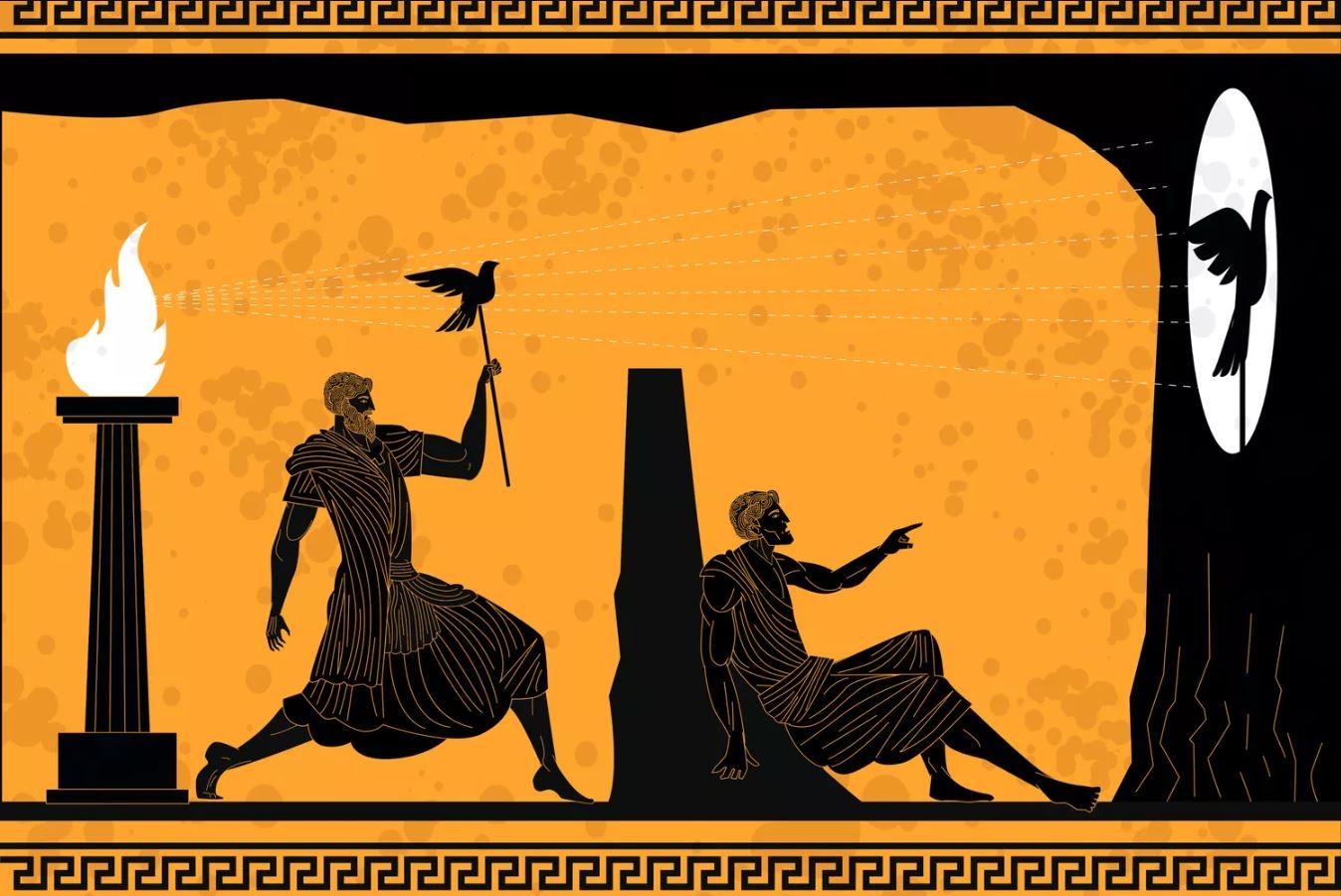
Chapter 7: The Cave and the Light
In one of philosophy's most famous passages, Socrates will reveal how most of us live our entire lives watching shadows on a wall, mistaking them for reality. The allegory of the cave awaits, along with the painful journey from darkness to light.