An excerpt from the original text.(complete · 7236 words)
OOK VII. And now I will describe in a figure the enlightenment or
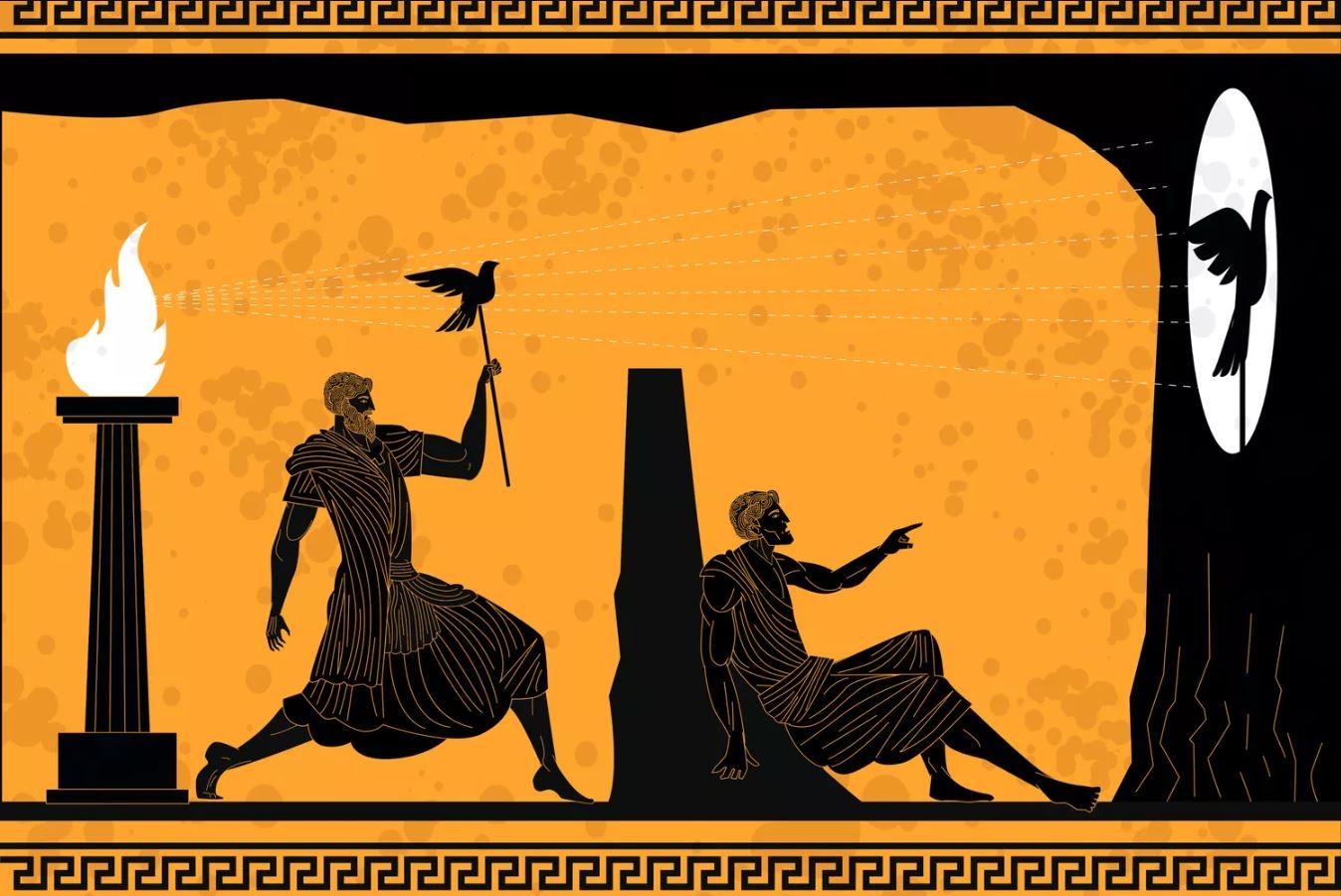
unenlightenment of our nature:—Imagine human beings living in an
underground den which is open towards the light; they have been there
from childhood, having their necks and legs chained, and can only see
into the den. At a distance there is a fire, and between the fire and
the prisoners a raised way, and a low wall is built along the way, like
the screen over which marionette players show their puppets. Behind the
wall appear moving figures, who hold in their hands various works of
art, and among them images of men and animals, wood and stone, and some
of the passers-by are talking and others silent. ‘A strange parable,’
he said, ‘and strange captives.’ They are ourselves, I replied; and
they see only the shadows of the images which the fire throws on the
wall of the den; to these they give names, and if we add an echo which
returns from the wall, the voices of the passengers will seem to
proceed from the shadows. Suppose now that you suddenly turn them round
and make them look with pain and grief to themselves at the real
images; will they believe them to be real? Will not their eyes be
dazzled, and will they not try to get away from the light to something
which they are able to behold without blinking? And suppose further,
that they are dragged up a steep and rugged ascent into the presence of
the sun himself, will not their sight be darkened with the excess of
light? Some time will pass before they get the habit of perceiving at
all; and at first they will be able to perceive only shadows and
reflections in the water; then they will recognize the moon and the
stars, and will at length behold the sun in his own proper place as he
is. Last of all they will conclude:—This is he who gives us the year
and the seasons, and is the author of all that we see. How will they
rejoice in passing from darkness to light! How worthless to them will
seem the honours and glories of the den! But now imagine further, that
they descend into their old habitations;—in that underground dwelling
they will not see as well as their fellows, and will not be able to
compete with them in the measurement of the shadows on the wall; there
will be many jokes about the man who went on a visit to the sun and
lost his eyes, and if they find anybody trying to set free and
enlighten one of their number, they will put him to death, if they can
catch him. Now the cave or den is the world of sight, the fire is the
sun, the way upwards is the way to knowledge, and in the world of
knowledge the idea of good is last seen and with difficulty, but when
seen is inferred to be the author of good and right—parent of the lord
of light in this world, and of truth and understanding in the other. He
who attains to the beatific vision is always going upwards; he is
unwilling to descend into political assemblies and courts of law; for
his eyes are apt to blink at the images or shadows of images which they
behold in them—he cannot enter into the ideas of those who have never
in their lives understood the relation of the shadow to the substance.
But blindness is of two kinds, and may be caused either by passing out
of darkness into light or out of light into darkness, and a man of
sense will distinguish between them, and will not laugh equally at both
of them, but the blindness which arises from fulness of light he will
deem blessed, and pity the other; or if he laugh at the puzzled soul
looking at the sun, he will have more reason to laugh than the
inhabitants of the den at those who descend from above. There is a
further lesson taught by this parable of ours. Some persons fancy that
instruction is like giving eyes to the blind, but we say that the
faculty of sight was always there, and that the soul only requires to
be turned round towards the light. And this is conversion; other
virtues are almost like bodily habits, and may be acquired in the same
manner, but intelligence has a diviner life, and is indestructible,
turning either to good or evil according to the direction given. Did
you never observe how the mind of a clever rogue peers out of his eyes,
and the more clearly he sees, the more evil he does? Now if you take
such an one, and cut away from him those leaden weights of pleasure and
desire which bind his soul to earth, his intelligence will be turned
round, and he will behold the truth as clearly as he now discerns his
meaner ends. And have we not decided that our rulers must neither be so
uneducated as to have no fixed rule of life, nor so over-educated as to
be unwilling to leave their paradise for the business of the world? We
must choose out therefore the natures who are most likely to ascend to
the light and knowledge of the good; but we must not allow them to
remain in the region of light; they must be forced down again among the
captives in the den to partake of their labours and honours. ‘Will they
not think this a hardship?’ You should remember that our purpose in
framing the State was not that our citizens should do what they like,
but that they should serve the State for the common good of all. May we
not fairly say to our philosopher,—Friend, we do you no wrong; for in
other States philosophy grows wild, and a wild plant owes nothing to
the gardener, but you have been trained by us to be the rulers and
kings of our hive, and therefore we must insist on your descending into
the den. You must, each of you, take your turn, and become able to use
your eyes in the dark, and with a little practice you will see far
better than those who quarrel about the shadows, whose knowledge is a
dream only, whilst yours is a waking reality. It may be that the saint
or philosopher who is best fitted, may also be the least inclined to
rule, but necessity is laid upon him, and he must no longer live in the
heaven of ideas. And this will be the salvation of the State. For those
who rule must not be those who are desirous to rule; and, if you can
offer to our citizens a better life than that of rulers generally is,
there will be a chance that the rich, not only in this world’s goods,
but in virtue and wisdom, may bear rule. And the only life which is
better than the life of political ambition is that of philosophy, which
is also the best preparation for the government of a State.
Then now comes the question,—How shall we create our rulers; what way
is there from darkness to light? The change is effected by philosophy;
it is not the turning over of an oyster-shell, but the conversion of a
soul from night to day, from becoming to being. And what training will
draw the soul upwards? Our former education had two branches,
gymnastic, which was occupied with the body, and music, the sister art,
which infused a natural harmony into mind and literature; but neither
of these sciences gave any promise of doing what we want. Nothing
remains to us but that universal or primary science of which all the
arts and sciences are partakers, I mean number or calculation. ‘Very
true.’ Including the art of war? ‘Yes, certainly.’ Then there is
something ludicrous about Palamedes in the tragedy, coming in and
saying that he had invented number, and had counted the ranks and set
them in order. For if Agamemnon could not count his feet (and without
number how could he?) he must have been a pretty sort of general
indeed. No man should be a soldier who cannot count, and indeed he is
hardly to be called a man. But I am not speaking of these practical
applications of arithmetic, for number, in my view, is rather to be
regarded as a conductor to thought and being. I will explain what I
mean by the last expression:—Things sensible are of two kinds; the one
class invite or stimulate the mind, while in the other the mind
acquiesces. Now the stimulating class are the things which suggest
contrast and relation. For example, suppose that I hold up to the eyes
three fingers—a fore finger, a middle finger, a little finger—the sight
equally recognizes all three fingers, but without number cannot further
distinguish them. Or again, suppose two objects to be relatively great
and small, these ideas of greatness and smallness are supplied not by
the sense, but by the mind. And the perception of their contrast or
relation quickens and sets in motion the mind, which is puzzled by the
confused intimations of sense, and has recourse to number in order to
find out whether the things indicated are one or more than one. Number
replies that they are two and not one, and are to be distinguished from
one another. Again, the sight beholds great and small, but only in a
confused chaos, and not until they are distinguished does the question
arise of their respective natures; we are thus led on to the
distinction between the visible and intelligible. That was what I meant
when I spoke of stimulants to the intellect; I was thinking of the
contradictions which arise in perception. The idea of unity, for
example, like that of a finger, does not arouse thought unless
involving some conception of plurality; but when the one is also the
opposite of one, the contradiction gives rise to reflection; an example
of this is afforded by any object of sight. All number has also an
elevating effect; it raises the mind out of the foam and flux of
generation to the contemplation of being, having lesser military and
retail uses also. The retail use is not required by us; but as our
guardian is to be a soldier as well as a philosopher, the military one
may be retained. And to our higher purpose no science can be better
adapted; but it must be pursued in the spirit of a philosopher, not of
a shopkeeper. It is concerned, not with visible objects, but with
abstract truth; for numbers are pure abstractions—the true
arithmetician indignantly denies that his unit is capable of division.
When you divide, he insists that you are only multiplying; his ‘one’ is
not material or resolvable into fractions, but an unvarying and
absolute equality; and this proves the purely intellectual character of
his study. Note also the great power which arithmetic has of sharpening
the wits; no other discipline is equally severe, or an equal test of
general ability, or equally improving to a stupid person.
Let our second branch of education be geometry. ‘I can easily see,’
replied Glaucon, ‘that the skill of the general will be doubled by his
knowledge of geometry.’ That is a small matter; the use of geometry, to
which I refer, is the assistance given by it in the contemplation of
the idea of good, and the compelling the mind to look at true being,
and not at generation only. Yet the present mode of pursuing these
studies, as any one who is the least of a mathematician is aware, is
mean and ridiculous; they are made to look downwards to the arts, and
not upwards to eternal existence. The geometer is always talking of
squaring, subtending, apposing, as if he had in view action; whereas
knowledge is the real object of the study. It should elevate the soul,
and create the mind of philosophy; it should raise up what has fallen
down, not to speak of lesser uses in war and military tactics, and in
the improvement of the faculties.
Shall we propose, as a third branch of our education, astronomy? ‘Very
good,’ replied Glaucon; ‘the knowledge of the heavens is necessary at
once for husbandry, navigation, military tactics.’ I like your way of
giving useful reasons for everything in order to make friends of the
world. And there is a difficulty in proving to mankind that education
is not only useful information but a purification of the eye of the
soul, which is better than the bodily eye, for by this alone is truth
seen. Now, will you appeal to mankind in general or to the philosopher?
or would you prefer to look to yourself only? ‘Every man is his own
best friend.’ Then take a step backward, for we are out of order, and
insert the third dimension which is of solids, after the second which
is of planes, and then you may proceed to solids in motion. But solid
geometry is not popular and has not the patronage of the State, nor is
the use of it fully recognized; the difficulty is great, and the
votaries of the study are conceited and impatient. Still the charm of
the pursuit wins upon men, and, if government would lend a little
assistance, there might be great progress made. ‘Very true,’ replied
Glaucon; ‘but do I understand you now to begin with plane geometry, and
to place next geometry of solids, and thirdly, astronomy, or the motion
of solids?’ Yes, I said; my hastiness has only hindered us.
‘Very good, and now let us proceed to astronomy, about which I am
willing to speak in your lofty strain. No one can fail to see that the
contemplation of the heavens draws the soul upwards.’ I am an
exception, then; astronomy as studied at present appears to me to draw
the soul not upwards, but downwards. Star-gazing is just looking up at
the ceiling—no better; a man may lie on his back on land or on water—he
may look up or look down, but there is no science in that. The vision
of knowledge of which I speak is seen not with the eyes, but with the
mind. All the magnificence of the heavens is but the embroidery of a
copy which falls far short of the divine Original, and teaches nothing
about the absolute harmonies or motions of things. Their beauty is like
the beauty of figures drawn by the hand of Daedalus or any other great
artist, which may be used for illustration, but no mathematician would
seek to obtain from them true conceptions of equality or numerical
relations. How ridiculous then to look for these in the map of the
heavens, in which the imperfection of matter comes in everywhere as a
disturbing element, marring the symmetry of day and night, of months
and years, of the sun and stars in their courses. Only by problems can
we place astronomy on a truly scientific basis. Let the heavens alone,
and exert the intellect.
Still, mathematics admit of other applications, as the Pythagoreans
say, and we agree. There is a sister science of harmonical motion,
adapted to the ear as astronomy is to the eye, and there may be other
applications also. Let us inquire of the Pythagoreans about them, not
forgetting that we have an aim higher than theirs, which is the
relation of these sciences to the idea of good. The error which
pervades astronomy also pervades harmonics. The musicians put their
ears in the place of their minds. ‘Yes,’ replied Glaucon, ‘I like to
see them laying their ears alongside of their neighbours’ faces—some
saying, “That’s a new note,” others declaring that the two notes are
the same.’ Yes, I said; but you mean the empirics who are always
twisting and torturing the strings of the lyre, and quarrelling about
the tempers of the strings; I am referring rather to the Pythagorean
harmonists, who are almost equally in error. For they investigate only
the numbers of the consonances which are heard, and ascend no
higher,—of the true numerical harmony which is unheard, and is only to
be found in problems, they have not even a conception. ‘That last,’ he
said, ‘must be a marvellous thing.’ A thing, I replied, which is only
useful if pursued with a view to the good.
All these sciences are the prelude of the strain, and are profitable if
they are regarded in their natural relations to one another. ‘I dare
say, Socrates,’ said Glaucon; ‘but such a study will be an endless
business.’ What study do you mean—of the prelude, or what? For all
these things are only the prelude, and you surely do not suppose that a
mere mathematician is also a dialectician? ‘Certainly not. I have
hardly ever known a mathematician who could reason.’ And yet, Glaucon,
is not true reasoning that hymn of dialectic which is the music of the
intellectual world, and which was by us compared to the effort of
sight, when from beholding the shadows on the wall we arrived at last
at the images which gave the shadows? Even so the dialectical faculty
withdrawing from sense arrives by the pure intellect at the
contemplation of the idea of good, and never rests but at the very end
of the intellectual world. And the royal road out of the cave into the
light, and the blinking of the eyes at the sun and turning to
contemplate the shadows of reality, not the shadows of an image
only—this progress and gradual acquisition of a new faculty of sight by
the help of the mathematical sciences, is the elevation of the soul to
the contemplation of the highest ideal of being.
‘So far, I agree with you. But now, leaving the prelude, let us proceed
to the hymn. What, then, is the nature of dialectic, and what are the
paths which lead thither?’ Dear Glaucon, you cannot follow me here.
There can be no revelation of the absolute truth to one who has not
been disciplined in the previous sciences. But that there is a science
of absolute truth, which is attained in some way very different from
those now practised, I am confident. For all other arts or sciences are
relative to human needs and opinions; and the mathematical sciences are
but a dream or hypothesis of true being, and never analyse their own
principles. Dialectic alone rises to the principle which is above
hypotheses, converting and gently leading the eye of the soul out of
the barbarous slough of ignorance into the light of the upper world,
with the help of the sciences which we have been describing—sciences,
as they are often termed, although they require some other name,
implying greater clearness than opinion and less clearness than
science, and this in our previous sketch was understanding. And so we
get four names—two for intellect, and two for opinion,—reason or mind,
understanding, faith, perception of shadows—which make a proportion—
being:becoming::intellect:opinion—and science:belief::understanding:
perception of shadows. Dialectic may be further described as that
science which defines and explains the essence or being of each nature,
which distinguishes and abstracts the good, and is ready to do battle
against all opponents in the cause of good. To him who is not a
dialectician life is but a sleepy dream; and many a man is in his grave
before his is well waked up. And would you have the future rulers of
your ideal State intelligent beings, or stupid as posts? ‘Certainly not
the latter.’ Then you must train them in dialectic, which will teach
them to ask and answer questions, and is the coping-stone of the
sciences.
I dare say that you have not forgotten how our rulers were chosen; and
the process of selection may be carried a step further:—As before, they
must be constant and valiant, good-looking, and of noble manners, but
now they must also have natural ability which education will improve;
that is to say, they must be quick at learning, capable of mental toil,
retentive, solid, diligent natures, who combine intellectual with moral
virtues; not lame and one-sided, diligent in bodily exercise and
indolent in mind, or conversely; not a maimed soul, which hates
falsehood and yet unintentionally is always wallowing in the mire of
ignorance; not a bastard or feeble person, but sound in wind and limb,
and in perfect condition for the great gymnastic trial of the mind.
Justice herself can find no fault with natures such as these; and they
will be the saviours of our State; disciples of another sort would only
make philosophy more ridiculous than she is at present. Forgive my
enthusiasm; I am becoming excited; but when I see her trampled
underfoot, I am angry at the authors of her disgrace. ‘I did not notice
that you were more excited than you ought to have been.’ But I felt
that I was. Now do not let us forget another point in the selection of
our disciples—that they must be young and not old. For Solon is
mistaken in saying that an old man can be always learning; youth is the
time of study, and here we must remember that the mind is free and
dainty, and, unlike the body, must not be made to work against the
grain. Learning should be at first a sort of play, in which the natural
bent is detected. As in training them for war, the young dogs should at
first only taste blood; but when the necessary gymnastics are over
which during two or three years divide life between sleep and bodily
exercise, then the education of the soul will become a more serious
matter. At twenty years of age, a selection must be made of the more
promising disciples, with whom a new epoch of education will begin. The
sciences which they have hitherto learned in fragments will now be
brought into relation with each other and with true being; for the
power of combining them is the test of speculative and dialectical
ability. And afterwards at thirty a further selection shall be made of
those who are able to withdraw from the world of sense into the
abstraction of ideas. But at this point, judging from present
experience, there is a danger that dialectic may be the source of many
evils. The danger may be illustrated by a parallel case:—Imagine a
person who has been brought up in wealth and luxury amid a crowd of
flatterers, and who is suddenly informed that he is a supposititious
son. He has hitherto honoured his reputed parents and disregarded the
flatterers, and now he does the reverse. This is just what happens with
a man’s principles. There are certain doctrines which he learnt at home
and which exercised a parental authority over him. Presently he finds
that imputations are cast upon them; a troublesome querist comes and
asks, ‘What is the just and good?’ or proves that virtue is vice and
vice virtue, and his mind becomes unsettled, and he ceases to love,
honour, and obey them as he has hitherto done. He is seduced into the
life of pleasure, and becomes a lawless person and a rogue. The case of
such speculators is very pitiable, and, in order that our thirty years’
old pupils may not require this pity, let us take every possible care
that young persons do not study philosophy too early. For a young man
is a sort of puppy who only plays with an argument; and is reasoned
into and out of his opinions every day; he soon begins to believe
nothing, and brings himself and philosophy into discredit. A man of
thirty does not run on in this way; he will argue and not merely
contradict, and adds new honour to philosophy by the sobriety of his
conduct. What time shall we allow for this second gymnastic training of
the soul?—say, twice the time required for the gymnastics of the body;
six, or perhaps five years, to commence at thirty, and then for fifteen
years let the student go down into the den, and command armies, and
gain experience of life. At fifty let him return to the end of all
things, and have his eyes uplifted to the idea of good, and order his
life after that pattern; if necessary, taking his turn at the helm of
State, and training up others to be his successors. When his time comes
he shall depart in peace to the islands of the blest. He shall be
honoured with sacrifices, and receive such worship as the Pythian
oracle approves.
‘You are a statuary, Socrates, and have made a perfect image of our
governors.’ Yes, and of our governesses, for the women will share in
all things with the men. And you will admit that our State is not a
mere aspiration, but may really come into being when there shall arise
philosopher-kings, one or more, who will despise earthly vanities, and
will be the servants of justice only. ‘And how will they begin their
work?’ Their first act will be to send away into the country all those
who are more than ten years of age, and to proceed with those who are
left...
At the commencement of the sixth book, Plato anticipated his
explanation of the relation of the philosopher to the world in an
allegory, in this, as in other passages, following the order which he
prescribes in education, and proceeding from the concrete to the
abstract. At the commencement of Book VII, under the figure of a cave
having an opening towards a fire and a way upwards to the true light,
he returns to view the divisions of knowledge, exhibiting familiarly,
as in a picture, the result which had been hardly won by a great effort
of thought in the previous discussion; at the same time casting a
glance onward at the dialectical process, which is represented by the
way leading from darkness to light. The shadows, the images, the
reflection of the sun and stars in the water, the stars and sun
themselves, severally correspond,—the first, to the realm of fancy and
poetry,—the second, to the world of sense,—the third, to the
abstractions or universals of sense, of which the mathematical sciences
furnish the type,—the fourth and last to the same abstractions, when
seen in the unity of the idea, from which they derive a new meaning and
power. The true dialectical process begins with the contemplation of
the real stars, and not mere reflections of them, and ends with the
recognition of the sun, or idea of good, as the parent not only of
light but of warmth and growth. To the divisions of knowledge the
stages of education partly answer:—first, there is the early education
of childhood and youth in the fancies of the poets, and in the laws and
customs of the State;—then there is the training of the body to be a
warrior athlete, and a good servant of the mind;—and thirdly, after an
interval follows the education of later life, which begins with
mathematics and proceeds to philosophy in general.
There seem to be two great aims in the philosophy of Plato,—first, to
realize abstractions; secondly, to connect them. According to him, the
true education is that which draws men from becoming to being, and to a
comprehensive survey of all being. He desires to develop in the human
mind the faculty of seeing the universal in all things; until at last
the particulars of sense drop away and the universal alone remains. He
then seeks to combine the universals which he has disengaged from
sense, not perceiving that the correlation of them has no other basis
but the common use of language. He never understands that abstractions,
as Hegel says, are ‘mere abstractions’—of use when employed in the
arrangement of facts, but adding nothing to the sum of knowledge when
pursued apart from them, or with reference to an imaginary idea of
good. Still the exercise of the faculty of abstraction apart from facts
has enlarged the mind, and played a great part in the education of the
human race. Plato appreciated the value of this faculty, and saw that
it might be quickened by the study of number and relation. All things
in which there is opposition or proportion are suggestive of
reflection. The mere impression of sense evokes no power of thought or
of mind, but when sensible objects ask to be compared and
distinguished, then philosophy begins. The science of arithmetic first
suggests such distinctions. The follow in order the other sciences of
plain and solid geometry, and of solids in motion, one branch of which
is astronomy or the harmony of the spheres,—to this is appended the
sister science of the harmony of sounds. Plato seems also to hint at
the possibility of other applications of arithmetical or mathematical
proportions, such as we employ in chemistry and natural philosophy,
such as the Pythagoreans and even Aristotle make use of in Ethics and
Politics, e.g. his distinction between arithmetical and geometrical
proportion in the Ethics (Book V), or between numerical and
proportional equality in the Politics.
The modern mathematician will readily sympathise with Plato’s delight
in the properties of pure mathematics. He will not be disinclined to
say with him:—Let alone the heavens, and study the beauties of number
and figure in themselves. He too will be apt to depreciate their
application to the arts. He will observe that Plato has a conception of
geometry, in which figures are to be dispensed with; thus in a distant
and shadowy way seeming to anticipate the possibility of working
geometrical problems by a more general mode of analysis. He will remark
with interest on the backward state of solid geometry, which, alas! was
not encouraged by the aid of the State in the age of Plato; and he will
recognize the grasp of Plato’s mind in his ability to conceive of one
science of solids in motion including the earth as well as the
heavens,—not forgetting to notice the intimation to which allusion has
been already made, that besides astronomy and harmonics the science of
solids in motion may have other applications. Still more will he be
struck with the comprehensiveness of view which led Plato, at a time
when these sciences hardly existed, to say that they must be studied in
relation to one another, and to the idea of good, or common principle
of truth and being. But he will also see (and perhaps without surprise)
that in that stage of physical and mathematical knowledge, Plato has
fallen into the error of supposing that he can construct the heavens a
priori by mathematical problems, and determine the principles of
harmony irrespective of the adaptation of sounds to the human ear. The
illusion was a natural one in that age and country. The simplicity and
certainty of astronomy and harmonics seemed to contrast with the
variation and complexity of the world of sense; hence the circumstance
that there was some elementary basis of fact, some measurement of
distance or time or vibrations on which they must ultimately rest, was
overlooked by him. The modern predecessors of Newton fell into errors
equally great; and Plato can hardly be said to have been very far
wrong, or may even claim a sort of prophetic insight into the subject,
when we consider that the greater part of astronomy at the present day
consists of abstract dynamics, by the help of which most astronomical
discoveries have been made.
The metaphysical philosopher from his point of view recognizes
mathematics as an instrument of education,—which strengthens the power
of attention, developes the sense of order and the faculty of
construction, and enables the mind to grasp under simple formulae the
quantitative differences of physical phenomena. But while acknowledging
their value in education, he sees also that they have no connexion with
our higher moral and intellectual ideas. In the attempt which Plato
makes to connect them, we easily trace the influences of ancient
Pythagorean notions. There is no reason to suppose that he is speaking
of the ideal numbers; but he is describing numbers which are pure
abstractions, to which he assigns a real and separate existence, which,
as ‘the teachers of the art’ (meaning probably the Pythagoreans) would
have affirmed, repel all attempts at subdivision, and in which unity
and every other number are conceived of as absolute. The truth and
certainty of numbers, when thus disengaged from phenomena, gave them a
kind of sacredness in the eyes of an ancient philosopher. Nor is it
easy to say how far ideas of order and fixedness may have had a moral
and elevating influence on the minds of men, ‘who,’ in the words of the
Timaeus, ‘might learn to regulate their erring lives according to
them.’ It is worthy of remark that the old Pythagorean ethical symbols
still exist as figures of speech among ourselves. And those who in
modern times see the world pervaded by universal law, may also see an
anticipation of this last word of modern philosophy in the Platonic
idea of good, which is the source and measure of all things, and yet
only an abstraction (Philebus).
Two passages seem to require more particular explanations. First, that
which relates to the analysis of vision. The difficulty in this passage
may be explained, like many others, from differences in the modes of
conception prevailing among ancient and modern thinkers. To us, the
perceptions of sense are inseparable from the act of the mind which
accompanies them. The consciousness of form, colour, distance, is
indistinguishable from the simple sensation, which is the medium of
them. Whereas to Plato sense is the Heraclitean flux of sense, not the
vision of objects in the order in which they actually present
themselves to the experienced sight, but as they may be imagined to
appear confused and blurred to the half-awakened eye of the infant. The
first action of the mind is aroused by the attempt to set in order this
chaos, and the reason is required to frame distinct conceptions under
which the confused impressions of sense may be arranged. Hence arises
the question, ‘What is great, what is small?’ and thus begins the
distinction of the visible and the intelligible.
The second difficulty relates to Plato’s conception of harmonics. Three
classes of harmonists are distinguished by him:—first, the
Pythagoreans, whom he proposes to consult as in the previous discussion
on music he was to consult Damon—they are acknowledged to be masters in
the art, but are altogether deficient in the knowledge of its higher
import and relation to the good; secondly, the mere empirics, whom
Glaucon appears to confuse with them, and whom both he and Socrates
ludicrously describe as experimenting by mere auscultation on the
intervals of sounds. Both of these fall short in different degrees of
the Platonic idea of harmony, which must be studied in a purely
abstract way, first by the method of problems, and secondly as a part
of universal knowledge in relation to the idea of good.
The allegory has a political as well as a philosophical meaning. The
den or cave represents the narrow sphere of politics or law (compare
the description of the philosopher and lawyer in the Theaetetus), and
the light of the eternal ideas is supposed to exercise a disturbing
influence on the minds of those who return to this lower world. In
other words, their principles are too wide for practical application;
they are looking far away into the past and future, when their business
is with the present. The ideal is not easily reduced to the conditions
of actual life, and may often be at variance with them. And at first,
those who return are unable to compete with the inhabitants of the den
in the measurement of the shadows, and are derided and persecuted by
them; but after a while they see the things below in far truer
proportions than those who have never ascended into the upper world.
The difference between the politician turned into a philosopher and the
philosopher turned into a politician, is symbolized by the two kinds of
disordered eyesight, the one which is experienced by the captive who is
transferred from darkness to day, the other, of the heavenly messenger
who voluntarily for the good of his fellow-men descends into the den.
In what way the brighter light is to dawn on the inhabitants of the
lower world, or how the idea of good is to become the guiding principle
of politics, is left unexplained by Plato. Like the nature and
divisions of dialectic, of which Glaucon impatiently demands to be
informed, perhaps he would have said that the explanation could not be
given except to a disciple of the previous sciences. (Symposium.)
Many illustrations of this part of the Republic may be found in modern
Politics and in daily life. For among ourselves, too, there have been
two sorts of Politicians or Statesmen, whose eyesight has become
disordered in two different ways. First, there have been great men who,
in the language of Burke, ‘have been too much given to general maxims,’
who, like J.S. Mill or Burke himself, have been theorists or
philosophers before they were politicians, or who, having been students
of history, have allowed some great historical parallel, such as the
English Revolution of 1688, or possibly Athenian democracy or Roman
Imperialism, to be the medium through which they viewed contemporary
events. Or perhaps the long projecting shadow of some existing
institution may have darkened their vision. The Church of the future,
the Commonwealth of the future, the Society of the future, have so
absorbed their minds, that they are unable to see in their true
proportions the Politics of to-day. They have been intoxicated with
great ideas, such as liberty, or equality, or the greatest happiness of
the greatest number, or the brotherhood of humanity, and they no longer
care to consider how these ideas must be limited in practice or
harmonized with the conditions of human life. They are full of light,
but the light to them has become only a sort of luminous mist or
blindness. Almost every one has known some enthusiastic half-educated
person, who sees everything at false distances, and in erroneous
proportions.
With this disorder of eyesight may be contrasted another—of those who
see not far into the distance, but what is near only; who have been
engaged all their lives in a trade or a profession; who are limited to
a set or sect of their own. Men of this kind have no universal except
their own interests or the interests of their class, no principle but
the opinion of persons like themselves, no knowledge of affairs beyond
what they pick up in the streets or at their club. Suppose them to be
sent into a larger world, to undertake some higher calling, from being
tradesmen to turn generals or politicians, from being schoolmasters to
become philosophers:—or imagine them on a sudden to receive an inward
light which reveals to them for the first time in their lives a higher
idea of God and the existence of a spiritual world, by this sudden
conversion or change is not their daily life likely to be upset; and on
the other hand will not many of their old prejudices and narrownesses
still adhere to them long after they have begun to take a more
comprehensive view of human things? From familiar examples like these
we may learn what Plato meant by the eyesight which is liable to two
kinds of disorders.
Nor have we any difficulty in drawing a parallel between the young
Athenian in the fifth century before Christ who became unsettled by new
ideas, and the student of a modern University who has been the subject
of a similar ‘aufklärung.’ We too observe that when young men begin to
criticise customary beliefs, or to analyse the constitution of human
nature, they are apt to lose hold of solid principle (ἅπαν τὸ βέβαιον
αὐτῶν ἐξοίχεται). They are like trees which have been frequently
transplanted. The earth about them is loose, and they have no roots
reaching far into the soil. They ‘light upon every flower,’ following
their own wayward wills, or because the wind blows them. They catch
opinions, as diseases are caught—when they are in the air. Borne hither
and thither, ‘they speedily fall into beliefs’ the opposite of those in
which they were brought up. They hardly retain the distinction of right
and wrong; they seem to think one thing as good as another. They
suppose themselves to be searching after truth when they are playing
the game of ‘follow my leader.’ They fall in love ‘at first sight’ with
paradoxes respecting morality, some fancy about art, some novelty or
eccentricity in religion, and like lovers they are so absorbed for a
time in their new notion that they can think of nothing else. The
resolution of some philosophical or theological question seems to them
more interesting and important than any substantial knowledge of
literature or science or even than a good life. Like the youth in the
Philebus, they are ready to discourse to any one about a new
philosophy. They are generally the disciples of some eminent professor
or sophist, whom they rather imitate than understand. They may be
counted happy if in later years they retain some of the simple truths
which they acquired in early education, and which they may, perhaps,
find to be worth all the rest. Such is the picture which Plato draws
and which we only reproduce, partly in his own words, of the dangers
which beset youth in times of transition, when old opinions are fading
away and the new are not yet firmly established. Their condition is
ingeniously compared by him to that of a supposititious son, who has
made the discovery that his reputed parents are not his real ones, and,
in consequence, they have lost their authority over him.
The distinction between the mathematician and the dialectician is also
noticeable. Plato is very well aware that the faculty of the
mathematician is quite distinct from the higher philosophical sense
which recognizes and combines first principles. The contempt which he
expresses for distinctions of words, the danger of involuntary
falsehood, the apology which Socrates makes for his earnestness of
speech, are highly characteristic of the Platonic style and mode of
thought. The quaint notion that if Palamedes was the inventor of number
Agamemnon could not have counted his feet; the art by which we are made
to believe that this State of ours is not a dream only; the gravity
with which the first step is taken in the actual creation of the State,
namely, the sending out of the city all who had arrived at ten years of
age, in order to expedite the business of education by a generation,
are also truly Platonic. (For the last, compare the passage at the end
of the third book, in which he expects the lie about the earthborn men
to be believed in the second generation.)
Master this chapter. Complete your experience
Purchase the complete book to access all chapters and support classic literature
As an Amazon Associate, we earn a small commission from qualifying purchases at no additional cost to you.
Available in paperback, hardcover, and e-book formats
Let's Analyse the Pattern
The Cave You're Living In
We attack those who challenge our limited worldview because their expanded perspective threatens the comfortable lies we've built our lives around.
Why This Matters
Connect literature to life
This chapter teaches you to recognize when people attack new ideas not because the ideas are wrong, but because they threaten familiar illusions.
Practice This Today
This week, notice when someone dismisses a suggestion immediately - ask yourself if they're defending the idea's merit or defending their comfort with the status quo.
Now let's explore the literary elements.
Key Quotes & Analysis
"The prison house is the world of sight, the light of the fire is the sun, and you will not misapprehend me if you interpret the journey upwards to be the ascent of the soul into the intellectual world."
Context: Explaining what the cave allegory really means
This transforms the cave from just a story into a map of human understanding. The physical journey out of darkness represents the mental journey from ignorance to wisdom. It's validating that enlightenment is hard - you're supposed to struggle.
In Today's Words:
Breaking free from limiting beliefs feels like climbing out of a dark hole into blinding daylight - painful but necessary.
"Better to be the poor servant of a poor master, and to endure anything, rather than think as they do and live after their manner."
Context: Quoting Homer about preferring harsh reality to comfortable illusion
Once you've seen truth, you can't go back to pretending. This explains why people who've had major awakenings often can't return to their old lives, even when the new reality is harder.
In Today's Words:
I'd rather struggle with the truth than be comfortable with lies.
"Men would say of him that up he went and down he came without his eyes; and that it was better not even to think of ascending."
Context: How the other prisoners react to the one who returns from above
This captures how threatening truth-tellers can be to those invested in illusions. The prisoners don't just disagree - they use his initial blindness as proof that seeking truth is dangerous. It's easier to attack the messenger than question your reality.
In Today's Words:
Look what happened to him when he tried to change - better to stay where we are and not rock the boat.
"The power and capacity of learning exists in the soul already; and that just as the eye was unable to turn from darkness to light without the whole body, so too the instrument of knowledge can only by the movement of the whole soul be turned from the world of becoming into that of being."
Context: Explaining how education really works
Learning isn't about stuffing information into an empty head - it's about turning your whole self toward truth. Real education changes how you see everything, not just what you know about one subject.
In Today's Words:
You already have what it takes to understand - you just need to shift your perspective to see what's been there all along.
Thematic Threads
Truth vs Comfort
In This Chapter
The cave prisoners choose familiar shadows over painful enlightenment, preferring comfortable lies to difficult truths
Development
Evolves from earlier discussions of justice—now showing how people resist even seeing true justice
In Your Life:
When someone's success or growth makes you uncomfortable, you might be defending your own cave
Education as Disruption
In This Chapter
True education doesn't add information—it fundamentally changes how you see, making you unable to return to old ways
Development
Builds on the guardian training theme, but now reveals education as potentially isolating and dangerous
In Your Life:
That feeling when you can't relate to old friends after you've grown—you've left a shared cave
Resistance to Growth
In This Chapter
The other prisoners don't just doubt the freed one—they want to kill him for threatening their worldview
Development
Deepens the theme of how societies resist change, even positive change, from previous chapters
In Your Life:
When family members say you've 'changed' as an accusation, not a compliment
Timing of Wisdom
In This Chapter
Plato warns against teaching critical thinking too early—without foundation, questioning everything leads to believing nothing
Development
Introduced here—adds nuance to the education discussion
In Your Life:
Why your teenager who questions everything needs structure, not just more freedom
Obligation of Knowledge
In This Chapter
The freed prisoner must return to help others, even knowing they'll hate him for it
Development
Transforms the leadership theme—true leaders serve those who resist them
In Your Life:
When you've learned something that could help your coworkers, but know they'll resent you for sharing it
You now have the context. Time to form your own thoughts.
Discussion Questions
- 1
In the cave allegory, what happens when the freed prisoner tries to tell others about the real world?
analysis • surface - 2
Why do the other prisoners mock and reject the one who's seen the truth instead of being curious?
analysis • medium - 3
Think of a time someone tried to show you a different way of doing things at work or home. How did you react? Were you the prisoner defending shadows or the one bringing light?
application • medium - 4
You discover your workplace has been doing something inefficiently for years. You know a better way but also know you'll face resistance. How do you introduce change without becoming the 'know-it-all' everyone resents?
application • deep - 5
Plato says we shouldn't teach critical thinking too early or people become cynics. What's the difference between healthy questioning and destructive cynicism? How do you stay curious without losing all faith?
reflection • deep
Critical Thinking Exercise
Map Your Cave
Draw three columns: 'Shadows I Used to Believe', 'Light That Changed My View', and 'Shadows I Might Still Believe'. In the first column, list beliefs or assumptions you've outgrown (about work, family, yourself). In the second, note what helped you see differently. In the third, honestly consider what comfortable lies you might still be holding onto.
Consider:
- •Focus on specific examples, not abstract concepts - 'overtime always equals dedication' rather than 'work culture'
- •Notice who resisted when you changed your views and why they might have felt threatened
- •Consider one 'shadow' you're currently defending - what would you lose if you admitted it wasn't real?
Journaling Prompt
Write about a time you were the freed prisoner trying to share new knowledge. How did others react? Looking back, what would you do differently to help them see without triggering their defenses?
Coming Up Next...
Chapter 8: The Decline of States and Souls
Having described the ideal state and its education system, Plato now turns to examine how governments decay. What causes a perfect system to fall apart? The answer reveals uncomfortable truths about human nature and the cycles of power.