

What to expect ahead
What follows is a compact summary of each chapter in the book, designed to help you quickly grasp the core ideas while inviting you to continue into the full original text. Even when chapter text is presented here, these summaries are meant as a gateway to understanding, so your eventual reading of the complete book feels richer, deeper, and more fully appreciated.
Nicomachean Ethics
A Brief Description
Written around 350 BCE and named after Aristotle's son Nicomachus, this is the most influential work on ethics ever produced—and it still reads like it was written for today.
Aristotle's central question is deceptively simple: what does it mean to live well? His answer cuts against everything modern self-help gets wrong. The good life isn't about pleasure, wealth, fame, or even moral rule-following. It's about eudaimonia—often translated as "happiness" but better understood as human flourishing. Living in a way that fully expresses what you are capable of as a human being.
To get there, Aristotle argues, you need virtue. Not as a list of commandments, but as a set of stable character traits—courage, honesty, generosity, practical wisdom—that you develop through repeated action the way an athlete develops skill. You become courageous by doing courageous things. You become honest by telling the truth until honesty becomes who you are. Virtue is a habit before it is a belief.
The book's most radical insight is the doctrine of the mean: every virtue sits between two vices. Courage lies between cowardice and recklessness. Generosity lies between miserliness and reckless spending. Getting it right requires practical wisdom (phronesis)—the ability to read situations clearly and respond well, which can't be reduced to any formula.
Aristotle also writes with surprising depth about friendship, arguing that the highest form—friendship based on shared virtue rather than pleasure or usefulness—is essential to the good life, not optional. And he takes pleasure seriously, refusing to treat it as mere distraction.
This is not a book of abstract theory. It is a handbook for becoming the kind of person whose life, looking back, was worth living.
Essential Life Skills Deep Dive
Explore chapter-by-chapter breakdowns of the essential life skills taught in this classic novel.
You Become What You Repeatedly Do
Virtue is a habit, not a feeling. Aristotle's argument that character is built through repeated action — you act first, the feeling and identity follow, and you are responsible for what you have built.
The Mean Between Extremes
Every virtue sits between two vices — excess and deficiency. Aristotle's doctrine of the mean, and why practical wisdom to find the right response is the master virtue that enables all the others.
Why We Do What We Know Is Wrong
Aristotle on akrasia — weakness of will. The two types of failure, why general knowledge doesn't produce particular right action, and how the disposition was built and can be rebuilt.
What Friendship Actually Is
Three types of friendship — utility, pleasure, and virtue — and why Aristotle argues that genuine friendship is not supplementary to the good life but constitutive of it.
Essential Skills
Life skills and patterns this book helps you develop—drawn from its themes and characters.
Critical Thinking Through Literature
Develop analytical skills by examining the complex themes and character motivations in Nicomachean Ethics, learning to question assumptions and see multiple perspectives.
Historical Context Understanding
Learn to place events and ideas within their historical context, understanding how Nicomachean Ethics reflects and responds to the issues of its time.
Empathy and Perspective-Taking
Build empathy by experiencing life through the eyes of characters from different times, backgrounds, and circumstances in Nicomachean Ethics.
Recognizing Timeless Human Nature
Understand that human nature remains constant across centuries, as Nicomachean Ethics reveals patterns of behavior and motivation that persist today.
Articulating Complex Ideas
Improve your ability to express nuanced thoughts and feelings by engaging with the sophisticated language and themes in Nicomachean Ethics.
Moral Reasoning and Ethics
Develop your ethical reasoning by grappling with the moral dilemmas and philosophical questions raised throughout Nicomachean Ethics.
Table of Contents
The Search for True Happiness
Aristotle opens his exploration of the good life by asking a fundamental question: What are we all r...
Building Character Through Daily Habits
Aristotle delivers one of philosophy's most practical insights: you become what you repeatedly do. J...
The Anatomy of Choice
Aristotle dissects what makes our actions truly our own versus those we're forced into by circumstan...
Money, Honor, and Finding Your Balance
Aristotle dives deep into how we handle money, honor, and our relationships with others, showing tha...
Justice as Fairness and Balance
Aristotle breaks down justice into two main types that we encounter daily. The first is distributive...
Two Types of Wisdom
Aristotle breaks down the mind into two thinking parts: one that deals with unchanging truths (like ...
Self-Control and the Battle Within
Aristotle tackles one of life's most frustrating puzzles: why do we sometimes do things we know are ...
The Three Types of Friendship
Aristotle breaks down friendship into three distinct categories that still ring true today. Friendsh...
The Art of Loving Others and Yourself
Aristotle tackles the messy realities of human relationships, starting with a fundamental question: ...
The Good Life and True Happiness
Aristotle concludes his great work on ethics by examining what truly makes life worth living. He tac...
About Aristotle
Published -350
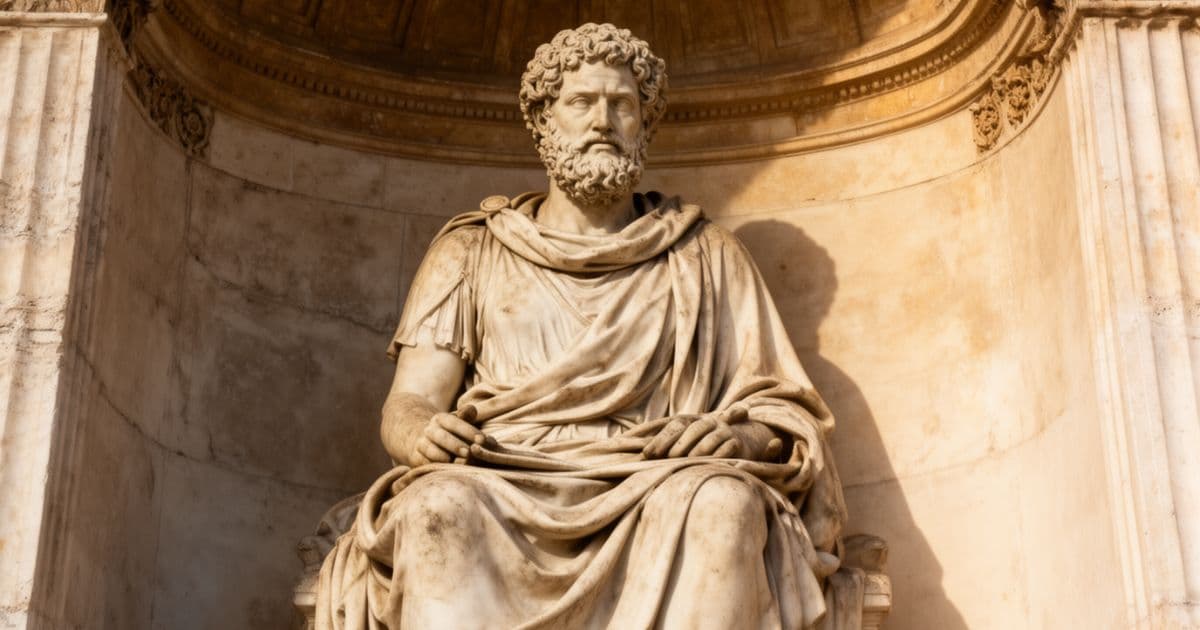
Aristotle (384–322 BCE) was born in Stagira, a small city on the northern coast of Greece, the son of a royal physician. At seventeen he traveled to Athens and enrolled in Plato's Academy, where he studied for twenty years—first as a student, then as a teacher. He was Plato's most brilliant pupil, and also his most persistent critic. While Plato believed that true reality existed in abstract, eternal Forms, Aristotle insisted that knowledge had to be grounded in the observable world. He wanted to understand things as they actually are.
After Plato's death, Aristotle left Athens. He spent several years on the island of Lesbos doing the detailed biological fieldwork that produced some of the most comprehensive studies of animal life in the ancient world—dissecting, classifying, observing. He was as meticulous about a squid's anatomy as he was about the structure of a tragic plot or the nature of a friendship. Then, in 343 BCE, Philip II of Macedon invited him to tutor the king's thirteen-year-old son. That boy was Alexander, later called the Great. For three years Aristotle taught him Homer, rhetoric, medicine, and philosophy. What Alexander absorbed from those lessons—and what he ignored—shaped the course of Western history.
In 335 BCE, Aristotle returned to Athens and founded his own school: the Lyceum. He lectured while walking the colonnaded walkways, earning him and his followers the name Peripatetics—the walkers. His output was staggering. He wrote on logic, biology, physics, metaphysics, rhetoric, poetics, politics, psychology, and ethics. What survives today is thought to be his lecture notes and working drafts, not the polished dialogues he published in his lifetime—which means we are reading Aristotle at his most direct and technical, not his most literary.
He also made foundational contributions to logic that would remain essentially unchallenged until the nineteenth century. His syllogistic reasoning—the formal structure of deductive argument—shaped how Western thinkers reasoned for two thousand years.
In 323 BCE, Alexander died. Anti-Macedonian sentiment swept Athens, and Aristotle, too closely associated with the Macedonian court, faced charges of impiety—the same charge that had killed Socrates sixty years earlier. Unwilling to let Athens sin twice against philosophy, he fled to Chalcis, where he died the following year at sixty-two.
His influence on Western thought cannot be overstated. Medieval Christian theology was built on an Aristotelian framework: Thomas Aquinas spent his career reconciling Aristotle with Christianity. Islamic philosophers—Averroes and Avicenna above all—preserved and extended his work during the centuries when Europe had largely lost it. When his texts returned to Europe through Arabic translations in the twelfth century, they reset the intellectual agenda for centuries. Even today, the concepts he introduced—substance, essence, causation, potential, actuality, the mean—are woven into how educated people think and argue, often without knowing it.
He was, as Dante put it, simply: the master of those who know.
Why This Author Matters Today
Aristotle's insights into human nature, social constraints, and the search for authenticity remain powerfully relevant. Their work helps us understand the timeless tensions between individual desire and social expectation, making them an essential guide for navigating modern life's complexities.
Amplified Classics is different.
not a sparknotes, nor a cliffnotes
This is a retelling. The story is still told—completely. You walk with the characters, feel what they feel, discover what they discover. The meaning arrives because you experienced it, not because someone explained a summary.
Read this, then read the original. The prose will illuminate—you'll notice what makes the author that author, because you're no longer fighting to follow the story.
Read the original first, then read this. Something will click. You'll want to go back.
Either way, the door opens inward.
Get the Full Book
Purchase the complete book to access all chapters and support classic literature
As an Amazon Associate, we earn a small commission from qualifying purchases at no additional cost to you.
Available in paperback, hardcover, and e-book formats
You Might Also Like


Free to read • No account required