An excerpt from the original text.(complete · 4532 words)
OOK V. I was going to enumerate the four forms of vice or decline in
states, when Polemarchus—he was sitting a little farther from me than
Adeimantus—taking him by the coat and leaning towards him, said
something in an undertone, of which I only caught the words, ‘Shall we
let him off?’ ‘Certainly not,’ said Adeimantus, raising his voice.
Whom, I said, are you not going to let off? ‘You,’ he said. Why?
‘Because we think that you are not dealing fairly with us in omitting
women and children, of whom you have slily disposed under the general
formula that friends have all things in common.’ And was I not right?
‘Yes,’ he replied, ‘but there are many sorts of communism or community,
and we want to know which of them is right. The company, as you have
just heard, are resolved to have a further explanation.’ Thrasymachus
said, ‘Do you think that we have come hither to dig for gold, or to
hear you discourse?’ Yes, I said; but the discourse should be of a
reasonable length. Glaucon added, ‘Yes, Socrates, and there is reason
in spending the whole of life in such discussions; but pray, without
more ado, tell us how this community is to be carried out, and how the
interval between birth and education is to be filled up.’ Well, I said,
the subject has several difficulties—What is possible? is the first
question. What is desirable? is the second. ‘Fear not,’ he replied,
‘for you are speaking among friends.’ That, I replied, is a sorry
consolation; I shall destroy my friends as well as myself. Not that I
mind a little innocent laughter; but he who kills the truth is a
murderer. ‘Then,’ said Glaucon, laughing, ‘in case you should murder us
we will acquit you beforehand, and you shall be held free from the
guilt of deceiving us.’
Socrates proceeds:—The guardians of our state are to be watch-dogs, as
we have already said. Now dogs are not divided into hes and shes—we do
not take the masculine gender out to hunt and leave the females at home
to look after their puppies. They have the same employments—the only
difference between them is that the one sex is stronger and the other
weaker. But if women are to have the same employments as men, they must
have the same education—they must be taught music and gymnastics, and
the art of war. I know that a great joke will be made of their riding
on horseback and carrying weapons; the sight of the naked old wrinkled
women showing their agility in the palaestra will certainly not be a
vision of beauty, and may be expected to become a famous jest. But we
must not mind the wits; there was a time when they might have laughed
at our present gymnastics. All is habit: people have at last found out
that the exposure is better than the concealment of the person, and now
they laugh no more. Evil only should be the subject of ridicule.
The first question is, whether women are able either wholly or
partially to share in the employments of men. And here we may be
charged with inconsistency in making the proposal at all. For we
started originally with the division of labour; and the diversity of
employments was based on the difference of natures. But is there no
difference between men and women? Nay, are they not wholly different?
THERE was the difficulty, Glaucon, which made me unwilling to speak of
family relations. However, when a man is out of his depth, whether in a
pool or in an ocean, he can only swim for his life; and we must try to
find a way of escape, if we can.
The argument is, that different natures have different uses, and the
natures of men and women are said to differ. But this is only a verbal
opposition. We do not consider that the difference may be purely
nominal and accidental; for example, a bald man and a hairy man are
opposed in a single point of view, but you cannot infer that because a
bald man is a cobbler a hairy man ought not to be a cobbler. Now why is
such an inference erroneous? Simply because the opposition between them
is partial only, like the difference between a male physician and a
female physician, not running through the whole nature, like the
difference between a physician and a carpenter. And if the difference
of the sexes is only that the one beget and the other bear children,
this does not prove that they ought to have distinct educations.
Admitting that women differ from men in capacity, do not men equally
differ from one another? Has not nature scattered all the qualities
which our citizens require indifferently up and down among the two
sexes? and even in their peculiar pursuits, are not women often, though
in some cases superior to men, ridiculously enough surpassed by them?
Women are the same in kind as men, and have the same aptitude or want
of aptitude for medicine or gymnastic or war, but in a less degree. One
woman will be a good guardian, another not; and the good must be chosen
to be the colleagues of our guardians. If however their natures are the
same, the inference is that their education must also be the same;
there is no longer anything unnatural or impossible in a woman learning
music and gymnastic. And the education which we give them will be the
very best, far superior to that of cobblers, and will train up the very
best women, and nothing can be more advantageous to the State than
this. Therefore let them strip, clothed in their chastity, and share in
the toils of war and in the defence of their country; he who laughs at
them is a fool for his pains.
The first wave is past, and the argument is compelled to admit that men
and women have common duties and pursuits. A second and greater wave is
rolling in—community of wives and children; is this either expedient or
possible? The expediency I do not doubt; I am not so sure of the
possibility. ‘Nay, I think that a considerable doubt will be
entertained on both points.’ I meant to have escaped the trouble of
proving the first, but as you have detected the little stratagem I must
even submit. Only allow me to feed my fancy like the solitary in his
walks, with a dream of what might be, and then I will return to the
question of what can be.
In the first place our rulers will enforce the laws and make new ones
where they are wanted, and their allies or ministers will obey. You, as
legislator, have already selected the men; and now you shall select the
women. After the selection has been made, they will dwell in common
houses and have their meals in common, and will be brought together by
a necessity more certain than that of mathematics. But they cannot be
allowed to live in licentiousness; that is an unholy thing, which the
rulers are determined to prevent. For the avoidance of this, holy
marriage festivals will be instituted, and their holiness will be in
proportion to their usefulness. And here, Glaucon, I should like to ask
(as I know that you are a breeder of birds and animals), Do you not
take the greatest care in the mating? ‘Certainly.’ And there is no
reason to suppose that less care is required in the marriage of human
beings. But then our rulers must be skilful physicians of the State,
for they will often need a strong dose of falsehood in order to bring
about desirable unions between their subjects. The good must be paired
with the good, and the bad with the bad, and the offspring of the one
must be reared, and of the other destroyed; in this way the flock will
be preserved in prime condition. Hymeneal festivals will be celebrated
at times fixed with an eye to population, and the brides and
bridegrooms will meet at them; and by an ingenious system of lots the
rulers will contrive that the brave and the fair come together, and
that those of inferior breed are paired with inferiors—the latter will
ascribe to chance what is really the invention of the rulers. And when
children are born, the offspring of the brave and fair will be carried
to an enclosure in a certain part of the city, and there attended by
suitable nurses; the rest will be hurried away to places unknown. The
mothers will be brought to the fold and will suckle the children; care
however must be taken that none of them recognise their own offspring;
and if necessary other nurses may also be hired. The trouble of
watching and getting up at night will be transferred to attendants.
‘Then the wives of our guardians will have a fine easy time when they
are having children.’ And quite right too, I said, that they should.
The parents ought to be in the prime of life, which for a man may be
reckoned at thirty years—from twenty-five, when he has ‘passed the
point at which the speed of life is greatest,’ to fifty-five; and at
twenty years for a woman—from twenty to forty. Any one above or below
those ages who partakes in the hymeneals shall be guilty of impiety;
also every one who forms a marriage connexion at other times without
the consent of the rulers. This latter regulation applies to those who
are within the specified ages, after which they may range at will,
provided they avoid the prohibited degrees of parents and children, or
of brothers and sisters, which last, however, are not absolutely
prohibited, if a dispensation be procured. ‘But how shall we know the
degrees of affinity, when all things are common?’ The answer is, that
brothers and sisters are all such as are born seven or nine months
after the espousals, and their parents those who are then espoused, and
every one will have many children and every child many parents.
Socrates proceeds: I have now to prove that this scheme is advantageous
and also consistent with our entire polity. The greatest good of a
State is unity; the greatest evil, discord and distraction. And there
will be unity where there are no private pleasures or pains or
interests—where if one member suffers all the members suffer, if one
citizen is touched all are quickly sensitive; and the least hurt to the
little finger of the State runs through the whole body and vibrates to
the soul. For the true State, like an individual, is injured as a whole
when any part is affected. Every State has subjects and rulers, who in
a democracy are called rulers, and in other States masters: but in our
State they are called saviours and allies; and the subjects who in
other States are termed slaves, are by us termed nurturers and
paymasters, and those who are termed comrades and colleagues in other
places, are by us called fathers and brothers. And whereas in other
States members of the same government regard one of their colleagues as
a friend and another as an enemy, in our State no man is a stranger to
another; for every citizen is connected with every other by ties of
blood, and these names and this way of speaking will have a
corresponding reality—brother, father, sister, mother, repeated from
infancy in the ears of children, will not be mere words. Then again the
citizens will have all things in common, in having common property they
will have common pleasures and pains.
Can there be strife and contention among those who are of one mind; or
lawsuits about property when men have nothing but their bodies which
they call their own; or suits about violence when every one is bound to
defend himself? The permission to strike when insulted will be an
‘antidote’ to the knife and will prevent disturbances in the State. But
no younger man will strike an elder; reverence will prevent him from
laying hands on his kindred, and he will fear that the rest of the
family may retaliate. Moreover, our citizens will be rid of the lesser
evils of life; there will be no flattery of the rich, no sordid
household cares, no borrowing and not paying. Compared with the
citizens of other States, ours will be Olympic victors, and crowned
with blessings greater still—they and their children having a better
maintenance during life, and after death an honourable burial. Nor has
the happiness of the individual been sacrificed to the happiness of the
State; our Olympic victor has not been turned into a cobbler, but he
has a happiness beyond that of any cobbler. At the same time, if any
conceited youth begins to dream of appropriating the State to himself,
he must be reminded that ‘half is better than the whole.’ ‘I should
certainly advise him to stay where he is when he has the promise of
such a brave life.’
But is such a community possible?—as among the animals, so also among
men; and if possible, in what way possible? About war there is no
difficulty; the principle of communism is adapted to military service.
Parents will take their children to look on at a battle, just as
potters’ boys are trained to the business by looking on at the wheel.
And to the parents themselves, as to other animals, the sight of their
young ones will prove a great incentive to bravery. Young warriors must
learn, but they must not run into danger, although a certain degree of
risk is worth incurring when the benefit is great. The young creatures
should be placed under the care of experienced veterans, and they
should have wings—that is to say, swift and tractable steeds on which
they may fly away and escape. One of the first things to be done is to
teach a youth to ride.
Cowards and deserters shall be degraded to the class of husbandmen;
gentlemen who allow themselves to be taken prisoners, may be presented
to the enemy. But what shall be done to the hero? First of all he shall
be crowned by all the youths in the army; secondly, he shall receive
the right hand of fellowship; and thirdly, do you think that there is
any harm in his being kissed? We have already determined that he shall
have more wives than others, in order that he may have as many children
as possible. And at a feast he shall have more to eat; we have the
authority of Homer for honouring brave men with ‘long chines,’ which is
an appropriate compliment, because meat is a very strengthening thing.
Fill the bowl then, and give the best seats and meats to the brave—may
they do them good! And he who dies in battle will be at once declared
to be of the golden race, and will, as we believe, become one of
Hesiod’s guardian angels. He shall be worshipped after death in the
manner prescribed by the oracle; and not only he, but all other
benefactors of the State who die in any other way, shall be admitted to
the same honours.
The next question is, How shall we treat our enemies? Shall Hellenes be
enslaved? No; for there is too great a risk of the whole race passing
under the yoke of the barbarians. Or shall the dead be despoiled?
Certainly not; for that sort of thing is an excuse for skulking, and
has been the ruin of many an army. There is meanness and feminine
malice in making an enemy of the dead body, when the soul which was the
owner has fled—like a dog who cannot reach his assailants, and quarrels
with the stones which are thrown at him instead. Again, the arms of
Hellenes should not be offered up in the temples of the Gods; they are
a pollution, for they are taken from brethren. And on similar grounds
there should be a limit to the devastation of Hellenic territory—the
houses should not be burnt, nor more than the annual produce carried
off. For war is of two kinds, civil and foreign; the first of which is
properly termed ‘discord,’ and only the second ‘war;’ and war between
Hellenes is in reality civil war—a quarrel in a family, which is ever
to be regarded as unpatriotic and unnatural, and ought to be prosecuted
with a view to reconciliation in a true phil-Hellenic spirit, as of
those who would chasten but not utterly enslave. The war is not against
a whole nation who are a friendly multitude of men, women, and
children, but only against a few guilty persons; when they are punished
peace will be restored. That is the way in which Hellenes should war
against one another—and against barbarians, as they war against one
another now.
‘But, my dear Socrates, you are forgetting the main question: Is such a
State possible? I grant all and more than you say about the blessedness
of being one family—fathers, brothers, mothers, daughters, going out to
war together; but I want to ascertain the possibility of this ideal
State.’ You are too unmerciful. The first wave and the second wave I
have hardly escaped, and now you will certainly drown me with the
third. When you see the towering crest of the wave, I expect you to
take pity. ‘Not a whit.’
Well, then, we were led to form our ideal polity in the search after
justice, and the just man answered to the just State. Is this ideal at
all the worse for being impracticable? Would the picture of a perfectly
beautiful man be any the worse because no such man ever lived? Can any
reality come up to the idea? Nature will not allow words to be fully
realized; but if I am to try and realize the ideal of the State in a
measure, I think that an approach may be made to the perfection of
which I dream by one or two, I do not say slight, but possible changes
in the present constitution of States. I would reduce them to a single
one—the great wave, as I call it. Until, then, kings are philosophers,
or philosophers are kings, cities will never cease from ill: no, nor
the human race; nor will our ideal polity ever come into being. I know
that this is a hard saying, which few will be able to receive.
‘Socrates, all the world will take off his coat and rush upon you with
sticks and stones, and therefore I would advise you to prepare an
answer.’ You got me into the scrape, I said. ‘And I was right,’ he
replied; ‘however, I will stand by you as a sort of do-nothing,
well-meaning ally.’ Having the help of such a champion, I will do my
best to maintain my position. And first, I must explain of whom I speak
and what sort of natures these are who are to be philosophers and
rulers. As you are a man of pleasure, you will not have forgotten how
indiscriminate lovers are in their attachments; they love all, and turn
blemishes into beauties. The snub-nosed youth is said to have a winning
grace; the beak of another has a royal look; the featureless are
faultless; the dark are manly, the fair angels; the sickly have a new
term of endearment invented expressly for them, which is ‘honey-pale.’
Lovers of wine and lovers of ambition also desire the objects of their
affection in every form. Now here comes the point:—The philosopher too
is a lover of knowledge in every form; he has an insatiable curiosity.
‘But will curiosity make a philosopher? Are the lovers of sights and
sounds, who let out their ears to every chorus at the Dionysiac
festivals, to be called philosophers?’ They are not true philosophers,
but only an imitation. ‘Then how are we to describe the true?’
You would acknowledge the existence of abstract ideas, such as justice,
beauty, good, evil, which are severally one, yet in their various
combinations appear to be many. Those who recognize these realities are
philosophers; whereas the other class hear sounds and see colours, and
understand their use in the arts, but cannot attain to the true or
waking vision of absolute justice or beauty or truth; they have not the
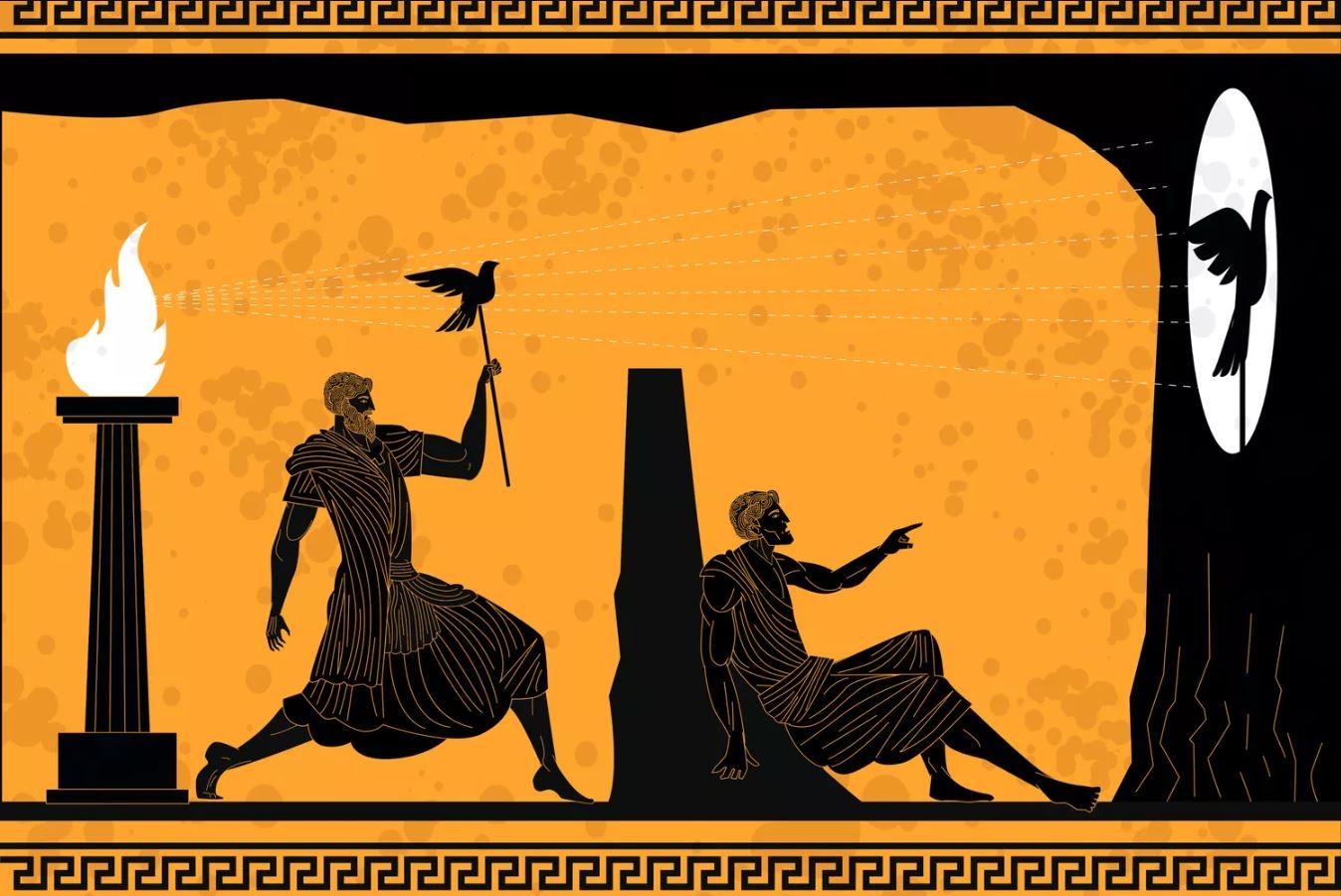
light of knowledge, but of opinion, and what they see is a dream only.
Perhaps he of whom we say the last will be angry with us; can we pacify
him without revealing the disorder of his mind? Suppose we say that, if
he has knowledge we rejoice to hear it, but knowledge must be of
something which is, as ignorance is of something which is not; and
there is a third thing, which both is and is not, and is matter of
opinion only. Opinion and knowledge, then, having distinct objects,
must also be distinct faculties. And by faculties I mean powers unseen
and distinguishable only by the difference in their objects, as opinion
and knowledge differ, since the one is liable to err, but the other is
unerring and is the mightiest of all our faculties. If being is the
object of knowledge, and not-being of ignorance, and these are the
extremes, opinion must lie between them, and may be called darker than
the one and brighter than the other. This intermediate or contingent
matter is and is not at the same time, and partakes both of existence
and of non-existence. Now I would ask my good friend, who denies
abstract beauty and justice, and affirms a many beautiful and a many
just, whether everything he sees is not in some point of view
different—the beautiful ugly, the pious impious, the just unjust? Is
not the double also the half, and are not heavy and light relative
terms which pass into one another? Everything is and is not, as in the
old riddle—‘A man and not a man shot and did not shoot a bird and not a
bird with a stone and not a stone.’ The mind cannot be fixed on either
alternative; and these ambiguous, intermediate, erring, half-lighted
objects, which have a disorderly movement in the region between being
and not-being, are the proper matter of opinion, as the immutable
objects are the proper matter of knowledge. And he who grovels in the
world of sense, and has only this uncertain perception of things, is
not a philosopher, but a lover of opinion only...
The fifth book is the new beginning of the Republic, in which the
community of property and of family are first maintained, and the
transition is made to the kingdom of philosophers. For both of these
Plato, after his manner, has been preparing in some chance words of
Book IV, which fall unperceived on the reader’s mind, as they are
supposed at first to have fallen on the ear of Glaucon and Adeimantus.
The ‘paradoxes,’ as Morgenstern terms them, of this book of the
Republic will be reserved for another place; a few remarks on the
style, and some explanations of difficulties, may be briefly added.
First, there is the image of the waves, which serves for a sort of
scheme or plan of the book. The first wave, the second wave, the third
and greatest wave come rolling in, and we hear the roar of them. All
that can be said of the extravagance of Plato’s proposals is
anticipated by himself. Nothing is more admirable than the hesitation
with which he proposes the solemn text, ‘Until kings are philosophers,’
etc.; or the reaction from the sublime to the ridiculous, when Glaucon
describes the manner in which the new truth will be received by
mankind.
Some defects and difficulties may be noted in the execution of the
communistic plan. Nothing is told us of the application of communism to
the lower classes; nor is the table of prohibited degrees capable of
being made out. It is quite possible that a child born at one hymeneal
festival may marry one of its own brothers or sisters, or even one of
its parents, at another. Plato is afraid of incestuous unions, but at
the same time he does not wish to bring before us the fact that the
city would be divided into families of those born seven and nine months
after each hymeneal festival. If it were worth while to argue seriously
about such fancies, we might remark that while all the old affinities
are abolished, the newly prohibited affinity rests not on any natural
or rational principle, but only upon the accident of children having
been born in the same month and year. Nor does he explain how the lots
could be so manipulated by the legislature as to bring together the
fairest and best. The singular expression which is employed to describe
the age of five-and-twenty may perhaps be taken from some poet.
In the delineation of the philosopher, the illustrations of the nature
of philosophy derived from love are more suited to the apprehension of
Glaucon, the Athenian man of pleasure, than to modern tastes or
feelings. They are partly facetious, but also contain a germ of truth.
That science is a whole, remains a true principle of inductive as well
as of metaphysical philosophy; and the love of universal knowledge is
still the characteristic of the philosopher in modern as well as in
ancient times.
At the end of the fifth book Plato introduces the figment of contingent
matter, which has exercised so great an influence both on the Ethics
and Theology of the modern world, and which occurs here for the first
time in the history of philosophy. He did not remark that the degrees
of knowledge in the subject have nothing corresponding to them in the
object. With him a word must answer to an idea; and he could not
conceive of an opinion which was an opinion about nothing. The
influence of analogy led him to invent ‘parallels and conjugates’ and
to overlook facts. To us some of his difficulties are puzzling only
from their simplicity: we do not perceive that the answer to them ‘is
tumbling out at our feet.’ To the mind of early thinkers, the
conception of not-being was dark and mysterious; they did not see that
this terrible apparition which threatened destruction to all knowledge
was only a logical determination. The common term under which, through
the accidental use of language, two entirely different ideas were
included was another source of confusion. Thus through the ambiguity of
(Greek) Plato, attempting to introduce order into the first chaos of
human thought, seems to have confused perception and opinion, and to
have failed to distinguish the contingent from the relative. In the
Theaetetus the first of these difficulties begins to clear up; in the
Sophist the second; and for this, as well as for other reasons, both
these dialogues are probably to be regarded as later than the Republic.
Master this chapter. Complete your experience
Purchase the complete book to access all chapters and support classic literature
As an Amazon Associate, we earn a small commission from qualifying purchases at no additional cost to you.
Available in paperback, hardcover, and e-book formats
Let's Analyse the Pattern
When systems are fundamentally broken, only 'radical' solutions that challenge core assumptions can create real change.
Why This Matters
Connect literature to life
This chapter teaches you to identify when 'that's impossible' really means 'that would change everything'—and why that's exactly what broken systems need.
Practice This Today
This week, notice when someone dismisses a solution as 'too radical'—then ask yourself if the real objection is that it would actually work.
Now let's explore the literary elements.
Key Quotes & Analysis
"Friends have all things in common"
Context: The phrase Socrates used earlier that his friends now demand he explain fully
This seemingly simple statement contains radical implications about property, family, and social organization. It's the seed from which Plato grows his vision of communal living among guardians.
In Today's Words:
Real friends share everything - but what if we took that literally?
"Do you think that we have come hither to dig for gold, or to hear you discourse?"
Context: Expressing frustration at the lengthy philosophical discussion
Thrasymachus represents practical people who think philosophy is a waste of time compared to making money. His sarcasm highlights the tension between material and intellectual pursuits.
In Today's Words:
Did we come here to get rich or to talk about impossible dreams?
"There is no practice of a profession which belongs to woman as woman or to man as man; natural capacities are equally distributed in both sexes"
Context: Arguing for gender equality among guardians
Revolutionary for ancient Greece, Socrates argues that gender differences are superficial compared to individual talents. He's not saying men and women are identical, but that both can be warriors or philosophers.
In Today's Words:
Being male or female doesn't determine what job you can do - talent does
"Until philosophers are kings, or the kings and princes of this world have the spirit and power of philosophy... cities will never have rest from their evils"
Context: Presenting his most radical proposal
The climax of Plato's political philosophy - only those who understand truth itself should rule. This seems impossible because philosophers don't want power and powerful people rarely seek wisdom.
In Today's Words:
Nothing will get better until the people in charge actually know what they're doing
Thematic Threads
Equality
In This Chapter
Women should be guardians with identical training and roles as men
Development
Extends justice principle from city structure to gender roles
In Your Life:
When you're told you can't do something because of who you are, not what you can do
Unity
In This Chapter
Abolishing private families creates one unified guardian class
Development
Builds on earlier theme of city harmony through specialized roles
In Your Life:
When personal interests conflict with what's best for your team or workplace
Truth vs Opinion
In This Chapter
Only philosophers who see reality, not shadows, should rule
Development
Introduced here as foundation for philosopher-king concept
In Your Life:
When you need someone who understands the real problem, not just what it looks like
Radical Solutions
In This Chapter
Three 'waves' of increasingly shocking proposals to fix society
Development
Escalates from city structure to complete social revolution
In Your Life:
When fixing something properly means suggesting changes that make people uncomfortable
You now have the context. Time to form your own thoughts.
Discussion Questions
- 1
What were Socrates' three radical proposals for the guardian class, and which one did he think would be most shocking?
analysis • surface - 2
Why does Socrates use the example of guard dogs to argue for women guardians? How does this strategy help him make his point?
analysis • medium - 3
Where do you see 'that's how we've always done it' blocking obvious improvements in your workplace or community?
application • medium - 4
If you had to propose a 'radical' fix for a broken system you deal with daily, how would you present it to overcome resistance?
application • deep - 5
What does this chapter reveal about why people defend broken systems even when better solutions exist?
reflection • deep
Critical Thinking Exercise
Design Your Guard Dog Argument
Think of a 'radical' change you'd like to see in your workplace, family, or community. Now find a simple comparison (like Socrates' guard dogs) where your idea already works naturally. Write out how you'd present your idea using this comparison to bypass emotional resistance.
Consider:
- •What obvious example shows your 'radical' idea is actually normal somewhere else?
- •What emotional objections will people raise that your comparison can defuse?
- •How can you acknowledge the change is hard while showing it's not wrong?
Journaling Prompt
Describe a time when you or someone else successfully introduced a big change by making it seem less threatening. What strategies worked?
Coming Up Next...
Chapter 6: The Ship of Fools
Having declared that philosophers must rule, Socrates now faces the harder question: what exactly makes someone a true philosopher? The answer will challenge everything Glaucon thinks he knows about wisdom, power, and the nature of reality itself.