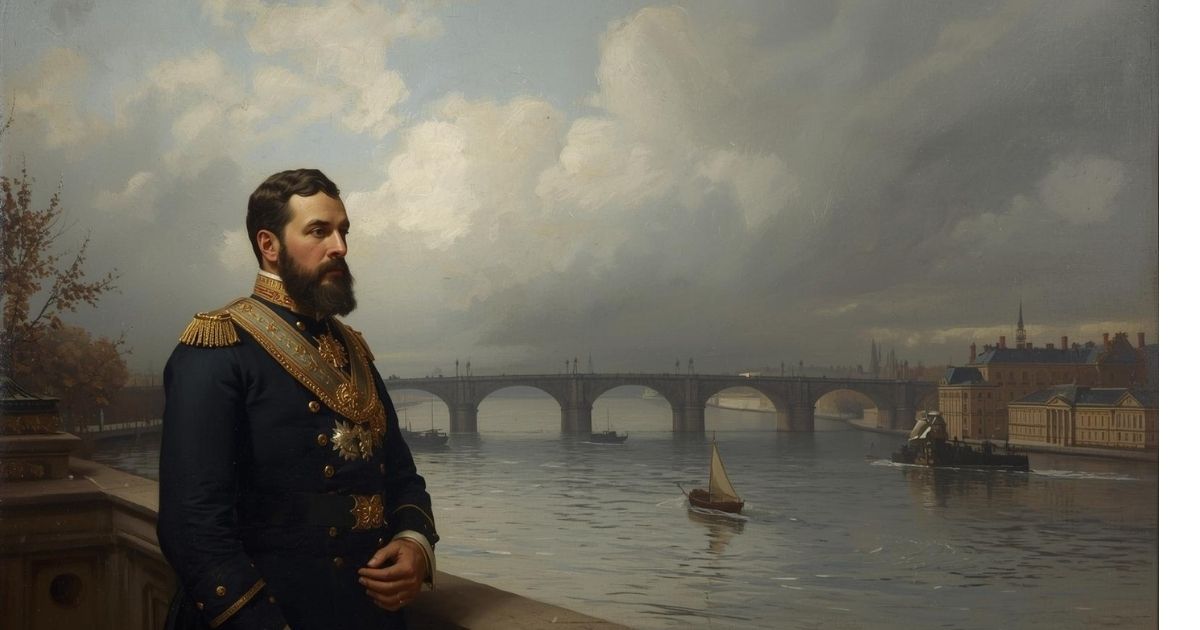
An excerpt from the original text.(complete · 4934 words)
t was late now, nearly half-past two, and the prince did not find
General Epanchin at home. He left a card, and determined to look up
Colia, who had a room at a small hotel near. Colia was not in, but he
was informed that he might be back shortly, and had left word that if
he were not in by half-past three it was to be understood that he had
gone to Pavlofsk to General Epanchin’s, and would dine there. The
prince decided to wait till half-past three, and ordered some dinner.
At half-past three there was no sign of Colia. The prince waited until
four o’clock, and then strolled off mechanically wherever his feet
should carry him.
In early summer there are often magnificent days in St.
Petersburg—bright, hot and still. This happened to be such a day.
For some time the prince wandered about without aim or object. He did
not know the town well. He stopped to look about him on bridges, at
street corners. He entered a confectioner’s shop to rest, once. He was
in a state of nervous excitement and perturbation; he noticed nothing
and no one; and he felt a craving for solitude, to be alone with his
thoughts and his emotions, and to give himself up to them passively. He
loathed the idea of trying to answer the questions that would rise up
in his heart and mind. “I am not to blame for all this,” he thought to
himself, half unconsciously.
Towards six o’clock he found himself at the station of the
Tsarsko-Selski railway.
He was tired of solitude now; a new rush of feeling took hold of him,
and a flood of light chased away the gloom, for a moment, from his
soul. He took a ticket to Pavlofsk, and determined to get there as fast
as he could, but something stopped him; a reality, and not a fantasy,
as he was inclined to think it. He was about to take his place in a
carriage, when he suddenly threw away his ticket and came out again,
disturbed and thoughtful. A few moments later, in the street, he
recalled something that had bothered him all the afternoon. He caught
himself engaged in a strange occupation which he now recollected he had
taken up at odd moments for the last few hours—it was looking about all
around him for something, he did not know what. He had forgotten it for
a while, half an hour or so, and now, suddenly, the uneasy search had
recommenced.
But he had hardly become conscious of this curious phenomenon, when
another recollection suddenly swam through his brain, interesting him
for the moment, exceedingly. He remembered that the last time he had
been engaged in looking around him for the unknown something, he was
standing before a cutler’s shop, in the window of which were exposed
certain goods for sale. He was extremely anxious now to discover
whether this shop and these goods really existed, or whether the whole
thing had been a hallucination.
He felt in a very curious condition today, a condition similar to that
which had preceded his fits in bygone years.
He remembered that at such times he had been particularly absentminded,
and could not discriminate between objects and persons unless he
concentrated special attention upon them.
He remembered seeing something in the window marked at sixty copecks.
Therefore, if the shop existed and if this object were really in the
window, it would prove that he had been able to concentrate his
attention on this article at a moment when, as a general rule, his
absence of mind would have been too great to admit of any such
concentration; in fact, very shortly after he had left the railway
station in such a state of agitation.
So he walked back looking about him for the shop, and his heart beat
with intolerable impatience. Ah! here was the very shop, and there was
the article marked “60 cop.” Of course, it’s sixty copecks, he thought,
and certainly worth no more. This idea amused him and he laughed.
But it was a hysterical laugh; he was feeling terribly oppressed. He
remembered clearly that just here, standing before this window, he had
suddenly turned round, just as earlier in the day he had turned and
found the dreadful eyes of Rogojin fixed upon him. Convinced,
therefore, that in this respect at all events he had been under no
delusion, he left the shop and went on.
This must be thought out; it was clear that there had been no
hallucination at the station then, either; something had actually
happened to him, on both occasions; there was no doubt of it. But again
a loathing for all mental exertion overmastered him; he would not think
it out now, he would put it off and think of something else. He
remembered that during his epileptic fits, or rather immediately
preceding them, he had always experienced a moment or two when his
whole heart, and mind, and body seemed to wake up to vigour and light;
when he became filled with joy and hope, and all his anxieties seemed
to be swept away for ever; these moments were but presentiments, as it
were, of the one final second (it was never more than a second) in
which the fit came upon him. That second, of course, was inexpressible.
When his attack was over, and the prince reflected on his symptoms, he
used to say to himself: “These moments, short as they are, when I feel
such extreme consciousness of myself, and consequently more of life
than at other times, are due only to the disease—to the sudden rupture
of normal conditions. Therefore they are not really a higher kind of
life, but a lower.” This reasoning, however, seemed to end in a
paradox, and lead to the further consideration:—“What matter though it
be only disease, an abnormal tension of the brain, if when I recall and
analyze the moment, it seems to have been one of harmony and beauty in
the highest degree—an instant of deepest sensation, overflowing with
unbounded joy and rapture, ecstatic devotion, and completest life?”
Vague though this sounds, it was perfectly comprehensible to Muishkin,
though he knew that it was but a feeble expression of his sensations.
That there was, indeed, beauty and harmony in those abnormal moments,
that they really contained the highest synthesis of life, he could not
doubt, nor even admit the possibility of doubt. He felt that they were
not analogous to the fantastic and unreal dreams due to intoxication by
hashish, opium or wine. Of that he could judge, when the attack was
over. These instants were characterized—to define it in a word—by an
intense quickening of the sense of personality. Since, in the last
conscious moment preceding the attack, he could say to himself, with
full understanding of his words: “I would give my whole life for this
one instant,” then doubtless to him it really was worth a lifetime. For
the rest, he thought the dialectical part of his argument of little
worth; he saw only too clearly that the result of these ecstatic
moments was stupefaction, mental darkness, idiocy. No argument was
possible on that point. His conclusion, his estimate of the “moment,”
doubtless contained some error, yet the reality of the sensation
troubled him. What’s more unanswerable than a fact? And this fact had
occurred. The prince had confessed unreservedly to himself that the
feeling of intense beatitude in that crowded moment made the moment
worth a lifetime. “I feel then,” he said one day to Rogojin in Moscow,
“I feel then as if I understood those amazing words—‘There shall be no
more time.’” And he added with a smile: “No doubt the epileptic Mahomet
refers to that same moment when he says that he visited all the
dwellings of Allah, in less time than was needed to empty his pitcher
of water.” Yes, he had often met Rogojin in Moscow, and many were the
subjects they discussed. “He told me I had been a brother to him,”
thought the prince. “He said so today, for the first time.”
He was sitting in the Summer Garden on a seat under a tree, and his
mind dwelt on the matter. It was about seven o’clock, and the place was
empty. The stifling atmosphere foretold a storm, and the prince felt a
certain charm in the contemplative mood which possessed him. He found
pleasure, too, in gazing at the exterior objects around him. All the
time he was trying to forget some thing, to escape from some idea that
haunted him; but melancholy thoughts came back, though he would so
willingly have escaped from them. He remembered suddenly how he had
been talking to the waiter, while he dined, about a recently committed
murder which the whole town was discussing, and as he thought of it
something strange came over him. He was seized all at once by a violent
desire, almost a temptation, against which he strove in vain.
He jumped up and walked off as fast as he could towards the “Petersburg
Side.” [One of the quarters of St. Petersburg.] He had asked someone, a
little while before, to show him which was the Petersburg Side, on the
banks of the Neva. He had not gone there, however; and he knew very
well that it was of no use to go now, for he would certainly not find
Lebedeff’s relation at home. He had the address, but she must certainly
have gone to Pavlofsk, or Colia would have let him know. If he were to
go now, it would merely be out of curiosity, but a sudden, new idea had
come into his head.
However, it was something to move on and know where he was going. A
minute later he was still moving on, but without knowing anything. He
could no longer think out his new idea. He tried to take an interest in
all he saw; in the sky, in the Neva. He spoke to some children he met.
He felt his epileptic condition becoming more and more developed. The
evening was very close; thunder was heard some way off.
The prince was haunted all that day by the face of Lebedeff’s nephew
whom he had seen for the first time that morning, just as one is
haunted at times by some persistent musical refrain. By a curious
association of ideas, the young man always appeared as the murderer of
whom Lebedeff had spoken when introducing him to Muishkin. Yes, he had
read something about the murder, and that quite recently. Since he came
to Russia, he had heard many stories of this kind, and was interested
in them. His conversation with the waiter, an hour ago, chanced to be
on the subject of this murder of the Zemarins, and the latter had
agreed with him about it. He thought of the waiter again, and decided
that he was no fool, but a steady, intelligent man: though, said he to
himself, “God knows what he may really be; in a country with which one
is unfamiliar it is difficult to understand the people one meets.” He
was beginning to have a passionate faith in the Russian soul, however,
and what discoveries he had made in the last six months, what
unexpected discoveries! But every soul is a mystery, and depths of
mystery lie in the soul of a Russian. He had been intimate with
Rogojin, for example, and a brotherly friendship had sprung up between
them—yet did he really know him? What chaos and ugliness fills the
world at times! What a self-satisfied rascal is that nephew of
Lebedeff’s! “But what am I thinking,” continued the prince to himself.
“Can he really have committed that crime? Did he kill those six
persons? I seem to be confusing things... how strange it all is.... My
head goes round... And Lebedeff’s daughter—how sympathetic and charming
her face was as she held the child in her arms! What an innocent look
and child-like laugh she had! It is curious that I had forgotten her
until now. I expect Lebedeff adores her—and I really believe, when I
think of it, that as sure as two and two make four, he is fond of that
nephew, too!”
Well, why should he judge them so hastily! Could he really say what
they were, after one short visit? Even Lebedeff seemed an enigma today.
Did he expect to find him so? He had never seen him like that before.
Lebedeff and the Comtesse du Barry! Good Heavens! If Rogojin should
really kill someone, it would not, at any rate, be such a senseless,
chaotic affair. A knife made to a special pattern, and six people
killed in a kind of delirium. But Rogojin also had a knife made to a
special pattern. Can it be that Rogojin wishes to murder anyone? The
prince began to tremble violently. “It is a crime on my part to imagine
anything so base, with such cynical frankness.” His face reddened with
shame at the thought; and then there came across him as in a flash the
memory of the incidents at the Pavlofsk station, and at the other
station in the morning; and the question asked him by Rogojin about
the eyes and Rogojin’s cross, that he was even now wearing; and the
benediction of Rogojin’s mother; and his embrace on the darkened
staircase—that last supreme renunciation—and now, to find himself full
of this new “idea,” staring into shop-windows, and looking round for
things—how base he was!
Despair overmastered his soul; he would not go on, he would go back to
his hotel; he even turned and went the other way; but a moment after he
changed his mind again and went on in the old direction.
Why, here he was on the Petersburg Side already, quite close to the
house! Where was his “idea”? He was marching along without it now. Yes,
his malady was coming back, it was clear enough; all this gloom and
heaviness, all these “ideas,” were nothing more nor less than a fit
coming on; perhaps he would have a fit this very day.
But just now all the gloom and darkness had fled, his heart felt full
of joy and hope, there was no such thing as doubt. And yes, he hadn’t
seen her for so long; he really must see her. He wished he could meet
Rogojin; he would take his hand, and they would go to her together. His
heart was pure, he was no rival of Parfen’s. Tomorrow, he would go and
tell him that he had seen her. Why, he had only come for the sole
purpose of seeing her, all the way from Moscow! Perhaps she might be
here still, who knows? She might not have gone away to Pavlofsk yet.
Yes, all this must be put straight and above-board, there must be no
more passionate renouncements, such as Rogojin’s. It must all be clear
as day. Cannot Rogojin’s soul bear the light? He said he did not love
her with sympathy and pity; true, he added that “your pity is greater
than my love,” but he was not quite fair on himself there. Kin! Rogojin
reading a book—wasn’t that sympathy beginning? Did it not show that he
comprehended his relations with her? And his story of waiting day and
night for her forgiveness? That didn’t look quite like passion alone.
And as to her face, could it inspire nothing but passion? Could her
face inspire passion at all now? Oh, it inspired suffering, grief,
overwhelming grief of the soul! A poignant, agonizing memory swept over
the prince’s heart.
Yes, agonizing. He remembered how he had suffered that first day when
he thought he observed in her the symptoms of madness. He had almost
fallen into despair. How could he have lost his hold upon her when she
ran away from him to Rogojin? He ought to have run after her himself,
rather than wait for news as he had done. Can Rogojin have failed to
observe, up to now, that she is mad? Rogojin attributes her strangeness
to other causes, to passion! What insane jealousy! What was it he had
hinted at in that suggestion of his? The prince suddenly blushed, and
shuddered to his very heart.
But why recall all this? There was insanity on both sides. For him, the
prince, to love this woman with passion, was unthinkable. It would be
cruel and inhuman. Yes. Rogojin is not fair to himself; he has a large
heart; he has aptitude for sympathy. When he learns the truth, and
finds what a pitiable being is this injured, broken, half-insane
creature, he will forgive her all the torment she has caused him. He
will become her slave, her brother, her friend. Compassion will teach
even Rogojin, it will show him how to reason. Compassion is the chief
law of human existence. Oh, how guilty he felt towards Rogojin! And,
for a few warm, hasty words spoken in Moscow, Parfen had called him
“brother,” while he—but no, this was delirium! It would all come right!
That gloomy Parfen had implied that his faith was waning; he must
suffer dreadfully. He said he liked to look at that picture; it was not
that he liked it, but he felt the need of looking at it. Rogojin was
not merely a passionate soul; he was a fighter. He was fighting for the
restoration of his dying faith. He must have something to hold on to
and believe, and someone to believe in. What a strange picture that of
Holbein’s is! Why, this is the street, and here’s the house, No. 16.
The prince rang the bell, and asked for Nastasia Philipovna. The lady
of the house came out, and stated that Nastasia had gone to stay with
Daria Alexeyevna at Pavlofsk, and might be there some days.
Madame Filisoff was a little woman of forty, with a cunning face, and
crafty, piercing eyes. When, with an air of mystery, she asked her
visitor’s name, he refused at first to answer, but in a moment he
changed his mind, and left strict instructions that it should be given
to Nastasia Philipovna. The urgency of his request seemed to impress
Madame Filisoff, and she put on a knowing expression, as if to say,
“You need not be afraid, I quite understand.” The prince’s name
evidently was a great surprise to her. He stood and looked absently at
her for a moment, then turned, and took the road back to his hotel. But
he went away not as he came. A great change had suddenly come over him.
He went blindly forward; his knees shook under him; he was tormented by
“ideas”; his lips were blue, and trembled with a feeble, meaningless
smile. His demon was upon him once more.
What had happened to him? Why was his brow clammy with drops of
moisture, his knees shaking beneath him, and his soul oppressed with a
cold gloom? Was it because he had just seen these dreadful eyes again?
Why, he had left the Summer Garden on purpose to see them; that had
been his “idea.” He had wished to assure himself that he would see them
once more at that house. Then why was he so overwhelmed now, having
seen them as he expected? just as though he had not expected to see
them! Yes, they were the very same eyes; and no doubt about it. The
same that he had seen in the crowd that morning at the station, the
same that he had surprised in Rogojin’s rooms some hours later, when
the latter had replied to his inquiry with a sneering laugh, “Well,
whose eyes were they?” Then for the third time they had appeared just
as he was getting into the train on his way to see Aglaya. He had had a
strong impulse to rush up to Rogojin, and repeat his words of the
morning “Whose eyes are they?” Instead he had fled from the station,
and knew nothing more, until he found himself gazing into the window of
a cutler’s shop, and wondering if a knife with a staghorn handle would
cost more than sixty copecks. And as the prince sat dreaming in the
Summer Garden under a lime-tree, a wicked demon had come and whispered
in his car: “Rogojin has been spying upon you and watching you all the
morning in a frenzy of desperation. When he finds you have not gone to
Pavlofsk—a terrible discovery for him—he will surely go at once to that
house in Petersburg Side, and watch for you there, although only this
morning you gave your word of honour not to see her, and swore that
you had not come to Petersburg for that purpose.” And thereupon the
prince had hastened off to that house, and what was there in the fact
that he had met Rogojin there? He had only seen a wretched, suffering
creature, whose state of mind was gloomy and miserable, but most
comprehensible. In the morning Rogojin had seemed to be trying to keep
out of the way; but at the station this afternoon he had stood out, he
had concealed himself, indeed, less than the prince himself; at the
house, now, he had stood fifty yards off on the other side of the road,
with folded hands, watching, plainly in view and apparently desirous of
being seen. He had stood there like an accuser, like a judge, not like
a—a what?
And why had not the prince approached him and spoken to him, instead of
turning away and pretending he had seen nothing, although their eyes
met? (Yes, their eyes had met, and they had looked at each other.) Why,
he had himself wished to take Rogojin by the hand and go in together,
he had himself determined to go to him on the morrow and tell him that
he had seen her, he had repudiated the demon as he walked to the house,
and his heart had been full of joy.
Was there something in the whole aspect of the man, today, sufficient
to justify the prince’s terror, and the awful suspicions of his demon?
Something seen, but indescribable, which filled him with dreadful
presentiments? Yes, he was convinced of it—convinced of what? (Oh, how
mean and hideous of him to feel this conviction, this presentiment! How
he blamed himself for it!) “Speak if you dare, and tell me, what is the
presentiment?” he repeated to himself, over and over again. “Put it
into words, speak out clearly and distinctly. Oh, miserable coward that
I am!” The prince flushed with shame for his own baseness. “How shall I
ever look this man in the face again? My God, what a day! And what a
nightmare, what a nightmare!”
There was a moment, during this long, wretched walk back from the
Petersburg Side, when the prince felt an irresistible desire to go
straight to Rogojin’s, wait for him, embrace him with tears of shame
and contrition, and tell him of his distrust, and finish with it—once
for all.
But here he was back at his hotel.
How often during the day he had thought of this hotel with loathing—its
corridor, its rooms, its stairs. How he had dreaded coming back to it,
for some reason.
“What a regular old woman I am today,” he had said to himself each
time, with annoyance. “I believe in every foolish presentiment that
comes into my head.”
He stopped for a moment at the door; a great flush of shame came over
him. “I am a coward, a wretched coward,” he said, and moved forward
again; but once more he paused.
Among all the incidents of the day, one recurred to his mind to the
exclusion of the rest; although now that his self-control was regained,
and he was no longer under the influence of a nightmare, he was able to
think of it calmly. It concerned the knife on Rogojin’s table. “Why
should not Rogojin have as many knives on his table as he chooses?”
thought the prince, wondering at his suspicions, as he had done when he
found himself looking into the cutler’s window. “What could it have to
do with me?” he said to himself again, and stopped as if rooted to the
ground by a kind of paralysis of limb such as attacks people under the
stress of some humiliating recollection.
The doorway was dark and gloomy at any time; but just at this moment it
was rendered doubly so by the fact that the thunder-storm had just
broken, and the rain was coming down in torrents.
And in the semi-darkness the prince distinguished a man standing close
to the stairs, apparently waiting.
There was nothing particularly significant in the fact that a man was
standing back in the doorway, waiting to come out or go upstairs; but
the prince felt an irresistible conviction that he knew this man, and
that it was Rogojin. The man moved on up the stairs; a moment later the
prince passed up them, too. His heart froze within him. “In a minute or
two I shall know all,” he thought.
The staircase led to the first and second corridors of the hotel, along
which lay the guests’ bedrooms. As is often the case in Petersburg
houses, it was narrow and very dark, and turned around a massive stone
column.
On the first landing, which was as small as the necessary turn of the
stairs allowed, there was a niche in the column, about half a yard
wide, and in this niche the prince felt convinced that a man stood
concealed. He thought he could distinguish a figure standing there. He
would pass by quickly and not look. He took a step forward, but could
bear the uncertainty no longer and turned his head.
The eyes—the same two eyes—met his! The man concealed in the niche had
also taken a step forward. For one second they stood face to face.
Suddenly the prince caught the man by the shoulder and twisted him
round towards the light, so that he might see his face more clearly.
Rogojin’s eyes flashed, and a smile of insanity distorted his
countenance. His right hand was raised, and something glittered in it.
The prince did not think of trying to stop it. All he could remember
afterwards was that he seemed to have called out:
“Parfen! I won’t believe it.”
Next moment something appeared to burst open before him: a wonderful
inner light illuminated his soul. This lasted perhaps half a second,
yet he distinctly remembered hearing the beginning of the wail, the
strange, dreadful wail, which burst from his lips of its own accord,
and which no effort of will on his part could suppress.
Next moment he was absolutely unconscious; black darkness blotted out
everything.
He had fallen in an epileptic fit.
As is well known, these fits occur instantaneously. The face,
especially the eyes, become terribly disfigured, convulsions seize the
limbs, a terrible cry breaks from the sufferer, a wail from which
everything human seems to be blotted out, so that it is impossible to
believe that the man who has just fallen is the same who emitted the
dreadful cry. It seems more as though some other being, inside the
stricken one, had cried. Many people have borne witness to this
impression; and many cannot behold an epileptic fit without a feeling
of mysterious terror and dread.
Such a feeling, we must suppose, overtook Rogojin at this moment, and
saved the prince’s life. Not knowing that it was a fit, and seeing his
victim disappear head foremost into the darkness, hearing his head
strike the stone steps below with a crash, Rogojin rushed downstairs,
skirting the body, and flung himself headlong out of the hotel, like a
raving madman.
The prince’s body slipped convulsively down the steps till it rested at
the bottom. Very soon, in five minutes or so, he was discovered, and a
crowd collected around him.
A pool of blood on the steps near his head gave rise to grave fears.
Was it a case of accident, or had there been a crime? It was, however,
soon recognized as a case of epilepsy, and identification and proper
measures for restoration followed one another, owing to a fortunate
circumstance. Colia Ivolgin had come back to his hotel about seven
o’clock, owing to a sudden impulse which made him refuse to dine at the
Epanchins’, and, finding a note from the prince awaiting him, had sped
away to the latter’s address. Arrived there, he ordered a cup of tea
and sat sipping it in the coffee-room. While there he heard excited
whispers of someone just found at the bottom of the stairs in a fit;
upon which he had hurried to the spot, with a presentiment of evil, and
at once recognized the prince.
The sufferer was immediately taken to his room, and though he partially
regained consciousness, he lay long in a semi-dazed condition.
The doctor stated that there was no danger to be apprehended from the
wound on the head, and as soon as the prince could understand what was
going on around him, Colia hired a carriage and took him away to
Lebedeff’s. There he was received with much cordiality, and the
departure to the country was hastened on his account. Three days later
they were all at Pavlofsk.
Master this chapter. Complete your experience
Purchase the complete book to access all chapters and support classic literature
As an Amazon Associate, we earn a small commission from qualifying purchases at no additional cost to you.
Available in paperback, hardcover, and e-book formats
Let's Analyse the Pattern
Heightened awareness from stress makes us both more perceptive of real threats and more likely to create imaginary ones.
Why This Matters
Connect literature to life
This chapter teaches how to honor gut feelings while avoiding the spiral of trauma-driven hypervigilance.
Practice This Today
This week, notice when you feel 'something's wrong'—ask yourself what specific evidence supports this feeling versus what might be anxiety amplifying real concerns.
Now let's explore the literary elements.
Key Quotes & Analysis
"I am not to blame for all this"
Context: Muishkin tries to convince himself he's not responsible for the escalating situation
Shows how people rationalize their role in conflicts, even when their actions (or inaction) contribute to the problem. Muishkin's passivity enables the dangerous situation.
In Today's Words:
This isn't my fault - I didn't ask for any of this drama
"He loathed the idea of trying to answer the questions that would rise up in his heart and mind"
Context: Describing Muishkin's mental state as he wanders the city
Captures the human tendency to avoid difficult self-examination when we're overwhelmed. Sometimes we'd rather stay confused than face hard truths.
In Today's Words:
He didn't want to deal with all the thoughts and feelings he'd have to sort through
"Those eyes again!"
Context: When he spots Rogojin watching him from a crowd
Represents the paranoid awareness that comes with being stalked or threatened. The repetition shows how trauma creates hypervigilance.
In Today's Words:
I swear that's him watching me again!
Thematic Threads
Mental Illness
In This Chapter
Muishkin's epilepsy creates both supernatural awareness and vulnerability, showing how neurological differences can be both gift and burden
Development
Deepened from earlier chapters to show the complex relationship between mental illness and perception
In Your Life:
You might recognize how your own anxiety or depression sometimes gives you insights others miss while also creating problems others don't have
Avoidance
In This Chapter
Both characters avoid direct confrontation about their shared obsession with Nastasia, leading to violence instead of resolution
Development
Escalated from earlier social avoidance to life-threatening consequences
In Your Life:
You might see how avoiding difficult conversations at work or home often makes the eventual confrontation much worse
Class Anxiety
In This Chapter
Muishkin's wandering through different parts of the city reflects his inability to find his place in any social stratum
Development
Continued exploration of his displacement from earlier chapters
In Your Life:
You might recognize the exhaustion of never quite fitting in anywhere—too educated for some spaces, not credentialed enough for others
Obsession
In This Chapter
Rogojin's stalking behavior shows how obsession transforms love into possession and ultimately violence
Development
Intensified from earlier jealousy to active predatory behavior
In Your Life:
You might notice how your own intense feelings about someone can sometimes cross the line from caring to controlling
Salvation
In This Chapter
Muishkin's seizure literally saves his life, suggesting that what seems like weakness can sometimes be protection
Development
New twist on earlier themes of his 'holy fool' nature being both burden and blessing
In Your Life:
You might recognize times when what felt like your worst trait actually protected you from something worse
You now have the context. Time to form your own thoughts.
Discussion Questions
- 1
What physical and mental signs warned Myshkin that something dangerous was approaching, and how did he try to test whether his perceptions were real?
analysis • surface - 2
Why did Myshkin's epileptic seizure actually save his life, and what does this reveal about how unexpected events can change outcomes?
analysis • medium - 3
Where have you seen someone's gut instincts be both accurate and overwhelming - like sensing real workplace tension but then reading threat into every interaction?
application • medium - 4
When you feel that 'something's wrong' sensation, how could you honor your intuition while avoiding the anxiety spiral that makes you question everything?
application • deep - 5
What does this chapter teach about the relationship between heightened awareness and vulnerability - how being more perceptive can make us both safer and more anxious?
reflection • deep
Critical Thinking Exercise
Map Your Early Warning System
Think of a recent time when you had a strong gut feeling that something was wrong - whether about a relationship, work situation, or family dynamic. Map out what specific signals your subconscious picked up versus what anxiety added to the mix. Then identify one concrete action you could have taken to address the real issue instead of spiraling.
Consider:
- •Physical sensations often carry information - tension, restlessness, or sleep disruption can signal real problems
- •Distinguish between patterns you're actually observing versus fears your mind is creating
- •Consider what difficult conversation or direct action might have resolved the uncertainty
Journaling Prompt
Write about a time when your intuition was trying to warn you about something real, but anxiety made you doubt yourself. What would you do differently now to trust your perceptions while managing the worry?
Coming Up Next...
Chapter 22: The Overprotective Host and Social Tensions
At Lebedeff's country house, the prince must recover from both his physical injuries and the psychological trauma of Rogojin's attack, while the complex web of relationships around the Epanchin family continues to tighten.