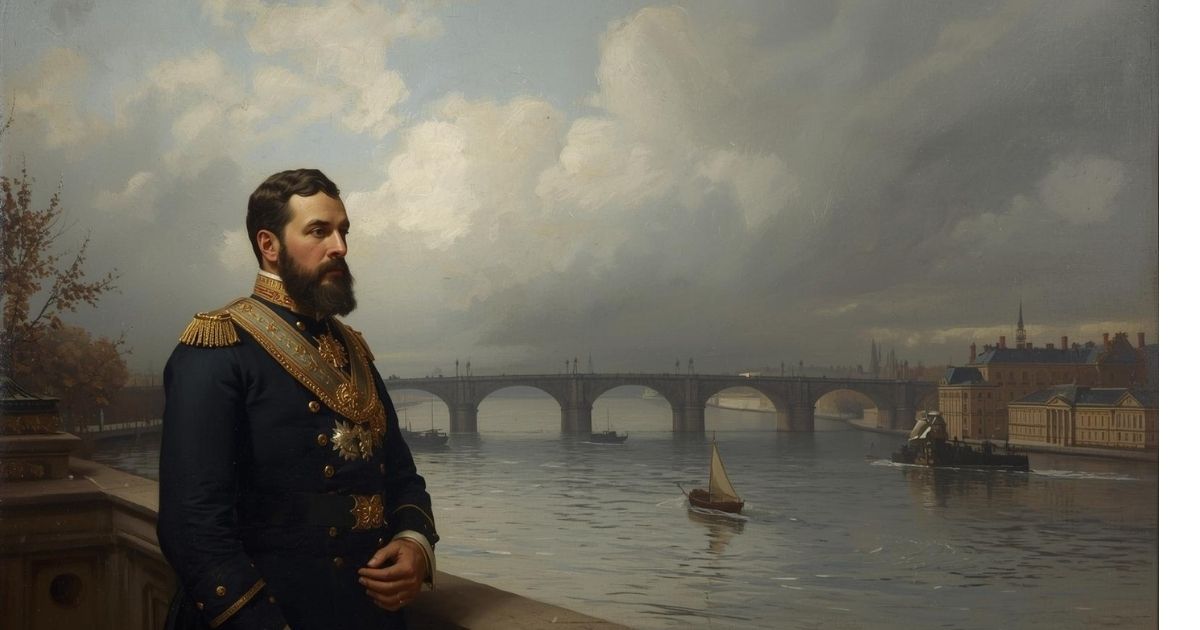
An excerpt from the original text.(complete · 4057 words)
eneral Epanchin lived in his own house near the Litaynaya. Besides
this large residence—five-sixths of which was let in flats and
lodgings—the general was owner of another enormous house in the
Sadovaya bringing in even more rent than the first. Besides these
houses he had a delightful little estate just out of town, and some
sort of factory in another part of the city. General Epanchin, as
everyone knew, had a good deal to do with certain government
monopolies; he was also a voice, and an important one, in many rich
public companies of various descriptions; in fact, he enjoyed the
reputation of being a well-to-do man of busy habits, many ties, and
affluent means. He had made himself indispensable in several quarters,
amongst others in his department of the government; and yet it was a
known fact that Fedor Ivanovitch Epanchin was a man of no education
whatever, and had absolutely risen from the ranks.
This last fact could, of course, reflect nothing but credit upon the
general; and yet, though unquestionably a sagacious man, he had his own
little weaknesses—very excusable ones,—one of which was a dislike to
any allusion to the above circumstance. He was undoubtedly clever. For
instance, he made a point of never asserting himself when he would gain
more by keeping in the background; and in consequence many exalted
personages valued him principally for his humility and simplicity, and
because “he knew his place.” And yet if these good people could only
have had a peep into the mind of this excellent fellow who “knew his
place” so well! The fact is that, in spite of his knowledge of the
world and his really remarkable abilities, he always liked to appear to
be carrying out other people’s ideas rather than his own. And also, his
luck seldom failed him, even at cards, for which he had a passion that
he did not attempt to conceal. He played for high stakes, and moved,
altogether, in very varied society.
As to age, General Epanchin was in the very prime of life; that is,
about fifty-five years of age,—the flowering time of existence, when
real enjoyment of life begins. His healthy appearance, good colour,
sound, though discoloured teeth, sturdy figure, preoccupied air during
business hours, and jolly good humour during his game at cards in the
evening, all bore witness to his success in life, and combined to make
existence a bed of roses to his excellency. The general was lord of a
flourishing family, consisting of his wife and three grown-up
daughters. He had married young, while still a lieutenant, his wife
being a girl of about his own age, who possessed neither beauty nor
education, and who brought him no more than fifty souls of landed
property, which little estate served, however, as a nest-egg for far
more important accumulations. The general never regretted his early
marriage, or regarded it as a foolish youthful escapade; and he so
respected and feared his wife that he was very near loving her. Mrs.
Epanchin came of the princely stock of Muishkin, which if not a
brilliant, was, at all events, a decidedly ancient family; and she was
extremely proud of her descent.
With a few exceptions, the worthy couple had lived through their long
union very happily. While still young the wife had been able to make
important friends among the aristocracy, partly by virtue of her family
descent, and partly by her own exertions; while, in after life, thanks
to their wealth and to the position of her husband in the service, she
took her place among the higher circles as by right.
During these last few years all three of the general’s
daughters—Alexandra, Adelaida, and Aglaya—had grown up and matured. Of
course they were only Epanchins, but their mother’s family was noble;
they might expect considerable fortunes; their father had hopes of
attaining to very high rank indeed in his country’s service—all of
which was satisfactory. All three of the girls were decidedly pretty,
even the eldest, Alexandra, who was just twenty-five years old. The
middle daughter was now twenty-three, while the youngest, Aglaya, was
twenty. This youngest girl was absolutely a beauty, and had begun of
late to attract considerable attention in society. But this was not
all, for every one of the three was clever, well educated, and
accomplished.
It was a matter of general knowledge that the three girls were very
fond of one another, and supported each other in every way; it was even
said that the two elder ones had made certain sacrifices for the sake
of the idol of the household, Aglaya. In society they not only disliked
asserting themselves, but were actually retiring. Certainly no one
could blame them for being too arrogant or haughty, and yet everybody
was well aware that they were proud and quite understood their own
value. The eldest was musical, while the second was a clever artist,
which fact she had concealed until lately. In a word, the world spoke
well of the girls; but they were not without their enemies, and
occasionally people talked with horror of the number of books they had
read.
They were in no hurry to marry. They liked good society, but were not
too keen about it. All this was the more remarkable, because everyone
was well aware of the hopes and aims of their parents.
It was about eleven o’clock in the forenoon when the prince rang the
bell at General Epanchin’s door. The general lived on the first floor
or flat of the house, as modest a lodging as his position permitted. A
liveried servant opened the door, and the prince was obliged to enter
into long explanations with this gentleman, who, from the first glance,
looked at him and his bundle with grave suspicion. At last, however, on
the repeated positive assurance that he really was Prince Muishkin, and
must absolutely see the general on business, the bewildered domestic
showed him into a little ante-chamber leading to a waiting-room that
adjoined the general’s study, there handing him over to another
servant, whose duty it was to be in this ante-chamber all the morning,
and announce visitors to the general. This second individual wore a
dress coat, and was some forty years of age; he was the general’s
special study servant, and well aware of his own importance.
“Wait in the next room, please; and leave your bundle here,” said the
door-keeper, as he sat down comfortably in his own easy-chair in the
ante-chamber. He looked at the prince in severe surprise as the latter
settled himself in another chair alongside, with his bundle on his
knees.
“If you don’t mind, I would rather sit here with you,” said the prince;
“I should prefer it to sitting in there.”
“Oh, but you can’t stay here. You are a visitor—a guest, so to speak.
Is it the general himself you wish to see?”
The man evidently could not take in the idea of such a shabby-looking
visitor, and had decided to ask once more.
“Yes—I have business—” began the prince.
“I do not ask you what your business may be, all I have to do is to
announce you; and unless the secretary comes in here I cannot do that.”
The man’s suspicions seemed to increase more and more. The prince was
too unlike the usual run of daily visitors; and although the general
certainly did receive, on business, all sorts and conditions of men,
yet in spite of this fact the servant felt great doubts on the subject
of this particular visitor. The presence of the secretary as an
intermediary was, he judged, essential in this case.
“Surely you—are from abroad?” he inquired at last, in a confused sort
of way. He had begun his sentence intending to say, “Surely you are not
Prince Muishkin, are you?”
“Yes, straight from the train! Did not you intend to say, ‘Surely you
are not Prince Muishkin?’ just now, but refrained out of politeness?”
“H’m!” grunted the astonished servant.
“I assure you I am not deceiving you; you shall not have to answer for
me. As to my being dressed like this, and carrying a bundle, there’s
nothing surprising in that—the fact is, my circumstances are not
particularly rosy at this moment.”
“H’m!—no, I’m not afraid of that, you see; I have to announce you,
that’s all. The secretary will be out directly—that is, unless you—yes,
that’s the rub—unless you—come, you must allow me to ask you—you’ve not
come to beg, have you?”
“Oh dear no, you can be perfectly easy on that score. I have quite
another matter on hand.”
“You must excuse my asking, you know. Your appearance led me to
think—but just wait for the secretary; the general is busy now, but the
secretary is sure to come out.”
“Oh—well, look here, if I have some time to wait, would you mind
telling me, is there any place about where I could have a smoke? I have
my pipe and tobacco with me.”
“Smoke?” said the man, in shocked but disdainful surprise, blinking
his eyes at the prince as though he could not believe his senses. “No,
sir, you cannot smoke here, and I wonder you are not ashamed of the
very suggestion. Ha, ha! a cool idea that, I declare!”
“Oh, I didn’t mean in this room! I know I can’t smoke here, of course.
I’d adjourn to some other room, wherever you like to show me to. You
see, I’m used to smoking a good deal, and now I haven’t had a puff for
three hours; however, just as you like.”
“Now how on earth am I to announce a man like that?” muttered the
servant. “In the first place, you’ve no right in here at all; you ought
to be in the waiting-room, because you’re a sort of visitor—a guest, in
fact—and I shall catch it for this. Look here, do you intend to take up
you abode with us?” he added, glancing once more at the prince’s
bundle, which evidently gave him no peace.
“No, I don’t think so. I don’t think I should stay even if they were to
invite me. I’ve simply come to make their acquaintance, and nothing
more.”
“Make their acquaintance?” asked the man, in amazement, and with
redoubled suspicion. “Then why did you say you had business with the
general?”
“Oh well, very little business. There is one little matter—some advice
I am going to ask him for; but my principal object is simply to
introduce myself, because I am Prince Muishkin, and Madame Epanchin is
the last of her branch of the house, and besides herself and me there
are no other Muishkins left.”
“What—you’re a relation then, are you?” asked the servant, so
bewildered that he began to feel quite alarmed.
“Well, hardly so. If you stretch a point, we are relations, of course,
but so distant that one cannot really take cognizance of it. I once
wrote to your mistress from abroad, but she did not reply. However, I
have thought it right to make acquaintance with her on my arrival. I am
telling you all this in order to ease your mind, for I see you are
still far from comfortable on my account. All you have to do is to
announce me as Prince Muishkin, and the object of my visit will be
plain enough. If I am received—very good; if not, well, very good
again. But they are sure to receive me, I should think; Madame Epanchin
will naturally be curious to see the only remaining representative of
her family. She values her Muishkin descent very highly, if I am
rightly informed.”
The prince’s conversation was artless and confiding to a degree, and
the servant could not help feeling that as from visitor to common
serving-man this state of things was highly improper. His conclusion
was that one of two things must be the explanation—either that this was
a begging impostor, or that the prince, if prince he were, was simply a
fool, without the slightest ambition; for a sensible prince with any
ambition would certainly not wait about in ante-rooms with servants,
and talk of his own private affairs like this. In either case, how was
he to announce this singular visitor?
“I really think I must request you to step into the next room!” he
said, with all the insistence he could muster.
“Why? If I had been sitting there now, I should not have had the
opportunity of making these personal explanations. I see you are still
uneasy about me and keep eyeing my cloak and bundle. Don’t you think
you might go in yourself now, without waiting for the secretary to come
out?”
“No, no! I can’t announce a visitor like yourself without the
secretary. Besides the general said he was not to be disturbed—he is
with the Colonel C—. Gavrila Ardalionovitch goes in without
announcing.”
“Who may that be? a clerk?”
“What? Gavrila Ardalionovitch? Oh no; he belongs to one of the
companies. Look here, at all events put your bundle down, here.”
“Yes, I will if I may; and—can I take off my cloak”
“Of course; you can’t go in there with it on, anyhow.”
The prince rose and took off his mantle, revealing a neat enough
morning costume—a little worn, but well made. He wore a steel watch
chain and from this chain there hung a silver Geneva watch. Fool the
prince might be, still, the general’s servant felt that it was not
correct for him to continue to converse thus with a visitor, in spite
of the fact that the prince pleased him somehow.
“And what time of day does the lady receive?” the latter asked,
reseating himself in his old place.
“Oh, that’s not in my province! I believe she receives at any time;
it depends upon the visitors. The dressmaker goes in at eleven. Gavrila
Ardalionovitch is allowed much earlier than other people, too; he is
even admitted to early lunch now and then.”
“It is much warmer in the rooms here than it is abroad at this season,”
observed the prince; “but it is much warmer there out of doors. As for
the houses—a Russian can’t live in them in the winter until he gets
accustomed to them.”
“Don’t they heat them at all?”
“Well, they do heat them a little; but the houses and stoves are so
different to ours.”
“H’m! were you long away?”
“Four years! and I was in the same place nearly all the time,—in one
village.”
“You must have forgotten Russia, hadn’t you?”
“Yes, indeed I had—a good deal; and, would you believe it, I often
wonder at myself for not having forgotten how to speak Russian? Even
now, as I talk to you, I keep saying to myself ‘how well I am speaking
it.’ Perhaps that is partly why I am so talkative this morning. I
assure you, ever since yesterday evening I have had the strongest
desire to go on and on talking Russian.”
“H’m! yes; did you live in Petersburg in former years?”
This good flunkey, in spite of his conscientious scruples, really could
not resist continuing such a very genteel and agreeable conversation.
“In Petersburg? Oh no! hardly at all, and now they say so much is
changed in the place that even those who did know it well are obliged
to relearn what they knew. They talk a good deal about the new law
courts, and changes there, don’t they?”
“H’m! yes, that’s true enough. Well now, how is the law over there, do
they administer it more justly than here?”
“Oh, I don’t know about that! I’ve heard much that is good about our
legal administration, too. There is no capital punishment here for one
thing.”
“Is there over there?”
“Yes—I saw an execution in France—at Lyons. Schneider took me over with
him to see it.”
“What, did they hang the fellow?”
“No, they cut off people’s heads in France.”
“What did the fellow do?—yell?”
“Oh no—it’s the work of an instant. They put a man inside a frame and a
sort of broad knife falls by machinery—they call the thing a
guillotine—it falls with fearful force and weight—the head springs off
so quickly that you can’t wink your eye in between. But all the
preparations are so dreadful. When they announce the sentence, you
know, and prepare the criminal and tie his hands, and cart him off to
the scaffold—that’s the fearful part of the business. The people all
crowd round—even women—though they don’t at all approve of women
looking on.”
“No, it’s not a thing for women.”
“Of course not—of course not!—bah! The criminal was a fine intelligent
fearless man; Le Gros was his name; and I may tell you—believe it or
not, as you like—that when that man stepped upon the scaffold he
cried, he did indeed,—he was as white as a bit of paper. Isn’t it a
dreadful idea that he should have cried—cried! Whoever heard of a grown
man crying from fear—not a child, but a man who never had cried
before—a grown man of forty-five years. Imagine what must have been
going on in that man’s mind at such a moment; what dreadful convulsions
his whole spirit must have endured; it is an outrage on the soul that’s
what it is. Because it is said ‘thou shalt not kill,’ is he to be
killed because he murdered some one else? No, it is not right, it’s an
impossible theory. I assure you, I saw the sight a month ago and it’s
dancing before my eyes to this moment. I dream of it, often.”
The prince had grown animated as he spoke, and a tinge of colour
suffused his pale face, though his way of talking was as quiet as ever.
The servant followed his words with sympathetic interest. Clearly he
was not at all anxious to bring the conversation to an end. Who knows?
Perhaps he too was a man of imagination and with some capacity for
thought.
“Well, at all events it is a good thing that there’s no pain when the
poor fellow’s head flies off,” he remarked.
“Do you know, though,” cried the prince warmly, “you made that remark
now, and everyone says the same thing, and the machine is designed with
the purpose of avoiding pain, this guillotine I mean; but a thought
came into my head then: what if it be a bad plan after all? You may
laugh at my idea, perhaps—but I could not help its occurring to me all
the same. Now with the rack and tortures and so on—you suffer terrible
pain of course; but then your torture is bodily pain only (although no
doubt you have plenty of that) until you die. But here I should
imagine the most terrible part of the whole punishment is, not the
bodily pain at all—but the certain knowledge that in an hour,—then in
ten minutes, then in half a minute, then now—this very instant—your
soul must quit your body and that you will no longer be a man—and that
this is certain, certain! That’s the point—the certainty of it. Just
that instant when you place your head on the block and hear the iron
grate over your head—then—that quarter of a second is the most awful of
all.
“This is not my own fantastical opinion—many people have thought the
same; but I feel it so deeply that I’ll tell you what I think. I
believe that to execute a man for murder is to punish him immeasurably
more dreadfully than is equivalent to his crime. A murder by sentence
is far more dreadful than a murder committed by a criminal. The man who
is attacked by robbers at night, in a dark wood, or anywhere,
undoubtedly hopes and hopes that he may yet escape until the very
moment of his death. There are plenty of instances of a man running
away, or imploring for mercy—at all events hoping on in some
degree—even after his throat was cut. But in the case of an execution,
that last hope—having which it is so immeasurably less dreadful to
die,—is taken away from the wretch and certainty substituted in its
place! There is his sentence, and with it that terrible certainty that
he cannot possibly escape death—which, I consider, must be the most
dreadful anguish in the world. You may place a soldier before a
cannon’s mouth in battle, and fire upon him—and he will still hope. But
read to that same soldier his death-sentence, and he will either go mad
or burst into tears. Who dares to say that any man can suffer this
without going mad? No, no! it is an abuse, a shame, it is
unnecessary—why should such a thing exist? Doubtless there may be men
who have been sentenced, who have suffered this mental anguish for a
while and then have been reprieved; perhaps such men may have been able
to relate their feelings afterwards. Our Lord Christ spoke of this
anguish and dread. No! no! no! No man should be treated so, no man, no
man!”
The servant, though of course he could not have expressed all this as
the prince did, still clearly entered into it and was greatly
conciliated, as was evident from the increased amiability of his
expression. “If you are really very anxious for a smoke,” he remarked,
“I think it might possibly be managed, if you are very quick about it.
You see they might come out and inquire for you, and you wouldn’t be on
the spot. You see that door there? Go in there and you’ll find a little
room on the right; you can smoke there, only open the window, because I
ought not to allow it really, and—.” But there was no time, after all.
A young fellow entered the ante-room at this moment, with a bundle of
papers in his hand. The footman hastened to help him take off his
overcoat. The new arrival glanced at the prince out of the corners of
his eyes.
“This gentleman declares, Gavrila Ardalionovitch,” began the man,
confidentially and almost familiarly, “that he is Prince Muishkin and a
relative of Madame Epanchin’s. He has just arrived from abroad, with
nothing but a bundle by way of luggage—.”
The prince did not hear the rest, because at this point the servant
continued his communication in a whisper.
Gavrila Ardalionovitch listened attentively, and gazed at the prince
with great curiosity. At last he motioned the man aside and stepped
hurriedly towards the prince.
“Are you Prince Muishkin?” he asked, with the greatest courtesy and
amiability.
He was a remarkably handsome young fellow of some twenty-eight summers,
fair and of middle height; he wore a small beard, and his face was most
intelligent. Yet his smile, in spite of its sweetness, was a little
thin, if I may so call it, and showed his teeth too evenly; his gaze
though decidedly good-humoured and ingenuous, was a trifle too
inquisitive and intent to be altogether agreeable.
“Probably when he is alone he looks quite different, and hardly smiles
at all!” thought the prince.
He explained about himself in a few words, very much the same as he had
told the footman and Rogojin beforehand.
Gavrila Ardalionovitch meanwhile seemed to be trying to recall
something.
“Was it not you, then, who sent a letter a year or less ago—from
Switzerland, I think it was—to Elizabetha Prokofievna (Mrs. Epanchin)?”
“It was.”
“Oh, then, of course they will remember who you are. You wish to see
the general? I’ll tell him at once—he will be free in a minute; but
you—you had better wait in the ante-chamber,—hadn’t you? Why is he
here?” he added, severely, to the man.
“I tell you, sir, he wished it himself!”
At this moment the study door opened, and a military man, with a
portfolio under his arm, came out talking loudly, and after bidding
good-bye to someone inside, took his departure.
“You there, Gania?” cried a voice from the study, “come in here, will
you?”
Gavrila Ardalionovitch nodded to the prince and entered the room
hastily.
A couple of minutes later the door opened again and the affable voice
of Gania cried:
“Come in please, prince!”
Master this chapter. Complete your experience
Purchase the complete book to access all chapters and support classic literature
As an Amazon Associate, we earn a small commission from qualifying purchases at no additional cost to you.
Available in paperback, hardcover, and e-book formats
Let's Analyse the Pattern
Performed power creates insecurity and exhaustion, while authentic power flows from honest self-knowledge and moral clarity.
Why This Matters
Connect literature to life
This chapter teaches how to distinguish between people who perform authority and those who embody it naturally through their actions and character.
Practice This Today
This week, notice when someone uses credentials or titles to shut down conversation versus when they lead through example and genuine expertise.
Now let's explore the literary elements.
Key Quotes & Analysis
"He had made himself indispensable in several quarters, amongst others in his department of the government; and yet it was a known fact that Fedor Ivanovitch Epanchin was a man of no education whatever, and had absolutely risen from the ranks."
Context: Describing General Epanchin's background and the contradiction between his success and humble origins
This quote captures the central tension of social mobility - how someone can be successful and valuable yet still feel insecure about their background. It shows how class anxiety persists even after achieving wealth and status.
In Today's Words:
He'd become the guy everyone needed to know in government circles, but everyone also knew he'd started with nothing and never went to college.
"He made a point of never asserting himself when he would gain more by keeping in the background; and in consequence many exalted personages valued him principally for his humility and simplicity, and because 'he knew his place.'"
Context: Explaining the general's strategy for maintaining his position among the nobility
This reveals the delicate dance of social climbing - knowing when to be humble and when to step forward. The general's success comes from understanding that sometimes power means not appearing powerful.
In Today's Words:
He was smart enough to stay quiet when it served him better, so the important people liked him because he didn't try to act like he was better than he was.
"The sight of a man being executed had turned his brain, and instead of the thing becoming easier with repetition, it had become more and more horrible to him."
Context: Prince Myshkin describing his reaction to witnessing an execution in France
This quote shows Myshkin's deep humanity and moral sensitivity. Unlike others who might become hardened to violence, he becomes more disturbed by it, revealing his fundamental goodness and the trauma that shapes his worldview.
In Today's Words:
Seeing someone get executed messed him up badly, and instead of getting used to it, it just got worse and worse for him.
Thematic Threads
Class Anxiety
In This Chapter
General Epanchin's wealth cannot erase his fear of being exposed as low-born, while Myshkin's poverty doesn't diminish his natural dignity
Development
Introduced here
In Your Life:
You might feel this when you get a promotion but worry you don't really deserve it, or when you code-switch between different social groups
Social Performance
In This Chapter
The household servants judge by appearance and expect certain behaviors from nobility, creating a complex dance of expectations
Development
Introduced here
In Your Life:
You see this when you feel pressure to act differently around your boss's boss, or when you change how you speak depending on who's listening
Recognition
In This Chapter
Myshkin's true nature gradually becomes visible to others despite his shabby appearance, while the general's insecurity shows despite his success
Development
Introduced here
In Your Life:
You experience this when someone sees your potential before you do, or when your character becomes clear to others over time
Moral Authority
In This Chapter
Myshkin's passionate stance against capital punishment reveals his deep convictions and wins respect from the servant
Development
Introduced here
In Your Life:
You might feel this when you take a stand on something that matters to you, even when it's unpopular or risky
Identity
In This Chapter
Characters struggle with who they really are versus who they appear to be, with Myshkin being the only one whose inner and outer selves align
Development
Introduced here
In Your Life:
You face this whenever you feel like you're wearing a mask at work, or when you wonder if people would like the 'real' you
You now have the context. Time to form your own thoughts.
Discussion Questions
- 1
Why does General Epanchin, despite his wealth and success, still feel anxious about his background and education?
analysis • surface - 2
How does Myshkin win over the suspicious servant despite looking poor and shabby?
analysis • medium - 3
Where have you seen someone try too hard to prove they belong or deserve respect? What gave them away?
application • medium - 4
When you feel insecure about your background or qualifications, how could Myshkin's approach help you navigate that situation?
application • deep - 5
What does this chapter reveal about the difference between earned respect and demanded respect?
reflection • deep
Critical Thinking Exercise
Map Your Power Moments
Think of two recent situations: one where you felt you had to prove yourself, and another where you felt naturally confident. Write down what was different about your mindset and behavior in each situation. What made the difference between performing power and embodying it?
Consider:
- •Notice how much energy each approach required
- •Consider how others responded to your authentic versus performed self
- •Think about which version of you felt more sustainable long-term
Journaling Prompt
Write about a time when someone's authentic presence surprised you. What did they do differently than people who try to impress? How did it change your view of real confidence?
Coming Up Next...
Chapter 3: An Awkward Introduction and Hidden Motives
Prince Myshkin finally meets General Epanchin face-to-face, where his unusual combination of innocence and insight will either charm or alarm the powerful man. Meanwhile, the general's family dynamics and hidden tensions begin to surface.