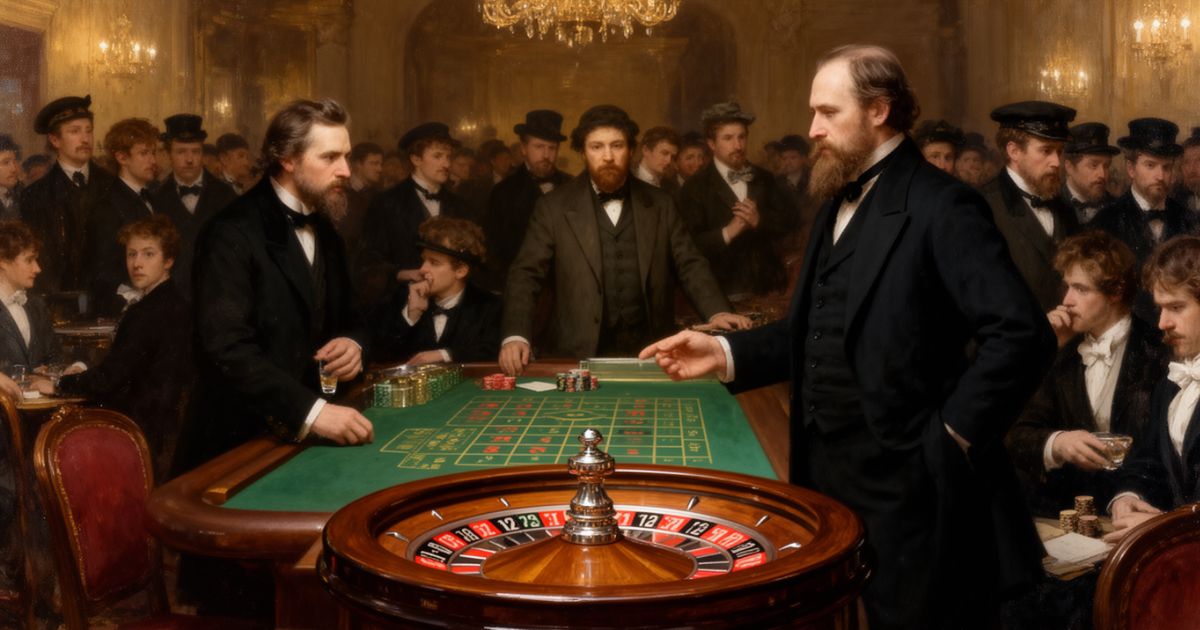
An excerpt from the original text.(complete · 4263 words)
t is a year and eight months since I last looked at these notes of
mine. I do so now only because, being overwhelmed with depression, I
wish to distract my mind by reading them through at random. I left them
off at the point where I was just going to Homburg. My God, with what a
light heart (comparatively speaking) did I write the concluding
lines!—though it may be not so much with a light heart, as with a
measure of self-confidence and unquenchable hope. At that time had I
any doubts of myself? Yet behold me now. Scarcely a year and a half
have passed, yet I am in a worse position than the meanest beggar. But
what is a beggar? A fig for beggary! I have ruined myself—that is all.
Nor is there anything with which I can compare myself; there is no
moral which it would be of any use for you to read to me. At the
present moment nothing could well be more incongruous than a moral. Oh,
you self-satisfied persons who, in your unctuous pride, are forever
ready to mouth your maxims—if only you knew how fully I myself
comprehend the sordidness of my present state, you would not trouble to
wag your tongues at me! What could you say to me that I do not already
know? Well, wherein lies my difficulty? It lies in the fact that by a
single turn of a roulette wheel everything for me, has become changed.
Yet, had things befallen otherwise, these moralists would have been
among the first (yes, I feel persuaded of it) to approach me with
friendly jests and congratulations. Yes, they would never have turned
from me as they are doing now! A fig for all of them! What am I? I am
zero—nothing. What shall I be tomorrow? I may be risen from the dead,
and have begun life anew. For still, I may discover the man in myself,
if only my manhood has not become utterly shattered.
I went, I say, to Homburg, but afterwards went also to Roulettenberg,
as well as to Spa and Baden; in which latter place, for a time, I acted
as valet to a certain rascal of a Privy Councillor, by name Heintze,
who until lately was also my master here. Yes, for five months I lived
my life with lacqueys! That was just after I had come out of
Roulettenberg prison, where I had lain for a small debt which I owed.
Out of that prison I was bailed by—by whom? By Mr. Astley? By Polina? I
do not know. At all events, the debt was paid to the tune of two
hundred thalers, and I sallied forth a free man. But what was I to do
with myself? In my dilemma I had recourse to this Heintze, who was a
young scapegrace, and the sort of man who could speak and write three
languages. At first I acted as his secretary, at a salary of thirty
gülden a month, but afterwards I became his lacquey, for the reason
that he could not afford to keep a secretary—only an unpaid servant. I
had nothing else to turn to, so I remained with him, and allowed myself
to become his flunkey. But by stinting myself in meat and drink I
saved, during my five months of service, some seventy gülden; and one
evening, when we were at Baden, I told him that I wished to resign my
post, and then hastened to betake myself to roulette.
Oh, how my heart beat as I did so! No, it was not the money that I
valued—what I wanted was to make all this mob of Heintzes, hotel
proprietors, and fine ladies of Baden talk about me, recount my story,
wonder at me, extol my doings, and worship my winnings. True, these
were childish fancies and aspirations, but who knows but that I might
meet Polina, and be able to tell her everything, and see her look of
surprise at the fact that I had overcome so many adverse strokes of
fortune. No, I had no desire for money for its own sake, for I was
perfectly well aware that I should only squander it upon some new
Blanche, and spend another three weeks in Paris after buying a pair of
horses which had cost sixteen thousand francs. No, I never believed
myself to be a hoarder; in fact, I knew only too well that I was a
spendthrift. And already, with a sort of fear, a sort of sinking in my
heart, I could hear the cries of the croupiers—“Trente et un, rouge,
impair et passe,” “Quarte, noir, pair et manque.” How greedily I gazed
upon the gaming-table, with its scattered louis d’or, ten-gülden
pieces, and thalers; upon the streams of gold as they issued from the
croupier’s hands, and piled themselves up into heaps of gold
scintillating as fire; upon the ell—long rolls of silver lying around
the croupier. Even at a distance of two rooms I could hear the chink of
that money—so much so that I nearly fell into convulsions.
Ah, the evening when I took those seventy gülden to the gaming table
was a memorable one for me. I began by staking ten gülden upon passe.
For passe I had always had a sort of predilection, yet I lost my stake
upon it. This left me with sixty gülden in silver. After a moment’s
thought I selected zero—beginning by staking five gülden at a time.
Twice I lost, but the third round suddenly brought up the desired coup.
I could almost have died with joy as I received my one hundred and
seventy-five gülden. Indeed, I have been less pleased when, in former
times, I have won a hundred thousand gülden. Losing no time, I staked
another hundred gülden upon the red, and won; two hundred upon the red,
and won; four hundred upon the black, and won; eight hundred upon
manque, and won. Thus, with the addition of the remainder of my
original capital, I found myself possessed, within five minutes, of
seventeen hundred gülden. Ah, at such moments one forgets both oneself
and one’s former failures! This I had gained by risking my very life. I
had dared so to risk, and behold, again I was a member of mankind!
I went and hired a room, I shut myself up in it, and sat counting my
money until three o’clock in the morning. To think that when I awoke on
the morrow, I was no lacquey! I decided to leave at once for Homburg.
There I should neither have to serve as a footman nor to lie in prison.
Half an hour before starting, I went and ventured a couple of stakes—no
more; with the result that, in all, I lost fifteen hundred florins.
Nevertheless, I proceeded to Homburg, and have now been there for a
month.
Of course, I am living in constant trepidation, playing for the
smallest of stakes, and always looking out for something—calculating,
standing whole days by the gaming-tables to watch the play—even seeing
that play in my dreams—yet seeming, the while, to be in some way
stiffening, to be growing caked, as it were, in mire. But I must
conclude my notes, which I finish under the impression of a recent
encounter with Mr. Astley. I had not seen him since we parted at
Roulettenberg, and now we met quite by accident. At the time I was
walking in the public gardens, and meditating upon the fact that not
only had I still some fifty gülden in my possession, but also I had
fully paid up my hotel bill three days ago. Consequently, I was in a
position to try my luck again at roulette; and if I won anything I
should be able to continue my play, whereas, if I lost what I now
possessed, I should once more have to accept a lacquey’s place,
provided that, in the alternative, I failed to discover a Russian
family which stood in need of a tutor. Plunged in these reflections, I
started on my daily walk through the Park and forest towards a
neighbouring principality. Sometimes, on such occasions, I spent four
hours on the way, and would return to Homburg tired and hungry; but, on
this particular occasion, I had scarcely left the gardens for the Park
when I caught sight of Astley seated on a bench. As soon as he
perceived me, he called me by name, and I went and sat down beside him;
but, on noticing that he seemed a little stiff in his manner, I
hastened to moderate the expression of joy which the sight of him had
called forth.
“You here?” he said. “Well, I had an idea that I should meet you. Do
not trouble to tell me anything, for I know all—yes, all. In fact, your
whole life during the past twenty months lies within my knowledge.”
“How closely you watch the doings of your old friends!” I replied.
“That does you infinite credit. But stop a moment. You have reminded me
of something. Was it you who bailed me out of Roulettenberg prison when
I was lying there for a debt of two hundred gülden? someone did so.”
“Oh dear no!—though I knew all the time that you were lying there.”
“Perhaps you could tell me who did bail me out?”
“No; I am afraid I could not.”
“What a strange thing! For I know no Russians at all here, so it cannot
have been a Russian who befriended me. In Russia we Orthodox folk do
go bail for one another, but in this case I thought it must have been
done by some English stranger who was not conversant with the ways of
the country.”
Mr. Astley seemed to listen to me with a sort of surprise. Evidently he
had expected to see me looking more crushed and broken than I was.
“Well,” he said—not very pleasantly, “I am none the less glad to find
that you retain your old independence of spirit, as well as your
buoyancy.”
“Which means that you are vexed at not having found me more abased and
humiliated than I am?” I retorted with a smile.
Astley was not quick to understand this, but presently did so and
laughed.
“Your remarks please me as they always did,” he continued. “In those
words I see the clever, triumphant, and, above all things, cynical
friend of former days. Only Russians have the faculty of combining
within themselves so many opposite qualities. Yes, most men love to see
their best friend in abasement; for generally it is on such abasement
that friendship is founded. All thinking persons know that ancient
truth. Yet, on the present occasion, I assure you, I am sincerely glad
to see that you are not cast down. Tell me, are you never going to
give up gambling?”
“Damn the gambling! Yes, I should certainly have given it up, were it
not that—”
“That you are losing? I thought so. You need not tell me any more. I
know how things stand, for you have said that last in despair, and
therefore, truthfully. Have you no other employment than gambling?”
“No; none whatever.”
Astley gave me a searching glance. At that time it was ages since I had
last looked at a paper or turned the pages of a book.
“You are growing blasé,” he said. “You have not only renounced life,
with its interests and social ties, but the duties of a citizen and a
man; you have not only renounced the friends whom I know you to have
had, and every aim in life but that of winning money; but you have also
renounced your memory. Though I can remember you in the strong, ardent
period of your life, I feel persuaded that you have now forgotten every
better feeling of that period—that your present dreams and aspirations
of subsistence do not rise above pair, impair rouge, noir, the twelve
middle numbers, and so forth.”
“Enough, Mr. Astley!” I cried with some irritation—almost in anger.
“Kindly do not recall to me any more recollections, for I can remember
things for myself. Only for a time have I put them out of my head. Only
until I shall have rehabilitated myself, am I keeping my memory dulled.
When that hour shall come, you will see me arise from the dead.”
“Then you will have to be here another ten years,” he replied. “Should
I then be alive, I will remind you—here, on this very bench—of what I
have just said. In fact, I will bet you a wager that I shall do so.”
“Say no more,” I interrupted impatiently. “And to show you that I have
not wholly forgotten the past, may I enquire where Mlle. Polina is? If
it was not you who bailed me out of prison, it must have been she. Yet
never have I heard a word concerning her.”
“No, I do not think it was she. At the present moment she is in
Switzerland, and you will do me a favour by ceasing to ask me these
questions about her.” Astley said this with a firm, and even an angry,
air.
“Which means that she has dealt you a serious wound?” I burst out with
an involuntary sneer.
“Mlle. Polina,” he continued, “Is the best of all possible living
beings; but, I repeat, that I shall thank you to cease questioning me
about her. You never really knew her, and her name on your lips is an
offence to my moral feeling.”
“Indeed? On what subject, then, have I a better right to speak to you
than on this? With it are bound up all your recollections and mine.
However, do not be alarmed: I have no wish to probe too far into your
private, your secret affairs. My interest in Mlle. Polina does not
extend beyond her outward circumstances and surroundings. About them
you could tell me in two words.”
“Well, on condition that the matter shall end there, I will tell you
that for a long time Mlle. Polina was ill, and still is so. My mother
and sister entertained her for a while at their home in the north of
England, and thereafter Mlle. Polina’s grandmother (you remember the
mad old woman?) died, and left Mlle. Polina a personal legacy of seven
thousand pounds sterling. That was about six months ago, and now Mlle.
is travelling with my sister’s family—my sister having since married.
Mlle.’s little brother and sister also benefited by the Grandmother’s
will, and are now being educated in London. As for the General, he died
in Paris last month, of a stroke. Mlle. Blanche did well by him, for
she succeeded in having transferred to herself all that he received
from the Grandmother. That, I think, concludes all that I have to
tell.”
“And De Griers? Is he too travelling in Switzerland?”
“No; nor do I know where he is. Also I warn you once more that you had
better avoid such hints and ignoble suppositions; otherwise you will
assuredly have to reckon with me.”
“What? In spite of our old friendship?”
“Yes, in spite of our old friendship.”
“Then I beg your pardon a thousand times, Mr. Astley. I meant nothing
offensive to Mlle. Polina, for I have nothing of which to accuse her.
Moreover, the question of there being anything between this Frenchman
and this Russian lady is not one which you and I need discuss, nor even
attempt to understand.”
“If,” replied Astley, “you do not care to hear their names coupled
together, may I ask you what you mean by the expressions ‘this
Frenchman,’ ‘this Russian lady,’ and ‘there being anything between
them’? Why do you call them so particularly a ‘Frenchman’ and a
‘Russian lady’?”
“Ah, I see you are interested, Mr. Astley. But it is a long, long
story, and calls for a lengthy preface. At the same time, the question
is an important one, however ridiculous it may seem at the first
glance. A Frenchman, Mr. Astley, is merely a fine figure of a man. With
this you, as a Britisher, may not agree. With it I also, as a Russian,
may not agree—out of envy. Yet possibly our good ladies are of another
opinion. For instance, one may look upon Racine as a broken-down,
hobbledehoy, perfumed individual—one may even be unable to read him;
and I too may think him the same, as well as, in some respects, a
subject for ridicule. Yet about him, Mr. Astley, there is a certain
charm, and, above all things, he is a great poet—though one might like
to deny it. Yes, the Frenchman, the Parisian, as a national figure, was
in process of developing into a figure of elegance before we Russians
had even ceased to be bears. The Revolution bequeathed to the French
nobility its heritage, and now every whipper-snapper of a Parisian may
possess manners, methods of expression, and even thoughts that are
above reproach in form, while all the time he himself may share in that
form neither in initiative nor in intellect nor in soul—his manners,
and the rest, having come to him through inheritance. Yes, taken by
himself, the Frenchman is frequently a fool of fools and a villain of
villains. Per contra, there is no one in the world more worthy of
confidence and respect than this young Russian lady. De Griers might so
mask his face and play a part as easily to overcome her heart, for he
has an imposing figure, Mr. Astley, and this young lady might easily
take that figure for his real self—for the natural form of his heart
and soul—instead of the mere cloak with which heredity has dowered him.
And even though it may offend you, I feel bound to say that the
majority also of English people are uncouth and unrefined, whereas we
Russian folk can recognise beauty wherever we see it, and are always
eager to cultivate the same. But to distinguish beauty of soul and
personal originality there is needed far more independence and freedom
than is possessed by our women, especially by our younger ladies. At
all events, they need more experience. For instance, this Mlle.
Polina—pardon me, but the name has passed my lips, and I cannot well
recall it—is taking a very long time to make up her mind to prefer you
to Monsieur de Griers. She may respect you, she may become your friend,
she may open out her heart to you; yet over that heart there will be
reigning that loathsome villain, that mean and petty usurer, De Griers.
This will be due to obstinacy and self-love—to the fact that De Griers
once appeared to her in the transfigured guise of a marquis, of a
disenchanted and ruined liberal who was doing his best to help her
family and the frivolous old General; and, although these transactions
of his have since been exposed, you will find that the exposure has
made no impression upon her mind. Only give her the De Griers of former
days, and she will ask of you no more. The more she may detest the
present De Griers, the more will she lament the De Griers of the
past—even though the latter never existed but in her own imagination.
You are a sugar refiner, Mr. Astley, are you not?”
“Yes, I belong to the well-known firm of Lovell and Co.”
“Then see here. On the one hand, you are a sugar refiner, while, on the
other hand, you are an Apollo Belvedere. But the two characters do not
mix with one another. I, again, am not even a sugar refiner; I am a
mere roulette gambler who has also served as a lacquey. Of this fact
Mlle. Polina is probably well aware, since she appears to have an
excellent force of police at her disposal.”
“You are saying this because you are feeling bitter,” said Astley with
cold indifference. “Yet there is not the least originality in your
words.”
“I agree. But therein lies the horror of it all—that, how trepidation,
playing ever mean and farcical my accusations may be, they are none the
less true. But I am only wasting words.”
“Yes, you are, for you are only talking nonsense!” exclaimed my
companion—his voice now trembling and his eyes flashing fire. “Are you
aware,” he continued, “that wretched, ignoble, petty, unfortunate man
though you are, it was at her request I came to Homburg, in order to
see you, and to have a long, serious talk with you, and to report to
her your feelings and thoughts and hopes—yes, and your recollections of
her, too?”
“Indeed? Is that really so?” I cried—the tears beginning to well from
my eyes. Never before had this happened.
“Yes, poor unfortunate,” continued Astley. “She did love you; and I
may tell you this now for the reason that now you are utterly lost.
Even if I were also to tell you that she still loves you, you would
none the less have to remain where you are. Yes, you have ruined
yourself beyond redemption. Once upon a time you had a certain amount
of talent, and you were of a lively disposition, and your good looks
were not to be despised. You might even have been useful to your
country, which needs men like you. Yet you remained here, and your life
is now over. I am not blaming you for this—in my view all Russians
resemble you, or are inclined to do so. If it is not roulette, then it
is something else. The exceptions are very rare. Nor are you the first
to learn what a taskmaster is yours. For roulette is not exclusively a
Russian game. Hitherto, you have honourably preferred to serve as a
lacquey rather than to act as a thief; but what the future may have in
store for you I tremble to think. Now good-bye. You are in want of
money, I suppose? Then take these ten louis d’or. More I shall not give
you, for you would only gamble it away. Take care of these coins, and
farewell. Once more, take care of them.”
“No, Mr. Astley. After all that has been said I—”
“Take care of them!” repeated my friend. “I am certain you are still
a gentleman, and therefore I give you the money as one gentleman may
give money to another. Also, if I could be certain that you would leave
both Homburg and the gaming-tables, and return to your own country, I
would give you a thousand pounds down to start life afresh; but, I give
you ten louis d’or instead of a thousand pounds for the reason that at
the present time a thousand pounds and ten louis d’or will be all the
same to you—you will lose the one as readily as you will the other.
Take the money, therefore, and good-bye.”
“Yes, I will take it if at the same time you will embrace me.”
“With pleasure.”
So we parted—on terms of sincere affection.
But he was wrong. If I was hard and undiscerning as regards Polina
and De Griers, he was hard and undiscerning as regards Russian people
generally. Of myself I say nothing. Yet—yet words are only words. I
need to act. Above all things I need to think of Switzerland.
Tomorrow, tomorrow—Ah, but if only I could set things right tomorrow,
and be born again, and rise again from the dead! But no—I cannot. Yet I
must show her what I can do. Even if she should do no more than learn
that I can still play the man, it would be worth it. Today it is too
late, but tomorrow. Yet I have a presentiment that things can never
be otherwise. I have got fifteen louis d’or in my possession, although
I began with fifteen gülden. If I were to play carefully at the
start—But no, no! Surely I am not such a fool as that? Yet why should
I not rise from the dead? I should require at first but to go
cautiously and patiently and the rest would follow. I should require
but to put a check upon my nature for one hour, and my fortunes would
be changed entirely. Yes, my nature is my weak point. I have only to
remember what happened to me some months ago at Roulettenberg, before
my final ruin. What a notable instance that was of my capacity for
resolution! On the occasion in question I had lost
everything—everything; yet, just as I was leaving the Casino, I heard
another gülden give a rattle in my pocket! “Perhaps I shall need it for
a meal,” I thought to myself; but a hundred paces further on, I changed
my mind, and returned. That gülden I staked upon manque—and there is
something in the feeling that, though one is alone, and in a foreign
land, and far from one’s own home and friends, and ignorant of whence
one’s next meal is to come, one is nevertheless staking one’s very last
coin! Well, I won the stake, and in twenty minutes had left the Casino
with a hundred and seventy gülden in my pocket! That is a fact, and it
shows what a last remaining gülden can do.... But what if my heart had
failed me, or I had shrunk from making up my mind? ...
No; tomorrow all shall be ended!
Master this chapter. Complete your experience
Purchase the complete book to access all chapters and support classic literature
As an Amazon Associate, we earn a small commission from qualifying purchases at no additional cost to you.
Available in paperback, hardcover, and e-book formats
Let's Analyse the Pattern
When addiction or obsession transforms random past success into false prophecy about future outcomes.
Why This Matters
Connect literature to life
This chapter teaches how to recognize when past luck gets twisted into future expectations.
Practice This Today
This week, notice when you think 'I'm due' for something good to happen—that's your brain creating false patterns from random events.
Now let's explore the literary elements.
Key Quotes & Analysis
"I have ruined myself—that is all. Nor is there anything with which I can compare myself; there is no moral which it would be of any use for you to read to me."
Context: The narrator reflects on his complete downfall and rejects any attempt at moral guidance.
This shows how addiction creates a kind of pride in self-destruction. He's not asking for pity or advice because he knows exactly what he's done wrong. It's the voice of someone who has crossed a line they can't uncross.
In Today's Words:
I'm beyond help and I know it, so don't waste your breath trying to fix me.
"She loved you, and loves you still—I know that for certain."
Context: Astley reveals the truth about Polina's feelings to the narrator.
This is perhaps the most painful revelation in the book - that love was there all along, but the narrator's addiction made him unable to recognize or accept it. It shows how self-destruction pushes away the very thing we most want.
In Today's Words:
The person you thought didn't care about you actually loved you the whole time.
"Tomorrow, tomorrow it will all come to an end, and I shall win everything back."
Context: The narrator's final thoughts as he plans to gamble Astley's gift money.
This perfectly captures the delusion of addiction - the belief that one more try will fix everything. Despite everything he's learned and lost, he still believes the same behavior will somehow produce different results.
In Today's Words:
This time will be different - I can feel it.
Thematic Threads
Addiction
In This Chapter
The narrator chooses gambling over redemption, proving addiction's complete victory over reason
Development
Evolved from early gambling scenes to complete psychological domination
In Your Life:
You might see this in any behavior you can't stop despite mounting consequences.
Lost Love
In This Chapter
Astley reveals Polina loved the narrator but it's too late—he destroyed their chance
Development
Final revelation of what was truly at stake throughout the story
In Your Life:
You might recognize relationships you damaged while chasing something else entirely.
Class Destruction
In This Chapter
The narrator has fallen from tutor to servant to debtor, losing all social standing
Development
Complete reversal from his original position of precarious respectability
In Your Life:
You might see how one obsession can systematically destroy everything you've built.
False Hope
In This Chapter
The narrator believes he can win everything back and prove himself to Polina
Development
Culmination of his pattern of using gambling to solve gambling-created problems
In Your Life:
You might catch yourself believing the same behavior that created problems will somehow solve them.
Selective Memory
In This Chapter
He remembers past wins while forgetting devastating losses, creating false confidence
Development
Shows how addiction distorts perception and decision-making
In Your Life:
You might notice yourself remembering only the good parts of bad situations or relationships.
You now have the context. Time to form your own thoughts.
Discussion Questions
- 1
The narrator has lost everything—money, status, love—yet when Astley gives him ten gold coins for a fresh start, what does he plan to do with them?
analysis • surface - 2
Why does the narrator focus on remembering his past gambling win with his last coin, while ignoring all the times he lost everything?
analysis • medium - 3
Where do you see this pattern of 'selective memory' in modern life—people focusing on past successes while ignoring repeated failures?
application • medium - 4
If you were Astley, how would you try to break through to someone who keeps choosing their addiction over recovery?
application • deep - 5
What does this chapter reveal about why some people choose familiar suffering over uncertain hope?
reflection • deep
Critical Thinking Exercise
Reality Audit: Track Your Selective Memory
Think of an area where you keep trying the same approach despite repeated disappointment—dating, career moves, investments, or family dynamics. Write down ALL the outcomes from your last five attempts, not just the good ones. Then identify what story you've been telling yourself about why 'this time will be different.'
Consider:
- •Notice which memories you naturally want to focus on versus the ones you want to forget
- •Ask yourself: Am I remembering accurately, or am I editing my history?
- •Consider whether you're treating past luck as a guarantee of future success
Journaling Prompt
Write about a time when you kept pursuing something because you remembered it working once, even though it failed multiple times. What would have happened if you'd faced the full pattern instead of cherry-picking the good memory?