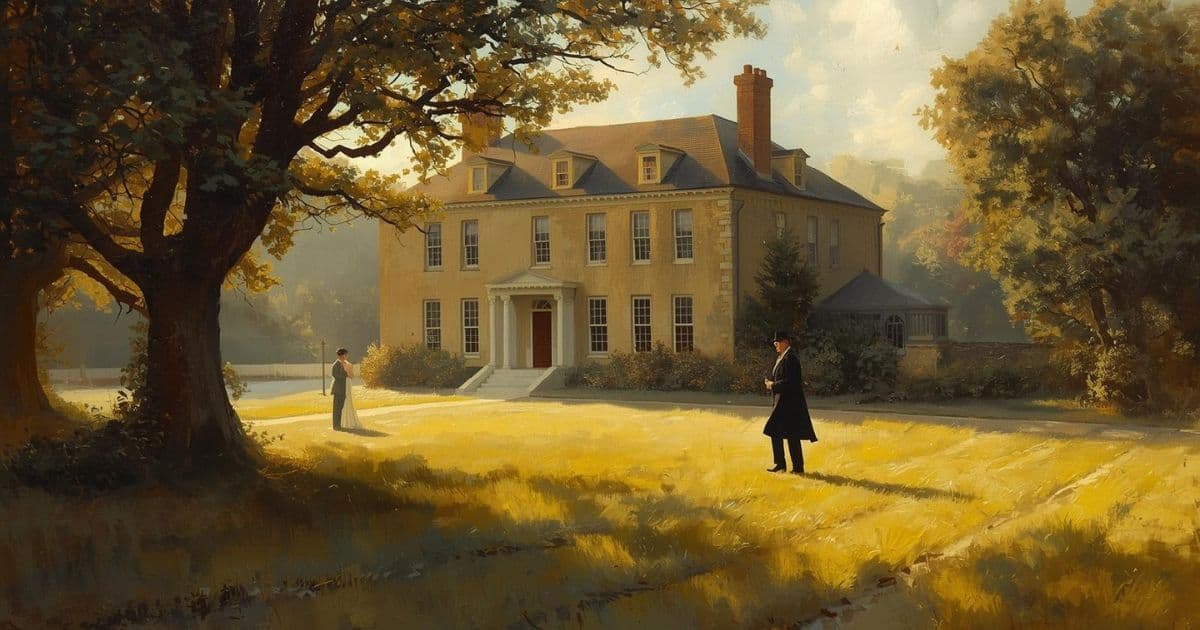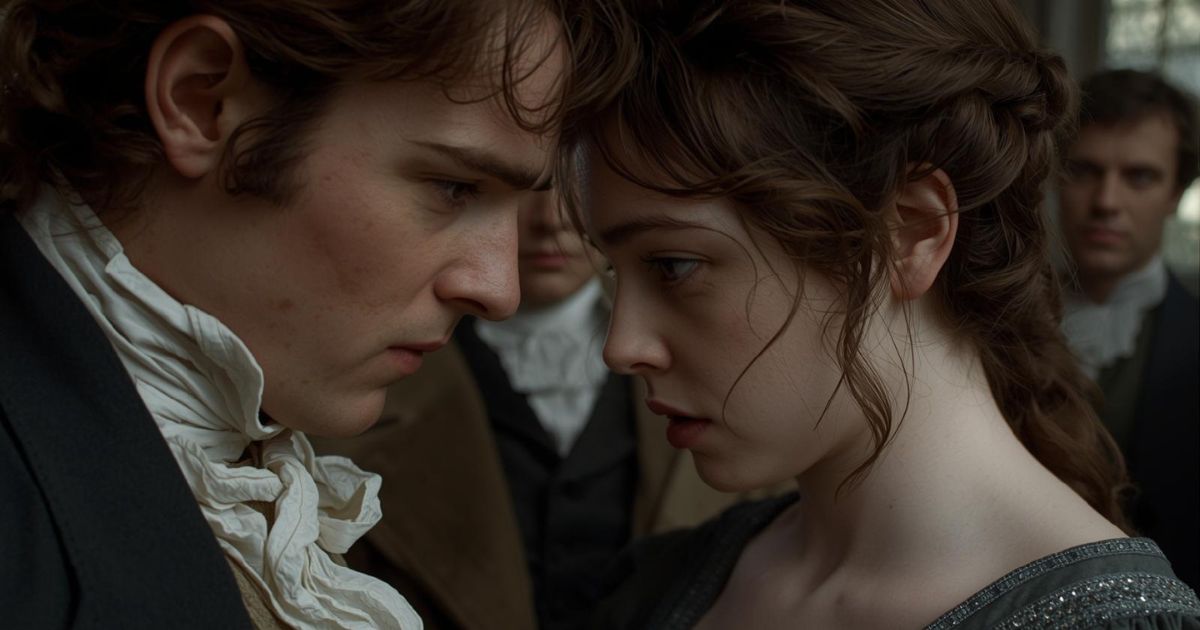
An excerpt from the original text.(complete · 1589 words)
X.
[Illustration]
Elizabeth’s spirits soon rising to playfulness again, she wanted Mr.
Darcy to account for his having ever fallen in love with her. “How could
you begin?” said she. “I can comprehend your going on charmingly, when
you had once made a beginning; but what could set you off in the first
place?”
“I cannot fix on the hour, or the spot, or the look, or the words, which
laid the foundation. It is too long ago. I was in the middle before I
knew that I had begun.”
“My beauty you had early withstood, and as for my manners--my behaviour
to you was at least always bordering on the uncivil, and I never spoke
to you without rather wishing to give you pain than not. Now, be
sincere; did you admire me for my impertinence?”
“For the liveliness of your mind I did.”
“You may as well call it impertinence at once. It was very little less.
The fact is, that you were sick of civility, of deference, of officious
attention. You were disgusted with the women who were always speaking,
and looking, and thinking for your approbation alone. I roused and
interested you, because I was so unlike them. Had you not been really
amiable you would have hated me for it: but in spite of the pains you
took to disguise yourself, your feelings were always noble and just; and
in your heart you thoroughly despised the persons who so assiduously
courted you. There--I have saved you the trouble of accounting for it;
and really, all things considered, I begin to think it perfectly
reasonable. To be sure you know no actual good of me--but nobody thinks
of that when they fall in love.”
“Was there no good in your affectionate behaviour to Jane, while she was
ill at Netherfield?”
“Dearest Jane! who could have done less for her? But make a virtue of it
by all means. My good qualities are under your protection, and you are
to exaggerate them as much as possible; and, in return, it belongs to me
to find occasions for teasing and quarrelling with you as often as may
be; and I shall begin directly, by asking you what made you so unwilling
to come to the point at last? What made you so shy of me, when you
first called, and afterwards dined here? Why, especially, when you
called, did you look as if you did not care about me?”
“Because you were grave and silent, and gave me no encouragement.”
“But I was embarrassed.”
“And so was I.”
“You might have talked to me more when you came to dinner.”
“A man who had felt less might.”
“How unlucky that you should have a reasonable answer to give, and that
I should be so reasonable as to admit it! But I wonder how long you
would have gone on, if you had been left to yourself. I wonder when
you would have spoken if I had not asked you! My resolution of
thanking you for your kindness to Lydia had certainly great effect. Too
much, I am afraid; for what becomes of the moral, if our comfort
springs from a breach of promise, for I ought not to have mentioned the
subject? This will never do.”
“You need not distress yourself. The moral will be perfectly fair. Lady
Catherine’s unjustifiable endeavours to separate us were the means of
removing all my doubts. I am not indebted for my present happiness to
your eager desire of expressing your gratitude. I was not in a humour to
wait for an opening of yours. My aunt’s intelligence had given me hope,
and I was determined at once to know everything.”
“Lady Catherine has been of infinite use, which ought to make her happy,
for she loves to be of use. But tell me, what did you come down to
Netherfield for? Was it merely to ride to Longbourn and be embarrassed?
or had you intended any more serious consequences?”
“My real purpose was to see you, and to judge, if I could, whether I
might ever hope to make you love me. My avowed one, or what I avowed to
myself, was to see whether your sister was still partial to Bingley, and
if she were, to make the confession to him which I have since made.”
“Shall you ever have courage to announce to Lady Catherine what is to
befall her?”
“I am more likely to want time than courage, Elizabeth. But it ought to
be done; and if you will give me a sheet of paper it shall be done
directly.”
“And if I had not a letter to write myself, I might sit by you, and
admire the evenness of your writing, as another young lady once did. But
I have an aunt, too, who must not be longer neglected.”
From an unwillingness to confess how much her intimacy with Mr. Darcy
had been overrated, Elizabeth had never yet answered Mrs. Gardiner’s
long letter; but now, having that to communicate which she knew would
be most welcome, she was almost ashamed to find that her uncle and aunt
had already lost three days of happiness, and immediately wrote as
follows:--
“I would have thanked you before, my dear aunt, as I ought to have done,
for your long, kind, satisfactory detail of particulars; but, to say the
truth, I was too cross to write. You supposed more than really existed.
But now suppose as much as you choose; give a loose to your fancy,
indulge your imagination in every possible flight which the subject will
afford, and unless you believe me actually married, you cannot greatly
err. You must write again very soon, and praise him a great deal more
than you did in your last. I thank you again and again, for not going to
the Lakes. How could I be so silly as to wish it! Your idea of the
ponies is delightful. We will go round the park every day. I am the
happiest creature in the world. Perhaps other people have said so
before, but no one with such justice. I am happier even than Jane; she
only smiles, I laugh. Mr. Darcy sends you all the love in the world that
can be spared from me. You are all to come to Pemberley at Christmas.
Yours,” etc.
Mr. Darcy’s letter to Lady Catherine was in a different style, and still
different from either was what Mr. Bennet sent to Mr. Collins, in return
for his last.
/* “Dear Sir, */
“I must trouble you once more for congratulations. Elizabeth will
soon be the wife of Mr. Darcy. Console Lady Catherine as well as
you can. But, if I were you, I would stand by the nephew. He has
more to give.
“Yours sincerely,” etc.
Miss Bingley’s congratulations to her brother on his approaching
marriage were all that was affectionate and insincere. She wrote even to
Jane on the occasion, to express her delight, and repeat all her former
professions of regard. Jane was not deceived, but she was affected; and
though feeling no reliance on her, could not help writing her a much
kinder answer than she knew was deserved.
The joy which Miss Darcy expressed on receiving similar information was
as sincere as her brother’s in sending it. Four sides of paper were
insufficient to contain all her delight, and all her earnest desire of
being loved by her sister.
Before any answer could arrive from Mr. Collins, or any congratulations
to Elizabeth from his wife, the Longbourn family heard that the
Collinses were come themselves to Lucas Lodge. The reason of this
sudden removal was soon evident. Lady Catherine had been rendered so
exceedingly angry by the contents of her nephew’s letter, that
Charlotte, really rejoicing in the match, was anxious to get away till
the storm was blown over. At such a moment, the arrival of her friend
was a sincere pleasure to Elizabeth, though in the course of their
meetings she must sometimes think the pleasure dearly bought, when she
saw Mr. Darcy exposed to all the parading and obsequious civility of her
husband. He bore it, however, with admirable calmness. He could even
listen to Sir William Lucas, when he complimented him on carrying away
the brightest jewel of the country, and expressed his hopes of their all
meeting frequently at St. James’s, with very decent composure. If he did
shrug his shoulders, it was not till Sir William was out of sight.
Mrs. Philips’s vulgarity was another, and, perhaps, a greater tax on his
forbearance; and though Mrs. Philips, as well as her sister, stood in
too much awe of him to speak with the familiarity which Bingley’s
good-humour encouraged; yet, whenever she did speak, she must be
vulgar. Nor was her respect for him, though it made her more quiet, at
all likely to make her more elegant. Elizabeth did all she could to
shield him from the frequent notice of either, and was ever anxious to
keep him to herself, and to those of her family with whom he might
converse without mortification; and though the uncomfortable feelings
arising from all this took from the season of courtship much of its
pleasure, it added to the hope of the future; and she looked forward
with delight to the time when they should be removed from society so
little pleasing to either, to all the comfort and elegance of their
family party at Pemberley.
[Illustration]
Master this chapter. Complete your experience
Purchase the complete book to access all chapters and support classic literature
As an Amazon Associate, we earn a small commission from qualifying purchases at no additional cost to you.
Available in paperback, hardcover, and e-book formats
Let's Analyse the Pattern
Why This Matters
Connect literature to life
This chapter teaches how to identify when a relationship is safe enough for playful vulnerability—revisiting difficult moments with curiosity rather than defensiveness.
Now let's explore the literary elements.
Key Quotes & Analysis
"I cannot fix on the hour, or the spot, or the look, or the words, which laid the foundation. It is too long ago. I was in the middle before I knew that I had begun."
Context: When Elizabeth asks when he first fell in love with her
Darcy admits he cannot pinpoint the moment he fell in love—it happened gradually before he was aware. This shows how genuine affection develops over time rather than in a single dramatic moment.
"For the liveliness of your mind I did."
Context: When Elizabeth asks if he admired her for her impertinence
Darcy's reply transforms what could be criticism into a compliment. He was drawn to Elizabeth because she was unlike the sycophantic women who flattered him—her wit and independence captivated him.
"I am happier even than Jane; she only smiles, I laugh."
Context: In her letter to Mrs. Gardiner announcing the engagement
Elizabeth's unrestrained joy bursts through this line. Her happiness exceeds even Jane's gentle contentment, reflecting how completely she has overcome her former prejudices against Darcy.
"I must trouble you once more for congratulations. Elizabeth will soon be the wife of Mr. Darcy. Console Lady Catherine as well as you can. But, if I were you, I would stand by the nephew. He has more to give."
Context: In his letter to Mr. Collins
Mr. Bennet's dry wit is on full display—he advises Collins to side with Darcy over Lady Catherine for practical reasons, with typical understated humor.
Thematic Threads
Playful intimacy
In This Chapter
Elizabeth and Darcy trace their falling-in-love story with humor and teasing
Development
Their relationship has evolved from tension to safe, affectionate banter
In Your Life:
When have you felt secure enough in a relationship to laugh about awkward or difficult moments from your shared past?
Vulnerability in security
In This Chapter
Darcy admits he was nervous and drawn to Elizabeth's impertinence
Development
Secure commitment allows honesty about former doubts and attractions
In Your Life:
Can you think of a time when feeling chosen and safe allowed you to share something vulnerable you'd never have said earlier?
Love as endurance
In This Chapter
Darcy bears Sir William Lucas and Mrs. Philips's vulgarity for Elizabeth's sake
Development
True love shows in what we willingly endure for our partner
In Your Life:
What have you endured—family events, social obligations, discomfort—for someone you love, and did it strengthen or strain the relationship?
Joy in commitment
In This Chapter
Elizabeth's letter bursts with happiness: 'I am happier even than Jane; she only smiles, I laugh'
Development
The engagement transforms previous anxiety into unrestrained joy
In Your Life:
When have you experienced a moment of pure, unselfconscious happiness in a relationship?
Hypocrisy vs. sincerity
In This Chapter
Miss Bingley's insincere congratulations contrast with Georgiana's genuine delight
Development
Austen contrasts performative politeness with authentic feeling
In Your Life:
How do you tell the difference between someone's sincere happiness for you and polite performance?
You now have the context. Time to form your own thoughts.
Discussion Questions
- 1
What does Elizabeth want Darcy to account for, and how does he respond?
- 2
Why can Elizabeth and Darcy now revisit their former misunderstandings with humor instead of hurt?
- 3
How does Darcy show his devotion by enduring Elizabeth's vulgar relatives?
- 4
What contrast does Austen draw between Miss Bingley's and Georgiana's reactions to the engagement?
- 5
What does Mr. Bennet's letter to Mr. Collins reveal about his character and his view of the marriage?
Critical Thinking Exercise
Revisit a Difficult Moment With Curiosity
Think of a moment in a current relationship—romantic, friendship, or family—that was awkward, painful, or tense. Now imagine approaching it with curiosity rather than blame: 'What were you thinking when...?' or 'I've always wondered how you felt about...' Write down what you would ask, how they might respond, and what might shift in your understanding. The goal isn't to rehash conflict but to turn a difficult memory into shared narrative—the way Elizabeth and Darcy trace their falling-in-love story.
Consider:
- •This works best when the relationship feels secure enough that the outcome isn't in doubt
- •Frame questions with curiosity, not accusation
- •Notice when defensiveness arises—in yourself or them—and whether the relationship has enough safety for this conversation
Coming Up Next...
Chapter 61
The final chapter will wrap up everyone's stories and show us where they all end up - the happily ever after we've been waiting for.