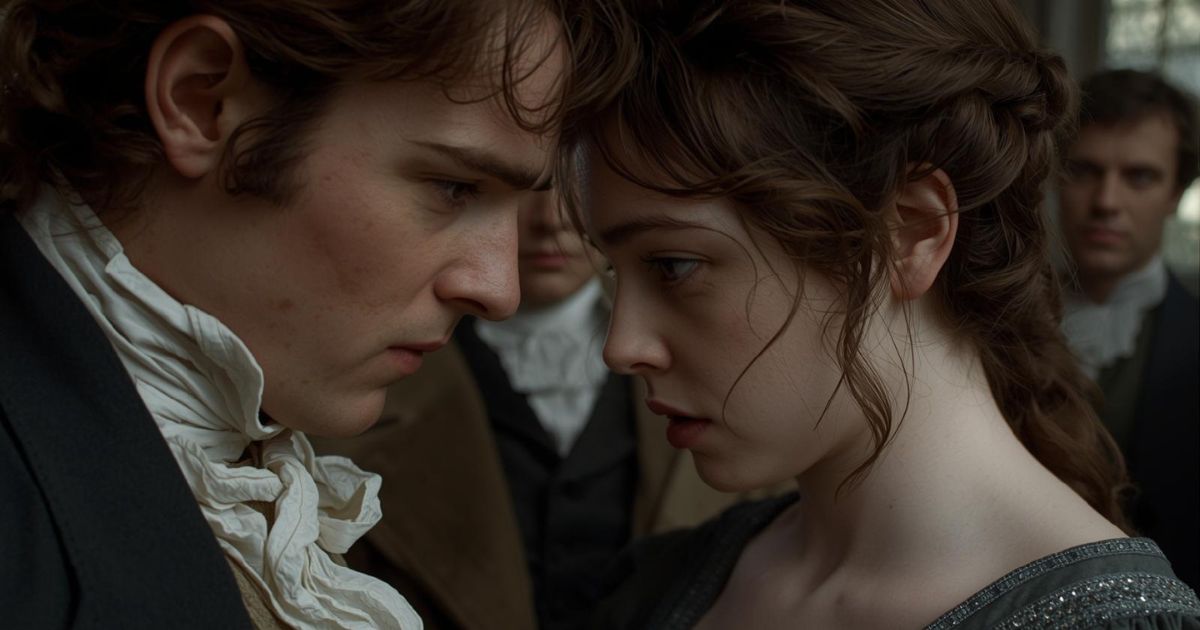
An excerpt from the original text.(complete · 2479 words)
IX.
[Illustration]
“My dear Lizzy, where can you have been walking to?” was a question
which Elizabeth received from Jane as soon as she entered the room, and
from all the others when they sat down to table. She had only to say in
reply, that they had wandered about till she was beyond her own
knowledge. She coloured as she spoke; but neither that, nor anything
else, awakened a suspicion of the truth.
The evening passed quietly, unmarked by anything extraordinary. The
acknowledged lovers talked and laughed; the unacknowledged were silent.
Darcy was not of a disposition in which happiness overflows in mirth;
and Elizabeth, agitated and confused, rather knew that she was happy
than felt herself to be so; for, besides the immediate embarrassment,
there were other evils before her. She anticipated what would be felt in
the family when her situation became known: she was aware that no one
liked him but Jane; and even feared that with the others it was a
dislike which not all his fortune and consequence might do away.
At night she opened her heart to Jane. Though suspicion was very far
from Miss Bennet’s general habits, she was absolutely incredulous here.
“You are joking, Lizzy. This cannot be! Engaged to Mr. Darcy! No, no,
you shall not deceive me: I know it to be impossible.”
“This is a wretched beginning, indeed! My sole dependence was on you;
and I am sure nobody else will believe me, if you do not. Yet, indeed, I
am in earnest. I speak nothing but the truth. He still loves me, and we
are engaged.”
Jane looked at her doubtingly. “Oh, Lizzy! it cannot be. I know how much
you dislike him.”
“You know nothing of the matter. That is all to be forgot. Perhaps I
did not always love him so well as I do now; but in such cases as these
a good memory is unpardonable. This is the last time I shall ever
remember it myself.”
Miss Bennet still looked all amazement. Elizabeth again, and more
seriously, assured her of its truth.
“Good heaven! can it be really so? Yet now I must believe you,” cried
Jane. “My dear, dear Lizzy, I would, I do congratulate you; but are you
certain--forgive the question--are you quite certain that you can be
happy with him?”
“There can be no doubt of that. It is settled between us already that we
are to be the happiest couple in the world. But are you pleased, Jane?
Shall you like to have such a brother?”
“Very, very much. Nothing could give either Bingley or myself more
delight. But we considered it, we talked of it as impossible. And do you
really love him quite well enough? Oh, Lizzy! do anything rather than
marry without affection. Are you quite sure that you feel what you ought
to do?”
“Oh, yes! You will only think I feel more than I ought to do when I
tell you all.”
“What do you mean?”
“Why, I must confess that I love him better than I do Bingley. I am
afraid you will be angry.”
“My dearest sister, now be, be serious. I want to talk very seriously.
Let me know everything that I am to know without delay. Will you tell me
how long you have loved him?”
“It has been coming on so gradually, that I hardly know when it began;
but I believe I must date it from my first seeing his beautiful grounds
at Pemberley.”
Another entreaty that she would be serious, however, produced the
desired effect; and she soon satisfied Jane by her solemn assurances of
attachment. When convinced on that article, Miss Bennet had nothing
further to wish.
“Now I am quite happy,” said she, “for you will be as happy as myself. I
always had a value for him. Were it for nothing but his love of you, I
must always have esteemed him; but now, as Bingley’s friend and your
husband, there can be only Bingley and yourself more dear to me. But,
Lizzy, you have been very sly, very reserved with me. How little did you
tell me of what passed at Pemberley and Lambton! I owe all that I know
of it to another, not to you.”
Elizabeth told her the motives of her secrecy. She had been unwilling to
mention Bingley; and the unsettled state of her own feelings had made
her equally avoid the name of his friend: but now she would no longer
conceal from her his share in Lydia’s marriage. All was acknowledged,
and half the night spent in conversation.
“Good gracious!” cried Mrs. Bennet, as she stood at a window the next
morning, “if that disagreeable Mr. Darcy is not coming here again with
our dear Bingley! What can he mean by being so tiresome as to be always
coming here? I had no notion but he would go a-shooting, or something or
other, and not disturb us with his company. What shall we do with him?
Lizzy, you must walk out with him again, that he may not be in Bingley’s
way.”
Elizabeth could hardly help laughing at so convenient a proposal; yet
was really vexed that her mother should be always giving him such an
epithet.
As soon as they entered, Bingley looked at her so expressively, and
shook hands with such warmth, as left no doubt of his good information;
and he soon afterwards said aloud, “Mrs. Bennet, have you no more lanes
hereabouts in which Lizzy may lose her way again to-day?”
“I advise Mr. Darcy, and Lizzy, and Kitty,” said Mrs. Bennet, “to walk
to Oakham Mount this morning. It is a nice long walk, and Mr. Darcy has
never seen the view.”
“It may do very well for the others,” replied Mr. Bingley; “but I am
sure it will be too much for Kitty. Won’t it, Kitty?”
Kitty owned that she had rather stay at home. Darcy professed a great
curiosity to see the view from the Mount, and Elizabeth silently
consented. As she went upstairs to get ready, Mrs. Bennet followed her,
saying,--
“I am quite sorry, Lizzy, that you should be forced to have that
disagreeable man all to yourself; but I hope you will not mind it. It is
all for Jane’s sake, you know; and there is no occasion for talking to
him except just now and then; so do not put yourself to inconvenience.”
During their walk, it was resolved that Mr. Bennet’s consent should be
asked in the course of the evening: Elizabeth reserved to herself the
application for her mother’s. She could not determine how her mother
would take it; sometimes doubting whether all his wealth and grandeur
would be enough to overcome her abhorrence of the man; but whether she
were violently set against the match, or violently delighted with it, it
was certain that her manner would be equally ill adapted to do credit to
her sense; and she could no more bear that Mr. Darcy should hear the
first raptures of her joy, than the first vehemence of her
disapprobation.
In the evening, soon after Mr. Bennet withdrew to the library, she saw
Mr. Darcy rise also and follow him, and her agitation on seeing it was
extreme. She did not fear her father’s opposition, but he was going to
be made unhappy, and that it should be through her means; that she,
his favourite child, should be distressing him by her choice, should be
filling him with fears and regrets in disposing of her, was a wretched
reflection, and she sat in misery till Mr. Darcy appeared again, when,
looking at him, she was a little relieved by his smile. In a few minutes
he approached the table where she was sitting with Kitty; and, while
pretending to admire her work, said in a whisper, “Go to your father; he
wants you in the library.” She was gone directly.
Her father was walking about the room, looking grave and anxious.
“Lizzy,” said he, “what are you doing? Are you out of your senses to be
accepting this man? Have not you always hated him?”
How earnestly did she then wish that her former opinions had been more
reasonable, her expressions more moderate! It would have spared her from
explanations and professions which it was exceedingly awkward to give;
but they were now necessary, and she assured him, with some confusion,
of her attachment to Mr. Darcy.
“Or, in other words, you are determined to have him. He is rich, to be
sure, and you may have more fine clothes and fine carriages than Jane.
But will they make you happy?”
“Have you any other objection,” said Elizabeth, “than your belief of my
indifference?”
“None at all. We all know him to be a proud, unpleasant sort of man; but
this would be nothing if you really liked him.”
“I do, I do like him,” she replied, with tears in her eyes; “I love him.
Indeed he has no improper pride. He is perfectly amiable. You do not
know what he really is; then pray do not pain me by speaking of him in
such terms.”
“Lizzy,” said her father, “I have given him my consent. He is the kind
of man, indeed, to whom I should never dare refuse anything, which he
condescended to ask. I now give it to you, if you are resolved on
having him. But let me advise you to think better of it. I know your
disposition, Lizzy. I know that you could be neither happy nor
respectable, unless you truly esteemed your husband, unless you looked
up to him as a superior. Your lively talents would place you in the
greatest danger in an unequal marriage. You could scarcely escape
discredit and misery. My child, let me not have the grief of seeing
you unable to respect your partner in life. You know not what you are
about.”
Elizabeth, still more affected, was earnest and solemn in her reply;
and, at length, by repeated assurances that Mr. Darcy was really the
object of her choice, by explaining the gradual change which her
estimation of him had undergone, relating her absolute certainty that
his affection was not the work of a day, but had stood the test of many
months’ suspense, and enumerating with energy all his good qualities,
she did conquer her father’s incredulity, and reconcile him to the
match.
“Well, my dear,” said he, when she ceased speaking, “I have no more to
say. If this be the case, he deserves you. I could not have parted with
you, my Lizzy, to anyone less worthy.”
To complete the favourable impression, she then told him what Mr. Darcy
had voluntarily done for Lydia. He heard her with astonishment.
“This is an evening of wonders, indeed! And so, Darcy did everything;
made up the match, gave the money, paid the fellow’s debts, and got him
his commission! So much the better. It will save me a world of trouble
and economy. Had it been your uncle’s doing, I must and would have
paid him; but these violent young lovers carry everything their own
way. I shall offer to pay him to-morrow, he will rant and storm about
his love for you, and there will be an end of the matter.”
He then recollected her embarrassment a few days before on his reading
Mr. Collins’s letter; and after laughing at her some time, allowed her
at last to go, saying, as she quitted the room, “If any young men come
for Mary or Kitty, send them in, for I am quite at leisure.”
Elizabeth’s mind was now relieved from a very heavy weight; and, after
half an hour’s quiet reflection in her own room, she was able to join
the others with tolerable composure. Everything was too recent for
gaiety, but the evening passed tranquilly away; there was no longer
anything material to be dreaded, and the comfort of ease and familiarity
would come in time.
When her mother went up to her dressing-room at night, she followed her,
and made the important communication. Its effect was most extraordinary;
for, on first hearing it, Mrs. Bennet sat quite still, and unable to
utter a syllable. Nor was it under many, many minutes, that she could
comprehend what she heard, though not in general backward to credit what
was for the advantage of her family, or that came in the shape of a
lover to any of them. She began at length to recover, to fidget about in
her chair, get up, sit down again, wonder, and bless herself.
“Good gracious! Lord bless me! only think! dear me! Mr. Darcy! Who would
have thought it? And is it really true? Oh, my sweetest Lizzy! how rich
and how great you will be! What pin-money, what jewels, what carriages
you will have! Jane’s is nothing to it--nothing at all. I am so
pleased--so happy. Such a charming man! so handsome! so tall! Oh, my
dear Lizzy! pray apologize for my having disliked him so much before. I
hope he will overlook it. Dear, dear Lizzy. A house in town! Everything
that is charming! Three daughters married! Ten thousand a year! Oh,
Lord! what will become of me? I shall go distracted.”
This was enough to prove that her approbation need not be doubted; and
Elizabeth, rejoicing that such an effusion was heard only by herself,
soon went away. But before she had been three minutes in her own room,
her mother followed her.
“My dearest child,” she cried, “I can think of nothing else. Ten
thousand a year, and very likely more! ’Tis as good as a lord! And a
special licence--you must and shall be married by a special licence.
But, my dearest love, tell me what dish Mr. Darcy is particularly fond
of, that I may have it to-morrow.”
This was a sad omen of what her mother’s behaviour to the gentleman
himself might be; and Elizabeth found that, though in the certain
possession of his warmest affection, and secure of her relations’
consent, there was still something to be wished for. But the morrow
passed off much better than she expected; for Mrs. Bennet luckily stood
in such awe of her intended son-in-law, that she ventured not to speak
to him, unless it was in her power to offer him any attention, or mark
her deference for his opinion.
Elizabeth had the satisfaction of seeing her father taking pains to get
acquainted with him; and Mr. Bennet soon assured her that he was rising
every hour in his esteem.
“I admire all my three sons-in-law highly,” said he. “Wickham, perhaps,
is my favourite; but I think I shall like your husband quite as well
as Jane’s.”
[Illustration:
“The obsequious civility.”
[Copyright 1894 by George Allen.]]
Master this chapter. Complete your experience
Purchase the complete book to access all chapters and support classic literature
As an Amazon Associate, we earn a small commission from qualifying purchases at no additional cost to you.
Available in paperback, hardcover, and e-book formats
Let's Analyse the Pattern
Why This Matters
Connect literature to life
This chapter teaches when and how to reveal difficult truths that could change relationships—leading with accountability and choosing the right confidant.
Now let's explore the literary elements.
Key Quotes & Analysis
"I have been a selfish being all my life, in practice, though not in principle."
Context: Elizabeth reflects on how she misjudged Darcy while explaining the truth to her father.
This shows Elizabeth's honest self-examination. She's admitting that despite believing herself to be fair-minded, she let prejudice cloud her judgment about Darcy's true character.
"He has made me so happy by telling me that he was totally ignorant of my sister's being in town last spring!"
Context: Elizabeth explains to her father why she now trusts Darcy completely.
This reveals how small details matter in relationships. Elizabeth is relieved that Darcy wasn't hiding knowledge about her sister, showing how trust is built through transparency and honesty.
"If any young men comes for Mary or Kitty, send them away instantly, for I am quite at leisure to act the part of a father."
Context: After learning about Darcy's character, Mr. Bennet jokes about being more careful with his remaining daughters.
This humor masks Mr. Bennet's realization that he's been too passive as a father. He's acknowledging his responsibility to protect his daughters while showing he's learned from recent events.
Thematic Threads
Truth-telling
In This Chapter
Elizabeth reveals Darcy's heroic actions and admits her wrong first impressions to her father
Development
Evolved from Elizabeth's internal struggle with changed perceptions to active sharing of truth
In Your Life:
When have you had to admit to someone that your negative first impression of another person was completely wrong, and how difficult was it to share that truth?
Personal Growth
In This Chapter
Elizabeth demonstrates maturity by admitting she was wrong about Darcy's character
Development
Culmination of Elizabeth's transformation from prejudiced to self-aware
In Your Life:
Can you think of a time when you had to swallow your pride and acknowledge you were fundamentally mistaken about someone's character?
Family Bonds
In This Chapter
Father-daughter relationship deepens through honest conversation and mutual respect
Development
Built on their established closeness, now enhanced by Elizabeth's vulnerability
In Your Life:
How do you handle conversations with family members when you need to be vulnerable about your mistakes or changed perspectives?
Hidden Worth
In This Chapter
Darcy's quiet heroism in saving Lydia contrasts with his public reputation
Development
Consistent theme of Darcy's true character being opposite of appearances
In Your Life:
Have you ever discovered that someone you dismissed or disliked was quietly doing good things behind the scenes that completely changed your opinion of them?
Prejudice
In This Chapter
Mr. Bennet's shock reveals how completely he misjudged Darcy based on first impressions
Development
Shows how prejudice affected the entire family, not just Elizabeth
In Your Life:
When has someone you trusted shared information that made you realize your judgment of another person was based on superficial impressions rather than their true character?
You now have the context. Time to form your own thoughts.
Discussion Questions
- 1
What truth does Elizabeth finally reveal to her father about Darcy, and how does Mr. Bennet react?
- 2
Why has Elizabeth been keeping this information to herself, and what changes her mind about sharing it now?
- 3
Think about your own workplace or family - when have you seen someone's reputation completely flip once the full story came out?
- 4
If you discovered you'd been completely wrong about someone's character, how would you handle telling the people who trusted your original judgment?
- 5
What does this scene reveal about the difference between protecting someone's feelings and protecting your own image?
Critical Thinking Exercise
Track Your Truth-Telling Moment
Think of a time when you had to admit to someone important that you were wrong about a person or situation. Write down what you were afraid would happen versus what actually happened when you told the truth. If you haven't had this experience yet, identify a current situation where you're holding back truth that could improve a relationship.
Consider:
- •Notice whether your fear was about looking foolish or about genuinely protecting someone else
- •Consider how the relationship changed after the truth-telling - stronger, weaker, or just different
- •Examine whether keeping the truth hidden was actually serving anyone or just avoiding temporary discomfort
Coming Up Next...
Chapter 60
As the dust settles on the engagement announcements, Elizabeth and Darcy will have time to reflect on their journey together and what their future holds.