
What to expect ahead
What follows is a compact summary of each chapter in the book, designed to help you quickly grasp the core ideas while inviting you to continue into the full original text. Even when chapter text is presented here, these summaries are meant as a gateway to understanding, so your eventual reading of the complete book feels richer, deeper, and more fully appreciated.
What happens when you raise a child on nothing but facts—and call it education?
Thomas Gradgrind has a philosophy: facts, facts, facts. No imagination. No wonder. No play. He raises his children—Louisa and Tom—the way a factory runs a machine: efficiently, without sentiment, without waste. The result is two adults who arrive at adulthood not knowing how to feel, what they want, or who they are. Louisa marries a man she doesn't love because she was never taught to trust her own instincts. Tom becomes a thief because he was never allowed to develop a moral compass—only a ledger sheet.
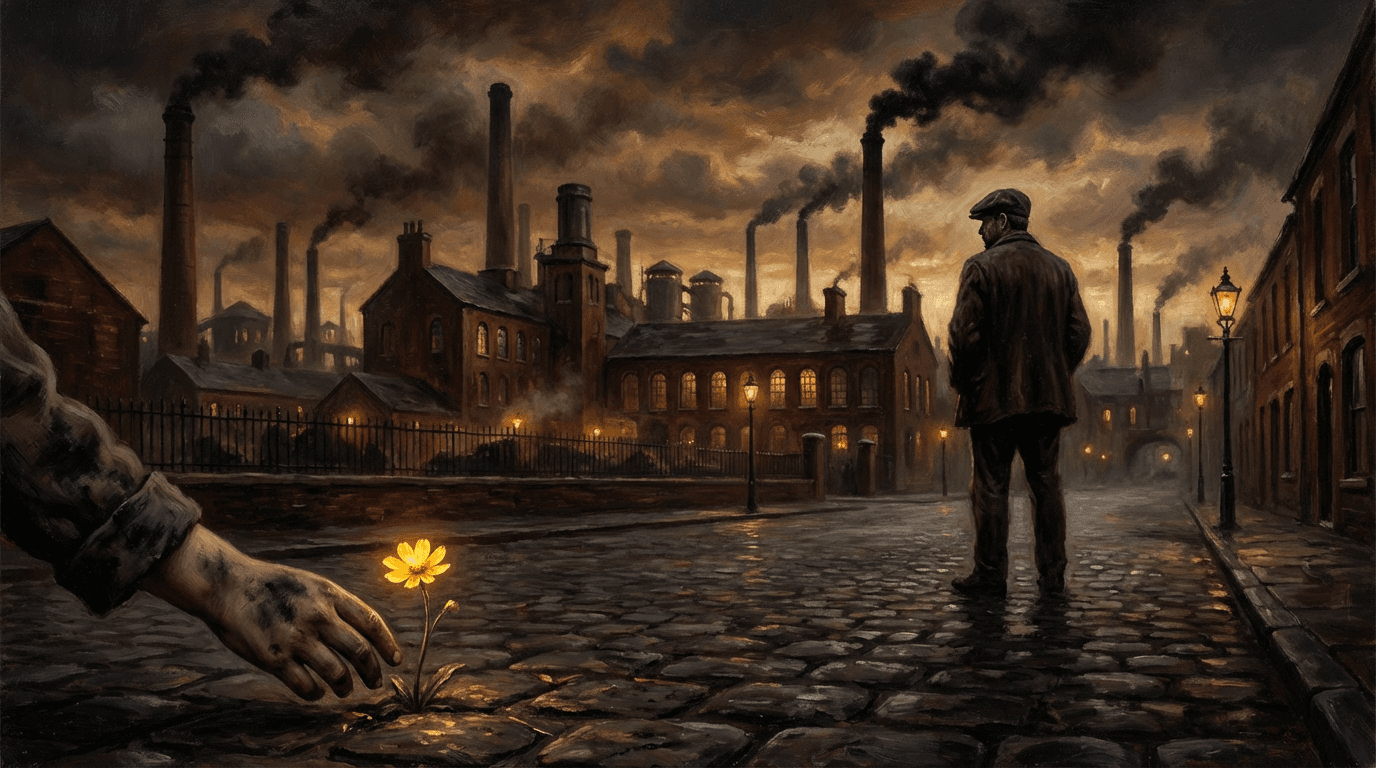
Charles Dickens set Hard Times in Coketown, a fictional industrial city of smoke, brick, and grinding machinery, to make a single argument: a society organized entirely around productivity and profit destroys the human beings it claims to serve. The factory workers are called "Hands." Not people. Hands. Their purpose is to produce. Their humanity is irrelevant. The circus performer Sissy Jupe—raised on imagination, warmth, and human connection—is useless by Gradgrind's standards, and the wisest person in the novel.
Why this matters now: We live inside versions of Coketown. Metrics-obsessed workplaces that measure everything except meaning. Educational systems that reward the testable and ignore the essential. Productivity culture that treats rest, play, and creativity as waste—rather than as the things that make work worth doing at all.
What's really going on: Across 36 chapters, you'll learn to recognize when systems are treating you as a means rather than an end, understand why imagination and emotion are not weaknesses but survival skills, and see how the people who seem least productive—like Sissy Jupe—are often the ones who know how to actually live.
The facts are never the whole story.
Essential Life Skills Deep Dive
Explore chapter-by-chapter breakdowns of the essential life skills taught in this classic novel.
Recognizing Dehumanizing Systems
8 chapters revealing how institutions reduce people to functions—and what it costs every human being inside them.
Reclaiming Imagination
6 chapters showing why creativity and play are not luxuries—and how to restore them after years of purely rational living.
Recovering from Emotional Suppression
6 chapters tracing Louisa Gradgrind's arc—from a childhood stripped of feeling to the collapse that forces her father to face what his philosophy destroyed.
Seeing Through Productivity Obsession
6 chapters dissecting the self-made man myth, utilitarian logic, and the cost of measuring a human life entirely by its output.
Essential Skills
Life skills and patterns this book helps you develop—drawn from its themes and characters.
Recognizing Dehumanizing Systems
See when organizations treat people as interchangeable units—and understand the real cost to everyone inside them.
Reclaiming Imagination
Understand why creativity and play are not luxuries but necessities—and how to restore them after years of purely rational living.
Recovering from Emotional Suppression
Heal from being raised to ignore your feelings and intuition—and learn to trust your inner life as a source of wisdom, not weakness.
Seeing Through Productivity Obsession
Identify when efficiency culture has colonized your sense of self-worth—and find your way back to a life that measures more than output.
Table of Contents
Facts Above All Else
The Factory School System
Finding the Escape Hatch
Meeting the Self-Made Man
The Sound of Grinding Machinery
The Circus Arrives
The Art of Strategic Positioning
The Death of Wonder
Sissy's Progress in School
Meeting Stephen Blackpool
Trapped by Circumstances
When Authority Becomes Absurd
Finding Light in Dark Places
The Mill Owner's True Face
When Your Past Catches Up
About Charles Dickens
Published 1854
Charles Dickens (1812–1870) was the most widely read novelist of the Victorian era—and one of the most politically committed writers in the English language. Born into genteel poverty, he spent part of his childhood working in a blacking factory while his father was imprisoned for debt. That experience never left him. It shaped every novel he wrote.
Dickens used fiction as a weapon. He attacked debtors' prisons, child labor, corrupt schools, and the brutal logic of the Poor Laws. He serialized his novels in magazines, making literature accessible to working-class readers who couldn't afford books. He understood that stories could do what editorials couldn't: make you feel the cost of injustice in your body.
Hard Times (1854) was his most direct attack on utilitarian philosophy—the Victorian idea that society should be organized for maximum measurable efficiency, and that human value could be calculated. Dickens had watched industrialization transform England into a landscape of factories, poverty, and human interchangeability. He wrote Hard Times in response: a short, fierce novel arguing that facts without feeling produce monsters, and that imagination is not an indulgence—it is what makes us human.
Why This Author Matters Today
Charles Dickens's insights into human nature, social constraints, and the search for authenticity remain powerfully relevant. Their work helps us understand the timeless tensions between individual desire and social expectation, making them an essential guide for navigating modern life's complexities.
More by Charles Dickens in Our Library



Amplified Classics is different.
not a sparknotes, nor a cliffnotes
This is a retelling. The story is still told—completely. You walk with the characters, feel what they feel, discover what they discover. The meaning arrives because you experienced it, not because someone explained a summary.
Read this, then read the original. The prose will illuminate—you'll notice what makes the author that author, because you're no longer fighting to follow the story.
Read the original first, then read this. Something will click. You'll want to go back.
Either way, the door opens inward.
Get the Full Book
Purchase the complete book to access all chapters and support classic literature
As an Amazon Associate, we earn a small commission from qualifying purchases at no additional cost to you.
Available in paperback, hardcover, and e-book formats
You Might Also Like



Free to read • No account required