
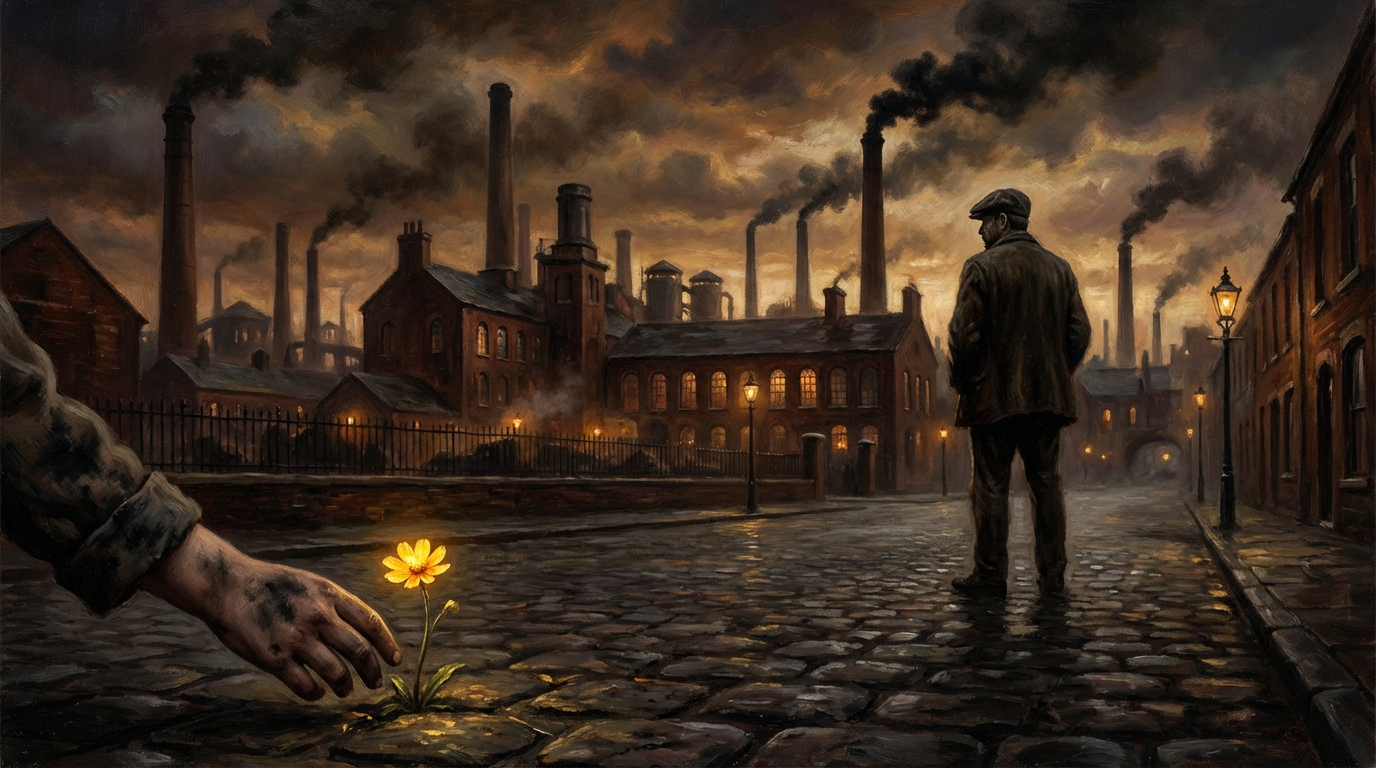
An excerpt from the original text.(complete · 3 words)
tephen Blackpool 49
Master this chapter. Complete your experience
Purchase the complete book to access all chapters and support classic literature
As an Amazon Associate, we earn a small commission from qualifying purchases at no additional cost to you.
Available in paperback, hardcover, and e-book formats
Let's Analyse the Pattern
When you maintain moral independence in polarized situations, all sides view you as a threat and push you toward isolation.
Why This Matters
Connect literature to life
This chapter teaches how to spot when situations are artificially framed as 'you're either with us or against us' and identify the hidden third options.
Practice This Today
This week, notice when someone presents you with only two choices in a conflict—then ask yourself what other options might exist that preserve both your relationships and your principles.
Now let's explore the literary elements.
Key Quotes & Analysis
"I ha' never had no fratch afore, bein' a man o' the kind o' temper as never had no fratch wi' no one."
Context: Stephen explaining his peaceful nature and why he avoids conflict
This shows Stephen's gentle character and his preference for avoiding confrontation. His dialect also emphasizes his working-class background and sets him apart from the educated characters.
In Today's Words:
I've never been one to pick fights or cause trouble with anybody - that's just not who I am.
"Tis a muddle, and that's aw."
Context: Stephen's response when pressed about complex social and economic issues
This becomes Stephen's signature phrase, representing how ordinary people feel overwhelmed by forces beyond their control. It captures the confusion of being caught between competing demands.
In Today's Words:
It's all just a mess, and I don't know what to make of it.
"She keeps me fra' being hearty and cheerful."
Context: Stephen describing how his wife's alcoholism and abandonment affect his spirit
This reveals the emotional toll of Stephen's trapped marriage. Despite his gentle nature, he acknowledges how his circumstances drain his natural optimism and prevent him from fully living.
In Today's Words:
She stops me from being happy and enjoying life.
Thematic Threads
Class
In This Chapter
Stephen exists in the working class but stands apart from it, creating a lonely middle ground between worker solidarity and individual conscience
Development
Introduced here - shows how class isn't just about money but about belonging and loyalty within your group
In Your Life:
You might feel this when your values don't align perfectly with your economic or social class expectations
Identity
In This Chapter
Stephen's identity is fractured - he's a worker who won't join workers, a husband who can't be a husband, a man in love who can't act on it
Development
Introduced here - explores how external circumstances can trap you in identities that don't fit
In Your Life:
You see this when your job title, family role, or social position doesn't match who you actually are inside
Social Expectations
In This Chapter
Society expects Stephen to either join the union or support management, be a proper husband or leave his wife - no middle ground allowed
Development
Introduced here - shows how social pressure eliminates nuanced positions
In Your Life:
You feel this when people expect you to choose sides in conflicts where you see valid points on multiple sides
Human Relationships
In This Chapter
Stephen's relationships are all constrained by external forces - his marriage by law, his love by social rules, his friendships by political divisions
Development
Introduced here - demonstrates how systems can corrupt even the most personal connections
In Your Life:
You experience this when workplace politics, family drama, or social expectations interfere with genuine connections
You now have the context. Time to form your own thoughts.
Discussion Questions
- 1
Why does Stephen refuse to join the union, and how do both his coworkers and the bosses react to his decision?
analysis • surface - 2
What makes Stephen's position so impossible? Why can't he find acceptance from either side despite his good intentions?
analysis • medium - 3
Where do you see this 'pick a side' pressure in your own workplace, family, or community? What happens to people who try to stay neutral?
application • medium - 4
If you were Stephen's friend, what advice would you give him about navigating this situation while keeping his principles intact?
application • deep - 5
What does Stephen's story reveal about the real cost of maintaining your integrity when everyone around you is choosing sides?
reflection • deep
Critical Thinking Exercise
Map Your Own 'No Man's Land'
Think of a situation where you've felt caught between two opposing sides - at work, in your family, or in your community. Draw a simple diagram showing yourself in the middle, with the two sides and their demands on either side of you. Then write down what each side expected from you and why you couldn't or wouldn't fully commit to either position.
Consider:
- •What were the real consequences of staying in the middle?
- •Did either side try to understand your reasoning, or did they just focus on your loyalty?
- •What would you do differently if faced with a similar situation again?
Journaling Prompt
Write about a time when you had to choose between fitting in and standing by your principles. What did you learn about the cost of integrity, and how do you decide when it's worth paying that price?
Coming Up Next...
Chapter 11: Trapped by Circumstances
Stephen's precarious position becomes even more dangerous as the labor tensions escalate. His refusal to pick a side will soon force him into a confrontation that could cost him everything he has left.



