
An excerpt from the original text.(complete · 3 words)
he Keynote 18
Master this chapter. Complete your experience
Purchase the complete book to access all chapters and support classic literature
As an Amazon Associate, we earn a small commission from qualifying purchases at no additional cost to you.
Available in paperback, hardcover, and e-book formats
Let's Analyse the Pattern
The gradual reshaping of human consciousness and behavior by the dominant rhythms and demands of our physical and social surroundings.
Why This Matters
Connect literature to life
This chapter teaches how to identify when your surroundings are gradually reshaping your thoughts, values, and behavior patterns.
Practice This Today
This week, notice when you start thinking or speaking like your workplace environment - using corporate jargon at home, measuring personal activities by productivity, or feeling restless during unstructured time.
Now let's explore the literary elements.
Key Quotes & Analysis
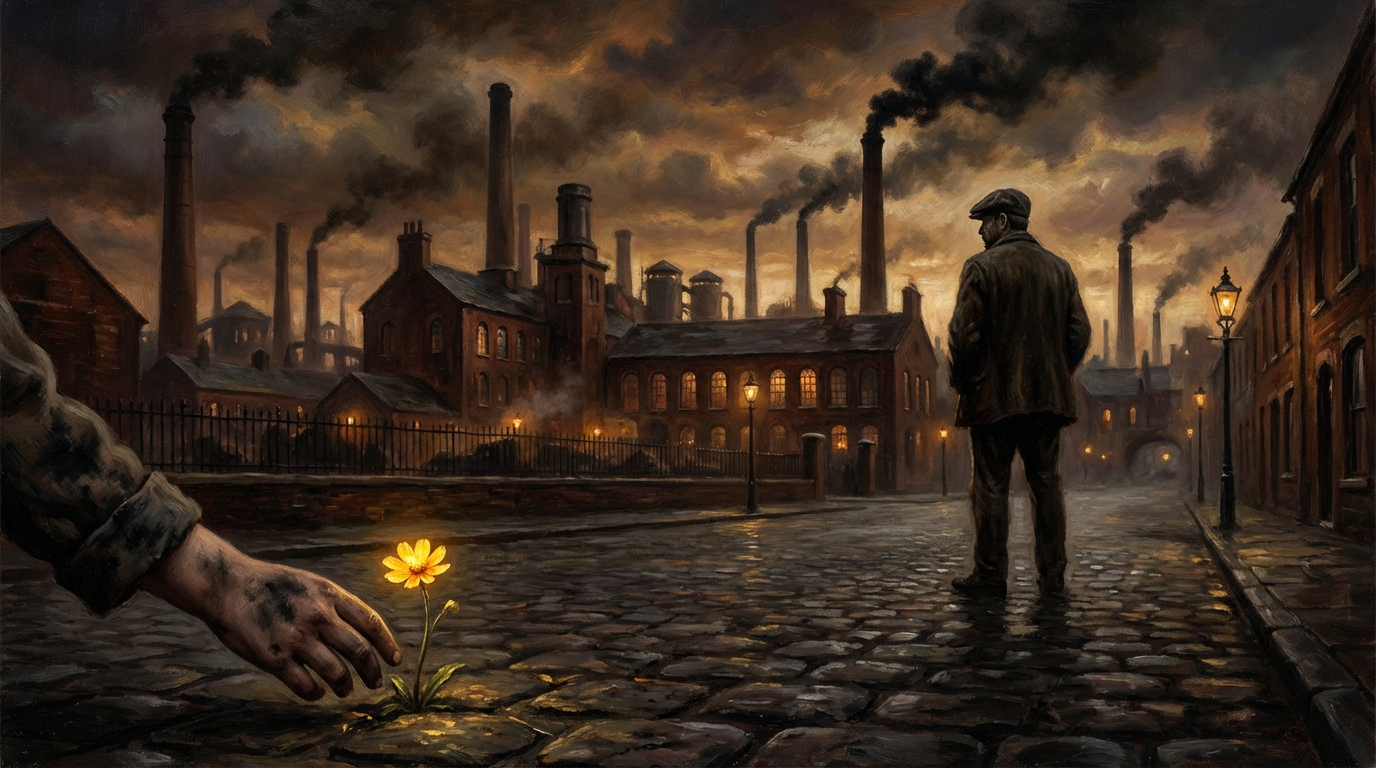
"It was a town of red brick, or of brick that would have been red if the smoke and ashes had allowed it."
Context: Dickens is describing the physical appearance of Coketown
This shows how industry literally changes the landscape and covers everything in grime. The pollution isn't just environmental - it's symbolic of how industrialization corrupts everything it touches.
In Today's Words:
The whole place was covered in so much industrial crud you couldn't even tell what color the buildings were supposed to be.
"It contained several large streets all very like one another, and many small streets still more like one another."
Context: Describing the monotonous layout of the industrial town
The repetitive architecture mirrors how the industrial system treats people as identical units. There's no room for individuality or beauty when efficiency is the only value.
In Today's Words:
Every street looked exactly the same - like someone copy-and-pasted the same boring design over and over.
"These attributes of Coketown were in the main inseparable from the work by which it was sustained."
Context: Explaining why the town looks and feels so mechanical
Dickens is showing that the ugly, repetitive environment isn't accidental - it's the inevitable result of organizing society around industrial production rather than human needs.
In Today's Words:
The town was ugly and soul-crushing because that's what happens when you build everything around making money instead of making life good.
Thematic Threads
Class
In This Chapter
The industrial environment creates and reinforces class divisions through shared rhythms of labor and exhaustion
Development
Builds on earlier classroom scenes to show how class shapes entire communities
In Your Life:
You might notice how different workplaces create invisible hierarchies through dress codes, meeting styles, or who gets to speak
Identity
In This Chapter
Individual identity gets worn down by repetitive industrial rhythms until people become interchangeable
Development
Expands from Gradgrind's fact-based identity suppression to show environmental identity erosion
In Your Life:
You might find yourself becoming more like your coworkers or neighbors without consciously choosing to change
Social Expectations
In This Chapter
The industrial keynote creates expectations that efficiency and productivity matter more than human connection
Development
Shows how Gradgrind's educational philosophy reflects broader social values
In Your Life:
You might feel pressure to optimize every aspect of life rather than simply enjoying experiences
Human Relationships
In This Chapter
Exhaustion and mechanical rhythms make genuine human connection a luxury workers can barely afford
Development
Introduces the environmental barriers to the relationships we'll see characters struggle with
In Your Life:
You might notice how work stress affects your ability to be present with family or friends
You now have the context. Time to form your own thoughts.
Discussion Questions
- 1
How does Dickens describe the physical environment of Coketown, and what effect does this setting have on the people who live there?
analysis • surface - 2
Why does Dickens call this chapter 'The Key-note'? What is the dominant 'note' or tone that industrial life strikes in people's daily existence?
analysis • medium - 3
Where do you see this pattern of environments reshaping people in your own workplace, neighborhood, or family life?
application • medium - 4
If you realized your environment was slowly changing you in ways you didn't like, what specific steps would you take to maintain your authentic self?
application • deep - 5
What does this chapter suggest about the relationship between our surroundings and our souls? Can we resist environmental influence, or does it always win in the end?
reflection • deep
Critical Thinking Exercise
Audit Your Environmental Keynotes
Choose three environments where you spend significant time (workplace, home, social spaces). For each one, identify the 'keynote' it strikes - the dominant rhythm, values, or pressures it creates. Write down what behaviors, thoughts, or attitudes each environment seems to encourage or reward. Then note any ways you've unconsciously adapted to match these environmental demands.
Consider:
- •Look for subtle influences, not just obvious ones - how does the pace, noise level, or physical setup shape your mindset?
- •Notice what gets rewarded or punished in each space - speed vs. quality, conformity vs. creativity, competition vs. collaboration
- •Consider whether the 'keynote' aligns with your personal values or pulls you away from who you want to be
Journaling Prompt
Write about a time when you noticed an environment was changing you - either positively or negatively. How did you recognize the shift, and what did you do about it?
Coming Up Next...
Chapter 6: The Circus Arrives
Just when the grinding monotony of Coketown seems absolute, we're about to encounter something completely different - a traveling circus that operates by entirely different rules. Sleary's horse-riding troupe brings color, laughter, and human warmth to this gray industrial world.



