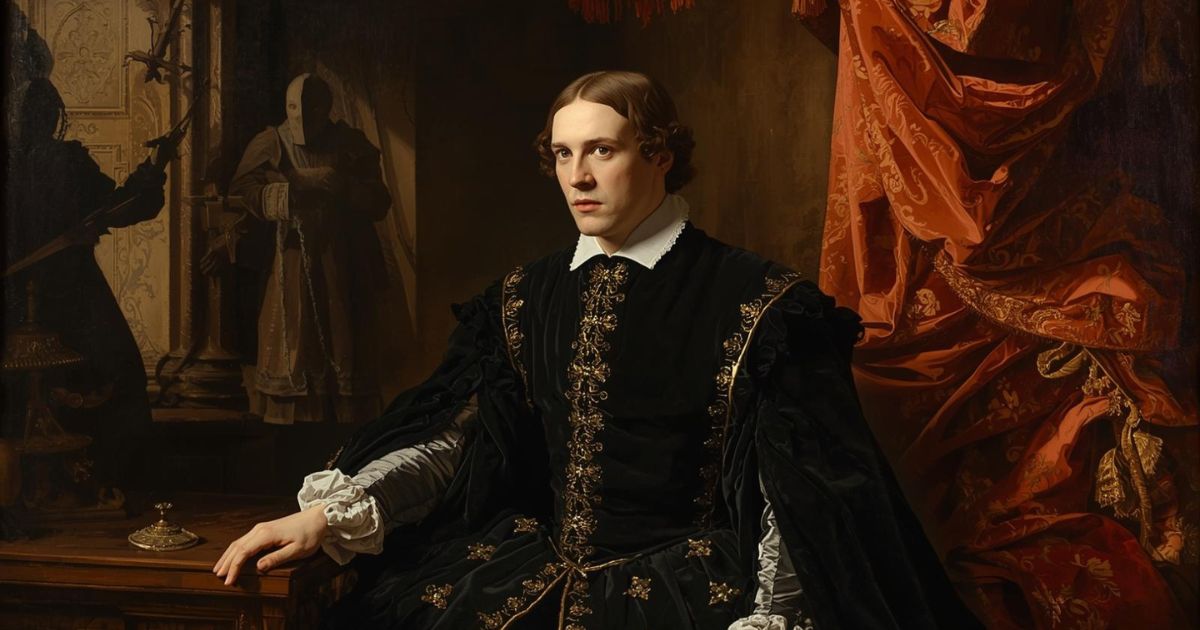
An excerpt from the original text.(complete · 4900 words)
CENE II. A room in the Castle.
Enter King, Queen, Rosencrantz, Guildenstern and Attendants.
KING.
Welcome, dear Rosencrantz and Guildenstern.
Moreover that we much did long to see you,
The need we have to use you did provoke
Our hasty sending. Something have you heard
Of Hamlet’s transformation; so I call it,
Since nor th’exterior nor the inward man
Resembles that it was. What it should be,
More than his father’s death, that thus hath put him
So much from th’understanding of himself,
I cannot dream of. I entreat you both
That, being of so young days brought up with him,
And since so neighbour’d to his youth and humour,
That you vouchsafe your rest here in our court
Some little time, so by your companies
To draw him on to pleasures and to gather,
So much as from occasion you may glean,
Whether aught to us unknown afflicts him thus
That, open’d, lies within our remedy.
QUEEN.
Good gentlemen, he hath much talk’d of you,
And sure I am, two men there are not living
To whom he more adheres. If it will please you
To show us so much gentry and good will
As to expend your time with us awhile,
For the supply and profit of our hope,
Your visitation shall receive such thanks
As fits a king’s remembrance.
ROSENCRANTZ.
Both your majesties
Might, by the sovereign power you have of us,
Put your dread pleasures more into command
Than to entreaty.
GUILDENSTERN.
We both obey,
And here give up ourselves, in the full bent,
To lay our service freely at your feet
To be commanded.
KING.
Thanks, Rosencrantz and gentle Guildenstern.
QUEEN.
Thanks, Guildenstern and gentle Rosencrantz.
And I beseech you instantly to visit
My too much changed son. Go, some of you,
And bring these gentlemen where Hamlet is.
GUILDENSTERN.
Heavens make our presence and our practices
Pleasant and helpful to him.
QUEEN.
Ay, amen.
[Exeunt Rosencrantz, Guildenstern and some Attendants.]
Enter Polonius.
POLONIUS.
Th’ambassadors from Norway, my good lord,
Are joyfully return’d.
KING.
Thou still hast been the father of good news.
POLONIUS.
Have I, my lord? Assure you, my good liege,
I hold my duty, as I hold my soul,
Both to my God and to my gracious King:
And I do think,—or else this brain of mine
Hunts not the trail of policy so sure
As it hath us’d to do—that I have found
The very cause of Hamlet’s lunacy.
KING.
O speak of that, that do I long to hear.
POLONIUS.
Give first admittance to th’ambassadors;
My news shall be the fruit to that great feast.
KING.
Thyself do grace to them, and bring them in.
[Exit Polonius.]
He tells me, my sweet queen, that he hath found
The head and source of all your son’s distemper.
QUEEN.
I doubt it is no other but the main,
His father’s death and our o’erhasty marriage.
KING.
Well, we shall sift him.
Enter Polonius with Voltemand and Cornelius.
Welcome, my good friends!
Say, Voltemand, what from our brother Norway?
VOLTEMAND.
Most fair return of greetings and desires.
Upon our first, he sent out to suppress
His nephew’s levies, which to him appear’d
To be a preparation ’gainst the Polack;
But better look’d into, he truly found
It was against your Highness; whereat griev’d,
That so his sickness, age, and impotence
Was falsely borne in hand, sends out arrests
On Fortinbras; which he, in brief, obeys,
Receives rebuke from Norway; and in fine,
Makes vow before his uncle never more
To give th’assay of arms against your Majesty.
Whereon old Norway, overcome with joy,
Gives him three thousand crowns in annual fee,
And his commission to employ those soldiers
So levied as before, against the Polack:
With an entreaty, herein further shown,
[Gives a paper.]
That it might please you to give quiet pass
Through your dominions for this enterprise,
On such regards of safety and allowance
As therein are set down.
KING.
It likes us well;
And at our more consider’d time we’ll read,
Answer, and think upon this business.
Meantime we thank you for your well-took labour.
Go to your rest, at night we’ll feast together:.
Most welcome home.
[Exeunt Voltemand and Cornelius.]
POLONIUS.
This business is well ended.
My liege and madam, to expostulate
What majesty should be, what duty is,
Why day is day, night night, and time is time
Were nothing but to waste night, day and time.
Therefore, since brevity is the soul of wit,
And tediousness the limbs and outward flourishes,
I will be brief. Your noble son is mad.
Mad call I it; for to define true madness,
What is’t but to be nothing else but mad?
But let that go.
QUEEN.
More matter, with less art.
POLONIUS.
Madam, I swear I use no art at all.
That he is mad, ’tis true: ’tis true ’tis pity;
And pity ’tis ’tis true. A foolish figure,
But farewell it, for I will use no art.
Mad let us grant him then. And now remains
That we find out the cause of this effect,
Or rather say, the cause of this defect,
For this effect defective comes by cause.
Thus it remains, and the remainder thus. Perpend,
I have a daughter—have whilst she is mine—
Who in her duty and obedience, mark,
Hath given me this. Now gather, and surmise.
[Reads.]
To the celestial, and my soul’s idol, the most beautified Ophelia—
That’s an ill phrase, a vile phrase; ‘beautified’ is a vile
phrase: but you shall hear.
[Reads.]
these; in her excellent white bosom, these, &c.
QUEEN.
Came this from Hamlet to her?
POLONIUS.
Good madam, stay awhile; I will be faithful.
[Reads.]
Doubt thou the stars are fire,
Doubt that the sun doth move,
Doubt truth to be a liar,
But never doubt I love.
O dear Ophelia, I am ill at these numbers. I have not art to reckon my
groans. But that I love thee best, O most best, believe it. Adieu.
Thine evermore, most dear lady, whilst this machine is to him,
HAMLET.
This in obedience hath my daughter show’d me;
And more above, hath his solicitings,
As they fell out by time, by means, and place,
All given to mine ear.
KING.
But how hath she receiv’d his love?
POLONIUS.
What do you think of me?
KING.
As of a man faithful and honourable.
POLONIUS.
I would fain prove so. But what might you think,
When I had seen this hot love on the wing,
As I perceiv’d it, I must tell you that,
Before my daughter told me, what might you,
Or my dear Majesty your queen here, think,
If I had play’d the desk or table-book,
Or given my heart a winking, mute and dumb,
Or look’d upon this love with idle sight,
What might you think? No, I went round to work,
And my young mistress thus I did bespeak:
‘Lord Hamlet is a prince, out of thy star.
This must not be.’ And then I precepts gave her,
That she should lock herself from his resort,
Admit no messengers, receive no tokens.
Which done, she took the fruits of my advice,
And he, repulsed,—a short tale to make—
Fell into a sadness, then into a fast,
Thence to a watch, thence into a weakness,
Thence to a lightness, and, by this declension,
Into the madness wherein now he raves,
And all we wail for.
KING.
Do you think ’tis this?
QUEEN.
It may be, very likely.
POLONIUS.
Hath there been such a time, I’d fain know that,
That I have positively said ‘’Tis so,’
When it prov’d otherwise?
KING.
Not that I know.
POLONIUS.
Take this from this, if this be otherwise.
[Points to his head and shoulder.]
If circumstances lead me, I will find
Where truth is hid, though it were hid indeed
Within the centre.
KING.
How may we try it further?
POLONIUS.
You know sometimes he walks four hours together
Here in the lobby.
QUEEN.
So he does indeed.
POLONIUS.
At such a time I’ll loose my daughter to him.
Be you and I behind an arras then,
Mark the encounter. If he love her not,
And be not from his reason fall’n thereon,
Let me be no assistant for a state,
But keep a farm and carters.
KING.
We will try it.
Enter Hamlet, reading.
QUEEN.
But look where sadly the poor wretch comes reading.
POLONIUS.
Away, I do beseech you, both away
I’ll board him presently. O, give me leave.
[Exeunt King, Queen and Attendants.]
How does my good Lord Hamlet?
HAMLET.
Well, God-a-mercy.
POLONIUS.
Do you know me, my lord?
HAMLET.
Excellent well. You are a fishmonger.
POLONIUS.
Not I, my lord.
HAMLET.
Then I would you were so honest a man.
POLONIUS.
Honest, my lord?
HAMLET.
Ay sir, to be honest, as this world goes, is to be one man picked out
of ten thousand.
POLONIUS.
That’s very true, my lord.
HAMLET.
For if the sun breed maggots in a dead dog, being a good kissing
carrion,—
Have you a daughter?
POLONIUS.
I have, my lord.
HAMLET.
Let her not walk i’ th’ sun. Conception is a blessing, but not as your
daughter may conceive. Friend, look to’t.
POLONIUS.
How say you by that? [Aside.] Still harping on my daughter. Yet he
knew me not at first; he said I was a fishmonger. He is far gone, far
gone. And truly in my youth I suffered much extremity for love; very
near this. I’ll speak to him again.—What do you read, my lord?
HAMLET.
Words, words, words.
POLONIUS.
What is the matter, my lord?
HAMLET.
Between who?
POLONIUS.
I mean the matter that you read, my lord.
HAMLET.
Slanders, sir. For the satirical slave says here that old men have grey
beards; that their faces are wrinkled; their eyes purging thick amber
and plum-tree gum; and that they have a plentiful lack of wit, together
with most weak hams. All which, sir, though I most powerfully and
potently believe, yet I hold it not honesty to have it thus set down.
For you yourself, sir, should be old as I am, if like a crab you could
go backward.
POLONIUS.
[Aside.] Though this be madness, yet there is method in’t.—
Will you walk out of the air, my lord?
HAMLET.
Into my grave?
POLONIUS.
Indeed, that is out o’ the air. [Aside.] How pregnant sometimes his
replies are! A happiness that often madness hits on, which reason and
sanity could not so prosperously be delivered of. I will leave him and
suddenly contrive the means of meeting between him and my daughter.
My honourable lord, I will most humbly take my leave of you.
HAMLET.
You cannot, sir, take from me anything that I will more willingly part
withal, except my life, except my life, except my life.
POLONIUS.
Fare you well, my lord.
HAMLET.
These tedious old fools.
Enter Rosencrantz and Guildenstern.
POLONIUS.
You go to seek the Lord Hamlet; there he is.
ROSENCRANTZ.
[To Polonius.] God save you, sir.
[Exit Polonius.]
GUILDENSTERN.
My honoured lord!
ROSENCRANTZ.
My most dear lord!
HAMLET.
My excellent good friends! How dost thou, Guildenstern? Ah,
Rosencrantz. Good lads, how do ye both?
ROSENCRANTZ.
As the indifferent children of the earth.
GUILDENSTERN.
Happy in that we are not over-happy;
On Fortune’s cap we are not the very button.
HAMLET.
Nor the soles of her shoe?
ROSENCRANTZ.
Neither, my lord.
HAMLET.
Then you live about her waist, or in the middle of her favours?
GUILDENSTERN.
Faith, her privates we.
HAMLET.
In the secret parts of Fortune? O, most true; she is a strumpet. What’s
the news?
ROSENCRANTZ.
None, my lord, but that the world’s grown honest.
HAMLET.
Then is doomsday near. But your news is not true. Let me question more
in particular. What have you, my good friends, deserved at the hands of
Fortune, that she sends you to prison hither?
GUILDENSTERN.
Prison, my lord?
HAMLET.
Denmark’s a prison.
ROSENCRANTZ.
Then is the world one.
HAMLET.
A goodly one; in which there are many confines, wards, and dungeons,
Denmark being one o’ th’ worst.
ROSENCRANTZ.
We think not so, my lord.
HAMLET.
Why, then ’tis none to you; for there is nothing either good or bad but
thinking makes it so. To me it is a prison.
ROSENCRANTZ.
Why, then your ambition makes it one; ’tis too narrow for your mind.
HAMLET.
O God, I could be bounded in a nutshell, and count myself a king of
infinite space, were it not that I have bad dreams.
GUILDENSTERN.
Which dreams, indeed, are ambition; for the very substance of the
ambitious is merely the shadow of a dream.
HAMLET.
A dream itself is but a shadow.
ROSENCRANTZ.
Truly, and I hold ambition of so airy and light a quality that it is
but a shadow’s shadow.
HAMLET.
Then are our beggars bodies, and our monarchs and outstretch’d heroes
the beggars’ shadows. Shall we to th’ court? For, by my fay, I cannot
reason.
ROSENCRANTZ and GUILDENSTERN.
We’ll wait upon you.
HAMLET.
No such matter. I will not sort you with the rest of my servants; for,
to speak to you like an honest man, I am most dreadfully attended. But,
in the beaten way of friendship, what make you at Elsinore?
ROSENCRANTZ.
To visit you, my lord, no other occasion.
HAMLET.
Beggar that I am, I am even poor in thanks; but I thank you. And sure,
dear friends, my thanks are too dear a halfpenny. Were you not sent
for? Is it your own inclining? Is it a free visitation? Come, deal
justly with me. Come, come; nay, speak.
GUILDENSTERN.
What should we say, my lord?
HAMLET.
Why, anything. But to the purpose. You were sent for; and there is a
kind of confession in your looks, which your modesties have not craft
enough to colour. I know the good King and Queen have sent for you.
ROSENCRANTZ.
To what end, my lord?
HAMLET.
That you must teach me. But let me conjure you, by the rights of our
fellowship, by the consonancy of our youth, by the obligation of our
ever-preserved love, and by what more dear a better proposer could
charge you withal, be even and direct with me, whether you were sent
for or no.
ROSENCRANTZ.
[To Guildenstern.] What say you?
HAMLET.
[Aside.] Nay, then I have an eye of you. If you love me, hold not
off.
GUILDENSTERN.
My lord, we were sent for.
HAMLET.
I will tell you why; so shall my anticipation prevent your discovery,
and your secrecy to the King and Queen moult no feather. I have of
late, but wherefore I know not, lost all my mirth, forgone all custom
of exercises; and indeed, it goes so heavily with my disposition that
this goodly frame the earth, seems to me a sterile promontory; this
most excellent canopy the air, look you, this brave o’erhanging
firmament, this majestical roof fretted with golden fire, why, it
appears no other thing to me than a foul and pestilent congregation of
vapours. What a piece of work is man, how noble in reason, how infinite
in faculties, in form and moving, how express and admirable; in action
how like an angel, in apprehension, how like a god: the beauty of the
world, the paragon of animals. And yet, to me, what is this
quintessence of dust? Man delights not me; no, nor woman neither,
though by your smiling you seem to say so.
ROSENCRANTZ.
My lord, there was no such stuff in my thoughts.
HAMLET.
Why did you laugh then, when I said ‘Man delights not me’?
ROSENCRANTZ.
To think, my lord, if you delight not in man, what Lenten entertainment
the players shall receive from you. We coted them on the way, and
hither are they coming to offer you service.
HAMLET.
He that plays the king shall be welcome,—his Majesty shall have tribute
of me; the adventurous knight shall use his foil and target; the lover
shall not sigh gratis, the humorous man shall end his part in peace;
the clown shall make those laugh whose lungs are tickle o’ th’ sere;
and the lady shall say her mind freely, or the blank verse shall halt
for’t. What players are they?
ROSENCRANTZ.
Even those you were wont to take such delight in—the tragedians of the
city.
HAMLET.
How chances it they travel? Their residence, both in reputation and
profit, was better both ways.
ROSENCRANTZ.
I think their inhibition comes by the means of the late innovation.
HAMLET.
Do they hold the same estimation they did when I was in the city? Are
they so followed?
ROSENCRANTZ.
No, indeed, they are not.
HAMLET.
How comes it? Do they grow rusty?
ROSENCRANTZ.
Nay, their endeavour keeps in the wonted pace; but there is, sir, an
aerie of children, little eyases, that cry out on the top of question,
and are most tyrannically clapped for’t. These are now the fashion, and
so berattle the common stages—so they call them—that many wearing
rapiers are afraid of goose-quills and dare scarce come thither.
HAMLET.
What, are they children? Who maintains ’em? How are they escoted? Will
they pursue the quality no longer than they can sing? Will they not say
afterwards, if they should grow themselves to common players—as it is
most like, if their means are no better—their writers do them wrong to
make them exclaim against their own succession?
ROSENCRANTZ.
Faith, there has been much to do on both sides; and the nation holds it
no sin to tarre them to controversy. There was for a while, no money
bid for argument unless the poet and the player went to cuffs in the
question.
HAMLET.
Is’t possible?
GUILDENSTERN.
O, there has been much throwing about of brains.
HAMLET.
Do the boys carry it away?
ROSENCRANTZ.
Ay, that they do, my lord. Hercules and his load too.
HAMLET.
It is not very strange; for my uncle is King of Denmark, and those that
would make mouths at him while my father lived, give twenty, forty,
fifty, a hundred ducats apiece for his picture in little. ’Sblood,
there is something in this more than natural, if philosophy could find
it out.
[Flourish of trumpets within.]
GUILDENSTERN.
There are the players.
HAMLET.
Gentlemen, you are welcome to Elsinore. Your hands, come. The
appurtenance of welcome is fashion and ceremony. Let me comply with you
in this garb, lest my extent to the players, which I tell you must show
fairly outward, should more appear like entertainment than yours. You
are welcome. But my uncle-father and aunt-mother are deceived.
GUILDENSTERN.
In what, my dear lord?
HAMLET.
I am but mad north-north-west. When the wind is southerly, I know a
hawk from a handsaw.
Enter Polonius.
POLONIUS.
Well be with you, gentlemen.
HAMLET.
Hark you, Guildenstern, and you too, at each ear a hearer. That great
baby you see there is not yet out of his swaddling clouts.
ROSENCRANTZ.
Happily he’s the second time come to them; for they say an old man is
twice a child.
HAMLET.
I will prophesy he comes to tell me of the players. Mark it.—You say
right, sir: for a Monday morning ’twas so indeed.
POLONIUS.
My lord, I have news to tell you.
HAMLET.
My lord, I have news to tell you. When Roscius was an actor in Rome—
POLONIUS.
The actors are come hither, my lord.
HAMLET.
Buzz, buzz.
POLONIUS.
Upon my honour.
HAMLET.
Then came each actor on his ass—
POLONIUS.
The best actors in the world, either for tragedy, comedy, history,
pastoral, pastoral-comical, historical-pastoral, tragical-historical,
tragical-comical-historical-pastoral, scene individable, or poem
unlimited. Seneca cannot be too heavy, nor Plautus too light, for the
law of writ and the liberty. These are the only men.
HAMLET.
O Jephthah, judge of Israel, what a treasure hadst thou!
POLONIUS.
What treasure had he, my lord?
HAMLET.
Why—
’One fair daughter, and no more,
The which he loved passing well.’
POLONIUS.
[Aside.] Still on my daughter.
HAMLET.
Am I not i’ th’ right, old Jephthah?
POLONIUS.
If you call me Jephthah, my lord, I have a daughter that I love passing
well.
HAMLET.
Nay, that follows not.
POLONIUS.
What follows then, my lord?
HAMLET.
Why,
As by lot, God wot,
and then, you know,
It came to pass, as most like it was.
The first row of the pious chanson will show you more. For look where
my abridgement comes.
Enter four or five Players.
You are welcome, masters, welcome all. I am glad to see thee well.
Welcome, good friends. O, my old friend! Thy face is valanc’d since I
saw thee last. Com’st thou to beard me in Denmark? What, my young lady
and mistress! By’r lady, your ladyship is nearer to heaven than when I
saw you last, by the altitude of a chopine. Pray God your voice, like a
piece of uncurrent gold, be not cracked within the ring. Masters, you
are all welcome. We’ll e’en to’t like French falconers, fly at anything
we see. We’ll have a speech straight. Come, give us a taste of your
quality. Come, a passionate speech.
FIRST PLAYER.
What speech, my lord?
HAMLET.
I heard thee speak me a speech once, but it was never acted, or if it
was, not above once, for the play, I remember, pleased not the million,
’twas caviare to the general. But it was—as I received it, and others,
whose judgements in such matters cried in the top of mine—an excellent
play, well digested in the scenes, set down with as much modesty as
cunning. I remember one said there were no sallets in the lines to make
the matter savoury, nor no matter in the phrase that might indite the
author of affectation, but called it an honest method, as wholesome as
sweet, and by very much more handsome than fine. One speech in it, I
chiefly loved. ’Twas Aeneas’ tale to Dido, and thereabout of it
especially where he speaks of Priam’s slaughter. If it live in your
memory, begin at this line, let me see, let me see:
The rugged Pyrrhus, like th’ Hyrcanian beast,—
It is not so: it begins with Pyrrhus—
The rugged Pyrrhus, he whose sable arms,
Black as his purpose, did the night resemble
When he lay couched in the ominous horse,
Hath now this dread and black complexion smear’d
With heraldry more dismal. Head to foot
Now is he total gules, horridly trick’d
With blood of fathers, mothers, daughters, sons,
Bak’d and impasted with the parching streets,
That lend a tyrannous and a damned light
To their vile murders. Roasted in wrath and fire,
And thus o’ersized with coagulate gore,
With eyes like carbuncles, the hellish Pyrrhus
Old grandsire Priam seeks.
So, proceed you.
POLONIUS.
’Fore God, my lord, well spoken, with good accent and good discretion.
FIRST PLAYER.
Anon he finds him,
Striking too short at Greeks. His antique sword,
Rebellious to his arm, lies where it falls,
Repugnant to command. Unequal match’d,
Pyrrhus at Priam drives, in rage strikes wide;
But with the whiff and wind of his fell sword
Th’unnerved father falls. Then senseless Ilium,
Seeming to feel this blow, with flaming top
Stoops to his base, and with a hideous crash
Takes prisoner Pyrrhus’ ear. For lo, his sword,
Which was declining on the milky head
Of reverend Priam, seem’d i’ th’air to stick.
So, as a painted tyrant, Pyrrhus stood,
And like a neutral to his will and matter,
Did nothing.
But as we often see against some storm,
A silence in the heavens, the rack stand still,
The bold winds speechless, and the orb below
As hush as death, anon the dreadful thunder
Doth rend the region; so after Pyrrhus’ pause,
Aroused vengeance sets him new a-work,
And never did the Cyclops’ hammers fall
On Mars’s armour, forg’d for proof eterne,
With less remorse than Pyrrhus’ bleeding sword
Now falls on Priam.
Out, out, thou strumpet Fortune! All you gods,
In general synod, take away her power;
Break all the spokes and fellies from her wheel,
And bowl the round nave down the hill of heaven,
As low as to the fiends.
POLONIUS.
This is too long.
HAMLET.
It shall to the barber’s, with your beard.—Prithee say on.
He’s for a jig or a tale of bawdry, or he sleeps.
Say on; come to Hecuba.
FIRST PLAYER.
But who, O who, had seen the mobled queen,—
HAMLET.
‘The mobled queen’?
POLONIUS.
That’s good! ‘Mobled queen’ is good.
FIRST PLAYER.
Run barefoot up and down, threat’ning the flames
With bisson rheum. A clout upon that head
Where late the diadem stood, and for a robe,
About her lank and all o’erteemed loins,
A blanket, in th’alarm of fear caught up—
Who this had seen, with tongue in venom steep’d,
’Gainst Fortune’s state would treason have pronounc’d.
But if the gods themselves did see her then,
When she saw Pyrrhus make malicious sport
In mincing with his sword her husband’s limbs,
The instant burst of clamour that she made,—
Unless things mortal move them not at all,—
Would have made milch the burning eyes of heaven,
And passion in the gods.
POLONIUS.
Look, where he has not turn’d his colour, and has tears in’s eyes. Pray
you, no more.
HAMLET.
’Tis well. I’ll have thee speak out the rest of this soon.—Good my
lord, will you see the players well bestowed? Do you hear, let them be
well used; for they are the abstracts and brief chronicles of the time.
After your death you were better have a bad epitaph than their ill
report while you live.
POLONIUS.
My lord, I will use them according to their desert.
HAMLET.
God’s bodikin, man, much better. Use every man after his desert, and who
should ’scape whipping? Use them after your own honour and dignity. The
less they deserve, the more merit is in your bounty. Take them in.
POLONIUS.
Come, sirs.
HAMLET.
Follow him, friends. We’ll hear a play tomorrow.
[Exeunt Polonius with all the Players but the First.]
Dost thou hear me, old friend? Can you play The Murder of Gonzago?
FIRST PLAYER.
Ay, my lord.
HAMLET.
We’ll ha’t tomorrow night. You could for a need study a speech of some
dozen or sixteen lines, which I would set down and insert in’t, could
you not?
FIRST PLAYER.
Ay, my lord.
HAMLET.
Very well. Follow that lord, and look you mock him not.
[Exit First Player.]
[To Rosencrantz and Guildenstern] My good friends, I’ll leave you
till night. You are welcome to Elsinore.
ROSENCRANTZ.
Good my lord.
[Exeunt Rosencrantz and Guildenstern.]
HAMLET.
Ay, so, God b’ wi’ ye. Now I am alone.
O what a rogue and peasant slave am I!
Is it not monstrous that this player here,
But in a fiction, in a dream of passion,
Could force his soul so to his own conceit
That from her working all his visage wan’d;
Tears in his eyes, distraction in’s aspect,
A broken voice, and his whole function suiting
With forms to his conceit? And all for nothing!
For Hecuba?
What’s Hecuba to him, or he to Hecuba,
That he should weep for her? What would he do,
Had he the motive and the cue for passion
That I have? He would drown the stage with tears
And cleave the general ear with horrid speech;
Make mad the guilty, and appal the free,
Confound the ignorant, and amaze indeed,
The very faculties of eyes and ears. Yet I,
A dull and muddy-mettled rascal, peak
Like John-a-dreams, unpregnant of my cause,
And can say nothing. No, not for a king
Upon whose property and most dear life
A damn’d defeat was made. Am I a coward?
Who calls me villain, breaks my pate across?
Plucks off my beard and blows it in my face?
Tweaks me by the nose, gives me the lie i’ th’ throat
As deep as to the lungs? Who does me this?
Ha! ’Swounds, I should take it: for it cannot be
But I am pigeon-liver’d, and lack gall
To make oppression bitter, or ere this
I should have fatted all the region kites
With this slave’s offal. Bloody, bawdy villain!
Remorseless, treacherous, lecherous, kindless villain!
Oh vengeance!
Why, what an ass am I! This is most brave,
That I, the son of a dear father murder’d,
Prompted to my revenge by heaven and hell,
Must, like a whore, unpack my heart with words
And fall a-cursing like a very drab,
A scullion! Fie upon’t! Foh!
About, my brain! I have heard
That guilty creatures sitting at a play,
Have by the very cunning of the scene,
Been struck so to the soul that presently
They have proclaim’d their malefactions.
For murder, though it have no tongue, will speak
With most miraculous organ. I’ll have these players
Play something like the murder of my father
Before mine uncle. I’ll observe his looks;
I’ll tent him to the quick. If he but blench,
I know my course. The spirit that I have seen
May be the devil, and the devil hath power
T’assume a pleasing shape, yea, and perhaps
Out of my weakness and my melancholy,
As he is very potent with such spirits,
Abuses me to damn me. I’ll have grounds
More relative than this. The play’s the thing
Wherein I’ll catch the conscience of the King.
[Exit.]
ACT III
Master this chapter. Complete your experience
Purchase the complete book to access all chapters and support classic literature
As an Amazon Associate, we earn a small commission from qualifying purchases at no additional cost to you.
Available in paperback, hardcover, and e-book formats
Let's Analyse the Pattern
When people choose watching and manipulating over direct communication, they destroy the trust that makes relationships meaningful.
Why This Matters
Connect literature to life
This chapter teaches how to recognize when concern is genuine versus when it's information gathering in disguise.
Practice This Today
This week, notice when someone asks questions that feel slightly off—too probing, too convenient, or coming from people who don't usually check on you that way.
Now let's explore the literary elements.
Key Quotes & Analysis
"I have of late—but wherefore I know not—lost all my mirth, forgone all custom of exercises; and indeed it goes so heavily with my disposition that this goodly frame, the earth, seems to me a sterile promontory."
Context: Hamlet describes his depression to his childhood friends who've come to spy on him.
This is one of literature's most honest descriptions of depression. Hamlet explains how everything that once brought him joy now feels meaningless, and even the beautiful world looks barren to him.
In Today's Words:
Lately I don't know why, but I've lost interest in everything I used to enjoy, and the whole world just looks empty and pointless to me.
"What a piece of work is a man! How noble in reason, how infinite in faculty! In form and moving how express and admirable! And yet, to me, what is this quintessence of dust?"
Context: Continuing his description of his mental state to Rosencrantz and Guildenstern.
Hamlet acknowledges that humans are amazing and capable, but depression has stripped away his ability to feel that wonder. He can intellectually recognize human potential while emotionally feeling nothing.
In Today's Words:
I know people are supposed to be amazing and capable of great things, but right now they just seem like walking dirt to me.
"O, what a rogue and peasant slave am I! Is it not monstrous that this player here, but in a fiction, in a dream of passion, could force his soul so to his own conceit that from her working all his visage wanned?"
Context: Hamlet berates himself after watching the actor cry real tears over the fictional death of Priam.
This moment of self-recognition drives the plot forward. Hamlet is ashamed that an actor can summon genuine emotion for a made-up story while he struggles to act on his father's real murder.
In Today's Words:
What's wrong with me? This actor can work himself into real tears over a fake story, and I can't even get motivated about my own father's murder.
"The play's the thing wherein I'll catch the conscience of the king."
Context: Hamlet's breakthrough moment when he decides to use theater to test Claudius's guilt.
This famous line shows Hamlet moving from paralysis to action. He realizes that truth can emerge through performance and that watching someone's reaction can reveal their guilt.
In Today's Words:
I'll put on a play that mirrors what he did, and his reaction will tell me if he's guilty.
Thematic Threads
Betrayal
In This Chapter
Childhood friends become spies, parents use children as bait, and every relationship becomes a potential surveillance operation
Development
Escalated from family betrayal to systematic corruption of all social bonds
In Your Life:
You might recognize this when friends start asking leading questions or when workplace relationships feel suddenly artificial
Authenticity
In This Chapter
Only the actor's performance of fictional grief feels genuine while all real relationships are corrupted by hidden agendas
Development
Introduced here as the antidote to surveillance culture
In Your Life:
You might find yourself more comfortable with strangers than family because there's less history of manipulation
Power Dynamics
In This Chapter
Authority figures recruit subordinates to spy on equals, using friendship and family bonds as tools of control
Development
Evolved from direct confrontation to sophisticated manipulation networks
In Your Life:
You might notice managers asking certain employees to report on others or family members pumping you for information about siblings
Isolation
In This Chapter
Hamlet's deep depression stems partly from being unable to trust anyone around him in an environment of constant surveillance
Development
Deepened from grief to complete social disconnection
In Your Life:
You might feel exhausted by relationships that require constant performance rather than offering genuine connection
Recognition
In This Chapter
Hamlet immediately sees through his friends' mission and uses the actors to devise his own test of truth
Development
Introduced here as both survival skill and strategic weapon
In Your Life:
You might develop an instinct for when conversations feel scripted or when people are fishing for specific information
You now have the context. Time to form your own thoughts.
Discussion Questions
- 1
Why does Hamlet immediately see through Rosencrantz and Guildenstern's mission to spy on him, even though they're his childhood friends?
analysis • surface - 2
What happens to relationships when people choose surveillance and manipulation over direct, honest communication?
analysis • medium - 3
Where do you see this pattern of surveillance replacing trust in modern workplaces, families, or relationships?
application • medium - 4
When you suspect someone is trying to manipulate or spy on you, how can you respond without becoming manipulative yourself?
application • deep - 5
Why does genuine emotion from the actor accomplish more than all the scheming and surveillance happening around Hamlet?
reflection • deep
Critical Thinking Exercise
Map Your Surveillance Network
Think about your daily life and identify three situations where someone might be watching, tracking, or gathering information about you (work monitoring, family checking up, social media surveillance, etc.). For each situation, write down: Who's watching? What are they trying to learn? What direct conversation could replace this surveillance?
Consider:
- •Consider both digital and in-person forms of surveillance
- •Think about times when you've been the one doing the watching
- •Notice which surveillance feels protective versus controlling
Journaling Prompt
Write about a time when someone's indirect approach to learning about you (asking others, checking your activities) damaged your relationship with them. How might direct communication have changed the outcome?
Coming Up Next...
Chapter 9: To Be or Not to Be
Hamlet prepares to test his uncle's guilt, but first he must confront the most famous question in all of literature - and the choice between action and inaction that defines us all.