An excerpt from the original text.(complete · 2333 words)
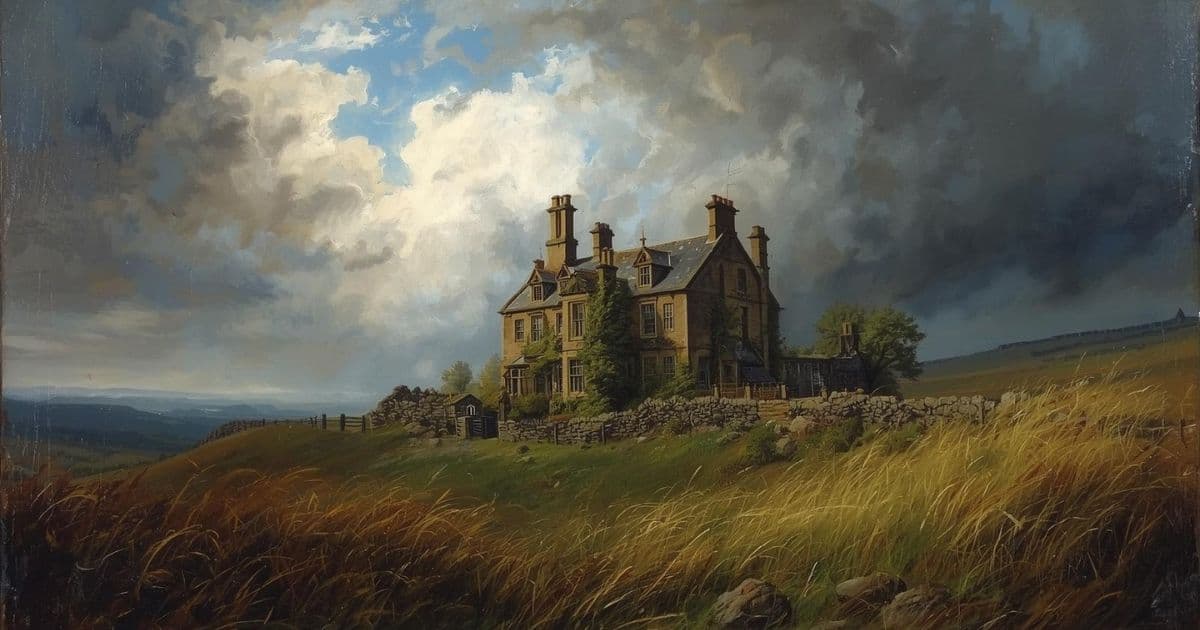
spent the following day roaming through the valley. I stood beside the sources of the Arveiron, which take their rise in a glacier, that with slow pace is advancing down from the summit of the hills to barricade the valley. The abrupt sides of vast mountains were before me; the icy wall of the glacier overhung me; a few shattered pines were scattered around; and the solemn silence of this glorious presence-chamber of imperial nature was broken only by the brawling waves or the fall of some vast fragment, the thunder sound of the avalanche or the cracking, reverberated along the mountains, of the accumulated ice, which, through the silent working of immutable laws, was ever and anon rent and torn, as if it had been but a plaything in their hands. These sublime and magnificent scenes afforded me the greatest consolation that I was capable of receiving. They elevated me from all littleness of feeling, and although they did not remove my grief, they subdued and tranquillized it. In some degree, also, they diverted my mind from the thoughts over which it had brooded for the last month. I retired to rest at night; my slumbers, as it were, waited on and ministered to by the assemblance of grand shapes which I had contemplated during the day. They congregated round me; the unstained snowy mountain-top, the glittering pinnacle, the pine woods, and ragged bare ravine, the eagle, soaring amidst the clouds—they all gathered round me and bade me be at peace.
Where had they fled when the next morning I awoke? All of soul-inspiriting fled with sleep, and dark melancholy clouded every thought. The rain was pouring in torrents, and thick mists hid the summits of the mountains, so that I even saw not the faces of those mighty friends. Still I would penetrate their misty veil and seek them in their cloudy retreats. What were rain and storm to me? My mule was brought to the door, and I resolved to ascend to the summit of Montanvert. I remembered the effect that the view of the tremendous and ever-moving glacier had produced upon my mind when I first saw it. It had then filled me with a sublime ecstasy that gave wings to the soul and allowed it to soar from the obscure world to light and joy. The sight of the awful and majestic in nature had indeed always the effect of solemnizing my mind and causing me to forget the passing cares of life. I determined to go without a guide, for I was well acquainted with the path, and the presence of another would destroy the solitary grandeur of the scene.
The ascent is precipitous, but the path is cut into continual and short windings, which enable you to surmount the perpendicularity of the mountain. It is a scene terrifically desolate. In a thousand spots the traces of the winter avalanche may be perceived, where trees lie broken and strewed on the ground, some entirely destroyed, others bent, leaning upon the jutting rocks of the mountain or transversely upon other trees. The path, as you ascend higher, is intersected by ravines of snow, down which stones continually roll from above; one of them is particularly dangerous, as the slightest sound, such as even speaking in a loud voice, produces a concussion of air sufficient to draw destruction upon the head of the speaker. The pines are not tall or luxuriant, but they are sombre and add an air of severity to the scene. I looked on the valley beneath; vast mists were rising from the rivers which ran through it and curling in thick wreaths around the opposite mountains, whose summits were hid in the uniform clouds, while rain poured from the dark sky and added to the melancholy impression I received from the objects around me. Alas! Why does man boast of sensibilities superior to those apparent in the brute; it only renders them more necessary beings. If our impulses were confined to hunger, thirst, and desire, we might be nearly free; but now we are moved by every wind that blows and a chance word or scene that that word may convey to us.
We rest; a dream has power to poison sleep.
We rise; one wand'ring thought pollutes the day.
We feel, conceive, or reason; laugh or weep,
Embrace fond woe, or cast our cares away;
It is the same: for, be it joy or sorrow,
The path of its departure still is free.
Man's yesterday may ne'er be like his morrow;
Nought may endure but mutability!
It was nearly noon when I arrived at the top of the ascent. For some time I sat upon the rock that overlooks the sea of ice. A mist covered both that and the surrounding mountains. Presently a breeze dissipated the cloud, and I descended upon the glacier. The surface is very uneven, rising like the waves of a troubled sea, descending low, and interspersed by rifts that sink deep. The field of ice is almost a league in width, but I spent nearly two hours in crossing it. The opposite mountain is a bare perpendicular rock. From the side where I now stood Montanvert was exactly opposite, at the distance of a league; and above it rose Mont Blanc, in awful majesty. I remained in a recess of the rock, gazing on this wonderful and stupendous scene. The sea, or rather the vast river of ice, wound among its dependent mountains, whose aerial summits hung over its recesses. Their icy and glittering peaks shone in the sunlight over the clouds. My heart, which was before sorrowful, now swelled with something like joy; I exclaimed, "Wandering spirits, if indeed ye wander, and do not rest in your narrow beds, allow me this faint happiness, or take me, as your companion, away from the joys of life."
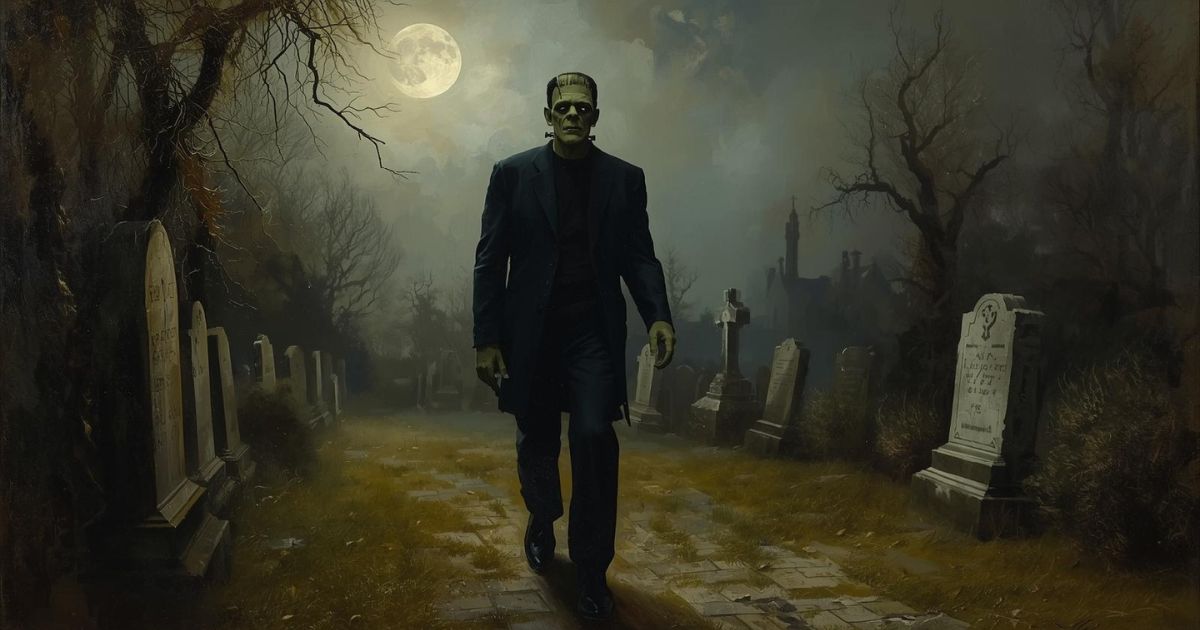
As I said this I suddenly beheld the figure of a man, at some distance, advancing towards me with superhuman speed. He bounded over the crevices in the ice, among which I had walked with caution; his stature, also, as he approached, seemed to exceed that of man. I was troubled; a mist came over my eyes, and I felt a faintness seize me, but I was quickly restored by the cold gale of the mountains. I perceived, as the shape came nearer (sight tremendous and abhorred!) that it was the wretch whom I had created. I trembled with rage and horror, resolving to wait his approach and then close with him in mortal combat. He approached; his countenance bespoke bitter anguish, combined with disdain and malignity, while its unearthly ugliness rendered it almost too horrible for human eyes. But I scarcely observed this; rage and hatred had at first deprived me of utterance, and I recovered only to overwhelm him with words expressive of furious detestation and contempt.
"Devil," I exclaimed, "do you dare approach me? And do not you fear the fierce vengeance of my arm wreaked on your miserable head? Begone, vile insect! Or rather, stay, that I may trample you to dust! And, oh! That I could, with the extinction of your miserable existence, restore those victims whom you have so diabolically murdered!"
"I expected this reception," said the daemon. "All men hate the wretched; how, then, must I be hated, who am miserable beyond all living things! Yet you, my creator, detest and spurn me, thy creature, to whom thou art bound by ties only dissoluble by the annihilation of one of us. You purpose to kill me. How dare you sport thus with life? Do your duty towards me, and I will do mine towards you and the rest of mankind. If you will comply with my conditions, I will leave them and you at peace; but if you refuse, I will glut the maw of death, until it be satiated with the blood of your remaining friends."
"Abhorred monster! Fiend that thou art! The tortures of hell are too mild a vengeance for thy crimes. Wretched devil! You reproach me with your creation, come on, then, that I may extinguish the spark which I so negligently bestowed."
My rage was without bounds; I sprang on him, impelled by all the feelings which can arm one being against the existence of another.
He easily eluded me and said,
"Be calm! I entreat you to hear me before you give vent to your hatred on my devoted head. Have I not suffered enough, that you seek to increase my misery? Life, although it may only be an accumulation of anguish, is dear to me, and I will defend it. Remember, thou hast made me more powerful than thyself; my height is superior to thine, my joints more supple. But I will not be tempted to set myself in opposition to thee. I am thy creature, and I will be even mild and docile to my natural lord and king if thou wilt also perform thy part, the which thou owest me. Oh, Frankenstein, be not equitable to every other and trample upon me alone, to whom thy justice, and even thy clemency and affection, is most due. Remember that I am thy creature; I ought to be thy Adam, but I am rather the fallen angel, whom thou drivest from joy for no misdeed. Everywhere I see bliss, from which I alone am irrevocably excluded. I was benevolent and good; misery made me a fiend. Make me happy, and I shall again be virtuous."
"Begone! I will not hear you. There can be no community between you and me; we are enemies. Begone, or let us try our strength in a fight, in which one must fall."
"How can I move thee? Will no entreaties cause thee to turn a favourable eye upon thy creature, who implores thy goodness and compassion? Believe me, Frankenstein, I was benevolent; my soul glowed with love and humanity; but am I not alone, miserably alone? You, my creator, abhor me; what hope can I gather from your fellow creatures, who owe me nothing? They spurn and hate me. The desert mountains and dreary glaciers are my refuge. I have wandered here many days; the caves of ice, which I only do not fear, are a dwelling to me, and the only one which man does not grudge. These bleak skies I hail, for they are kinder to me than your fellow beings. If the multitude of mankind knew of my existence, they would do as you do, and arm themselves for my destruction. Shall I not then hate them who abhor me? I will keep no terms with my enemies. I am miserable, and they shall share my wretchedness. Yet it is in your power to recompense me, and deliver them from an evil which it only remains for you to make so great, that not only you and your family, but thousands of others, shall be swallowed up in the whirlwinds of its rage. Let your compassion be moved, and do not disdain me. Listen to my tale; when you have heard that, abandon or commiserate me, as you shall judge that I deserve. But hear me. The guilty are allowed, by human laws, bloody as they are, to speak in their own defence before they are condemned. Listen to me, Frankenstein. You accuse me of murder, and yet you would, with a satisfied conscience, destroy your own creature. Oh, praise the eternal justice of man! Yet I ask you not to spare me; listen to me, and then, if you can, and if you will, destroy the work of your hands."
"Why do you call to my remembrance," I rejoined, "circumstances of which I shudder to reflect, that I have been the miserable origin and author? Cursed be the day, abhorred devil, in which you first saw light! Cursed (although I curse myself) be the hands that formed you! You have made me wretched beyond expression. You have left me no power to consider whether I am just to you or not. Begone! Relieve me from the sight of your detested form."
"Thus I relieve thee, my creator," he said, and placed his hated hands before my eyes, which I flung from me with violence; "thus I take from thee a sight which you abhor. Still thou canst listen to me and grant me thy compassion. By the virtues that I once possessed, I demand this from you. Hear my tale; it is long and strange, and the temperature of this place is not fitting to your fine sensations; come to the hut upon the mountain. The sun is yet high in the heavens; before it descends to hide itself behind your snowy precipices and illuminate another world, you will have heard my story and can decide. On you it rests, whether I quit forever the neighbourhood of man and lead a harmless life, or become the scourge of your fellow creatures and the author of your own speedy ruin."
As he said this he led the way across the ice; I followed. My heart was full, and I did not answer him, but as I proceeded, I weighed the various arguments that he had used and determined at least to listen to his tale. I was partly urged by curiosity, and compassion confirmed my resolution. For the first time, also, I felt what the duties of a creator towards his creature were, and that I ought to render him happy before I complained of his wickedness. These motives urged me to comply with his demand. We crossed the ice, therefore, and ascended the opposite rock. The air was cold, and the rain again began to descend; we entered the hut, the fiend with an air of exultation, I with a heavy heart and depressed spirits. But I consented to listen, and seating myself by the fire which my odious companion had lighted, he thus began his tale.
Master this chapter. Complete your experience
Purchase the complete book to access all chapters and support classic literature
As an Amazon Associate, we earn a small commission from qualifying purchases at no additional cost to you.
Available in paperback, hardcover, and e-book formats
Let's Analyse the Pattern
Learning about life by watching others live it, while simultaneously becoming more aware of your own exclusion from what you're observing.
Why This Matters
Connect literature to life
This chapter teaches how to decode the unspoken rules and power structures within any group by careful observation.
Practice This Today
This week, notice when you're in observer mode—at work, family gatherings, or social events—and identify who really holds influence versus who just talks loudest.
Now let's explore the literary elements.
Key Quotes & Analysis
"I found that these people possessed a method of communicating their experience and feelings to one another by articulate sounds."
Context: When he first realizes that the family's sounds are actually language with meaning
This shows the creature's complete isolation from human society - he doesn't even understand that speech carries meaning. It emphasizes how much basic human knowledge he lacks.
In Today's Words:
I figured out that these people were actually talking to each other, not just making noise.
"The gentle manners and beauty of the cottagers greatly endeared them to me."
Context: As he describes his growing attachment to the family he watches
The creature is drawn to their kindness and finds beauty in their treatment of each other. This reveals his capacity for appreciation and his hunger for gentleness.
In Today's Words:
The way they were so kind to each other made me fall in love with this family.
"I discovered also another means through which I was enabled to assist their labours."
Context: When he begins secretly helping the family by gathering firewood
This shows the creature's desire to contribute and connect, even from a distance. He wants to be useful to people he cares about, demonstrating his fundamentally caring nature.
In Today's Words:
I found ways to help them out without them knowing it was me.
Thematic Threads
Identity
In This Chapter
The creature begins forming his identity through comparison—understanding himself by watching what he is not
Development
Evolved from basic survival needs to complex self-awareness through social observation
In Your Life:
You might recognize yourself more clearly when watching how others handle situations you struggle with
Class
In This Chapter
The creature occupies the ultimate outsider position—not just poor or different, but completely excluded from human society
Development
Deepened from Victor's privileged background to show the most extreme form of social exclusion
In Your Life:
You might feel this when you're the only one without certain experiences, education, or connections in a group
Human Relationships
In This Chapter
Family bonds are revealed as the foundation of human meaning—sharing, comfort, joy in each other's presence
Development
Introduced here as the creature's first exposure to functional human connection
In Your Life:
You might take your own family relationships for granted until you see someone who has none
Social Expectations
In This Chapter
The creature learns that humans are expected to live in community, not isolation—connection is the norm, not the exception
Development
Introduced here through the creature's realization of what 'normal' human life looks like
In Your Life:
You might feel pressure to appear connected and social even when you're struggling with loneliness
You now have the context. Time to form your own thoughts.
Discussion Questions
- 1
What does the creature learn about the De Lacey family just by watching them, and why is this his first real education about human nature?
analysis • surface - 2
Why does watching the family's kindness toward each other make the creature feel more lonely rather than hopeful?
analysis • medium - 3
Think about a time you were the outsider looking in—at work, school, or social situations. What did you notice about group dynamics that the insiders probably took for granted?
application • medium - 4
The creature stays stuck as an observer instead of trying to make contact. When you're on the outside of something you want to be part of, what's your strategy for moving from watcher to participant?
application • deep - 5
What does this chapter suggest about how we learn what 'normal' looks like, and why might outsiders sometimes understand family or workplace dynamics better than the people living them?
reflection • deep
Critical Thinking Exercise
Map Your Observer Moments
Think of a situation where you're currently an outsider looking in—maybe a new workplace, friend group, or community. Write down three specific patterns or dynamics you've noticed that the insiders seem to take for granted. Then identify one small action you could take to move from observer to participant.
Consider:
- •What unwritten rules have you picked up that nobody explicitly taught you?
- •Which relationships or power dynamics stand out most clearly from your outside perspective?
- •What's one thing you've learned by watching that could help you navigate similar situations in the future?
Journaling Prompt
Write about a time when being on the outside taught you something valuable about how groups work. How did that outsider knowledge help you later when you became an insider somewhere else?
Coming Up Next...
Chapter 15: The Creature's First Days—Learning to Exist
The creature begins his story from the very beginning—his first moments of confused consciousness, abandoned and alone, trying to understand a world that will only show him hatred.