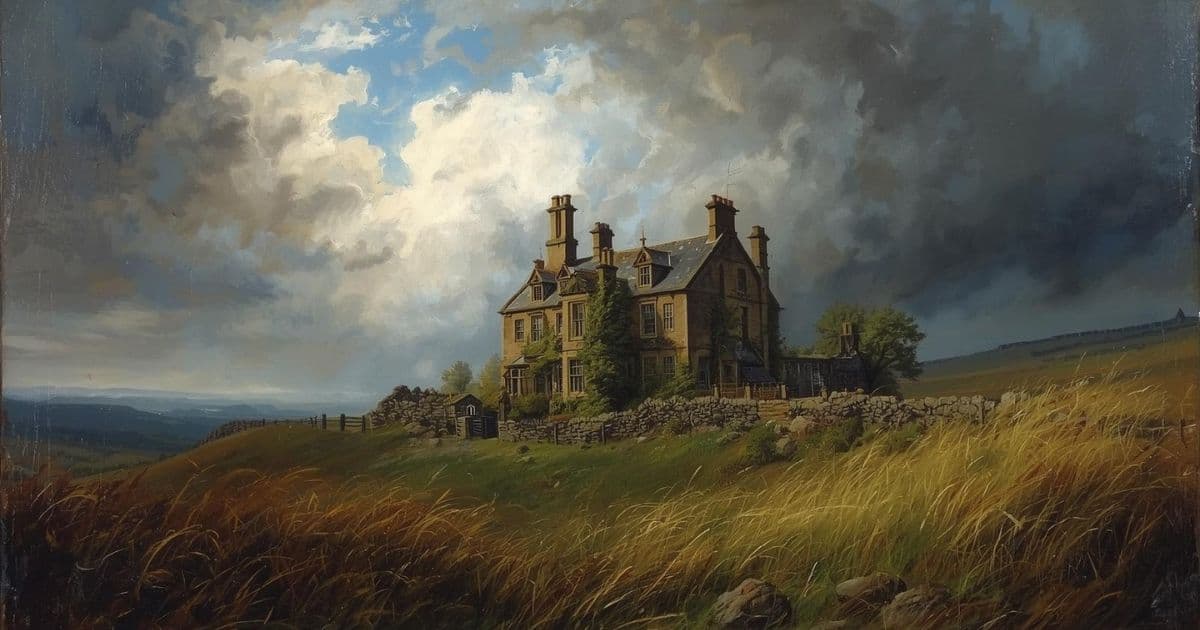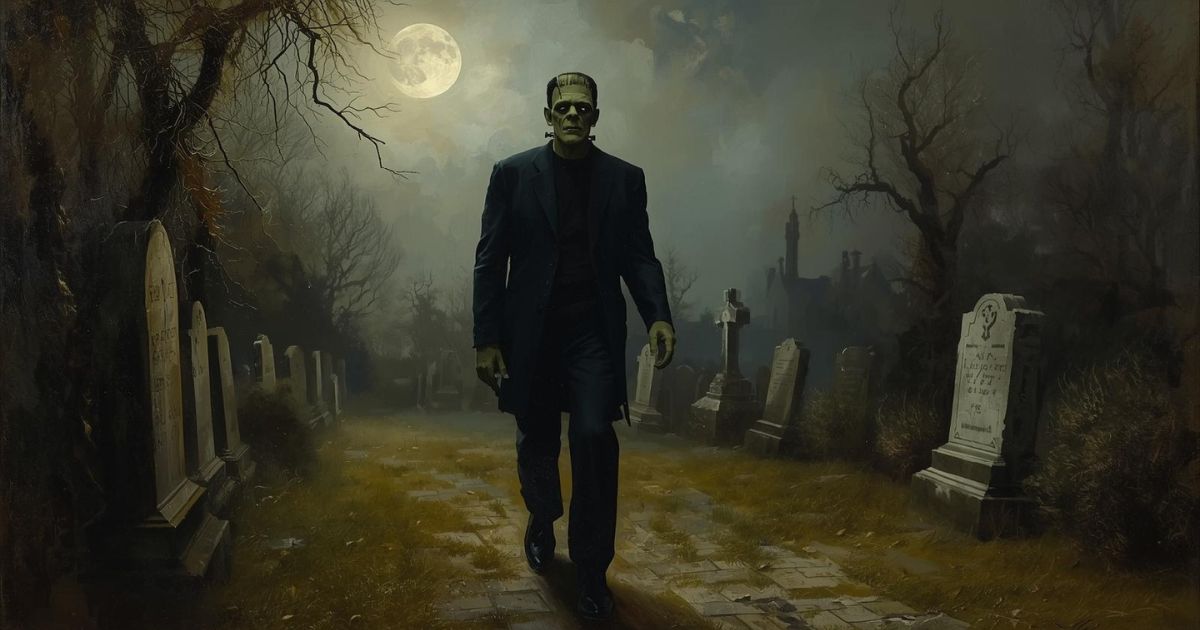
An excerpt from the original text.(complete · 2210 words)
othing is more painful to the human mind than, after the feelings have been worked up by a quick succession of events, the dead calmness of inaction and certainty which follows and deprives the soul both of hope and fear. Justine died, she rested, and I was alive. The blood flowed freely in my veins, but a weight of despair and remorse pressed on my heart which nothing could remove. Sleep fled from my eyes; I wandered like an evil spirit, for I had committed deeds of mischief beyond description horrible, and more, much more (I persuaded myself) was yet behind. Yet my heart overflowed with kindness and the love of virtue. I had begun life with benevolent intentions and thirsted for the moment when I should put them in practice and make myself useful to my fellow beings. Now all was blasted; instead of that serenity of conscience which allowed me to look back upon the past with self-satisfaction, and from thence to gather promise of new hopes, I was seized by remorse and the sense of guilt, which hurried me away to a hell of intense tortures such as no language can describe.
This state of mind preyed upon my health, which had perhaps never entirely recovered from the first shock it had sustained. I shunned the face of man; all sound of joy or complacency was torture to me; solitude was my only consolation—deep, dark, deathlike solitude.
My father observed with pain the alteration perceptible in my disposition and habits and endeavoured by arguments deduced from the feelings of his serene conscience and guiltless life to inspire me with fortitude and awaken in me the courage to dispel the dark cloud which brooded over me. "Do you think, Victor," said he, "that I do not suffer also? No one could love a child more than I loved your brother"—tears came into his eyes as he spoke—"but is it not a duty to the survivors that we should refrain from augmenting their unhappiness by an appearance of immoderate grief? It is also a duty owed to yourself, for excessive sorrow prevents improvement or enjoyment, or even the discharge of daily usefulness, without which no man is fit for society."
This advice, although good, was totally inapplicable to my case; I should have been the first to hide my grief and console my friends if remorse had not mingled its bitterness, and terror its alarm, with my other sensations. Now I could only answer my father with a look of despair and endeavour to hide myself from his view.
About this time we retired to our house at Belrive. This change was particularly agreeable to me. The shutting of the gates regularly at ten o'clock and the impossibility of remaining on the lake after that hour had rendered our residence within the walls of Geneva very irksome to me. I was now free. Often, after the rest of the family had retired for the night, I took the boat and passed many hours upon the water. Sometimes, with my sails set, I was carried by the wind; and sometimes, after rowing into the middle of the lake, I left the boat to pursue its own course and gave way to my own miserable reflections. I was often tempted, when all was at peace around me, and I the only unquiet thing that wandered restless in a scene so beautiful and heavenly—if I except some bat, or the frogs, whose harsh and interrupted croaking was heard only when I approached the shore—often, I say, I was tempted to plunge into the silent lake, that the waters might close over me and my calamities forever. But I was restrained, when I thought of the heroic and suffering Elizabeth, whom I tenderly loved, and whose existence was bound up in mine. I thought also of my father and surviving brother; should I by my base desertion leave them exposed and unprotected to the malice of the fiend whom I had let loose among them?
At these moments I wept bitterly and wished that peace would revisit my mind only that I might afford them consolation and happiness. But that could not be. Remorse extinguished every hope. I had been the author of unalterable evils, and I lived in daily fear lest the monster whom I had created should perpetrate some new wickedness. I had an obscure feeling that all was not over and that he would still commit some signal crime, which by its enormity should almost efface the recollection of the past. There was always scope for fear so long as anything I loved remained behind. My abhorrence of this fiend cannot be conceived. When I thought of him I gnashed my teeth, my eyes became inflamed, and I ardently wished to extinguish that life which I had so thoughtlessly bestowed. When I reflected on his crimes and malice, my hatred and revenge burst all bounds of moderation. I would have made a pilgrimage to the highest peak of the Andes, could I when there have precipitated him to their base. I wished to see him again, that I might wreak the utmost extent of abhorrence on his head and avenge the deaths of William and Justine.
Our house was the house of mourning. My father's health was deeply shaken by the horror of the recent events. Elizabeth was sad and desponding; she no longer took delight in her ordinary occupations; all pleasure seemed to her sacrilege toward the dead; eternal woe and tears she then thought was the just tribute she should pay to innocence so blasted and destroyed. She was no longer that happy creature who in earlier youth wandered with me on the banks of the lake and talked with ecstasy of our future prospects. The first of those sorrows which are sent to wean us from the earth had visited her, and its dimming influence quenched her dearest smiles.
"When I reflect, my dear cousin," said she, "on the miserable death of Justine Moritz, I no longer see the world and its works as they before appeared to me. Before, I looked upon the accounts of vice and injustice that I read in books or heard from others as tales of ancient days or imaginary evils; at least they were remote and more familiar to reason than to the imagination; but now misery has come home, and men appear to me as monsters thirsting for each other's blood. Yet I am certainly unjust. Every body believed that poor girl to be guilty; and if she could have committed the crime for which she suffered, assuredly she would have been the most depraved of human creatures. For the sake of a few jewels, to have murdered the son of her benefactor and friend, a child whom she had nursed from its birth, and appeared to love as if it had been her own! I could not consent to the death of any human being, but certainly I should have thought such a creature unfit to remain in the society of men. But she was innocent. I know, I feel, she was innocent; you are of the same opinion, and that confirms me. Alas! Victor, when falsehood can look so like the truth, who can assure themselves of certain happiness? I feel as if I were walking on the edge of a precipice, towards which thousands are crowding and endeavouring to plunge me into the abyss. William and Justine were assassinated, and the murderer escapes; he walks about the world free, and perhaps respected. But even if I were condemned to suffer on the scaffold for the same crimes, I would not change places with such a wretch."
I listened to this discourse with the extremest agony. I, not in deed, but in effect, was the true murderer. Elizabeth read my anguish in my countenance, and kindly taking my hand, said, "My dearest friend, you must calm yourself. These events have affected me, God knows how deeply; but I am not so wretched as you are. There is an expression of despair, and sometimes of revenge, in your countenance that makes me tremble. Dear Victor, banish these dark passions. Remember the friends around you, who centre all their hopes in you. Have we lost the power of rendering you happy? Ah! While we love, while we are true to each other, here in this land of peace and beauty, your native country, we may reap every tranquil blessing—what can disturb our peace?"
And could not such words from her whom I fondly prized before every other gift of fortune suffice to chase away the fiend that lurked in my heart? Even as she spoke I drew near to her, as if in terror, lest at that very moment the destroyer had been near to rob me of her.
Thus not the tenderness of friendship, nor the beauty of earth, nor of heaven, could redeem my soul from woe; the very accents of love were ineffectual. I was encompassed by a cloud which no beneficial influence could penetrate. The wounded deer dragging its fainting limbs to some untrodden brake, there to gaze upon the arrow which had pierced it, and to die, was but a type of me.
Sometimes I could cope with the sullen despair that overwhelmed me, but sometimes the whirlwind passions of my soul drove me to seek, by bodily exercise and by change of place, some relief from my intolerable sensations. It was during an access of this kind that I suddenly left my home, and bending my steps towards the near Alpine valleys, sought in the magnificence, the eternity of such scenes, to forget myself and my ephemeral, because human, sorrows. My wanderings were directed towards the valley of Chamounix. I had visited it frequently during my boyhood. Six years had passed since then: I was a wreck, but nought had changed in those savage and enduring scenes.
I performed the first part of my journey on horseback. I afterwards hired a mule, as the more sure-footed and least liable to receive injury on these rugged roads. The weather was fine; it was about the middle of the month of August, nearly two months after the death of Justine, that miserable epoch from which I dated all my woe. The weight upon my spirit was sensibly lightened as I plunged yet deeper in the ravine of Arve. The immense mountains and precipices that overhung me on every side, the sound of the river raging among the rocks, and the dashing of the waterfalls around spoke of a power mighty as Omnipotence—and I ceased to fear or to bend before any being less almighty than that which had created and ruled the elements, here displayed in their most terrific guise. Still, as I ascended higher, the valley assumed a more magnificent and astonishing character. Ruined castles hanging on the precipices of piny mountains, the impetuous Arve, and cottages every here and there peeping forth from among the trees formed a scene of singular beauty. But it was augmented and rendered sublime by the mighty Alps, whose white and shining pyramids and domes towered above all, as belonging to another earth, the habitations of another race of beings.
I passed the bridge of Pélissier, where the ravine, which the river forms, opened before me, and I began to ascend the mountain that overhangs it. Soon after, I entered the valley of Chamounix. This valley is more wonderful and sublime, but not so beautiful and picturesque as that of Servox, through which I had just passed. The high and snowy mountains were its immediate boundaries, but I saw no more ruined castles and fertile fields. Immense glaciers approached the road; I heard the rumbling thunder of the falling avalanche and marked the smoke of its passage. Mont Blanc, the supreme and magnificent Mont Blanc, raised itself from the surrounding aiguilles, and its tremendous dôme overlooked the valley.
A tingling long-lost sense of pleasure often came across me during this journey. Some turn in the road, some new object suddenly perceived and recognized, reminded me of days gone by, and were associated with the lighthearted gaiety of boyhood. The very winds whispered in soothing accents, and maternal Nature bade me weep no more. Then again the kindly influence ceased to act—I found myself fettered again to grief and indulging in all the misery of reflection. Then I spurred on my animal, striving so to forget the world, my fears, and more than all, myself—or, in a more desperate fashion, I alighted and threw myself on the grass, weighed down by horror and despair.
At length I arrived at the village of Chamounix. Exhaustion succeeded to the extreme fatigue both of body and of mind which I had endured. For a short space of time I remained at the window watching the pallid lightnings that played above Mont Blanc and listening to the rushing of the Arve, which pursued its noisy way beneath. The same lulling sounds acted as a lullaby to my too keen sensations; when I placed my head upon my pillow, sleep crept over me; I felt it as it came and blessed the giver of oblivion.
Master this chapter. Complete your experience
Purchase the complete book to access all chapters and support classic literature
As an Amazon Associate, we earn a small commission from qualifying purchases at no additional cost to you.
Available in paperback, hardcover, and e-book formats
Let's Analyse the Pattern
When we carry devastating secrets to protect others, the isolation and guilt destroy us more than the truth would.
Why This Matters
Connect literature to life
This chapter teaches how to distinguish between necessary discretion and secrets that poison your mental health.
Practice This Today
This week, notice when you feel isolated by something you can't tell anyone - ask yourself what you're really protecting.
Now let's explore the literary elements.
Key Quotes & Analysis
"I was seized by remorse and the sense of guilt, which hurried me away to a hell of intense tortures such as no language can describe."
Context: Victor reflects on his mental state after learning of William's death
Shows how guilt becomes its own form of torture. Victor's internal punishment is worse than any external consequence could be. The word 'hell' emphasizes how psychological torment can be more devastating than physical pain.
In Today's Words:
The guilt was eating me alive - I felt like I was being tortured from the inside out.
"I could not bring myself to disclose a secret which would fill my hearer with consternation and make fear and unnatural horror the inmates of his breast."
Context: Victor explains why he cannot tell his father the truth about the monster
Victor convinces himself he's protecting others by staying silent, but he's really protecting himself from judgment. This rationalization keeps him trapped in isolation when honesty might actually help.
In Today's Words:
I couldn't tell him the truth because it would freak him out too much.
"Nothing is more painful to the human mind than, after the feelings have been worked up by a quick succession of events, the dead calmness of inaction."
Context: Victor describes the agony of waiting and being unable to act
Captures the torture of knowing something terrible is happening but feeling powerless to stop it. The contrast between intense emotion and forced stillness creates unbearable psychological pressure.
In Today's Words:
The worst part is when everything's falling apart and there's nothing you can do but sit there and watch.
Thematic Threads
Guilt
In This Chapter
Victor's overwhelming guilt about creating the creature that killed William consumes his physical and mental health
Development
Evolved from earlier pride and ambition into devastating self-blame and psychological torment
In Your Life:
You might feel this crushing weight when your past decisions create harm you can't undo or openly address
Isolation
In This Chapter
Victor becomes increasingly withdrawn, unable to share his terrible knowledge with family or friends
Development
Deepened from his secretive work habits into complete emotional disconnection from loved ones
In Your Life:
You might recognize this when you're going through something so difficult you can't explain it to anyone close to you
Class
In This Chapter
Justine, a servant, faces trial for murder while Victor, from a wealthy family, keeps silent about the real killer
Development
Continues the theme of how social position determines whose voice matters and who faces consequences
In Your Life:
You might see this when working-class people take blame for problems created by those with more power and resources
Truth
In This Chapter
Victor knows the truth that could save Justine but believes it's too unbelievable to share
Development
Introduced here as the central tension between dangerous knowledge and moral obligation
In Your Life:
You might face this when you know something important but fear the personal cost of speaking up
Family
In This Chapter
Victor's father worries about his son's deteriorating health but doesn't understand the real cause
Development
Shows how Victor's secrets create distance even within loving family relationships
In Your Life:
You might recognize this when your struggles affect your family but you can't explain what's really wrong
You now have the context. Time to form your own thoughts.
Discussion Questions
- 1
What secret is Victor carrying, and why does he feel he can't tell anyone the truth about William's death?
analysis • surface - 2
How does keeping this secret affect Victor's physical and mental health? What specific symptoms does he experience?
analysis • medium - 3
Where do you see people today carrying secrets that are 'eating them alive'? What makes these secrets feel too dangerous to share?
application • medium - 4
If you were Victor's friend and noticed his deterioration, how would you approach him? What would you do if someone you cared about was clearly suffering from hidden guilt?
application • deep - 5
Victor thinks he's protecting others by staying silent, but he's actually protecting himself from consequences. What does this reveal about how we justify keeping harmful secrets?
reflection • deep
Critical Thinking Exercise
Map Your Secret Burden
Think of a time when you carried information that felt too heavy or dangerous to share - maybe you witnessed something unfair, knew about someone's mistake, or had knowledge that could hurt someone. Write down what you were really protecting by staying silent. Was it truly others' wellbeing, or were you protecting yourself from uncomfortable consequences?
Consider:
- •Consider the difference between protecting others and protecting yourself from their reactions
- •Notice how isolation from keeping secrets affects your relationships and mental health
- •Think about whether the 'unspeakable' truth was actually as explosive as it felt in your mind
Journaling Prompt
Write about a secret you've carried that became toxic. How did it change you? What would have happened if you'd found one safe person to tell? What would you do differently now?
Coming Up Next...
Chapter 14: Confrontation on the Glacier
Victor's solitary wandering in the mountains is about to be interrupted by an encounter he's been dreading and unconsciously seeking—the creature will finally confront its creator.