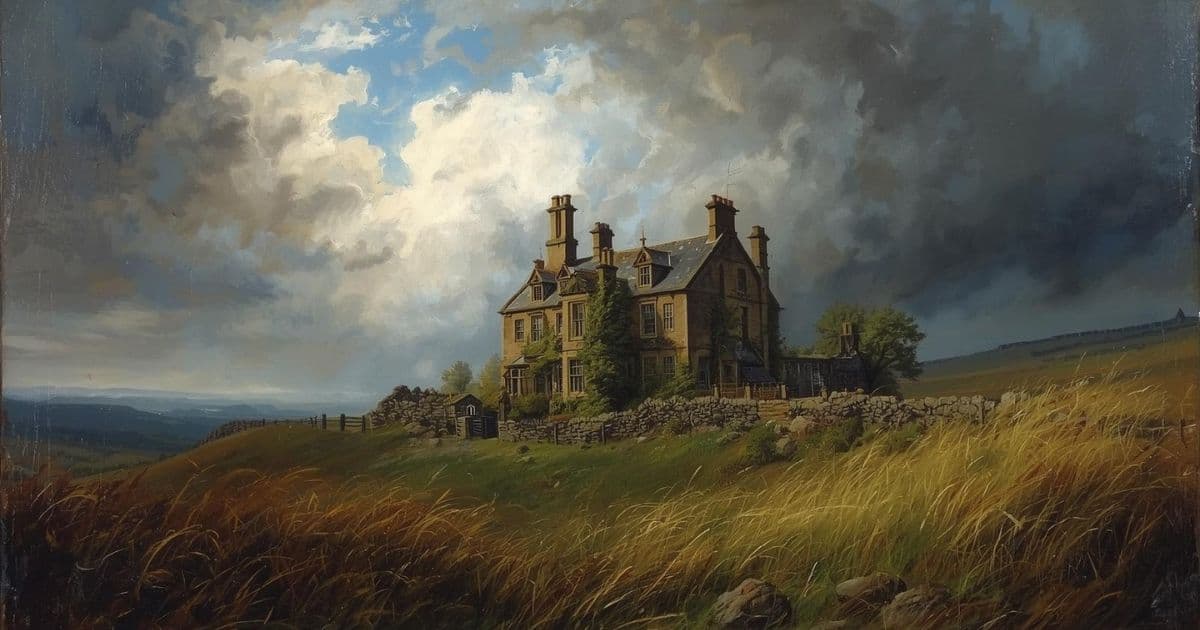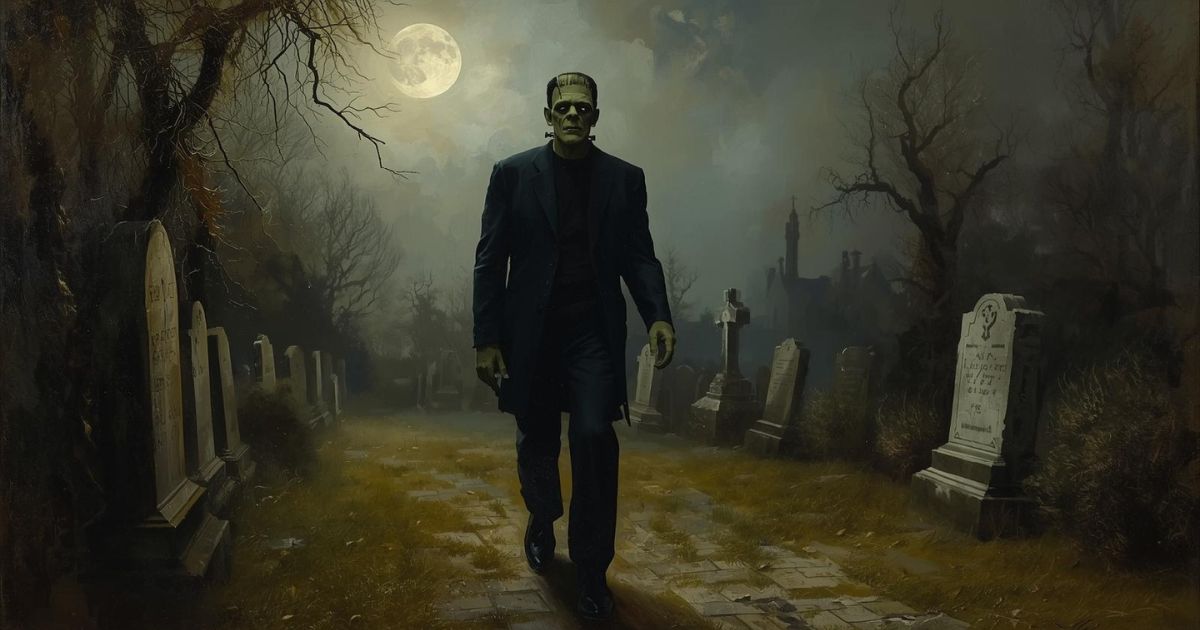
An excerpt from the original text.(complete · 912 words)
"t is with considerable difficulty that I remember the original era of my being; all the events of that period appear confused and indistinct. A strange multiplicity of sensations seized me, and I saw, felt, heard, and smelt at the same time; and it was, indeed, a long time before I learned to distinguish between the operations of my various senses. By degrees, I remember, a stronger light pressed upon my nerves, so that I was obliged to shut my eyes. Darkness then came over me and troubled me, but hardly had I felt this when, by opening my eyes, as I now suppose, the light poured in upon me again. I walked and, I believe, descended, but I presently found a great alteration in my sensations. Before, dark and opaque bodies had surrounded me, impervious to my touch or sight; but I now found that I could wander on at liberty, with no obstacles which I could not either surmount or avoid. The light became more and more oppressive to me, and the heat wearying me as I walked, I sought a place where I could receive shade. This was the forest near Ingolstadt; and here I lay by the side of a brook resting from my fatigue, until I felt tormented by hunger and thirst. This roused me from my nearly dormant state, and I ate some berries which I found hanging on the trees or lying on the ground. I slaked my thirst at the brook, and then lying down, was overcome by sleep.
"It was dark when I awoke; I felt cold also, and half frightened, as it were, instinctively, finding myself so desolate. Before I had quitted your apartment, on a sensation of cold, I had covered myself with some clothes, but these were insufficient to secure me from the dews of night. I was a poor, helpless, miserable wretch; I knew, and could distinguish, nothing; but feeling pain invade me on all sides, I sat down and wept.
"Soon a gentle light stole over the heavens and gave me a sensation of pleasure. I started up and beheld a radiant form rise from among the trees. I gazed with a kind of wonder. It moved slowly, but it enlightened my path, and I again went out in search of berries. I was still cold when under one of the trees I found a huge cloak, with which I covered myself, and sat down upon the ground. No distinct ideas occupied my mind; all was confused. I felt light, and hunger, and thirst, and darkness; innumerable sounds rang in my ears, and on all sides various scents saluted me; the only object that I could distinguish was the bright moon, and I fixed my eyes on that with pleasure.
"Several changes of day and night passed, and the orb of night had greatly lessened, when I began to distinguish my sensations from each other. I gradually saw plainly the clear stream that supplied me with drink and the trees that shaded me with their foliage. I was delighted when I first discovered that a pleasant sound, which often saluted my ears, proceeded from the throats of the little winged animals who had often intercepted the light from my eyes. I began also to observe, with greater accuracy, the forms that surrounded me and to perceive the boundaries of the radiant roof of light which canopied me. Sometimes I tried to imitate the pleasant songs of the birds but was unable. Sometimes I wished to express my sensations in my own mode, but the uncouth and inarticulate sounds which broke from me frightened me into silence again.
"The moon had disappeared from the night, and again, with a lessened form, showed itself, while I still remained in the forest. My sensations had by this time become distinct, and my mind received every day additional ideas. My eyes became accustomed to the light and to perceive objects in their right forms; I distinguished the insect from the herb, and by degrees, one herb from another. I found that the sparrow uttered none but harsh notes, whilst those of the blackbird and thrush were sweet and enticing.
"One day, when I was oppressed by cold, I found a fire which had been left by some wandering beggars, and was overcome with delight at the warmth I experienced from it. In my joy I thrust my hand into the live embers, but quickly drew it out again with a cry of pain. How strange, I thought, that the same cause should produce such opposite effects! I examined the materials of the fire, and to my joy found it to be composed of wood. I quickly collected some branches, but they were wet and would not burn. I was pained at this and sat still watching the operation of the fire. The wet wood which I had placed near the heat dried and itself became inflamed. I reflected on this, and by touching the various branches, I discovered the cause and busied myself in collecting a great quantity of wood, that I might dry it and have a plentiful supply of fire. When night came on and brought sleep with it, I was in the greatest fear lest my fire should be extinguished. I covered it carefully with dry wood and leaves and placed wet branches upon it; and then, spreading my cloak, I lay on the ground and sank into sleep.
Master this chapter. Complete your experience
Purchase the complete book to access all chapters and support classic literature
As an Amazon Associate, we earn a small commission from qualifying purchases at no additional cost to you.
Available in paperback, hardcover, and e-book formats
Let's Analyse the Pattern
We form our identity not through self-discovery but through internalizing how others react to us, making their perceptions our reality.
Why This Matters
Connect literature to life
This chapter teaches how surroundings shape behavior—whether it's creatures, children, or AI systems.
Practice This Today
This week, notice when someone's 'bad' behavior might actually be a logical response to a toxic environment.
Now let's explore the literary elements.
Key Quotes & Analysis
"I was a poor, helpless, miserable wretch; I knew, and could distinguish, nothing; but feeling pain invade me on all sides, I sat down and wept."
Context: His first moments of consciousness, overwhelmed by sensations he can't understand
Shows the creature's fundamental innocence and vulnerability. He's not born evil - he's born confused and in pain, like any newborn, but without anyone to comfort or guide him.
In Today's Words:
I was completely lost and everything hurt, so I just sat there and cried.
"No distinct ideas occupied my mind; all was confused. I felt light, and hunger, and thirst, and darkness."
Context: Describing his earliest sensory experiences
Emphasizes how we take basic understanding for granted. The creature has to learn from scratch what hunger means, what cold feels like, what darkness is.
In Today's Words:
I couldn't think straight - I just felt all these sensations hitting me at once.
"I learned to distinguish between the operations of my various senses."
Context: Gradually figuring out how his body works
Shows the creature's intelligence and capacity for learning. He's not a mindless monster - he's actively trying to understand his world and improve his situation.
In Today's Words:
I figured out the difference between what I could see, hear, smell, and touch.
Thematic Threads
Identity
In This Chapter
The creature's sense of self forms entirely through others' reactions—he has no internal reference point for who he is
Development
Introduced here as the creature gains consciousness and begins interacting with the world
In Your Life:
You might recognize this when you realize your self-doubt started with one person's criticism that you've been carrying for years
Social Expectations
In This Chapter
Humans expect certain appearances and behaviors—the creature's difference immediately marks him as 'other' and threatening
Development
Introduced here through the humans' instinctive fear and rejection
In Your Life:
You see this when people make assumptions about your capabilities based on your accent, appearance, or background
Human Relationships
In This Chapter
The creature observes the cottage family's warmth and realizes he lacks this fundamental human experience of belonging
Development
Introduced here as the creature first witnesses genuine human connection
In Your Life:
You might feel this watching other families' easy affection when your own family struggles to express love
Class
In This Chapter
The creature becomes an outsider not by choice but by appearance—he's automatically excluded from human society
Development
Introduced here as the creature experiences his first social rejection
In Your Life:
You experience this when you're treated differently in stores, restaurants, or professional settings based on how you look or sound
Personal Growth
In This Chapter
The creature learns through trial and error—fire burns, some berries poison—developing survival skills through direct experience
Development
Introduced here as the creature's education begins through observation and experimentation
In Your Life:
You see this when you realize your most valuable skills came from making mistakes and figuring things out yourself, not from formal education
You now have the context. Time to form your own thoughts.
Discussion Questions
- 1
What does the creature learn about survival in his first days of consciousness, and how does he learn it?
analysis • surface - 2
Why do you think the humans flee when they see the creature, and how does their reaction affect him?
analysis • medium - 3
Where do you see people today learning about themselves through others' reactions rather than their own self-knowledge?
application • medium - 4
If you were advising the creature on how to handle rejection and build genuine connections, what would you tell him?
application • deep - 5
What does this chapter reveal about how environment and early experiences shape who we become?
reflection • deep
Critical Thinking Exercise
Mirror Audit: Track Your Reflection Sources
For the next 24 hours, notice when you form an opinion about yourself based on someone else's reaction. Keep a simple log: What happened? Whose reaction influenced you? How did it make you feel about yourself? At the end, look for patterns in whose opinions carry the most weight with you.
Consider:
- •Pay attention to both positive and negative reactions that stick with you
- •Notice if certain types of people (authority figures, peers, strangers) have more influence
- •Consider whether the person's reaction says more about them or about you
Journaling Prompt
Write about a time when someone's first reaction to you was completely wrong. How did you handle it? What did you learn about the difference between how others see you and who you actually are?
Coming Up Next...
Chapter 16: The Creature Learns About Humanity
The creature's secret education continues as he watches the cottage family more closely, beginning to understand language and human emotions. His longing to join them grows stronger, but so does his awareness of how different he is.