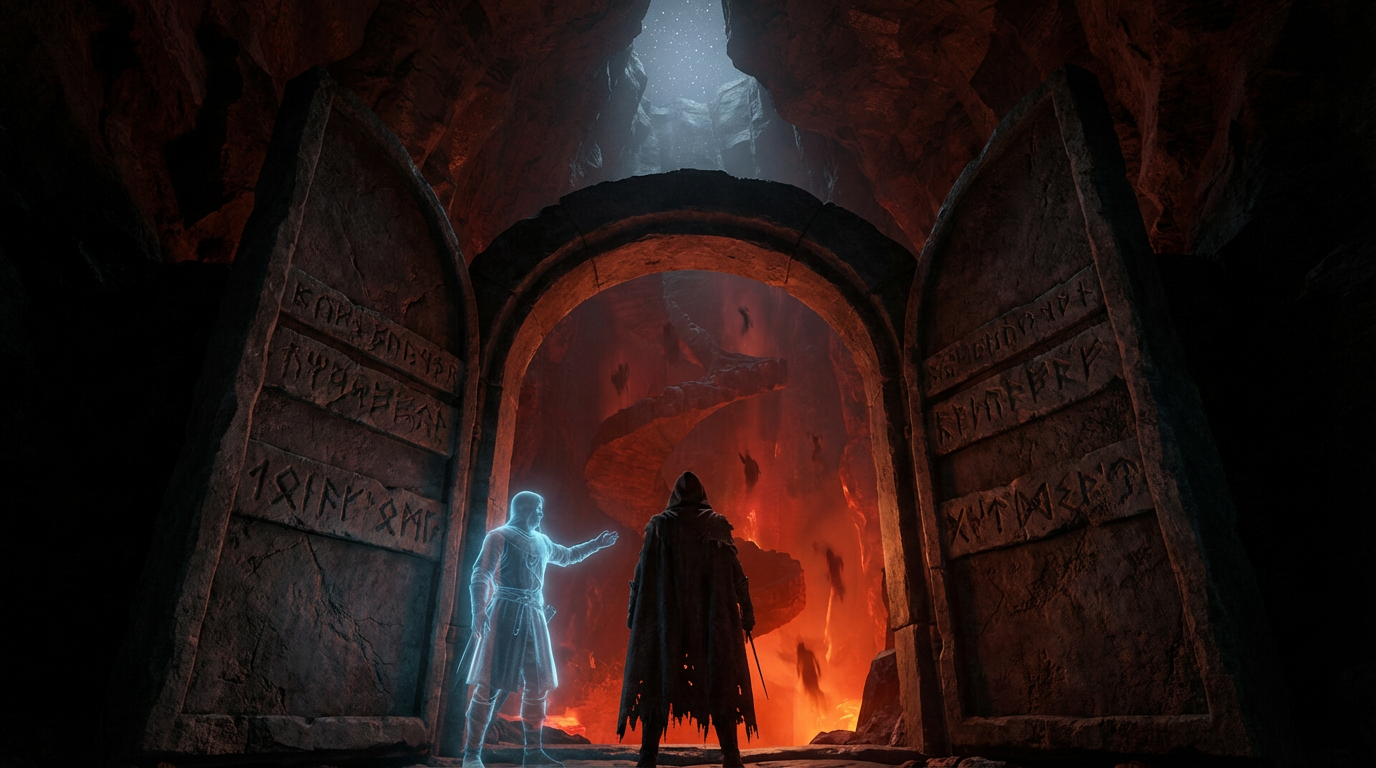
An excerpt from the original text.(complete · 1092 words)
f e’er the sacred poem that hath made
Both heav’n and earth copartners in its toil,
And with lean abstinence, through many a year,
Faded my brow, be destin’d to prevail
Over the cruelty, which bars me forth
Of the fair sheep-fold, where a sleeping lamb
The wolves set on and fain had worried me,
With other voice and fleece of other grain
I shall forthwith return, and, standing up
At my baptismal font, shall claim the wreath
Due to the poet’s temples: for I there
First enter’d on the faith which maketh souls
Acceptable to God: and, for its sake,
Peter had then circled my forehead thus.

Next from the squadron, whence had issued forth
The first fruit of Christ’s vicars on the earth,
Toward us mov’d a light, at view whereof
My Lady, full of gladness, spake to me:
“Lo! lo! behold the peer of mickle might,
That makes Falicia throng’d with visitants!”

As when the ring-dove by his mate alights,
In circles each about the other wheels,
And murmuring cooes his fondness; thus saw I
One, of the other great and glorious prince,
With kindly greeting hail’d, extolling both
Their heavenly banqueting; but when an end
Was to their gratulation, silent, each,
Before me sat they down, so burning bright,
I could not look upon them. Smiling then,
Beatrice spake: “O life in glory shrin’d!”
Who didst the largess of our kingly court
Set down with faithful pen! let now thy voice
Of hope the praises in this height resound.
For thou, who figur’st them in shapes, as clear,
As Jesus stood before thee, well can’st speak them.”

“Lift up thy head, and be thou strong in trust:
For that, which hither from the mortal world
Arriveth, must be ripen’d in our beam.”

Such cheering accents from the second flame
Assur’d me; and mine eyes I lifted up
Unto the mountains that had bow’d them late
With over-heavy burden. “Sith our Liege
Wills of his grace that thou, or ere thy death,
In the most secret council, with his lords
Shouldst be confronted, so that having view’d
The glories of our court, thou mayst therewith
Thyself, and all who hear, invigorate
With hope, that leads to blissful end; declare,
What is that hope, how it doth flourish in thee,
And whence thou hadst it?” Thus proceeding still,
The second light: and she, whose gentle love
My soaring pennons in that lofty flight
Escorted, thus preventing me, rejoin’d:
Among her sons, not one more full of hope,
Hath the church militant: so ’tis of him
Recorded in the sun, whose liberal orb
Enlighteneth all our tribe: and ere his term
Of warfare, hence permitted he is come,
From Egypt to Jerusalem, to see.
The other points, both which thou hast inquir’d,
Not for more knowledge, but that he may tell
How dear thou holdst the virtue, these to him
Leave I; for he may answer thee with ease,
And without boasting, so God give him grace.”
Like to the scholar, practis’d in his task,
Who, willing to give proof of diligence,
Seconds his teacher gladly, “Hope,” said I,
“Is of the joy to come a sure expectance,
Th’ effect of grace divine and merit preceding.
This light from many a star visits my heart,
But flow’d to me the first from him, who sang
The songs of the Supreme, himself supreme
Among his tuneful brethren. ‘Let all hope
In thee,’ so speak his anthem, ‘who have known
Thy name;’ and with my faith who know not that?
From thee, the next, distilling from his spring,
In thine epistle, fell on me the drops
So plenteously, that I on others shower
The influence of their dew.” Whileas I spake,
A lamping, as of quick and vollied lightning,
Within the bosom of that mighty sheen,
Play’d tremulous; then forth these accents breath’d:
“Love for the virtue which attended me
E’en to the palm, and issuing from the field,
Glows vigorous yet within me, and inspires
To ask of thee, whom also it delights;
What promise thou from hope in chief dost win.”

“Both scriptures, new and ancient,” I reply’d;
“Propose the mark (which even now I view)
For souls belov’d of God. Isaias saith,

That, in their own land, each one must be clad
In twofold vesture; and their proper lands this delicious life.
In terms more full,
And clearer far, thy brother hath set forth
This revelation to us, where he tells
Of the white raiment destin’d to the saints.”
And, as the words were ending, from above,
“They hope in thee,” first heard we cried: whereto
Answer’d the carols all. Amidst them next,
A light of so clear amplitude emerg’d,
That winter’s month were but a single day,
Were such a crystal in the Cancer’s sign.

Like as a virgin riseth up, and goes,
And enters on the mazes of the dance,
Though gay, yet innocent of worse intent,
Than to do fitting honour to the bride;
So I beheld the new effulgence come
Unto the other two, who in a ring
Wheel’d, as became their rapture. In the dance
And in the song it mingled. And the dame
Held on them fix’d her looks: e’en as the spouse
Silent and moveless. “This is he, who lay
Upon the bosom of our pelican:
This he, into whose keeping from the cross
The mighty charge was given.” Thus she spake,
Yet therefore naught the more remov’d her Sight
From marking them, or ere her words began,
Or when they clos’d. As he, who looks intent,
And strives with searching ken, how he may see
The sun in his eclipse, and, through desire
Of seeing, loseth power of sight: so I
Peer’d on that last resplendence, while I heard:
“Why dazzlest thou thine eyes in seeking that,
Which here abides not? Earth my body is,
In earth: and shall be, with the rest, so long,
As till our number equal the decree
Of the Most High. The two that have ascended,
In this our blessed cloister, shine alone
With the two garments. So report below.”

As when, for ease of labour, or to shun
Suspected peril at a whistle’s breath,
The oars, erewhile dash’d frequent in the wave,
All rest; the flamy circle at that voice
So rested, and the mingling sound was still,
Which from the trinal band soft-breathing rose.
I turn’d, but ah! how trembled in my thought,
When, looking at my side again to see
Beatrice, I descried her not, although
Not distant, on the happy coast she stood.
Master this chapter. Complete your experience
Purchase the complete book to access all chapters and support classic literature
As an Amazon Associate, we earn a small commission from qualifying purchases at no additional cost to you.
Available in paperback, hardcover, and e-book formats
Let's Analyse the Pattern
The necessary but disorienting moment when external support withdraws to force reliance on internalized strength and skills.
Why This Matters
Connect literature to life
This chapter teaches how to identify when discomfort signals growth rather than failure, especially when support systems change.
Practice This Today
This week, notice when you feel abandoned or overwhelmed after someone reduces their help—ask yourself if this might be recognition of your increased capability rather than neglect.
Now let's explore the literary elements.
Key Quotes & Analysis
"Hope is sure expectance of future joy"
Context: When James asks him to define hope during his examination
This definition shows hope as confidence, not wishful thinking. Dante demonstrates that true hope is based on firm promises, not uncertain possibilities. It's the foundation for persisting through hardship.
In Today's Words:
Hope means being sure good things are coming, not just wishing they might
"Let now thy voice of hope the praises sound"
Context: She encourages Dante to speak confidently about hope to James
Beatrice pushes Dante to voice his understanding actively, not just possess it quietly. She knows that articulating spiritual truths deepens understanding and proves readiness.
In Today's Words:
Don't just know it - say it out loud and own it
"The twofold vesture thou dost promise here"
Context: Explaining what hope promises to the faithful
Dante shows sophisticated theological understanding - hope promises both spiritual glory and physical resurrection. This completeness of restoration gives hope its power to sustain people through suffering.
In Today's Words:
You promise to make us whole again, inside and out
Thematic Threads
Personal Growth
In This Chapter
Dante must face spiritual tests without Beatrice's constant guidance, developing independent confidence
Development
Evolved from early dependence on Virgil to gradual self-reliance with Beatrice's support
In Your Life:
You might recognize this when mentors step back or when you're expected to handle situations that once required help.
Identity
In This Chapter
Dante defines himself through his understanding of hope and scripture, showing intellectual maturity
Development
Built from his initial confusion in the dark wood to confident articulation of complex spiritual concepts
In Your Life:
You see this when you can explain your values clearly instead of just following others' expectations.
Social Expectations
In This Chapter
The apostles test Dante like professors examining a student, expecting sophisticated theological responses
Development
Continued from earlier trials where Dante must prove his worthiness to spiritual authorities
In Your Life:
You experience this in job interviews, performance reviews, or any situation where you must demonstrate competence to authority figures.
Human Relationships
In This Chapter
Beatrice deliberately steps back, allowing Dante to develop independence from their guiding relationship
Development
Shifted from her role as rescuer to teacher to someone who must now withdraw support
In Your Life:
You see this when healthy relationships evolve from dependence to interdependence, requiring both parties to grow.
You now have the context. Time to form your own thoughts.
Discussion Questions
- 1
What happens when Dante turns to look for Beatrice after his conversation with the apostle James?
analysis • surface - 2
Why does Dante become temporarily blind when he tries to see John's physical form?
analysis • medium - 3
Where have you seen this pattern of support being withdrawn just when someone is ready for independence?
application • medium - 4
How would you prepare yourself for moments when your usual support system steps back?
application • deep - 5
What does this chapter suggest about the relationship between comfort and growth?
reflection • deep
Critical Thinking Exercise
Map Your Support System Transitions
Think of three times in your life when someone who had been guiding or supporting you stepped back, leaving you to handle things independently. For each situation, write down what happened, how you felt initially, and what skills or confidence you gained as a result. Look for the pattern of how support withdrawal actually signals readiness for growth.
Consider:
- •Notice whether the timing felt right to you or if it seemed too early
- •Consider how your initial panic or discomfort transformed into capability
- •Think about whether you would have grown as much if the support had remained
Journaling Prompt
Write about a current situation where you sense support might be stepping back. How can you prepare yourself to handle this transition with confidence rather than fear?
Coming Up Next...
Chapter 93: Adam Speaks: The First Human's Story
Temporarily blinded and separated from Beatrice, Dante must navigate his next spiritual test without his beloved guide's immediate presence. The apostle John prepares to examine him on the greatest virtue of all - one that will determine his readiness for the ultimate vision.