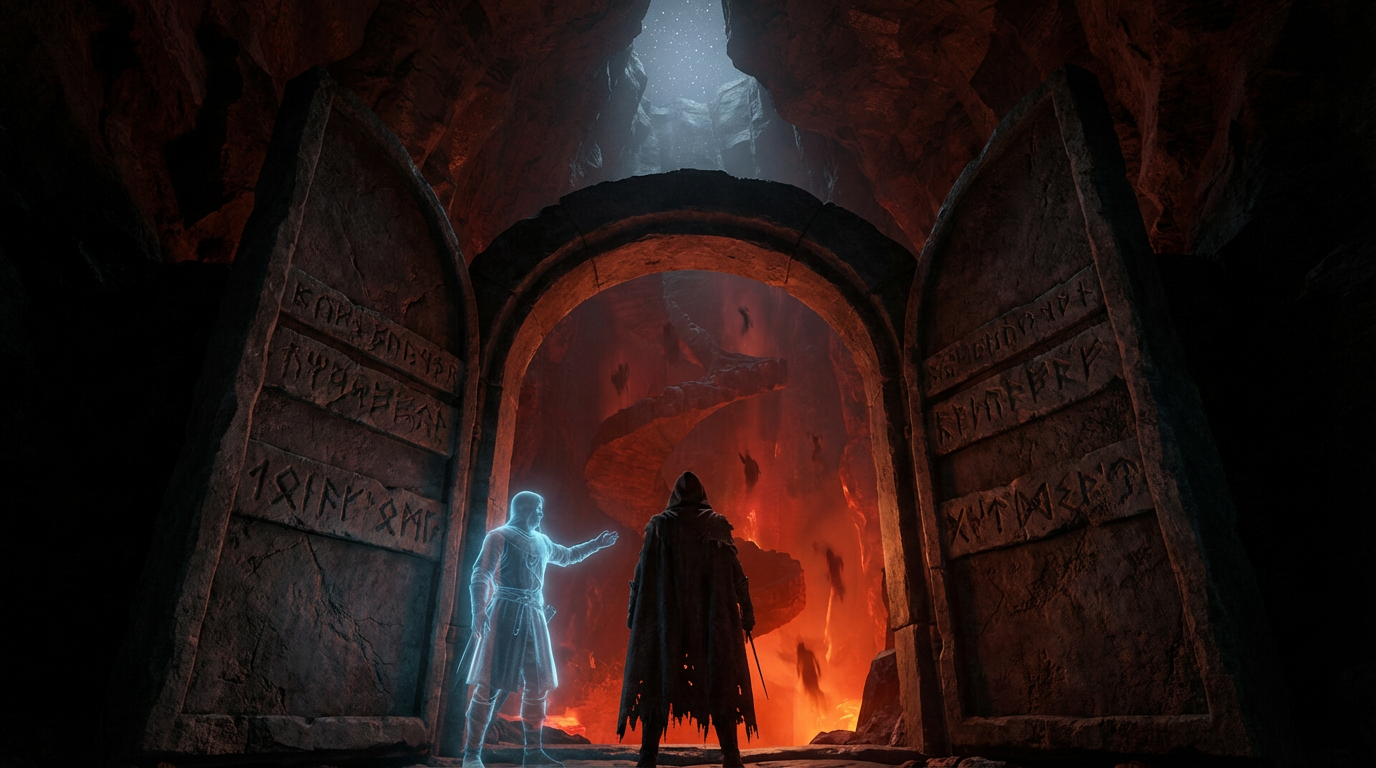
An excerpt from the original text.(complete · 1106 words)
With dazzled eyes, whilst wond’ring I remain’d,
Forth of the beamy flame which dazzled me,
Issued a breath, that in attention mute
Detain’d me; and these words it spake: “’Twere well,
That, long as till thy vision, on my form
O’erspent, regain its virtue, with discourse
Thou compensate the brief delay. Say then,
Beginning, to what point thy soul aspires:
And meanwhile rest assur’d, that sight in thee
Is but o’erpowered a space, not wholly quench’d:
Since thy fair guide and lovely, in her look
Hath potency, the like to that which dwelt
In Ananias’ hand.” I answering thus:
“Be to mine eyes the remedy or late
Or early, at her pleasure; for they were
The gates, at which she enter’d, and did light
Her never dying fire. My wishes here
Are centered; in this palace is the weal,
That Alpha and Omega, is to all
The lessons love can read me.” Yet again
The voice which had dispers’d my fear, when daz’d
With that excess, to converse urg’d, and spake:
“Behooves thee sift more narrowly thy terms,
And say, who level’d at this scope thy bow.”

“Philosophy,” said I, “hath arguments,
And this place hath authority enough
’T’ imprint in me such love: for, of constraint,
Good, inasmuch as we perceive the good,
Kindles our love, and in degree the more,
As it comprises more of goodness in ’t.
The essence then, where such advantage is,
That each good, found without it, is naught else
But of his light the beam, must needs attract
The soul of each one, loving, who the truth
Discerns, on which this proof is built. Such truth
Learn I from him, who shows me the first love
Of all intelligential substances
Eternal: from his voice I learn, whose word
Is truth, that of himself to Moses saith,
‘I will make all my good before thee pass.’
Lastly from thee I learn, who chief proclaim’st,
E’en at the outset of thy heralding,
In mortal ears the mystery of heav’n.”

“Through human wisdom, and th’ authority
Therewith agreeing,” heard I answer’d, “keep
The choicest of thy love for God. But say,
If thou yet other cords within thee feel’st
That draw thee towards him; so that thou report
How many are the fangs, with which this love
Is grappled to thy soul.” I did not miss,
To what intent the eagle of our Lord
Had pointed his demand; yea noted well
Th’ avowal, which he led to; and resum’d:
“All grappling bonds, that knit the heart to God,
Confederate to make fast our clarity.
The being of the world, and mine own being,
The death which he endur’d that I should live,
And that, which all the faithful hope, as I do,
To the foremention’d lively knowledge join’d,
Have from the sea of ill love sav’d my bark,
And on the coast secur’d it of the right.
As for the leaves, that in the garden bloom,
My love for them is great, as is the good
Dealt by th’ eternal hand, that tends them all.”

I ended, and therewith a song most sweet
Rang through the spheres; and “Holy, holy, holy,”
Accordant with the rest my lady sang.
And as a sleep is broken and dispers’d
Through sharp encounter of the nimble light,
With the eye’s spirit running forth to meet
The ray, from membrane on to the membrane urg’d;
And the upstartled wight loathes that be sees;
So, at his sudden waking, he misdeems
Of all around him, till assurance waits
On better judgment: thus the saintly came
Drove from before mine eyes the motes away,
With the resplendence of her own, that cast
Their brightness downward, thousand miles below.
Whence I my vision, clearer shall before,
Recover’d; and, well nigh astounded, ask’d
Of a fourth light, that now with us I saw.

And Beatrice: “The first diving soul,
That ever the first virtue fram’d, admires
Within these rays his Maker.” Like the leaf,
That bows its lithe top till the blast is blown;
By its own virtue rear’d then stands aloof;
So I, the whilst she said, awe-stricken bow’d.
Then eagerness to speak embolden’d me;
And I began: “O fruit! that wast alone
Mature, when first engender’d! Ancient father!
That doubly seest in every wedded bride
Thy daughter by affinity and blood!
Devoutly as I may, I pray thee hold
Converse with me: my will thou seest; and I,
More speedily to hear thee, tell it not “

It chanceth oft some animal bewrays,
Through the sleek cov’ring of his furry coat.
The fondness, that stirs in him and conforms
His outside seeming to the cheer within:
And in like guise was Adam’s spirit mov’d
To joyous mood, that through the covering shone,
Transparent, when to pleasure me it spake:
“No need thy will be told, which I untold
Better discern, than thou whatever thing
Thou holdst most certain: for that will I see
In Him, who is truth’s mirror, and Himself
Parhelion unto all things, and naught else
To him. This wouldst thou hear; how long since God
Plac’d me high garden, from whose hounds
She led me up in this ladder, steep and long;
What space endur’d my season of delight;
Whence truly sprang the wrath that banish’d me;
And what the language, which I spake and fram’d
Not that I tasted of the tree, my son,
Was in itself the cause of that exile,
But only my transgressing of the mark
Assign’d me. There, whence at thy lady’s hest
The Mantuan mov’d him, still was I debarr’d
This council, till the sun had made complete,
Four thousand and three hundred rounds and twice,
His annual journey; and, through every light
In his broad pathway, saw I him return,
Thousand save sev’nty times, the whilst I dwelt
Upon the earth. The language I did use
Was worn away, or ever Nimrod’s race
Their unaccomplishable work began.
For naught, that man inclines to, ere was lasting,
Left by his reason free, and variable,
As is the sky that sways him. That he speaks,
Is nature’s prompting: whether thus or thus,
She leaves to you, as ye do most affect it.
Ere I descended into hell’s abyss,
El was the name on earth of the Chief Good,
Whose joy enfolds me: Eli then ’twas call’d
And so beseemeth: for, in mortals, use
Is as the leaf upon the bough; that goes,
And other comes instead. Upon the mount
Most high above the waters, all my life,
Both innocent and guilty, did but reach
From the first hour, to that which cometh next
(As the sun changes quarter), to the sixth.
Master this chapter. Complete your experience
Purchase the complete book to access all chapters and support classic literature
As an Amazon Associate, we earn a small commission from qualifying purchases at no additional cost to you.
Available in paperback, hardcover, and e-book formats
Let's Analyse the Pattern
Strong beliefs develop through the alignment of reason, trusted authority, and personal experience rather than relying on single sources.
Why This Matters
Connect literature to life
This chapter teaches how to develop beliefs that can withstand challenge by drawing from reason, trusted sources, and personal experience rather than relying on single sources.
Practice This Today
This week, notice when you feel defensive about a belief or decision - ask yourself if it's supported by logic, respected advice, and your own experience, or just one of these.
Now let's explore the literary elements.
Key Quotes & Analysis
"Philosophy hath arguments, and this place hath authority enough to imprint in me such love"
Context: When challenged to explain the sources of his faith
Dante shows mature thinking by acknowledging that his beliefs come from both reason and revelation. He's not choosing between logic and faith but drawing from both sources to build a complete worldview.
In Today's Words:
I believe this because it makes logical sense AND because I trust the source - I'm not just going on feelings here.
"Good, inasmuch as we perceive the good, kindles our love, and in degree the more, as it comprises more of goodness in it"
Context: Explaining how love works in relation to goodness
This reveals a key insight about human motivation - we naturally love what we recognize as genuinely good, and the more good we see in something, the stronger our love grows. It's not arbitrary emotion but recognition of value.
In Today's Words:
The more genuinely good something is, the more we naturally want to be close to it - real love follows real worth.
"Not the tasting of the tree was cause of exile so long, but only the o'erpassing of the bound"
Context: Explaining what his sin really was
Adam clarifies that the problem wasn't the specific action but crossing a boundary that had been set. This shifts focus from the fruit to the principle of respecting limits, making the story about human nature rather than arbitrary rules.
In Today's Words:
It wasn't about the apple - it was about crossing a line I knew I wasn't supposed to cross.
Thematic Threads
Growth Through Boundaries
In This Chapter
Adam explains his exile came from crossing a set boundary, showing how transgression can be part of necessary development
Development
Builds on earlier themes of necessary descent and learning through difficulty
In Your Life:
Sometimes the rules you need to break for growth are the ones that once protected you but now limit you.
Cosmic Perspective
In This Chapter
Adam's 4,000-year view of human history shows how individual struggles fit into vast patterns of change
Development
Expands the journey's scope from personal to universal human experience
In Your Life:
Your current problems, while real and important, are part of much larger cycles of human experience.
Evolution of Understanding
In This Chapter
Adam reveals that even fundamental things like language constantly evolve and disappear over time
Development
Reinforces themes about change being the only constant in human experience
In Your Life:
The 'way things have always been' in your family or workplace is actually just a temporary phase in ongoing evolution.
Questioning Authority
In This Chapter
The soul challenges Dante to justify his beliefs rather than simply state them
Development
Continues the pattern of testing and proving convictions through the journey
In Your Life:
Being asked to explain why you believe something isn't an attack - it's an opportunity to strengthen your convictions.
Integration of Sources
In This Chapter
Dante's response combines logical reasoning, scriptural authority, and personal spiritual experience
Development
Shows the maturation of his thinking from earlier, simpler responses to complex questions
In Your Life:
Your best decisions come when your head, trusted advisors, and gut feeling all point in the same direction.
You now have the context. Time to form your own thoughts.
Discussion Questions
- 1
When the soul challenges Dante to explain not just what he loves but why he loves it, what three types of evidence does Dante use to support his beliefs?
analysis • surface - 2
Why does Adam say his exile wasn't really about eating forbidden fruit, but about crossing a boundary? What's the difference between those two explanations?
analysis • medium - 3
Think about a strong belief or conviction you hold - about parenting, work, relationships, or life in general. Can you trace it back to multiple sources like Dante does, or does it rest on just one foundation?
application • medium - 4
Adam reveals that even language itself changes over thousands of years. How does this perspective help us think about other things we consider permanent or unchangeable in our own lives?
application • deep - 5
What does Adam's story suggest about the relationship between breaking rules, facing consequences, and personal growth? How might this apply to mistakes we or our children make?
reflection • deep
Critical Thinking Exercise
Build Your Three-Pillar Foundation
Think of an important decision you're facing or a belief you hold strongly about work, family, or relationships. Write down what logic/evidence suggests, what people you respect would advise, and what your direct experience tells you. Look for where these three sources align or conflict - this reveals the strength of your foundation.
Consider:
- •Notice if you're relying too heavily on just one pillar - pure emotion, single authority, or untested logic
- •Pay attention to conflicts between your sources - they often reveal areas that need more investigation
- •Consider whose advice you value and why - are they people who've successfully navigated similar situations?
Journaling Prompt
Write about a time when you changed your mind about something important. What combination of new evidence, trusted advice, and personal experience led to that shift? How did having multiple sources of insight make the change easier or harder?
Coming Up Next...
Chapter 94: Heaven's Corruption and Divine Justice
The heavenly chorus erupts in a universal song of praise that overwhelms Dante with its beauty. As the music fills all of Paradise, he experiences a joy so complete it seems like the entire universe is smiling - setting the stage for the final, most profound revelations of his journey.