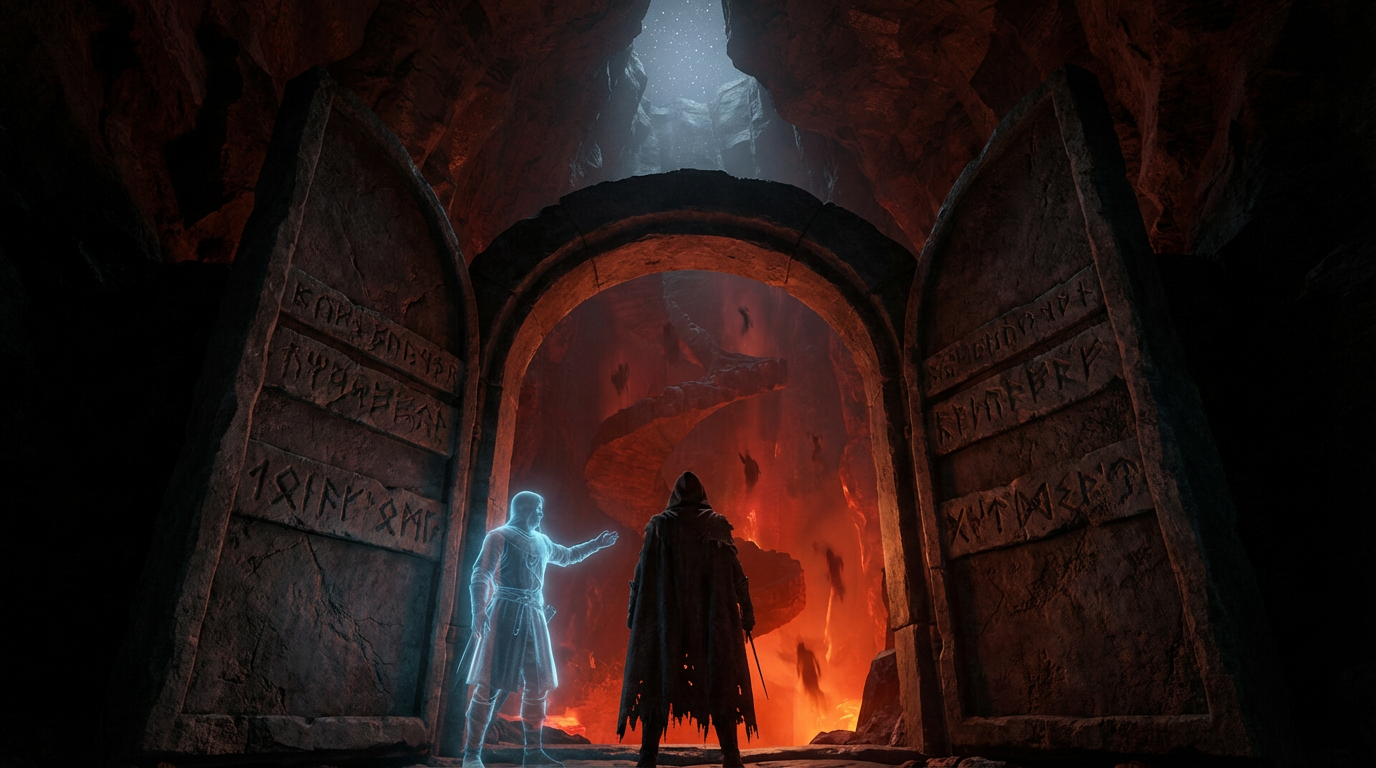
An excerpt from the original text.(complete · 1160 words)
We reach’d the summit of the scale, and stood
Upon the second buttress of that mount
Which healeth him who climbs. A cornice there,
Like to the former, girdles round the hill;
Save that its arch with sweep less ample bends.

Shadow nor image there is seen; all smooth
The rampart and the path, reflecting nought
But the rock’s sullen hue. “If here we wait
For some to question,” said the bard, “I fear
Our choice may haply meet too long delay.”

Then fixedly upon the sun his eyes
He fastn’d, made his right the central point
From whence to move, and turn’d the left aside.
“O pleasant light, my confidence and hope,
Conduct us thou,” he cried, “on this new way,
Where now I venture, leading to the bourn
We seek. The universal world to thee
Owes warmth and lustre. If no other cause
Forbid, thy beams should ever be our guide.”

Far, as is measur’d for a mile on earth,
In brief space had we journey’d; such prompt will
Impell’d; and towards us flying, now were heard
Spirits invisible, who courteously
Unto love’s table bade the welcome guest.
The voice, that first? flew by, call’d forth aloud,
“They have no wine; “ so on behind us past,
Those sounds reiterating, nor yet lost
In the faint distance, when another came
Crying, “I am Orestes,” and alike
Wing’d its fleet way. “Oh father!” I exclaim’d,
“What tongues are these?” and as I question’d, lo!
A third exclaiming, “Love ye those have wrong’d you.”

“This circuit,” said my teacher, “knots the scourge
For envy, and the cords are therefore drawn
By charity’s correcting hand. The curb
Is of a harsher sound, as thou shalt hear
(If I deem rightly), ere thou reach the pass,
Where pardon sets them free. But fix thine eyes
Intently through the air, and thou shalt see
A multitude before thee seated, each
Along the shelving grot.” Then more than erst
I op’d my eyes, before me view’d, and saw
Shadows with garments dark as was the rock;
And when we pass’d a little forth, I heard
A crying, “Blessed Mary! pray for us,
Michael and Peter! all ye saintly host!”

I do not think there walks on earth this day
Man so remorseless, that he hath not yearn’d
With pity at the sight that next I saw.
Mine eyes a load of sorrow teemed, when now
I stood so near them, that their semblances
Came clearly to my view. Of sackcloth vile
Their cov’ring seem’d; and on his shoulder one
Did stay another, leaning, and all lean’d
Against the cliff. E’en thus the blind and poor,
Near the confessionals, to crave an alms,
Stand, each his head upon his fellow’s sunk,
So most to stir compassion, not by sound
Of words alone, but that, which moves not less,
The sight of mis’ry. And as never beam
Of noonday visiteth the eyeless man,
E’en so was heav’n a niggard unto these
Of his fair light; for, through the orbs of all,
A thread of wire, impiercing, knits them up,
As for the taming of a haggard hawk.

It were a wrong, methought, to pass and look
On others, yet myself the while unseen.
To my sage counsel therefore did I turn.
He knew the meaning of the mute appeal,
Nor waited for my questioning, but said:
“Speak; and be brief, be subtle in thy words.”

On that part of the cornice, whence no rim
Engarlands its steep fall, did Virgil come;
On the’ other side me were the spirits, their cheeks
Bathing devout with penitential tears,
That through the dread impalement forc’d a way.

I turn’d me to them, and “O shades!” said I,

“Assur’d that to your eyes unveil’d shall shine
The lofty light, sole object of your wish,
So may heaven’s grace clear whatsoe’er of foam
Floats turbid on the conscience, that thenceforth
The stream of mind roll limpid from its source,
As ye declare (for so shall ye impart
A boon I dearly prize) if any soul
Of Latium dwell among ye; and perchance
That soul may profit, if I learn so much.”

“My brother, we are each one citizens
Of one true city. Any thou wouldst say,
Who lived a stranger in Italia’s land.”

So heard I answering, as appeal’d, a voice
That onward came some space from whence I stood.

A spirit I noted, in whose look was mark’d
Expectance. Ask ye how? The chin was rais’d
As in one reft of sight. “Spirit,” said I,
“Who for thy rise are tutoring (if thou be
That which didst answer to me,) or by place
Or name, disclose thyself, that I may know thee.”

“I was,” it answer’d, “of Sienna: here
I cleanse away with these the evil life,
Soliciting with tears that He, who is,
Vouchsafe him to us. Though Sapia nam’d
In sapience I excell’d not, gladder far
Of others’ hurt, than of the good befell me.
That thou mayst own I now deceive thee not,
Hear, if my folly were not as I speak it.
When now my years slop’d waning down the arch,
It so bechanc’d, my fellow citizens
Near Colle met their enemies in the field,
And I pray’d God to grant what He had will’d.
There were they vanquish’d, and betook themselves
Unto the bitter passages of flight.
I mark’d the hunt, and waxing out of bounds
In gladness, lifted up my shameless brow,
And like the merlin cheated by a gleam,
Cried, “It is over. Heav’n! I fear thee not.”
Upon my verge of life I wish’d for peace
With God; nor repentance had supplied
What I did lack of duty, were it not
The hermit Piero, touch’d with charity,
In his devout orisons thought on me.
But who art thou that question’st of our state,
Who go’st to my belief, with lids unclos’d,
And breathest in thy talk?”—“Mine eyes,” said I,
“May yet be here ta’en from me; but not long;
For they have not offended grievously
With envious glances. But the woe beneath
Urges my soul with more exceeding dread.
That nether load already weighs me down.”

She thus: “Who then amongst us here aloft
Hath brought thee, if thou weenest to return?”

“He,” answer’d I, “who standeth mute beside me.
I live: of me ask therefore, chosen spirit,
If thou desire I yonder yet should move
For thee my mortal feet.”—“Oh!” she replied,
“This is so strange a thing, it is great sign
That God doth love thee. Therefore with thy prayer
Sometime assist me: and by that I crave,
Which most thou covetest, that if thy feet
E’er tread on Tuscan soil, thou save my fame
Amongst my kindred. Them shalt thou behold
With that vain multitude, who set their hope
On Telamone’s haven, there to fail
Confounded, more shall when the fancied stream
They sought of Dian call’d: but they who lead
Their navies, more than ruin’d hopes shall mourn.”
Master this chapter. Complete your experience
Purchase the complete book to access all chapters and support classic literature
As an Amazon Associate, we earn a small commission from qualifying purchases at no additional cost to you.
Available in paperback, hardcover, and e-book formats
Let's Analyse the Pattern
Finding satisfaction in others' failures rather than focusing on your own success, which ultimately blinds you to your own opportunities and potential.
Why This Matters
Connect literature to life
This chapter teaches how to recognize when we're unconsciously undermining our own progress by focusing on others' failures instead of our own growth.
Practice This Today
This week, notice when you feel pleased about someone else's mistake or setback, then immediately ask yourself what you could be doing to advance your own goals instead.
Now let's explore the literary elements.
Key Quotes & Analysis
"They have no wine"
Context: The first example of love called out as they enter the terrace of envy
This refers to Mary noticing the wedding hosts' embarrassment at running out of wine and asking Jesus to help. It's the opposite of envy - seeing others' needs and wanting to help rather than taking pleasure in their problems.
In Today's Words:
Someone's in trouble - let's help them out
"I took more joy in others' hurt than in my own good fortune"
Context: Sapia confesses her envious nature to Dante
This brutal self-assessment shows how envy corrupts our ability to find happiness. Instead of celebrating our wins, we get more satisfaction from others losing. It's a toxic pattern that steals our own joy.
In Today's Words:
I was happier when bad things happened to people I didn't like than when good things happened to me
"Now I see that I was like a blackbird who rejoices in winter, thinking spring will never come"
Context: Sapia describes her foolish satisfaction at her city's military defeat
She realizes her short-sighted thinking - celebrating temporary setbacks for others while missing the bigger picture. Envy makes us stupid, focusing on petty victories while missing real opportunities for happiness.
In Today's Words:
I was celebrating too early, not realizing I was setting myself up for disappointment
Thematic Threads
Envy
In This Chapter
Souls have their eyes sewn shut, representing how envy blinds us to our own blessings and possibilities
Development
Introduced here as a specific sin being purged, showing its destructive power
In Your Life:
You might recognize this when you feel secretly pleased about a coworker's mistake instead of focusing on your own performance.
Self-awareness
In This Chapter
Sapia honestly admits her ugly truth about taking pleasure in enemies' defeats rather than her own victories
Development
Building on earlier themes of confession and honest self-examination
In Your Life:
This appears when you have to admit uncomfortable truths about your motivations and reactions to others' success or failure.
Community dependence
In This Chapter
The blind souls must lean on each other for support, learning interdependence
Development
Continues the theme of how individual growth requires community connection
In Your Life:
You see this when you realize you need others' help and support to overcome your own destructive patterns.
Reputation and legacy
In This Chapter
Sapia asks Dante to restore her reputation on earth, showing concern for how she's remembered
Development
Builds on ongoing theme of earthly connections mattering even in spiritual transformation
In Your Life:
This shows up when you worry about how your mistakes will be remembered and want opportunities to make things right.
Spiritual blindness
In This Chapter
Physical blindness represents how envy cuts us off from seeing beauty and joy in the world
Development
Extends the metaphor of sight and blindness from earlier circles
In Your Life:
You experience this when negative emotions prevent you from seeing good opportunities or positive aspects of your situation.
You now have the context. Time to form your own thoughts.
Discussion Questions
- 1
Why are the envious souls sitting with their eyes sewn shut, and what does this punishment teach us about how envy actually works?
analysis • surface - 2
Sapia admits she felt more joy watching her enemies lose than celebrating her own victories. What does this reveal about the psychology of envy?
analysis • medium - 3
Where do you see people today getting more satisfaction from others' failures than from their own successes? What situations make this tempting?
application • medium - 4
If you caught yourself feeling secretly pleased about someone else's setback, what specific steps would you take to redirect that energy toward your own growth?
application • deep - 5
How does focusing on comparing ourselves to others actually blind us to our own opportunities and path forward?
reflection • deep
Critical Thinking Exercise
Create Your Personal Scoreboard
Think of an area where you often compare yourself to others - work, parenting, finances, relationships. Create a personal scoreboard that tracks only your own progress, not your position relative to others. List 3-5 specific metrics that measure your growth in this area over the past month. Then identify one action you can take this week to improve your own score.
Consider:
- •Focus on metrics you can actually control and influence
- •Choose measurements that reflect genuine progress, not just activity
- •Notice how it feels to evaluate yourself without comparing to others
Journaling Prompt
Write about a time when you felt genuinely happy about someone else's success, even in an area where you were struggling. What made that possible, and how did it feel different from comparison or envy?
Coming Up Next...
Chapter 48: The Poison of Envy Revealed
A mysterious question echoes around the mountain about someone who can open and close his eyes at will. The souls are curious about this living visitor who walks among the dead, and Dante's unique status as a living person in Purgatory becomes a source of wonder and hope for those seeking redemption.