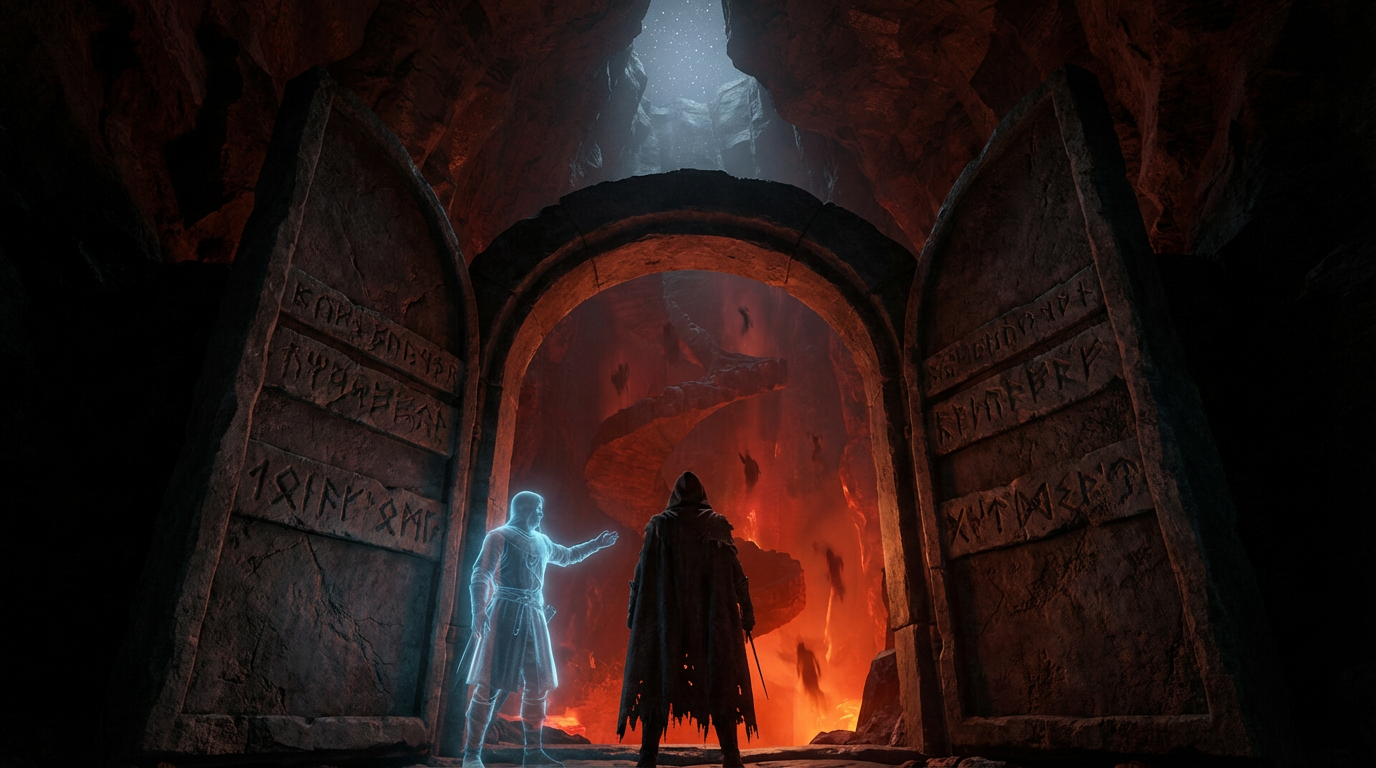
An excerpt from the original text.(complete · 1188 words)
“Say who is he around our mountain winds,
Or ever death has prun’d his wing for flight,
That opes his eyes and covers them at will?”

“I know not who he is, but know thus much
He comes not singly. Do thou ask of him,
For thou art nearer to him, and take heed
Accost him gently, so that he may speak.”

Thus on the right two Spirits bending each
Toward the other, talk’d of me, then both
Addressing me, their faces backward lean’d,
And thus the one began: “O soul, who yet
Pent in the body, tendest towards the sky!
For charity, we pray thee’ comfort us,
Recounting whence thou com’st, and who thou art:
For thou dost make us at the favour shown thee
Marvel, as at a thing that ne’er hath been.”

“There stretches through the midst of Tuscany,
I straight began: “a brooklet, whose well-head
Springs up in Falterona, with his race
Not satisfied, when he some hundred miles
Hath measur’d. From his banks bring, I this frame.
To tell you who I am were words misspent:
For yet my name scarce sounds on rumour’s lip.”

“If well I do incorp’rate with my thought
The meaning of thy speech,” said he, who first
Addrest me, “thou dost speak of Arno’s wave.”

To whom the other: “Why hath he conceal’d
The title of that river, as a man
Doth of some horrible thing?” The spirit, who
Thereof was question’d, did acquit him thus:
“I know not: but ’tis fitting well the name
Should perish of that vale; for from the source
Where teems so plenteously the Alpine steep
Maim’d of Pelorus, (that doth scarcely pass
Beyond that limit,) even to the point
Whereunto ocean is restor’d, what heaven
Drains from th’ exhaustless store for all earth’s streams,
Throughout the space is virtue worried down,
As ’twere a snake, by all, for mortal foe,
Or through disastrous influence on the place,
Or else distortion of misguided wills,
That custom goads to evil: whence in those,
The dwellers in that miserable vale,
Nature is so transform’d, it seems as they
Had shar’d of Circe’s feeding. ’Midst brute swine,
Worthier of acorns than of other food
Created for man’s use, he shapeth first
His obscure way; then, sloping onward, finds
Curs, snarlers more in spite than power, from whom
He turns with scorn aside: still journeying down,
By how much more the curst and luckless foss
Swells out to largeness, e’en so much it finds
Dogs turning into wolves. Descending still
Through yet more hollow eddies, next he meets
A race of foxes, so replete with craft,
They do not fear that skill can master it.
Nor will I cease because my words are heard
By other ears than thine. It shall be well
For this man, if he keep in memory
What from no erring Spirit I reveal.
Lo! I behold thy grandson, that becomes
A hunter of those wolves, upon the shore
Of the fierce stream, and cows them all with dread:
Their flesh yet living sets he up to sale,
Then like an aged beast to slaughter dooms.
Many of life he reaves, himself of worth
And goodly estimation. Smear’d with gore
Mark how he issues from the rueful wood,
Leaving such havoc, that in thousand years
It spreads not to prime lustihood again.”

As one, who tidings hears of woe to come,
Changes his looks perturb’d, from whate’er part
The peril grasp him, so beheld I change
That spirit, who had turn’d to listen, struck
With sadness, soon as he had caught the word.

His visage and the other’s speech did raise
Desire in me to know the names of both,
whereof with meek entreaty I inquir’d.

The shade, who late addrest me, thus resum’d:
“Thy wish imports that I vouchsafe to do
For thy sake what thou wilt not do for mine.
But since God’s will is that so largely shine
His grace in thee, I will be liberal too.
Guido of Duca know then that I am.
Envy so parch’d my blood, that had I seen
A fellow man made joyous, thou hadst mark’d
A livid paleness overspread my cheek.
Such harvest reap I of the seed I sow’d.
O man, why place thy heart where there doth need
Exclusion of participants in good?
This is Rinieri’s spirit, this the boast
And honour of the house of Calboli,
Where of his worth no heritage remains.
Nor his the only blood, that hath been stript
(’twixt Po, the mount, the Reno, and the shore,)
Of all that truth or fancy asks for bliss;
But in those limits such a growth has sprung
Of rank and venom’d roots, as long would mock
Slow culture’s toil. Where is good Lizio? where
Manardi, Traversalo, and Carpigna?
O bastard slips of old Romagna’s line!
When in Bologna the low artisan,
And in Faenza yon Bernardin sprouts,
A gentle cyon from ignoble stem.
Wonder not, Tuscan, if thou see me weep,
When I recall to mind those once lov’d names,
Guido of Prata, and of Azzo him
That dwelt with you; Tignoso and his troop,
With Traversaro’s house and Anastagio s,
(Each race disherited) and beside these,
The ladies and the knights, the toils and ease,
That witch’d us into love and courtesy;
Where now such malice reigns in recreant hearts.
O Brettinoro! wherefore tarriest still,
Since forth of thee thy family hath gone,
And many, hating evil, join’d their steps?
Well doeth he, that bids his lineage cease,
Bagnacavallo; Castracaro ill,
And Conio worse, who care to propagate
A race of Counties from such blood as theirs.
Well shall ye also do, Pagani, then
When from amongst you tries your demon child.
Not so, howe’er, that henceforth there remain
True proof of what ye were. O Hugolin!
Thou sprung of Fantolini’s line! thy name
Is safe, since none is look’d for after thee
To cloud its lustre, warping from thy stock.
But, Tuscan, go thy ways; for now I take
Far more delight in weeping than in words.
Such pity for your sakes hath wrung my heart.”

We knew those gentle spirits at parting heard
Our steps. Their silence therefore of our way
Assur’d us. Soon as we had quitted them,
Advancing onward, lo! a voice that seem’d
Like vollied light’ning, when it rives the air,
Met us, and shouted, “Whosoever finds
Will slay me,” then fled from us, as the bolt
Lanc’d sudden from a downward-rushing cloud.
When it had giv’n short truce unto our hearing,
Behold the other with a crash as loud
As the quick-following thunder: “Mark in me
Aglauros turn’d to rock.” I at the sound
Retreating drew more closely to my guide.

Now in mute stillness rested all the air:
And thus he spake: “There was the galling bit.
But your old enemy so baits his hook,
He drags you eager to him. Hence nor curb
Avails you, nor reclaiming call. Heav’n calls
And round about you wheeling courts your gaze
With everlasting beauties. Yet your eye
Turns with fond doting still upon the earth.
Therefore He smites you who discerneth all.”
Master this chapter. Complete your experience
Purchase the complete book to access all chapters and support classic literature
As an Amazon Associate, we earn a small commission from qualifying purchases at no additional cost to you.
Available in paperback, hardcover, and e-book formats
Let's Analyse the Pattern
The Poison River - How Individual Corruption Spreads
Individual moral compromises flow through social systems, normalizing corruption and creating cascading community-wide decay.
Why This Matters
Connect literature to life
This chapter teaches how to identify the upstream sources of downstream problems in organizations and communities.
Practice This Today
This week, when you encounter workplace dysfunction or community problems, ask yourself: 'What individual choices created this pattern, and am I contributing to the solution or the problem?'
Now let's explore the literary elements.
Key Quotes & Analysis
"For thou dost make us at the favour shown thee Marvel, as at a thing that ne'er hath been."
Context: When the spirits first encounter Dante and realize he's still alive
This shows how rare divine grace is - even souls in purgatory are amazed when someone receives special help from Heaven. It emphasizes that Dante's journey is extraordinary, not something anyone can expect.
In Today's Words:
You're getting help that nobody ever gets - how is that possible?
"I know not: but 'tis fitting such a name Should perish of that river"
Context: When asked why he won't name the Arno River directly
Guido's disgust is so complete that he won't even speak the river's name. This shows how thoroughly corruption has poisoned what should be a source of life and beauty for the region.
In Today's Words:
That place is so messed up it doesn't deserve to be named.
"The blood of every one is so depraved, that it has turned to beasts"
Context: Describing the moral state of people in the Arno valley
This captures Dante's belief that sin literally dehumanizes people. When we act on our worst impulses consistently, we lose our humanity and become like animals driven by instinct rather than reason.
In Today's Words:
Everyone there has become so corrupt they're not even human anymore.
"Heaven calls you upward, and around you wheels, showing its eternal beauties"
Context: Explaining why divine correction is necessary
This reveals the tragedy of human focus - we're surrounded by beauty and higher purposes, but we keep our eyes on petty earthly concerns. Divine intervention becomes necessary to break this destructive pattern.
In Today's Words:
Life is offering you amazing possibilities, but you're too busy staring at the ground to notice.
Thematic Threads
Class
In This Chapter
Guido mourns the decline of noble families and virtuous leadership, showing how moral decay affects social hierarchies
Development
Continues from earlier observations about power and responsibility, now focusing on generational decline
In Your Life:
You might notice how leadership failures at work or in your community affect everyone below them in the hierarchy.
Identity
In This Chapter
When Dante reveals his Tuscan origins, it triggers deep reflection on regional character and moral identity
Development
Builds on Dante's journey of self-discovery, now examining how place shapes character
In Your Life:
You might consider how your hometown, workplace culture, or family background has shaped your values and choices.
Social Expectations
In This Chapter
The spirits lament how society has lost its moral compass, with people becoming 'beasts' instead of humans
Development
Deepens from earlier themes about conformity, now showing consequences of lowered standards
In Your Life:
You might recognize how lowered expectations in your environment make it easier to justify your own compromises.
Personal Growth
In This Chapter
Guido's confession about envy making him sick when others were happy shows the self-destructive nature of certain sins
Development
Continues the pattern of souls gaining wisdom through suffering and reflection
In Your Life:
You might notice how your own negative emotions—jealousy, resentment, spite—actually harm you more than their targets.
Human Relationships
In This Chapter
The chapter shows how individual sins poison community bonds and create cycles of mutual destruction
Development
Expands from personal relationships to community-wide social fabric
In Your Life:
You might see how one person's toxic behavior can spread through your workplace, family, or friend group, affecting everyone's relationships.
You now have the context. Time to form your own thoughts.
Discussion Questions
- 1
How does Guido del Duca describe the corruption spreading through his region, and what animal metaphors does he use?
analysis • surface - 2
Why does Guido blame himself for contributing to his region's moral decay, even though he was just one person among many?
analysis • medium - 3
Where do you see this 'downstream corruption' pattern in modern workplaces, families, or communities?
application • medium - 4
When you encounter toxic behavior spreading through your environment, what strategies could you use to stop being part of the problem?
application • deep - 5
What does this chapter suggest about individual responsibility when everyone around you is cutting corners or acting badly?
reflection • deep
Critical Thinking Exercise
Map Your River System
Think of a negative behavior or attitude that you've seen spread through a group you belong to - workplace gossip, family dysfunction, friend group drama, or community prejudice. Draw a simple map showing how this behavior flowed from person to person like water through a river system. Identify where you fit in this flow and mark one specific place where you could act as a 'filter' rather than a conduit.
Consider:
- •Start with the original source - who first introduced this toxic pattern?
- •Notice how each person modified or amplified the behavior as it passed through them
- •Consider how your own actions might be contributing to the downstream effects
Journaling Prompt
Write about a time when you chose to break a negative cycle instead of passing it along. What made you decide to be the filter? What was the result?
Coming Up Next...
Chapter 49: The Angel of Mercy and Visions of Forgiveness
As the day progresses toward evening, Dante and Virgil continue their ascent. The mountain's spiritual lessons are far from over, and new revelations about human nature and divine justice await on the path ahead.