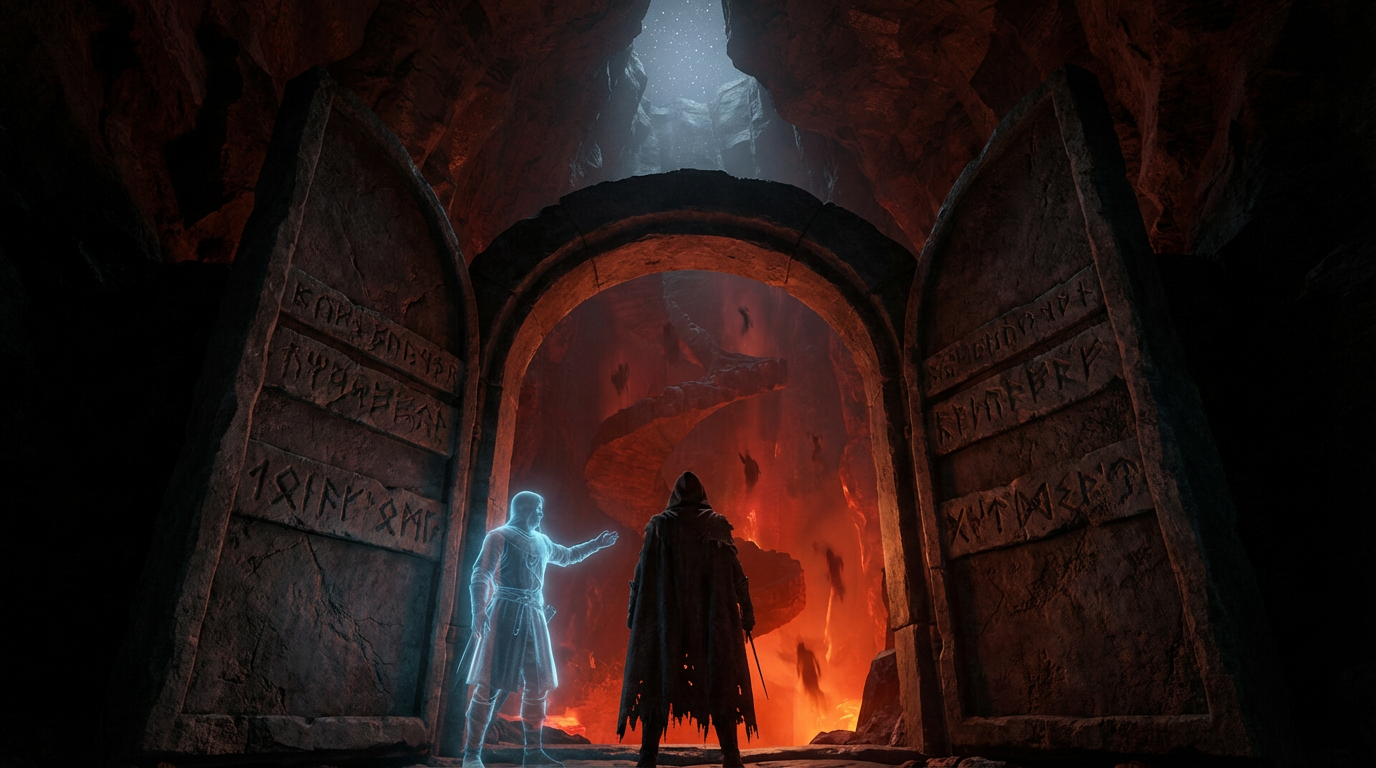
An excerpt from the original text.(complete · 992 words)
When we had passed the threshold of the gate
(Which the soul’s ill affection doth disuse,
Making the crooked seem the straighter path),
I heard its closing sound. Had mine eyes turn’d,
For that offence what plea might have avail’d?

We mounted up the riven rock, that wound
On either side alternate, as the wave
Flies and advances. “Here some little art
Behooves us,” said my leader, “that our steps
Observe the varying flexure of the path.”

Thus we so slowly sped, that with cleft orb
The moon once more o’erhangs her wat’ry couch,
Ere we that strait have threaded. But when free
We came and open, where the mount above
One solid mass retires, I spent, with toil,
And both, uncertain of the way, we stood,
Upon a plain more lonesome, than the roads
That traverse desert wilds. From whence the brink
Borders upon vacuity, to foot
Of the steep bank, that rises still, the space
Had measur’d thrice the stature of a man:
And, distant as mine eye could wing its flight,
To leftward now and now to right dispatch’d,
That cornice equal in extent appear’d.

Not yet our feet had on that summit mov’d,
When I discover’d that the bank around,
Whose proud uprising all ascent denied,
Was marble white, and so exactly wrought
With quaintest sculpture, that not there alone
Had Polycletus, but e’en nature’s self
Been sham’d. The angel who came down to earth
With tidings of the peace so many years
Wept for in vain, that op’d the heavenly gates
From their long interdict) before us seem’d,
In a sweet act, so sculptur’d to the life,
He look’d no silent image. One had sworn
He had said, “Hail!” for she was imag’d there,
By whom the key did open to God’s love,
And in her act as sensibly impress
That word, “Behold the handmaid of the Lord,”
As figure seal’d on wax. “Fix not thy mind
On one place only,” said the guide belov’d,
Who had me near him on that part where lies
The heart of man. My sight forthwith I turn’d
And mark’d, behind the virgin mother’s form,
Upon that side, where he, that mov’d me, stood,
Another story graven on the rock.

I passed athwart the bard, and drew me near,
That it might stand more aptly for my view.
There in the self-same marble were engrav’d
The cart and kine, drawing the sacred ark,
That from unbidden office awes mankind.
Before it came much people; and the whole
Parted in seven quires. One sense cried, “Nay,”
Another, “Yes, they sing.” Like doubt arose
Betwixt the eye and smell, from the curl’d fume
Of incense breathing up the well-wrought toil.
Preceding the blest vessel, onward came
With light dance leaping, girt in humble guise,
Sweet Israel’s harper: in that hap he seem’d
Less and yet more than kingly. Opposite,
At a great palace, from the lattice forth
Look’d Michol, like a lady full of scorn
And sorrow. To behold the tablet next,
Which at the hack of Michol whitely shone,
I mov’d me. There was storied on the rock
The’ exalted glory of the Roman prince,
Whose mighty worth mov’d Gregory to earn
His mighty conquest, Trajan th’ Emperor.
A widow at his bridle stood, attir’d
In tears and mourning. Round about them troop’d
Full throng of knights, and overhead in gold
The eagles floated, struggling with the wind.
The wretch appear’d amid all these to say:
“Grant vengeance, sire! for, woe beshrew this heart
My son is murder’d.” He replying seem’d;

“Wait now till I return.” And she, as one
Made hasty by her grief; “O sire, if thou
Dost not return?”—“Where I am, who then is,
May right thee.”—” What to thee is other’s good,
If thou neglect thy own?”—“Now comfort thee,”
At length he answers. “It beseemeth well
My duty be perform’d, ere I move hence:
So justice wills; and pity bids me stay.”

He, whose ken nothing new surveys, produc’d
That visible speaking, new to us and strange
The like not found on earth. Fondly I gaz’d
Upon those patterns of meek humbleness,
Shapes yet more precious for their artist’s sake,
When “Lo,” the poet whisper’d, “where this way
(But slack their pace), a multitude advance.
These to the lofty steps shall guide us on.”

Mine eyes, though bent on view of novel sights
Their lov’d allurement, were not slow to turn.

Reader! I would not that amaz’d thou miss
Of thy good purpose, hearing how just God
Decrees our debts be cancel’d. Ponder not
The form of suff’ring. Think on what succeeds,
Think that at worst beyond the mighty doom
It cannot pass. “Instructor,” I began,
“What I see hither tending, bears no trace
Of human semblance, nor of aught beside
That my foil’d sight can guess.” He answering thus:
“So courb’d to earth, beneath their heavy teems
Of torment stoop they, that mine eye at first
Struggled as thine. But look intently thither,
An disentangle with thy lab’ring view,
What underneath those stones approacheth: now,
E’en now, mayst thou discern the pangs of each.”

Christians and proud! O poor and wretched ones!
That feeble in the mind’s eye, lean your trust
Upon unstaid perverseness! Know ye not
That we are worms, yet made at last to form
The winged insect, imp’d with angel plumes
That to heaven’s justice unobstructed soars?
Why buoy ye up aloft your unfleg’d souls?
Abortive then and shapeless ye remain,
Like the untimely embryon of a worm!

As, to support incumbent floor or roof,
For corbel is a figure sometimes seen,
That crumples up its knees unto its breast,
With the feign’d posture stirring ruth unfeign’d
In the beholder’s fancy; so I saw
These fashion’d, when I noted well their guise.

Each, as his back was laden, came indeed
Or more or less contract; but it appear’d
As he, who show’d most patience in his look,
Wailing exclaim’d: “I can endure no more.”
Master this chapter. Complete your experience
Purchase the complete book to access all chapters and support classic literature
As an Amazon Associate, we earn a small commission from qualifying purchases at no additional cost to you.
Available in paperback, hardcover, and e-book formats
Let's Analyse the Pattern
The Weight of Superiority
The belief that we're above others creates an unsustainable weight that eventually crushes our ability to grow and connect.
Why This Matters
Connect literature to life
This chapter teaches how to recognize when maintaining an image becomes more exhausting than the actual work.
Practice This Today
This week, notice when you feel pressure to appear more knowledgeable than you are - that's the warning sign to choose strategic honesty instead.
Now let's explore the literary elements.
Key Quotes & Analysis
"Here some little art behooves us, that our steps observe the varying flexure of the path"
Context: Warning Dante that they need skill and attention to navigate the winding mountain path
This shows that personal growth isn't just about good intentions - it requires actual skill, focus, and adaptability. The path changes constantly, so you can't just follow a simple formula.
In Today's Words:
We're going to need to really pay attention here and adjust as we go - this isn't going to be easy or straightforward
"Not there alone had Polycletus, but e'en nature's self been shamed"
Context: Describing how incredibly lifelike and perfect the marble carvings of humility are
The art is so perfect it surpasses both human skill and nature itself, suggesting that divine truth about humility is more beautiful and real than anything we can create or imagine.
In Today's Words:
This was so perfectly done it made the greatest artists and even real life look amateur by comparison
"O proud Christians, wretched and weary, who are sick in your mind's vision and put your trust in backward steps"
Context: Reflecting on seeing the proud souls bent under their burdens
Dante realizes that pride makes us spiritually sick and causes us to move backward instead of forward. It's a warning about how thinking we're better than others actually holds us back from real progress.
In Today's Words:
Look at all these people who think they're so great - they're actually miserable and going nowhere because they can't see past their own egos
Thematic Threads
Pride
In This Chapter
Souls literally crushed under stone slabs, unable to lift their heads, contrasted with marble examples of chosen humility
Development
Evolving from earlier themes of recognition and consequence into physical manifestation of spiritual weight
In Your Life:
You might feel this when you refuse to ask for help at work because you think it makes you look weak.
Class
In This Chapter
Emperor Trajan stopping his royal procession to help a common widow shows true nobility through service
Development
Building on earlier class themes by showing how real status comes from lifting others up
In Your Life:
You see this when people with authority use their position to help rather than to separate themselves from others.
Social Expectations
In This Chapter
The contrast between what society expects from powerful figures versus what actually creates lasting greatness
Development
Deepening the exploration of how external expectations can trap us in destructive patterns
In Your Life:
You experience this when you feel pressure to appear perfect or above certain struggles that everyone actually faces.
Personal Growth
In This Chapter
The crushing physical burden represents the spiritual work required to transform pride into humility
Development
Showing how growth often feels impossible in the moment but leads to freedom
In Your Life:
You feel this when admitting you were wrong or need to change feels overwhelming but ultimately liberates you.
Human Relationships
In This Chapter
The examples show how humility creates connection while pride creates isolation and burden
Development
Expanding on how our internal state directly affects our ability to connect with others
In Your Life:
You notice this when your need to be right in arguments prevents you from actually solving problems with people you care about.
You now have the context. Time to form your own thoughts.
Discussion Questions
- 1
What three examples of humility are carved into the marble, and what made each person choose to humble themselves?
analysis • surface - 2
Why are the proud souls literally bent double under stone slabs while the humble figures are preserved in beautiful marble?
analysis • medium - 3
Think about your workplace or family - where do you see people carrying the 'weight' of always having to be right or better than others?
application • medium - 4
When have you felt crushed by trying to maintain a position of superiority, and how might strategic humility have lightened that load?
application • deep - 5
What does this chapter reveal about the difference between humility as weakness versus humility as intelligent strength?
reflection • deep
Critical Thinking Exercise
Weight Check: Map Your Pride Burdens
Draw a simple stick figure representing yourself. Around the figure, write down areas where you feel pressure to prove you're better, smarter, or more capable than others. For each burden, estimate its 'weight' - how much mental energy does maintaining this superiority cost you daily? Then identify one burden you could lighten through strategic humility this week.
Consider:
- •Notice which burdens feel heaviest and drain the most energy
- •Consider how your need to be 'above' others might actually be holding you back
- •Think about people you respect who demonstrate strength through humility
Journaling Prompt
Write about a time when admitting you were wrong or didn't know something actually made you stronger or more respected. What did that teach you about the relationship between humility and power?
Coming Up Next...
Chapter 45: The Weight of Pride and Fame's Fleeting Nature
The souls under their crushing burdens begin to pray together, and Dante will hear a familiar voice among them - someone whose pride once seemed unbreakable but who now demonstrates the deepest humility.