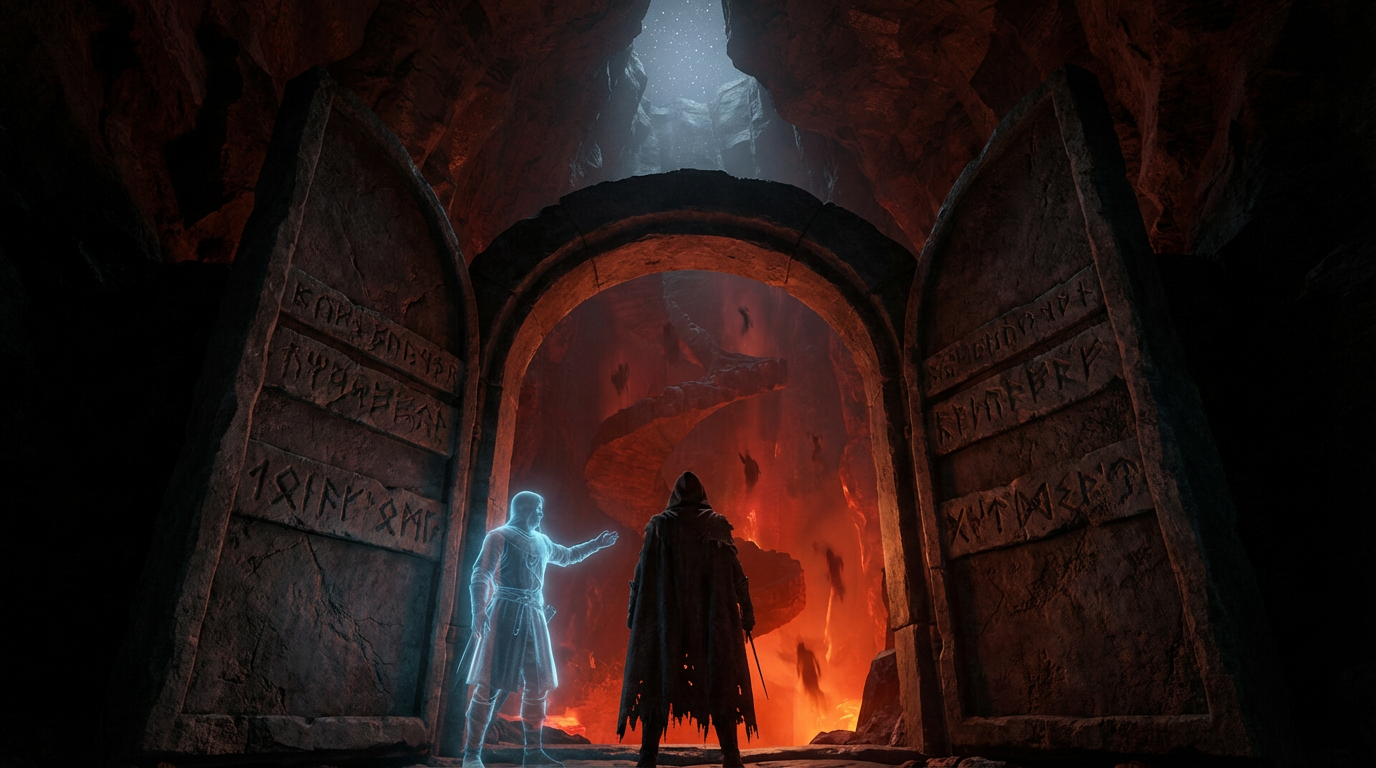
An excerpt from the original text.(complete · 1054 words)
Thus we from bridge to bridge, with other talk,
The which my drama cares not to rehearse,
Pass’d on; and to the summit reaching, stood
To view another gap, within the round
Of Malebolge, other bootless pangs.

Marvelous darkness shadow’d o’er the place.

In the Venetians’ arsenal as boils
Through wintry months tenacious pitch, to smear
Their unsound vessels; for th’ inclement time
Sea-faring men restrains, and in that while
His bark one builds anew, another stops
The ribs of his, that hath made many a voyage;
One hammers at the prow, one at the poop;
This shapeth oars, that other cables twirls,
The mizen one repairs and main-sail rent
So not by force of fire but art divine
Boil’d here a glutinous thick mass, that round
Lim’d all the shore beneath. I that beheld,
But therein nought distinguish’d, save the surge,
Rais’d by the boiling, in one mighty swell
Heave, and by turns subsiding and fall. While there
I fix’d my ken below, “Mark! mark!” my guide
Exclaiming, drew me towards him from the place,
Wherein I stood. I turn’d myself as one,
Impatient to behold that which beheld
He needs must shun, whom sudden fear unmans,
That he his flight delays not for the view.
Behind me I discern’d a devil black,
That running, up advanc’d along the rock.
Ah! what fierce cruelty his look bespake!
In act how bitter did he seem, with wings
Buoyant outstretch’d and feet of nimblest tread!
His shoulder proudly eminent and sharp
Was with a sinner charg’d; by either haunch
He held him, the foot’s sinew griping fast.

“Ye of our bridge!” he cried, “keen-talon’d fiends!
Lo! one of Santa Zita’s elders! Him
Whelm ye beneath, while I return for more.
That land hath store of such. All men are there,
Except Bonturo, barterers: of ‘no’
For lucre there an ‘aye’ is quickly made.”

Him dashing down, o’er the rough rock he turn’d,
Nor ever after thief a mastiff loos’d
Sped with like eager haste. That other sank
And forthwith writing to the surface rose.
But those dark demons, shrouded by the bridge,
Cried “Here the hallow’d visage saves not: here
Is other swimming than in Serchio’s wave.
Wherefore if thou desire we rend thee not,
Take heed thou mount not o’er the pitch.” This said,
They grappled him with more than hundred hooks,
And shouted: “Cover’d thou must sport thee here;
So, if thou canst, in secret mayst thou filch.”
E’en thus the cook bestirs him, with his grooms,
To thrust the flesh into the caldron down
With flesh-hooks, that it float not on the top.

Me then my guide bespake: “Lest they descry,
That thou art here, behind a craggy rock
Bend low and screen thee; and whate’er of force
Be offer’d me, or insult, fear thou not:
For I am well advis’d, who have been erst
In the like fray.” Beyond the bridge’s head
Therewith he pass’d, and reaching the sixth pier,
Behov’d him then a forehead terror-proof.

With storm and fury, as when dogs rush forth
Upon the poor man’s back, who suddenly
From whence he standeth makes his suit; so rush’d
Those from beneath the arch, and against him
Their weapons all they pointed. He aloud:
“Be none of you outrageous: ere your time
Dare seize me, come forth from amongst you one,
Who having heard my words, decide he then
If he shall tear these limbs.” They shouted loud,
“Go, Malacoda!” Whereat one advanc’d,
The others standing firm, and as he came,
“What may this turn avail him?” he exclaim’d.

“Believ’st thou, Malacoda! I had come
Thus far from all your skirmishing secure,”
My teacher answered, “without will divine
And destiny propitious? Pass we then
For so Heaven’s pleasure is, that I should lead
Another through this savage wilderness.”

Forthwith so fell his pride, that he let drop
The instrument of torture at his feet,
And to the rest exclaim’d: “We have no power
To strike him.” Then to me my guide: “O thou!
Who on the bridge among the crags dost sit
Low crouching, safely now to me return.”

I rose, and towards him moved with speed: the fiends
Meantime all forward drew: me terror seiz’d
Lest they should break the compact they had made.
Thus issuing from Caprona, once I saw
Th’ infantry dreading, lest his covenant
The foe should break; so close he hemm’d them round.

I to my leader’s side adher’d, mine eyes
With fixt and motionless observance bent
On their unkindly visage. They their hooks
Protruding, one the other thus bespake:
“Wilt thou I touch him on the hip?” To whom
Was answer’d: “Even so; nor miss thy aim.”

But he, who was in conf’rence with my guide,
Turn’d rapid round, and thus the demon spake:
“Stay, stay thee, Scarmiglione!” Then to us
He added: “Further footing to your step
This rock affords not, shiver’d to the base
Of the sixth arch. But would you still proceed,
Up by this cavern go: not distant far,
Another rock will yield you passage safe.
Yesterday, later by five hours than now,
Twelve hundred threescore years and six had fill’d
The circuit of their course, since here the way
Was broken. Thitherward I straight dispatch
Certain of these my scouts, who shall espy
If any on the surface bask. With them
Go ye: for ye shall find them nothing fell.
Come Alichino forth,” with that he cried,
“And Calcabrina, and Cagnazzo thou!
The troop of ten let Barbariccia lead.
With Libicocco Draghinazzo haste,
Fang’d Ciriatto, Grafflacane fierce,
And Farfarello, and mad Rubicant.
Search ye around the bubbling tar. For these,
In safety lead them, where the other crag
Uninterrupted traverses the dens.”

I then: “O master! what a sight is there!
Ah! without escort, journey we alone,
Which, if thou know the way, I covet not.
Unless thy prudence fail thee, dost not mark
How they do gnarl upon us, and their scowl
Threatens us present tortures?” He replied:
“I charge thee fear not: let them, as they will,
Gnarl on: ’tis but in token of their spite
Against the souls, who mourn in torment steep’d.”

To leftward o’er the pier they turn’d; but each
Had first between his teeth prest close the tongue,
Toward their leader for a signal looking,
Which he with sound obscene triumphant gave.
Master this chapter. Complete your experience
Purchase the complete book to access all chapters and support classic literature
As an Amazon Associate, we earn a small commission from qualifying purchases at no additional cost to you.
Available in paperback, hardcover, and e-book formats
Let's Analyse the Pattern
Apparent power often masks procedural limitations, and those who perform authority most aggressively usually have the least real decision-making power.
Why This Matters
Connect literature to life
This chapter teaches how to distinguish between theatrical intimidation and genuine authority by watching how quickly aggressive gatekeepers transform when faced with higher-level backing.
Practice This Today
This week, notice when someone's aggressive behavior immediately softens when you mention a supervisor, cite a policy, or demonstrate system knowledge—that's theatrical power revealing its limits.
Now let's explore the literary elements.
Key Quotes & Analysis
"Mark! mark! my guide exclaiming, drew me towards him from the place, wherein I stood."
Context: Warning Dante when the black demon approaches with a corrupt politician
Shows how Virgil protects Dante while teaching him to observe carefully. He's not just a guide but an active protector who knows when danger is real.
In Today's Words:
Hey, pay attention! Get over here, you need to see this.
"Ah! what fierce cruelty his look bespake! In act how bitter did he seem"
Context: Dante describing the black demon's appearance as it arrives
Captures the theatrical nature of demonic intimidation - they look scary on purpose. But this is performance as much as genuine threat.
In Today's Words:
This guy looked absolutely vicious and ready for violence.
"So not by force of fire but art divine boiled here a glutinous thick mass"
Context: Describing the pitch that boils without natural fire
Even Hell's punishments follow divine order, not chaos. There's a system and purpose behind everything, even the corruption of corrupt politicians.
In Today's Words:
This wasn't regular boiling - this was supernatural justice at work.
Thematic Threads
Power
In This Chapter
Demons appear threatening but immediately submit to higher authority, revealing the difference between performed power and real authority
Development
Expanding from individual pride to systemic power structures and how they actually function
In Your Life:
You might see this when dealing with customer service reps who act tough but fold when you ask for a supervisor
Class
In This Chapter
Virgil navigates the demon bureaucracy through knowledge of proper procedures and authority, while Dante remains nervous and dependent
Development
Continuing theme of how social knowledge and connections determine outcomes
In Your Life:
You might experience this when you need someone who 'speaks the language' to help you navigate medical billing or legal processes
Corruption
In This Chapter
Politicians boil in pitch while demons make jokes about their crimes, treating corruption as routine business
Development
Introduced here as institutional rather than personal failing
In Your Life:
You might recognize this in how certain industries or departments seem designed to enable unethical behavior
Social Expectations
In This Chapter
Demons perform crude gestures and intimidation because it's expected of their role, not from genuine malice
Development
Building on how people perform roles society assigns them
In Your Life:
You might notice this when people act hostile in their professional capacity but are reasonable when approached as individuals
Identity
In This Chapter
Dante must learn to distinguish between genuine threats and theatrical displays, developing discernment
Development
Continuing his growth in reading situations and understanding social dynamics
In Your Life:
You might find yourself learning to separate someone's job-required behavior from their actual intentions toward you
You now have the context. Time to form your own thoughts.
Discussion Questions
- 1
What changed the demons' behavior when Virgil spoke to their leader?
analysis • surface - 2
Why do you think the demons were so aggressive at first but then became helpful guides?
analysis • medium - 3
Where have you seen people act tough until someone with real authority shows up?
application • medium - 4
How would you handle a situation where someone is using intimidation tactics but you suspect they don't have real power?
application • deep - 5
What does this scene reveal about the difference between performing authority and actually having it?
reflection • deep
Critical Thinking Exercise
Map Your Authority Chain
Think of a recent frustrating interaction with customer service, a government office, or workplace bureaucracy. Draw or list the chain of authority from the person you dealt with up to someone who could actually solve your problem. Identify who had real decision-making power versus who was just following scripts.
Consider:
- •The person being difficult might have less power than they're projecting
- •Someone higher up the chain might have different incentives or procedures
- •Documentation and knowing the right language often matter more than being right
Journaling Prompt
Write about a time when you successfully navigated past an intimidating gatekeeper. What worked? How did you recognize who had real authority to help you?
Coming Up Next...
Chapter 22: The Demons' Deadly Game
The demon escort begins, but Dante quickly realizes his grotesque guides might not be as trustworthy as promised. Their crude military formation and obscene signals suggest this 'protection' could become a trap.