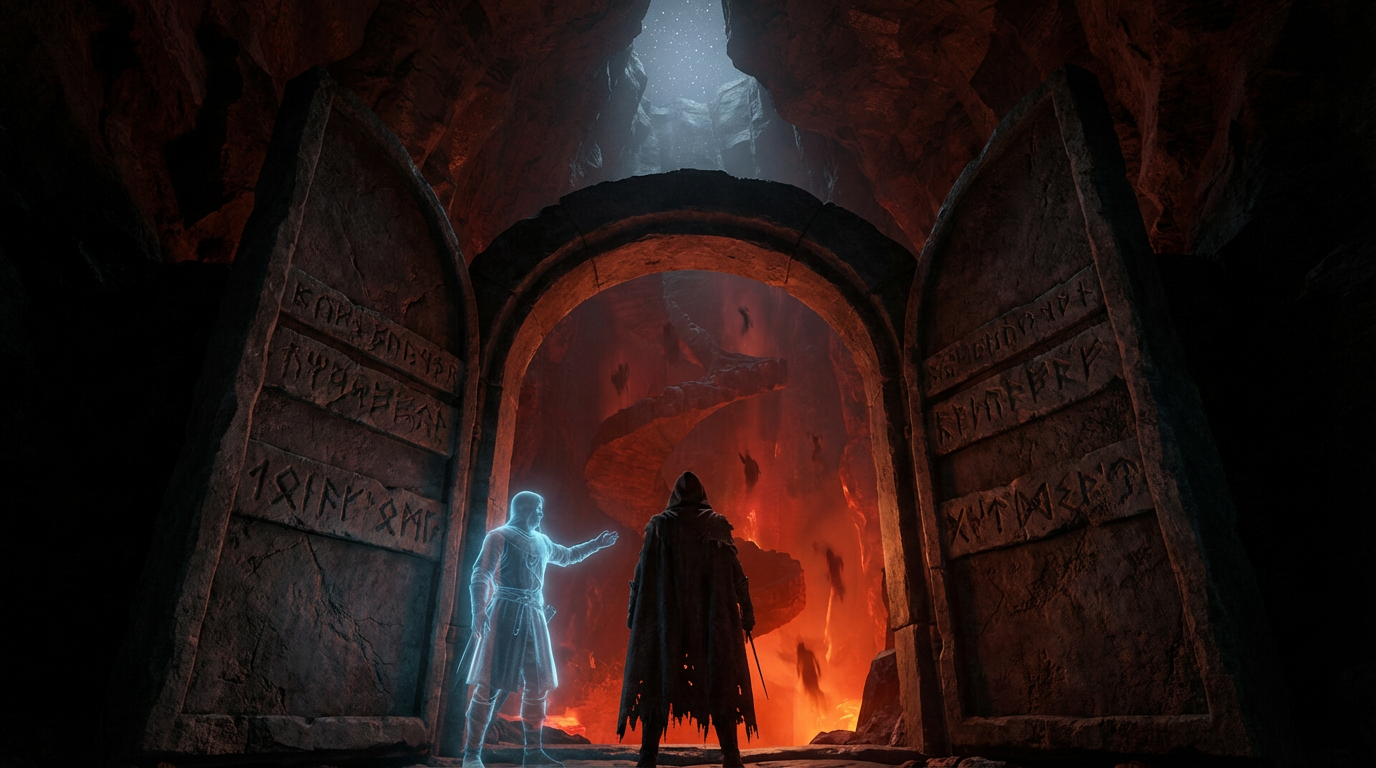
An excerpt from the original text.(complete · 1059 words)
Woe to thee, Simon Magus! woe to you,
His wretched followers! who the things of God,
Which should be wedded unto goodness, them,
Rapacious as ye are, do prostitute
For gold and silver in adultery!
Now must the trumpet sound for you, since yours
Is the third chasm. Upon the following vault
We now had mounted, where the rock impends
Directly o’er the centre of the foss.

Wisdom Supreme! how wonderful the art,
Which thou dost manifest in heaven, in earth,
And in the evil world, how just a meed
Allotting by thy virtue unto all!

I saw the livid stone, throughout the sides
And in its bottom full of apertures,
All equal in their width, and circular each,
Nor ample less nor larger they appear’d
Than in Saint John’s fair dome of me belov’d
Those fram’d to hold the pure baptismal streams,
One of the which I brake, some few years past,
To save a whelming infant; and be this
A seal to undeceive whoever doubts
The motive of my deed. From out the mouth
Of every one, emerg’d a sinner’s feet
And of the legs high upward as the calf
The rest beneath was hid. On either foot
The soles were burning, whence the flexile joints
Glanc’d with such violent motion, as had snapt
Asunder cords or twisted withs. As flame,
Feeding on unctuous matter, glides along
The surface, scarcely touching where it moves;
So here, from heel to point, glided the flames.

“Master! say who is he, than all the rest
Glancing in fiercer agony, on whom
A ruddier flame doth prey?” I thus inquir’d.

“If thou be willing,” he replied, “that I
Carry thee down, where least the slope bank falls,
He of himself shall tell thee and his wrongs.”

I then: “As pleases thee to me is best.
Thou art my lord; and know’st that ne’er I quit
Thy will: what silence hides that knowest thou.”
Thereat on the fourth pier we came, we turn’d,
And on our left descended to the depth,
A narrow strait and perforated close.
Nor from his side my leader set me down,
Till to his orifice he brought, whose limb
Quiv’ring express’d his pang. “Whoe’er thou art,
Sad spirit! thus revers’d, and as a stake
Driv’n in the soil!” I in these words began,
“If thou be able, utter forth thy voice.”

There stood I like the friar, that doth shrive
A wretch for murder doom’d, who e’en when fix’d,
Calleth him back, whence death awhile delays.

He shouted: “Ha! already standest there?
Already standest there, O Boniface!
By many a year the writing play’d me false.
So early dost thou surfeit with the wealth,
For which thou fearedst not in guile to take
The lovely lady, and then mangle her?”

I felt as those who, piercing not the drift
Of answer made them, stand as if expos’d
In mockery, nor know what to reply,
When Virgil thus admonish’d: “Tell him quick,
I am not he, not he, whom thou believ’st.”

And I, as was enjoin’d me, straight replied.

That heard, the spirit all did wrench his feet,
And sighing next in woeful accent spake:
“What then of me requirest?” If to know
So much imports thee, who I am, that thou
Hast therefore down the bank descended, learn
That in the mighty mantle I was rob’d,
And of a she-bear was indeed the son,
So eager to advance my whelps, that there
My having in my purse above I stow’d,
And here myself. Under my head are dragg’d
The rest, my predecessors in the guilt
Of simony. Stretch’d at their length they lie
Along an opening in the rock. ’Midst them
I also low shall fall, soon as he comes,
For whom I took thee, when so hastily
I question’d. But already longer time
Hath pass’d, since my souls kindled, and I thus
Upturn’d have stood, than is his doom to stand
Planted with fiery feet. For after him,
One yet of deeds more ugly shall arrive,
From forth the west, a shepherd without law,
Fated to cover both his form and mine.
He a new Jason shall be call’d, of whom
In Maccabees we read; and favour such
As to that priest his king indulgent show’d,
Shall be of France’s monarch shown to him.”

I know not if I here too far presum’d,
But in this strain I answer’d: “Tell me now,
What treasures from St. Peter at the first
Our Lord demanded, when he put the keys
Into his charge? Surely he ask’d no more
But, Follow me! Nor Peter nor the rest
Or gold or silver of Matthias took,
When lots were cast upon the forfeit place
Of the condemned soul. Abide thou then;
Thy punishment of right is merited:
And look thou well to that ill-gotten coin,
Which against Charles thy hardihood inspir’d.
If reverence of the keys restrain’d me not,
Which thou in happier time didst hold, I yet
Severer speech might use. Your avarice
O’ercasts the world with mourning, under foot
Treading the good, and raising bad men up.
Of shepherds, like to you, th’ Evangelist
Was ware, when her, who sits upon the waves,
With kings in filthy whoredom he beheld,
She who with seven heads tower’d at her birth,
And from ten horns her proof of glory drew,
Long as her spouse in virtue took delight.
Of gold and silver ye have made your god,
Diff’ring wherein from the idolater,
But he that worships one, a hundred ye?
Ah, Constantine! to how much ill gave birth,
Not thy conversion, but that plenteous dower,
Which the first wealthy Father gain’d from thee!”

Meanwhile, as thus I sung, he, whether wrath
Or conscience smote him, violent upsprang
Spinning on either sole. I do believe
My teacher well was pleas’d, with so compos’d
A lip, he listen’d ever to the sound
Of the true words I utter’d. In both arms
He caught, and to his bosom lifting me
Upward retrac’d the way of his descent.

Nor weary of his weight he press’d me close,
Till to the summit of the rock we came,
Our passage from the fourth to the fifth pier.
His cherish’d burden there gently he plac’d
Upon the rugged rock and steep, a path
Not easy for the clamb’ring goat to mount.

Thence to my view another vale appear’d
Master this chapter. Complete your experience
Purchase the complete book to access all chapters and support classic literature
As an Amazon Associate, we earn a small commission from qualifying purchases at no additional cost to you.
Available in paperback, hardcover, and e-book formats
Let's Analyse the Pattern
People in positions of sacred trust gradually corrupt their role by using authority for personal gain rather than serving those who depend on them.
Why This Matters
Connect literature to life
This chapter teaches how to recognize when systems of trust have been inverted for personal profit.
Practice This Today
This week, notice when authority figures ask you to bend rules 'just this once' or suggest that unethical behavior is 'how things really work' - these are early warning signs of deeper corruption.
Now let's explore the literary elements.
Key Quotes & Analysis
"Woe to thee, Simon Magus! woe to you, His wretched followers! who the things of God, Which should be wedded unto goodness, them, Rapacious as ye are, do prostitute For gold and silver in adultery!"
Context: Dante's opening condemnation as he sees the punishment of simoniacs
Dante uses the metaphor of adultery to show how selling sacred things is like cheating on God. The word 'prostitute' emphasizes how they've degraded something holy into a commercial transaction.
In Today's Words:
Shame on all you people who take things that should be sacred and sell them for money like they're just merchandise!
"I made me rich above, and here am wretched"
Context: Nicholas confesses how his corruption led to his damnation
This simple admission reveals the tragic irony of corruption - what seemed like success in life becomes eternal punishment. It shows how short-term gains can lead to long-term destruction.
In Today's Words:
I got wealthy by cheating, and now I'm paying for it forever.
"Are ye so soon of the new gold sated?"
Context: Nicholas mistakes Dante for the next corrupt pope he's expecting
This reveals how corruption becomes predictable - Nicholas knows exactly when the next corrupt pope will arrive because the system is so broken. It shows how corruption creates cycles.
In Today's Words:
Wow, you got tired of stealing money faster than I expected.
Thematic Threads
Class
In This Chapter
Religious hierarchy mirrors class structure—popes enriching their families while common believers suffer from corrupt leadership
Development
Expanded from earlier focus on individual class mobility to institutional class corruption
In Your Life:
You see this when management gets bonuses while cutting worker benefits, or when union leaders live lavishly while members struggle.
Identity
In This Chapter
Nicholas lost his identity as shepherd and became a merchant, selling sacred things for gold
Development
Continued exploration of how people betray their true calling for material gain
In Your Life:
You face this when deciding whether to compromise your professional ethics for advancement or financial pressure.
Social Expectations
In This Chapter
Society expects religious leaders to be moral guides, making their corruption especially damaging to social trust
Development
Building on earlier themes of how failing to meet role expectations harms communities
In Your Life:
You experience this when trusted institutions—healthcare, education, government—fail to live up to their stated missions.
Personal Growth
In This Chapter
Dante finds moral courage to condemn even papal authority when it has gone wrong
Development
Dante's growing confidence in speaking truth to power, regardless of social hierarchy
In Your Life:
You grow when you learn to challenge authority figures who abuse their positions, even when it feels scary.
Human Relationships
In This Chapter
Corruption destroys the fundamental relationship between leaders and those they serve
Development
Expanded from personal betrayals to institutional betrayals that affect entire communities
In Your Life:
You see this in any relationship where someone uses their trusted position to exploit rather than serve you.
You now have the context. Time to form your own thoughts.
Discussion Questions
- 1
What punishment do the corrupt church leaders face, and how does it symbolically fit their crime?
analysis • surface - 2
Why does Pope Nicholas mistake Dante for Pope Boniface VIII, and what does this reveal about the pattern of corruption?
analysis • medium - 3
Where do you see modern examples of people in trusted positions using their authority for personal gain rather than serving those who depend on them?
application • medium - 4
How would you protect yourself when you recognize this pattern of corruption in your workplace, healthcare system, or community organizations?
application • deep - 5
What does this chapter teach us about how small compromises in positions of trust can lead to complete betrayal of sacred duties?
reflection • deep
Critical Thinking Exercise
Map the Trust Betrayal
Think of a situation where someone in authority used their position for personal gain rather than serving others. Draw a simple diagram showing: the person's official role, who they were supposed to serve, how they actually benefited themselves, and who got hurt. Then identify the warning signs that might have predicted this behavior.
Consider:
- •Look for patterns where words don't match actions over time
- •Notice when leaders consistently benefit while asking others to sacrifice
- •Consider how small compromises can escalate into major betrayals
Journaling Prompt
Write about a time when you had to decide between personal gain and serving others who trusted you. What helped you make the right choice, or what would help you choose differently next time?
Coming Up Next...
Chapter 20: The Fortune Tellers' Twisted Fate
Dante and Virgil continue their descent into new horrors, where they'll encounter a different kind of sinner in the fourth ditch. The punishments grow more complex as they move deeper into the realm of fraud and deception.