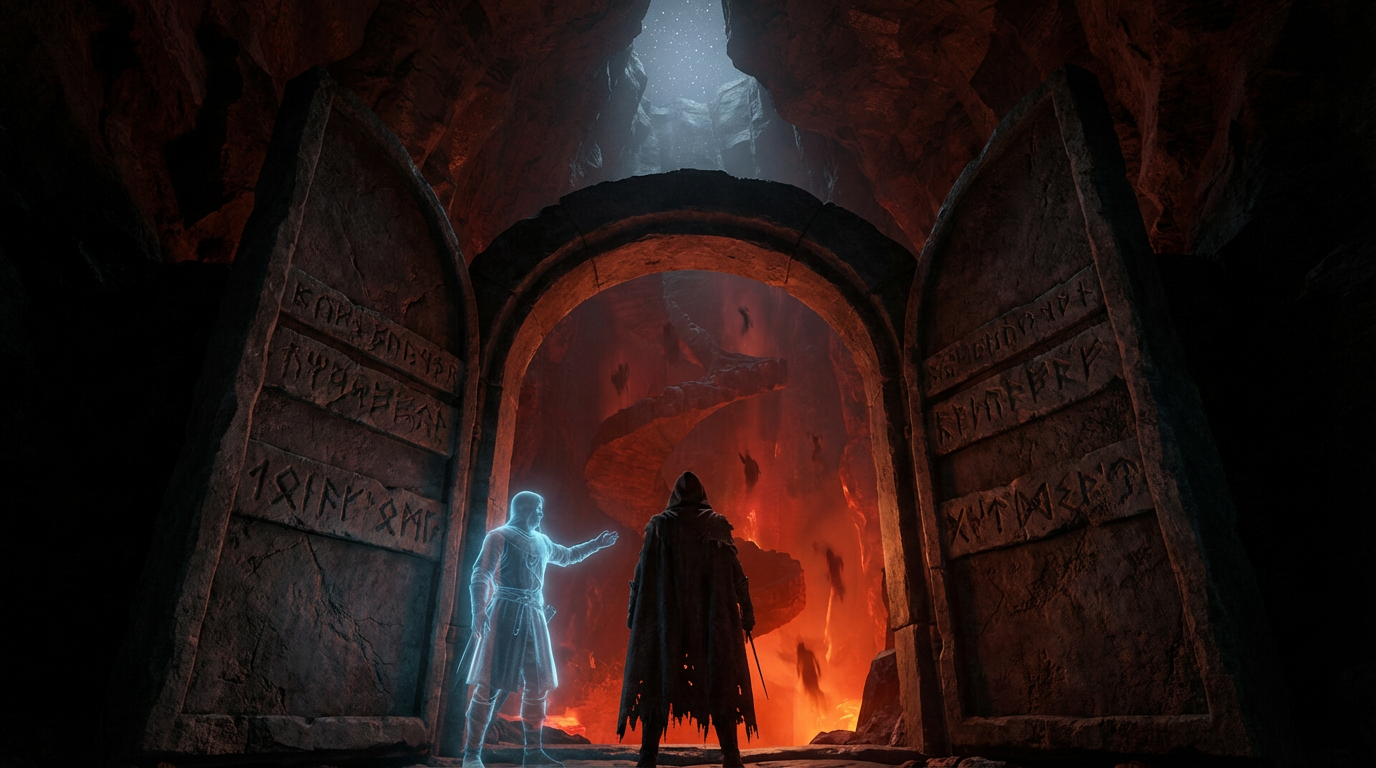
An excerpt from the original text.(complete · 1016 words)
There is a place within the depths of hell
Call’d Malebolge, all of rock dark-stain’d
With hue ferruginous, e’en as the steep
That round it circling winds. Right in the midst
Of that abominable region, yawns
A spacious gulf profound, whereof the frame
Due time shall tell. The circle, that remains,
Throughout its round, between the gulf and base
Of the high craggy banks, successive forms
Ten trenches, in its hollow bottom sunk.

As where to guard the walls, full many a foss
Begirds some stately castle, sure defence
Affording to the space within, so here
Were model’d these; and as like fortresses
E’en from their threshold to the brink without,
Are flank’d with bridges; from the rock’s low base
Thus flinty paths advanc’d, that ’cross the moles
And dikes, struck onward far as to the gulf,
That in one bound collected cuts them off.
Such was the place, wherein we found ourselves
From Geryon’s back dislodg’d. The bard to left
Held on his way, and I behind him mov’d.

On our right hand new misery I saw,
New pains, new executioners of wrath,
That swarming peopled the first chasm. Below
Were naked sinners. Hitherward they came,
Meeting our faces from the middle point,
With us beyond but with a larger stride.
E’en thus the Romans, when the year returns
Of Jubilee, with better speed to rid
The thronging multitudes, their means devise
For such as pass the bridge; that on one side
All front toward the castle, and approach
Saint Peter’s fane, on th’ other towards the mount.

Each divers way along the grisly rock,
Horn’d demons I beheld, with lashes huge,
That on their back unmercifully smote.
Ah! how they made them bound at the first stripe!
None for the second waited nor the third.

Meantime as on I pass’d, one met my sight
Whom soon as view’d; “Of him,” cried I, “not yet
Mine eye hath had his fill.” With fixed gaze
I therefore scann’d him. Straight the teacher kind
Paus’d with me, and consented I should walk
Backward a space, and the tormented spirit,
Who thought to hide him, bent his visage down.
But it avail’d him nought; for I exclaim’d:
“Thou who dost cast thy eye upon the ground,
Unless thy features do belie thee much,
Venedico art thou. But what brings thee
Into this bitter seas’ning? “ He replied:
“Unwillingly I answer to thy words.
But thy clear speech, that to my mind recalls
The world I once inhabited, constrains me.
Know then ’twas I who led fair Ghisola
To do the Marquis’ will, however fame
The shameful tale have bruited. Nor alone
Bologna hither sendeth me to mourn
Rather with us the place is so o’erthrong’d
That not so many tongues this day are taught,
Betwixt the Reno and Savena’s stream,
To answer SIPA in their country’s phrase.
And if of that securer proof thou need,
Remember but our craving thirst for gold.”

Him speaking thus, a demon with his thong
Struck, and exclaim’d, “Away! corrupter! here
Women are none for sale.” Forthwith I join’d
My escort, and few paces thence we came
To where a rock forth issued from the bank.
That easily ascended, to the right
Upon its splinter turning, we depart
From those eternal barriers. When arriv’d,
Where underneath the gaping arch lets pass
The scourged souls: “Pause here,” the teacher said,
“And let these others miserable, now
Strike on thy ken, faces not yet beheld,
For that together they with us have walk’d.”

From the old bridge we ey’d the pack, who came
From th’ other side towards us, like the rest,
Excoriate from the lash. My gentle guide,
By me unquestion’d, thus his speech resum’d:
“Behold that lofty shade, who this way tends,
And seems too woe-begone to drop a tear.
How yet the regal aspect he retains!
Jason is he, whose skill and prowess won
The ram from Colchos. To the Lemnian isle
His passage thither led him, when those bold
And pitiless women had slain all their males.
There he with tokens and fair witching words
Hypsipyle beguil’d, a virgin young,
Who first had all the rest herself beguil’d.
Impregnated he left her there forlorn.
Such is the guilt condemns him to this pain.
Here too Medea’s inj’ries are avenged.
All bear him company, who like deceit
To his have practis’d. And thus much to know
Of the first vale suffice thee, and of those
Whom its keen torments urge.” Now had we come
Where, crossing the next pier, the straighten’d path
Bestrides its shoulders to another arch.

Hence in the second chasm we heard the ghosts,
Who jibber in low melancholy sounds,
With wide-stretch’d nostrils snort, and on themselves
Smite with their palms. Upon the banks a scurf
From the foul steam condens’d, encrusting hung,
That held sharp combat with the sight and smell.

So hollow is the depth, that from no part,
Save on the summit of the rocky span,
Could I distinguish aught. Thus far we came;
And thence I saw, within the foss below,
A crowd immers’d in ordure, that appear’d
Draff of the human body. There beneath
Searching with eye inquisitive, I mark’d
One with his head so grim’d, ’twere hard to deem,
If he were clerk or layman. Loud he cried:
“Why greedily thus bendest more on me,
Than on these other filthy ones, thy ken?”

“Because if true my mem’ry,” I replied,
“I heretofore have seen thee with dry locks,
And thou Alessio art of Lucca sprung.
Therefore than all the rest I scan thee more.”

Then beating on his brain these words he spake:
“Me thus low down my flatteries have sunk,
Wherewith I ne’er enough could glut my tongue.”

My leader thus: “A little further stretch
Thy face, that thou the visage well mayst note
Of that besotted, sluttish courtezan,
Who there doth rend her with defiled nails,
Now crouching down, now risen on her feet.
Thais is this, the harlot, whose false lip
Answer’d her doting paramour that ask’d,
‘Thankest me much!’—‘Say rather wondrously,’
And seeing this here satiate be our view.”
Master this chapter. Complete your experience
Purchase the complete book to access all chapters and support classic literature
As an Amazon Associate, we earn a small commission from qualifying purchases at no additional cost to you.
Available in paperback, hardcover, and e-book formats
Let's Analyse the Pattern
Systems that legitimize individual betrayal by normalizing harmful behavior and diffusing personal responsibility.
Why This Matters
Connect literature to life
This chapter teaches how to recognize when organizations create elaborate systems to make wrong feel normal and make you doubt your moral instincts.
Practice This Today
This week, notice when someone uses 'that's just how we do things here' or 'everyone else is okay with it' to pressure you into compromising your values.
Now let's explore the literary elements.
Key Quotes & Analysis
"There is a place within the depths of hell Call'd Malebolge, all of rock dark-stain'd"
Context: Dante introduces the eighth circle of hell as they descend into it
This sets up hell's most organized section, showing that corruption isn't chaos but has structure and hierarchy. The dark-stained rock suggests permanent corruption that can't be washed clean.
In Today's Words:
There's this place in the worst part of hell called Malebolge, and it's built like a fortress of dirty, stained rock.
"I was the one who brought Ghisolabella to do the Marquis' will"
Context: When confronted by Dante, Venedico admits to selling his sister for political gain
This confession reveals the depth of corruption - he betrayed family for power. His matter-of-fact tone shows how normalized this behavior became in his world.
In Today's Words:
Yeah, I'm the one who pimped out my own sister to get in good with the boss.
"But many more of us you'll find down here who speak the Bolognese tongue"
Context: After admitting his crime, he tries to deflect by pointing out other sinners from his region
Classic corrupt behavior - when caught, point to others doing the same thing. It's the 'everyone else was doing it' defense that never actually excuses the behavior.
In Today's Words:
But hey, there's plenty more of us from Bologna down here, so don't act like I'm the only one.
Thematic Threads
Class
In This Chapter
Hell's fraud section mirrors corporate hierarchy—organized, systematic exploitation rather than chaotic crime
Development
Evolved from individual pride to institutional corruption affecting entire social classes
In Your Life:
You might notice how workplace hierarchies can make unethical requests feel normal and unavoidable
Identity
In This Chapter
Venedico and Jason use their social positions (politician, hero) to justify or enable their betrayals
Development
Shows how public identity can become a mask for private corruption
In Your Life:
You might see how professional or family roles can be used to excuse harmful behavior
Social Expectations
In This Chapter
The flatterers represent how social pressure to please corrupts authentic communication
Development
Introduces the theme of how social norms can become toxic when systematized
In Your Life:
You might recognize when you're expected to give false praise or go along with harmful group dynamics
Human Relationships
In This Chapter
Jason's seduction pattern and Venedico's family betrayal show how intimacy becomes a tool for exploitation
Development
Deepens from personal relationship struggles to systematic abuse of trust
In Your Life:
You might notice when someone uses emotional closeness or family bonds to manipulate or exploit you
You now have the context. Time to form your own thoughts.
Discussion Questions
- 1
What's the difference between how corruption works in the earlier circles of hell versus this organized system in Malebolge?
analysis • surface - 2
Why does Venedico point to all the other people from Bologna who are also in hell? What does this reveal about how people justify participating in corrupt systems?
analysis • medium - 3
Where do you see this pattern of 'everyone's doing it' being used to justify harmful behavior in workplaces, families, or communities today?
application • medium - 4
If you found yourself in a workplace or organization where corruption was systematic and normalized, what specific steps would you take to protect your integrity?
application • deep - 5
What does the image of flatterers drowning in excrement teach us about how false praise ultimately harms both the giver and receiver?
reflection • deep
Critical Thinking Exercise
Map Your Organizational Pressure Points
Think of an organization you're part of (workplace, family, social group, community). Draw or list the informal hierarchy and identify where pressure exists to compromise personal values for group loyalty. Mark the spots where people might say 'that's just how things work here' or 'everyone does it.' Consider what small corruptions are normalized through the system's structure.
Consider:
- •Notice how institutional language ('policy,' 'procedure,' 'tradition') can make harmful behavior seem neutral
- •Identify who benefits most from maintaining the current system
- •Consider what would happen if you refused to participate in questionable practices
Journaling Prompt
Write about a time when you felt pressure to go along with something that didn't feel right because it was 'just how things are done.' How did you handle it, and what would you do differently now?
Coming Up Next...
Chapter 19: The Pope in Hell
The journey into corruption deepens as Dante encounters those who sold sacred things for profit. Simon Magus and his followers await, showing how even the most holy institutions can be twisted by greed and ambition.